Archives For October 31, 2013

Screen Shot 2013-11-29 at 12.50.41 PMThe National Council of Teachers of English (NCTE) and the Council on English Leadership (CEL) met for a convention last week (11/21-26/13) at the Hynes Convention Center in Boston, Massachusetts. Thousands of English teachers and educators (happily) put aside their piles of essays and their red pens in order to attend to participate in a nationwide conversation on teaching English/Language Arts at all grade levels. This annual conference runs the weekend before the Thanksgiving holiday, and this year there were many reasons to be thankful that such a great opportunity exists. Here are our specific thanks to all of those who made this conference amazing.

Thanks to our Regional School District #6 in Connecticut for allowing us to attend:

Our first and most important thanks is to the administration, Board of Education, and staff from Regional School District #6 that allowed five members of the English Department at Wamogo Middle/High School to attend the conference and select from over 700 sessions offered from Thursday night-Sunday afternoon.  District support for such great professional development is truly appreciated!

Thanks to the program chairs who selected our proposals:

Members of Wamogo Middle/High School English/Language Arts department submitted a variety of proposals last year to demonstrate how we use technology in our classrooms. We are grateful that four of our proposals were chosen to share as presentations for other educators. The explanations of our presentations with links to these presentations are included below:

The Blog’s the Thing! (NCTE) roundtable discussion

This presentation demonstrated the use of the blog platform for students to engage in thoughtful discussion on characters and themes from Hamlet by having students “stop the action” of the play to offer advice to characters during different scenes.

Reinventing the Writing Workshop with Digital Literacy to Improve Student Engagement (NCTE)

Technology has reinvented the Writing Workshop in meeting the needs of 21st Century learners with the addition of digital literacies. This presentation features open source software platforms appropriate to the different tasks, purposes and audiences for writing instruction along with examples of student work and grading criteria.

How We Mooo-ved Our District from Cows to Computer (CEL)

This presentation illustrated how professional development in our district was organized on the ED Camp model to allow any teacher who would like to share their expertise or simply discuss a problem with fellow staff or faculty members.These technology initiatives have allowed members of the English Department to help teachers assess, organize, deliver context materials and related readings (fiction and non-fiction) that improve students’ digital literacy as well as foster independence in each student’s growth in reading.

Digital Writing with Collaboration (CEL)

This presentation showed how preparing students to write for the real world  (21st Century skills) must include the collaborative experience, from the initial creation to the final product. The use of digital platforms allows students to be college and career ready through the production and distribution of collaborative writing.

Thanks to the many teachers and educators who presented:

We are also thankful that so many other classroom teachers and educators from all over the USA shared their best classrooms practices. Our collective regret is that we could not attend every session that appealed to us; the jam-packed schedule defied our best attempts at strategic selection. We agreed, however, that quality of the presentations we did get to attend was amazing and relevant to what we do every day. The conference reinforced the importance of teacher-to-teacher professional development.

Thanks to the book publishers who made books available for classroom libraries:

The NCTE Convention offers book publishers opportunity to put advanced reader copies of fiction and non-fiction into the hands of teachers at every grade level. While publishers hope to catch the attention of teachers who will recommend the book to students, teachers look for books to add to their classroom library collection. Many publishers also make books available at a reduced cost  for the same reason. For example, I picked up several copies of books in the “After the Dust Settled” series (apocalyptic young adult literature) by Jonathan Mary-Todd for $2/copy, a purchase made necessary because these books keep disappearing off our classroom library shelves.
Screen Shot 2013-11-29 at 12.51.29 PM

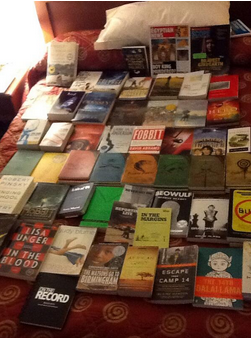
Our “haul” from the NCTE Convention from book publishers and authors…headed for our classroom libraries.


Thanks to the authors who gave away signed copies of their books:

The tote bags distributed free to all registrants bore popular author Nicholas Spark’s imprimatur, a visual testament to the celebrity draw of authors at this convention. Authors are the rock stars at this convention: the children’s book authors rock, the young adult authors rock, and the educator trade book authors rock. Attendees stood in lines snaking around booths on the convention floor waiting to meet authors and have books signed. In the past, my request to an author is to have the book signed with the phrase “READ ME!” on the inside cover. I had the same done this year, so when a student asks what to read, I will point that the author has already made a suggestion to read the book.

There were also a number of authors representing a variety of genres who served as keynote speakers including: Neal ShustermanTeri Lesesne, Laurie Halse AndersonKelly Gallagher, Walter Dean MyersIshmael Beah, and Robert Pinsky. 

We are so thankful to have the opportunity to personally meet and mingle with the rock stars of the convention!

Thanks for the Tweeters:

Finally, the fingers of dedicated Tweeters attending the convention kept us abreast of all the events at the conference. There was a steady stream of information from sessions we could not attend, summaries of keynotes addresses, and updates as to upcoming book signings. The hashtags #NCTE13 and #CEL13 were invaluable sources for notes and quotes during the convention and for well after we left Boston.  For example, some Friday session tweets were archived onto the Storify platform for later use.

Next year, the NCTE Convention is scheduled for Washington, D.C., which gives me one more reason to be thankful…the convention is within driving distance!

red tentMany of my students do not know Old Testament stories other than “Noah’s Ark” and “Adam and Eve”. There is the occasional biblical teen scholar who may be able to recount the origin a pillar of salt (Lot’s wife) or maybe there will be a student who saw the musical Joseph and the Amazing Technicolor Dreamcoat and make a patriarchal connection. For the most part, students are not up to date on Methuselah or even which of the brothers killed the other (Cain or Abel). They are far more likely to ask, “So, where did all the other people come from if Eve was the only woman?”

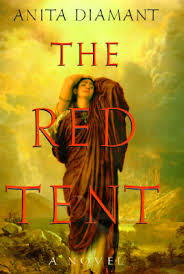
Fortunately, The Red Tent, a novel by Anita Diamant (1997) does address other women of the Old Testament. Her fictionalized version of the story of Dinah, daughter of Leah and Jacob, is based on in a brief but particularly violent and gruesome incident in the Book of Genesis. In the King James Version of the Bible, Dinah is known as the daughter who is “defiled” by Shechem, a prince, who then wanted to marry her (Genesis 34: 1-3):

1 And Dinah the daughter of Leah, which she bare unto Jacob, went out to see the daughters of the land.

2 And when Shechem the son of Hamor the Hivite, prince of the country, saw her, he took her, and lay with her, and defiled her.

3 And his soul clave unto Dinah the daughter of Jacob, and he loved the damsel, and spake kindly unto the damsel.

Dinah’s brothers, sought vengeance for the attack on their sister. They tricked Shechem and his family, claiming to come in peace, and exacted their punishment by killing the royal family and all males in the city:

26 And they slew Hamor and Shechem his son with the edge of the sword, and took Dinah out of Shechem’s house, and went out.

27 The sons of Jacob came upon the slain, and spoiled the city, because they had defiled their sister.

This horrific incident is explained very differently in the Diamant’s fictional retelling, as are many other familial incidents, from Dinah’s point of view. The rivalry between Rachel and Leah, the rivalry between Jacob and Esau, and the rivalry between the sons of Joseph, Dinah’s younger brother, are rich with detail and dialogue. The sparse accounts given in the Old Testament are fleshed out in this compelling narrative, with the women center stage, a striking contrast to the male-dominated biblical text.

Several of my female students in Advanced Placement English Literature choose to read The Red Tent as an independent choice, and their response is not unlike other female student responses chronicled in the article “The Wandering Womb at Home in The Red Tent: An Adolescent Bildungsroman in a Different Voice” by Holly Blackford. In this review, Blackford writes about the female students’ enthusiasm for the book:

So emotional about the story of The Red Tent that they can barely speak, and indeed continually interrupt one another, they cite the way in which the contemporary novel revises the patriarchal story of Jacob; represents the concerns of girls in terms of emotion and relationship; and details the entire lifecycle of girl-to-woman through engaging first-person narration:
  Carol: There are certain books I just can’t put down.
      Laticia: Seriously, I’ll read until like three in the morning . . .
      Interviewer: Like what?
      Carol: Like The Red Tent!

Blackford also points out that this revision of an ancient text  comes at a time when girls are, “hungering for an exploration of female-centered myths, deities, worlds, and power-structures.” Her claim in The Alan Review (March, 2005) is that books like The Red Tent:

“… appeal to adolescent women and grow their appreciation for contemporary women’s literature that speaks “in a different voice” (Gilligan) from the more masculine canon they expect in their school curriculum.”

There are about 20 copies of The Red Tent on the class independent book cart, all purchased at book sales for $1.00 each. Picador USA publishers produced an oversized text, about 2″ taller than a standard trade paperback; on the AP English Lit book cart’s top shelf, these copies stick out. The cover art, designed and illustrated by Honi Werner, is also eye-catching. Students always pick up the book with interest.

“What’s this about?” one asks.
“Read the back,” I reply.
“‘...told in Dinah’s voice, this novel reveals the traditions and turmoil of ancient womanhood-the world of the red tent,’ (*pause suspiciously*)…is this a ‘chick book’?”
“Yes,” I chuckle, “this is most definitely a chick book….probably the ultimate chick book, of ALL chick books.”

How else to describe a story that centers on celebrating the onset of womanhood?

After they read any independent book, the AP students are required to write an essay. The essay prompt this quarter for any book they choose is taken from the AP released exam list of questions:

In retrospect, the reader often discovers that the first chapter of a novel or the opening scene of a drama introduces some of the major themes of the work. Write an essay about the opening of the first chapter of a novel in which you explain how it functions in this way. *hint: the lens you use is the lens from the conclusion of the novel*

Students who choose to read Diamant’s The Red Tent will certainly want to return to the beginning to explain how Dinah’s life story begins and ends with the women who loved and supported her.  They will also have had a “crash course” on the Book of Genesis, which is the source of many other literary allusions. While The Red Tent is not great literature, this novel sets many female students looking for equally compelling contemporary novels about women, with or without that “chick book” label.

If nothing else, the Common Core State Standards’ (CCSS) contribution to the academic lexicon will be the renaming of the genre known as non-fiction to a larger genre of informational texts. This renaming expanded the genre to include many forms of reading: textbooks, letters, speeches, maps, brochures, memoirs, biographies, and news articles, to name a few.

So where to find these informational texts? What is appetizing enough to make middle school students want to read a story, and then, answer the questions to check their understanding? What kind of high interest texts appeal to high school students who prefer to “Google” or “Sparknote” answers rather than read a text closely? What multi-media elements could be added to make an informational text palatable enough to be consumed by all levels of readers?

Screen Shot 2013-11-11 at 6.30.17 PM

The 2:12 video for accompanies the story

Well, teachers should look no further than the October 1, 2013, New York Times‘ feature article dedicated to Doritos Tortilla Chip titled That Nacho Dorito Taste. This short feature article combined photography and graphics;  a short video: and even shorter text that combined to provide an explanation on how this particular food is engineered so that “you can’t eat just one.”

The article is timely since the CCSS  requires that the student diet of reading should be 70% informational texts and 30% fiction by the time they graduate from high school.  The Literacy Standards specifically address reading in math, science, social studies, and the technical areas and recommends the increase in reading informational texts be completed in these classes. One of the technical areas content area classes could be a culinary arts class, a marketing class, or a health science class, but consider this particular informational text as scrumptious for any class.

In organizing this story, New York Times reporter Michael Moss, who also narrates the embedded video, interviewed food scientist Steven A. Witherly, author of “Why Humans Like Junk Food,” in order to better understand how all of the chemical elements combine in the Nacho Cheese Doritos chip to make it alluring to our taste buds.  According to Witherly, the mixing of flavors on this particular chip is purposeful:

 “What these are trying to do is excite every stinking taste bud receptor you have in your mouth.”

The graphics for the article by Alicia DeSantis and Jennifer Daniel are cleverly combined with photographs by Fred R. Conrad, also from the The New York Times. A separate page layout with the graphic/photo mix delivers tidbits of information about the Dorito chip. Each detail is organized by topic, as this example shows:

Screen Shot 2013-11-10 at 9.46.47 PM

A teacher does not even have to work at organizing questions for students to answer since the New York Time Learning Network, a free educational blog offered by the paper, organized an entire lesson plan on this article. The lesson is titled 6 Q’s About the News | The Science Behind Your Craving for Doritos, organized by Katherine Schulten. The questions on the blog include:

WHAT is psychobiology?
WHAT is “dynamic contrast”?
HOW do the acids in Doritos work on the brain?

WHAT is “sensory-specific satiety”?

WHERE do half the calories in Doritos come from, and, according to the graphic, HOW does that work on the brain?

WHY is “forgettable flavor” so important to Doritos’ success?

The higher order questions invite students to consider:

Now that you know the formula behind Doritos, are you more likely to eat more or less of them? WHY?
HOW many processed foods do you eat a day?
WHAT might a graphic explaining the effects of this food look like?

So go ahead. Read the Nacho Cheese Doritos article. See how irresistible an informational text can be. Once you read one this good, you will be searching to find another!

vet day

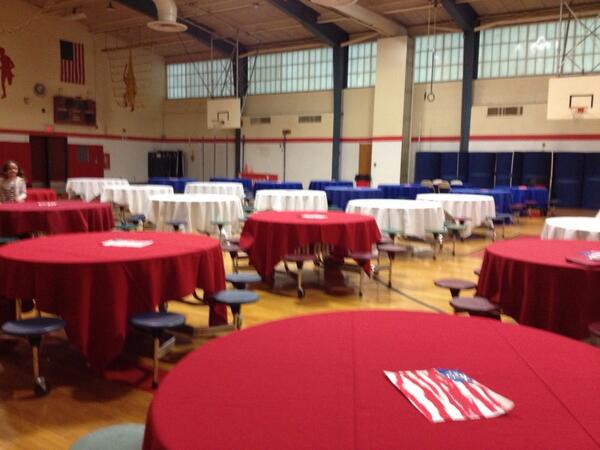
Tables sit prepped and ready for the Veterans Day crowd

I just returned from cooking several hundred eggs for the 16th Annual Veteran’s Day Breakfast, an event held at the Wamogo Middle/High School in Litchfield, Connecticut. This annual breakfast is offered by the student service groups (Student Council, Peer Counselors) for military veterans, servicemen, and their families. The food is cooked by teachers and student volunteers; even family members help out. This morning, the five-year-old son of the AP Psychology teacher stood next to me and stirred the scrambled eggs in one of several portable griddles. He had come prepared with his own chef’s apron “to cook for the soldiers”.

Screen Shot 2013-11-11 at 9.46.27 PM

Students serving Veterans and their families

The breakfast is served from 7:30AM until 10:30AM and serves large portions of the following: scrambled eggs, pancakes,bacon, sausage, hash browns, toast and baked goods. The coffee is hot and plentiful. The tables are decorated with cards from elementary schoolchildren in the district of hand-painted flags accompanied by letters thanking the veterans.

Veterans from all over the Litchfield and Northern Fairfield County area come to this event. Many wear their former military uniforms, while others wear jackets and hats bearing the insignia of a branch of the armed forces. Many veterans have patches or embroidered labels that indicate when they served (“Vietnam Veteran”, “Desert Storm”), other patches wear reminders of the continuing support necessary for POW/MIAs. Alumni who have joined a branch of the service return in their new uniforms and mingle with their former teachers and the underclassmen who remember them.

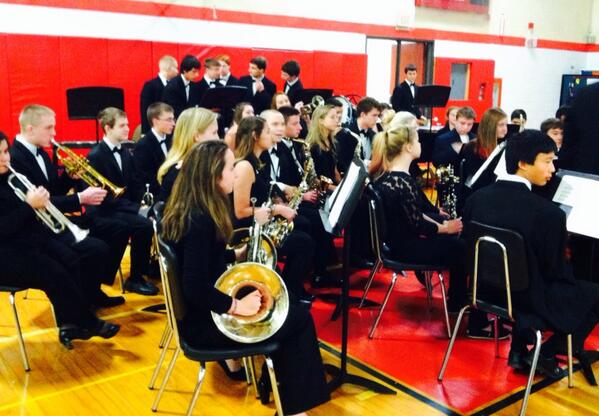
Wamogo Band performs at the annual Veteran's Day Breakfast.

Wamogo Band performs at the annual Veteran’s Day Breakfast.

The attendees are treated to performances by the school band and choir during the breakfast. Students have spent the past weeks practicing with either the chorus teacher or the band director in preparation for this event. The choir sings first with patriotic songs; some of the guests join in. The highlight of the morning, however, is the tribute to the veterans and servicemen when the songs from each branch of the service are played.

The Coast Guard march “Semper Paratrus” is played first, then, a medley of the other branches of the service theme music is played: “Anchors Aweigh” (Navy), “The Caissons Go Rolling Along” (Army), “The Halls of Montezuma” (Marines), and finally “The Air Force Song”-(‘Off we go into the wild, blue yonder…’)  As each song plays, those who have served or who are serving in that particular branch of the service, stand to receive the recognition and applause from the audience. This year, the number of Army and Air Force veterans was the largest, but when the lone Marine stood to be recognized, I overheard someone say, “That’s ok….one Marine is all that is necessary.”  Wamogo High School itself is well represented in each branch of the military; there are several students who enlist or enter an ROTC program at graduation every year, a percentage greater than the state average.

Canon Crew

Canon crew from the 1st Litchfield Artillary

To top off the morning, there is a cannon shot from the top of the hill by the Litchfield First Artillery Division whose members include some faculty. Overall, over 100 students, roughly 20% of the student body, participated today in cooking, cleaning tables, or serving food; or performing musically for the veterans. They came to school early- on a day off -to thank those who supported the United States by serving in the military in war and in peace, and who now continue to support Regional School District #6.

Those students and audience members who sang “America the Beautiful” this morning have seen, up close and personal, the faces of those who served. The students had the chance to sing to these veterans these high words of praise from this song….

O beautiful for heroes proved In liberating strife,
Who more than self their country loved,
And mercy more than life!
America! America! May God thy gold refine
Till all success be nobleness,
And ev’ry gain divine!

Thank you, Veterans and Servicemen, from Wamogo Middle/High School.

We have been discussing loss a great deal in English class. In order to begin our  study of King Lear, students had to create lists of their 10 favorite things while I played the song “My Favorite Things” from The Sound of Music. After they made their lists, I  had them “lose” -one at a time- an item off the list.

“Cross off #7,” I announced with great seriousness.
There were immediate groans from students.
“That’s Starbucks!” one whined.
“My truck!” claimed another, “How will I drive?”
“Cross off #3,” I called out.
More protestations. More groans.
“No way I am crossing off my dog,” another retorted.

Soon, their lists were down to two items each. They stirred uncomfortably; they were unsettled by the mere thought of being separated from things or people they valued.

“Maybe I value my stuff over people too much,” mused one thoughtfully looking over her list.

In this short exercise, my students conveyed some of the same sentiments that are expressed in Elizabeth Bishop’s poem “One Art”:

One Art

by Elizabeth Bishop

The art of losing isn’t hard to master;
so many things seem filled with the intent
to be lost that their loss is no disaster,

Lose something every day. Accept the fluster
of lost door keys, the hour badly spent.
The art of losing isn’t hard to master. (continued…)

My students were struck by the repetition of the words “master” and “disaster” in the poem, a result of the villanelle* (see below) format. They noted the progression of items lost in the poem: the car keys, the watch, the houses, the cities, rivers, and finally, the loss of continents.

They noted the choice of hyphens and parentheses in the poem. The hyphen at the beginning of the final stanza was a “hesitation” according to one student, “because she doesn’t even want to write the last stanza.”

“How do you know?” I asked.

“Because she has to command herself,” the student replied, “See the parentheses and the words ‘(Write it!)’ on the last line?”

“Why? What is she losing in the last stanza?” I asked. They called out their ideas:
“Love.”
“You.”
“Her life…”

“So is the art of losing hard to master or not?” I asked them. They thought, and wrote the following in their notebooks:

  • “No one wants to  master losing things…who wants to be a loser, literally?”
  • “She is taking about the loss of physical objects in comparison to the loss of people, and no one wants to lose people…like a friend or lover.”
  • “The speaker is rushing towards the end, speaking faster with ‘shan’t’ and ‘losing’s’ as if things are slipping away, and out of control, until she writes down the losses….and commits them to memory.”
  • “She is trying to convince herself.”

Elizabeth Bishop’s poem brought my class back to the many themes we had been discussing in our unit on King Lear. We had spent several classes focused on the tragedy of a king who in dividing his kingdom, upends the order of the realm. In the process, he loses his daughters, his knights (protectors), his friends, his mind, and finally, his life. The students concluded that Lear was no “master of disaster.”

“Pretty cool that 19 lines can say almost the same thing as Shakespeare’s five act play,” concluded one student as he wrapped up his books  to leave.

Pretty cool, Elizabeth Bishop.

*villanelle: The villanelle has 19 lines, 5 stanzas of three lines and 1 stanza of four lines with two rhymes and two refrains. The 1st, then the 3rd lines alternate as the last lines of stanzas 2, 3, and 4, and then stanza 5 (the end) as a couplet. It is usually written in tetrameter (4 feet) or pentameter.

Every student can learn and perform differently in any given classroom. A hypothetical classroom of 24 hypothetical students is still a hypothetical classroom of diversity, with 24 individual combinations of learning styles.  Teachers should differentiate for a wide variety of learners and prepare for all students, especially those who have with dissimilar interests and abilities. How dissimilar? Consider this video of a toddler’s dance recital that went viral as an example:

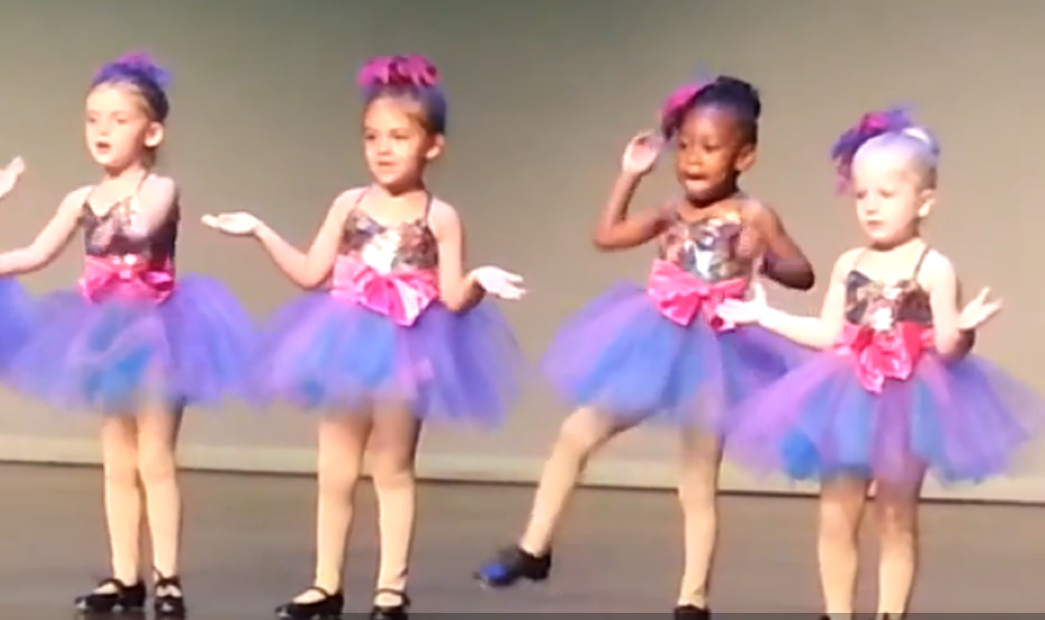
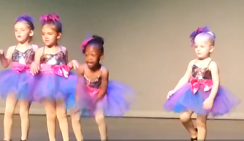
There is obviously a “lesson plan” for this recital. The dance instructor’s objective for the recital is to have all the dancers perform the same dance routine to the song “Broadway Baby”. The routine has been choreographed, as evidenced by the photos, with simple arm movements and tap steps.

Screen Shot 2013-11-03 at 10.14.41 AM

Dancer #3 loosely following the routine…

At the stage right section of the chorus line, the four little girls in their festive tutus catch the attention of the videographer in the audience. He records the performance in which three out of four dancers are dedicated to staying in step and following the routine they had practiced.

Three of the four dancers synchronize their arm and toe-tapping movements; they obviously know the steps of dance routine.  Their performance, in contrast, is juxtaposed with the animated interpretation of another dancer whose enthusiasm for performance is both charming and comical.

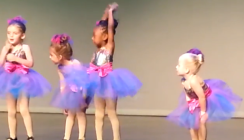
Screen Shot 2013-11-03 at 10.15.39 AM

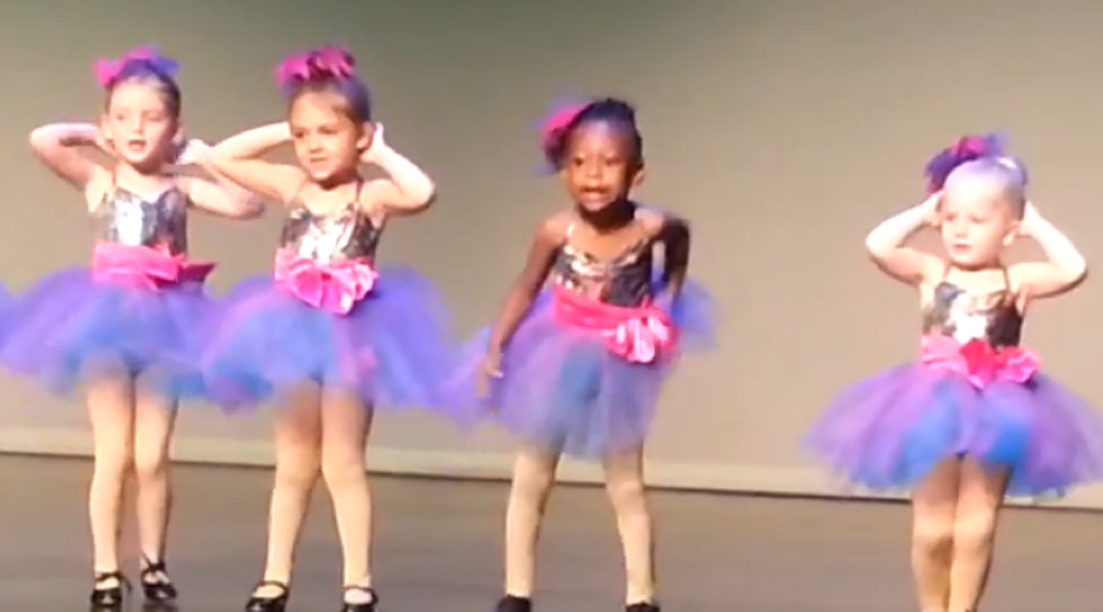
…singing and dancing her interpretation…

This dancer, let’s call her Dancer #3 (third from the left), is whole-heartedly performing her own distinctive dance steps and arm movements while still loosely following the choreographed routine. As the other dancers in the chorus line follow and conform according to scripted direction, Dancer #3 dances to her own distinctive beat.

Screen Shot 2013-11-03 at 10.10.11 AM

….expressing herself in movement…

The members of the audience are heard laughing in the background of the video. It is probably safe to say that in the audience watching the recital were the anxious parents, relatives, and friends of all the little girls in the chorus line.

Screen Shot 2013-11-03 at 10.10.58 AM

…and celebrating her difference…

Each audience member was rooting for their special dancer on stage, and depending on the point of view, each dancer was wonderful. Dancer #3’s family and friends, however, have the evidence to prove that their little girl’s performance was matchless.

Now consider how every classroom has has at least one Dancer #3. All teachers must be prepared to instruct a student or set of students like her who may differ in how they learn and perform. These differences are usually addressed under the educational theory of  learning styles, and there are numerous different theories about how these styles impact how individuals learn.. One theory (Fleming, 2001) suggests that all learners use one of three common learning styles: visual, auditory, and kinesthetic. Another theory  (Gardner) suggests that there are seven different learning styles for learners:

  • Visual (spatial): learning using pictures, images, and spatial understanding.
  • Aural (auditory-musical): learning using sound and music.
  • Verbal (linguistic): learning using words, both in speech and writing.
  • Physical (kinesthetic): learning using your body, hands and sense of touch.
  • Logical (mathematical): learning using logic, reasoning and systems.
  • Social (interpersonal): learning in groups or with other people.
  • Solitary (intrapersonal): learning alone through self-study.

Education theorists may suggest even more learning styles, but whatever the learning style, teachers must be prepared to meet all the needs of all the learners in their classrooms. The most recent discussion about learning styles provides the evidence that that all learners benefit when a multitude of learning styles are addressed in a classroom. The education reformer John Hattie uses many studies in his work Visible Learning, and he places little regard on the practice of individually matching a learning style to each learner. He notes that such a practice is only is 41% effective. That effectiveness of addressing learning styles is increased, however, when all there are a multitude of learning styles used regularly in a classroom for all learning styles. There is a positive result when all students are stimulated to listen (aural), to watch (visual), and to move (kinesthetic) in class whenever there is new learning. Since addressing all the learning styles is the basis for differentiation in the classroom, teachers must be prepared with activities that stimulate all students.

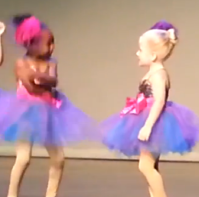
Screen Shot 2013-11-03 at 10.13.00 AM

…while drawing admiration from fellow dancers

Going back to the video and watching the energy of Dancer #3, her teacher would be well-advised to increase kinesthetic learning activities in class whenever possible. Perhaps because of her young age, Dancer #3 is not self-conscious about herself, providing the clearest example of a kinesthetic learner whose learning style is expressed through movement. That expression made a positive contribution to the recital if it is measured by the reaction of the audience and measured by the littlest dancer to the right who had been watching Dancer #3 out of the corner of her eye.  The final frames show this small dancer turn in admiration to the other dancers at a job well done; she holds her hand out as if to congratulate the exuberant Dancer #3. They smile at each other in delight.

Key to understanding the importance of celebrating student differences is recognizing that this video would not have been the viral hit viewed by millions if Dancer #3 had danced the routine exactly as her dancing teacher had choreographed. Instead, Dancer #3 tapped and sang what she learned and demonstrated her own learning style; she elevated the group’s performance to a different level by dancing to a different beat.

Her dance is a celebration of difference, and also a “heads up” to her teacher(s)…. better get ready!

An interesting graphic came across my screen this week. The purpose was to call attention to the hours spent testing elementary students by comparing them to the tests for college or graduate school:

Screen Shot 2013-10-29 at 8.28.06 PM

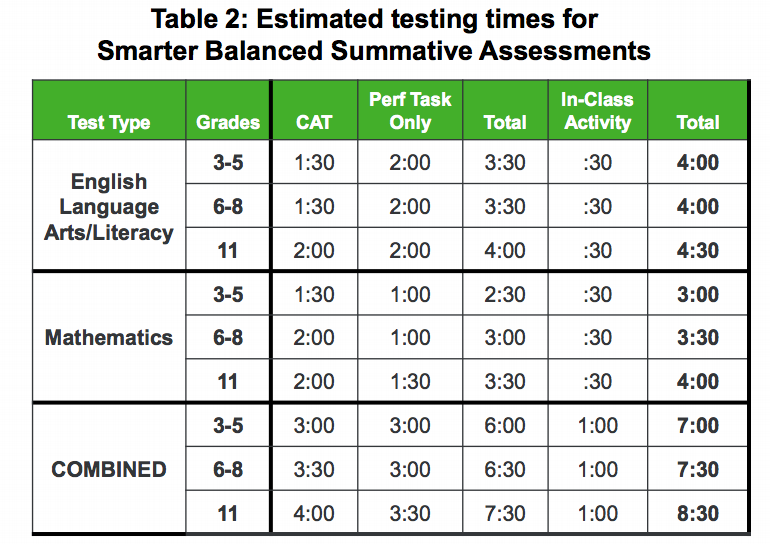
Standardized testing is not new to schools in the State of Connecticut. Many schools will be using the Smarter Balance Assessment (SBAC) this year (pilot) for state testing. The new testing schedule will be the same as the NY State tests. The SBAC website provides testing times:

Screen Shot 2013-10-30 at 8.26.11 PM

Both charts illustrate the number of hours that elementary, middle, and high school students will sit in order to take tests to measure their achievement in meeting the Common Core State Standards (CCSS). The SBAC tests will be given over a period of week(s), and scheduling may depend on the number of available computers that meet the testing software criteria.

Each sitting will match the minimum amount of time an older student sits for college and law school entrance exams. While these entrance exams (SAT, LSAT, and MCATs) are taken only once, the SBACS are taken annually in grades 3-8 and again in grade 11. Consider that an average student’s experience taking the SAT is a little under four hours, while a student will take the SBAC repeatedly for a total of 52 hours over the course of one academic career. Yet, the hours spent taking a test are not the only hours committed.

Washington Post education reporter, Valerie Strauss, cited a study by the American Federation of Teachers in her July 25, 2013, article How much time do school districts spend on standardized testing? This much.”  The report compared “two unnamed medium-sized school districts — one in the Midwest and one in the East” and determined that:

The grade-by-grade analysis of time and money invested in standardized testing found that test prep and testing absorbed 19 full school days in one district and a month and a half in the other in heavily tested grades.

The percentage of time for SBAC testing is roughly .07% of the school year (based on an average of 1100 school hours/year), but when when test preparation is added, (ex:19 days), that percentage jumps to 11%. This jump is enough to make the time for test preparation equivalent to a year of physical education classes. Ironically, research is proving that physical education may be the best kind of test preparation.

An article by Dr. Catherine L. Davis and Dr. Norman K. Pollock  detailed some of the more recent studies on the relationship between physical education and cognition, noting that “benefits have been detected with 20 minutes per day of vigorous physical activity”.

Their paper, Does Physical Activity Enhance Cognition and Academic Achievement in Children? determined that, “incorporating 40 minutes per day of vigorous activity to attain greater cognitive benefits would require additional programs available to children of all skill levels.” They concluded that:

In a period when greater emphasis is being placed on preparing children to take standardized tests, these studies should give school administrators reasons to consider investing in quality physical education and vigorous activity programs, even at the expense of time spent in the classroom. Time devoted to physical activity at school does not harm academic performance and may actually improve it.

Schools are motivated to try different strategies in order to improve test scores. The data from standardized tests are used to determine the effectiveness of curriculum as well as individual student performance. Standardized test scores are also an increasing metric in teacher evaluations. In the State of Connecticut, test scores could count as much as 40% in a teacher’s performance review, with the spotlight on those educators who teach in testing grades 3-8 and grade 11.

Paradoxically, the focus on standardized testing as an evaluation tool is a contributing factor to the increasing commitment of time and resources to test preparation. Next generation tests like the SBACs will be taken on computers that will require school systems to invest in computer hardware that meets specific criteria. The cost of the hardware and practice software could be justified by increasing the number of students who will take the tests.

Additionally, those who fund education want tests that run on this hardware to be an effective measure of student achievement, and these tests must be of a substantive duration to make the expense worthwhile. Given the commitment of time and money, students will continue to sit for tests and test preparation, perhaps for even longer periods in the future.

What might students be thinking about sitting for all these standardized tests?

They might borrow the words of their favorite author, Dr. Seuss, “And we did not like it. Not one little bit.”