Archives For March 31, 2015

This weekend marks the 100th Anniversary of the World War I poem “In Flanders Fields”. This poem was written by Canadian physician and poet Lieutenant Colonel John McCrae on  May 3, 1915, as a tribute to his fallen friend, Alexis Helmer, who was killed at the Second Battle of Ypes. Canadian forces lost 5,975 men in this battle that marked the first use of poison gas by the German army.

According to legend, McCrae threw away the poem, but it was rescued from obscurity when fellow soldiers retrieved it from a wastebasket. The poem is popular as one of the memorial statements for WWI particularly in Canada. McCrae never returned home as he died of pneumonia near the end of the war.

The poem is written as a rondeau, a form of song that originated in France  between the late 13th and the 15th centuries. The format has a fixed pattern with a refrain; the scansion is AB-aAab-AB, where “A” and “B” are the repeated refrain parts, and “a” and “b” the remaining verses:

In Flanders fields the poppies blow
Between the crosses, row on row,
That mark our place, and in the sky,
The larks, still bravely singing, fly,
Scarce heard amid the guns below.
We are the dead; short days ago
We lived, felt dawn, saw sunset glow,
Loved and were loved, and now we lie
In Flanders fields.

Take up our quarrel with the foe!
To you from failing hands we throw
The torch; be yours to hold it high!
If ye break faith with us who die
We shall not sleep, though poppies grow
In Flanders fields.

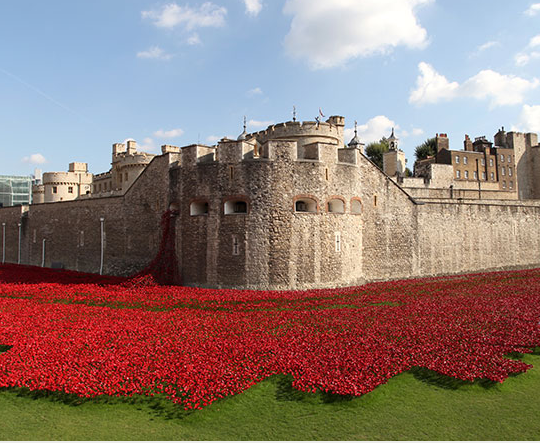
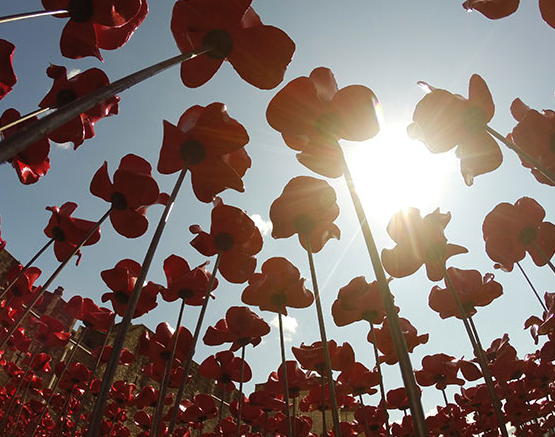
Ceramic poppies commemorate British soldiers killed during WWI

Ceramic poppies commemorate British soldiers killed during WWI

The poem was published in the British magazine Punch seven months later, and its references to the red poppies that grow on the fields of battle where soldiers fell gave rise to the “remembrance poppy.” Sales of remembrance poppies, usually made of silk, were used to fund war bonds, and after WWI, continued to be sold to fund veteran’s programs.

This past year (August-November 2014), a total of 888,246 ceramic kiln-fired remembrance poppies, hand formed by artists, were planted on the grounds of the Tower of London. Each of the poppies represented a British soldier killed during WWI.

The Tower Remembers Project website hosts videos on the creation of the poppies, which are the brainchild of artists Paul Cummins and Tom Piper.

888,246  poppies spill from the walls of the Tower of London; one for each British soldier killed in WWI.

888,246 poppies spill from the walls of the Tower of London; one for each British soldier killed in WWI.Paul Cummins

The exhibit called Blood Swept Lands and Seas of Red was installed at the Tower of London, in order to mark the one hundred year anniversary of Britain’s engagement in the First World War.

The ceramic poppies were sold and the proceeds split between six different charities, all associated with supporting veterans of war.

The poem also inspired the In Flanders Field Museum in Ypes, Belgium. In the museum, the poppies are on bracelets with imbedded RFID-chips that allow the wearer to read the personal stories about the war, filmed monologues and aerial photography.

Here in the United States, the American Legion adopted the poppy as their official symbol of remembrance in 1920 through the efforts of University of Georgia Professor Moina Michael.

The poem that McCrea wrote for a friend has inspired memorials to those who fought and died in World War I and all other wars as well. The poppy has been the torch, a way to “not break faith with us who die.”

All hail.extol.…laud the mighty Roget’s Thesaurus!

Any one struggling with trying to find the right word can attest to the support that he or she may have found in the pages of Roget’s Thesaurus, a reference book that celebrates its birthday every April 29th. Writers pour through its pages in the hunt to find an alternate to “said” (articulated, phonated, viva voce) or establish the kind of “sleep” (catnap, doze, trance) or select the state of being “happy” (elated, joyous, upbeat).

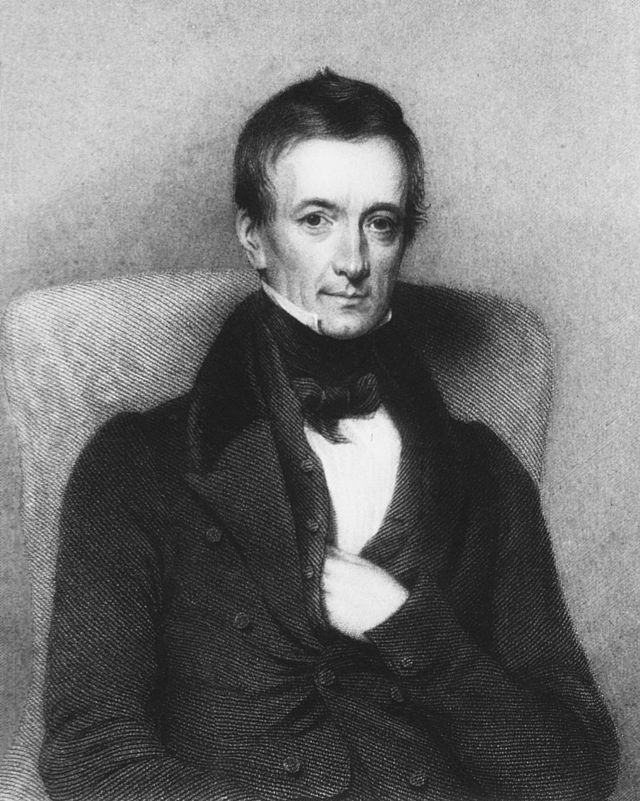
Paul Mark Roget, Creator of the thesaurus

Paul Mark Roget, Creator of the thesaurus

Like its cousin the dictionary, the synonyms and antonyms of Roget’s Thesaurus are arranged alphabetically. That decision was made by its originator, Peter Mark Roget who published the first thesaurus in 1852, some 100 years after Samuel Johnson published the successful Dictionary of the English Language.

Roget’s objective with the thesaurus was to help the writer or speaker “to find the word, or words, by which [an] idea may be most fitly and aptly expressed.”

In the forward to the first edition, Roget wrote:

“It is now nearly fifty years since I first projected a system of verbal classification similar to that on which the present work is founded. Conceiving that such a compilation might help to supply my own deficiencies, I had, in the year 1805, completed a classed catalogue of words on a small scale, but on the same principle, and nearly in the same form, as the Thesaurus now published.”

The word “thesaurus” is derived from the Greek θησαυρός (thēsauros), “treasure, treasury, storehouse”, and the thesaurus is indeed a treasure of language. A word of caution, however, to those who use this treasure trove improperly; fancy words do not guarantee academic writing.

For example, there is a danger of overuse, as demonstrated in this dialogue from a episode of Friends when the character Joey wanted to appear “smart”. He had replaced every ordinary word in an application letter with its synonym from the thesaurus:

Joey: I wrote, “They’re warm nice people with big hearts.”

Chandler: “And that became, ‘They’re humid pre-processing Homo sapiens with full-sized aortic pumps’?”

Students often make these same kinds of novice errors. In their attempts to sound “smart”, they include words they do not understand, adding “verdant” to  “green” grasses. They create contradictory combinations such as “nimbly lethargic” or “exigent tolerance.” Then, there is the tale of the student whose creative writing assignment featured a woman eating a delicious chignon, a bun one puts in one’s hair.

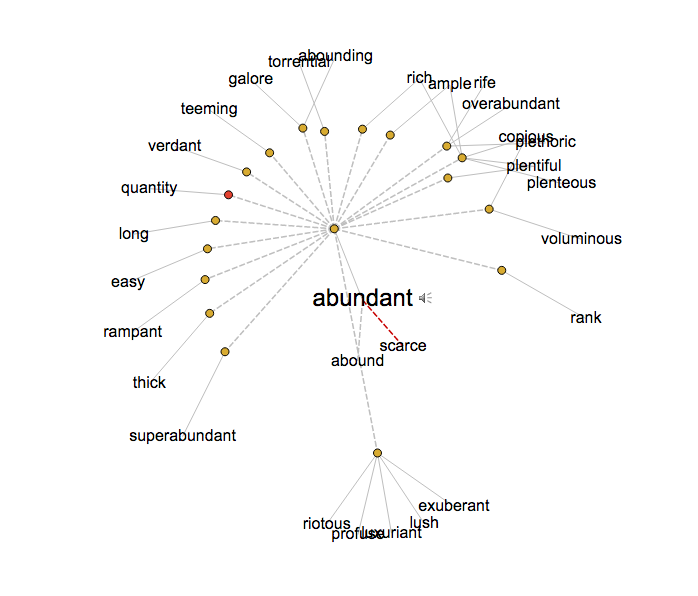
Click on any word to create new word blossoms or "daisies"

Click on any word to create new word blossoms or “daisies”

Now, with software available on multiple platforms, students can choose to hunt through pages of a text or try one of several online thesaurus tools that help them find the perfect word.

There is the subscription based VisualThesaurus which is an “interactive dictionary and thesaurus which creates word maps that blossom with meanings and branch to related words.” Clicking on any word allows students to see an abundance of alternatives. A free version of this form of interactive thesaurus is found at Visuwords.

Merriam-Webster also offers a student friendly thesaurus at WordCentral which offers many other interactive features such as word-of-the-day or student-created disctionaries.

Interactive activities for students

Interactive activities for students

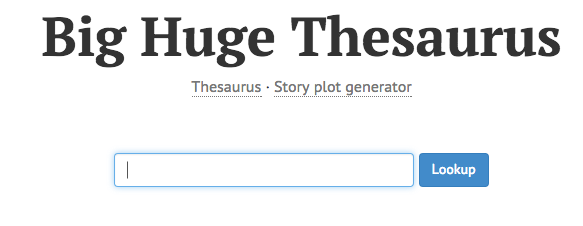
Simpler versions can be found at  BigHugeLabs or at Thesaurusland offer stripped down versions  that require only that a student enters a word in the search box to get synonyms or antonyms.

Screenshot 2015-04-27 21.40.53

Simple version of an online thesaurus


 Students can jubilate or rejoice or revel or solemnize in marking the 163rd anniversary of the thesaurus.  They can acknowledge or appreciate or enjoy or welcome how the thesaurus has helped their writing.
However, as intently or as meticulously or as scrupulously as they search in texts or search online, students will not be able to answer the question, what’s another word for thesaurus?


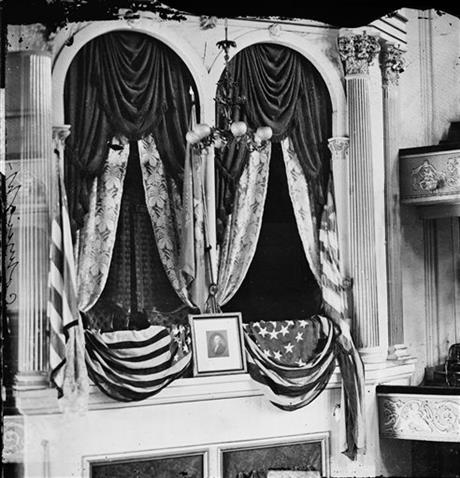
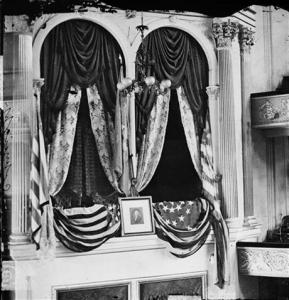
This April 1865 photo provided by the Library of Congress shows President Abraham Lincoln\'s box at Ford\'s Theater, the site of his assassination. Under the headline "Great National Calamity!" the AP reported Lincoln’s assassination, on April 15, 1865. (AP Photo/Library of Congress)

This April 1865 photo provided by the Library of Congress shows President Abraham Lincoln\’s box at Ford\’s Theater, the site of his assassination. Under the headline “Great National Calamity!” the AP reported Lincoln’s assassination, on April 15, 1865. (AP Photo/Library of Congress)

News stories are generally written in what is commonly known as the inverted pyramid style, in which the opening paragraph features the “5 Ws” of journalism: Who, What, Where, When, Why, and How. The reason for this style is so that the reader gets the most important information up front. Given the amount of time readers have today to read the amount of news generated in a 24 hour news cycle, the inverted pyramid makes sense.

In contrast, 150 years ago a dispatch by the Associated Press took a storytelling approach  when President Abraham Lincoln’s assassination at the hands of John Wilkes Booth was relayed by AP correspondent Lawrence Gobright. Under the headline”Great National Calamity!” he chose to deliver gently the monumental news of Lincoln’s death in paragraph 9:

The surgeons exhausted every effort of medical skill, but all hope was gone.

The Common Core State Standards in Literacy promotes primary source documents, such as this news release, in English Language Arts and Social Studies. Documents like this provide students an opportunity to consider the voice or point-of-view of a writer within a historical context.

In this 19th Century AP news release, an editor’s note attached described in vivid detail Gobright’s efforts to gain first-hand information in compiling the story of Lincoln’s assassination. In the tumult that followed the assassination, Gobright became more than a witness as he:

scrambled to report from the White House, the streets of the stricken capital, and even from the blood-stained box at Ford’s Theatre, where, in his memoir he reports he was handed the assassin’s gun and turned it over to authorities.
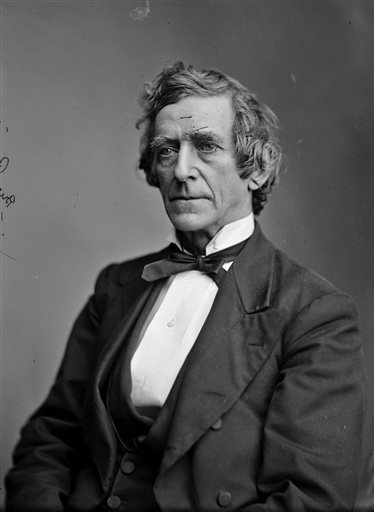
This circa 1865-1880 photograph provided by the Library of Congress' Brady-Handy Collection shows Lawrence A. Gobright, the Associated Press' first Washington correspondent. A native of Hanover, Pa., Gobright covered both inaugurations of Abraham Lincoln, the Civil War and Lincoln's assassination during a career spanning more than a third of a century in Washington. Under the headline "Great National Calamity!" the AP reported President Abraham Lincoln’s assassination, on April 15, 1865. (AP Photo/Library of Congress)

This circa 1865-1880 photograph provided by the Library of Congress’ Brady-Handy Collection shows Lawrence A. Gobright, the Associated Press’ first Washington correspondent.. Under the headline “Great National Calamity!” the AP reported President Abraham Lincoln’s assassination, on April 15, 1865. (AP Photo/Library of Congress)

Gobright’s opening line for the news story identified the setting as Ford’s Theatre; he then added information of considerable interest to the Union Army, that:

It was announced in the papers that Gen. Grant would also be present, but that gentleman took the late train of cars for New Jersey.

After setting up who was or was not in attendance,  Gobright detailed the sequence of events in paragraph 3:

During the third act and while there was a temporary pause for one of the actors to enter, a sharp report of a pistol was heard, which merely attracted attention, but suggested nothing serious until a man rushed to the front of the President’s box, waving a long dagger in his right hand, exclaiming, ‘Sic semper tyrannis,’

Describing the assailant’s escape on horseback, Gobright concluded the reaction of the crowd in the audience in paragraph 4 in an understatement, “The excitement was of the wildest possible description…”

His AP’s edited version online states that the report does not contain details on the second assassination report on Secretary of State William Seward. There is his reference to the other members of Lincoln’s cabinet who, after hearing about the attack on Lincoln, travelled to the deathbed:

They then proceeded to the house where the President was lying, exhibiting, of course, intense anxiety and solicitude.

As part of a 150 year memorial tribute, the AP offers two websites with Gobright’s report, the first with an edited version of the report and the second, an interactive site with graphics. The readabilty score on Gobright’s release is a grade 10.3, but with some frontloading of vocabulary (solicitude, syncope) this story can be read by students in middle school. There are passages that place the student in the moment such as:

  • There was a rush towards the President’s box, when cries were heard — ‘Stand back and give him air!’ ‘Has anyone stimulants?’
  • On an examination of the private box, blood was discovered on the back of the cushioned rocking chair on which the President had been sitting; also on the partition and on the floor.

The NYTimes reporting of the assassination, having the advantage of several hours start, did not bury the lede, or begin with details of secondary importance, offering the critical information through a series of headlines beginning with the kicker “An Awful Event”:

An Awful Event
The Deed Done at Ford’s Theatre Last Night.
THE ACT OF A DESPERATE REBEL
The President Still Alive at Last Accounts.
No Hopes Entertained of His Recovery.
Attempted Assassination of Secretary Seward.
DETAILS OF THE DREADFUL TRAGEDY.

Their six column spread allowed space for the six drop heads, or smaller secondary headlines, above that were stacked to provide an outline of the events. The article that follows begins with then Secretary of War Edwin Stanton’s message to Major General Dix, April 15, 1865 at 1:30 AM:

This evening about 9:30 PM, at Ford’s Theatre, the President while sitting in his private box, with Mrs. Lincoln, Mrs. Harris, and Major Rathburn, was shot by an assassin who suddenly entered the box and approached behind the President.

Stanton’s 324 word report has a readability grade 7.2, and includes also details about the other assassination attempt on Seward’s life:

About the same hour an assassin, whether the same or not, entered Mr. SEWARD’s apartments, and under the pretence of having a prescription, was shown to the Secretary’s sick chamber. The assassin immediately rushed to the bed, and inflicted two or three stabs on the throat and two on the face.

A second dispatch features Gobright’s reporting and appears below Stanton’s message in the second column. Following these accounts, a third dispatch  by an unnamed reporter is dated Friday, April 14, 11:15 P.M. and like Gobright’s account begins with a storybook-type lead:

A stroke from Heaven laying the whole of the city in instant ruins could not have startled us as did the word that broke from Ford’s Theatre a half hour ago that the President had been shot. It flew everywhere in five minutes, and set five thousand people in swift and excited motion on the instant.

These first-person accounts of Gobright, Stanton, and others covering Lincoln’s assassination will allow students to contrast what they recognize as the reporting styles of today with an example of the storytelling reporting style 150 years ago. Students can analyze both styles for conveying information, and then comment on impact each style may have on an audience.

More important is the opportunity to ditch the dry facts from a textbook, as these newspaper releases allow students to discover that at the heart of stories about Lincoln’s assassination, the reporters were really storytellers, and their hearts were breaking.

National Poetry Month was first suggested in 1995 by the Academy of American Poets as “a way to increase awareness and appreciation of poetry in the United States.”

20 years later, this celebration of poetry has taken root and flourished.

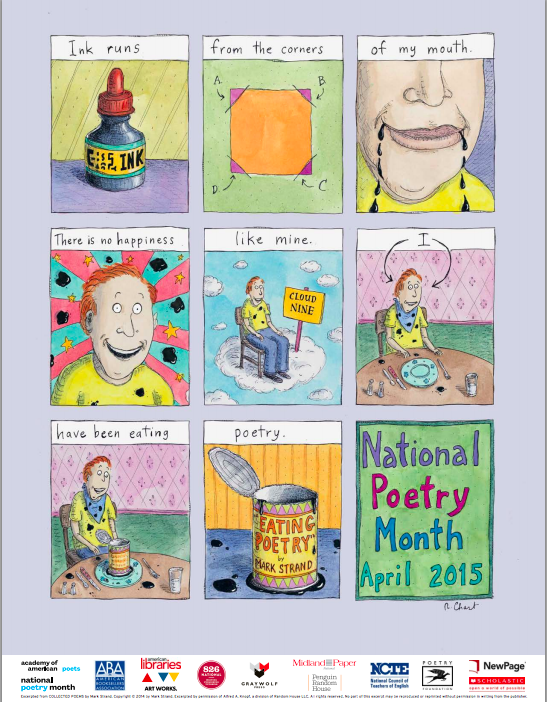
This year, in 2015, the celebrations will be promoted with a poster designed by National Book Award finalist and The New Yorker cartoonist Roz Chast. The poster‘s nine panels contain the words from the opening stanza of the poet Mark Strand’s poem Eating Poetry:

Ink runs from the corners of my mouth.

There is no happiness like mine.

I have been eating poetry.

Screenshot 2015-03-29 17.56.35

Teachers can order the poster from the Poets.org website or download a smaller page sized copy to use in their classes.

In addition to the poster, the Academy of American Poets has developed a program titled “Dear Poet”, a set of four lesson plans that teachers can use with students in grades 5-12. The lesson plans connect to the literacy standards of the Common Core in a “multimedia education project that invites young people in grades five through twelve to write letters in response to poems written and read by some of the award-winning poets who serve on the Academy of American Poets Board of Chancellors.”

Examples of some of the activities in the lesson plans connected to English Language Arts standards include:

Speaking (and gesturing):

  • Students make a sound, using their own voice, without words, to express how they are feeling at the moment.
  • Right now I feel… (using only a hand gesture)
  • Right now I feel… (using only their voice with no words)
  • Right now I feel… (using their gesture, voice, and descriptive words)

Listening:

Students listen and describe the sound by writing in their journals.

Reading:

Students read six poems and complete a T-chart with one side with what “jumps out at them” in the poem and on the other side, why they think this is important to the poet’s voice/poem.

Writing:

Students draft a letter addressed to a chosen poet, telling him/her what in the poem spoke to them, and asking questions relating to how the poet wrote this poem.

The lesson plans include links for students to upload their letters as an authentic task.

During the month of April, teachers can follow updates on Twitter using the hashtag #npm15 and follow the Academy of American Poets @POETSorg.

The end of National Poetry Month will conclude with “Poem in Your Pocket Day” (April 30) and teachers and students alike can celebrate by selecting a poem, carrying it, and sharing it with others throughout the day. Copies of suggested poems (in the public domain) are available by download.

For those who would want to continue the celebration of poetry all year, there is also a link to a poem a day a previously unpublished poems is delivered by e-mail daily during the week and classic poems delivered on the weekends.

There is a behavioral theory that practicing a specific skill for 66 days will make that practice a life-long habit. While the planned 30 days of poetry practice in the month of April will fall short, the American Academy of Poets should attempt a co-op the “National Fitness Month” of May using the ploy, “Poems are a work-out for the mind!”

  Continue Reading…