Archives For November 30, 1999

sols_6Why do I stay? This question is circulating on blogs and in videos by teachers from across the country. My friend Catherine, a teacher and literacy specialist, brought this question to my attention in her post this week. She was participating in a challenge organized by Two Writing Teachers called  The Slice of Life. The instructions for participating are on a link that goes first to a definition (“Slice of life is a phrase describing the use of mundane realism depicting everyday experiences in art and entertainment“) while other links provide procedures:

WRITE your slice. SHARE your link. GIVE some comments to (at least three) other slicers.

On one post she linked her Slice of Life post to blogger Beth Shaum’s video “Why I Stay”.  Catherine listed her reasons for staying and noted that other teachers have written about their reasons for remaining in the classroom, “despite changes in curriculum because of Common Core State Standards, new testing, and new evaluations that are being imposed on educators.” The video on Shaum’s blog addresses startling statistics about the teaching and the education profession:

More than 30% of new educators quit teaching after three years, and nearly 50% leave before hitting the five-year mark. (USNews.com)

Shaum’s video showed dozens of teachers from around the country sharing their reasons for staying in education.

I have not written to The Slice of Life challenge, but I did think the idea of recording my personal reasons as to why I have stayed and taught for 22 years in grades 6-12 would be an exercise that could both help me frame my own thinking and possibly encourage younger teachers who are often overwhelmed.

My reason for “why I stay” is purely selfish.…I want to share the stories.

I want to share with children, teens, and adults the stories they have read, seen, or heard.

I want to share the stories in picture books.
I want to share the stories in chapter books.
I want to share the stories in the canon.

So, I teach students to read stories so that we can talk and share the stories that make us human..

I want to share books.

I want to share books at every grade level.

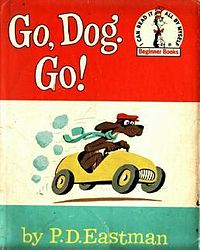
hungry Whales Go_Dog_Go

I want to share books:

  • Go, Dog, Go
  • Hungry Hungry Sharks
  • The Whales Go By

I want to share more books:

  • Nancy Drew’s The Password to Larkspur Lane
  • The Twenty-One Balloons
  • A Wrinkle in Time

Larkspur wrinkle 21 balloons

I want to share novels:

  • Of Mice and Men
  • The Road
  • The Curious Incident of the Dog in the Night-time

I want to share stories written as dramas. I want to talk about:

  • Hamlet
  • Medea
  • The Importance of Being Ernest

I want to share stories made into film. I want to talk about:

  • One Flew Over the Cuckoo’s Nest
  • The Wizard of Oz
  • The Shawshank Redemption

I want to share stories in poems. I want to talk about:

  • The Odyssey
  • Paradise Lost
  • The Cremation of Sam McGee

Guernica Fall of Icarus

GW Delaware

I want to share the stories in paintings. I want to talk about:

  • Guernica
  • The Fall of Icarus
  • George Washington Crossing the Delaware

I want to share the stories that were responsible for essays and speeches. I want to talk about:

  • The Gettysburg Address
  • A Modest Proposal
  • Self-Reliance

I want to share the stories of people’s lives, stories about nature, and stories that mark cultural trends. I want to share:

  • Will You Sign Here, John Hancock?
  • Silent Spring
  • The Tipping Point

From the ancient lights of the campfires to the soft glow from a Kindle, our stories record our humanity.I stayed 22 years in teaching because I want students to understand that record of humanity. I stayed 22 years in teaching because I want students to respond to stories through writing and through speaking. And I stayed because I wanted to encourage students to record their own stories. I want to read and hear and see their stories.

In this great cultural experiment of public education for ALL, I stay to share the stories.

There is always a “first mover”, the one who starts the action. A creator.

But is this creator an artist? Or is this creator a scientist?

A recent broadcast on National Public Radio puts the evidence solidly in artist’s corner. This evidence is in the form of the 3-D Doodler, a new device featured on Marketplace as an invention funded through Kickstarter. The 3-D Doodler is a thick pen not unlike a glue gun that exudes a ribbon of thin plastic that hardens into the shape being drawn. There was a team of scientists and engineers who created the 3-D Doodler.

The video demonstrates how the 3-D Doodler operates like a pen that continues to write even after it is lifted from a surface allowing the writer to operate without a canvas. There are no limits to the size of the creation; the only limit is the supply of plastic. Oh, and the power source.

But, a crayon does not need a power source. A crayon only needs a hand and an imagination. Especially if the crayon is the beautiful color purple.

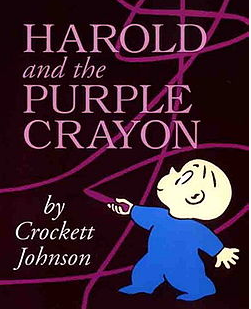
Before the 3-D Doodler, there was Harold and the Purple Crayon

Crockett Johnson’s Harold and the Purple Crayon was first published in 1955, and was voted one of the “Top 100 Picture Books” of all time in a 2012 poll by School Library Journal. Loved by children of several generations, Harold’s creativity endures.

Screen Shot 2013-03-27 at 9.40.03 PMHis story begins,

“One night, after thinking it over for some time, Harold decided to go for a walk in the moonlight.”

On the right hand side of the first page, Harold’s distinctive large round head and wide eyes are turned expectantly to a blank space in the top right corner of the page. Clenched in his right hand is a purple crayon; he has just completed a full page drawing of intersecting lines on the opposite page.

“There wasn’t any moon, and Harold needed a moon for a walk in the moonlight.”

On the next page, standing on his tiptoes in his full bodysuit, Harold draws a slice of the moon.

“And he needed something to walk on.”

Bending over, Harold draws a straight line and “sets off on his walk taking his big purple crayon with him.” Harold travels through a forest, past a dragon, on the ocean, to the beach, up a mountain, in a hot air balloon, through a maze of city buildings, until he finally finds his way back into his bedroom through an open window. At the end of the story, Johnson displays the sophisticated word play that makes the story so much fun to read aloud. Harold is in his bedroom, where he:

“…made his bed. He got in and he drew up the covers.”

Get it? He “made” the bed? “Drew” up the covers”? Johnson was a genius. An artistic genius.

The success of Harold and the Purple Crayon was extended by Johnson in a number of sequels. Harold’s imagination allowed him to travel through numerous landscapes:

  • Harold’s Fairy Tale 1956
  • Harold’s Trip to the Sky 1957
  • Harold’s Circus’s 1959
  • Harold’s ABC 1963

The series gave rise to a video puzzle game, Crayon Physics. However, the artist Harold was not limited by the laws of physics. The crayon was not bound to wear and tear. The canvases were large and blank and ready for a creator.

The new 3D Doodler can also be used to write on a large blank canvas. However, this new technology is seriously limited by the need for a power source and a continuous supply of “ink.”

In deciding the case of which came first, the artist or the scientist, the evidence is illustrated quite literally in doodles. These doodles are in purple, not plastic. Harold is a first mover whose imagination continues to inspire. Sorry, 3D Doodler, in this landscape of creation, Harold the artist comes first.

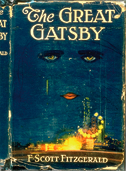
003-Great-Gatsby

Charles Scribner’s and Son issued the first hardback edition in April 1925, adorning its cover with a painting of a pair of eyes and lips floating on a blue field above a cityscape.

The Great Gatsby film is coming out soon….” the English teacher said to me, “Can you believe Gatsby is almost 90?”

Wait, 90? The Great Gatsby is almost 90? That debonair, handsome American icon we met in his 30’s could be well over 100 years old?

“He had one of those rare smiles with a quality of eternal reassurance in it, that you may come across four or five times in life. It faced, or seemed to face, the whole external world for an instant and then concentrated on you with an irresistible prejudice in your favor. It understood you just as far as you wanted to be understood, believed in you as you would like to believe in yourself.”

F. Scott Fitzgerald began writing his great American novel in 1922, with some of the elements surfacing in the story “Absolution” in the June 1924 issue of the magazine The American Mercury.  During the years 1923–1924, Fitzgerald, his wife Zelda, and their baby daughter, Frances “Scottie”,  traveled from New York to the French Riviera, where the novel was finished. Fitzgerald went through several revisions between 1923 to 1925 before the  novel was finally published.

According to Brant Mangum in a publication from Virginia Commonwealth University: 

Fitzgerald’s ambitious goal as he approached the composition of The Great Gatsby was to “write something new–something extraordinary and beautiful and simple + intricately patterned.”

The reaction of the critics was harsh; one early review ran with the headline:

 “F. SCOTT FITZGERALD’S LATEST DUD.”

Praise, however came from recognized writers T. S. Eliot, Edith Wharton and Willa Cather. Ten days after the book came out, Maxwell Perkins, Fitzgerald’s editor, sent the telegram: “SALES SITUATION DOUBTFUL EXCELLENT REVIEWS.” The first printing of 20,870 copies was a slow seller; Scribner’s printed another 3,000 copies four months late and finished the run. According to an article Living on $500,000 a Year: What F. Scott Fitzgerald’s tax returns reveal about his life and times by William J. Quirk in American Scholar over 12 million copies have been sold, with approximately 300-400 hundred thousand sold annually. However, Fitzgerald never did match his famous protagonist’s wealth:

“Royalties from The Great Gatsby totaled only $8,397 during Fitzgerald’s lifetime. Today Gatsby is read in nearly every high school and college and regularly produces $500,000 a year in [F. Scott Fitzgerald’s daughter] Scottie’s trust for her children.”

Fitzgerald died young, age 44, in December of 1940.

“His estate was solvent but modest—around $35,000, mostly from an insurance policy. The tax appraisers considered the copyrights worthless. Today, even multiplying Fitzgerald’s estate by 30, it would not require an estate tax return.”

He did write other novels, stories, essays, but The Great Gatsby remains his most important addition to the canon. So why call this work the great American novel?

Jonathan Yardley makes his case by calling attention to the distinctively American elements in the novel in the Washington Post book review Gatsby”: The Greatest Of Them All (1/2/07) writes:

In an extraordinarily compressed space — the novel is barely 50,000 words long — Fitzgerald gives us a meditation on some of this country’s most central ideas, themes, yearnings and preoccupations: the quest for a new life, the preoccupation with class, the hunger for riches and “the last and greatest of all human dreams…”

Our contemporary American obsession with celebrity and wealth is obvious to students who are assigned The Great Gatsby. Our nation’s economy  from boom through a recent recession, echoes the experience the heady times of the  Roaring 20’s before the Great Depression. The narrative style is engaging and packed with imagery. Anyone who spent time in a high school literature classroom over the past 50 years can recall taking notes on Fitzgerald’s metaphors and complex symbols. Mangum discusses these in his essay:

 The green light, which carries meaning at every level of the story–as Gatsby’s go-ahead sign, as money, as the “green breast of the new world,” as springtime–is strategically placed in chapters one, five, and nine. The eyes of T.J. Eckleburg “brood on over the solemn dumping ground,” which is the wasteland that America has become (514).

The appeal of Jay Gatsby’s character is explained in a chapter in America: A Self-Made Country by political commentator Chris Matthews. He writes:

“The reader, like Nick Carraway, comes to like this guy. We love his dream  because we have, all of us, shared something very much like it. Gatsby for me is undeniably the great American novel. We celebrate its hero and his “heightened sensitivity” to the promise of life. his “extraordinary gift for hope”, his “romantic readiness” because we as a country share every bit of it” (20).

The final passage of the novel is Fitzgerald’s commentary on the American dream. Nick’s final stream of consciousness:

“Gatsby believed in the green light, the orgastic future that year by year recedes before us. It eluded us then, but that’s no matter—tomorrow we will run faster, stretch out our arms farther. . . . And then one fine morning—
So we beat on, boats against the current, borne back ceaselessly into the past.”

Such imagery naturally lends itself to the movie screen, and The Great Gatsby has had more than its fair share of remakes:

  • 2000:  Mira Sorvino, Toby Stephens, Paul Rudd (made for TV)
  • 1974: Robert Redford, Mia Farrow, Bruce Dern
  • 1949: Alan Ladd, Betty Field, Macdonald Carey
  • 1926: Warner Baxter, Lois Wilson, Neil Hamilton 

Now, the latest version is coming May (2013), when the Australian film director Baz Lurhman will put his spin on this American story:

Once more, Jay Gatsby will be glamorously immortalized in his youth; this time digitally mastered rather than in celluoid.

However, should someone want to try an even newer genre in order to experience a 21st Century Gatsby, there is the Nintendo Great Gatsby Game that can be played on a computer. While Gatsby is fixed forever as young and ambitious, he now is also amazingly spry for his years! ( “to jump, move arrow keys together right and left”)

For an “Old Sport”, Gatsby wears his age well.

What better way to celebrate International Women’s Day 2013 but to pay tribute to Canadian author Margaret Atwood? Poet, novelist, lecturer, inventor, tweeter, and celebrity ice hockey goalie, Atwood’s achievements in each of these roles is accomplished with wit, grace, and aplomb.

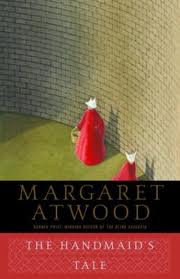
Handmaid's tale

There are other earlier covers, but this one is my personal favorite.

My Advanced Placement English Literature class just finished reading her novel, The Handmaid’s Tale. The novel is set in the dystopia of Gilead, where in response to political and ecological upheaval, a quasi-Christian theocracy is organized in the eastern section of the United States. Astute Sparknote writers, graduates of Harvard, recognized many of the landmarks in the novel’s setting (the brick wall, the gymnasium) as that of their alma mater, an indication of Atwood’s wry sense of irony. In the novel, fertility is an obsession. Rituals and “ceremonies” are enforced; offenders and outliers are publicly executed or sent to labor in toxic waste dumps. The main character Offred, who had a daughter before the establishment of the Republic of Gilead, is valued only for her ability to reproduce.

Because of the mature themes, The Handmaid’s Tale is often taught in senior high school classes. The title is often suggested on the exam for the open-ended Question #3 on the AP Literature exam which means other schools assign the book. There are always plenty of copies available in the secondary market. Our classroom library has over 60 copies from a variety of library book sales and thrift stores. I have spent under $100.00 in adding this title to our curriculum; I’d like to think that Atwood might be pleased with this “ecological” way to have students read the text despite her loss of possible retail revenue. However, if one wanted a new copy, they are available at Amazon for $10.20 paperback or an audio recording by Claire Danes is available  at Audible.com  for $24.95.

When we discuss the clothing that marks the different “castes” of people in Gilead,  I always use the endpaper story Atwood published in the New York Times Magazine published “When Afghanistan Was at Peace”

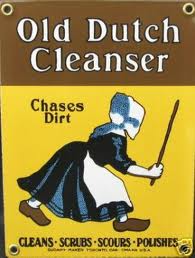
Six years after our trip, I wrote ”The Handmaid’s Tale,” a speculative fiction about an American theocracy. The women in that book wear outfits derived in part from nuns’ costumes, partly from girls’ schools’ hemlines and partly — I must admit — from the faceless woman on the Old Dutch Cleanser box, but also partly from the chador I acquired in Afghanistan and its conflicting associations. As one character says, there is freedom to and freedom from. But how much of the first should you have to give up in order to assure the second? All cultures have had to grapple with that, and our own — as we are now seeing — is no exception. Would I have written the book if I never visited Afghanistan? Possibly. Would it have been the same? Unlikely.”

Dutch Cleanser

The combination of the Dutch Cleanser girl with the chador is the inspiration for Offred’s clothing; the story and the visual always sparks a discussion on the symbolic effect of clothing.

My students always argue about the genre of The Handmaid’s Tale. This year there were a number of votes for political science book, others for a dystopian love story; no one said science fiction. Atwood would be relieved; she has always drawn the distinction between science fiction and her writing which she calls “speculative fiction”. Several of my students also read the other books Oryx and Crake and The Year of The Flood that are speculative fiction.

Here is Atwood with her take on the genre of specultive fiction.

The conclusion of The Handmaid’s Tale ends in an allusion to the story of Orpheus and Eurydice:

“We may call Eurydice forth from the world of the dead, but we cannot make her answer; and when we turn to look at her we glimpse her only for a moment, before she slips from our grasp and flees.”

After we finished the novel, the class read Atwood’s poem Eurydice. I asked them what they thought.

  • “There is a sense of longing in both.”
  • “The language is so similar. There is the white curtain…the gauze.”
  • “‘It is not through him you will get your freedom’ is just like
    from and freedom to…that is Offred’s problem”
  • “We could have just read the poem! They’re almost the same!”

One other area of speculative fiction where Atwood has shared her thoughts is on the topic of modernity…and Zombies. In an interview on George Stroumboulopoulos Tonight, Atwood was quite clear on the limits of Zombie stories:

“No zombie story is ever told from the zombie point of view… they’re not narrative…they don’t have language and that impedes one from telling a story.”

Outside of fiction, Atwood has also written about debt. Her non-fiction book Payback: Debt and the Shadow Side of Wealth came from her 2008 Massey Lectures. Not surprisingly, her interest in debt began in from her study of Victorian Literature. In an interview with Suzanne Ellis, CityLine “Margaret Atwood On Payback And The Concept Of Debt”  Atwood discussed how the Victorian stories that are on the surface about love and romance are really all about financial arrangements:

“In [Jane Austen’s] Sense and Sensibility, Marianne can’t marry the love of her life because he needs to marry a rich person. He doesn’t have any money. She’s devastated by that and gets a bad cold,” Atwood muses. “You start following the money in these novels and it takes you to the most amazing places. Where did Heathcliff get the money that he uses to buy Wuthering Heights, or I should say to gamble the owner of it out of it? How does he do that? We’re not quite sure but it’s something pretty shady.”

The book was made into a documentary and released in the spring of 2012. The New York Times critic A.O. Scott opens his film review with the premise of the documentary:

A glance at the headlines from Europe, the news from Washington or this month’s bills will confirm that we live in an age of debt. Debt, a concept at once straightforward and almost metaphysically complex, is a source of personal, national and global anxiety, and forms a link between the individual and the worldwide economic system.

While the film did not receive critical acclaim, Atwood’s ability to connect herself and link to the world through Twitter is often lauded.  She is an avid twitterer with 383,430 followers and over 15,000 tweets of her own. She links to political issues, comments on travels, and gives recipe advice:

Screen Shot 2013-03-08 at 11.06.17 AM Screen Shot 2013-03-08 at 11.07.07 AM Screen Shot 2013-03-08 at 11.08.58 AM Screen Shot 2013-03-08 at 11.09.56 AM

She also is the inventor of the “long pen”, a device that allows her to attend book signings from distances and sign books “virtually”. When she is tired of traveling to sign books, she can now meet her adoring public in virtual space and provide them with an authentic signature. Fortunately, I saw her before the “long pen” at a Barnes and Noble reading/book signing for her short story collection Moral Disorder. She was amazingly articulate; in the 40 minute talk, she never hesitated or once said “um”.

And just when you thought that Atwood could not be more accomplished, she starred in a video explaining “How to Stop a Hockey Puck” for the comedian reporter Rick Mercer. I put the video below. (Too bad her “Dance Party Video” was removed from YOUTube for copyright violations.)

So, on this International Woman’s Day, let’s hear a cheer for Margaret Atwood!

She writes. She tweets. She scores!

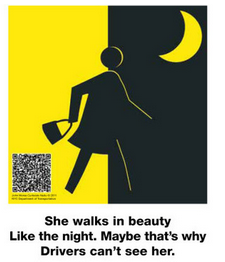
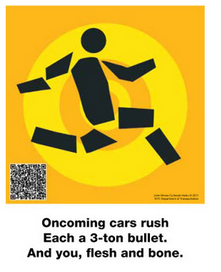
Mash-up are usually the blending of music from two or more sources. However a different mash-up was featured in a story by National Public Radio (NPR) where street signs in New York City were rewritten into Haiku poetry, Haiku Traffic Signs Bring Poetry To NYC Streets. This story illustrated how a mashup could be made of a very basic informational text with a strict poetic form. “Caution: Oncoming Traffic” was expanded into a poem of  of 5 syllables/7 syllable/5 syllables of “8 million swimming/The traffic rolling like waves/Watch for undertow.” In the NPR story,

“Traffic warning street signs written as haiku are appearing on poles around the five boroughs, posted by the New York City Department of Transportation. The poems and accompanying artwork were created by artist John Morse.”

Screen Shot 2013-03-03 at 5.35.21 PM Screen Shot 2013-03-03 at 5.35.31 PM Screen Shot 2013-03-03 at 5.35.39 PM

NYC’s Department of Transportation hoped the signs would catch new eyes in order to communicate important information. The unusual combination of graphics and verse on street signs presented pedestrians with additional information, a different point of view. The reordering of information is just one example of how presenting information in a different genre also provides new writing opportunities for new audiences.

Since the English Language Arts Common Core is rattling its standards calling for an increase in informational texts, the 9th grade curriculum is including a non-fiction unit where students choose a non-fiction text of their own to read. The CCSS  require this increase based on:

“…extensive research establishing the need for college and career ready students to be proficient in reading complex informational text independently in a variety of content areas. Most of the required reading in college and workforce training programs is informational in structure and challenging in content…”

Our students may choose a text to read on topics that range from animal or adventure topics to travel or war. There are titles that have been made available in bulk on the secondary market, such as public library book sales or thrift stores and added to our classroom book carts. The books purchased for $1.00 each (see how) include:

  • Girl Interrupted-Keysen
  • Guts-Paulsen
  • Tuesdays with Morrie-Albom
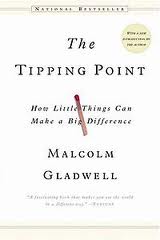
  • The Tipping Point– Gladwell
  • Left for Dead-Nelson
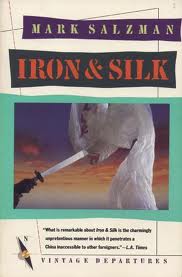
  • Iron and Silk-Salzman
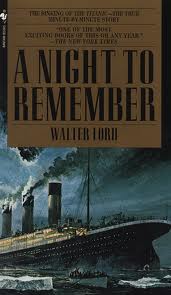
  • A Night to Remember-Lord
  • Hiroshima-Hersey
  • The Teammates-Halberstam

iron and silk Night to remember dog year Tipping

There are also a number of books that deal with animal literature that are stocked on the classroom book cart. Many of these texts will also be available for the senior elective, “Critter Lit”:

  • With Love from Baghdad-Kopelman
  • Tell Me Where It Hurts-Trout
  • Seabiscuit-Hillebrand
  • Winterdance– Paulsen
  • A Dog Year-Katz
  • Wesley the Owl-O’Brien
  • Alex and Me-Royte
  • Modoc-Helfer
  • The Pig Who Sang to the Moon-Masson

Students may chose from these titles or another non-fiction choice though the school library, which also offers the online book shelf Overdrive. The students organize themselves into thematic groups while the unit runs for four weeks (block schedule) with some overlap during the standardized testing weeks. The students spend time reading in class, and they organize themselves into thematic groups. Rather than respond in essays or traditional research papers, the students are given an opportunity to create genre mash-ups.

First, to prepare for writing mash-ups, the students generated a list of the kinds of non-fiction writing they see everyday including:

  • License plate
  • Newspaper article
  • Letter to the editor
  • Ad
  • food labels
  • Menu
  • Directions
  • Q&A Interview
  • Diary
  • Weather report
  • Sports report
  • Billboard
  • Tweet
  • Blog post
  • Directions

Next, the mini-lessons that begin each class are quick( 5-10 minutes) and focus on the characteristics of a particular genre from the list so that students can create rewrite each text in that genre. For example, students review how information is arranged on a food label before creating a “food label” for the books they are reading. Students read billboards and street signs before creating the same.  After each mini-lesson, students write about their text in the assigned genre and use a Google Docs folder to develop a portfolio of authentic writing. The result is a portfolio of mash-ups of informational texts rewritten by students into other genres.

Like the haiku and street sign mash-up, these mashups will still communicate essential information. Students can write about the texts they choose to read in the authentic genres they encounter everyday.

Finally, when April comes around, the students may try writing their essential information in poetry: sonnets, limericks, villanelles and even haikus. After all, April is National Poetry Month!

There are many great reasons to teach at the high school level: no outdoor recess duty, college level content, plus, a teacher never has to choose a “line leader”. Best of all, there are no bulletin board requirements.

While most elementary school classroom walls are crammed with colorful thematic cut-outs (apples, shamrocks, stars), high school walls are monochromatic. While middle school classrooms have student work displayed regularly, an essay hung in September will curl and fade on the wall of a high school classroom twisting in the air like an ancient leaf of papyrus.

Generally speaking, high school teachers do not spend a lot of time decorating the classroom. Subject content or motivational posters are the wall covering of choice, unchanged for the requisite 181 days of instruction. Perhaps it is inevitable that teachers who share classrooms do not personalize classrooms.

However, for one brief part of the 3rd grading quarter, Read Across America Week (February 25-March 1st) changed the decorating habits of the faculty at Wamogo Middle/High School.

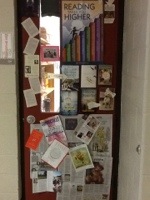
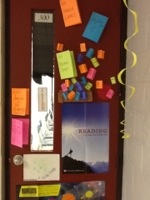
English teacher door...a wide rang of reading complete with motivational poster!

English teacher door…a wide rang of reading complete with motivational poster!

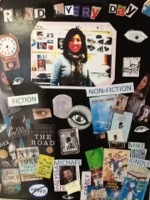
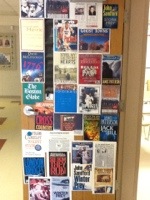
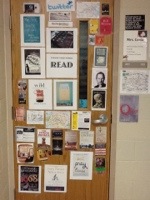
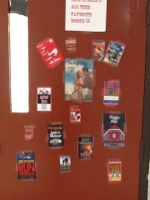
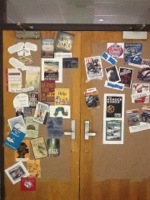
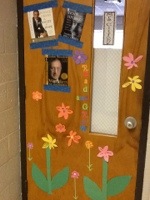
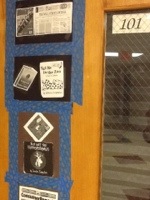
In a collective effort to demonstrate the importance of reading to students, teachers from every discipline decorated their classroom doors with materials they have read or are currently reading.

20130301-112618.jpg

When sharing a door meant less space, this resource room teacher used a poster.

Social Studies (Gr 7) had this door and the side wall as well!

Social Studies (Gr 7) had this door and the side wall as well! The genre range (politics-humor-sports) was astounding!

20130301-112656.jpg

The Art teacher door centered around the command “READ”.

20130301-112713.jpg

Health and Physical Ed teacher revealed a “retro” fondness for the books that contributed to her growing up including Erich Segal’s “Love Story”

20130301-112741.jpg

Alternative education students had to walk through a double door display! Students selected the books they read as well in this display.

20130301-112806.jpg

The resource room mixed decorative flowers with John Wooden “On :Leadership”

20130301-112843.jpg

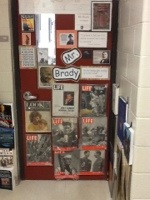
One Social Studies teacher took the assignment to heart by hanging what he reads, quite literally, onto the door and walls….He was considered the “winner!”

Admittedly, when the “Doors of Wamogo” was announced, there was a little hesitation. What would go on the door? When was this “due”?

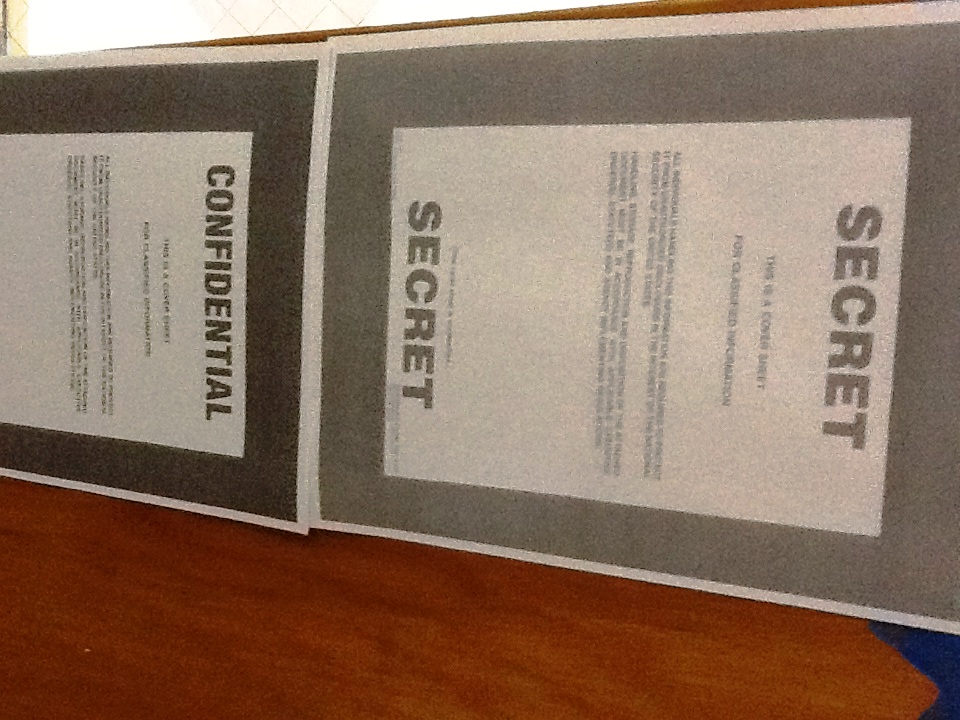
Finally, a few brave souls stepped up. First, there was the Social Studies teacher, an Army Reserve Colonel, who started by hanging “classified” documents on his door. His display was followed by the Business and Career Department teacher, also a basketball coach, who hung sports magazines and the cover of a Bobby Knight memoir.

The English Department members, the Literary Specialist, and the media center Librarian displayed a range of the reading, from Where the Wild Things Are to Great Expectations.

As the week went on, the competition became a little more intense. Finally,  the Grade 8 Social Studies teacher simply emptied out his bookshelf and placed all his favorite texts alongside the door in addition to the door.

Side shot of the "Classified" materials read by a Social Studies teacher

Side shot of the “Classified” materials read by a Social Studies teacher

Perhaps one of the more interesting outcomes was the sharing of titles between faculty and staff. “Oh, I loved that book!” one teacher would say to another. “This is a hard book, but well worth the effort,” said one teacher. “Yes, we read this in our ‘book club’!” exclaimed another. “Who is the Jody Picoult freak?” questions a science fiction reader. “How much Stephen King can you read?” was the retort.

20130301-112826.jpg

Math teacher places “Put Me in the Zoo” on his door; hopefully. this says more about his new baby daughter than the classes!

Students had a chance to look at all the titles: assigned reading from high school that they currently are reading (Romeo and Juliet, Animal Farm), political/history books, and sports memoirs. There were magazine covers, newspaper mastheads, and comic strips. Blogger, WordPress, Twitter, Facebook logos were prominent, social media as informational texts.

So what the “Doors of Wamogo”  created for Read Across America Day in our small rural school was a very large window. The doors provided a window into the lives of our faculty, a window for our students to see us as readers, and for our students to see what books made us successful.

These doors illustrate how reading gave each teacher and staff member a chance to at the window of opportunity; reading = individual success.

We had so much fun, we might try decorating again next year!

Happy Read Across America Day, 2013!

20130301-112923.jpg

Taking the playfulness of a Dr. Seuss motif to heart with replicas of books shared by students.

In keeping my classroom libraries filled with books, the trends I notice are not necessarily trends in book buying, but trends in book discarding. After exams, midterms or finals, assigned titles are discarded to make room on a bookshelf or in a school locker for new required reading. Following trends means knowing that three to four months after the curriculum unit ended, an assigned title begins to crowd its way onto the bookshelves of thrift stores such as Goodwill or St. Vincent’s or the Salvation Army.

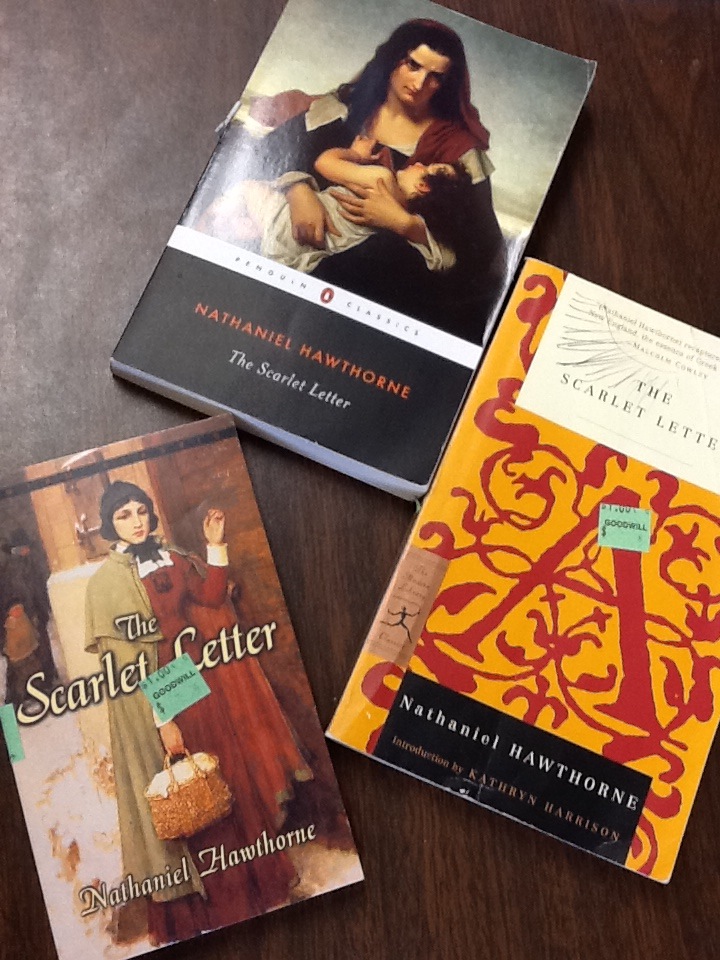
Three copies of "The Scarlet Letter" on the shelf at Goodwill. All new; never opened!

Three copies of “The Scarlet Letter” on the shelf at Goodwill this past week. All new; never opened, bearing their $1.00 each price tags.

Since Puritans are usually up for discussion in September in American History coursework, many English departments turn to Nathaniel Hawthorne’s novel The Scarlet Letter for their Advanced Placement or college bound students as a complementary read. Therefore, I was not surprised when, during this last week of January, copies of The Scarlet Letter began appearing, not in single copies, but in droves. I expected as much. The Scarlet Letter represents the “not keeping” trend. While a student may hesitate for a millisecond before placing The Great Gatsby or To Kill a Mockingbird or Catcher in the Rye in the “throw away” pile, I imagine there is universal delight in discarding The Scarlet Letter, a delight only exacerbated by discarding its equally loathed curriculum companion, Arthur Miller’s The Crucible.

The mention of The Scarlet Letter may set off groans. Woe to the teacher who attempts this book without the iron cast-backbone or the determination of an evangelist. Readers of The Scarlet Letter will need to be converted, and it is only the fear and damnation of another scarlet letter that keeps them plodding on, the scarlet “F”!

The tone of the book is set immediately with the opening line:

A throng of bearded men, in sad-colored garments and gray, steeple-crowned hats, intermixed with women, some wearing hoods, and others bareheaded, was assembled in front of a wooden edifice, the door of which was heavily timbered with oak, and studded with iron spikes.

Looking further down the page for some relief from the gloom, the reader should notice that he or she is being directly addressed, as if from a pulpit delivering a parable or allegory:

Finding it so directly on the threshold of our narrative, which is now about to issue from that inauspicious portal, we could hardly do otherwise than pluck one of its flowers and present it to the reader. It may serve, let us hope, to symbolize some sweet moral blossom, that may be found along the track, or relieve the darkening close of a tale of human frailty and sorrow.

Yes, Hawthorne will be delivering this sermon for 192 pages in the Dover Thrift Edition ($3.15).

Students are aware that this classic will improve SAT scores with the challenging vocabulary and complex structures of 19th Century prose, but they still seek help beyond the classroom. There are Sparknotes, Schmoop notes, E-Notes, Cliff Notes, and Bookrags available for this text, so as a result, the paperback text on the thrift store shelf may never have been opened. The copies available at thrift stores are generally pristine copies. I imagine they were purchased by parents who dutifully picked up the book because of a syllabus of some sort. Maybe this was a summer reading choice, a particularly deadening assignment. Actually, the effort in purchasing this text could have been avoided, because the text itself is online at no less than six places:

And there are free audio versions at:

But we still teach The Scarlet Letter, and our paperback collection of The Scarlet Letter distributed in class is comprised of at least 10 different editions. No student is on the same page number when the text is read aloud in class in order to share the conflicts between Dimmesdale, Hester Prynne, and Chillingsworth. Interestingly, what seems initially complex to the student is eventually understood as a really a ripping good love triangle of sex, intrigue, and irony. Once they see Hawthorne laying out hypocrisies of the Puritan society, they are more genuinely engaged. Plus, there is the lovely child Pearl, and they grow to sympathize for her.

In order to engage students in assessments, our Grade 11 teacher has organized “self-directed” projects for students to choose  and some of these have included:

  • Create a song telling the ballad of Hester Pyrnne.  You may compose the song, or write new words for an existing melody.  Share the song with the class either live or via audio or videotape.
  • Think of a sin associated with Dimmesdale and Chillingworth.  Create a badge that uses a letter or other symbol to represent the sin.  In addition, use art, needlework, or some other craft to make the badge reveal something about the man’s character, interests, or profession.  Write an explanatory caption or paragraph to accompany the badge.
  • Choose music to be the score for a film version of the novel.  Choose music for at least five major scenes.  Write explanatory notes for each selection

The harvesting of The Scarlet Letter texts from thrift store shelves is best from January-March. I can add as many as 10-12 copies during these months. Competition for the title grows during the summer, and the books are often more dog-earred by then.

But with all the negativity, why teach The Scarlet Letter? Because Hawthorne provides a bridge from this historical period to ours by using the empathy that is generated in fiction. Our brains are wired for stories more than facts, and reading The Scarlet Letter helps our students identify with characters in order to understand the politics and policies of this turbulent time when our nation was still in its infancy. Additionally, his story serves as a springboard for other stories. According to Canadian author Margaret Atwood, “The roots of totalitarianism in America are found, I discovered, in the theocracy of the 17th Century. The Scarlet Letter is not that far behind [the novel] The Handmaid’s Tale, my take on American Puritanism.”
Oh, and yes. We also assign The Handmaid’s Tale.

"Dawn spread her rosy fingers..."

“Dawn spread her rosy fingers…”

Our 9th grade classes have been reading Robert Fitzgerald’s excellent translation of The Odyssey. At the beginning of every book, “young Dawn spreads her fingertips of rose to make heaven bright”. My students have heard this phrase so often that they chorus back to me “fingertips of rose” when we read aloud. One morning this past week, I raced up the hill to school to get my iPad so I could capture this picture of the “rosy fingers” and put it on the class wiki.

We dutifully started The Odyssey with the “Invocation to the Muse” and Books 1-4, but the Telemachus “coming of age” story did not really capture their interest. Meeting Odysseus in Book 5 did not improve their respect for the “worthy man of twists and turns.” Once we read Book 9,  the meeting with the Cyclops, Polyphemus, their interest was revived. Apparently, they enjoy a good story of man-eating monster as much as previous generations from 2020 years ago.

I have only been able to locate about a dozen copies of this translation in the secondary market, so we did have to buy a class set. These replaced a worn set of the Richmond Lattimore translation. There will be an audio version of the Fitzgerald translation available in November 2013 I will be ordering so I will finally be able to hear how to pronounce all those Greek names!.

Our final project for the Odyssey is a narrative that students complete called “The Wamogossey: A Day in the Life of a Freshman at Wamogo High School.” Happily,  writing narratives are once again favored in curriculum aligned to the Common Core State Standards:

CCSS.ELA-Literacy.W.9-10.3 Write narratives to develop real or imagined experiences or events using effective technique, well-chosen details, and well-structured event sequences.

The inclusion of the narrative confirms what most writing teachers recognize, that writing a narrative gives a students a better appreciation for reading a narrative.

In writing The Wamogossey, we allow students to organize themselves as individual narrators or in groups of two or three. Our instructions to the students are based on the following premise:

You and your partners are to create a modern equivalent of The Odyssey. The setting is Wamogo High School; the hero a 9th grader – Fresheus or Freshiope.

Your character must make their way through a day at school, facing modern equivalents of the Lotus Eaters, Cyclops, Sirens, and all that Odysseus encountered. The goal is simply to get home alive, where the or she can relax and feel safe.You must mirror Odysseus’ adventures, including how he solves the problems (trickery, patience, skill, self-control, etc).  The essential nature of the obstacles must be the same, in the same order, but set in modern Wamogo.

Each student in a group working on The Wamogossey is required to write three adventures: a single narrator needs three (3) adventures; two people writing the Wamogossey need six (6) adventures; three members of the group need nine (9) adventures. This organization assures that there is an equal sharing of responsibilities regardless as to the size of the group. They compose the narrative on Google Docs; each narrator writing in a different color ink.

In addition, to assure fairness in grading, we allow students to have some feedback on the distribution of points. The project is assigned a base grade (EX: 40 points) Once the project is graded based, that number is multiplied by the number of students in group. For example a project worth 40 points may be awarded only 34 points. If there were three members of the group, then there are 34 X 3 points available, or a total of 102 points. The members of the group then determine a fair distribution of points; slackers are usually “outed” by members of their group. We rarely need to intervene.

The Wamogossey narratives must begin with an invocation to their muse. These are usually very personal and often reflect that we have a vocational agricultural program. For example, from this year’s submissions:

Sing in me, Brandon,
and help me tell the story of tractors, you, skilled in all ways of contending,
the fixing, harried for hours on end,
after the break downs and endless driving in the field.
I saw the end of the last row of corn
and learned that good crops come slowly
and weathered many bitter days
in the early morning cold, while I fought only
to save my life, to get home to the barn.
But not by will nor valor could I save all the gas I use,
Of these adventures, Brandon, tell about me in my school day, lift the great song again.
Begin when the alarm rang, calling me to adventure, when all I hungered for was for home, my  Farm All tractors, and being ready…

In addition to the modernized twists of Homer’s plot, each adventure needs an epithet (“grey-eyed goddess”) and one Homeric simile. My students call these similes “enough already; we get the point” similes.There is also extra credit for using vocabulary from The Odyssey.

So far, several of The Wamogossey entries parallel Odysseus’s adventure very nicely. One student’s encounter with “Eaganphemus” (the Cyclops/our principal) is clever:

Encounter with the Cyclops- Book 9
I was hurrying to class, I was going so fast, I felt like I was in a race car, and the people around me are in a fuzz.  All of a sudden, I saw the huge Eaganphemus standing in my way. I almost slammed into him, my wheels spinning so fast. I tried to get around him, but I couldn’t  But, I happened to have M&M’s in my pocket, so I threw them at him. He seemed overwhelmed! He tried to catch all of them at once!! Once he was trying to gobble them down I raced past, now that he was distracted. I somehow survived getting past him.

As the semester ends next week, the students will have finished their hero’s journey. Odysseus will return to Ithaka and to Penelope, and, yes, another “Dawn will spread her rosy fingers…”.  I may get to run up the hill again to snap another picture.

brainwith contentThis winter, I am discontented. I see less of the “click” of recognition in a student’s eyes when he or she “knows something”. At the risk of sounding like a fuddy-duddy (“old-fashioned person,” 1871, American English, of uncertain origin), my students used to come to class pre-loaded with information; they had a predictable set of stories in their brains. These were often fairy tales such as Cinderella or Jack and the Beanstalk or folktales such as Rip Van Winkle or Johnny Appleseed. And speaking of apple seed, students used to know many of the Biblical stories as well. They may have been misinformed that the fruit of the Tree of Knowledge in the Garden of Eden was an apple and did not know that they could thank John Milton’s Paradise Lost for that substitution, but at the very least students used to be familiar with the Garden of Eden stories, the genesis of multiple allusions.

Today’s students’ lack of content, specifically story content, means that a good deal of class time is spent on a “back story” so they can better understand all the allusions or references in a particular text. Allusions are critical to understanding almost anything taught in English: Chaucer, Shakespeare, Bronte, Hawthorne, Faulkner, Steinbeck, etc. For example, our 10th grade is beginning Beowulf this week, and we read the Burton Raffel’s translation. He opens with the monster Grendel down in his cave howling at the sound of men singing the song of creation. Grendel swears vengeance against the “Almighty” for the exile of his ancestor Cain:

He was spawned in that slime,
Conceived by a pair of those monsters born
Of Cain, murderous creatures banished
By God, punished forever for the crime
Of Abel’s death.

“Can anyone tell me who Cain or Abel is?” we ask.
This year, only two out of 27 students had any idea about the story of Cain and Abel. Cain’s relationship to Grendel is part of the monster’s motivation, and so we were forced to do a little “Bible as literature” storytelling. Unfortunately, the number of students who have no information about the most basic Old Testament stories, which happen to be the same stories in Torah and the Koran, grows every year.

Fortunately, we are a 1:1 district and our students are equipped to quickly use their devices to learn who Cain and Abel are, so we can stop and have them quickly research any allusion, but this immediate research on a digital device disrupts the flow of the story of Beowulf. Moreover, the need to constantly look up information ultimately turns every text into a hyper-text.

This constant researching could be reflected in measuring the lack of information our students have when they approach a task. Last December (2012), the results of the Trends in International Mathematics and Science Study were released and, despite significant improvements,  students in the United States did not rank as high as did students from other countries. The results were discussed at a forum at the Washington Post where  David Conley, CEO of the Education Policy Improvement Center noted,
“One of the great ironies is that we are headed into an age where students can get almost any piece of information off their phones, yet, what we are doing is getting more and more information into their heads. The goal is to go beyond that and make them understand that they have to own their own learning.” (Conley, Ed Policy Improvement Center)

I agree; students need to own content for successful recall and application. I have no objection to students improving their research skills; even Wikipedia is acceptable for quick textual reference research, but students must understand the content in their brains in order to apply that information when they encounter a text. Employing content and applying information is different from employing the skill of accessing information. Owning content is critical to understanding an author’s use of allusions or references. Owning content contributes to fluid reading and better understanding. However, not all owned content is equal.

My admiration for the plethora of animated cartoon sources that do provide story content with a modernized twist is a bit mixed. For example, the popular Shrek series is riddled with storybook allusions. Unfortunately, students often do not understand allusions in these modern re-tellings as parodies. Students need to be disavowed from a belief that Puss ‘n Boots is fat and wears a pink bow or that Snow White is very proud and vain. One could argue the same modernized treatment was done for the original Grimm’s Fairy Tales which have been made more palatable and child-friendly. However, these gruesome original stories were the allusions for writers in earlier centuries. When the Common Core State Standards suggested reading list is filled with the literature and informational texts from centuries past, the recently released cartoon parodies of the originals may not be particularly helpful in understanding these allusions.

While the students today are exposed to information from a myriad of sources, they need to own information to be educated. Students need content, stories and information that they understand, to apply to a text or problem without relying on a digital device. So, this winter, the heightened level of my discontent is measured by the increase of fingering for information on devices. I miss the light that would go off in the students’ eyes when they “knew something,” particularly if that “something” was a story.

I miss content.

Go Away. I’m Reading.

December 30, 2012 — 2 Comments

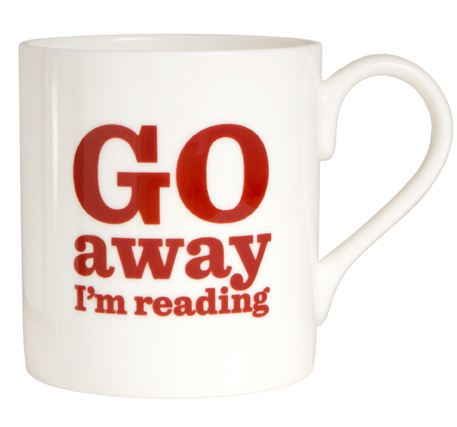
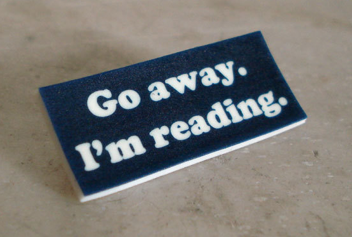
Perhaps you received a book this past holiday, or perhaps you had some time to catch up on book you have been waiting to read. You might need one of these signs:

Why might you need a “Go Away. I’m Reading” sign? Because reading is often interrupted by people. The sign could stop those interruptions by others that inevitably occur at a critical moment in a book or article. You would use the sign to ward off those who are blind to the obvious and ask, “What are you doing?” You might even use the sign to stymie those who intrude to ask, “What are you reading?” But you would most certainly wave the sign to stop those who interrupt to ask, “Is what you’re doing so important?”

Reading is a very quiet, sedentary activity, an activity that requires concentration. You cannot multi-task reading. An interruption in that concentration disrupts comprehension, and there are studies that look to measure the effects of interruptions on comprehension. There was the 2002 study from the University of North Carolina at Chapel Hill titled, “The Effect of Interruption on Working Memory During Discourse Processing ” by Kerry Ledoux and Peter C. Gordon.

Ledoux and Gordon conducted separate experiments using the same narrative and expository passages, but they varied who read the narrative and who read the narrative and expository passages. They gathered evidence to prove that comprehension of similar (narrative) passages was more disrupted by interruption in the first experiment, and than with dissimilar (narrative/expository) passages  in the second experiment:

This supports the notion that the maintenance of text information in working memory is affected by interruption. Second, we found that the initial reading of the second passage in a pair is disrupted more if the first passage in the pair is of a similar type than if it is of a dissimilar type.

Their two experiments looked directly at the systems of language processing necessary for comprehension:

 Our results support the view of the role of working memory in language processing as a system whose function comprises the creation and maintenance of an elaborate, semantic representation of a text and the efficient retrieval of this representation from long-term memory.

They determined that interruptions had an adverse impact on the role of working memory, but could not determine the magnitude of these interruptions because of differences in texts.

Another more recent study concluded that visual clues are helpful to resume reading after an interruption. An abstract from the 2012 study by JE Cane, F Couchard, and UW Weger from the University of Kent, UK titled, “The Time-Course of Recovery from Interruption During Reading: Eye Movement Evidence for the Role of Interruption Lag and Spatial Memory” centered on the impotence of visual cues. Locating where one stopped reading is important to recovering comprehension:

Two experiments examined how interruptions impact reading and how interruption lags and the reader’s spatial memory affect the recovery from such interruptions. Participants read paragraphs of text and were interrupted unpredictably by a spoken news story while their eye movements were monitored. Time made available for consolidation prior to responding to the interruption did not aid reading resumption. However, providing readers with a visual cue that indicated the interruption location did aid task resumption substantially.

Predictably, cuing the place where the interruption took place is helpful to comprehension, but there is also considerably conversation about the amount of time it takes a reader to return to a full involvement with a text. Consider that research in the business communities has determined that many interruptions are costly and hurt business productivity. A 2005 NYTimes Magazine article by Clive Thompson titled Meet the Life Hackers  described a study by Gloria Mark, a professor at the University of California at Irvine. Mark looked at interruptions in the average 21st Century office worker. She developed a series of timed tasks that mimic work in the business day. Her research was organized so that,

 Each employee spent only 11 minutes on any given project before being interrupted and whisked off to do something else. What’s more, each 11-minute project was itself fragmented into even shorter three-minute tasks, like answering e-mail messages, reading a Web page or working on a spreadsheet. And each time a worker was distracted from a task, it would take, on average, 25 minutes to return to that task.

Although 25 minutes may not be the same amount of time required for the average reader to return to a text, Mark’s research does demonstrate the serious loss of time interruptions cause to work productivity. If one of these activities involved reading, then reading productivity was adversely effected.

One other interesting view on uninterrupted reading has been offered by the Telecommunications Information Networking Architecture Consortium (TINAC). In 1988, they published a “manifesto” on writing hypertext, those texts that feature embedded links for the reader. What is surprising is how they began the “manifesto” by focusing not on the writing of such texts starting from the reading of such texts.  Their first statement:

I) No interruptions.

Reading should be a seamless and uninterrupted experience. Its choices proceed from the expression of possibilities as a narrative medium and depend upon the complicity of the reader in the creation of a narrative. Reading is design enacted.

Reading is “design enacted”, meaning that even the distractions in hypertexts are meant to be done in a sitting without distractions, without interruption.

Ultimately, conveying the importance of uninterrupted reading may be necessary. But if the little sign, “Go Away. I’m Reading.” doesn’t work, you might want to try other strategies. A quick survey on the Internet reveals available like-minded products.

There are plans for free “Go Away. I’m Reading” Book Covers in several different styles. There are also “Go Away. I’m Reading” coffee mugs handy for uninterrupted newspaper reading in the morning.

However, the ultimate solution may still be the most simple: find a quiet spot in the house, and lock the door.