Archives For November 30, 1999

The release of the National Assessment of Educational Progress (NAEP) Progress Report for 2012  (“Nation’s Report Card”) provides an overview on the progress made by specific age groups in public and private schools in reading and in mathematics since the early 1970s. The gain in reading scores after spending billions of dollars, countless hours and effort was a measly 2% rise in scores for 17-year-olds. After 41 years of testing, the data on the graphs show a minimal 2% growth. After 41 years, Einstein’s statement, “Insanity is doing the same thing repeatedly and expecting different results,” is a confirmation that efforts in developing effective reading programs have left the education system insane.

The rather depressing news from NAEP in reading scores (detailed in a previous blog) could be offset, however, by information included in additional statistics in the report. These statistics measure the impact of “reading for fun” on student test scores. Not surprisingly, the students who read more independently, scored higher. NAEP states:

Results from previous NAEP reading assessments show students who read for fun more frequently had higher average scores. Results from the 2012 long-term trend assessment also reflect this pattern. At all three ages, students who reported reading for fun almost daily or once or twice a week scored higher than did students who reported reading for fun a few times a year or less

The irony is that reading for fun is not measured in levels or for specific standards as they are in the standardized tests. For example, the responses in standardized tests are measured accordingly:

High Level readers:

  • Extend the information in a short historical passage to provide comparisons (CR – ages 9 and 13)
  • Provide a text-based description of the key steps in a process (CR)
  • Make an inference to recognize a non-explicit cause in an expository passage (MC – age 13)
  • Provide a description that includes the key aspects of a passage topic (CR – ages 9 and 13)

Mid Range Readers:

  • Read a highly detailed schedule to locate specific information (MC – age 13)
  • Provide a description that reflects the main idea of a science passage (CR – ages 9 and 13)
  • Infer the meaning of a supporting idea in a biographical sketch (MC – ages 9 and 13)
  • Use understanding of a poem to recognize the best description of the poem’s speaker (MC)

Low Level Readers:

  • Summarize the main ideas in an expository passage to provide a description (CR – ages 9 and 13)
  • Support an opinion about a story using details (CR – ages 9 and 13)
  • Recognize an explicitly stated reason in a highly detailed description (MC)
  • Recognize a character’s feeling in a short narrative passage (MC – age 13)

(CR Constructed-response question /MC Multiple-choice question)

Independent reading, in contrast, is deliberately void of any assessment. Students may choose to participate in a discussion or keep a log on their own, but that is their choice.  The only measurement is a student’s willingness to volunteer the frequency of their reading, a form of anecdotal data.

According to the graph below (age 17 only), students who volunteered that they read less frequently were in the low to mid-level ranges in reading. Students who volunteered that they read everyday met the standards at the top of the reading scale.
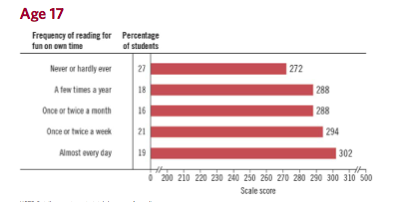
Graph showing that 17-year-olds who read for fun score higher on standardized tests

#1 Graph showing that 17-year-olds who read for fun score higher on standardized tests

Sadly, this NAEP data recorded a decline in reading for fun over the last 17 years-exactly the age of those students who have demonstrated only a 2% increase in reading ability. The high number of independent readers (“reading for fun”) was in 1994 at 30%.
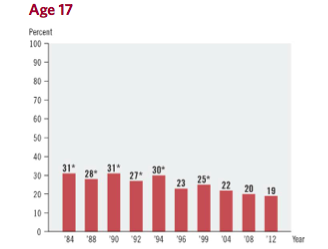
Steady decline  in the number of 17- year-old students who say that they  "read for fun."

#2 Steady decline in the number of 17- year-old students who say that they “read for fun.”

So what happened the following years, in 1995 and 1996, to cause the drop in students who read voluntarily? What has happened to facilitate the steady decline?

In 1995 there were many voices advocating independent reading: Richard Allington, Stephen Krashen, and Robert Marzano. The value of independent reading had been researched and was being recommended to all districts.

Profit for testing companies or publishing companies, however, is not the motive in independent reading programs.There are no “scripted” or packaged or leveled programs to offer when students choose to “read for fun”, and there is no test that can be developed in order to report a score on an independent read. The numerical correlation of reading independently and higher test scores (ex: read 150 pages=3 points) is not individually measurable; and districts, parents, and even students are conditioned to receiving a score. Could the increase of reading programs from educational publishers with leveled reading box sets or reading software, all implemented in the early 1990s, be a factor?

Or perhaps the controversy on whole language vs. phonics, a controversy that raged during the 1990s, was a factor? Whole language was increasingly controversial, and reading instructional strategies were being revised to either remove whole language entirely or blend instruction with the more traditional phonics approach.

The sad truth is that there was plenty of research by 1995 to support a focus on independent “reading for fun” in a balanced literacy program, for example:

Yet seventeen years later, as detailed in the NAEP report of 2012, the scores for 17-year-old students who read independently for fun dropped to the lowest level of 19%. (chart #2)

While the scores from standardized testing over 41 years according to the NAEP report show only 2% growth in reading, the no cost independent “reading for fun” factor has proven to have a benefit on improving reading scores. Chart #1 shows a difference of 30 points out of a standardized test score of 500 or a 6% difference in scores between students who do not read to those who read daily. Based on the data in NAEP’s report, reading programs have been costly and yielded abysmal results, but letting students choose to “read for fun” has been far less costly and reflects a gain in reading scores.

The solution to breaking this cycle is given by the authors of The Nation’s Report Card. Ironically, these authors are assessment experts, data collectors, who have INCLUDED a strategy that is largely anecdotal, a strategy that can only be measured by students volunteering information about how often they read.

The choice to include the solution of “reading for fun” is up to all stakeholders-districts, educators, parents, students. If “reading for fun” has yielded the positive outcomes, then this solution should take priority in all reading programs. If not, then we are as insane as Einstein said; in trying to raise reading scores through the continued use of reading programs that have proven to be unsuccessful, we are “doing the same thing repeatedly and expecting different results.”

sunThe paradox of summer reading:  Read=pleasure or Read=work.

All students should read at least one book this summer and practice the independent reading skills they have used the whole school year. They should receive credit for reading over the summer, but to give credit means an assessment. An assessment comes dangerously close to committing Readicide,(n): The systematic killing of the love of reading, often exacerbated by the inane, mind-numbing practices found in schools.

Anecdotally, 50% of students will read for fun. The other 50% will skim or Sparknote to complete an assignment, or they will not read at all for a variety of reasons: “it’s boring”, “too much work”, “I hate to read.”  Many students avoid books creating a “reading-free zone” from June through August. In addition, there are some parents who openly complain that assignments over the summer interfere with family vacation plans.

But there are many parents who understand the importance of reading. They could be frustrated all summer as they responsibly hound their children to do their summer assignments rather than wait until the last minute.

Summer reading is fun for some, but summer reading is a hassle for others. Why bother, indeed?

Well, research clearly demonstrates that summer reading is important in maintaining reading skills at every grade level. A meta-analysis (1996) of 39 separate studies about the effects of summer on student learning came to the conclusion that summer reading was critical to stopping the “summer slide”. Without summer reading, there could be a loss equaling about one month on each grade-level equivalent scale. Students would be playing a cognitive “catch-up” through November each school year.

In “The Effects of Summer Vacation on Achievement Test Scores: A Narrative and Meta-Analytic Review” by H. Cooper, B. Nye, K. Charlton, J. Lindsay and S. Greathouse, there were several key findings:

 At best, students showed little or no academic growth over the summer. At worst, students lost one to three months of learning.
 Summer learning loss was somewhat greater in math than reading.
 Summer learning loss was greatest in math computation and spelling.
 For disadvantaged students, reading scores were disproportionately affected and the achievement gap between rich and poor widened.

There have been studies since 1996 that confirm the findings of the meta-analysis, so, summer reading cannot be optional if students are to maintain their skills and progress as readers. The problem for teachers is how to engage the 50% who will not read over the summer. My English Department has tried the following:

  • One summer, we tried an assigned book route. We used a multiple choice quiz to measure student comprehension. The results were average to below average. Most students hated having to read an assigned book.
  • One summer, we tried the dialectical journal kept by a student on either an independent book choice or an assigned book (see post). The results were mixed with 25% students not completing the journal or completing the journal so poorly that we were chasing students for work past the due date and well into the end of the first quarter.
  • One summer, we tried the “project of your choice” in response to a “book of your choice”, but then we were buried in a pile of projects, with a wide variable in the quality of these projects.

So, this summer (2013) we are again trying something different in the hopes of finding a better measurement for summer reading. We are giving students their choice in reading fiction or non-fiction. The incoming 7th and 8th graders choose a book for the summer, and the school will provide that book. Students who will be entering grades 9 -11, may checkout a book from an extensive list organized by our school media specialist or any other book they choose.

Summer reading will be assessed with a writing assignment when all students return in September. The questions will align with standardized test essay questions (CAPT, SAT) and students may have the book in hand or notes from the book; students who read early in the summer will have the same advantages as students who read later in the summer, or the night before the writing prompt:

Essay question(s) for a work of FICTION read over the summer:
How does the main character change from the beginning of the story to the end? What do you think causes the change?
How did the plot develop and why?
How did the main character change? What words or actions showed this change?

Essay question(s) for a work of NON-FICTION read over the summer:
If this book was intended to teach the reader something, did it succeeded? Was something learned from reading this book, if so what? If not, why did the book fail as a teaching tool?Was there a specific passage that had left an impression, good or bad? Share the passage and its effect on the reader.

This assessment will be given the second week in September, and while there is a concern that writing is not as effective in measuring a student’s reading comprehension, at minimum this assessment will give the English Department members a chance to teach a writing prompt response.

Students who are in honors level or Advanced Placement courses will still have required reading. For example, incoming 9th grade honor students will read The Alchemist and The Book Thief while 12th grade Advanced Placement English Literature Students will be given the choice to read three of the following five titles: Bel Canto, The Story of Edgar Sawtelle, The Poisonwood Bible, Little Bee, or A Thousand Splendid Suns.

Before students leave for the summer, we plan on putting books into as many hands as possible. We will encourage students to organize themselves with book buddies, a suggestion from a post by Christopher Lehman, having them organize who they will be reading alongside, someone who they could talk with about their reading. The students have Shelfari accounts and can communicate online during the summer. We will promote our own reading book sites and include an audiobook site SYNC that pairs a young adult novel with a classic each week during the summer. For example, August 1 – 7, 2013 will feature Death Cloud by Andrew Lane, read by Dan Weyman (Macmillan Audio) with The Adventures of Sherlock Holmes by Arthur Conan Doyle, read by Ralph Cosham (Blackstone Audio). We will post information about summer reading on our websites, and send out Remind 101 notices.

While the research clearly demonstrates that summer reading is important, how students accomplish summer reading assignments during vacation time is a paradox. Should we assess reading for pleasure, or should students be left on their own and possibly lose reading skills?  Quiz them in September or lose them to the summer slide? No right answer, but good evidence to continue the tradition of summer reading.

Smartblogs recently ran a post by Bill Ferriter titled “Reading Nonfiction is not Optional ” where he argued that there is too much fiction in a student’s reading diet. “The sad truth,” he wrote, “is that fiction still dominates the literacy lives of young readers. Whether they are wrapped up in fantastic exploits written by guys like Rick Riordan or churning through the latest release in the hottest new vampire series, today’s kids rarely make room for nonfiction in their book bags.”

Sad truth? Why is this a “sad truth”? What is wrong with reading fiction? Fiction, like its counterpart non-fiction, offers our student readers valuable life lessons. For example, in an online article in guardian.co.uk September 7, 2011 Reading Fiction ‘Improves Empathy’, Study Finds, Professor Keith Oatly at the University of Toronto who studies the psychology of fiction reports that:

“I think the reason fiction but not non-fiction has the effect of improving empathy is because fiction is primarily about selves interacting with other selves in the social world. The subject matter of fiction is constantly about why she did this, or if that’s the case what should he do now, and so on. With fiction we enter into a world in which this way of thinking predominates. …. In fiction, also, we are able to understand characters’ actions from their interior point of view, by entering into their situations and minds, rather than the more exterior view of them that we usually have.”

Annie Murphy Paul noted the same study in her article in The New York TimesYour Brain on Fiction (3/17/12) writing that, “Brain scans are revealing what happens in our heads when we read a detailed description, an evocative metaphor or an emotional exchange between characters. Stories, this research is showing, stimulate the brain and even change how we act in life.” Apparently, our brains cannot differentiate between the fictional experience and the real life experience, “in each case, the same neurological regions are stimulated.” Furthermore, the simulation of social experience in fiction through a character’s point of view  helps prepare our brains for real-life social interactions.

In other words, while the genre of non-fiction may be the recording of real life, the genre of fiction is critical in preparing readers for real life.

In his post, Ferriter also quoted young adult (YA) writer Walter Dean Myers:

“We all know we should eat right and we should exercise, but reading is treated as if it’s this wonderful adjunct…We’re still thinking in terms of enticing kids to read with a sports book or a book about war. We’re suggesting that they’re missing something if they don’t read but, actually, we’re condemning kids to a lesser life. If you had a sick patient, you would not try to entice them to take their medicine. You would tell them, ‘Take this or you’re going to die.’ We need to tell kids flat out: reading is not optional.”

Ferriter’s paraphrase of Myers’s statement, the title of his post, “Reading Nonfiction is not Optional,” strikes the wrong tone. Myers, a writer of both YA fiction and non-fiction, did not specify as to the genre he endorsed for student reading. Myers was advocating reading, period. Both fiction and non-fiction are critical to our students’ growth and development, not one genre at the expense of another.

Independent reading means a student can choose to read non-fiction OR fiction

Yes, the English Language Arts Common Core State Standards (ELA CCSS) call for an increase in non-fiction. The authors of the ELA CCSS created a little chart on page 5 of the ELA CCSS that notes that students should be reading 70% non-fiction and 30% fiction by grade 12. But this is not the ratio for reading in an English Language Arts classroom. That is the ratio for a whole school curriculum.

I am particularly sensitive to the increasing number of attacks on fiction and the need to reducing fiction from the English classroom. Ferriter’s post makes a similar argument and could be associated with the myth that “English teachers will be asked to teach non-fiction”. This myth is directly repudiated in the ELA CCSS document:

“Fact: With the Common Core ELA Standards, English teachers will still teach their students literature as well as literary non‐fiction. However, because college and career readiness overwhelmingly focuses on complex texts outside of literature, these standards also ensure students are being prepared to read, write, and research across the curriculum, including in history and science. These goals can be achieved by ensuring that teachers in other disciplines are also focusing on reading and writing to build knowledge within their subject areas.”

In other words, reading must be offered in every discipline, students must read across the curriculum.While Ferriter’s Reading Nonfiction is Not Optional makes the important point that all teachers are responsible for modeling reading, he oversteps when he says, “If you want students to love nonfiction — and you should considering the important role that nonfiction plays in learning — you really do need to stop spending all of your sustained silent reading time figuring out what’s going to happen next to Origami Yoda.” Good SSR programs allow for independent choice in any genre by students. What Ferriter could have suggested that the expansion of SSR to other disciplines would increase reading of non-fiction while having the additional benefit of satisfying the ELA CCSS.

Of course, I often hear arguments from teachers in other disciplines moaning, “What do I drop out of my course to include reading?” which could be interpreted as the reason why the authors of the ELA CCSS felt the need to develop reading and writing standards for History, Social Studies, Science and the Technical Areas. These disciplines need to step up the reading in their classrooms.

But who said reading non-fiction was an option? I can assure Ferriter that English/Language Arts teachers are dedicated to improving student reading. They are not hung up on genre, but when they teach fiction, English/Language Arts teachers are teaching their subject matter. The adoption of the ELA CCSS means that all disciplines must offer for opportunities to share their subject matter. To re-frame Ferriter’s argument to align with the new standards, reading non-fiction in every classroom is not an option, and reading non-fiction in an English/Language Arts classroom can be a choice. After all, that growing body of research shows that fiction is just as important as non-fiction for our students, including what happens in Origami Yoda.

The Friends of the Westport Public Library book sale never disappoints a reader. In fact, many of the books that I have purchased at this sale in previous summers (2009-2011) now stock our classroom libraries for grades 7-12. Our Grade 10 World Literature class now has entire class sets of The Life of Pi and The Curious Incident of the Dog in the Night-time. The same can be said for the Grade 12 Memoir Class with The Glass Castle. This means that I have had to become more selective and pluck out only the titles that we need to replace or increase. Now, when I see the covers of these texts, I have to stop my hand from its automatic reach; our shelves are already full! So, if there are schools looking to add these titles, I left many great titles on the tables.

This Westport Public Library book sale is massive and almost professionally run; the volunteers could consider running training classes for other library book sales. There are legions of volunteers who straighten tables of books or count purchases. Be aware, however, there are also legions of shoppers; parking is at a premium.

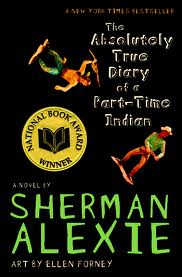
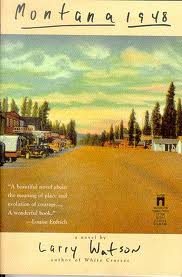
This year, I found copies of books for the Grade 11 Native American Unit: Larry Watson’s Montana 1948, Sherman Alexie’s The Absolutely True Diary of a Part Time Indian.  I suspect these books are also taught in the Westport school system because of the number of copies. Montana 1948 is “about a middle-class Montana family torn apart by scandal during the summer of 1948” and was awarded the Milkweed National Fiction Prize. The Absolutely True Diary of a Part Time Indian was reviewed by School Library Journal as a semi-autobiographical chronicle of Arnold Spirit, aka Junior, a Spokane Indian “whose determination to both improve himself and overcome poverty, despite the handicaps of birth, circumstances, and race, delivers a positive message in a low-key manner.” Both receive high marks from our students.

There were also two copies of A World Lit Only by Fire: The Medieval Mind and the Renaissance: Portrait of an Age by William Manchester which is a new text for our AP European World History course.

The large tents for the Westport book sale provide enough room for patrons and the tables full books. Maps are distributed at the entrance; a mountain of empty boxes is available for shoppers to fill.  Hard to tell if the organizing committee has chosen not to alphabetize because of the number of books titles or because they want to encourage more browsing, I am not sure. I know I visited every table! There were far more book vendors there this year who load up large bags using professional scanners. This sale makes it easy for them to return books they do not want by genre; there are clearly labeled containers; if you cannot find a title, check these containers!

Books are priced at $.50-$3.00 on Saturday, the first day of the sale; there are discount days through Tuesday, June 24.

Saturday & Sunday 9 am to 6 pm
Monday (everything 1/2 price) 9 am to 6 pm
Tuesday (free day: suggested cash donation $5/bag) 9 am to 1 pm

Signs marking each genre were placed on the tables, but the maps were more reliable. I used the map to locate the young adult section which were filled with great choices for independent reading. As a bonus, the children’s section has its own separate tent. Picture books are raised on shelves, smaller chapter books are laid spines up for easier browsing.

I spent $80.50 in total for four bags of carefully selected books.

As I left, the local newspaper photographer was taking candid shots of students in the Children’s section. One young girl, about 11 years old,  had her arms so full of book, the photographer could not see her face.

“Where are you?” she joked with the girl.
“I’m lost in these books,” the girl giggled in response.

I left smiling.

With one broad sweep of a word-processing program, NY Times Columnist David Brooks brushed off the Newbery Award collection of the best children’s novels as containing some “exquisitely sensitive novellas” in his essay Honor Code (July 5, 2012). He should reconsider this judgment on several counts.

The premise of his editorial was to bring attention to recent statistics that suggest young boys are falling behind in the American education system. First, he compared the contemporary American schoolboy to the rambunctious Prince Hal of William Shakespeare’s history plays, Henry IV parts I and II and Henry V. This comparison proved an apt metaphor, although Brookes failed to call attention to the irony of his allusion; Prince Hal and the American schoolboy are both out of place in their respective educational institutions. Unfortunately, he over- stepped his position when he mischaracterized the  prestigious Newbery Award given to excellence in children’s literature by stating: “If schools want to educate a fiercely rambunctious girl, they can’t pretend they will successfully tame her by assigning some of those exquisitely sensitive Newbery award-winning novellas.”

Simply because a book is  written for young audiences (elementary through middle school) and is shorter in length than an adult novel does not mean the book is a novella; the Newbery Award books are novels. However, on several occasions the Newbery has been awarded to books of poetry (1989 Medal Winner: Joyful Noise: Poems for Two Voices by Paul Fleischman) or short stories, songs and poems (2008 Medal Winner: Good Masters! Sweet Ladies! Voices from a Medieval Village by Laura Amy Schlitz).

As to the charge that some of the Newbrry novels are “exquisitely sensitive,” well, yes, some are. I am “exquisitely sensitive” myself when I remember my reading the 1963 Medal Winner: A Wrinkle in Time by Madeleine L’Engle. However, while I can only comfortably include those titles that I have read or recommended to my students, there are fewer “sensitive” novels than one might suspect, in fact, some of the Newbery Award novels are brash, outrageous, or disturbingly violent. More than a few of them have been banned.

Consider that Mr. Brookes began reading Newbery books in 1969; he would be eight or nine years old.  The “exquisitely sensitive” 1967 Medal Winner: Up a Road Slowly by Irene Hunt would be available to him as would 1947 Medal Winner: Miss Hickory by Carolyn Sherwin Bailey However, during a 10 year school reading career, ages 8-18, he could have also encountered:

  • 1969 Medal Winner: The High King by Lloyd Alexander
  • 1970 Medal Winner: Sounder by William H. Armstrong
  • 1972 Medal Winner: Mrs. Frisby and the Rats of NIMH by Robert C. O’Brien
  • 1974 Medal Winner: The Slave Dancer by Paula Fox
  • 1976 Medal Winner: The Grey King by Susan Cooper
  • 1977 Medal Winner: Roll of Thunder, Hear My Cry by Mildred D. Taylor
  • 1979 Medal Winner: The Westing Game by Ellen Raskin

These are seven books that do not qualify as “exquisitely sensitive” books “to tame” rambunctious students. If Brooks had continued to read the canon of Newbery award winning novels as an adult, he would have encountered the following “definitely NOT exquisitely sensitive” books as well:

  • 1987 Medal Winner: The Whipping Boy by Sid Fleischman
  • 1991 Medal Winner: Maniac Magee by Jerry Spinelli
  • 1990 Medal Winner: Number the Stars by Lois Lowry
  • 1994 Medal Winner:  The Giver by Lois Lowry
  • 1999 Medal Winner:  Holes by Louis Sachar
  • 2000 Medal Winner: Bud, Not Buddy by Christopher Paul Curtis
  • 2003 Medal Winner:  Crispin: The Cross of Lead by Avi
  • 2009 Medal Winner: The Graveyard Book by Neil Gaiman

I would also like to give a shout out to the one book that was read by every “rambunctious” boy I ever taught, the  1988 Newbery Honor book Hatchet by Gary Paulsen. For many boys, this is the ONLY book they remember.

Newbery authors do not write in order “to tame” rambunctious youth, boys or girls, and I would suspect that several would take great offense to that statement.  Authors for children and adults alike write to tell an extraordinary story, to share an experience, or to give voice to a character or person from the “margin”, an outsider who has a voice through the written word.

Many authors are not “tame” themselves, in fact, this year’s Newbery Award winning writer was Jack Gantos for Dead End in Norvelt. Gantos has a fascinating back story. He  was convicted as a young man of smuggling drugs and spent time in a federal prison. His behavior, in fact , was very much like the  behavior of Prince Hal of Shakespeare’s plays. However,Gantos was a reader and found great literature to guide him during times of trouble. While in prison, he was without a notebook and wrote in the margins of The Brothers Karamazov, intertwining his words with Dostoevsky . His memoir of his felonious behavior  is called A Hole in My Life, and we teach the text as a required read in our Grade 12 Memoir class.

The Newbery Award winners reflect the rich diversity of literature that is available to students, rambunctious or not. These novels are not assigned “to tame” , but they are assigned, or recommended, to comfort a reader, to entertain a reader, to challenge a reader’s beliefs, or to incite a reader to action. They may be short, but they are not novellas, and no teacher “pretends” they are the solution to educating a fiercely rambunctious student.  Most teachers know that these Newbery Award novels, and their Newbery Award honorees companions, may be the  only solution for educating that fiercely rambunctious student.

A bit of self-indulgence here. I have been blogging for a year on July 3, which means that the Used Books in Class blog is a one year old “toddler.”

I started this blog for two reasons. The first was a response to Kelly Gallagher’s Readicide, a book I have mentioned numerous times in posts on this blog. I was determined to increase reading in the classroom per his suggestion through “book floods,” and I began purchasing used books for the classroom libraries at Wamogo High School (Region 6 in CT). Fortunately for me, in the Fairfield and Litchfield counties in Connecticut there are numerous sources for excellent quality used books available for $1.00 (or less) through public library book sales held generally in the summer and Goodwill or other thrift stores.  I wanted to share how I had added entire class sets of books ( for example: The Curious Incident of the Dog in the Night-Time, The Kite Runner, The Bluest Eye, A Walk in the Woods) or increased books in classroom libraries for independent choice reading in grades 7-12.

The second reason was that this past year I required students to write using blogs. At each grade level (9-12), the Wamogo English Department teachers used blogs in the classroom in order to increase student reading and writing collaboration. Our Lord of the Flies unit included “survival activities” on team blogs for 10 graders. The freshmen classes used a blog in different ways: to record individual book reports and to respond to questions associated with whole class reads.. The journalism class’s newspaper format is a blog, and we have also had students blog responses to Hamlet or record their progress on Capstone projects. If I was requiring that students blog, I needed to know how to blog as well.

I researched the use of blogs in the classroom. According to Trey Martindale and David A Wiley,  in their paper Using Weblogs in Scholarship and Teaching, “Clearly two keys to effective blogging are knowing who one’s audience is, and knowing that that audience is in fact reading one’s blog. My students were motivated and willing to write regularly and with clarity, knowing that fellow students and the instructor were reading the blogs.”  I recognized that most student writing is read by the teacher, so our students needed to understand how to target an larger audience. I emphasized this question for my students by having them identify the audiences of other blogs, and then consider the question  “Who am I writing this blog for?” and “Who will be able to read this post?”.  Similarly, I had to apply the same consideration for this blog.

I also researched whether blogging was an effective strategy to increasing reading and writing in the classroom. Would student blogging rather that standard writing (papers, essays) improve comprehension skills? In one study by N.B. Ellison and Yuehua Wu, “Analysis revealed no significant differences in comprehension between blog and paper assignments, although students reported spending less time writing in the blogging condition.” However, in another study by R. MacBride and Lynn Luehmann using blogging in science and math classrooms, “Findings indicate that (1) teachers’ intentions focused on creating additional forms of participation as well as increasing student exposure time with content; (2) blogs were used in a wide variety of ways that likely afforded particular benefits; and (3) both teacher and students perceived the greater investment to be worthwhile. ”

I found the same to be true for this blog, Used Books in Class. My first post (7/3/11)  received 8 hits! I was surprised anyone would be interested in this blog about used books, but those first hits motivated me. Now, after a year, the focus of the blog has shifted from “used books” in class to posts discussing “how books are used” in class. I have drifted into other areas of education, namely the English Language Arts Common Core State Standards, but these issues directly or indirectly impact teaching in the classroom.  26,518 hits later, I still am still surprised at the interest this blog has received. Honestly,  it’s not like readers could use yet one more education blog; there is some serious competition for attention!

Yet there is one more reason that I discovered for blogging as I wrote over the course of a year. I found other blogs to be informative on issues in education, and their comment sections were one way to enter into online discussions. I had followed Shelly Blake-Plock who authored Teach Paperless from 2009-May 2012. In his post, Why Teachers Should Blog, he offered one line that stood out:

Because to blog is to teach yourself what you think.

I had no idea how true that statement would be for me this year. Blogging has allowed me to frame an evolving philosophy of education, and I had to think about my own teaching practice every time I sat down to write. Blogging has provided the platform for me to articulate my responses to issues in education, and I had to think about how public my response would be every time I sat down to write. Blogging has let me practice my writing voice, and I had to think about how this voice needed to attract the reader and keep the reader reading every time I sat down to write. In summation, blogging has taught me over the course of this year how to think in order to write about education.

Thank you for reading posts on this blog. I am heading into year two with this “toddler”. When I started, I wondered if I would have enough topics to write about. I do not worry about that any more because this blog has taught me how to write what I think, and I  am thinking all the time. I think, therefore I blog.

Shhhhh….We’ve been very, very quiet in grade 9 this year with our Silent Sustained Reading (SSR) academic experiment in the college prep 9th grade class. 77 students were asked to read a minimum of eight (8)  independent reading books of their choice as part of the curriculum, and to facilitate reading, students were provided 20 minutes twice a week (40 mins total/week) of SSR.  Responses to the independent books were recorded later on blogs or presented in class.

The inclusion of independent student choice texts with the time made available for SSR meant a reduction in the number of whole class reads; four texts remained in the curriculum: Romeo and Juliet, Of Mice and Men, Speak, and selections from The Odyssey. Classroom libraries were augmented with high interest texts (used books in class) with support from the school library and Overdrive software to allow for a wide selection by students.

So, what were the results? At the beginning of the school year, students took a survey based on questions suggested in Kelly Gallagher’s Readicide. This week, (June 2012) the same students retook the same survey. In order to account for percentage differences in attendance and enrollments, results were also checked using a t-test calculator to determine statistical significance. While there was only little change in students viewing reading as “fun” or “easy,” 57% to 59% or a 2% increase in the affirmative, the other data gathered from the survey indicates a positive shift in the attitude of our students towards themselves as better readers coupled with an increase in time spent reading  outside of class.

According to our September survey, 39% of our students rated themselves as “good” readers, 42% rated themselves as “average” readers, and 21% rated themselves as “poor” readers. The difference in June was very statistically significant (t-test) with 66% of students rating themselves as good readers; 30% of students rating themselves as average readers, and only 8% of students rating themselves as poor readers.

Responding to the prompt “I read independently every day and look forward to my reading time” in September;  9% of students responded “usually”, 35 % of students responded “sometimes”, and 56% of students responded “rarely”. However, by June, the difference in student attitudes her was also very statistically significant (t-test) with 19% of students responding “usually” (up 10%),  53% of students responding “sometimes” (up 21%), and 33% responding “rarely” (down 23%).

Finally, not only did the SSR program did increase the number of books read  by students for class, students indicated (very statistically significant) that they increased the number of additional independent books they read over the course of the year. Students reading no addditional books dropped from 32% to 11% while students reading 1-2 books increased from 52% to 58%, students reading  3-4 books increased from 13% to 22%, and students reading over 4 books increased from 3% to 8%.  These numbers complemented the finding of students who increased their overall “not for school reading/reading for pleasure” for 60 minutes or more (5%), for 30-60 minutes (17%) , and for 30 minutes or less (17%). The number of students who admitted to doing no additional reading dropped from 22% to 15%.

So what are the implications of this data? There are numerous studies that support independent reading for academic achievement. Students who read independently may also have an advantage as adults in the workplace. Author Stephen D. Krashen writes in The Power of Reading:

What the research tells me [about SSR] is that when children or less literate adults start reading for pleasure… good things will happen. Their reading comprehension will improve, and they will find difficult, academic-style texts easier to read. Their writing style will improve, and they will be better able to write prose in a style that is acceptable to schools, business, and the scientific community. Their vocabulary will improve, and their spelling and control of grammar will improve.

Additionally, high school is not too late to start an SSR program. Author  Steven Gardiner defended the practice when he  responded to questions about his book Building Student Literacy Through Sustained Silent Reading and discussed the use of SSR at the high school level:

On more than one occasion, I’ve started class by simply reading aloud. I didn’t explain what I was doing or why, I just started reading. They may be 15 or 17 years old, but they quickly get quiet and listen, trying to understand what is going to happen next, just like youngsters in story hour. They aren’t too old for reading aloud, and they aren’t too old for SSR. Most students are grateful for the time. When I look at changes in modern society, I understand why.

So do I. Our students occupy a digitally distracting universe: tweeting, texting, tethered to some instant communication that generates a almost compulsive nervous response. Carving out time, 10-20 minutes a class, for quiet SSR is necessary for students who need to focus when they read. Sadly, this may be the only time during a day when students read.

The significance of our efforts to increase our students’ independent and voluntary reading is addressed in the 2007 NEA report To Read or Not To Read: A Question of National Consequence:

Voluntary reading involves personal choice, reading widely from a variety of sources, and choosing what one reads. Aliterates, people who have the ability toread but choose not to, miss just as much as those who cannot read at all. Individuals read to live life to its fullest, to earn a living, to understand what is going on in the world, and to benefit from the accumulated knowledge of civilization. Even the benefits of democracy, and the capacity to govern ourselves successfully, depend on reading.

Our practice of  good reading habits,  SSR provided twice weekly with student selected texts, can lead to improved attitudes towards reading, and we now have the data to prove that one academic year of SSR has improved our 9th grade student attitudes towards reading. SSR will be included as an important part of our literacy efforts at other grade levels as well.

Every generation of readers has one. That book. The book with racy passages. The book with the “reputation”. The naughty book.

The proliferation of  Fifty Shades of Grey-that book- means that is entirely possible that at least one of my high school students will bring in copy as an  independent choice reading text. Of course I will require the student choose something more age- appropriate if this particular book is being read for class credit, but there are many books that teeter on acceptable boundaries.  I have had middle school students bring in copies of Twilight, Eclipse, Breaking Dawn; a series built on heart-pounding sexual teasing for three prolonged book lengths. I have seen a 10th grade student engrossed in reading Girl with the Dragon Tattoo, and although I was aware of the steamy material, I saw no such reaction from the student who was being deeply exposed to Swedish misogyny. Popular culture books, particularly steamy popular culture books, are passing fads in literature.

Naughty book popularity rises and falls with readers. Every year there is some student who could be sneaking  “for mature audience” materials. When I was growing up, the paperback copies of The Godfather opened automatically, like Lucy for Sonny, on page 18. Yes, Mario Puzo’s bestseller was full of quivering and pulsing, when it wasn’t violently establishing the dominance of the Corleone family.  Coffee, Tea or Me? , which detailed the escapades of stewardesses during the sexual revolutionwas the other “naughty” text that I remember the adults keeping out of my reach. No matter. I “borrowed” my aunt’s copy during Thanksgiving dinner and read furiously in an upstairs hallway. Hiding from the relatives celebrating the holiday, I wasn’t missed, probably because I had been seated at the “kid’s table” with at least a dozen cousins.

I also know other adults have had brief flings with inappropriate literature in their youth. I know this also, because Pamela Munoz Ryan, author of the award winning  children’s book  Esperanza Rising, discussed her naughty book adventure at a keynote address at the 82nd Saturday Reunion at Columbia Teacher’s College in March 2012. Opening her remarks, Ryan claimed, “to read because it’s safe and to write because it’s dangerous.” She explained how her love of stories made her choose to write, and then she shared her own “naughty book” story.

When Ryan was young, she discovered racy romance novels in the home library shelves of a Coca-Cola addicted neighbor. Ryan would return those empty soda bottles for candy money, while at the same time, she would “borrow” a copy of a torrid romance novel. She recalled one specific incident, however, involving The Valley of the Dolls, a steamy best-selling fictional account of the rich and famous. She snuck the book out of her neighbor’s house in the back waistband of her pants. At the time, she explained, the only “safe” place for reading was the town public library, and Ryan was soon holed up in a little used aisle of books pouring through the Valley of the Dolls. There, she was approached by the town librarian.

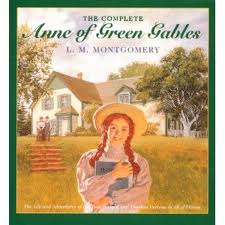
“I could not help notice how engrossed you are in reading,” said the librarian while Ryan desperately tried to hide the title of the book, “and I wondered if  you ever read this book?” In her hand the librarian held a copy of Anne of Green Gables.

Ryan said she had not read the book and feeling obliged, checked it out.

“I rode home on my bike that day,” says Ryan, “with a copy of Valley of the Dolls tucked in my waistband, and a copy of Anne of Green Gables  in my bicycle basket.” She paused for a moment with the recollection, “You know,” she stated to a congregation of teachers, “I have read the Valley of the Dolls only once, but I have read, reread, and revisited Anne of Green Gables many times.”

Teachers too know that a student will at some point in his or her life be exposed to reading materials that may be too mature, or too salacious, for his or her age. We can counter these sensational texts because we know what books will last, what books will transcend the effects of time, and what memorable characters will help our students as they mature and grow into adults. Students should read because, as Ryan stated, “it is safe”, and we need to encourage their reading as much as possible. We should be ready to help them make good choices, such as the classics Little Women or  A Tree Grows in Brooklyn. We should be ready to recommend a contemporary Esperanza Rising, The Book Thief  or Dairy Queen. We must allow students a choice in their reading but look for the opportunity to suggest a more appropriate title, because we know that the Fifty Shades of Grey tucked in the backpack ,or in their waistband, is a passing fad. Great literature endures, and fortunately, Anne of Green Gables will be there for the reader.

Current efforts to improve our students’ love of reading is allowing them the opportunity to choose what they want to read.  Since the amount of time available to teachers in a school year is finite, the inclusion of independent choice reading materials in a curriculum means that some things, usually whole class novels, have to go. In the case of our 9th grade students, the curriculum has been reduced to  three whole class reads: Romeo and Juliet, Speak, and Of Mice and Men. The remainder of the year is devoted to student choice, fiction and non-fiction. In other words, I am running a blended reading curriculum of student choice with whole class novels. I am convinced my students need this balanced approached to literacy.

Balancing between whole class novels and independent reading

Those who advocate student choice in the classroom make some excellent points. Last fall (2011), Kelly Gallagher (Readicide) in an audio interview with Mike McQueen on the Reading on the Run website said,

” I want to know does my child’s school have expectation that my child will read recreationally? Do they support that by giving kids time to read? Do they support that by giving kids interesting books to read not just academic books to read? Those are kind of questions that I would ask in looking at my child’s school.”

Gallagher’s most recent tweets on his KellyGtogo@Twitter demonstrate his continued campaign against language arts curriculum that are limited to whole class readings:

  • gr. 4-12: half the books our students read should be recreational in nature. We don’t want to raise test takers; we want to raise readers. 
  • more books = more reading = better reading. nothing happens without books.
  • Dear Common Core, where are recreational reading expectations? 

Yet, Gallagher still recognizes the importance of the whole class novel stating, “I am a proponent of academic reading, I do believe that kids should read you know, rich academic text. You know, I want my 9th graders to read Romeo and Juliet or my 12th graders to read Hamlet.”

There are, however, some educators who have eliminated whole class reading in an attempt to either engage students with choice only or as a differentiated approach to addressing reading levels in a class. In an article in Education Week  (7/2011) titled, Against the Whole Class Novel, Pam Allyn takes the position that whole class novels do not encourage reading and instead lead to alienation and isolation. She writes, “We have now reached a point at which teaching with neither the whole-class novel nor the basal reader, in which the whole class reads a selection together, is viable. We must end these practices. They are not benefiting our students.” She illustrates her position with the story of Sam who struggled with To Kill a Mockingbird saying, “…no way was this book a refuge for him, or an inspiration. It did not help him learn to read, nor did it help him to become a lifelong lover of text.”

Instead, Allyn suggests,

“If a student has found 16 blogs about boats, let him read those in school. And maybe that student will follow one of those blogs to a newspaper series about a regatta, or to Dove, Robin Lee Graham’s personal account of sailing around the world as a teenager. In these ways, our students will be exposed to a wider variety of genres than the whole-class novel ever allowed, and they will be more compelled to think critically across genres, as the common-core standards will require of them.”

While I agree with Allyn that not every book will make a student a lifelong reader, I believe she is clouding the issue of whole class reading with bad teaching of a whole class novel.Yes, it is true that some books are very difficult for reluctant or low level readers, so it is surprising that she suggests a student may choose Graham’s Dove  (RL 6.6) given her earlier reference the isolation a low level reader may have with to To Kill a Mockingbird (RL 5.6)  Regardless, a low level reader will struggle with a high level text unless there is some instruction or support. And while I agree that her suggestion of more inclusive reading materials (blogs, magazines, non-fiction) is important,  I also believe the communal experience that occurs in the reading of a whole class novel is equally important.

I am not suggesting the unit that beats a novel to death for week upon week, or what I refer to as the “it takes as long to read The Hobbit as it did Bilbo to get to his confrontation with the dragon, Smaug”. I am promoting the whole class novel experience where students work collaboratively to decode a text, share opinions, make comparisons, or criticize plot points. I promote the whole class novel with support for the low level readers and supplemental activities for the less engaged students. Reading levels should not limit student accessibility to a text when there is support available, for example, an audiobook. Please note: I did not say vocabulary and worksheets are supplemental activities.

Ideally, I advocate the whole class novel to capitalize on contexts or issues in other subject areas. Students can read All Quiet on the Western Front while they are studying World War I in Modern World History classes. Students can read Silent Spring as a companion piece to an enviormental studies course. Students can share the stories in Warriors Don’t Cry or Mississippi 1951 when they are studying a Civil Right’s unit. Whenever possible, I advocate a interdisciplinary read as a whole class novel.

I see great benefit in asking students to recall the themes, characters, settings or plot points with something they read earlier in their lives, particularly with the more complex texts at the middle or high school level. I will ask about the dystopia of The Giver when we read Brave New World, or the societies represented by animals in Charlotte’s Web when we read Animal Farm. A shared understanding of a previous reading experience with others provides immeasurable insights into a new reading experience.

Another argument for whole class reading comes from educator, Mrs_Laf in her blog post Confessions of an English Teacher who recently admitted that while, “I am the first person to champion individual and small group reading and used to be the first to decry the whole-class novel…I’m teaching a whole-class novel.”

She explains that her immersion into choice only reading resulted in many students selecting reading that did not challenge them. Students chose “fun books”, which she compared to beach reads noting that her students were not reading as closely as she wanted. In other words, “not all reading is the same.”  She decided that many students still needed to be taught to read a novel, just the same as students are taught to read a poem or short story. Her solution? Well, first she picks high interest books (The Hunger Games) which students purchase for annotation. Students make notes in the margin, put question marks next to the text they find confusing. In using this approach, “The trick is to get them to be patient with it.  This is a different kind of reading and we are reading for a different purpose.” Her point is a good one. Many students may need to be taught to read a more challenging text if all they read is what interests them.

I see reading as a community for my students as both academic and social.  I need to prepare students for the rigors of college and the real world since there is an expectation of cultural literacy  in our society. Students will encounter references to texts that compare relationships to the doomed Romeo and Juliet or the awkward Holden Caufield or the fair-minded  Atticus Finch or the the skin-flint Ebenezer Scrooge; they should understand those references. Teaching complex texts that students would not select independently ensures they can be included in conversations that extend beyond the classroom.

Teaching a whole class novel can be successful if, like any subject matter, students can be engaged. Language arts teachers need to seek a balance in in allowing for student choice while still teaching students how to read a challenging text. Every wave of innovation in teaching such as the recent calls for independent choice has an opposite one, such as traditional whole class novel instruction. Maintaining balance with these waves is what makes education successful. Balance means emotional stability; calmness of mind; harmony in the parts of a whole. Providing for independent choice plus whole class reading equals a balanced student.

“Chance favors the prepared” in the used book market.

Saturday is my day for running errands which takes me to Brookfield or New Milford, two Northwest Connecticut communities. Each of these towns has a their own Goodwill store located on Route 7, and I make regular stops to their bookshelves of donated books looking to see what has been most recently donated.

This past Saturday morning, I did just that. In fact, I stopped at both stores and purchased a total of 47 books for $41.43. WhenI came home, I noticed that WebEnglish Teacher had posted a link to a website listing the 100 Essential Reads for the Lifelong Learner  organized by Online Schools. These books were organized by discipline: fiction, non-fiction, autobiography/memoir, biography, world literature literary theory, history, political science,science/math/social science. Her question was “How many of these essential books have you read?” I was happy to see some familiar titles on the list, but many were new to me.

I could not help but notice that I had just purchased five of the suggested titles on this list for different classroom libraries that very day! There were other titles on the list available on thrift store shelves that I did not get since our libraries either already had enough copies or the titles are available online in the public domain.  The Online Classroom Essential Reads List is organized so that each title had a designated number, not a rank, and link provided for each book with a short explanation. Some of the links are helpful.

Here is a list of the 5 PURCHASED ESSENTIAL READS and the grade or class that uses them:

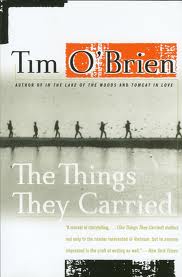
35. The Things They Carried by Tim O’Brien. This fictional account of a platoon in Vietnam is based on Tim O’Brien’s experience in the war himself and explores the fear and courage that are necessary to bring one through to the other side.

-This is a text that is used in our Grade 11-American Literature classes. The book is one of the few texts that students will willingly complete; once they finished the first story, they are hooked which is a tribute to O’Brien’s writing style. The prose is artistic but not difficult for even our lowest readers. Our students are curious about Vietnam, a part of history that is chronologically left for those lazy days of June. We use film clips (Platoon, Apocolypse Now, The Deer Hunter) in our unit with this text. We also eat MREs in class, and organize lists as to what each of use “carries.”

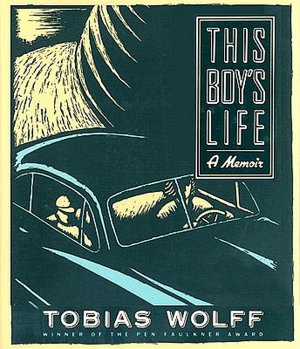
43. This Boy’s Life by Tobias Wolff. Wolff recounts his life as a boy and teen struggling with his identity as he lives with his divorced mother and her second husband in the 1950’s.

-This text will go into the English IV elective Memoir. There is a possibility that a 9th grader will choose this as an independent reading book in the non-fiction unit. The narration captures teen angst very well, and could work as a non-fiction companion piece to Catcher in the Rye in Grade 11. If Common Core wants classrooms to integrate more non-fiction, this is an excellent piece to add.

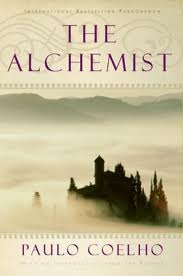
61. The Alchemist by Paulo Coelho. Discover how to find the beauty in life no matter what your experience as you follow the life of a young shepherd who gains so much from his journey of life.

-This book is assigned as summer reading for incoming English II honor students. We require a dialectic journal with 30 quotes from the texts as the summer reading assignment. Despite the burden of writing, students really enjoy this book which allows us to segue from “the journey” archetype taught in Grade 9 to the different types of perspectives in Grade 10 World Literature.

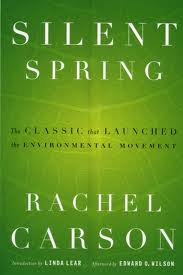
94. Silent Spring by Rachel Carson. Carson’s powerful writing on the topic of environmental justice creates a book that will make the reader think seriously about humanity’s relationship to the Earth.

-I got this book for the environmental studies teacher. So far, I have found five nice copies this past year. She offers this as optional reading to her students, and I think this should be required reading for students interested in pursuing an environmental science…or any science, for that matter.

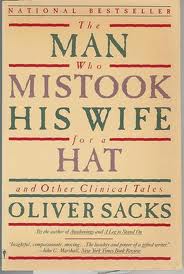
100. The Man Who Mistook His Wife for a Hat by Oliver Sacks. Psychology student or not, this book will appeal to anyone who has an interest in the curious way the mind works–and how it does not work. Several of the most bizarre cases are detailed here.

-I rarely find copies of this book, so finding one in good condition is a score! The psychology/sociology teacher loves to lend this book to her students; they are fascinated by the case studies. I am always excited to find a gently used copy for her to share.

Here is a list of the 10 essential reads I LEFT ON THE SHELVES (and where they are used in our curriculum)

1. The Great Gatsby by F. Scott Fitzgerald.-Grade 11; we have enough copies

12. Heart of Darkness by Joseph Conrad. -AP English Literature; text is in the public domain so students read this online.

14. The Call of the Wild by Jack London.- Grade 9;  text is in the public domain so students read this online.

15. To Kill a Mockingbird by Harper Lee. -Grade 11; we have enough copies

28. The Poisonwood Bible by Barbara Kingsolver.- AP English Literature; we have enough copies

33. Middlesex by Jeffrey Eugenides.- Optional read for Grade 11 Coming of Age unit OR Advanced Placement English

34. Life of Pi by Yann Martel. -Grade 10; We have enough copies

58. One Hundred Years of Solitude by Gabriel Garcia Marquez. AP English Literature; we have enough copies

82. The Elements of Style by William Strunk and E. B. White.- Resource for AP English Language and AP English Literature and Creative Writing

98. The Interpretation of Dreams by Sigmund Freud.-I will need to check with the psychology teacher!

 Both Goodwill stores, Brookfield and New Milford, regularly offer a wide variety of used books, and our classroom libraries are currently well-stocked with titles puchased used for $.50-$2.00.
This past Saturday, the  total cost for the five  “essential” titles I did purchase? $5.18. Getting these essential reads into the hands of our students? Priceless.