Archives For November 30, 1999

“Ancora imparo. [I am still learning.]”

― Michelangelo, at age 87 in 1562

In the United States, students will spend 96 weeks or collectively about two years of their academic life in summer vacation days. Our 183 day (in Connecticut) school year became standardized not because of farming, but as a result of an industrial society that opted to let urban students out of the sweltering cities during the summer months.

Kenneth Gold, a professor of education at the College of Staten Island, debunked the myth of an agrarian school year in his book School’s In: The History of Summer Education in American Public Schools. He noted that if schools were following a true agrarian school year, students would be more available during the summer months while crops were growing but unavailable during planting (late spring) and harvesting (early fall).  His research demonstrated that before the standardized school year, there were concerns that too much school was bad for the health of students and teachers:

“There was a whole medical theory that [people would get sick] from too much schooling and teaching” (Gold)

Summer vacation was the solution to these medical concerns during the mid-19th Century. The result was a standardization of education has led to our present “summer leisure economy.” The 21st Century emphasis on  academic skills  necessary for success in life now contrasts with the mid-19th Century’s standards. There is a growing body of research on the adverse impact of summer vacation on learning.

A meta-analysis of 138 influences or “what works in education” was published (2009) in Influences And Effect Sizes Related To Student Achievement by John Hattie and Greg Yates. Their  results are posted on the Visible Learning website.  They ranked the effects of completed studies (international), and using data from these studies they demonstrated that an influence greater than .04 was a contribution to student achievement.

For their finding on summer vacation,  39 studies were used to rank the effect of summer vacation on student achievement. The findings using this data revealed summer vacation as having a negative effect ( -.09 effect) on education. They ranked summer vacation at the bottom of what works in education, a dismal 134 out of 138. Many researchers refer to the achievement damage done as the “summer slide.”

So what do some teachers do to counter this effect?

At the beginning of summer, students are sent home with work packets, reading lists, and other materials to counter the effects of what is commonly known as the “summer slide.” My school (grades 7-12) is no exception, and the objective for assigning this work is to provide students the practice in reading, writing, or math they need to maintain the skills they have developed during the school year.

The reality is that by mid-August, students and parents recognize they are in “crunch time,” and the summer work assigned as academic practice morphs into a contentious activity that looms large on the calendar. Parents remind/force/argue students to complete the work. Students may wait until the last possible moment to do schoolwork. Both parents and students see the work as an incursion into their summer break from school.

Meanwhile, on the teacher side, the knowledge that all those packets and reading responses will be submitted for assessment the first weeks back at school is daunting as well.

I believe I can safely say that no one-teachers, parents, students- likes summer work.

As an example, I recently received a note from a parent whose child is in enrolled in an honors level. This level is assigned more work to do, and she offered an impassioned plea that her children work hard to juggle their academics, athletics, jobs, etc. “They need a break,” she begged stating that they already can read and write well. “Why must we do this to students every summer?” she asked.

Must we? Do students who read and write well really need more practice? Do students need a break?

I wish I could make all stakeholders, including this one, happy by declaring that summer vacation should be an “academic-free zone”, but in my educator’s heart, I do not believe that students need a “break” especially when it comes to learning. I believe learning is ongoing, and those work packets and reading lists are designed at a minimum to keep students’ minds active. Granted, some of the assignments may be poorly designed, but they are based on a philosophy of maintaining skill sets.

While many students are fortunate to have the means to travel during summer vacation or indulge in firsthand experiences that benefit them academically, there are other students in their classes who do not. The work packets and summer reading equalize academic practice for all students during summer vacation.

Furthermore, learning individual responsibility to complete work assigned is another lesson at all grade levels. Students who choose other endeavors, namely athletics or jobs, must learn to be organized. In my experience as a teacher, the students who are the most successful are those who participate in multiple activities and learn to balance their academic responsibilities. How a student completes his or her summer work is also life lesson.

Consider again the 96 weeks that students have off for summer vacation during their academic career (K-12) because of a decision made in the mid-19th Century. Yes, I want students to have time to play and to travel and to relax, but why not have some assigned academic practice during their collective two years in the 21st Century that are afforded for summer vacation?learning never stops
I am happy to concede that the summer work packets and reading lists are a poor substitute for authentic learning, and I will continue to look for ways to encourage student minds throughout the entire year, not just from September to June. In considering the note from that parent, I am thinking that interdisciplinary summer work might prove successful in reducing the amount for students and in sharing the grading workload for teachers.

Summer vacation, however,  should not be an excuse to stop learning. The artist Michelangelo explained that he was “still learning” at the age of 87. Our job as educators is to encourage students to recognize they are always learning, year round. Whether there are work packets, reading lists, or other assignments, there is no summer break from learning.

A student’s mind should not be on vacation.

Throwbacks in education are common.

This time, Robert Pondiscio, a Senior Fellow and Vice President for External Affairs at the Thomas B. Fordham Institution is itching for a fight to reopen old “reading war” wounds. He has taken umbrage with the NYTimes (7/2/14) opinion piece Balanced Literacy Is One Effective Approach by Lucy Calkins: Director of the Teachers College Reading and Writing Project at Columbia University and a proponent of balanced literacy.

Pondiscio’s op-ed (7/3/2014) titled, Why Johnny Won’t Learn to Read charges back into the heat of that fight as he referenced the 1997 National Reading Panel’s review of studies on the teaching of reading.

In reminding everyone that “phonics won,” Pondiscio jettisons the definition of the word “balanced” in the phrase balanced literacy. The Oxford Online Dictionary states that when “balanced” is used as an adjective, it is defined as:

  • Keeping or showing a balance; in good proportions:
  • Taking everything into account; fairly judged or presented:
  • having different elements in the correct proportion

Screenshot 2014-07-06 17.07.23Since 1997, the term “balanced literacy” has come to mean that the parts of the phonics approach should be in good proportions with other approaches for teaching reading and writing. Pondiscio however, recasts the phrase “balanced literacy” in mythological terms, as a hydra…“a new head for whole language.” His interpretation is unsupported by definition.

Pondiscio’s wish that the “win” by phonics would eradicate whole language’s contributions to teaching literacy is overstated as some of the recommendations by the NRP could be associated with whole language:

  • Teaching vocabulary words—teaching new words, either as they appear in text, or by introducing new words separately. This type of instruction also aids reading ability.
  • Reading comprehension strategies—techniques for helping individuals to understand what they read. Such techniques involve having students summarize what they’ve read, to gain a better understanding of the material.

Beyond his use of the NRP’s 17 year-old-study, there is another problem in his choice of evidence, a quote by Susan Pimentel, one of the “principal authors of the Common Core.” Pimentel lacks the academic credentials to qualify her as an expert in literacy  (BS Early Childhood; Law Degree) in her claims that balanced literacy is “worrisome and runs counter to the letter and spirit of Common Core.” In contrast, many early literacy educators find the ELA CCSS worrisome, running counter to the spirit of new and emerging readers.

Moreover, Pimentel’s on again/off again association with the other CCSS “architects” (David Coleman and Jason Zimba) from Student Achievement Partners (SAP) was laid bare by Mercedes Schneider in a February 27, 2014, post: Schneider Dissects Sue Pimentel’s Role in Common Core Drafting; Exposes How 3 People Were Main CCSS Architects. In a blog post, Schneider documents Pimentel’s role through SAP’s tax filings and marginalizes Pimentel’s contributions with a suggestion that her inclusion on the CCSS was gender-based, “a female speaking to an audience from a profession that is primarily female, and that is good public relations for selling the CCSS product.”

Further on in Pondiscio’s op-ed, there is a reference to a NY Department of Education study on the Core Knowledge Study (2008-2012) which demonstrated, “significantly stronger gains than comparison school students on nearly all measures was for 1000 students in grades K-2 in 20 schools.” The use of this study is no surprise. Pondiscio’s promotion of this Core Knowledge program is due to the leadership of E.D. Hirsch, Jr., a Fordham Medal of Valor winner. What is missing is information on the size of the study, which involved less than 1% of K-2 student population (1.1 million total student enrollment in 2013), and its methodology in comparison to other literacy programs. Hirsch himself concurs that, “The study was too small. We need a bigger one – and one that gauges long-term as well as short-term effects.”

But what is Pondiscio most damning complaint against balanced literacy?

 “While the Common Core focuses kids’ attention on what the text says, balanced literacy often elicits a personal response to literature.” (Pondiscio)

Let me repeat his concern.

Pondiscio is distressed that a student may respond emotionally to a work of literature.

How is this a problem?

I quite am certain that a personal response in a reader is exactly what any author of literature hopes to achieve.

Reading literature is more than a decoding exercise. Reading literature at any age, especially good complex  literature, is an exercise that connects the reader and the author in an intimate bond of empathy.

Balanced literacy does require a student use evidence from a text, but the advantage to balanced literacy is that it recognizes that students cannot be silenced on what they think or feel about their reading, whether the choice of texts is theirs or not.

Pondiscio’s issue with whole language is that it emphasized reading for meaning instead of spelling, grammar, and sounding words out. In making this final part of his argument, Pondiscio reduces words to data or things devoid of meaning.

Such thinking reminds me of a line from Al Pacino’s Looking for Richard, a film study on William Shakespeare’s Richard III.

While filming on the streets of  NYC, Pacino is seen asking passers-by what is their relationship to Shakespeare. One pan handler stops long enough to explain how he feels the words in Shakespeare “instruct us”:

If we think words are things  and have no feelings in words…then we say things to each other that mean nothing.

But if we felt what we said,  we’d say less and mean more.

The pan-handler shuffles off after offering his personal explanation on words and meaning.

Pondiscio claims he wants “students to grapple with challenging texts that are worth reading,” but grappling with what the pan-handler says about the meaning of words in those texts, challenging or not,  is even more important.

My school district completed four days of first class professional development that began with a visit from Dave Burgess, the author of Teach Like a Pirate and ended with faculty-led collaborative committees organizing for an accreditation visit from the New England Association of Schools and Colleges (NEASC).  In four short days, the veteran teachers adjusted, organized classrooms, and prepared the first week of lessons. The administrators indicated that schools were off to a “great start”  while the facility management personnel finished polishing the floors and touching up wall paint. One group however, looked different.

teacher appleThe new teachers’ eyes glazed over. Although some have taught for years in other districts, each one has been lost in the labyrinth of our hallways at least once this past week. There are at least fifty names they still need in order to match staff to academic disciplines and a number of faces before they begin to match their attendance rolls with students. The location of materials for various units of study has yet to be established; boxes are unopened in their classrooms.

In short, they are whelmed. Merriam-Webster online defines whelmed as

1. to turn (as a dish or vessel) upside down usually to cover something : cover or engulf completely with usually disastrous effect
2. to overcome in thought or feeling : overwhelm

According to the dictionary, there is no “over” in being “overwhelmed”. Watching the newest members of the faculty trying to mentally sort through the information they had taken in the past four days reminded me of how I felt my first few years of teaching. Putting “over” with whelmed seemed redundant; I was “engulfed completely” my first years of school as well.

Twenty-three years later, I am less whelmed by the start of school, but I still have to adapt. There are always new materials, new changes to schedules, new students to get to know. In 2013-2014 there is also a new state mandated teacher evaluation system and a set of new tests will be rolled out this year to measure the new Common Core State Standards. For these new-to-district teachers, the flood of information in the early days of the school year must seem insurmountable. There is research, however, that indicates with three years of practice, teachers develop strategies for being effective in improving student achievement in the classroom.

In particular, there is research that demonstrates that “teachers in their first and, to a somewhat lesser extent, their second year tend to perform significantly worse in the classroom” (Rivkin, Hanushek, and Kain -2005). In a follow-up interview to this study, Kati Haycock was quoted in Education Next as saying,

“And experience does matter for inexperienced teachers. As a group, first-year teachers tend to be less effective than those with even a little more experience, and effectiveness tends to climb steeply for any given cohort of teachers until it begins to plateau after a few years. According to research by Eric Hanushek and others, disproportionate exposure to inexperienced teachers contributes to the achievement gap.”

How a teacher develops on a learning curve is significant for both the teacher and the students, which is why the story from Mokoto Rich of the New York Times At Charter Schools, Short Careers by Choice (8/26/2013) flies in the face of both anecdotal data and research studies. The article addressed the high turnover rate of teachers in charter schools by first highlighting the story of 24 year-old teacher, Tyler Dowdy. With two completed years of teaching behind him, Dowdy is “exploring his next step, including applying for a supervisory position at the school.” The article described him as someone, “who is already thinking beyond the classroom, wants something more.” His interest in education appeared cursory, “I feel like our generation is always moving onto the next thing,” he said, “and always moving onto something bigger and better.”

Supporting Dowdy’s lack of commitment to the profession, was the statement by Wendy Kopp, founder of  Teach for America (TFA)  who said,

“Strong schools can withstand the turnover of their teachers…The strongest schools develop their teachers tremendously so they become great in the classroom even in their first and second years.”

Kopp’s claims, however, have little credibility considering her own lack of classroom experience. While she has taken TFA from a $22 million dollar enterprise in 2003 to a $244 million dollar business in ten years before her departure this year as CEO, there is no record of her creating or delivering lessons to students herself. She has not had the experience of developing or implementing classroom management skills, a major cause of much teacher turnover.  Teachers, new and old, experience first-hand the fallacies in her argument. Yes, during the first years, teaching can be greatly improved, but that does not mean a new teacher has become “great”. Like so many educational reformers without classroom experience, Kopp dismisses critical teacher training as something that can be condensed, like TFA’s five week summer teacher preparation program.

A five week training for TFA is luxurious compared to the two and a half weeks of training over the summer for other teacher training programs, such as the YES Prep program like Dowdy’s, where new teachers “learn common disciplinary methods and work with curriculum coordinators to plan lessons.” Yet, these teachers from these accelerated programs will look the way new recruits in my district look, glazed and anxious. These teachers will soon learn the importance of experience. They will understand that the only way to learn how to teach is to practice teaching over and over and over….in spite of being whelmed.

Read picture books.

Yes, I am talking to you.

(No, not you kids….)

I am talking to you….you, Advanced Placement English Literature teacher, pretentiously waving me off with your worn cover of Thomas Hardy’s Tess of the D’Urbevilles. Yes, you too..the one taking notes on Nathaniel Hawthorne’s The Scarlet Letter, the book you assigned for summer reading?

Time to do some other kind of reading.

Time to read for pleasure.

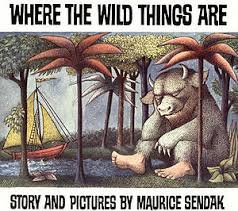
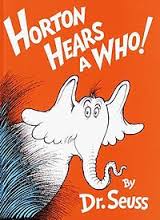
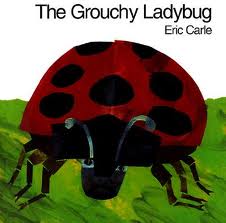
It’s time to wallow in Sendack (Maurice), Carle (Eric), and Seuss (Dr.).

Max Horton Ladybug

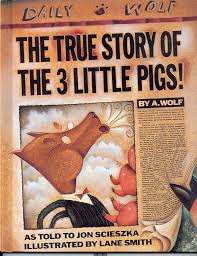
It’s time to discover Mo Williams’s Pigeon, Jon Scieszka’s Big Bad Wolf, and Jon Klassen’s hatless bear.

BearPigspigon

Why?

Primarily because teachers, all teachers, who are familiar with children’s literature can be positive role models for their students. They can engage students by making references to these books or they can make suggestions to young readers. They may even use them in lessons. But a new compelling reason has come out of a study by Jo Bowers and Dr Susan Davis, senior lecturers in primary education at Cardiff Metropolitan University. A review of responses by teacher trainees for primary grades indicates that reading children’s literature is good for your well-being.

An article in the British paper The Guardian Why Teachers Should Read More Children’s Books explains the study and promotes a paper Reflecting on Teacher Wellbeing that Bowers and Davis will give at Issues and Changing Perceptions conference in December 2013.

They had set up a year-long blog where teacher trainees could post reviews for three books they used with children over the course of the year. They then asked a focus group of these blog contributors a series of questions about their own reading experiences, such as, “What made you become a reader?”

The joys of reading became apparent, namely, how they had enjoyed “getting totally lost in a book” or “absorbed” by the narrative. It also became evident that they had close personal associations with certain texts from their own childhoods, and the fact that they could turn the page of a book and by knowing what was on that page gave them comfort and confidence to share that book with their class.

Trainee teachers reported they were using children’s books of all genres as a form of escapism from the stresses and strains of teaching in the primary classrooms. Researchers concluded that trainee teachers were using the book as a form of bibliotherapy, a therapy “increasingly moving away from its original medical model– whereby practitioners ‘prescribed’ self-help books to patients suffering from depression or eating disorders.” While the teacher trainees had to read the children’s literature selections as part of their professional development, they also found the experience pleasurable:

We have also found that trainee teachers often don’t read purely for pleasure, citing time constraints as the reason. Our blog project forced them to read as part of their professional development, and because they wanted to improve their subject knowledge. Wellbeing was secondary, but nonetheless became part of the project, almost by default. One of our students summed it up nicely: “Books are like best friends during stressful times.”

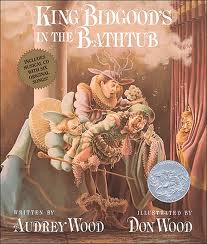
So, go ahead and pick up that copy of King Bidgood’s in the Bathtub and chant loudy the refrain “…and he won’t get out!”
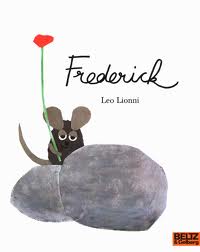
Listen to the poetic wisdom of a small mouse who notes that everyone has a gift to bring in Leo Lionni’s Fredrick.
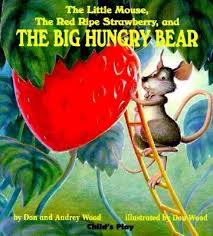
Or, share a red, ripe strawberry in The Little Mouse, The Big Hungry Bear and The Red Ripe Stawberry.

king Fredrick mouse

You will be reading for pleasure. You will be reading quickly, and you will probably feel better, things Thomas Hardy and Nathaniel Hawthorne may not do for you.

References according to The Guardian:

Jo Bowers and Dr Susan Davis are senior lecturers in primary education at Cardiff Metropolitan University. Follow them on Twitter: @Jo_Bowersand @drsuzyw. Reflecting on Teacher Wellbeing – Issues and Changing Perceptions conference will be held at Cardiff Metropolitan University on Wednesday 4 December 2013. For further information please contact:cseenterprise@cardiffmet.ac.uk.


I recently had to write a position statement on assessment and evaluation.  The timing of this assignment, June 2013, coincided with the release of the National Assessment of Educational Progress (NAEP) Progress Report for 2012. This “Nation’s Report Card” provides an overview on the progress made by specific age groups in public and private schools in reading and in mathematics since the early 1970s.

Since NAEP uses the results of standardized tests, and those standardized tests use multiple choice questions, here is my multiple choice question for consideration:

Based on the 2012 NAEP Report results, what difference(s) in reading scores separates a 17-year-old high school student in 1971 from a 17-year-old high school student in 2012?

a. 41 years
b. billions in dollars spent in training, teaching, and testing
c. a 2 % overall difference in growth in reading
d. all of the above

You could act on your most skeptical instincts about the costs and ineffectiveness of standardized testing and make a calculated guess from the title of this blog post or you could skim the 57 page report (replete with charts, graphs, graphics, etc) that does not take long to read, so you could get the information quickly to answer correctly: choice “D”.

Yes, 41 years later, a 17-year old scores only 2% higher than a previous generation that probably contained his or her parents.

There have been billions of dollars invested in developing reading skills for our nation’s children. In just the last twelve years, there has been the federal effort in the form of Reading First, the literacy component of President Bush’s 2001 “No Child Left Behind” Act. Reading First initially offered over $6 billion to fund scientifically based reading-improvement efforts in five key early reading skills: phonemic awareness, phonics, fluency, vocabulary, and comprehension. The funding of grants for students enrolled in kindergarten through grade three in Title I Schools began in 2002-2003.

There have been individual state initiatives that complement Reading First, funded by state legislatures, such as:

There have been efforts to improve literacy made by non-profit educational corporations/foundations such as The Children’s Literacy Initiative, the National Reading Panel, and a Born to Read initiative from the American Library Association. In addition, there have been a host of policy statements from The National Council of Teachers of English and programs offered by the National Writing Project that have helped to drive attention towards the importance of reading.

All of these initiatives drove publishers of educational materials to create programs, materials and resources for educators to use. Unfortunately, the question of which reading program would prove most effective (Direct Instruction, Reading Recovery, Success for All and others) became a tangled controversy as charges of conflicts of interest between the consultants who had been hired by the Department of Education (DOE) and who trained teachers and state department of education personnel had also authored reading programs for curriculum. Fuel to this controversy was added when a review in 2006 by the DOE’s Inspector General suggested that the personnel in the DOE had frequently tried to dictate which curriculum schools must use with Reading First grant money.

Trying to improve our our students’ reading scores has been the focus so much so that our education systems have been awash in funding, materials, initiatives and controversies since 2001 in our collective to improve reading for students…and the result?

The result is a measly 2% of growth in reading for those leaving our school systems.

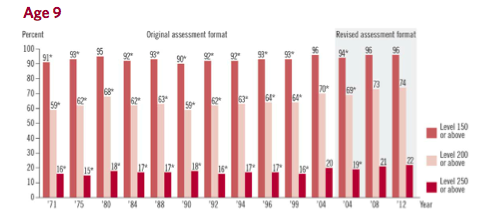
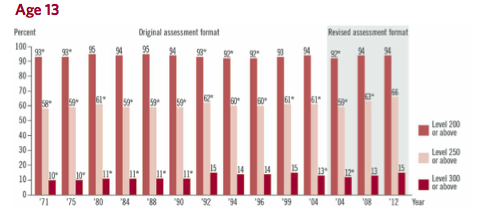
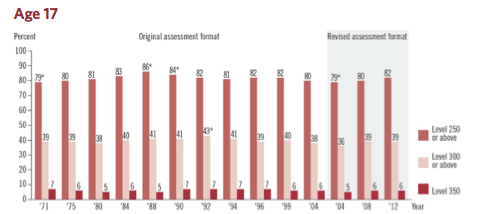
The evidence for this statement has been tracked by NAEP, an organization that has been assessing the progress of  9-, 13-, and 17-year-olds in reading. The graphs below taken from the NAEP report measure annual growth at each age level at the high level 250, mid level 200, and low level 150 of reading.  There are other levels measured for highest or lowest achieving students, but the levels measured on the graphs levels are correlated to the following descriptions:

LEVEL 250: Interrelate Ideas and Make Generalizations
Readers at this level use intermediate skills and strategies to search for, locate, and organize the information they find in relatively lengthy passages and can recognize paraphrases of what they have read. They can also make inferences and reach generalizations about main ideas and the author’s purpose from passages dealing with literature, science, and social studies. Performance at this level suggests the ability to search for specific information, interrelate ideas, and make generalizations.

LEVEL 200: Demonstrate Partially Developed Skills and Understanding
Readers at this level can locate and identify facts from simple informational paragraphs, stories, and news articles. In addition, they can combine ideas and make inferences based on short, uncomplicated passages. Performance at this level suggests the ability to understand specific or sequentially related information.

LEVEL 150: Carry Out Simple, Discrete Reading Tasks
Readers at this level can follow brief written directions. They can also select words, phrases, 9 or sentences to describe a simple picture and can interpret simple written clues to identify a common object. Performance at this level suggests the ability to carry out simple, discrete reading tasks.

Screen Shot 2013-06-29 at 7.52.04 PM

The NAEP report does offer some positive developments. For example, from 1971-2012, reading scores for 9-year-olds have seen an increase of 5% in students reading at the lower (150) level, an increase of 15% for students reading at mid-range (200), and an increase of 6% for students reading at the higher (250) level.

Screen Shot 2013-06-29 at 7.52.16 PMSimilarly, reading scores for 13-year olds have increased 8% for students reading at mid-level, and 5% for students at the higher level. Scores for student reading at the lower level, however, saw a negligible increase of only 1%.

At this point, I should note that the NAEP report does contain some positive finding. For example, the measurements indicate that the gaps for racial/ethnic groups did narrow in reading over the past 41 years. According to the report:

Even though White students continued to score 21 or more points higher on average than Black and Hispanic students in 2012, the White – Black and White – Hispanic gaps narrowed in comparison to the gaps in the 1970s at all three ages. The White – Black score gaps for 9- and 17-year-olds in 2012 were nearly half the size of the gaps in 1971.

Unfortunately, even that positive information should be considered with the understanding that most of these gains for racial and ethnic groups were accomplished before 2004.

Finally, for students leaving public and private school systems, the overall news is depressing. Any gains in reading in ages 9 and 13, were flattened by age 17. The growth for students reading at higher level dropped from 7% to 6%, while the  percentage of mid-range readers remained the same at 39%. The gains of 3% were in the scores of lower range readers, from 79% to 82%. Considering the loss of 1% at the higher end, the overall growth in measurement is that measly 2%.

Screen Shot 2013-06-29 at 7.55.37 PM

That’s it. A financial comparison would be a  yield $.02 for every dollar we have invested. Another comparison is that for every 100 students, only two have demonstrated improvement after 13 years of education.

Assessing the last 12 of the 41 years of measuring reading initiatives illustrates that there has been no real progress in reading as measured by standardized tests in our public and private education institutions grades K-12. NAEP’s recounting of the results after considerable funding, legislation, and effort, is as Shakespeare said, “a tale…full of sound and fury, signifying nothing.”

Continue Reading…

Wikipedia-logoA short-lived category sub-set in a Wikipedia entry set off a feminist firestorm at the end of April. In an editorial for the New York Times titled “Wikipedia’s Sexism“,  the writer Amanda Filipacchi noted the removal of women writers from the Wikipedia web page category “American Novelists”; women writers had been regrouped under a new web page, “American Women Novelists”. Filipacchi wrote:

 “I looked up a few female novelists. You can see the categories they’re in at the bottom of their pages. It appears that many female novelists, like Harper Lee, Anne Rice, Amy Tan, Donna Tartt and some 300 others, have been relegated to the ranks of ‘American Women Novelists’ only, and no longer appear in the category ‘American Novelists.’ If you look back in the “history” of these women’s pages, you can see that they used to appear in the category ‘American Novelists,’ but that they were recently bumped down. Male novelists on Wikipedia, however — no matter how small or obscure they are — all get to be in the category ‘American Novelists.’ It seems as though no one noticed.”

The category “American Women Novelists” was created by a 32-year-old history student at Wayne State University, John Pack Lambert.  His editing was violation of Wikipedia’s rules that categories should not be based on gender.

Yet, this regrouping called attention to other “gender-biased” incidents that have happened at “the free encyclopedia that anyone can edit.” Apparently “anyone” is not editing.  In an interview on NPR by Lynn Neary,”What’s In A Category? ‘Women Novelists’ Sparks Wiki-Controversy”, Wikipedia editor Ryan Kaldari admitted:

“Only about 10 percent or less of the editors at Wikipedia are women. And so a lot of times there’s this subconscious, white, male, privileged sexism that exists on Wikipedia that isn’t really acknowledged.”

While that admission is startling in its honesty and frightening implications about editors at Wikipedia, another interesting story seems to have gone unnoticed. At age 12, Wikipedia is “coming of age”. The repercussions from this incident mark another step towards Wikipedia’s gradual movement towards acceptability; Wikipedia is learning how to becoming academically legitimate.

For example, what difference would it have made years or even several months ago if a Wikipedia editor had decided to create gender based subsets within categories if the Wikipedia was used primarily as a source to “settle a bet with a roommate“? In addition, as the web becomes more collaborative in the sharing of information, is the information on Wikipedia less valid because the more than one writer is responsible for the article? Moreover, do the “real time” corrections like those made every day on Wikipedia improve the validity of information available or do these corrections even matter since research from Ohio State University shows that many people cling to misinformation despite corrections? And up until last April, would any scholar or academic have cared how a Wikipedia editor organized one of the 4,325 categories currently available?

In the article “Wikipedia’s Woman Problem”, James Gleick in the New York Review of Books explained that Wikipedia has logged thousands of pages of discussions on categories:

“It’s fair to say that Wikipedia has spent far more time considering the philosophical ramifications of categorization than Aristotle and Kant ever did.”

Aristotle? Kant? Wikipedia is philosophical? That sounds almost scholarly.

Gleich makes the point that categories matter to Wikipedia:

“Categories are a big deal. They are an important way to group articles; some people use them to navigate or browse. Categories provide structure for a web of knowledge—not a tree, because a category can have multiple parents, as well as multiple children.”

The creation of the “American Women Novelist” category briefly separated Toni Morrison, Anne Rice, Nora Roberts, and Annie Dillard from their category counterparts such as Isaac Asimov, Ernest Hemingway, Hunter S. Thompson, Truman Capote,and Zane Gray. The result was that many scholarly people did care, especially female novelists. Joyce Carol Oates (novelist, short story writer, playwright, poet, literary critic, professor, editor) expressed her views on Twitter:

“Wikipedia bias an accurate reflection of universal bias. All (male) writers are writers; a (woman) writer is a woman writer.”

“New idea for Wikipedia sex-bias: list names alphabetically only of those Americans who ARE NOT writers/ poets.”

Similarly, the novelist Amy Tan, mentioned in the NY TImes editorial by Filipacchi, tweeted her response:

#WikipediaFail I have been reduced to a Lady Novelist. American novelists=only men. 1990s ghettoization returns!

These comments among others are an indication of broader academic conversations generated by Lambert’s changes to the “American Novelists” page and the exponential growth of information available online today. Who is in charge of information, the organization of information, and the accuracy of information? Salon’s Andrew Leonard’s considers an argument that the editing process for Wikipedia entries is public and that the process of continuous editing brings about accuracy. In his commentary “Wikipedia’s Shame” Leonard points out:

“…hardcore Wikipedia advocates argue that no matter how dumb or ugly the original bad edit or mistake might have been, the process, carried out in the open for all to see, generally results, in the long run, in something more closely resembling truth than what we might see in more mainstream approaches to knowledge assembly.”

But this is not the only incident involving authors and their dissatisfaction with decisions by Wikipedia, and gender bias is not the only controversy. There was also a recent incident involving the novelist Philip Roth. In August 2012, Roth contacted Wikipedia about a misstatement on an entry dedicated to his novel The Human Stain. Wikipedia would not authorize the change, and Roth wrote about the editors’ decision in an open letter published in The New Yorker:

SEPTEMBER 7, 2012

Dear Wikipedia,

I am Philip Roth. I had reason recently to read for the first time the Wikipedia entry discussing my novel “The Human Stain.” The entry contains a serious misstatement that I would like to ask to have removed. This item entered Wikipedia not from the world of truthfulness but from the babble of literary gossip—there is no truth in it at all.

Yet when, through an official interlocutor, I recently petitioned Wikipedia to delete this misstatement, along with two others, my interlocutor was told by the ‘English Wikipedia Administrator’—in a letter dated August 25th and addressed to my interlocutor—that I, Roth, was not a credible source: ‘I understand your point that the author is the greatest authority on their own work,’ writes the Wikipedia Administrator—’but we require secondary sources.'”

Really? The primary word of the author requires secondary sources? That definitely sounds like Wikipedia’s step towards the scholarly; the kind of instructions a teacher might given to a student doing a research paper.  With Roth’s situation, however, the editor’s decision seems incongruous, and the explanation reads more like text written by George Orwell, author of the prescient novel 1984.

If that Wikipedia’s editor’s response is Orwellian, then consider another comment made by Wikipedia editor Kaladari that the “American Woman Novelist” vs. “American Novelist” controversy has “about 33,000 words of discussion on it which is quite a lot.” Then he added, “It’s actually more than the novel Animal Farm.

Mr. Kaladari’s comparison may not have been intended to be ironic, but Orwell’s allegorical novel Animal Farm about a brutal regime that tries to rewrite history may be closer to this heart of this incident that readers realize. Think back to high school and remember the revolutionary speech by the pig, Old Major:

“There, comrades, is the answer to all our problems. It is summed up in a single word–Man.” 

“Exactly,” respond female writers everywhere.