Archives For November 30, 1999

boringMany educators use Twitter to communicate as part of personal learning networks (PLN). I appreciate the means to share messages with other educators, but I am sometimes alarmed by some of the tweets I read. The brevity of 140 characters does not allow for nuances. The tweet is, by design, blunt.
Example #1: Most teachers do not share a professional language. And they don’t share prof lang with students. 
I wonder, “Really? Is there evidence to support this claim?”
Example #2: Freedom—for educators and parents—is necessary, but not sufficient, for excellent schools
I think, “Define Freedom. Define sufficient. Define excellent.”
These tweets are made of some sentiment that begins an argument, but they are so brief and banal that they cut off debate.
Such was the case this week when prominent author and educator Dr. Tony Wagner paraphrased a statement made by Education Secretary Arne Duncan (week May 21, 2013) in a response on his twitter feed.  Wagner is the first Innovation Education Fellow at the Technology & Entrepreneurship Center at Harvard; he is a former high school teacher, K-8 principal, and a university professor in teacher education. Wagner’s tweet read:

“‘Too many high school students are dropping out, not because school is too hard, but because it’s too easy @arneduncan’ Wrong! It’s boring!” @DrTonyWagner.

While I disagree with Duncan’s generalization that schools are too easy, I was even more disturbed by Wagner’s response, about school, “It’s boring!”
I hear this complaint enough from students before they read the class novel or before we start the unit. I did not expect to hear it from Wagner.
Students say “this is boring” so much that I will not let them use the word “boring” any more.
But, is school boring?
Is it?
I take issue with Wagner’s claim. I would like to debate this.
As someone who attended Mr. Orontias’s History and Geography class in 1970, I can confidently say I have experienced boring. His 45 minute lecture delivered in a monotone right after lunch was not in a time space continuum; the clock hands did not move.
I know boring.
In contrast, my students’ high school today is not boring. As examples, I offer the following:
  • We have a Bring Your Own Technology (BYOT) initiative;
  • We employ student driven learning with choice on reading, topics, and presentation;
  • We include project based assessments and encourage reflection on tests.
We do, however, require that students do schoolwork. They practice math problems. They do research. They must complete reading assignments. They have deadlines. Some of this work is repetitious; some of this work is tedious. Some rote learning may be necessary to develop background knowledge before students can engage in active participation or collaboration.
So, when I hear from students that they are “bored” with school, often what they are saying is “schoolwork is not fun.”
This is not unexpected. A great deal of time is spent everyday in “not fun” activities inside school, just as a number of “not fun” activities are required in the real world.
I sympathize, but the reality is that not every lesson in school is fun. Education objectives require students to work rather than have the teachers be the engine of the classroom.
Wagner is one of the innovative educators who promotes education to incorporate more real world problems, reforming education to prepare students with 21st Century skills in order to engage students in meaningful enterprises. Whatever innovations are developed by education reformers like Wagner, students will experience frustrations, and experience failures. There will be efforts expended by teachers and students successfully and unsuccessfully. Work will be necessary, and some of that work will not be fun. If the goal of schools is to prepare students to learn the value of work, to prepare students for the workforce, work should be applauded, even if the work is not fun, or if the work is “boring.”
Arne Duncan’s statement that high school students are dropping out because schools are too easy is a gross overstatement. How easy will the real world be for those high school dropouts?
Similarly, Wagner’s accusation that high school is boring is infuriatingly terse, using only 20 out of Twitter’s 140 characters. How bored will students be if they drop out and cannot find fulfilling employment?
There are isolated cases of students who may write code for some fabulous new social media or video game that goes viral, but those are isolated. A high school diploma is necessary for even the most menial employment.
Today’s schools are not boring. Today’s schools are preparing students for work environments just like schools have done in decades past. Historically, teachers do not predict the job market, instead they prepare students with the fundamentals so that their students may create the job market. Some of that preparation is not fun; it is work, and in student lingo, it is boring.
Stating this needs more than a pithy remark that negates the efforts of teachers who are engaging students with 21st Century skills, with active rather than passive instruction.
Education has come a long way since my experience in the 1970s because of the efforts of education reformers like Dr. Wagner. Forty years ago, education came in primarily in the form of direct instruction. We sat in rows and listened to lectures, and yes, that was boring.
Except for the day that Mr. Orontias stepped into the wastebasket.
That was not boring at all.

Tributes for teachers during Teacher Appreciation Week are welcome coming just as the school year comes to a close when very tired teachers are looking back to see student progress over the past eight months. Many of the tributes are touching, and some are comical. Comedy was the intent of the The Late Show with David Letterman, when the producers invited ten (10)  Teach For America teachers to deliver Letterman’s Top Ten List. In introducing the selected ten teachers, Letterman prefaced the performance with his own tribute,

“My God! If there is a future, it is in the hands of our teachers doing thankless work day after day (APPLAUSE) …..and by the way thankless is the wrong word… we should be grateful, eternally grateful, for the work these people do…”

After his heart-felt introduction, each of the ten Teach for American teachers stepped forward to deliver one entry on the list:

The Top 10 Reasons I Decided to Become a Teacher

  • 10. I hope to live up to the teachers who inspired me. . .like Ms. What’s Her Name
  • 9. It’s no fun saying the Pledge of Allegiance every day by myself.
  • 8. Honestly, I didn’t pay much attention the first time through school.
  • 7. Kids need to know the moon landing was faked. 
  • 6. If I could make a difference in just one student’s life–well, that wouldn’t be a very good average. 
  • 5. The glamour. 
  • 4. You work long hours, but at least the pay is bad.
  • 3. Hoping to teach in an all song-and-dance high school, like on “Glee.” 
  • 2. In the summer, I can watch all you losers go to the office. 
  • 1. I want to help kids talk good. 

This very funny video was posted on the Teach for America website, listing participating teachers as members of the Class of ’13. Teach for America is a not for profit organization established in 1990 under a proposal by Wendy Kopp. The original objective is explained on their website:

We recruit a diverse group of leaders with a record of achievement who work to expand educational opportunity, starting by teaching for two years in a low-income community.                 

Teach for America sent 500 teachers to low-income schools in its first year. To date, over 33,000 have completed the program, however, Teach for America has come under some criticism for the “temporary” nature of the assignments. Two years of teaching is not enough, argued David Greene in an editorial featured in the New York Times (4/30/13),Invitation to a Dialogue: The Art of Teaching”:

Corps members should intern for a year under the supervision of a talented mentor teacher, then teach for at least four years, not two. That may discourage some. Good. We want career teachers. A “temp” work force does not improve education or erase the achievement gap. Rather it helps to create havoc in schools desperately trying to gain stability, a key factor in any school’s success.

Greene explained that he has served in the past as a mentor to Teach for America corps members, and that he has seen their “tears, anxieties, heartaches, successes and achievements.” He claims, however, that the preparation for these teachers now includes “simple, formulaic scripts” instead of letting these teachers be “creative, independent, spontaneous, practical and rule-bending.” He noted:

Scripts and rules and models strictly followed cannot replace what the best teachers have: practical wisdom. In our anti-teacher world and scripted teaching climate perpetuated by corporate reformers, what room is there for the teachers we want for our kids?

Greene cautioned that the today’s Teach for America has “morphed into more of a leadership institute”, with too little classroom experience to inform the members as they move quickly from the classroom into higher levels in education administration and in educational reform.

Letterman’s producers must be applauded for focusing attention on teachers during Teacher Appreciation Week, but in the future, they might consider a different group to represent teachers. Perhaps they could recruit seasoned veteran teachers who made this career choice, or if new teachers are what they want, they might look to spotlight new teachers who do not have the benefits of training and continuing support from Teach for America. Or, they might look to recruit the teacher described below in a letter published in the NYTimes written by Derl Clausen, a high school student, in a response to Greene’s editorial:

He walks in five minutes late to first period, half-shaven, cup of coffee in hand. He walks over to the white board, his stage, puts his coffee down, and looks into the eyes of every student. He’s not given the best students, and so his standardized test scores are average. Instead, they leave with something more; they leave inspired.

He tells them about life: the challenges, the problems, the reason he’s half-shaven. He turns “Romeo and Juliet” into a lesson on love, algebra into a philosophy discussion, and science into an art appreciation class. Vocabulary, equations and historical dates will enter and leave children’s memories, but the inspiration, motivation and wisdom that he gives them will remain throughout their lives.

It’s that teacher who is worth the five-minute wait, the smell of coffee — and if anyone questions his half-shaven beard, he’ll learn a whole lot more about life.

Clausen’s describes a teacher who goes “off script”, a teacher that fits Greene’s observation that, “Often it is the least orthodox teacher who most engages and excites students.” Clausen’s portrait could be a choice worth of a Top Ten List, or maybe even a guest appearance. Clausen and the half-shaved teacher as guests on The Late Show with David Letterman for Teacher Appreciation Week 2014? Not a satirical list, but one real teacher-student relationship as part of a Teacher Appreciation Week “Top Ten”.

Spoiler alertEnter the spoiler alert. Because the number of ways people hear about stories is increasing, spoiler alerts for books and films are offered as a “heads-up”, a means to prevent plot details from becoming public.  Knowing the end of a story might mean that the strategy of “predicting” a story has been compromised, however, there are genres of stories that absolutely count on predictability, for example, Nancy Drew will always solve a mystery with her best friend, Bess and George, while on TV, predictability has a time limit; the shipwrecked crew will never leave Gilligan’s Island (30 mins) and House will solve a medical mystery (60 mins).

Predictability means to state, tell about, or make known in advance, especially on the basis of special knowledge, and students are taught at an early age that making predictions can help them to determine what will happen in a story.

I noticed how predictions are important even if the end has already been decided when my six-year-old niece was watching the Disney film Running Brave. This was her favorite film, and she watched the VHS tape every afternoon. On one such afternoon, I noticed she was drifting asleep, so I made a move to turn off the video.

“Wait,” she cried out, “I think….I think he’s going to win again.”

From her perspective, the outcome of the race was still in doubt. The cinematic elements, the tight editing of shots , and a triumphant soundtrack created suspense where the viewer might doubt the inevitable. Krista had seen the movie hundreds of times, but she still was “testing” her prediction.

I admit that I have felt the same way watching Miracle, holding my breath for the final seconds wondering if the US ice hockey team would still win the Olympic medal. Krista’s experience is also mirrored in the classes where students often choose books based on a movie that they have seen.

In the independent reading allowed in our curriculum, the 9th graders can choose contemporary fiction or non-fiction, and many of the titles have movies in circulation, for example:

Some students purposefully choose these books because they know the endings, and in knowing how the book ends allows the reader to pay more attention to the craft of the author in bringing all the plot points together in a conclusion. Take for example, the Harry Potter series. Most readers predicted with certainty that Harry Potter would finally face his nemesis, Voldemort. The how and when, however, were still very much in the air, and J.K.Rowling’s crafting of the series’s magical settings and character development kept readers in a willing suspension of disbelief for the length of seven volumes. The final conclusion was satisfying to her fans who knew all along that Harry would prevail, after all, Good’s triumph over Evil is a predictable plot. Readers and filmgoers were not disappointed in following the story of a boy with the scar on his forehead because in each volume and subsequent film release, they correctly predicted that “I think…I think he will win again.”

So when I teach a whole class novel, I know there are some students who already know the ending. They may have reached the conclusion before others, or been informed by older students who notoriously share their opinions and critical information with younger students. In this case, my role is to impress on students that knowing the outcome will not destroy a well-told story, and to focus their attention on the other elements. This was the case with John Steinbeck’s Of Mice and Men.

“I heard this is a sad book,” one student said when I assigned the first chapter, “One guy kills another guy.”
Other students looked up for my confirmation.
“Yes, this is a sad book, but the reason for the sadness is really about caring. We will grow to care for these characters.”
“I already don’t care if I already know what happens,” was his reply.
Four weeks later, this student refused to watch the final scene in the film version.
“I know what happens, and I cannot watch,” he said sadly as he walked out into the hall.

The same sentiments are expressed at the beginning of our study of Shakespeare’s Romeo and Juliet.
“Guess what? They die,” said a student as I passed out the books.
“Yes, they die,” I kept passing out the copies.
“So why are reading this?” another asked.
“Because this is a great story,” I responded, “and the story’s ending will mean more after we finish because we will have read how Shakespeare writes about these ‘star-cross’d lovers’.”
“But we already know how it ends!” they whined.

Now that we are in Act III, no one cares that they know the end, instead, they are recognizing how Shakespeare creates the tragedy. They notice the “hints”: Juliet seeing Romeo “As one dead in the bottom of a tomb”, Friar Lawrence’s herbs of “Violent delights”, and “Love devouring death”.

This discovery of an author’s details makes students more appreciative of the craft in writing as they still try to predict. They notice Shakespeare’s allusions: “Such a wagoner/As Phaeton would whip you to the west/And bring in cloudy night immediately” (3.2.2-4), because we had studied the Phaeton myth earlier in the year.

“Uh-oh. That’s not good,” I heard one say, “Romeo’s gonna crash and burn like Phaeton.”

That kind of analysis is exactly what the English Language Arts Common Core would like to see in a close reading of a text. How interesting that students who already know “what happens” may be better at picking up on an author’s craft that a close reading generates.

Spoiler alerts do warn those readers or viewers who want to be surprised, but knowing the ending does not necessarily ruin the reading or viewing experience. Want to experiment? Here are 50 plot spoilers for 50 novels. I predict that each novel will not disappoint, even if you already know the ending.

Tuesday nights are #edchat nights on Twitter, and educators across the country, even across the globe, discuss topics of general interest for an hour. Last night (5/7) the topic was posted: What is BIG Shift in ed that everyone is looking for? Is there 1 idea that can positively affect education? While I was surfing the column of tweets that piling up, I was alarmed by one of the “tweets” in one of the sidebar discussions that break out between tweeters.The topic began with a comment about high school teachers by one tweeter”

Do they [teachers] need to be experts OR can they be great teachers instead?

The response to this question caught my eye and made me a little concerned: 

 HS Ts need not be content experts, but rather good directors and literate within their subject.

The brevity in Twitter-language communication often makes the tone in tweets sound dogmatic; many read like proclamations, and this was a proclamation I found startling. Yes, teachers need to be good directors, but the standard for literate is “being able to  know how to read and write” in a subject area? That definition sets a low bar for teachers.  My own experience in school guided my response; I tweeted back:

I respectfully disagree; my best HS teachers were content experts. Made me want to know what they knew.

The return tweet by was unsettling:

Good T[teachers] facilitate learning & help S[students] engage. With tech, a content-expert is less imp. 

Captured in the dialogue above is a contemporary problem in education, a growing separation between skills or content created by the exponential growth of information.  For example, in 2011, The Telegraph published “Welcome to the Information Age – 174 Newspapers a Day” which began:

The growth in the internet, 24-hour television and mobile phones means that we now receive five times as much information every day as we did in 1986.

The article written by Richard Alleyne, illustrated the explosion in the increase of information using a variety of statistics:

  • Every day the average person produces six newspapers worth of information compared with just two and a half pages 24 years ago – nearly a 200-fold increase. 
  • We now each have the equivalent of 600,000 books stored in computers, microchips and even the strip on the back of a credit card.
  • In 1986 we received around 40 newspapers full of information every day- this rocketed to 174 in 2007.
  • The ability to process all this information with computers has doubled every 18 months.

Today’s information overload is the major reason that many educators are promoting 21st Century skills; there is little hope that any human could manage the amount of information available. Instead there is every reason to believe that developing the necessary skills to access information is critical in education. However, to declare that teachers do not need to be content experts is a step in the wrong direction. 

Would anyone want a doctor or lawyer who was skilled but lacked content knowledge? Would anyone want a business manager or a craftsman who had content knowledge but no skills?  Why then do respected educators suggest that there should be a preference for skills over content in the teaching profession ? The problem appears to be that many people, educators included, connect content knowledge in the classroom with “lecture”. This association is evidenced by another tweeter who continued the conversation:

Content I agree, but just trying to focus away from “content expert” = lecturer. That’s not best role.

Really? For thousands of years, information was passed from one generation to another through the lecture format. Each subsequent generation added more knowledge in lecture formats, preparing the next generation for an undefined future. So did the Socratic method (5th C BCE) which encouraged debate and inquiry between teacher and students in order to stimulate critical thinking and to illuminate ideas. Instructors used dialectic methods, arguments to persuade and inform. Now, suddenly, because there is an over-abundance of information, the lecture is dead?

Well, certainly the long and dry lecture delivered to students without their participation has always been deadening. Contemporary educators have adapted and improved the lecture by delivering content through different strategies to accomodate different learning styles.  Successful instruction is not delivered from the podium, but delivered in mini-lessons, project-based assessments, literature circles, reading and writing workshops, and labs. Yet, there was one more concern about the teacher as content expert, a concern about teacher control:

T[teachers]s direct content. S[students]s don’t have total control, but the emphasis needs to shift to the S[students]s.

While this tweet sounded blunt, the reality is that teachers do direct a great deal of content in delivering content knowledge as outlined in curriculum, and that content could be lost in turning control over to the students. There are many ways students can be offered choice in content: choice in independent reading, choice in research, choice in project presentation. Students must first have some content to make decisions and to take control of their learning. This sentiment was reflected in one of the last tweets in the conversation:

I agree content experts are important, but not as important as allowing S[students}s to access and struggle to understand.

I added my final comment:

Sure, if they [teachers] give them [students] the answers all the time. But a content expert knows questions-what to ask & where to help guide.

That struggle for understanding is exactly what has happened for millenium, from instructor to student. This Twitter conversation had come full circle, a full Socratic circle. Through Twitter’s #edchat, educators discussed the teacher as content expert or as a skilled instructor. We were participating in reasoned debate from our different points of view about a subject in order to establish a truth.

balanceThe sidebar conversation on #edchat had begun with the question, “Do they [teachers] need to be experts OR can they be great teachers instead?” This answer to this question is not a choice between content knowledge or being “great” with skill. Furthermore, the skill to dispense knowledge is enhanced not replaced by technology.

In determining what makes a teacher great, on #edchat or in any other forum, there is no “or”…the balanced combination of content and skills is what makes a teacher great.

The Twitter English Chat (#engchat) last night (5/6/13) was on vocabulary, and I was too late to join the conversation. There was, however, one tweet went by that I would like to answer. Shawn White (@swpax) posted:

Does anyone have fun, effective ways to teach/learn Latin & Greek roots?

Yes. Try a kinesthetic approach.

This past January, I posted two sets of Greek Root vocabulary words on Quizlet. This free software allows anyone to “study anything” or “find or create what you need to learn.” I found two sets of Greek roots that were already posted. Quizlet allows teachers to share materials, so I copied the words and posted them to an account that students could access.

Set I:http://quizlet.com/14668765/greek-root-list-i-flash-cards/

Set II: http://quizlet.com/14668889/greek-root-list-iii-flash-cards/

Quizlet also posts the lists to Twitter so students can access the lists. There are a variety of ways that students and teachers can use Quizlet. The flashcard mode has an audio mode which is really helpful for students to hear the correct pronunciation.

Screen Shot 2013-05-06 at 8.32.41 PM

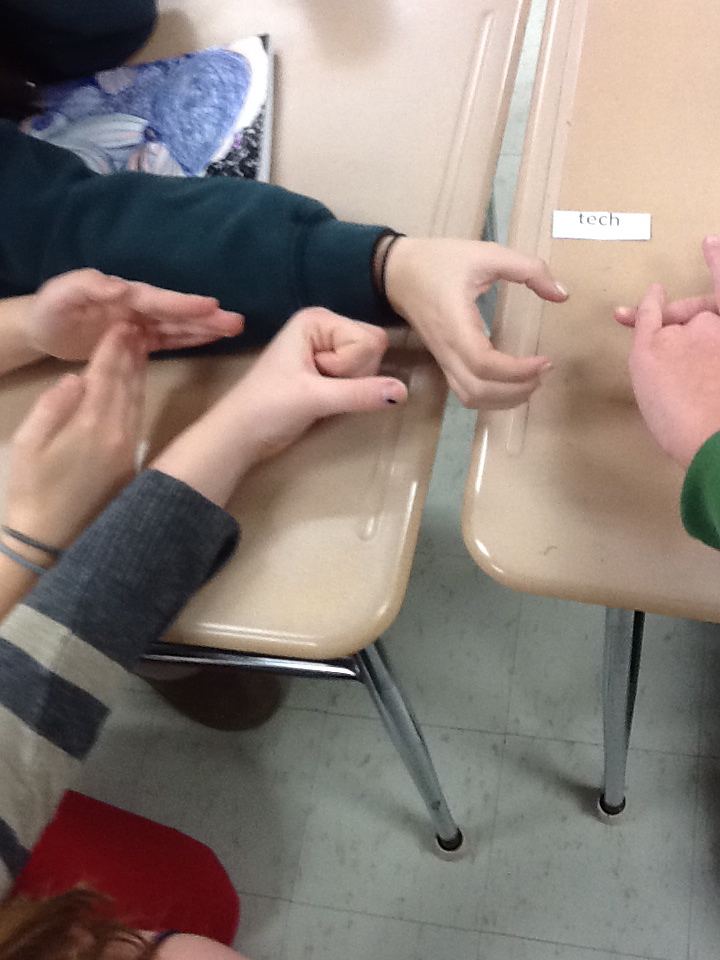
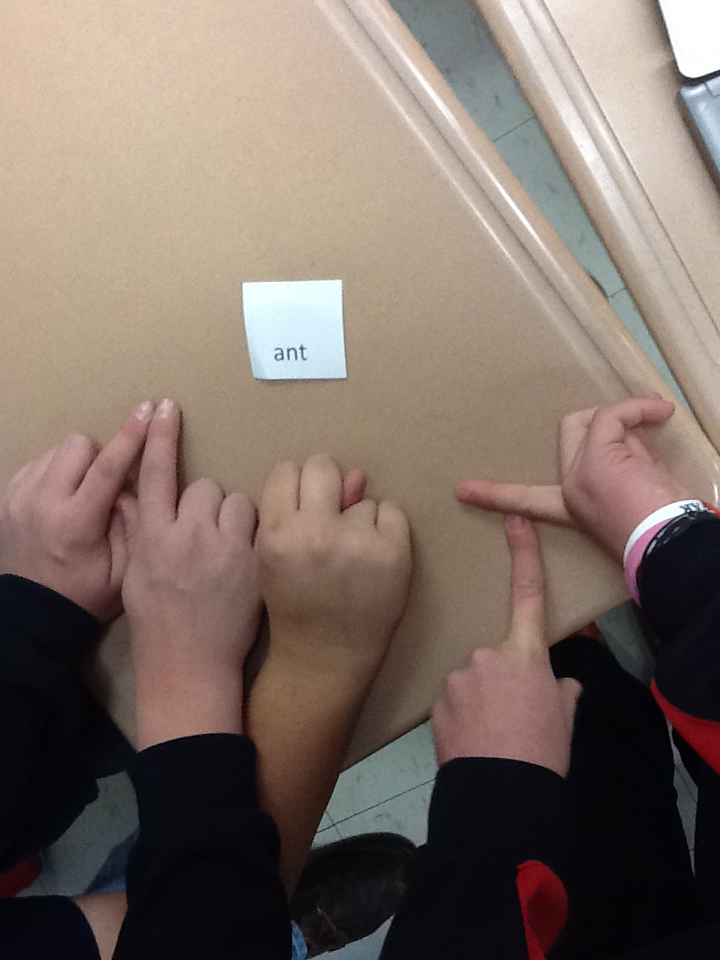
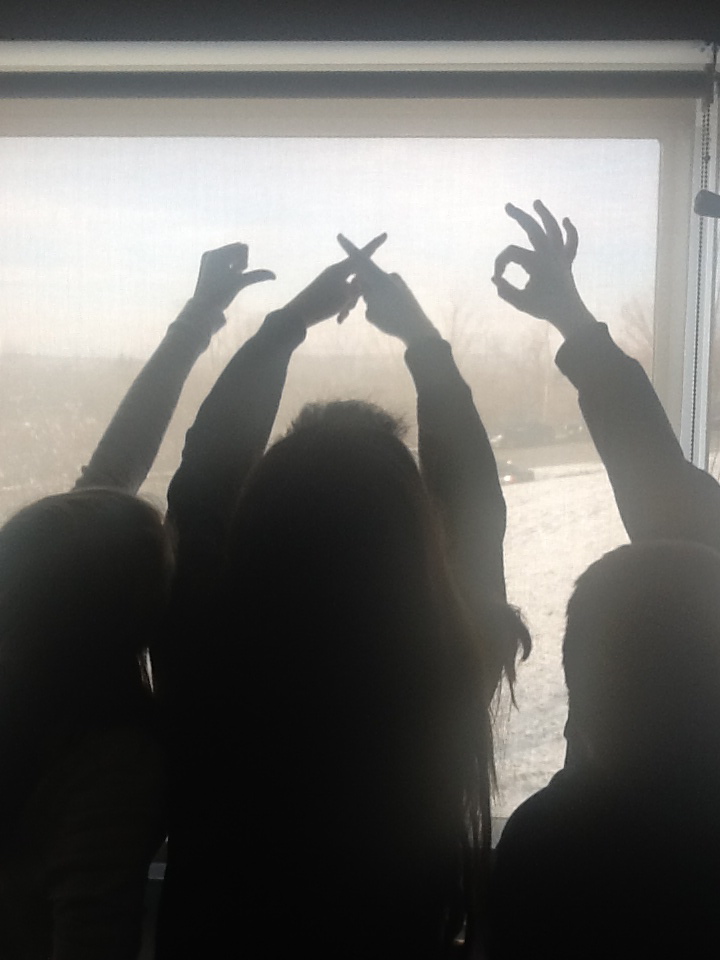
After the 9th graders had the lists, we practiced the words and their meanings kinesthetically. The students used their fingers to spell out Greek roots: ant (against), tech (skill), exo (outside).

TECH-(Skill)

TECH-Skill

ANT-against

ANT-against

ORTH-Correct

ORTH-Correct

EXO- Outside

EXO- Outside

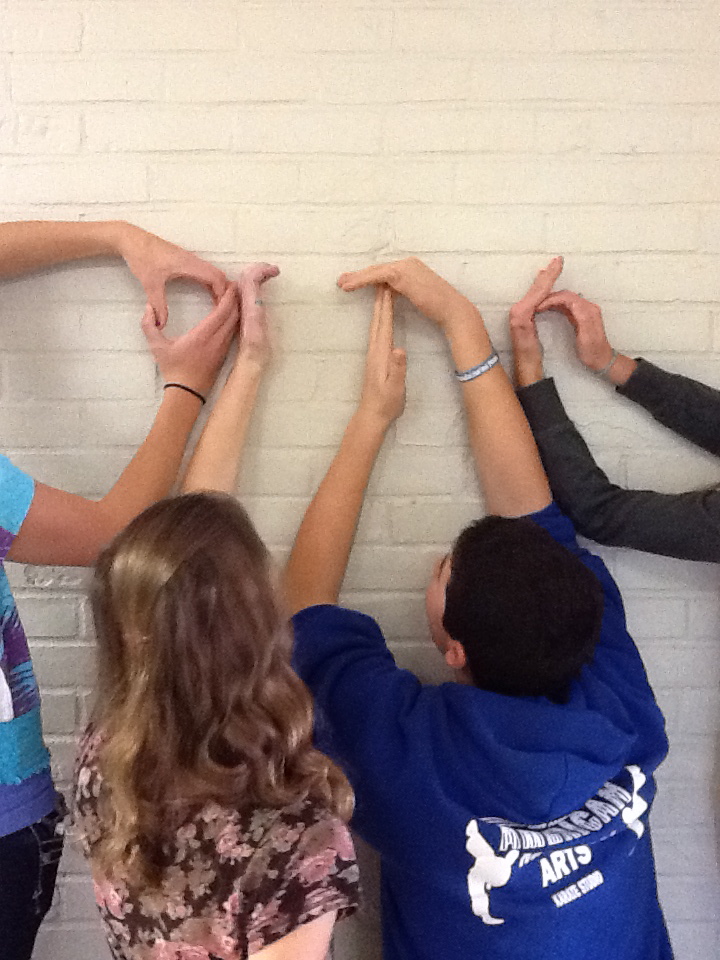
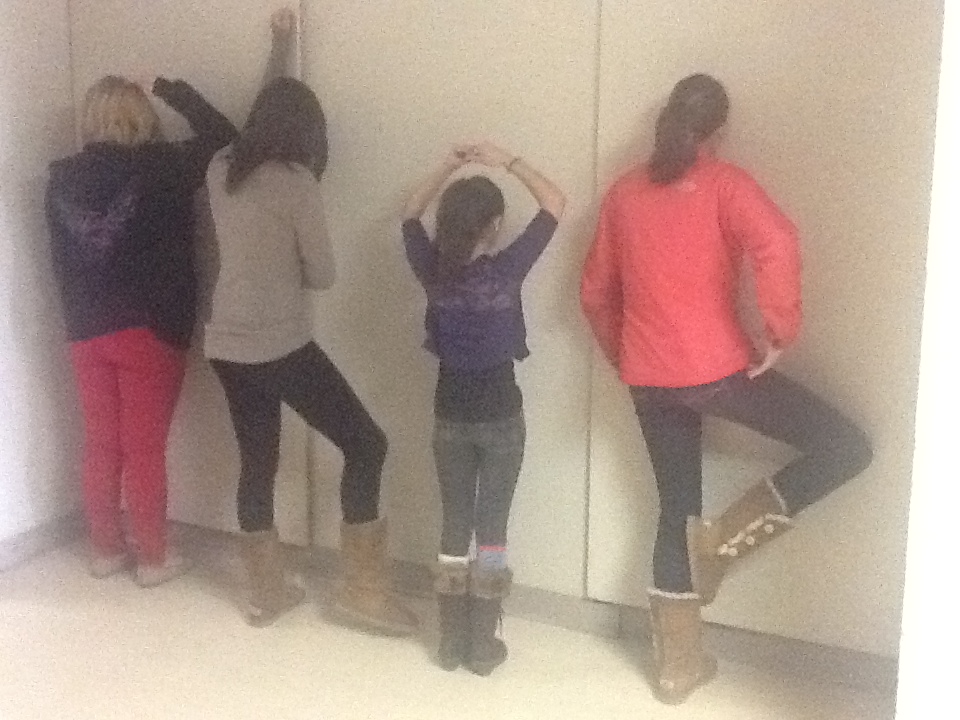
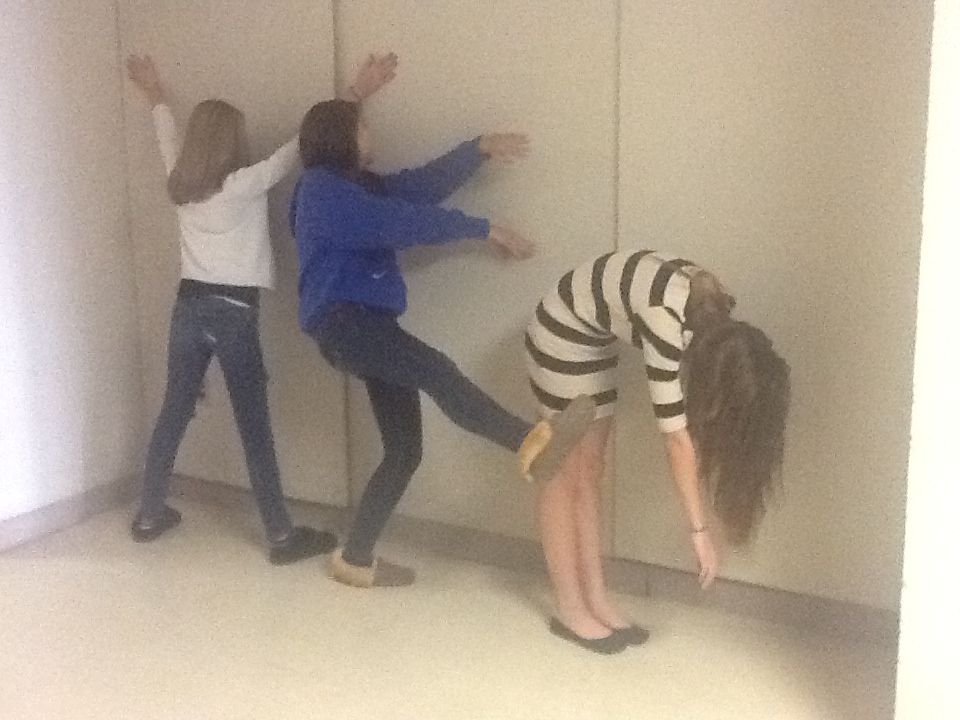
They twisted their bodies into letters and spread out against the wall spelling out xen (foreign), phob (fear).

This was fun. (Sorry you cannot see their smiles)

This was also effective. The class average was  96% on Set I and 87% on Set II.

Greek roots are difficult to memorize, but they are essential to decoding other vocabulary words. Between 5-25% of English words are derived from the Greek. The Greek roots are particularly important in understanding today’s vocabulary in science and medicine.

How fitting, then, that kinesthetic is a synonym for biomechanics. And guess what the etymology of biomechanics is? Greek, of course!  Bios (living organism) + mechane, (machine).

This connection between my activity and the root might just be Greek fate…. but that’s another lesson!

PHOB-Fear

PHOB-Fear

XEN-Foreign

XEN-Foreign

Once the snow has melted, and mud dries up enough so wearing flip flops is possible, the season of dress code violations begins. Whether your school dress code policy is ultra conservative or lassiez faire, every spring, there will be one or two students, usually female, who will challenge the dress code with an alarmingly inappropriate outfit.

Part of the problem is that middle and high school females come in all shapes and sizes. A T-tank may be perfectly acceptable on one boyish girl’s figure, but eye-popping on a more buxom girl. A short skirt that looks sporty on one girl can look like taut athletic bandage wrap on another. Showing a little skin, say a an upper arm or a long leg may look healthy on one student while baring a large middle abdominal area or the top of the derriere provides more information than necessary.

I have often wondered how any student could think that the off the shoulder or midriff display is acceptable in school. Lately, I have been assigning the blame to Disney. Specifically, I blame the Disney princesses.

Consider how the Disney princesses of older generations were fully clothed. These princesses were:

  • Snow White (1937)
  • Sleeping Beauty (1959)
  • Cinderella (1950)

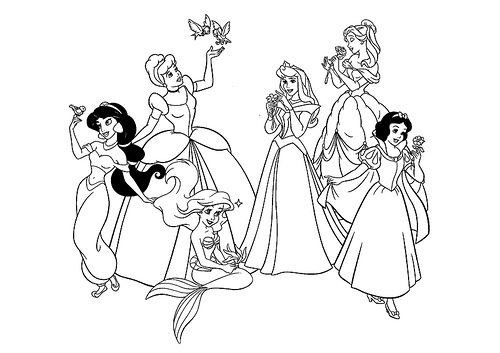
disney-princess-coloring-pages-7-comThese old-fashioned Disney princesses twirled with full skirted gowns, short or full sleeves, and accessorized their looks with gloves, capes, and the occasional scarf for cleaning.  There was an open neckline, but no décolletage. Princess Aurora (Sleeping Beauty) had a slight “over the shoulder” design that was covered by a large white collar in the pink/blue/pink/blue ballgown. The only character to reveal much flesh was Peter Pan’s Tinkerbell (1953) in a strapless gymnastic tight of sparkling citrus green. In subsequent generations, and without the benefit of a singing voice, Tinkerbell has been upgraded from fairy to princess. Her more melodious princess cousins were more modest dressers.

The next round of Disney princesses began in 1989. These princesses looked and acted very differently beginning with:

  • The Little Mermaid (1989) 
  • Beauty and the Beast (1991) 
  • Aladdin (1992) 
  • Pocahontas (1995)
  • The Hunchback of Notre Dame (1996) 
  • Hercules (1997) 
  • The Frog Princess (2009)

Recall the fashion influences of each of these princesses on students for the past 24 years:

  • The Little Mermaid‘s Princess Ariel’s species (born mermaid/part-time human) dictated that she wore little clothing, but the clamshells and low cut waist on her tail left little to the imagination. In creating such a daring outfit, the irony of Ariel’s lyrics,”Bet’cha on land they understand/That they don’t reprimand their daughters” appears to have been lost on her costume designers.
  • Beauty and the Beast‘s Princess Belle was a throwback to the princesses of the previous generation with the exception of her bare shoulders and a plunging neckline, a daring choice for dancing with a (possibly hungry?) “Beast”.
  • Aladdin‘s Princess Jasmine drew from the Ariel model; her cropped top and low cut balloon pants left a large expanse of middle, a surprising choice for a princess from a culture that suggests head to toe coverage for females in public.
  • In Pocahontas, the athletic Princess Pocahontas was designed as an American-Tarzan-ette. Dressed organically in a one-shoulder playsuit of buckskin and shells, she was lean, muscular, and barefoot; there was little clothing to hamper her progress through Colonial Virginia’s brush and briar.
  • In The Hunchback of Notre-Dame, the Gypsy Princess Esmerelda was dressed as the seductress Victor Hugo created; with her dark eyes smoldering over a daring low neckline and her shawl wrapped provocatively at her hips over a high slit skirt to jingle as she swayed. 
  • Princess Megera from Hercules had a body design lifted from the Barbie model with an equally impossible ratio of bust to hips size that allowed her to squeeze into her tight toga. While other princesses swayed, Megera sashayed into her hero’s life.
  • In The Frog Princess, Disney removed the racial barrier in creating Tiana. An African American Princess, Tiana was dressed in a gown mashup of Belle’s flowing ball gown skirt sitting below Tinkerbell’s bodice, that is when she was not on screen as a naked frog.

The fashions of these Disney princesses (1989-2009) were generally less modest than the fashions of previous generations. Their costumes had plunging necklines, bared midriffs, and high skirts. Their outfits, however, could also indicate the kinds of princesses they were, not castle-bound beauties, but more hands-on active counterparts to their princes.

For a quarter of a century, girls have grown up with the images of Ariel, Belle, Jasmine, Megera, Esmerelda, Pocohantas, and Tiana. They have dreamed of swimming “Under the Sea” or running with the “Colors of the Wind” or dancing with teapots to “Be Our Guest”.

So what would be the outfit of choice for school boards trying to design policy for  female students who have imitated the fashions of their beloved princesses since childhood? What princess outfit could pass muster?

There could be a vote for the clothing of Mulan (1998) a warrior princess who was forced to remain clothed top to bottom in order to hide her gender during warrior training and battle. Even when she returned to her role as a dutiful daughter, she was completely covered in a beautiful kimono. This choice, however, may be too much of a cultural stretch.

Finally, there could be a vote for the Princess Rapunzel from Tangled (2010) whose hair was the fashion statement. Part costume and part weapon, Rapunzel’s hair kept the audience from noticing any exposed body parts, however hair like hers could make movement through the crowded school hallways difficult.

Oh, Disney, if only you knew the consternation caused by your princess fashion designs. Maybe school boards could send your animators their dress codes so future princesses would dress accordingly. Better yet, Disney, you could stick to animating animals. We don’t mind seeing Dory (Finding Nemo) or Nala (The Lion King) naked; in fact, we like them better that way.

sols_6Why do I stay? This question is circulating on blogs and in videos by teachers from across the country. My friend Catherine, a teacher and literacy specialist, brought this question to my attention in her post this week. She was participating in a challenge organized by Two Writing Teachers called  The Slice of Life. The instructions for participating are on a link that goes first to a definition (“Slice of life is a phrase describing the use of mundane realism depicting everyday experiences in art and entertainment“) while other links provide procedures:

WRITE your slice. SHARE your link. GIVE some comments to (at least three) other slicers.

On one post she linked her Slice of Life post to blogger Beth Shaum’s video “Why I Stay”.  Catherine listed her reasons for staying and noted that other teachers have written about their reasons for remaining in the classroom, “despite changes in curriculum because of Common Core State Standards, new testing, and new evaluations that are being imposed on educators.” The video on Shaum’s blog addresses startling statistics about the teaching and the education profession:

More than 30% of new educators quit teaching after three years, and nearly 50% leave before hitting the five-year mark. (USNews.com)

Shaum’s video showed dozens of teachers from around the country sharing their reasons for staying in education.

I have not written to The Slice of Life challenge, but I did think the idea of recording my personal reasons as to why I have stayed and taught for 22 years in grades 6-12 would be an exercise that could both help me frame my own thinking and possibly encourage younger teachers who are often overwhelmed.

My reason for “why I stay” is purely selfish.…I want to share the stories.

I want to share with children, teens, and adults the stories they have read, seen, or heard.

I want to share the stories in picture books.
I want to share the stories in chapter books.
I want to share the stories in the canon.

So, I teach students to read stories so that we can talk and share the stories that make us human..

I want to share books.

I want to share books at every grade level.

hungry Whales Go_Dog_Go

I want to share books:

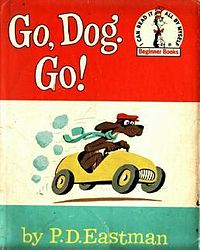
  • Go, Dog, Go
  • Hungry Hungry Sharks
  • The Whales Go By

I want to share more books:

  • Nancy Drew’s The Password to Larkspur Lane
  • The Twenty-One Balloons
  • A Wrinkle in Time

Larkspur wrinkle 21 balloons

I want to share novels:

  • Of Mice and Men
  • The Road
  • The Curious Incident of the Dog in the Night-time

I want to share stories written as dramas. I want to talk about:

  • Hamlet
  • Medea
  • The Importance of Being Ernest

I want to share stories made into film. I want to talk about:

  • One Flew Over the Cuckoo’s Nest
  • The Wizard of Oz
  • The Shawshank Redemption

I want to share stories in poems. I want to talk about:

  • The Odyssey
  • Paradise Lost
  • The Cremation of Sam McGee

Guernica Fall of Icarus

GW Delaware

I want to share the stories in paintings. I want to talk about:

  • Guernica
  • The Fall of Icarus
  • George Washington Crossing the Delaware

I want to share the stories that were responsible for essays and speeches. I want to talk about:

  • The Gettysburg Address
  • A Modest Proposal
  • Self-Reliance

I want to share the stories of people’s lives, stories about nature, and stories that mark cultural trends. I want to share:

  • Will You Sign Here, John Hancock?
  • Silent Spring
  • The Tipping Point

From the ancient lights of the campfires to the soft glow from a Kindle, our stories record our humanity.I stayed 22 years in teaching because I want students to understand that record of humanity. I stayed 22 years in teaching because I want students to respond to stories through writing and through speaking. And I stayed because I wanted to encourage students to record their own stories. I want to read and hear and see their stories.

In this great cultural experiment of public education for ALL, I stay to share the stories.

Six years ago, the video “Shift Happens” (2007) was featured at our school’s professional development day. I clearly remember one take-away:

We are currently preparing students for jobs that don’t exist using technologies that do not exist in order to solve problems we don’t even know are problems yet.

The video was created by Karl Fisch, and modified by Scott McLeod. The slides provided statistics on the rapid exponential growth in population and in information, highlighting the differences between the present and what was successful in the past, specifically England’s position on the world stage in 1900. Several slides are alarming in calling attention to the building tsunami of information available to students with examples such as ” there is more information in a week’s worth of the The New York Times than what an average person knew in the 1700s”. Since 2007, there have been several updated versions of “Shift Happens” uploaded to YouTube; there have also been many imitations.

I thought of this video this week when I drove past a sign on a large office building: Strategic Information Technologies.

“What does that mean?” I asked my friend Catherine, “Is the technology stategic because of geography? Strategic because of a choice of software or hardware?” I continued, “I don’t know what a ‘strategic information technologist’ does…Is this one of the unknown new jobs were are ‘preparing’ our 21st Century students to take?” I referenced the video.

“That’s ridiculous!” Catherine responded, “The people who ‘prepared’ us for the 21st Century were not worried about what new jobs would be available in our future. In fact,” she continued, “they taught us what they knew…what they thought we should know, and we are doing just fine.”

I was startled. Could a “Shift Happens” video place a misguided emphasis on adjusting skills and content in order to prepare students for the unidentified problems they don’t even know are problems yet?

“After all,” she continued, “We are the generation that created these new technologies that we didn’t know would exist today.”

When I reflect on her statement I think about how my favorite teachers in grades K-12  (Sister Ella, Mrs. Rowland, Miss Montessi) were not obsessed with preparing me for some unidentified job in the future. Instead, their collective obsession was to prepare me with basic skills and content so that I could be a productive member of society  I was taught to think, to read well, write well, speak well, know math, appreciate history, recognize science, and, since I attended Catholic school, recite my Catechism.

Perhaps, educators cannot predict the future for their students, but educators can address trends. For example, in 1957, the American public began to reconsider how the role of public education may contribute to winning the Space Race with the Soviets once Sputnik had been released. The investments in education made as a consequence resulted in increased scientific advancements and many spin-off technologies. In contrast, however, predictions such as those at the 1964 NY World’s Fair of a future with flying cars, jet packs, vacation trips to Mars and beyond, underwater cities, and robot laborers have never came to fruition.

Similarly, Karl Fisch’s video alerted educators to the rapid changes in education and the global implications in preparing students for the real world. He wrote:

“…it’s a different world out there. A world whereanyone’s ideas can quickly spread if they happen to strike a chord.”
This was certainly true of the “Shift Happens” video which had great success without “a large company or a huge public relations effort to make an impact.” Fisch continued:
This is just one of the reasons that I believe our schools need to change. They need to change to reflect this new world, this flatter world, this information-abundant, globally connected, rapidly changing, technology super-charged world that they are going to spend the rest of their lives in.

Fisch made no silly “predictions” like those at the NY World’s Fair. Instead, his video served to bring attention to trends that require an increase in the skills of  communication and sharing information.

In order to communicate and to share, students from grades K-12 must think, read well, write well, and speak well regardless as to what predictions are being made about new industries or technologies. In trying to anticipate the future, educators must not discount how the generations of students who learned these important skills became the graduates who are now responsible for evolving changes of the present.

Shift is not an entirely new enterprise on the world stage, for example,  the Renaissance, the Enlightenment, the Reformation, the Industrial Revolution are all examples of global “shifts”. In the six short years since the “Shift Happens” video, Facebook has replaced MySpace as the world’s most formidable social network; Twitter has evolved into a powerful communication tool. The role of educators is not  to predict the next Steve Jobs or Bill Gates or company that will spawn new jobs or dominate an industry or the next “shift”. Instead, the role of educators must be to continue to teach those skills of thinking, reading, writing, and speaking well that contributed to the “shift” that is happening for our students.

There is no surprise that “Shift Happens”, and the students who are prepared to think, to read well, to write well, and to speak well will not be surprised either.

If I had a choice of vanity license plates, I might consider one that marked my recent experience as a volunteer on an educational accreditation team.

NEASC PlateEducational accreditation is the “quality assurance process during which services and operations of schools are evaluated by an external body to determine if applicable standards are met.”

I served as a volunteer on a panel for the New England Association of Schools and Colleges (NEASC), an agency that provides accreditation services  – Pre-K through university for more than 2000 public and private institutions in the six state region.  NEASC  Panels are composed of experienced chairpersons and volunteer teachers, administrators, and support staff who visit schools according to a set schedule. According to its website:

In preparation for a NEASC evaluation, all member schools must undertake an exhaustive self-study involving the participation of faculty, administrators, staff, students, community members, and board members.

The key word here? Exhaustive.

Exhaustive in preparation for a NEASC visit. Exhaustive in being hosting a NEASC visit. Exhaustive in being a member of the NEASC team that visits.

But first, a little background. In order to serve as a volunteer, I had to leave several lessons on Hamlet, my favorite unit, with my substitute. So, when I understood the level of professional discretion required for a NEASC visit, I felt a curious connection to the Ghost, Hamlet’s father, who likewise abides by an oath.  On the ramparts of Elsinore, he tells Hamlet:

But that I am forbid
To tell the secrets of my prison-house
I could a tale unfold whose lightest word
Would harrow up thy soul, freeze thy young blood,(1.5.749-752)

I may not say what school I visited nor may I discuss any part of the actual accreditation discussion by members of my team. So this post will speak only as a self reflection of the process and a few moments of recognition on how accreditation works.

List, list, O, list! (1.5.758)

Sunday morning at 9:30 AM, the team members were already hard at work organizing piles of documents prepared for our visit. We were organized into pairs, two members to work on each of the seven standards, 14 members of the team and two chairpeople.

There was a working lunch before the entire team went to the school for a prepared presentation. This presentation was the high school’s opportunity to quickly familiarize us with their school’s culture and present their strengths and needs that they had determined in the (exhaustive) self study.

Madam, how like you this play?(3.2.222)

Returning to our hotel, the lodgings provided by our hosting school, the work began in earnest. We looked through bins of student work to see if they met the standards set by NEASC.  We looked at all forms of assessments, lesson plans, and student responses. We recorded our findings well into the night, and finally left the work room at 10 PM.

…to sleep;/To sleep: perchance to dream (3.1.65-66)

On both Monday and Tuesday, the team was up early to return to the school (7:00 AM), and the team split up individually or in groups to spend a school day conducting interviews with faculty, staff, and students. Facility tours, lunches shared with students in the cafeteria, and opportunities to “pop-into” classes were available. There simply was no “unobligated time” as we worked steadily in the work room at the school. Here we would record our findings before returning to the school hallways.

Were you not sent for? Is it
your own inclining? Is it a free visitation? Come,
deal justly (2.2.275-276)

Both Monday and Tuesday evening sessions were long as team members furiously documented their findings into a report that will still need editing and revision.  We had worked from 6AM-10:30PM with time allotted for meals and one hour respite in order to call home or check on my own school’s e-mail.  Closing my eyes, I thought how much,

My spirits grow dull, and fain I would beguile
The tedious day with sleep. (3.2.226-227)

An early Wednesday morning work session let us polish the report and present our final conclusions to other members of the team. Finally, the votes as to whether the team would recommend accreditation or not to the school were tallied, and we marched into the school library to meet the faculty and staff a final time. We were leaving a report for them to:

suit the action to the word, the word
to the action; (3.2.17-18)

The chair gave a short speech indicating the tone but not the contents of our report, and then, according to protocol, we left as team, not speaking to anyone from the school, nor to each other. Staying silent, I thought

Farewell, and let your haste commend your duty. (1.2.39)

The experience provided me with insights into the strengths and weaknesses in the educational program of my own school, and I am eager to share ways that can improve instruction with my fellow faculty members. Our school is scheduled for a visit in the spring of 2014 by a NEASC accreditation team.

As professional development, the experience was positive but physically demanding and intellectually challenging. The chairs’ use of technology (Google docs, Livebinders, Linot) allowed for efficient sharing of information on seven standards: Core Values and Beliefs, Curriculum, Instruction, Assessment, School Culture and Leadership, School Resources, and Community Resources. Awash in papers and digital materials for 16 hours a day, I wondered how any previous teams using only hard copies had collaborated successfully.

Additionally, as I looked at the various standards of instruction, I also found myself wondering about the consequences of implementing Common Core Standards (CCSS) and the growing reliance on standardized testing in evaluating teachers and assessing student understanding. Will the current form of regional accreditation adjust to measurements that will be implemented nationally? The United States is broken into five regional accreditation districts, however, if students meet the national standards, how will these regional accreditation panels be used?

Finally, our four day “snap shot” coupled with a the school’s own exhaustive self-study could not address all of the arbitrary elements out of a school’s control, but the process is far more informative and meaningful than any standardized test results that could be offered by the CCSS. Consider also that the financing of a school seriously impacts, for good or for ill, all standards of measuring a school’s success. The intangible “culture” surrounding a school and the fluid landscape of 21st Century’s technology are other arbitrary factors that impact all standards. We even encountered a “snow-delayed” opening as if to remind us that a capricious Mother Nature refuses to allow for standardized measurement!

I only hope that my experience in informing another school in order to improve their educational program will prove beneficial. I know that when the team comes in the spring of 2014, that that they will do as I have tried to do:

 report me and my cause aright…(5.2.339)

The rest I now need requires silence.

There are many great reasons to teach at the high school level: no outdoor recess duty, college level content, plus, a teacher never has to choose a “line leader”. Best of all, there are no bulletin board requirements.

While most elementary school classroom walls are crammed with colorful thematic cut-outs (apples, shamrocks, stars), high school walls are monochromatic. While middle school classrooms have student work displayed regularly, an essay hung in September will curl and fade on the wall of a high school classroom twisting in the air like an ancient leaf of papyrus.

Generally speaking, high school teachers do not spend a lot of time decorating the classroom. Subject content or motivational posters are the wall covering of choice, unchanged for the requisite 181 days of instruction. Perhaps it is inevitable that teachers who share classrooms do not personalize classrooms.

However, for one brief part of the 3rd grading quarter, Read Across America Week (February 25-March 1st) changed the decorating habits of the faculty at Wamogo Middle/High School.

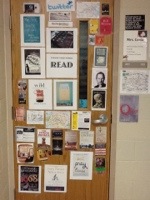
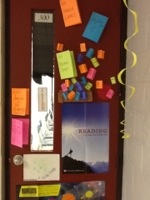
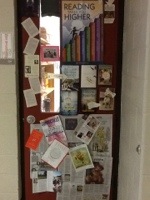
English teacher door...a wide rang of reading complete with motivational poster!

English teacher door…a wide rang of reading complete with motivational poster!

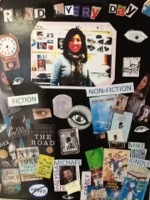
In a collective effort to demonstrate the importance of reading to students, teachers from every discipline decorated their classroom doors with materials they have read or are currently reading.

20130301-112618.jpg

When sharing a door meant less space, this resource room teacher used a poster.

Social Studies (Gr 7) had this door and the side wall as well!

Social Studies (Gr 7) had this door and the side wall as well! The genre range (politics-humor-sports) was astounding!

20130301-112656.jpg

The Art teacher door centered around the command “READ”.

20130301-112713.jpg

Health and Physical Ed teacher revealed a “retro” fondness for the books that contributed to her growing up including Erich Segal’s “Love Story”

20130301-112741.jpg

Alternative education students had to walk through a double door display! Students selected the books they read as well in this display.

20130301-112806.jpg

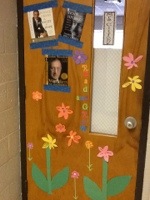
The resource room mixed decorative flowers with John Wooden “On :Leadership”

20130301-112843.jpg

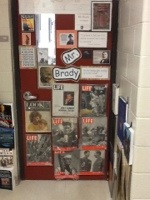
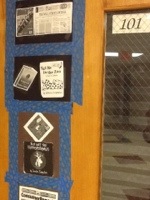
One Social Studies teacher took the assignment to heart by hanging what he reads, quite literally, onto the door and walls….He was considered the “winner!”

Admittedly, when the “Doors of Wamogo” was announced, there was a little hesitation. What would go on the door? When was this “due”?

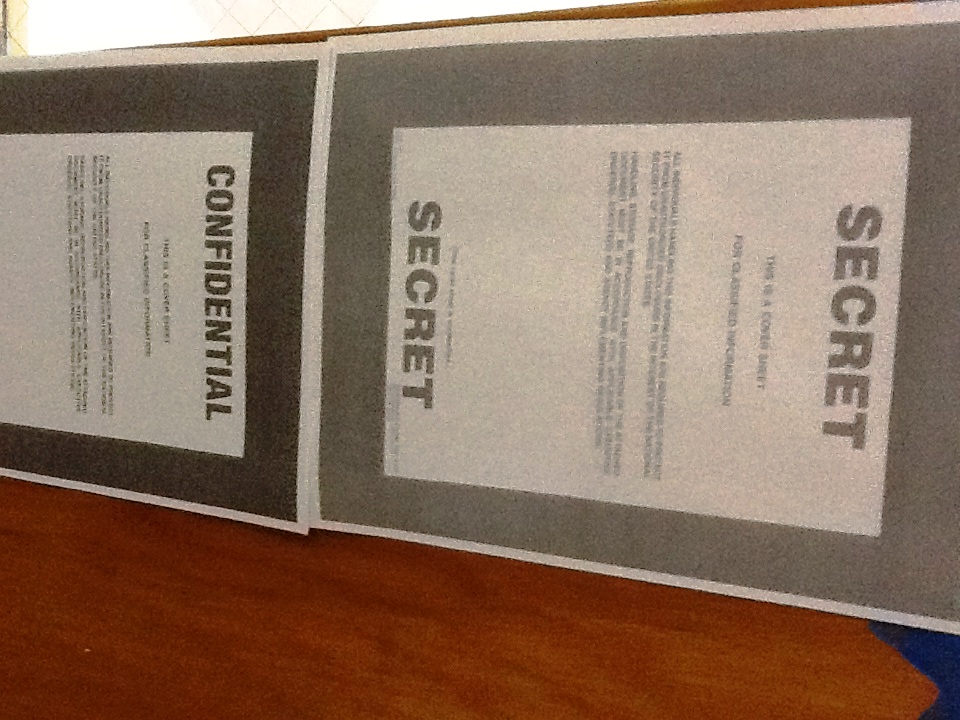
Finally, a few brave souls stepped up. First, there was the Social Studies teacher, an Army Reserve Colonel, who started by hanging “classified” documents on his door. His display was followed by the Business and Career Department teacher, also a basketball coach, who hung sports magazines and the cover of a Bobby Knight memoir.

The English Department members, the Literary Specialist, and the media center Librarian displayed a range of the reading, from Where the Wild Things Are to Great Expectations.

As the week went on, the competition became a little more intense. Finally,  the Grade 8 Social Studies teacher simply emptied out his bookshelf and placed all his favorite texts alongside the door in addition to the door.

Side shot of the "Classified" materials read by a Social Studies teacher

Side shot of the “Classified” materials read by a Social Studies teacher

Perhaps one of the more interesting outcomes was the sharing of titles between faculty and staff. “Oh, I loved that book!” one teacher would say to another. “This is a hard book, but well worth the effort,” said one teacher. “Yes, we read this in our ‘book club’!” exclaimed another. “Who is the Jody Picoult freak?” questions a science fiction reader. “How much Stephen King can you read?” was the retort.

20130301-112826.jpg

Math teacher places “Put Me in the Zoo” on his door; hopefully. this says more about his new baby daughter than the classes!

Students had a chance to look at all the titles: assigned reading from high school that they currently are reading (Romeo and Juliet, Animal Farm), political/history books, and sports memoirs. There were magazine covers, newspaper mastheads, and comic strips. Blogger, WordPress, Twitter, Facebook logos were prominent, social media as informational texts.

So what the “Doors of Wamogo”  created for Read Across America Day in our small rural school was a very large window. The doors provided a window into the lives of our faculty, a window for our students to see us as readers, and for our students to see what books made us successful.

These doors illustrate how reading gave each teacher and staff member a chance to at the window of opportunity; reading = individual success.

We had so much fun, we might try decorating again next year!

Happy Read Across America Day, 2013!

20130301-112923.jpg

Taking the playfulness of a Dr. Seuss motif to heart with replicas of books shared by students.