Archives For November 30, 1999

The teachers at the professional development session were visibly frustrated; I could hear the irritation in their comments. The presentation on the use of digital technology was to help them improve digital literacy across the content areas, but many of the sites in the demonstration were blocked by the school’s Internet filter. I sympathized with their frustration because just three years ago, I was like them. Three years ago, our school’s Internet filter blocked everything.blocked youtube

Back then, members of my English department were finding excellent resources to use to teach the novels All Quiet on the Western Front, The Crucible, and the memoir Night. Unfortunately, many of these resources were unavailable because they were on YouTube or had descriptors such as “witchcraft in Salem, Massachusetts” or “Nazi” that were blocked by our filters. The filters were useless to a large degree since many of the students knew a variety of different strategies to get around each filter. So, the irony was that the students had access where the teachers did not.

Furthermore, the students were having a rich and very authentic experience of using the Internet outside of school. Once they came into our building, however, they were detached from the very technology that they would need to use in their future. Our school web filters  created an “un-authentic” web experience for our students. We were losing the opportunity to teach them digital citizenship because they were not digital citizens.

Fortunately, our administration took the position that teaching our students 21st Century skills meant that they should have access to the Internet in a technology rich learning experience. The filters were minimized. Our acceptable use policy was enforced, and teachers and students had access to the Internet resources.

We moved from exclusively computer lab use to 1:1 netbooks in English/Social Studies to a “Bring Your Own Digital Device” (BYOD) over the course of the next two years, and now, two years later, I can testify that unblocking the Internet has not created a problem for teachers or students. Yes, the students can watch YouTube videos, but they also make videos and share them with other students. They make videos for our “Friendship and Respect” Assemblies and share these on YouTube; they watch Oscar winning films for Film and Literature Class that are on YouTube; they embed YouTube videos into their blogs.

Furthermore, our students have access to the Internet to meet the state adopted Common Core Literacy Standard:

CCSS.ELA-Literacy.CCRA.W.6 Use technology, including the Internet, to produce and publish writing and to interact and collaborate with others.

Of course, our students are not perfect, and their behaviors using the Internet at school are not always tied to curriculum. I once came upon a group of young men huddled around a computer screen one morning. They were watching a video, and as I grew closer, I could hear a voice say, “She’s a beauty…” and another agree, “Oh, I want her!” I feared the worst, but when  I came up behind them to see what was on the screen, I got a eyeful of a 2006 Ford F250 XLT Powerstroke Turbo Diesel Pick Up Truck. Curriculum? No. Authentic experience? Yes.

The frustrated teachers who were sitting in the professional development asked what steps they could take to have their administrators review acceptable use policies and open the Internet filters for their students. They discussed looking at other school districts’ acceptable use policies. Perhaps there might be some testimony about the success of unlocking an Internet filter?

This post is one such testimony, and I offer this to any teacher that is looking to “unblock” the Internet in order to engage students in developing 21st Century skills. We are already in the second decade of this 21st Century, and the skills necessary to use the Internet are becoming more valuable in this Information Age. According to the 2012 data, using the Internet is a real world experience for 2,405,518,376 people. That is 1/3 of the world’s population, and there has already been a 566% increase in use since the beginning of the new millenium.

Our students are counted in those numbers already. While they use the Internet outside of school for social media; they should be taught to use the Internet for education and productivity in school. So once they have access to YouTube, they can never go back…they will only go forward.

Of course, I received multiple links to the NY TimesMacbeth Mashup“from fellow English teachers, and yes, I thought that Claire Needell Hollander wrote a very funny piece. Yes, I believe students should be exposed to Shakespeare regularly, with or without the recommendations of the Common Core State Standards (CCSS). But, Macbeth for seventh and eighth graders? No!  That is just wrong. Wrong on theme, wrong for content, and very wrong for 11 and 12 year olds.

Hollander began her feature article making a great point about classroom dynamics:

“We say the classroom, as if an ideal classroom exists that somehow resembles every other classroom in America. In reality, every classroom has its own dynamic, and every class I’ve ever taught looks different from every other class. Perhaps more important, they also sound different.”

She is right. A chemistry of personalities creates a different dynamic in every classroom. The age of those personalities is also a factor. As I read the piece, however, I grew more and more frustrated. Macbeth features witches, warfare, murder, and, like most Shakespeare plays, sexual language. The word “blood” is repeated 41 times over the course of the play. Even the play itself is cursed; actors will not say the name of the play in the theatre. Many critics consider this Shakespeare’s “darkest play”.

Hollander herself questioned the appropriateness of this play for middle school students. She writes:

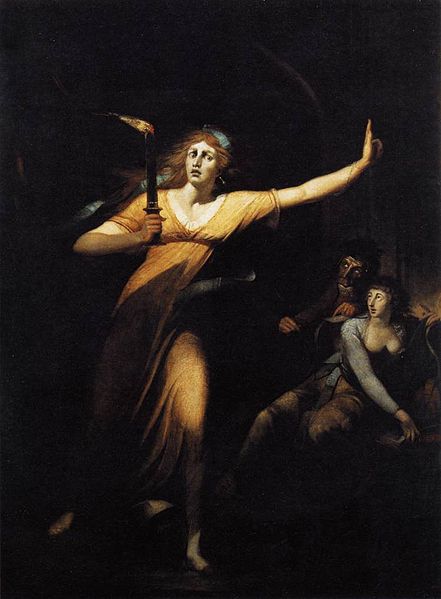
Lady Macbeth

John Henry Fuseli/ Johann Heinrich Füssli, Lady Macbeth Sleepwalking. Musée du Louvre, Paris Date: 1784. Creative Commons. Lady Macbeth driven to madness and suicide because her guilt in participating in the murder of King Duncan which leads to the murder of the guards, Macduff’s family, Banquo, and others…the stuff that nightmares are made upon.

“The kids have copies of the play with a modern English version on one side, but this isn’t easy either.”

“Tears of hilarity. Maybe middle school is too young for “Macbeth.”

Maybe? Definitely! So, why choose Macbeth?

Apparently, Hollander was attempting to satisfy a recommendation for archaic language for the secondary level in the English Language Arts Common Core. This is explained in Appendix A Language Conventionality and Clarity:

Texts that rely on literal, clear, contemporary, and conversational language tend to be easier to read than texts that rely on figurative, ironic, ambiguous, purposefully misleading, archaic, or otherwise unfamiliar language (such as general academic and domain-specific vocabulary).

In other words, the CCSS state that students should be exposed to complex diction, and the CCSS has made specific recommendations for grade 8 including:

  • Little Women by Louisa May Alcott (1869)
  • The Adventures of Tom Sawyerby Mark Twain (1876)
  • “The Road Not Taken” by Robert Frost (1915)

Hollander could consider the how the wording in CCSS Reading Standard 8  should guide her in selecting material for her combined seventh and eighth graders:

Analyze how a modern work of fiction draws on themes, patterns of events, or character types from myths, traditional stories, or religious works such as the Bible, including describing how the material is rendered new.

So many students come to high school without the necessary content to understand many of Shakespeare’s allusions. Perhaps the students know little about King Arthur and the Knights of the Round Table; why not Malory’s Morte d’Arthur? Or understanding the Pantheon of Greek Gods and Goddesses would be helpful; why not Edith Hamilton’s Greek Mythology?  Beowulf is usually taught in grade 10; the opening begins, “He was spawned in that slime, /Conceived by a pair of those monsters born/ Of Cain, murderous creatures banished/ By God, punished forever for the crime/ Of Abel’s death” (Raffel). Student should know this Biblical story of Cain and Abel. Students must come to high school prepared with the content needed to understand increasingly complex texts.

So why choose Macbeth? In fact, why choose Shakespeare at all? Ultimately, by not considering the recommendations of the CCSS to saturate students with the grade appropriate texts in our rich literary tradition, Hollander leaves them ill-prepared for Shakespeare at the high school level, when they are more mature to appreciate his themes.

So please, leave Macbeth, with his nihlism, his “...tale/Told by an idiot, full of sound and fury,/Signifying nothing” for older students.  Please leave Lady Macbeth with “…the smell of the blood still” where “all the perfumes of Arabia will not sweeten this little hand”, and leave Macbeth for high school. Besides, if Hollander is trying to meet the recommendations of the Common Core, she should leave Macbeth where the Common Core placed it, as a complex texts for 9th and 10th grades. The noisy mashup of Macbeth will still be crude and rowdy and demanding; but the students will be older, and these few additional years of maturity are necessary for dark tragedy in “the Scottish play”.

Ode on Grading (Earned)

January 28, 2013 — 2 Comments

The semester just ended, and there are papers to grade. In addition, the midterms are done, and there are essays and papers to grade. I am surrounded by paper. A recent article titled “Why Teachers Secretly Hate to Grade Papers” by John T. Tierney in The Atlantic received quite a bit of buzz, with most teachers flat out saying, “Secretly? There is nothing secret about our hating to grade!”

The article discussed the inability to be fair when grading, but I particularly enjoyed the following paragraph:

The sheer drudgery and tedium. When you’re two-thirds of the way through 35 essays on why the Supreme Court’s decision in the case of McCulloch v. Maryland is important for an understanding of the development of American federalism, it takes a strong spirit not to want to poke your eyes out with a steak knife rather than read one more. I have lots of friends who are teachers and professors. Their tweets and Facebook status updates when they’re in the midst of grading provide glimpses into minds on the edge of the abyss — and, in some cases, already deranged.

Since several of my classes are deep in the Odyssey, the “poke your eyes out” reference kicked all my Greek allusions into high gear. Consequently, instead of full-fledged blog post that will drain me of the minutes I have before grades are due, I leave you with a quick poetic attempt to capture my grading frustration:

Tantalus Has It Easy

My desk is piled high
with papers and essays that had been assigned
during the Christmas break,
when Dawn spread her rosy fingers on the
new year calendar empty of responsibilities.

Sing in me, Muse, and tell me
What was I thinking? an invocation I repeat
with each carefully completed grading rubric
stapled to a hastily penned paper.

More than one paper bears the correcting
suggestions I had made days ago without
the corrections I suggested. I am Cassandra,
unhappy prophetess whose warnings
go unheeded.

I hear a teacher’s scantron sheets
click noisely in the teacher’s room next door.
“Grading’s done,” he chortles, while I am
caught between the Scylla of unintelligible answers
and the Charybdis of illegible handwriting.

I see the PE teacher leaving early to workout
the stress of the week at the local fitness club.
Apparently, fate favors
the Olympically-sculpted

While I, like Sisyphus,upload_6i2s45k8nordin9cemradc8sv7249883.jpeg-final
reach for another paper to roll up
the grading curve.

forbesFobes recently published a feature article/photo spread, 30 Educators under 30:The Millennials Overhauling Education And Leaving No Child (Or Teacher) Behind by Meghan Casserly, 12/7/2012. The lead in for the article read:

The 30 Gen-Yers on our list are innovators, advocates, thought-leaders and reformers. Through outreach initiatives and engineering they’re committed, like my mom, to giving kids everywhere the best chance at success. They’re committed to making the lives of teachers like her just a little bit easier, whether through technology that saves them precious minutes communicating with parents or helps them use data analytics to track performance more efficiently than traditional paper grade books ever could.

A series of slick, glossy photos of well-dressed, smiling bright-eyed entrepreneurs and CEOs followed. Readers were advised to, “Click through the gallery for the 30 men and women who are disrupting education from top to bottom.” Disrupting? Is that what needs to happen to education? To disrupt? To disrupt means:

1. To throw into confusion or disorder;
2. To interrupt or impede the progress, movement, or procedure of;
3. To break or burst; rupture.

Disrupting is a perplexing choice if the purpose of the article is to praise the contributions these individuals are making to the business of education. When students disrupt a class, they are given detentions. The choice of the verb is contradictory because in the next sentence readers are encouraged “to visit their websites and reach out to congratulate them, to give them well-deserved credit for their hard work.” Are we being asked to congratulate disruption?

I did visit some of the websites mentioned in the photospread, and I do want to express my thanks to the CEOs who provide free and well-designed software programs. Specifically, I noted the photos of  Nic Borg, 26, Cofounder and CEO, Edmodo; Sam Chaudhary, 26, and Liam Don, 26, Co-founders of ClassDojo; and Andrew Sutherland, 23, Founder, Quizlet.  I will agree that these products contribute positively to my classroom environment. None of their products are “disruptive”.

The photos of these four product founders and their 26 smiling cohorts confirmed that all were vibrantly under 30, so I concede the “30 under 30” part of the headline. And yes, all 30 individuals are associated with the business of education, but they are not educators. These 30 individuals are educreators. The difference? Educators are in classrooms….Educreators are not.

Educators are in the classroom designing lessons, developing assessments, grading papers, contacting parents, posting bulletin boards, collecting data, analyzing data, meeting with teachers, collaborating with special education teachers, organizing supplies, selecting resources, and adjusting plans every minute of ever school day, and in most cases, for hours before or after school. In short, educators teach.

All Edu-creators have been in classrooms…as students. One edu-creator featured in the article spent three years in a classroom for Teach for America, one year more than the required two years of service. Each of the edu-creators has a product to improve education, but that does not make them educators. They are not in the classroom teaching; many are marketing a product for the classroom.

There has been an explosion of educreations that parallels the expansion of technology in the classroom. Many of these educreations from educreators are offered free or in “lite” versions. Ultimately, these products will make money for their founders and CEOs; there will be subscriptions or advertisements that generate revenue for these ’30 under 30″, and that is how capitalism works. A good product will sell, and many of these are good products. However, these products are tools for educators to use, not replacements for educators themselves.

Other members of the “30 under 30” are contributing to education policy by serving on boards, writing books, or being advocates for non-profits. These roles are also important, but again, these educreators have little practical experience to anticipate the problems that even the smallest changes in policy can have in the classroom. For example, a change in a state endorsed teacher evaluation system can result in thousands of hours for training evaluators and teachers  to meet new requirements, and those new requirements will be modified numerous times until an evaluation system proves effective. The effect of policy on the individual teacher or classroom is rarely witnessed; instead, policymakers are focused on the collection of “data”, not the hundreds of personal stories policy creates.

Comments under the article decry the lack of teachers. As Becky D succinctly  states:

I think it an egregious oversight that this list doesn’t include a single practicing educator.

Meghan Casserly’s response?

Educators obviously impact hundreds if not thousands of students over the course of their careers–and I looked for ways to weigh that against some of the other people on this list. Particularly for teachers under 30, it was extremely difficult to compare them in any apples-to-apples way. That said, there were some amazing teachers nominated who I was sure fit the bill—only to find out they were already 30!

So, are we to take from this comment that there are no real educators under 30 who are overhauling education and leaving no child behind? Perhaps there are no “amazing teachers” under 30 immediately visible to Casserly because they are so busy designing lessons, developing assessments, grading papers, contacting parents, posting bulletin boards, collecting data, analyzing data, meeting with teachers, collaborating with special education teachers, organizing supplies, selecting resources, and adjusting plans every minute of every school day that they simply do not have the time to create new educational software programs, run advocacy groups, or write educational policy. They are teachers, and they are real educators. They will not be featured in a Forbes magazine article about overhauling education because they are engaged in the time-consuming and productive activity of building skills and improving understanding for students of all ages.

What did Casserly get right with this article? She suggests that if the reader does get to meet one of the featured “30 under 30”, that the reader should ask, “…what teacher they have to thank for helping them land on our pages.” I agree;  their educators would be proud of the success of their former students, their own educreations.

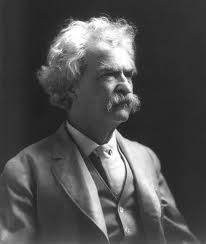
The health of the American Public school system is under debate in many different arenas: political, financial, social, ideological, and now, technological. At the root of these debates is our collective recognition or understanding confirmed by the author Mark Twain (Samuel Clemens):

“We believe that out of the public school grows the greatness of a nation.”

I have used this quote many times myself, but I had never researched the quotation’s context until recently. This quote comes from an address given to the Public Education Association at a Meeting of the Berkeley Lyceum, New York, November 23, 1900. The speech was given the title, “I am a Boxer”, and its brief 588 word composition means that Twain spoke onstage for all of six minutes, applause aside.

The historical background for the speech deals with European colonization in Africa and Asia, and the American efforts to annex the Philippines.  Predictably, there was resistance by the natives of a country resulting in serious and costly conflicts such as the Boer War in South Africa and the Boxer Rebellion in China. Twain had joined with a number of other Americans including William Jennings Bryan, Andrew Carnegie, John Dewey, and William James in an effort to stop a new rush to colonize. They formed the Anti-Imperialist League, and for a short time they coordinated efforts to stop the developing American Empire. Twain’s speech also referenced Russia’s involvement in the Boxer Rebellion in joint operations with US Marines and British troops.

On that Friday, Twain opened the speech to the Public Education Association with his familiar self-deprecating humor:

“I don’t suppose that I am called here as an expert on education, for that would show a lack of foresight on your part and a deliberate intention to remind me of my shortcomings.”

He explains that his extensive travels had improved his understanding of other cultures, and that may be a primary reason for the invitation to have him speak. His best seller The Innocents Abroad had been published the previous year (1899), and he was lecturing extensively on this travelogue. But he also considered his audience and noted another reason for this address:

“The other reason that I can see is that you have called me to show by way of contrast what education can accomplish if administered in the right sort of doses.”

His argument against Anti-Imperialism was satirically addressed in the next two paragraphs suggesting if the Public Education Association’s pictures that had been sent to an exhibition in Paris could convince Russia and France to withdraw troops from colonial conflict-how quickly world peace could be achieved!

He then illustrated his Anti-Imperialistic philosophy using the Boxer Rebellion by opening with a rhetorical question:

“Why should not China be free from the foreigners, who are only making trouble on her soil? If they would only all go home, what a pleasant place China would be for the Chinese! We do not allow Chinamen to come here, and I say in all seriousness that it would be a graceful thing to let China decide who shall go there.”

The last sentences in this section of the speech are the source for the title of this speech, “The Boxer believes in driving us out of his country. I am a Boxer too, for I believe in driving him out of our country.”

The anti-immigrant declaration of “I believe in driving him out of our country” is surprising coming from the liberal Twain. One hopes he was playing to the sentiments of his audience rather than some xenophobic desire to keep America free of the Chinese. The Boxers’s fierce opposition to Christianity did not make them popular in the United States. However, the statement could also be read as a converse to the statement that the Boxer is “driving us out of his country”, a form of quid pro quo.

So how does Twain get from the Boxer Rebellion to public schools? In the paragraph that follows the declaration of commonality with the Boxer, Twain updates his satirical comments to note that, sadly, Russia would not be withdrawing its troops; there would be no world peace. Russia could choose to  have an army or public schools, and as it could not afford both, Russia had chosen the army. Twain decries the choice:

“This is a monstrous idea to us. We believe that out of the public school grows the greatness of a nation.”

In using the pronouns “us” and “we” Twain joins the service of the Public Education Association. As he committed himself to the cause of the Boxer, Twain commits himself to the cause of the educator. Immediately after this statement, Twain includes a paragraph so prescient, a reader might think it came out of a recent town hall meeting:

“It is curious to reflect how history repeats itself the world over. Why, I remember the same thing was done when I was a boy on the Mississippi River. There was a proposition in a township there to discontinue public schools because they were too expensive. An old farmer spoke up and said if they stopped the schools they would not save anything, because every time a school was closed a jail had to be built.”

Twain wryly commented on his own anecdote with a familiar “Twain-ism”, commenting that the practice of not funding schools was  “like feeding a dog on his own tail. He’ll never get fat. I believe it is better to support schools than jails.”

He ended the speech with an off-handed compliment to the Public Education Association:

“The work of your association is better and shows more wisdom than the Czar of Russia and all his people. This is not much of a compliment, but it’s the best I’ve got in stock.”

Twain’s short address connected two unlikely ideas: the Boxer Rebellion and the American public school system. The speech is humorous, highly political, and frighteningly prescient. The thesis of his argument is not found in the title, but is found in the concerns he has about the funding of public education in America and abroad. In summary, Twain believed that nations who choose to fund armies over education will not be great. Education is necessary for world peace.

Mark Twain may have claimed that “I am a Boxer” in this short address, but he communicated quite clearly “I am an Educator.” Public education already had wonderful resources in the literature of Twain with The Adventures of Tom Sawyer and Huckleberry Finn. This speech solidly affirms his belief in the importance of our public education system. His contributions to the profession of education have not been matched since.

Sensible shoes dominate the NCTE Conference.

Spotting an English teacher in the crowds moving through the glitzy MGM Conference Center in Las Vegas is easy. Just look for the sensible shoes.

English teacher stamina is the stuff of legend, built up through hours of standing in front of a class, negotiating the space between groups of students and book bags tossed casually on the  classroom floor. We have perfected the quick sprint down a hallway to the copier for extra copies of a quiz or test.  Yes, we have learned from experience the necessitiy of wearing sensible, comfortable shoes. Our footwear choices came from our hard fought classroom experience, and that training was key to participation at the National Council of Teachers of English Conference (NCTE) since the MGM conference center has cavernous corridors and sessions are scattered over several acres of property. We walk, we walk, and we walk…quickly! There are hundreds of sessions, and only a few days to share new ideas and improvements to pedagogy.

“Dreams. Connect. Ignite.” is the motto of this NCTE 102nd Conference. While I have not personally witnessed much in the way of dreaming, the igniting is thankfully limited to the videos of pyrotechnics that are an element in the  Cirque de Soleil show “Ka.”. But I have participated in and witnessed plenty of connecting. My year of tweeting on Twitter has paid off!

Twitter gives teachers the opportunity to communicate with other teachers; to form communities of educators who ” follow” other educators. This is a very individualized form of professional development since I can pick those educators who are most helpful to me in helping me improve my practice. While I am attending sessions, I tweet what I am learning as notes to myself and to others.I  use the hashtag #NCTE12 to share my thoughts with other attendees. I have discovered many educators through the English Companion Ning and specific Twitter streams with hashtags such as  #engchat, #edchat, and #sschat. I follow the Twitter stream of conferences I attend, and my own school district’s stream #rsd6.

Here at the conference I have met other educators with whom I have been communicating over the past year, and the conversations we have had face to face are simply an extention of what we have been saying online. I have enthusiastically shared my use of Twitter with other attendees; “Look, you have to get on Twitter and follow this (speaker, educator)!” I greet those who tweet to me or follow me with the same enthusiasm I would greet old teaching companions. Meeting at this conference, we are free of the 140 character limit, the constant trimming of thought. Face to face we can complete a sentence without an abbreviation or a hashtag.

There are so many offerings at this conference that am I rushing from session to session. I do try and pay attention, however, to those who pass me in the maze of hallways and lobbies, scanning a name tag looking to see if one of attendees passing me might be one of my twitter “friends.” How do I know who to look at? Well, first, I look at the shoes.

The National Council of Teachers of English Annual Convention and the Council on English Leadership Convention begin this weekend (11/15-21) at the MGM Grand in Las Vegas, and I am so delighted to have the opportunity to present with my fellow faculty member, Stephanie Pixley, at three separate sessions. We are able to present to other teachers because of the great support and training our Regional School District #6 (Administration and Board of Education) has given its teachers in the use of technology in classrooms to improve student learning and develop 21st Century skills.

Wamogo High School in Litchfield, Connecticut, is a 1:1 Bring Your Own Digital Device (BYOD) school for grades 9-12, and we are learning everyday how our students’ use of technology has helped us differentiate our instruction, increase our students’ independence, and allow us to provide authentic tasks for our students. Last year, we used netbooks in our English and Social Studies classes and found how successfully technology could be used in reading and writing workshops at every grade level. This year, those netbooks have been moved to grades 7 and 8 for their use, and the high school students either provide their own devices or rent one from the school’s technology department..

The first session we will be offering is devoted to Cormac McCarthy’s novel The Road. We will feature work that the students have completed in using Abraham Maslow’s “Hierarchy of Needs” as a way to analyze characters in this post-apocalyptic novel. We will be demonstrating how our students, “Explore the poetic language of survival in Cormac McCarthy’s The Road the potential of 21st century connectivity and collaboration, and the use of mysteries to enhance students’ critical thinking abilities as presenters share literature experiences in three high school classrooms.”

Navigating the Mind: The Road Meets Maslow’s Hierarchy
Time:  Saturday 11/17 8:00 AM – 9:15 AM
Level:  Secondary (9-12)
Topic of Interest: Literature
Location:  Studio Room 6, Grand Arena, Main Floor by Grand Garden Arena, MGM Grand

The other two sessions will be offered to the Council on English Leadership:

You Ain’t Nothing but a Blog Hound
Monday 11/19 4-5:00 PM
D.3 Room 106

Description: You may already know that a blog platform offers students at all grade levels an opportunity to engage in an authentic writing experience in or outside the classroom. This workshop demonstrates the use of a blog platform for students to engage in thoughtful discussion on whole class or independent reading. This workshop will also feature how to organize, moderate, and assess both blog posts and comments on a variety of blog platforms. There will also be a focus on improving a student’s awareness of audience and purpose in a written response, and strategies will be provided so student comments are more sophisticated than a standard “I liked what you wrote.”

Writer’s Workshop Graduates to High Tech Literature Circles
Tuesday  11/20 10-11:00 AM
F.2  Room 106

Description: This session will feature strategies used in the teaching of writing at the middle and high school levels using a variety of 2.0 technologies, including blogs, wikis, and document sharing software. The emphasis will be on providing examples of differentiated student-centered activities that will develop independence in the writer’s transition from middle school to high school. High-tech writing provides opportunities for student accountability, group collaboration, and whole class communication

(NOTE: This session was presented this at Literacy for All Convention, 11/5 & 11/6 in Providence, RI)

We are looking forward to presenting and attending the wonderful selection of sessions over the next few days. This is certainly a wonderful opportunity for our own professional development and a chance for us to showcase our small but very forward thinking school district-Regional School District #6 !

The impending Hurricane Sandy did little to stop over 2000 teachers from attending the 83rd Saturday Reunion at Teacher’s College at Columbia University on Saturday, October 27. Taking up the microphone in a set of informal welcoming remarks, Lucy Calkins complimented the crowd that had gathered in the Nave in Riverside Church, “So many of you have come here…instead of clearing out storm drains or without stocking up on toilet paper. You have weathered the trip despite the predictions of this ‘Franken-storm’.” The crowd laughed appreciatively.

“Yes. We are in a storm,” she continued with growing seriousness. “Today, we are in a ‘Perfect Storm’ in education, and we must learn to travel these hurricane winds and sail.”

Calkins was referencing the convergence of the Common Core State Standards with educational reform efforts that emphasize standardized testing. Newly designed teacher evaluations tied to single metric tests combined with cuts in funding for public school education because of a stagnent economy have also contributed to this ‘Perfect Storm’. This audience understood her metaphor.

Lucy Calkins is the Founding Director of the Reading and Writing Project LLC and the Teachers College Reading and Writing Project as well as the Robinson Professor in Children’s Literature at Teachers College where she co-directs the Literacy Specialist Program.

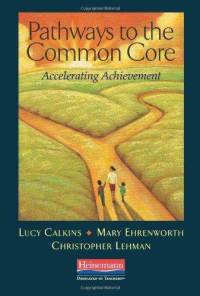
Co-authors Lucy Calkins, Mary Ehrenworth and Christopher Lehman all led sessions at the 83rd Saturday Reunion of the Teachers College Reading and Writing Project on Saturday, October 27, 2012

At a session that followed her welcoming remarks titled, “Implementing the Common Core: What’s Working, in Big Exciting Ways, to Engine Dramatic Reforms,” Calkins explained that she would not be delivering a big keynote at this conference on the Common Core, despite her belief that she considers this “most important document in the history of American education.” Instead, she plans to take time off from teaching to tour the country speaking on the Common Core and the book she co-authored, Pathways to the Common Core, in ordercto help school districts with the real work of accelerating students to perform at the level required by the Common Core, noting that “85% of our students are not there.”

Calkins also expressed her concerns that our nation’s history of large-scale educational reform is not good. “We have been sent many times to reform school,” she continued, “we have to be worried that this [Common Core] may be just one more reform.” However, Calkins stated that what works in this particular reform’s effort is the “absolute and total appreciation that what will make the difference is the teacher.” She directly confronted all the teachers in attendance and directed, “You need to be knowledgeable, and read the actual Common Core, not the ‘Publisher’s Guide to the Common Core’.” Her concerns at this conference echo her remarks in March 2012 at the 82nd Saturday reunion where she specifically called out David Coleman, co-founder and CEO of Student Achievement Partners  and who, according to Pathways to the Common Core, “received a  four-year 18 million dollar grant from the GE Foundation to develop materials and do teacher training around the CCSS” (6). Coleman has since moved on to take a position as the President of the College Board. Pathways to the Common Core, co- authored with Mary Ehrenworth and Christopher Lehman, details concerns that this enormous grant and any additional grant money will result supporting those who are “spelling out implications and specifying what they wish the Common Core had said,”(5). Already there has been a growing body of materials that contradict the intentions of the standards:

“There will certainly be additional materials and documents that emerge following this new round of money, with the potential to make similar claims as the Publisher’s Criteria for the Common Core Standards in English Language Arts and Literacy, Grades 3-12 (Coleman and Pimentel 2011)  and the Rubrics for Evaluating Open Education Resources (OER) Objects (Achieve 2011). When documents are presented as if they’ve gone through the process of review and been ratified by the states on subcommittees, it is troubling”(6).

Calkins reminded participants that the crucial difference will be the professional teachers who bring colleagues into their work to build a community of teachers, and that this community should know the Common Core standards.

Turning to the topic of her session, Calkins also explained that some of the most exciting work that was recently taking place on the Common Core  at the Teachers College was with their work with students in argument and debate.

She described the success teachers at the Reading and Writing Project were having with students who participated in read-aloud by gathering evidence for one position or another. For example, students had listened to a reading of The Stray and took notes on different positions. Following the basic rules of debate, students were given the opportunity to caucus with those who held their opinions before debating or refuting their debate partner’s position. In order to model the process with Shel Silverstein’s The Giving Tree, teachers taking one position that the tree was strong stood to caucus with like-minded participants, while those seated conferred with those who agreed with the different opinion that the tree was weak. Calkins directed teachers to stand, sit, debate or caucus, modeling how this might work in a classroom in one 45-50 minute period. She showed several video clips showed students participating in the same process demonstrating the success of using these techniques. “The results were fantastic,” Calkins exclaimed as the videos played, “so exciting to see the students gathering evidence and using the text in their arguments.”

What was evident during her sessions at this conference was that during this ‘Perfect Storm’ in education, Calkins is confidently empowering teachers to sail through what seems to feel like hurricane force changes in the profession. Her efforts in preparing teachers to navigate these new challenges can help insure that while these controversial storms may rage outside, inside the classroom day after day, the teacher is prepared to be the captain of the ship.

Educational reform is on the minds of many business leaders and several have weighed in with their concerns:

“We know we are facing a transition, and we must take this opportunity to provide today’s students with the tools and the thinking that is required for the future” ( John Chambers, Cisco Systems).

“….our high schools – even when they’re working exactly as designed – cannot teach our kids what they need to know today,” (Bill Gates, Microsoft).

“The fact is, too many graduating seniors are unprepared for what will be required to succeed in college or in the workplace,” (William G. Jurgensen, CEO, Nationwide)

These business leaders have every right to express their interest in improving education for the nation. After all, their businesses will require an educated work force. However, too often business leaders speak about educational reform using a business model that is radically different from the public education model.

Funding-Private equity vs. Tax Dollar

A business is funded by an individual or a group of investors, and additional revenue for a business can be added through profits, loans, or the selling of additional shares. In contrast, public school education is funded by taxpayers at the local, state, and federal level; ultimately, politicians control the purse strings for school districts. This manner of funding can be grossly inequitable: On the blog CT news.com, in 2011, Ansonia, Connecticut, spent $10,520 per student while the nearby district Region 9 (Easton/Redding) spent $18,426 per student that same year. Funding can often be capricious as tax revenues depend on the general economy and political agendas; funding can change annually with revenue that cannot be transfered year to year or invested. There are always political promises to reduce taxes despite rising operating and capital costs in educating our nation’s youth to develop 21st Century skills for our future workforce.

Business Loss-Cutting Poor Performers?

Another problem with using the business model for education is the business loss. A clear definition of a business loss is on Investopedia.com:

A business practice that seeks to detect, identify, investigate and prevent events that cause a drop in value of any of an organization’s revenues, assets and services. Loss-management improvements may involve changes in a business’s operating policies and business model in order to limit instances of accidental and/or intentional loss.

A business with a business loss must be flexible. A business may change operating policies (hours, locations, retail policies, purchasing policies, etc).  In contrast, a public school system that deals with a loss in funding or facilities or student enrollment cannot change hours, locations, or policy arbitrarily or with the speed that business has to react to changes in the market.  Furthermore, a business is free to drop a product line or drop poor performing employees. In contrast, schools cannot drop specific programs (core subjects of math, language arts, science, social studies) or poor performing students. Dropping poor performing students would certainly help test score results but that is not the purpose of public education. In this nation we  educate every student.

Competition-Winners vs. Losers

Business is built on competition and products and services go head to head for the public’s dollar. Economists believe that the market will crowd out inferior products and services using this competitive model. However, employing this model of competition in education would result in a tiered system of inequity. Education reform efforts to introduce competition have included choice through charter schools, but the results of these competitive efforts have not been any more successful than the efforts expended by the public schools. In the inital pilot study (2003) The National Assessment of Educational Progress (NAEP), considered  population differences and reported that “the mathematics performance of White, Black, and Hispanic fourth-graders in charter schools was not measurably different from the performance of fourth-graders with similar racial/ethnic backgrounds in other public schools.” The study also reported that, “In reading, there was no measurable difference in performance between charter school students in the fourth grade and their public school counterparts as a whole.” What this means is that competition with other schools is not a factor in school success. Furthermore, the students cannot be part of a competitive market with winners and losers if the goal is to educate every student. Every student must be a winner.

The Single Metric Test

A business with a single product is limited, so many businesses diversify.  Businesses measure success on products or services with monthly, quarterly, and annually produced data through a variety of measurements. Education in contrast is being forced to measure student achievement through standardized tests. Each standardized test “snapshot” is taken one day during a school year, and the results establish a school as being a success or failure. Reform efforts fron No Child Left Behind and Race to the Top exploit this one test metric. Judging a school with this system of measurement is like measuring retail business’s success by one day of sales. Many states are using these single metric tests for teacher evaluations. Would a company’s CEO be judged by one day’s stock price or a salesman by one day of sales? Additionally, the calls listed above ask for “tools and the thinking” that our business leaders want for their future workforce; an increased focus on single metric tests is not a solution for 21st Century skill development and critical problem solving.

Business leaders should have a great deal to say about education since they will be hiring the product of the nation’s education system. But the tenets of business do not match the tenets of education, and business policy does not always have a comparative counterpart in education. Public education is a very specialized institution and the reform of education must come from those who have both the training and classroom experience, beyond the just “being in the classroom” experience of many successful business leaders.

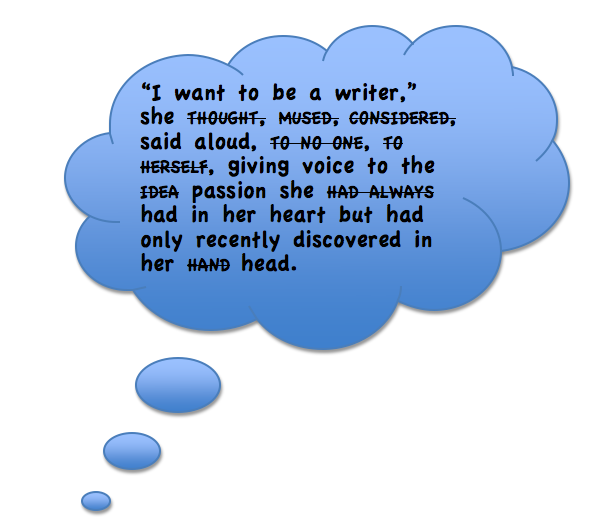
One of my favorite cartoons features a young woman, obviously nervous, seated next to a white-suited, white-haired caricature of Samuel Clemens. Above her head floats a thought bubble,“‘I want to be a writer,’ she thought, mused, considered, said aloud, to no one, to herself, giving voice to the idea passion she had always had in her heart but had only recently discovered in her hand head.”

I also always wanted to be a writer, but the responsibility of writing stopped me. Writing was a task that I took very seriously. I had to write papers for courses I took. I had to write letters-personal and professional- and I had to write memos for work. Writing was a product that needed to be perfect. As a result, my writing duties had stifled my writing passion.

However, sixteen months ago I started this blog to share the ways I had increased the number of books in school classrooms. During the first month of entries, I wondered if I would have enough materials to write about on a blog about used books in class.

I am almost embarrassed to admit that what I have discovered is that writing is less product and more thinking. Sadly, I was an English teacher who required writing and encouraged students to write regularly in class, but who did not cognitively understand that writing is really a recording of thinking. I was always interested developing (and assigning) the prompt and collecting (and correcting) the final product. I did not fully understand the necessity of thinking as the most critical part of the writing until I began to write myself.

Now, as a convert to writing as thinking, I am using this post to encourage others to write in order to think.

October 19-20th, 2012 will be the National Day of Writing. The National Writing Project (NWP) is encouraging people to contribute to “What I Write” on their website:

What do you write or compose? Blog posts? Poems? Videos? Grocery lists, computer code, or song lyrics? Whatever you write, on Friday, October 19, use the hashtag #whatiwrite to share your compositions with the world as part of this year’s National Day on Writing.

National Council of Teachers of English (NCTE) has  links on their blog for people to read what authors say about why they write. The NYTimes Learning Network also has a page on their blog asking, “Post what, you ask? Well, could be…

  • Thoughts about what you write, whether it’s poetry, short stories, school essays, computer code, love notes, song lyrics or Facebook updates.
  • A link to some writing you want to show others.
  • A photo or drawing that illustrates something about writing, or illustrates something you’ve written.
  • Thoughts about things you’d like to write someday.
  • Notes on your writing process.
  • Thoughts on the role of writing in your life in general.
  • Advice about writing.
  • Links to good pieces about writers or writing

So, on Friday, October 19th, I will have my students create lists of topics they want to “think” about, topics* they want to explore in writing over the course of the year. We will collaborate on a master list using a Google doc that we can revisit over the course of the school year. I want my students to learn how to write, but more importantly, I want my students to learn how to write so they can think. I want they to feel free to write without constant assessment. I want them to write and read what they write to understand what they think. Hopefully, in this process they will discover that writing is not an academic responsibility, and that good writing is really good thinking. And I will imagine  thought bubbles over their heads as they write.

Share the hashtag #whatIwrite.

*Topic list created 10/18/2012