Archives For November 30, 1999

The health of the American Public school system is under debate in many different arenas: political, financial, social, ideological, and now, technological. At the root of these debates is our collective recognition or understanding confirmed by the author Mark Twain (Samuel Clemens):

“We believe that out of the public school grows the greatness of a nation.”
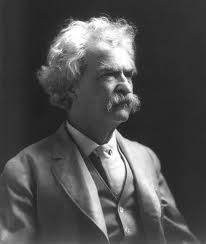
I have used this quote many times myself, but I had never researched the quotation’s context until recently. This quote comes from an address given to the Public Education Association at a Meeting of the Berkeley Lyceum, New York, November 23, 1900. The speech was given the title, “I am a Boxer”, and its brief 588 word composition means that Twain spoke onstage for all of six minutes, applause aside.

The historical background for the speech deals with European colonization in Africa and Asia, and the American efforts to annex the Philippines.  Predictably, there was resistance by the natives of a country resulting in serious and costly conflicts such as the Boer War in South Africa and the Boxer Rebellion in China. Twain had joined with a number of other Americans including William Jennings Bryan, Andrew Carnegie, John Dewey, and William James in an effort to stop a new rush to colonize. They formed the Anti-Imperialist League, and for a short time they coordinated efforts to stop the developing American Empire. Twain’s speech also referenced Russia’s involvement in the Boxer Rebellion in joint operations with US Marines and British troops.

On that Friday, Twain opened the speech to the Public Education Association with his familiar self-deprecating humor:

“I don’t suppose that I am called here as an expert on education, for that would show a lack of foresight on your part and a deliberate intention to remind me of my shortcomings.”

He explains that his extensive travels had improved his understanding of other cultures, and that may be a primary reason for the invitation to have him speak. His best seller The Innocents Abroad had been published the previous year (1899), and he was lecturing extensively on this travelogue. But he also considered his audience and noted another reason for this address:

“The other reason that I can see is that you have called me to show by way of contrast what education can accomplish if administered in the right sort of doses.”

His argument against Anti-Imperialism was satirically addressed in the next two paragraphs suggesting if the Public Education Association’s pictures that had been sent to an exhibition in Paris could convince Russia and France to withdraw troops from colonial conflict-how quickly world peace could be achieved!

He then illustrated his Anti-Imperialistic philosophy using the Boxer Rebellion by opening with a rhetorical question:

“Why should not China be free from the foreigners, who are only making trouble on her soil? If they would only all go home, what a pleasant place China would be for the Chinese! We do not allow Chinamen to come here, and I say in all seriousness that it would be a graceful thing to let China decide who shall go there.”

The last sentences in this section of the speech are the source for the title of this speech, “The Boxer believes in driving us out of his country. I am a Boxer too, for I believe in driving him out of our country.”

The anti-immigrant declaration of “I believe in driving him out of our country” is surprising coming from the liberal Twain. One hopes he was playing to the sentiments of his audience rather than some xenophobic desire to keep America free of the Chinese. The Boxers’s fierce opposition to Christianity did not make them popular in the United States. However, the statement could also be read as a converse to the statement that the Boxer is “driving us out of his country”, a form of quid pro quo.

So how does Twain get from the Boxer Rebellion to public schools? In the paragraph that follows the declaration of commonality with the Boxer, Twain updates his satirical comments to note that, sadly, Russia would not be withdrawing its troops; there would be no world peace. Russia could choose to  have an army or public schools, and as it could not afford both, Russia had chosen the army. Twain decries the choice:

“This is a monstrous idea to us. We believe that out of the public school grows the greatness of a nation.”

In using the pronouns “us” and “we” Twain joins the service of the Public Education Association. As he committed himself to the cause of the Boxer, Twain commits himself to the cause of the educator. Immediately after this statement, Twain includes a paragraph so prescient, a reader might think it came out of a recent town hall meeting:

“It is curious to reflect how history repeats itself the world over. Why, I remember the same thing was done when I was a boy on the Mississippi River. There was a proposition in a township there to discontinue public schools because they were too expensive. An old farmer spoke up and said if they stopped the schools they would not save anything, because every time a school was closed a jail had to be built.”

Twain wryly commented on his own anecdote with a familiar “Twain-ism”, commenting that the practice of not funding schools was  “like feeding a dog on his own tail. He’ll never get fat. I believe it is better to support schools than jails.”

He ended the speech with an off-handed compliment to the Public Education Association:

“The work of your association is better and shows more wisdom than the Czar of Russia and all his people. This is not much of a compliment, but it’s the best I’ve got in stock.”

Twain’s short address connected two unlikely ideas: the Boxer Rebellion and the American public school system. The speech is humorous, highly political, and frighteningly prescient. The thesis of his argument is not found in the title, but is found in the concerns he has about the funding of public education in America and abroad. In summary, Twain believed that nations who choose to fund armies over education will not be great. Education is necessary for world peace.

Mark Twain may have claimed that “I am a Boxer” in this short address, but he communicated quite clearly “I am an Educator.” Public education already had wonderful resources in the literature of Twain with The Adventures of Tom Sawyer and Huckleberry Finn. This speech solidly affirms his belief in the importance of our public education system. His contributions to the profession of education have not been matched since.

The National Council of Teachers of English Annual Convention and the Council on English Leadership Convention begin this weekend (11/15-21) at the MGM Grand in Las Vegas, and I am so delighted to have the opportunity to present with my fellow faculty member, Stephanie Pixley, at three separate sessions. We are able to present to other teachers because of the great support and training our Regional School District #6 (Administration and Board of Education) has given its teachers in the use of technology in classrooms to improve student learning and develop 21st Century skills.

Wamogo High School in Litchfield, Connecticut, is a 1:1 Bring Your Own Digital Device (BYOD) school for grades 9-12, and we are learning everyday how our students’ use of technology has helped us differentiate our instruction, increase our students’ independence, and allow us to provide authentic tasks for our students. Last year, we used netbooks in our English and Social Studies classes and found how successfully technology could be used in reading and writing workshops at every grade level. This year, those netbooks have been moved to grades 7 and 8 for their use, and the high school students either provide their own devices or rent one from the school’s technology department..

The first session we will be offering is devoted to Cormac McCarthy’s novel The Road. We will feature work that the students have completed in using Abraham Maslow’s “Hierarchy of Needs” as a way to analyze characters in this post-apocalyptic novel. We will be demonstrating how our students, “Explore the poetic language of survival in Cormac McCarthy’s The Road the potential of 21st century connectivity and collaboration, and the use of mysteries to enhance students’ critical thinking abilities as presenters share literature experiences in three high school classrooms.”

Navigating the Mind: The Road Meets Maslow’s Hierarchy
Time:  Saturday 11/17 8:00 AM – 9:15 AM
Level:  Secondary (9-12)
Topic of Interest: Literature
Location:  Studio Room 6, Grand Arena, Main Floor by Grand Garden Arena, MGM Grand

The other two sessions will be offered to the Council on English Leadership:

You Ain’t Nothing but a Blog Hound
Monday 11/19 4-5:00 PM
D.3 Room 106

Description: You may already know that a blog platform offers students at all grade levels an opportunity to engage in an authentic writing experience in or outside the classroom. This workshop demonstrates the use of a blog platform for students to engage in thoughtful discussion on whole class or independent reading. This workshop will also feature how to organize, moderate, and assess both blog posts and comments on a variety of blog platforms. There will also be a focus on improving a student’s awareness of audience and purpose in a written response, and strategies will be provided so student comments are more sophisticated than a standard “I liked what you wrote.”

Writer’s Workshop Graduates to High Tech Literature Circles
Tuesday  11/20 10-11:00 AM
F.2  Room 106

Description: This session will feature strategies used in the teaching of writing at the middle and high school levels using a variety of 2.0 technologies, including blogs, wikis, and document sharing software. The emphasis will be on providing examples of differentiated student-centered activities that will develop independence in the writer’s transition from middle school to high school. High-tech writing provides opportunities for student accountability, group collaboration, and whole class communication

(NOTE: This session was presented this at Literacy for All Convention, 11/5 & 11/6 in Providence, RI)

We are looking forward to presenting and attending the wonderful selection of sessions over the next few days. This is certainly a wonderful opportunity for our own professional development and a chance for us to showcase our small but very forward thinking school district-Regional School District #6 !

Bond.

James Bond.

007.

On Her Majesty’s Secret Service, and (surprise!) a metaphor for why relying on the standardized test is flawed.

Honestly, I was not expecting Skyfall, the latest James Bond blockbuster, to resonate with issues being discussed in educational reform today, but sitting in the darkened theatre, I suddenly heard the same concerns about the validity of tests used in assessing secret agents that I hear in assessing students.

Apparently, M-I 6 wrestles with the question: Do tests really measure ability?

Spoiler Alert! If you are someone who intends to see the film, I may be giving away a few facts; not major plot points, but a few incidental pieces of information. Bond Purists-stop reading now, please.

Before Bond (Daniel Craig) returns to work for M (Dame Judi Dench), he needs to pass a set of standardized performance tests. He is first put through a series of grueling fitness tests. He is tested on his ability to shoot a pistol at various distances in a firing range. Finally, he faces a series of psychological tests. The results of how well he succeeded in this battery of objective tests is initially kept from the audience, but the viewers are not surprised when he eventually returns to service.

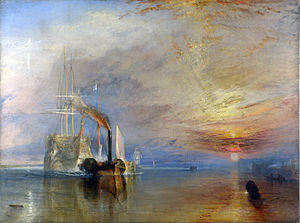
Painting at the National Gallery in London

The film’s screenwriters saw fit to combine the concerns about the results of these tests with M-I 6’s concerns about Bond’s age. No scene is more direct in confronting Bond’s age than in his first meeting with the young gadget supplier “Q”. The filmmakers placed Bond at a British National Gallery sitting on a bench looking at J.M.W. Turner’s painting Fighting Temeraire Tugged to Her Last Berth To Be Broken Up, 1838 .

Turner’s symbolic message of the painting depicts the shift from sail power to coal engine, the billowing white clouds swirling like sails a stark contrast to the blackened smokestack of the tug in the forefront of the painting.  Q enters, sits next to Bond, and strikes up a conversation:

Q: It always makes me feel a bit melancholy. Grand old war ship. being ignominiously haunted away to scrap… The inevitability of time, don’t you think? What do you see?
Bond:  A bloody big ship. Excuse me.
Q: 007. I’m your new Quartermaster.
Bond: You must be joking.
Q:  Why, because I’m not wearing a lab coat?
Bond: Because you still have spots.
Q: My complexion is hardly relevant.
Bond: Your competence is.
Q: Age is no guarantee of efficiency.
Bond:  And youth is no guarantee of innovation.

Skyfall (http://www.imdb.com/title/tt1074638/quotes)

Of course, the M-I 6 tests are designed to determine if Bond is too old, if his brand of “boots on the ground” spying should be replaced by agents in command of newer technologies. And of course, M is obligated to submit Bond to the required standardized tests, tests given on one particular day. However, she is not obligated to act on the results of the tests.

M’s response, therefore, is to weigh what audiences know are the 50 years of evidence on Bond’s unconventional performance as a creative problem solver. She recognizes that Bond possesses those intangible qualities of initiative and drive, and while a standardized test does measure a level of ability, what makes Bond a valuable British agent is his ability to confound a standard.

Watching James Bond puzzle the test-driven establishment is a large part of the enjoyment for the audience. Agent 007 cannot be limited by a test score if he is going to save the free world.

Which brings me back to the shared message about testing from Skyfall and its application to education reform. The audience understands that the testing in Skyfall is flawed because of the limited results; standardized testing in education is similarly limited. Like M, educators should not let their students be defined by test scores from standardized tests, those single metric assessments given on one day. Like M, educators should pay more attention to having students develop problem-solving skills and to consider other assessments that measure students’ critical thinking skills.  Students should have the opportunity to be evaluated on the intangible qualities of initiative and drive through project-based learning. Like Agent 007, students should be allowed the opportunity to confound those standards measured by objective testing.

Oh, and maybe they could also ask for their chocolate milk shaken, not stirred.

Jack Gantos stood on the steps of the altar at NYC Riverside Chapel blinking through large black glasses as he addressed the large crowd of educators who sat eager to hear him speak, “I feel compelled to throw a little fairy dust teaching into this…to educate and illuminate simultaneously.” Then, looking back at the large screen that projected the cover of his Newbery Award winning book, Dead End in Norvelt, he grinned broadly, “Yes, I wrote this book!”

Jack Gantos was the final keynote speaker at the Teachers College 83rd Saturday Reunion on Saturday, October 27th, and he was clearly enjoying this opportunity to talk about his evolution as a reader and as a writer.  The large screen projected other images, handwritten notes and neatly drawn “spy” maps. “Here are some pages from a journal I kept,” explained Gantos, “ and you should know, that the boy that wrote this journal in fifth grade is the same man who writes today.” And write he does. Gantos is the author of the Rotten Ralph series and several books dedicated to the character Joey Pigza. In addition to this most recent Newbery Award, Gantos has also won Michael L. Printz and Robert F. Sibert honors, and he has been a National Book Award Finalist.

“The very first award you give yourself to set the bar high,” he intoned earnestly. “What everybody needs to do is to honestly come to some sense of literary standards, and those standards are defined by your reading.”

As a teacher, I am most familiar with Gantos’s memoir A Hole in My Life, which is a core text for our 12th grade Memoir elective. At 208 pages, the small paperback is much less intimidating than other memoirs, but its small size packs an amazing punch. With brutal honesty, Gantos details the year when just out of high school he became involved in smuggling drugs, and how he survived his prison sentence. A pattern of his prison mug shots covers the front of the text, and Gantos remarks about that picture early in the memoir:

“The prisoner in the photograph is me. The ID number is mine. Th ephoto was taken in 1972 at the medium-security Federal Correctional Institution in Ashland, Kentucky. I was twenty-one years old and had been locked up for a year already -the bleakest year of my life-and I had more time ahead of me” (3).

The memoir also chronicles Gantos’s development as a writer, and how, “dedicating himself more fully to the thing he most wanted to do helped him endure and ultimately overcome the worst experience of his life.” (Amazon)

I have one class set (30) of these memoirs, and I occasionally find additional copies at used book sales which indicates that the book is often assigned for summer reading.

When they read A Hole in My Life, many students have strong reactions to the prison scenes, which take place in the last third of the memoir. “This is NOT a kid’s book,” more than one of them has told me, “this guy cannot be a children’s author!”  They are notorious for trying to “protect” younger readers from any sordid incidents recounted in a book, and Gantos spares no details in describing some of the violent injuries he witnessed while working in the prison’s hospital ward. A Hole in My Life carries differences in age recommendations. Publisher’s Weekly suggests ages 12 and up, the book is a 2003 Bank Street – Best Children’s Book of the Year, and the Amazon recommendation is for ages 14 and up.

During his address, Gantos talked about the importance talking to teachers and students had in his creative process. Pointing to a picture of the cover, he said proudly, “This is the book that gets me into the front door of some high school where I can I get to talk about books and writing. This book is just like a key where I get to meet those high school kids.”

Usually, I usually assign the memoir to be read and discussed in literature circles and frequently students take these instructions to simply restate plot, “what happened? What happened next?” However, since Gantos was eager to share his structure with his audience, I may employ this strategy with this text. “When you think about a story,” he paused to show a graph projected on the big screen, ”you don’t think about the 50% invisible side called the structure. When I write, I draw 16 boxes and I fill them” he gestured to his sketches, “Beginning, middle,…action, story, character,” proving to this audience that their time pushing graphic organizers onto their students is still a worthwhile endeavor. As for the ending? “A book always has a double ending; the first is the physical ending, but the second is the emotional ending.” This is true in A Hole in My Life. Gantos relates the heartbreaking loss of his prison diary, written in between the lines of The Brother’s Karamazov, Gantos sharing the page space with the words of Dostoevsky. This diary was the more expensive the price to pay for his felonious actions, not the physical time he had spent behind bars.

He explained to his audience, “the reader wants to know how has the character been changed by an experience…the reader wants to have been inspired.” Gantos continued with more passion as he continued, “You read a book, and the next day, the book will be the same, but that you won’t. The that book will infects you and add to that little Library of Congress you have in your head.”

Gantos’s use of the Library of Congress, with the marble and beautiful domed ceiling as a metaphor for the reader’s brain is particularly vivid. The Library of Congress is the largest library in the world, with millions of books, recordings, photographs, maps and manuscripts in its collections. That powerful image is one every teacher in the room hopes for their students.  After all, what could be better than producing a nation of graduates who have the resources of Library of Congress readily available in their brains?

The impending Hurricane Sandy did little to stop over 2000 teachers from attending the 83rd Saturday Reunion at Teacher’s College at Columbia University on Saturday, October 27. Taking up the microphone in a set of informal welcoming remarks, Lucy Calkins complimented the crowd that had gathered in the Nave in Riverside Church, “So many of you have come here…instead of clearing out storm drains or without stocking up on toilet paper. You have weathered the trip despite the predictions of this ‘Franken-storm’.” The crowd laughed appreciatively.

“Yes. We are in a storm,” she continued with growing seriousness. “Today, we are in a ‘Perfect Storm’ in education, and we must learn to travel these hurricane winds and sail.”

Calkins was referencing the convergence of the Common Core State Standards with educational reform efforts that emphasize standardized testing. Newly designed teacher evaluations tied to single metric tests combined with cuts in funding for public school education because of a stagnent economy have also contributed to this ‘Perfect Storm’. This audience understood her metaphor.

Lucy Calkins is the Founding Director of the Reading and Writing Project LLC and the Teachers College Reading and Writing Project as well as the Robinson Professor in Children’s Literature at Teachers College where she co-directs the Literacy Specialist Program.

Co-authors Lucy Calkins, Mary Ehrenworth and Christopher Lehman all led sessions at the 83rd Saturday Reunion of the Teachers College Reading and Writing Project on Saturday, October 27, 2012

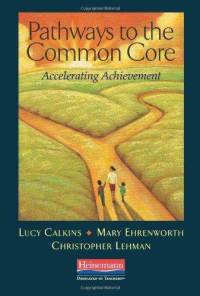
At a session that followed her welcoming remarks titled, “Implementing the Common Core: What’s Working, in Big Exciting Ways, to Engine Dramatic Reforms,” Calkins explained that she would not be delivering a big keynote at this conference on the Common Core, despite her belief that she considers this “most important document in the history of American education.” Instead, she plans to take time off from teaching to tour the country speaking on the Common Core and the book she co-authored, Pathways to the Common Core, in ordercto help school districts with the real work of accelerating students to perform at the level required by the Common Core, noting that “85% of our students are not there.”

Calkins also expressed her concerns that our nation’s history of large-scale educational reform is not good. “We have been sent many times to reform school,” she continued, “we have to be worried that this [Common Core] may be just one more reform.” However, Calkins stated that what works in this particular reform’s effort is the “absolute and total appreciation that what will make the difference is the teacher.” She directly confronted all the teachers in attendance and directed, “You need to be knowledgeable, and read the actual Common Core, not the ‘Publisher’s Guide to the Common Core’.” Her concerns at this conference echo her remarks in March 2012 at the 82nd Saturday reunion where she specifically called out David Coleman, co-founder and CEO of Student Achievement Partners  and who, according to Pathways to the Common Core, “received a  four-year 18 million dollar grant from the GE Foundation to develop materials and do teacher training around the CCSS” (6). Coleman has since moved on to take a position as the President of the College Board. Pathways to the Common Core, co- authored with Mary Ehrenworth and Christopher Lehman, details concerns that this enormous grant and any additional grant money will result supporting those who are “spelling out implications and specifying what they wish the Common Core had said,”(5). Already there has been a growing body of materials that contradict the intentions of the standards:

“There will certainly be additional materials and documents that emerge following this new round of money, with the potential to make similar claims as the Publisher’s Criteria for the Common Core Standards in English Language Arts and Literacy, Grades 3-12 (Coleman and Pimentel 2011)  and the Rubrics for Evaluating Open Education Resources (OER) Objects (Achieve 2011). When documents are presented as if they’ve gone through the process of review and been ratified by the states on subcommittees, it is troubling”(6).

Calkins reminded participants that the crucial difference will be the professional teachers who bring colleagues into their work to build a community of teachers, and that this community should know the Common Core standards.

Turning to the topic of her session, Calkins also explained that some of the most exciting work that was recently taking place on the Common Core  at the Teachers College was with their work with students in argument and debate.

She described the success teachers at the Reading and Writing Project were having with students who participated in read-aloud by gathering evidence for one position or another. For example, students had listened to a reading of The Stray and took notes on different positions. Following the basic rules of debate, students were given the opportunity to caucus with those who held their opinions before debating or refuting their debate partner’s position. In order to model the process with Shel Silverstein’s The Giving Tree, teachers taking one position that the tree was strong stood to caucus with like-minded participants, while those seated conferred with those who agreed with the different opinion that the tree was weak. Calkins directed teachers to stand, sit, debate or caucus, modeling how this might work in a classroom in one 45-50 minute period. She showed several video clips showed students participating in the same process demonstrating the success of using these techniques. “The results were fantastic,” Calkins exclaimed as the videos played, “so exciting to see the students gathering evidence and using the text in their arguments.”

What was evident during her sessions at this conference was that during this ‘Perfect Storm’ in education, Calkins is confidently empowering teachers to sail through what seems to feel like hurricane force changes in the profession. Her efforts in preparing teachers to navigate these new challenges can help insure that while these controversial storms may rage outside, inside the classroom day after day, the teacher is prepared to be the captain of the ship.

 David Coleman, incoming president of the College Board is staring out from the front cover of the October 2012 issue of The Atlantic . Actually, he is not staring. I think he is smirking…a Cheshire Cat smirk.

He has every reason to smirk. Coleman one of the architects of the Common Core State Standards has emerged as one of the more influential education policymakers to change what will be taught in classrooms and how this content will be taught without ever having spent time in the classroom himself.

Yes, Coleman has never taught in a public school classroom, although he was very successful as a student. He was educated in the Manhattan public school system, the son of highly educated parents, his father, a psychiatrist, and his mother, president of Bennington College. His privileged liberal arts credentials are immersive and include Yale, a Rhodes Scholarship, Oxford, and Cambridge.

His perspective on education has been informed by the business side of education which included pro-bono work at the management consulting firm McKinsey & Company. He developed and sold the assessment company Grow Network; co-founded and sold Student Achievement Partner; and most recently, accepted a position as president of The College Board.

Coleman has materialized, like Lewis Carroll’s enigmatic Cheshire Cat, as the cool outsider who surveys education as a Wonderland ruled by nonsense. He has promoted an agenda of close reading and an increase in non-fiction, to a ratio of 70% of all required reading by grade 12, from his perch high above the daily dust-ups of the average classroom.

Now, after developing the CCSS, replete with new batteries of state tests, he has moved on to the pinnacle of high stakes testing, the SAT. His arrival comes amid renewed concerns from studies about the SAT that demonstrate the unfairness of the test for minorities, females, and students living in poverty.

While I can embrace many of the standards in the English Language Arts Common Core State Standards (CCSS),  I remain unconvinced by Coleman’s sweeping claims that “close reading” lessons  of several days focused on a complex and difficult text is critical to improving understanding. I have practiced close reading, but not with the singular and tortuous focus Coleman advocates. There is little research as to how this approach will improve reading skills for all students. For 21 years, I have been a “boots on the ground” promoter of reading to a population of students who are reading less and less of the assigned materials, so I speak from experience when I state that Coleman’s emphasis on close reading can have an adverse effect on an already poor reader.

Furthermore, Coleman negates the effectiveness of the past 35 years of having students engage with a text using Louise Rosenblatt’s Reader Response Theory. His blunt charge “as you grow up in this world you realize people really don’t give a sh*t about what you feel or what you think” is simply not true. I cannot imagine any author who would not want to know what a reader thought. Writing is supposed to inspire; writing is an invitation to a dialogue. Furthermore, how will not listening to what students thought engage them in writing at all?

The question is how did Coleman get to place his large footprint on education, and why did teachers let him move into this position? Were teachers so preoccupied with teaching that they failed to see how the dynamics of education were moving from engaging leaders from public school institutions to accepting leadership from more commercial enterprises?

Dennis Van Roekel alluded to the rise of Coleman and others like him when he delivered an address to the National Education Association 91st Representative Assembly this past July:

Are we willing to assert our leadership, and take RESPONSIBILITY for our professions?
The demands of our work are changing as our students change, and the world around us is changing too – ever so fast.I say it is time for us to lead the next generation of professionals – in educating the next generation of students!

I’m so tired of OTHERS defining the solutions… without even asking those who do the work every day of their professional life.
I want to take advantage of this opportunity for US to lead – and I’m not waiting to be asked, nor am I asking anyone’s permission.

Because if we are not ready to lead, I know there are many others ready, willing, and waiting to do it for us. Or maybe I should say, do it “to” us.

Van Roekel’s quote echoes the question rhetorically posed by noted educator Lucy Caulkins at her presentation of the 82nd reunion at Columbia Teacher’s College, “Where is the proof, David Coleman, that your strategy works?”

Coleman’s ascent to the top of American education policy has been steady. He made contributions to the CCSS which will result in nationwide metrics for grades K-12. Add this testing to his new control of the SAT, and his influence on American education and the tests that measure learning will continue through the college level, all without his having the informative experience of teaching in a classroom. That any one individual without any teaching experience could have had this impact on the daily workings of the classroom is a commentary on the current state of madness that public education now finds itself.

At one point in in her Adventures in Wonderland, Alice comes across the Cheshire Cat in the hope of finding her way out:

‘But I don’t want to go among mad people,’ Alice remarked.
‘Oh, you can’t help that,’ said the Cat: ‘we’re all mad here. I’m mad. You’re mad.’
‘How do you know I’m mad?’ said Alice.
‘You must be,’ said the Cat, ‘or you wouldn’t have come here.’

Carroll’s Cheshire Cat character is a tease, an enigmatic riddler who offers judgments and cryptic clues but no  solution to the frustrated Alice. Coleman is education’s Cheshire Cat, offering positions in education but with no evidence to prove his solutions will work.

Curiouser and curiouser. David Coleman has become one of the most influential educational policymakers in our public school systems, but at this time, we have little else but his smirk.

One of my favorite units from the National Council of Teachers of English website (NCTE-http://www.readwritethink.org/) is the unit,“Id, Ego, and the Superego in Dr. Seuss’s The Cat in the Hat” by Junius Wright of Charleston, South Carolina. The lessons in this unit use The Cat in the Hat “as a primer to teach students how to analyze a literary work using the literary tools of plot, theme, characterization, and psychoanalytical criticism.” The unit is stretched over eight 50 minute sessions, complete with handouts and worksheets for grades 9-12. I have completed the unit with my Advanced Placement English Literature students, however, in a shorter period of time of two 80 minute sessions, since many of my seniors are taking psychology or took psychology as juniors, and they are already familiar with Freud’s seminal work The Interpretation of Dreams.

The premise is that students will read The Cat in the Hat and analyze the development of characters (Narrator, Cat in the Hat, Fish) from the picture book through the stages of id, ego, and superego or analyze the static nature of characters (Thing 1 & Thing 2) locked in one stage.

Wright provides student friendly definitions and commentary for each psychoanalytic stage in one of the handouts on the Read, Write, Think website:

Id
The id is the part of the personality that contains our primitive impulses—such as thirst, anger, hunger—and the desire for instant gratification or release. According to Freud, we are born with our id. The id is an important part of our personality because as newborns, it allows us to get our basic needs met. Freud believed that the id is based on our pleasure principle. The id wants whatever feels good at the time, with no consideration for the other circumstances of the situation. The id is sometimes represented by a devil sitting on someone’s shoulder. As this devil sits there, he tells the ego to base behavior on how the action will influence the self, specifically how it will bring the self pleasure.
Superego
The superego is the part of the personality that represents the conscience, the moral part of us. The superego develops due to the moral and ethical restraints placed on us by our caregivers. It dictates our belief of right and wrong. The superego is sometimes represented by an angel sitting on someone’s shoulder, telling the ego to base behavior on how the action will influence society.
Ego
The ego is the part of the personality that maintains a balance between our impulses (our id) and our conscience (our superego). The ego is based on the reality principle. The ego understands that other people have needs and desires and that sometimes being impulsive or selfish can hurt us in the end. It is the ego’s jobto meet the needs of the id, while taking into consideration the reality of the situation. The ego works, in other words, to balance the id and superego. The ego is represented by a person, with a devil (the id) on one shoulder and an angel (the superego) on the other.

I usually read the story aloud, although there are several websites that have The Cat and the Hat with audio read-aloud for teachers who do not want to get swept up in Seuss iambic rhythms and rhymes. I have collected about 30 copies of The Cat in the Hat at used book sales over the past two years; each copy has cost between $.50-$2.00, so the total investment has been $25.00. Making sure each student has a copy of the text is tremendously important, because it is through the illustrations that the students can successfully analyze the characters.

“So we sat in the house. We did nothing at all. So all we could do was to Sit! Sit! Sit! Sit! And we did not like it. Not one little bit.”

“Look how bland their faces are,” notes Alex, “I think this is really the ego stage.”

“I know some good games we could play,” Said the cat. “I know some new tricks,” Said the Cat in the Hat. “A lot of good tricks. I will show them to you. Your mother Will not mind at all if I do.”

“Now, that’s just creepy!” says Skye. “The Cat walks in and starts convincing them that their Mother won’t mind?”
“That Cat is in id,” replies Mike, “he’s going to do what ever he wants.”

 “No! Not in the house!” Said the fish in the pot. “They should not fly kites In a house! They should not. Oh, the things they will bump! Oh, the things they will hit! Oh, I do not like it! Not one little bit!”

“Look at the Fish,” laughs Nancy, “He is out of the water, risking his life for the kids.”
There is a chorus of “Superego.” Everyone agrees.

After the unit, and once the students have a clear sense of how to analyze the characters in this story, I ask them to take this idea and analyze a different piece of literature. My students have just completed a reading of Antigone, so I asked them to psychoanalyze the actions of one character. Not surprisingly, most of them chose to study Creon’s movement from ego on his first day on the job as the King of Thebes, through his dissolution into id when he fights with both Antigone and his son Haemon.

“But, isn’t he really in superego?” asks Tom, “I mean, Creon is trying to uphold the law as king; he is trying to do what is right, or at least what is politically smart.” Other students consider his point….and this is the reason I love teaching this lesson. The use of psychological criticism humanizes literary characters, and our discussions after this lesson are always more informed by our deepening understanding of human nature. Students will use their understanding of id, ego, and superego from this lesson and apply these understandings to Frankenstein, Paradise Lost, Dr. Jekyll and Mr. Hyde, Richard III, and other important works of literature.

So, thank you, Junius Wright, for a wonderful unit on psychological criticism, but more importantly, thank you, Dr. Seuss. Not only did you teach my students to read, but you continue to teach them to think. And what did they think of the ending of The Cat in the Hat?

Should we tell her The things that went on there that day? She we tell her about it? Now, what SHOULD we do? Well… what would YOU do If you mother asked YOU?

Not one would confess. Sadly, there is not one superego in the entire class.

Be vewy, vewy quiet….we’re reading!

Our new block schedule at Wamogo High School has made the school much quieter. We have alternating days, four periods of 85 minute classes; the traffic in the hallway is less, and, thankfully, so are the announcements. This quiet provides an excellent environment for us to continue our practice of silent sustained reading (SSR) at all grade levels, 7-12. We embarked on our SSR program two years ago, and we have noted both the anecdotal success with the program through participant surveys and the reading scores on the CMT/CAPT (State of CT mandated tests).

There are a number of texts on the incorporation of an SSR program in a language arts classrooms. Janice Pilgreen’s book (2000) The SSR HandbookHow to Organize and Manage a Sustained Silent Reading Program has an eight point checklist for successfully implementing SSR.

Using Pilgreen’s checklist (her suggestions in red), here is an explanation of how Wamogo is implementing the SSR program this year:

  • “Students need to be flooded with reading materials.”Our classroom libraries of whole class reads and independent reads are full. We have several carts that we can roll into classrooms of independent reading materials. Some carts are dedicated to specific grade levels or classes. For example, our Memoir class have a cart full of memoirs of all reading levels that students can select. Our school library is one of the few in the state to offer Overdrive® to all of its schools. Region 6 students and staff can easily download ebooks to a variety of devices from our Overdrive® catalog with over 15,000 titles. Students and staff can borrow free ebooks and read them on their iPod, iPad, laptop, Kindle or Nook. Creating a flood of reading materials is discussed also in Kelly Gallagher’s book Readicide. 
  • Appeal: The reading materials should be geared toward the interests of the students who are reading them.” We are sensitive to the wide variety of interests in our school. Many of our students are vocational agriculture students who are interested in non-fiction selections. We include all genres: manuals, graphic novels, historical non-fiction, fiction (YA titles) in trying to find books that interest our students.
  • Conducive Environment: The physical setting should be quiet and comfortable.” The new block schedule has benefitted the SSR program in an welcomed level of quiet in the school day. We do have the students read at their desks; we do not have “comfy chairs”.
  • Encouragement: Students need supportive adult role models who can offer assistance in locating reading material.” Our English Department teachers read with the students. We read the books during SSR so that we can make recommendations and discuss books with our students. Our amazing library media specialist comes in and gives book talks. She has also successfully incorporated popular author booktalks, in person or on SKYPE, with popular writers such as Neil Schusterman, Gordan Korman,and  Laurie Halse Anderson. (I am hoping for a Jon Szeiska interview one day *hint-hint*)
  • Staff Training: SSR doesn’t just happen; the staff of a school should be well versed in the goals and procedures used at the school.” Our department has seen the benefits of the SSR program, and we support each other with strategies to make the program work for us. There are teachers who use SSR time to confer with students, however, we found conferencing  distracted other readers. We also discuss the best times to implement an SSR activity in a block period, and how to measure results. 
  • Non-accountability: This is perhaps the most controversial factor. Pilgreen found that students read more, and had more positive attitudes toward reading, when book reports and such were not required.” In today’s data driven classrooms, this is a difficult, even risky, decision. In 9th grade, we do require one book review per quarter to be placed on a shared class blog, and we do require students to read more than one book per quarter. I also record the start page and the end page (students provide this number) as a way of keeping track of their progress. But, there are no other assessments of their independent reading.
  • “Follow-up Activities: Pilgreen found that follow-up activities such as conversations about books read by students or the teacher encouraged other to try them out.” We do spontaneous book talks. “Anyone reading a good book?” I will ask, “Any recommendations?” Students will share their reactions to a book when asked.
  •  “Distributed Time to Read: A common error made by schools new to SSR is that they have one long SSR period a week, rather than shorter periods that occur daily. Pilgreen found that successful programs have students read for fifteen to twenty minutes daily.” We have found that 15-20 minutes of reading time is ideal. On an alternating block schedule, this gives our students 30-60 minutes a week of quality reading time.

A classroom book cart in Grade 9 with high interest titles

Robert Marzano’s book Building Background Knowledge for Academic Achievement, ASCD, (2004) references Pilgreen’s eight steps; he  suggests a 5-Step Process for implementing SSR:

Step 1: Students identify topics of interest to them.
Step 2: Students identify reading material.
Step 3: Students are provided with uninterrupted time to read.
Step 4: Students write about or represent the information in their notebooks.
Step 5: Students interact with the information.

The major difference between Pilgreen and Marzano is the use of a notebook (step 4) for recording which we may incorporate this year in having students respond to prompt. These prompts are centered on story elements (“What similarities do you notice between your character and the archetypal character we study who is on a journey?”) . Our students are using writing notebooks for free-writes (front to back) and notes/vocabulary/grammar (back to front). Their first assignment was to “decorate” the notebooks, and already there are some enthusiastic participants for both decorating and free-writes!Finally Doug Fisher and Nancy Frey make a case for including SSR as a means to acquire content vocabulary in their book  Word Wise and Content Rich, Grades 7-12: Five Essential Steps to Teaching Academic Vocabulary, Fisher and Frey consider SSR as a means to contribute to gains in both background knowledge and vocabulary.

One more reason to implement SSR? The world is noisy. Students have their individual soundtracks plugged into their ears wherever they go; all venues from public transportation to shopping to sporting events have soundtracks; phone ring tones abound. There is a cacophony of sound in a student’s brain during the waking, perhaps even the sleeping, hours.The daily 15-20 minutes we offer students to read may be the only 15-20 minutes in a day where they are forced to be quiet. SSR allows them to absorb information without distraction. Ultimately, SSR at every grade level provides the opportunity for students to shut out the noise of school; SSR teaches our students to be vewy, vewy quiet. They’re reading.

Teachers Built “It”

September 4, 2012 — Leave a comment

The claim “I built it” is being tossed around this political season.  I am not a fan of the unspecific pronoun “it”, but as “it” in this context stands for any one of a number of diverse businesses that power our nation’s economy, the inclusive, ubiquitous pronoun will have to serve.

While I agree that the success of our nation is due in large part to those who “built it [businesses]” in the past and to those individuals who will “build it [businesses]” in the future, I feel the need to point out that there is one profession that has more claim to this catch phrase then others. If America is a world power today because of those who “built it,” the individuals who “built it” are teachers. For example:

  • Teachers have “built it” by  teaching the reading and comprehension of texts in differing levels of complexity;
  • Teachers have “built it” by teaching formal and informal writing to communicate;
  • Teachers have “built it” by explaining the essentials of numeracy;
  • Teachers have “built it” by presenting the basic  laws of motion, gravity, and energy;
  • Teachers have “built it” by clarifying the organization of elements which compose the organic and inorganic on the planet;
  • Teachers have “built it” by explaining  science of colors and techniques of expression or the science of sound and musical techniques of expression or the science of drama and the techniques of performance;
  • Teachers have “built it” by presenting instruction in other languages to promote global understanding;
  • Teachers have literally  “built it” with hands-on lessons in engineering and industrials arts.
  • Teachers have “built it” by presenting lessons of history; the lessons of economic principles to budding businessmen, strategic principles to future military leaders, and political science to future politicians;
  • Teachers have “built it” by instilling an appreciation for civics and law to our nations’ citizens and to those who directly interpret and defend our Constitution.

Teachers at every grade level, teaching youngsters in kindergarten to teaching adults in graduate school, have had a hand in building our nation’s skills and developing our national brain trust. Teachers in all schools, public and private, have dedicated time and energy in the passing of information from one generation to the next. Teachers of all disciplines have shared their expertise in the hopes of building a better society.

Granted, not all teaching has been successful. There have been teachers that have missed steps in the building of knowledge; students may not have gained information that would have been beneficial. Some lessons have ended in failure, and despite best efforts, statistics on literacy for American adults vary over 80%. There is more that can be done to improve education, and so there are teachers working to “build” a better education system for all citizens.

Teachers are “building it” using the Bloom’s taxonomy of knowledge, comprehension, application, analysis, synthesis, and evaluation. Teachers are “building it” with an appreciation for the different learning styles of students from the verbal-linguistic to the  logical-mathematical; from the visual-spatial to the bodily-kinesthetic; from the interpersonal to the intrapersonal, and from the musical to the naturalistic.

In classrooms everywhere, whether a student is seated in an august university or in a home school kitchen, there are teachers who are at this very moment teaching students how to “build it”, whatever “it” might be. In each of these classrooms, the “building on” knowledge and understanding is critical to the success of what will be “built” in the future.

The phrase, “I built it” might even have its origins in the classroom. How often has teacher affirmed a student’s success with “You did it!” or “Look what you did!” rather than self-serving “Look what you just learned because a teacher taught you.”

Yes, our nation has been blessed with  inventors, industrialists, and entrepreneurs who can claim that they “built” successful economic enterprises. Yes, our nation has great artists, philosophers, and communicators who “built” our formidable culture.Yes, our nation is rich with independent and collaborative thinkers who now “build” pathways for our future.

But do not forget that there have been the teachers who “built it”in the classrooms where “it” stands for intellectual curiosity, understanding, and knowledge. The “it” that teachers build is education.

I am glad there are so many Americans of every political persuasion who proudly can state, “I built it!” Just so they remember that they “built it” because their teachers taught them how.

Going back to school means that teachers and students will confront two philosophical statements. One statement is the school’s mission statement that quite literally confronts them as they enter a school building. The second statement is the statement of purpose for the Common Core State Standards (CCSS) that currently guides the curriculum for K-12 teachers in states that adopted the CCSS.

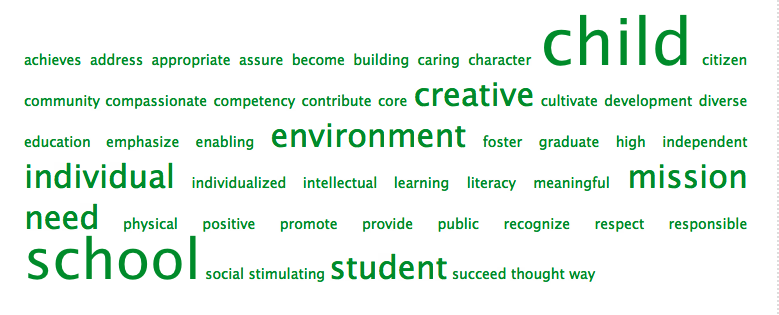
Here is an interesting exercise. Below, there are three randomly selected school mission statements plus the mission statement from my own school, Wamogo Middle/High School. These statements are generic enough to be for any grade level; they could be for any school.  You could test your school’s mission statement as well. I pasted the combination of these four statements into a Wordsift.com word cloud generator that highlights the more frequently used terms. (illustration below)

_______School recognizes that each child is an individual; that all children are creative; that all children need to succeed. Therefore, _______ School respects the individual needs of children; fosters a caring and creative environment; and emphasizes the social, emotional, physical, intellectual development of each child.

Our mission at ____ High School is to provide individualized education that addresses students’ unique learning styles, cultivates independent thought, and promotes the building of character, enabling them to contribute to their communities in meaningful and positive ways.

The mission of _______Public Schools is to assure that, within a nurturing and stimulating environment, each of our diverse students and graduates achieves literacy and appropriate core competencies, and becomes a responsible and compassionate citizen.

The mission of Wamogo is to educate all students in a challenging, disciplined, and supportive environment. In cooperation with students, parents, and community members, we seek to empower students to be lifelong, independent learners and contributors in a diverse and ever changing society. (Wamogo Middle/High School)

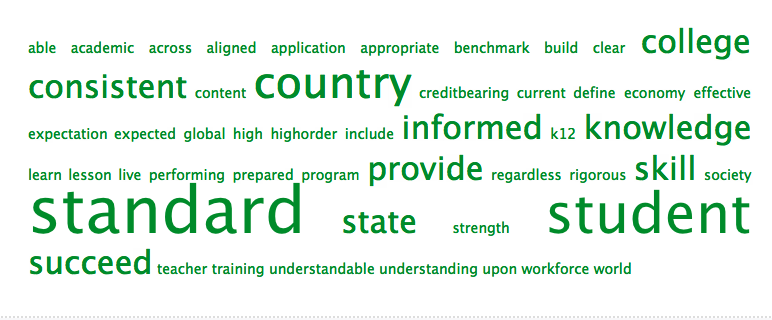
Next, I selected an an excerpt from introduction that explains the purpose and goals of the Common Core State Standards; the text selected was about the same length as the mission statements. I pasted the excerpt  into another Wordsift.com word cloud generator that highlights the more frequently used terms. (illustration below)

The standards are informed by the highest, most effective models from states across the country and countries around the world, and provide teachers and parents with a common understanding of what students are expected to learn. Consistent standards will provide appropriate benchmarks for all students, regardless of where they live.

These standards define the knowledge and skills students should have within their K-12 education careers so that they will graduate high school able to succeed in entry-level, credit-bearing academic college courses and in workforce training programs. The standards:

  • Are aligned with college and work expectations;
  • Are clear, understandable and consistent;
  • Include rigorous content and application of knowledge through high-order skills;
  • Build upon strengths and lessons of current state standards;
  • Are informed by other top performing countries, so that all students are prepared to succeed in our global economy and society; and
  • Are evidence-based.

What is immediately  apparent is that the language in the school mission statement Wordsift wordcloud is very different than the language in the CCSS Wordsift wordcloud. For example, the words education and school do not appear in the CCSS wordcloud; the words skill and knowledge do not appear in the school mission statements wordcloud. The word standard is emphasized in the CCSS wordcloud; the  word child is emphasized in the school mission statement wordcloud. The word career is in the CCSS workcloud; its counterpart is citizen in the mission statement wordcloud. The words college, consistent, informed, provide dominate the CCSS wordcloud. The words creative, environment, individual, need dominate the school mission statement wordcloud. The word student is one of the few emphasized overlapping vocabulary choices. Neither mentions 21st century skills.

I am not a fan of school mission statements. They are usually written by committee, and each successive rewrite makes the language in the statement generalized or vague or bland; I believe that “please all, please none” is the problem with a mission statement. However, one would hope that the differences in diction between a generic mission statement and the Common Core would not be so striking. Ultimately, these two ideas contribute to a common outcome; there should be some commonality other than an emphasis on the word student.

Additionally, the difference is not only one of word choice, but also one of tone. The verbs assure, become, contribute, cultivate, foster, promote, and recognize in the school mission statement wordcloud differ in tone from the few verbs  build, define, learn, live, and graduate in the CCSS wordcloud. The adjectives caring, compassionate, diverse, individualized, stimulating in the school mission statement wordcloud differ in tone from aligned, appropriate, effective, expected, higher order, global and rigorous as adjectives in the CCSS wordcloud. The words social, public and character are not in the CCSS wordcloud; the words economy, benchmark and workforce are not in the mission statement wordcloud. Perhaps it is not a surprise that the language of the mission statements is more sensitive or empathetic in tone than the businesslike language of the CCSS.

My random selection of the three school mission statement plus the statement of my own school cannot possibly speak for all school mission statements. There may be mission statements that have vastly different vocabulary.  Regardless, this imperfect comparison highlights a gap in the language of these mission statements and the language of the CCSS. The goals and purpose of the Common Core should have something in common with goals and purpose of a school.