Archives For November 30, 1999

The release of the National Assessment of Educational Progress (NAEP) Progress Report for 2012  (“Nation’s Report Card”) provides an overview on the progress made by specific age groups in public and private schools in reading and in mathematics since the early 1970s. The gain in reading scores after spending billions of dollars, countless hours and effort was a measly 2% rise in scores for 17-year-olds. After 41 years of testing, the data on the graphs show a minimal 2% growth. After 41 years, Einstein’s statement, “Insanity is doing the same thing repeatedly and expecting different results,” is a confirmation that efforts in developing effective reading programs have left the education system insane.

The rather depressing news from NAEP in reading scores (detailed in a previous blog) could be offset, however, by information included in additional statistics in the report. These statistics measure the impact of “reading for fun” on student test scores. Not surprisingly, the students who read more independently, scored higher. NAEP states:

Results from previous NAEP reading assessments show students who read for fun more frequently had higher average scores. Results from the 2012 long-term trend assessment also reflect this pattern. At all three ages, students who reported reading for fun almost daily or once or twice a week scored higher than did students who reported reading for fun a few times a year or less

The irony is that reading for fun is not measured in levels or for specific standards as they are in the standardized tests. For example, the responses in standardized tests are measured accordingly:

High Level readers:

  • Extend the information in a short historical passage to provide comparisons (CR – ages 9 and 13)
  • Provide a text-based description of the key steps in a process (CR)
  • Make an inference to recognize a non-explicit cause in an expository passage (MC – age 13)
  • Provide a description that includes the key aspects of a passage topic (CR – ages 9 and 13)

Mid Range Readers:

  • Read a highly detailed schedule to locate specific information (MC – age 13)
  • Provide a description that reflects the main idea of a science passage (CR – ages 9 and 13)
  • Infer the meaning of a supporting idea in a biographical sketch (MC – ages 9 and 13)
  • Use understanding of a poem to recognize the best description of the poem’s speaker (MC)

Low Level Readers:

  • Summarize the main ideas in an expository passage to provide a description (CR – ages 9 and 13)
  • Support an opinion about a story using details (CR – ages 9 and 13)
  • Recognize an explicitly stated reason in a highly detailed description (MC)
  • Recognize a character’s feeling in a short narrative passage (MC – age 13)

(CR Constructed-response question /MC Multiple-choice question)

Independent reading, in contrast, is deliberately void of any assessment. Students may choose to participate in a discussion or keep a log on their own, but that is their choice.  The only measurement is a student’s willingness to volunteer the frequency of their reading, a form of anecdotal data.

According to the graph below (age 17 only), students who volunteered that they read less frequently were in the low to mid-level ranges in reading. Students who volunteered that they read everyday met the standards at the top of the reading scale.
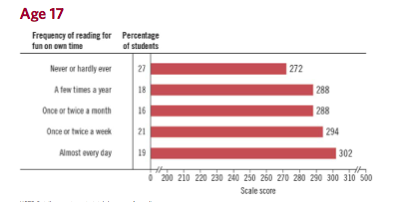
Graph showing that 17-year-olds who read for fun score higher on standardized tests

#1 Graph showing that 17-year-olds who read for fun score higher on standardized tests

Sadly, this NAEP data recorded a decline in reading for fun over the last 17 years-exactly the age of those students who have demonstrated only a 2% increase in reading ability. The high number of independent readers (“reading for fun”) was in 1994 at 30%.
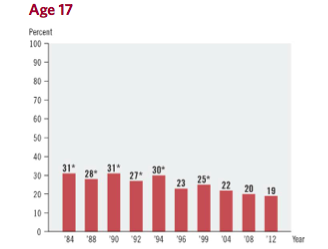
Steady decline  in the number of 17- year-old students who say that they  "read for fun."

#2 Steady decline in the number of 17- year-old students who say that they “read for fun.”

So what happened the following years, in 1995 and 1996, to cause the drop in students who read voluntarily? What has happened to facilitate the steady decline?

In 1995 there were many voices advocating independent reading: Richard Allington, Stephen Krashen, and Robert Marzano. The value of independent reading had been researched and was being recommended to all districts.

Profit for testing companies or publishing companies, however, is not the motive in independent reading programs.There are no “scripted” or packaged or leveled programs to offer when students choose to “read for fun”, and there is no test that can be developed in order to report a score on an independent read. The numerical correlation of reading independently and higher test scores (ex: read 150 pages=3 points) is not individually measurable; and districts, parents, and even students are conditioned to receiving a score. Could the increase of reading programs from educational publishers with leveled reading box sets or reading software, all implemented in the early 1990s, be a factor?

Or perhaps the controversy on whole language vs. phonics, a controversy that raged during the 1990s, was a factor? Whole language was increasingly controversial, and reading instructional strategies were being revised to either remove whole language entirely or blend instruction with the more traditional phonics approach.

The sad truth is that there was plenty of research by 1995 to support a focus on independent “reading for fun” in a balanced literacy program, for example:

Yet seventeen years later, as detailed in the NAEP report of 2012, the scores for 17-year-old students who read independently for fun dropped to the lowest level of 19%. (chart #2)

While the scores from standardized testing over 41 years according to the NAEP report show only 2% growth in reading, the no cost independent “reading for fun” factor has proven to have a benefit on improving reading scores. Chart #1 shows a difference of 30 points out of a standardized test score of 500 or a 6% difference in scores between students who do not read to those who read daily. Based on the data in NAEP’s report, reading programs have been costly and yielded abysmal results, but letting students choose to “read for fun” has been far less costly and reflects a gain in reading scores.

The solution to breaking this cycle is given by the authors of The Nation’s Report Card. Ironically, these authors are assessment experts, data collectors, who have INCLUDED a strategy that is largely anecdotal, a strategy that can only be measured by students volunteering information about how often they read.

The choice to include the solution of “reading for fun” is up to all stakeholders-districts, educators, parents, students. If “reading for fun” has yielded the positive outcomes, then this solution should take priority in all reading programs. If not, then we are as insane as Einstein said; in trying to raise reading scores through the continued use of reading programs that have proven to be unsuccessful, we are “doing the same thing repeatedly and expecting different results.”

As the first semester begins to draw to a close, I need to check in and see what progress the 9th grade students are making with Silent Sustained Reading (SSR). Our school’s move to a block schedule (A/B) days of 83 minute classes has given us the opportunity to provide students with 10-20 minutes of SSR every English class period. I try very hard not to put any restriction on what students read, although I still urge them to try and “read up” to more complicated texts. I wrote about the rationale for this program in a previous post, “Be Vewy, Vewy Quiet…We’re Reading”.

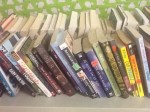
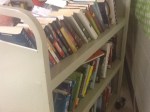
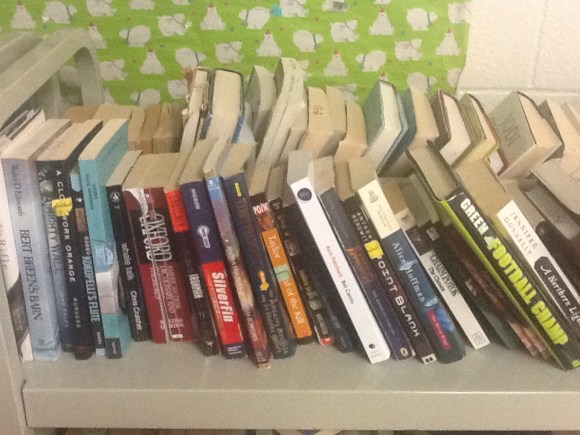
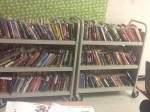
To facilitate the SSR program, there are two carts in the room with books I have purchased through the secondary market, mostly thrift stores and public library book sales (hence the title of the blog “Used Books in Class”). Each cart holds about 150 books; at $1-$2 a book, I have spent about $500 on the 300 books available for SSR.

A wide selection

A wide selection

The most popular titles in circulation these past few months have been:

Lauren Myracle’s TTFN and TTYL
John Flanagan’s Ranger’s Apprentice (any one in the series)
Catherine Gilbert Murdock ‘s Dairy Queen
Gabrielle Zevin’s Elsewhere
Alice Sebold’s The Lovely Bones
Patricia McCormack’s Cut
Carl Deuker’s Gym Candy
S. A. Bodeen’s The Compound
Sarah Dressen’s  Dreamland
Nicholas Sparks’s Dear John
Suzanne Collins’s The Hunger Games Trilogy (pick any one of these; they are on EVERYONE’S shelf)

The students are keeping their responses to the books they read on the Shelfari website this year. This is a commercial site tied to the retail giant Amazon, but there are ways to lock down the private groups we have established for each class. Last year, we used Blogger, but there were some glitches with Internet Explorer and Blogger; unless we used a browser like Firefox, the pages kept jumping and commenting was impossible. When students are on the Shelfari site, they can see what other students in the class are reading, and posting titles they have read or plan on reading is really easy. In addition, there are already reviews of the books, so students are forced to add something original to a review of the book. They can read recommendations (for and against the text) and they can participate in a discussion.

This morning I posted the following discussion prompt on Shelfari:

Hello,
You have had 16 weeks of SSR in class-most of the time with your choice of reading materials.
Tell me how you are progressing as a reader. Are you finding enough materials to read? Have you read at least ONE good book? Are you a better reader now that you were in September? Why or why not?

Some of the responses made my teacher’s heart pound proudly:

Over the past 16 weeks of SSR, I’ve probably read 5 or 6 books. Some of them were short, but some were a reasonable length. I’ve really been enjoying the SSR time we’ve been getting because the quiet period of time we get is really beneficial to my reading skills.

I am progressing in my reading. So far I have read three books this year. I am finding plenty to read. I have found many good books, including “Prom & Prejudice” and “Awkward”. I feel I am a better reader than I was in September because I am reading more difficult books than I was before and in September.

Yes I am better reader because last year I read even slower than I do now and I understand more because of the vocabulary words. I am finding enough materials to read. A good book I read this year was Miracle on 49th Street, this was good because it was a very suspenseful book.

But then, there are the honest appraisals that make me concerned about how students select books and a student’s ability to stay focused in a class for 10-20 minutes:

I’m an average speed reader, but I tend to get distracted. I’ve read a lot of good books, but they were in a lot of different genres. It’s hard for me to find books that interest me lately. I feel that my reading skills have changed a little, I’ve been able to understand things a little more.

During the past 16 weeks of SSR I haven’t really improved very much with my reading. I have only finished one book and I am working on another the first was a pretty good length and didn’t take long to read and the other is pretty long. I am a slow reader and I also just never find the time to sit down and read my book. Also, I get distracted while reading my book sometimes, so I haven’t progressed very much in the weeks of SSR.

And then, there are the even more painfully honest appraisals:

I’m a really really slow reader, and tend to get very distracted while reading, so I have a hard time making lots of progress in books. Books that are available to me don’t interest me. There was only one book that I’ve read and liked in my whole life; but there are no sequels. No I’m not a better reader, my reading skills never change, I’m always a slow and easily distracted reader.

The quiet time in SSR may not be “quiet” enough for some students, so I need to think about the physical space being more reader friendly. Apparently, I also need to have some students develop an understanding of what they like to read, and see how I can get those books onto my book carts.

Success with SSR is monitored through student self-appraisal, so I will be checking back in a few months to see if students note any changes in how they are reading. If nothing else, I know that there is power in the shared quiet reading experience we have twice or three times a week. When their heads are bent down in a book, I can feel them read.

The cover is not at all frightening, but the contents are. I had found two copies of Max Brooks’s World War Z: An Oral History of the Zombie Wars at summer book sales ($1.00 each) and placed them on the 9th grade independent reading book carts.  There was not much interest; the paperback measures a hefty 342 pages. But lately, the book is gaining some tractions with some of the freshmen boys.

“It’s about these interviews with survivors of the Zombie apocalypse ” explained Paul to the class yesterday when he volunteered to share what he was reading, “and it is really realistic. You hear how the zombie plague started and how the governments are corrupt.”

When a classmate endorses a book, the other students listen; first person testimonials are very powerful in our independent reading program. I had touted the book early in September to students when they were first perusing the book carts  The storyline was compelling enough for me, a squeamish reader, to appreciate how Brooks made a zombie war a study in political science. How would governments react to an epidemiological disaster? What would our military do to contain a potent virus? What rules would govern the survivors? I found the book to be a heart pounding read, and I read a few paragraphs to the class who listened with interest.

World War Z is told through a series of eye-witness accounts that occasionally connect characters and events. For example, there is the testimony of the fictional Dr. Kwang Jingshu, Greater Chongqing, United Federation of China:

“I found ‘Patient Zero’ behind the locked door of an abandoned apartment across town. . . . His wrists and feet were bound with plastic packing twine. Although he’d rubbed off the skin around his bonds, there was no blood. There was also no blood on his other wounds. . . . He was writhing like an animal; a gag muffled his growls. At first the villagers tried to hold me back. They warned me not to touch him, that he was ‘cursed.’ I shrugged them off and reached for my mask and gloves. The boy’s skin was . . . cold and gray . . . I could find neither his heartbeat nor his pulse.”

There is also very realistic testimony from the fictional General Travis D’Ambrosia, Supreme Allied Commander, Europe:

“Two hundred million zombies. Who can even visualize that type of number, let alone combat it? . . . For the first time in history, we faced an enemy that was actively waging total war. They had no limits of endurance. They would never negotiate, never surrender. They would fight until the very end because, unlike us, every single one of them, every second of every day, was devoted to consuming all life on Earth.”

What was most frightening as I read was my increasing doubt that the hundreds of characters interviewed in this story were fictional at all. Brooks has written post-zombie war interviews of doctors, generals, mayors, and newspaper reporters with remarkable authenticity.

But World War Z is not the only post-apocolyptic zombie book making the rounds in class. Another popular book making the rounds is Jonathan Mayberry’s Rot and Ruin (Benny Imura) the first novel in a series. I often see the rather grotesque cover art sitting on a desk, one eyeball staring up at the ceiling.

A review of Rot and Ruin on Amazon states:
In the zombie-infested, post-apocalyptic America where Benny Imura lives, every teenager must find a job by the time they turn fifteen or get their rations cut in half. Benny doesn’t want to apprentice as a zombie hunter with his boring older brother Tom, but he has no choice. He expects a tedious job whacking zoms for cash, but what he gets is a vocation that will teach him what it means to be human.
Zombie literature seems to cross our class’s gender lines, although Rot and Ruin seems to be more popular with the girls in the class. At present, there are only a few copies available through our school library, so I will be looking out for it at book sales. In addition to these titles, we also have several copies of James Dashner’s The Maze Runner, a series also loosely connected to the zombie phenomenon.
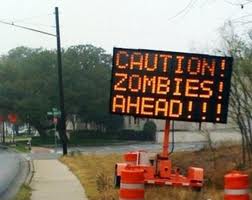
I am not entirely sure what my students’ fascination with zombies means. There are always trends or fads in literature; several years ago handsome vampires were all the rage, and several year before that, wizards ruled the reading lists. So I am aware that this infatuation with all things zombie will eventually fade, but maybe I can convince them to use their own brains as “food” for thought.

Current efforts to improve our students’ love of reading is allowing them the opportunity to choose what they want to read.  Since the amount of time available to teachers in a school year is finite, the inclusion of independent choice reading materials in a curriculum means that some things, usually whole class novels, have to go. In the case of our 9th grade students, the curriculum has been reduced to  three whole class reads: Romeo and Juliet, Speak, and Of Mice and Men. The remainder of the year is devoted to student choice, fiction and non-fiction. In other words, I am running a blended reading curriculum of student choice with whole class novels. I am convinced my students need this balanced approached to literacy.

Balancing between whole class novels and independent reading

Those who advocate student choice in the classroom make some excellent points. Last fall (2011), Kelly Gallagher (Readicide) in an audio interview with Mike McQueen on the Reading on the Run website said,

” I want to know does my child’s school have expectation that my child will read recreationally? Do they support that by giving kids time to read? Do they support that by giving kids interesting books to read not just academic books to read? Those are kind of questions that I would ask in looking at my child’s school.”

Gallagher’s most recent tweets on his KellyGtogo@Twitter demonstrate his continued campaign against language arts curriculum that are limited to whole class readings:

  • gr. 4-12: half the books our students read should be recreational in nature. We don’t want to raise test takers; we want to raise readers. 
  • more books = more reading = better reading. nothing happens without books.
  • Dear Common Core, where are recreational reading expectations? 

Yet, Gallagher still recognizes the importance of the whole class novel stating, “I am a proponent of academic reading, I do believe that kids should read you know, rich academic text. You know, I want my 9th graders to read Romeo and Juliet or my 12th graders to read Hamlet.”

There are, however, some educators who have eliminated whole class reading in an attempt to either engage students with choice only or as a differentiated approach to addressing reading levels in a class. In an article in Education Week  (7/2011) titled, Against the Whole Class Novel, Pam Allyn takes the position that whole class novels do not encourage reading and instead lead to alienation and isolation. She writes, “We have now reached a point at which teaching with neither the whole-class novel nor the basal reader, in which the whole class reads a selection together, is viable. We must end these practices. They are not benefiting our students.” She illustrates her position with the story of Sam who struggled with To Kill a Mockingbird saying, “…no way was this book a refuge for him, or an inspiration. It did not help him learn to read, nor did it help him to become a lifelong lover of text.”

Instead, Allyn suggests,

“If a student has found 16 blogs about boats, let him read those in school. And maybe that student will follow one of those blogs to a newspaper series about a regatta, or to Dove, Robin Lee Graham’s personal account of sailing around the world as a teenager. In these ways, our students will be exposed to a wider variety of genres than the whole-class novel ever allowed, and they will be more compelled to think critically across genres, as the common-core standards will require of them.”

While I agree with Allyn that not every book will make a student a lifelong reader, I believe she is clouding the issue of whole class reading with bad teaching of a whole class novel.Yes, it is true that some books are very difficult for reluctant or low level readers, so it is surprising that she suggests a student may choose Graham’s Dove  (RL 6.6) given her earlier reference the isolation a low level reader may have with to To Kill a Mockingbird (RL 5.6)  Regardless, a low level reader will struggle with a high level text unless there is some instruction or support. And while I agree that her suggestion of more inclusive reading materials (blogs, magazines, non-fiction) is important,  I also believe the communal experience that occurs in the reading of a whole class novel is equally important.

I am not suggesting the unit that beats a novel to death for week upon week, or what I refer to as the “it takes as long to read The Hobbit as it did Bilbo to get to his confrontation with the dragon, Smaug”. I am promoting the whole class novel experience where students work collaboratively to decode a text, share opinions, make comparisons, or criticize plot points. I promote the whole class novel with support for the low level readers and supplemental activities for the less engaged students. Reading levels should not limit student accessibility to a text when there is support available, for example, an audiobook. Please note: I did not say vocabulary and worksheets are supplemental activities.

Ideally, I advocate the whole class novel to capitalize on contexts or issues in other subject areas. Students can read All Quiet on the Western Front while they are studying World War I in Modern World History classes. Students can read Silent Spring as a companion piece to an enviormental studies course. Students can share the stories in Warriors Don’t Cry or Mississippi 1951 when they are studying a Civil Right’s unit. Whenever possible, I advocate a interdisciplinary read as a whole class novel.

I see great benefit in asking students to recall the themes, characters, settings or plot points with something they read earlier in their lives, particularly with the more complex texts at the middle or high school level. I will ask about the dystopia of The Giver when we read Brave New World, or the societies represented by animals in Charlotte’s Web when we read Animal Farm. A shared understanding of a previous reading experience with others provides immeasurable insights into a new reading experience.

Another argument for whole class reading comes from educator, Mrs_Laf in her blog post Confessions of an English Teacher who recently admitted that while, “I am the first person to champion individual and small group reading and used to be the first to decry the whole-class novel…I’m teaching a whole-class novel.”

She explains that her immersion into choice only reading resulted in many students selecting reading that did not challenge them. Students chose “fun books”, which she compared to beach reads noting that her students were not reading as closely as she wanted. In other words, “not all reading is the same.”  She decided that many students still needed to be taught to read a novel, just the same as students are taught to read a poem or short story. Her solution? Well, first she picks high interest books (The Hunger Games) which students purchase for annotation. Students make notes in the margin, put question marks next to the text they find confusing. In using this approach, “The trick is to get them to be patient with it.  This is a different kind of reading and we are reading for a different purpose.” Her point is a good one. Many students may need to be taught to read a more challenging text if all they read is what interests them.

I see reading as a community for my students as both academic and social.  I need to prepare students for the rigors of college and the real world since there is an expectation of cultural literacy  in our society. Students will encounter references to texts that compare relationships to the doomed Romeo and Juliet or the awkward Holden Caufield or the fair-minded  Atticus Finch or the the skin-flint Ebenezer Scrooge; they should understand those references. Teaching complex texts that students would not select independently ensures they can be included in conversations that extend beyond the classroom.

Teaching a whole class novel can be successful if, like any subject matter, students can be engaged. Language arts teachers need to seek a balance in in allowing for student choice while still teaching students how to read a challenging text. Every wave of innovation in teaching such as the recent calls for independent choice has an opposite one, such as traditional whole class novel instruction. Maintaining balance with these waves is what makes education successful. Balance means emotional stability; calmness of mind; harmony in the parts of a whole. Providing for independent choice plus whole class reading equals a balanced student.