Archives For September 30, 2012

It’s Halloween…what is the most frightening story you have ever read?

“I busied myself to think of a story, — a story to rival those which had excited us to this task. One which would speak to the mysterious fears of our nature, and awaken thrilling horror — one to make the reader dread to look round, to curdle the blood, and quicken the beatings of the heart. ……. I thought and pondered — vainly. I felt that blank incapability of invention which is the greatest misery of authorship, when dull Nothing replies to our anxious invocations. Have you thought of a story?” (Shelley, Preface)

Yes. Frankenstein. Mary Shelley’s masterpiece drafted when she was18 years old.  Teaching Mary Shelley’s “ghost story” always elicits the most interesting responses from my students. I have taught the novel every year for the past 12 years to students in grades 10-12, in AP or unleveled curriculums, and the results are always satisfying.

Note: I did not say easy.
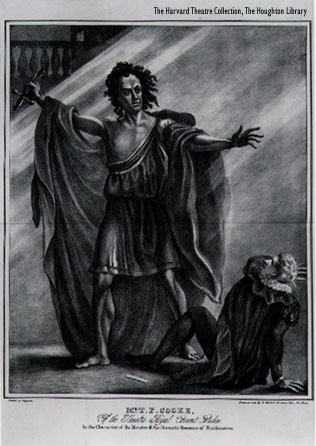
Since I am now familiar enough with the text and the pitfalls that catch most students, I know that I will need to summon an enormous amount of energy to begin teaching Frankenstein. First, there is the baggage of the pop culture monster with its green skin, bolted neck and squared boots. That baggage must be “unpacked” first. Then, there is Robert Walton’s epistolary start of the novel, coupled with Victor Frankenstein’s lengthy autobiography.  References to Cornelius Agrippa, Lake Geneva, and Galvanism are more stumbling blocks.

  • “So, where is the Monster?”
  • “When does this book get good?”
  • “I’m sorry, but this is just boring!”

Okay, Chapter Five.  On a dark and stormy night,

“With an anxiety that almost amounted to agony, I collected the instruments of life around me, that I might infuse a spark of being into the lifeless thing that lay at my feet. It was already one in the morning; the rain pattered dismally against the panes, and my candle was nearly burnt out, when, by the glimmer of the half-extinguished light, I saw the dull yellow eye of the creature open; it breathed hard, and a convulsive motion agitated its limbs”(Shelley, 5).

The Monster lives! Like the Creator in Genesis who “formed the man of dust from the ground and breathed into his nostrils the breath of life, and the man became a living creature” (Genesis 2:8), Shelley breathes life into her creation without regard to hard science.  In both stories, the empirical data or formulas, which led to these creations, express leaps of faith understood by the reader. The spark of life is imbued; the creation lives and breathes. The Creator of Genesis differs immediately from Victor when he, “planted a garden in Eden, in the east, and there he put the man whom he had formed”(Genesis 2:8), In contrast, the reader can hear Victor’s sudden gasp, “Beautiful!–Great God!” so repulsed is he once the creature comes to life. Victor weakly admits that all this work has been a failure, and comments almost apologetically, “The different accidents of life are not so changeable as the feelings of human nature” (Shelley, 5). Unfortunately, the creation has been loosed upon the earth; he will not easily be unmade simply because his creator has changed his mind.

Exhausted, Victor sleeps only to be wakened by

“when, by the dim and yellow light of the moon, as it forced its way through the window shutters, I beheld the wretch — the miserable monster whom I had created… His jaws opened, and he muttered some inarticulate sounds, while a grin wrinkled his cheeks. He might have spoken, but I did not hear; one hand was stretched out, seemingly to detain me, but I escaped, and rushed down stairs” (Shelley, 5).

Rejection! Abandonment! Isolation.

The Creator in Genesis does not abandon his creations, despite their disastrous decision to disobey. Rather, the reader finds this Creator “made for Adam and for his wife garments of skins and clothed them (Genesis 3:21) before banishing them from the Garden.Victor, in contrast, flees from the sound and the touch of the Monster who was trying to say….what? Creator?….Father?

  • Daddy.”
  • “Victor is a jerk.”
  • “He ran away because he didn’t want the responsibility.”

Exactly. And that is why Frankenstein gets to the heart of so many of the issues that our students, our culture, our world must deal with today. There are questions of responsibility. The responsibilities of a creator for the created can be extended to include the responsibilities of parents to children, of scientists to inventions, of writers to literature, of politicians to policies, and of pundits to sound bytes. What happens when the “creation” goes bad?

  • “If Victor kills the Monster, is it murder?”
  • “It’s Victor’s fault that the Monster is a murderer.”

Is the Monster a human? Shelley allows that the Monster eats, reads, and pines for a companion; he is alone, and miserable. A critical scene has the Monster pleading with Victor for a friend, a companion, a mate. Shelley has her Monster claim to have a soul; is the Monster a human? What makes a human a human?

  • Having a mate will mean monster babies!”
  • “Why didn’t Victor think about what the Monster would do?”
  • “This is just like Jurassic Park !”

Shelley’s novel also considers related ethical questions. These include what is the result of unleashing a new technology on earth? Because the technology exists to create, should the technology be used? How far should technology go in helping humanity?

In our brave new world, the “lyger” has been created because geographically separated tigers and lions can be crossbred in labs. Genetically altered crops are in the mainstream food source. These technological advancements have moved into our world with a ripple. But what of the advancements that will follow? Will human cloning become a reality, and will society deal ethically with clones? How far are we from artificial intelligence and should-or can- this intelligence be controlled? What does Frankenstein teach the reader about making ethical decisions today or in the near future? Why is literature such a great predictor for what will happen in the future?

We feel pathos. The Monster’s story is one of tragedy.

  • “Victor is the real monster.”
  • “I feel bad for the Monster…he didn’t want to be a Monster.”

By the end of the novel, my students have dealt with some very profound ideas. They have asked some very important questions about responsibility, humanity, and ethical behavior. They feel a sense of accomplishment in reading a difficult 19th Century text. They have confronted contemporary issues through literature, and isn’t that what is supposed to happen in the classroom?

Mary Shelley was only 18 years old when she attempted to answer some of the questions about the limits of man.  She was young and ambitious, like many of our students. Her “hideous progeny” is extraordinarily prescient; then novel is in every way a Modern Prometheus-a modern myth. Mary Shelley’s Frankenstein is a must read, and a cautiously frightening tale, for Halloween or for any other day.

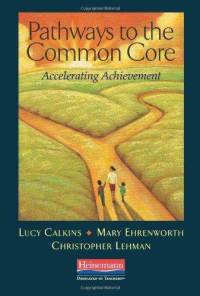
The impending Hurricane Sandy did little to stop over 2000 teachers from attending the 83rd Saturday Reunion at Teacher’s College at Columbia University on Saturday, October 27. Taking up the microphone in a set of informal welcoming remarks, Lucy Calkins complimented the crowd that had gathered in the Nave in Riverside Church, “So many of you have come here…instead of clearing out storm drains or without stocking up on toilet paper. You have weathered the trip despite the predictions of this ‘Franken-storm’.” The crowd laughed appreciatively.

“Yes. We are in a storm,” she continued with growing seriousness. “Today, we are in a ‘Perfect Storm’ in education, and we must learn to travel these hurricane winds and sail.”

Calkins was referencing the convergence of the Common Core State Standards with educational reform efforts that emphasize standardized testing. Newly designed teacher evaluations tied to single metric tests combined with cuts in funding for public school education because of a stagnent economy have also contributed to this ‘Perfect Storm’. This audience understood her metaphor.

Lucy Calkins is the Founding Director of the Reading and Writing Project LLC and the Teachers College Reading and Writing Project as well as the Robinson Professor in Children’s Literature at Teachers College where she co-directs the Literacy Specialist Program.

Co-authors Lucy Calkins, Mary Ehrenworth and Christopher Lehman all led sessions at the 83rd Saturday Reunion of the Teachers College Reading and Writing Project on Saturday, October 27, 2012

At a session that followed her welcoming remarks titled, “Implementing the Common Core: What’s Working, in Big Exciting Ways, to Engine Dramatic Reforms,” Calkins explained that she would not be delivering a big keynote at this conference on the Common Core, despite her belief that she considers this “most important document in the history of American education.” Instead, she plans to take time off from teaching to tour the country speaking on the Common Core and the book she co-authored, Pathways to the Common Core, in ordercto help school districts with the real work of accelerating students to perform at the level required by the Common Core, noting that “85% of our students are not there.”

Calkins also expressed her concerns that our nation’s history of large-scale educational reform is not good. “We have been sent many times to reform school,” she continued, “we have to be worried that this [Common Core] may be just one more reform.” However, Calkins stated that what works in this particular reform’s effort is the “absolute and total appreciation that what will make the difference is the teacher.” She directly confronted all the teachers in attendance and directed, “You need to be knowledgeable, and read the actual Common Core, not the ‘Publisher’s Guide to the Common Core’.” Her concerns at this conference echo her remarks in March 2012 at the 82nd Saturday reunion where she specifically called out David Coleman, co-founder and CEO of Student Achievement Partners  and who, according to Pathways to the Common Core, “received a  four-year 18 million dollar grant from the GE Foundation to develop materials and do teacher training around the CCSS” (6). Coleman has since moved on to take a position as the President of the College Board. Pathways to the Common Core, co- authored with Mary Ehrenworth and Christopher Lehman, details concerns that this enormous grant and any additional grant money will result supporting those who are “spelling out implications and specifying what they wish the Common Core had said,”(5). Already there has been a growing body of materials that contradict the intentions of the standards:

“There will certainly be additional materials and documents that emerge following this new round of money, with the potential to make similar claims as the Publisher’s Criteria for the Common Core Standards in English Language Arts and Literacy, Grades 3-12 (Coleman and Pimentel 2011)  and the Rubrics for Evaluating Open Education Resources (OER) Objects (Achieve 2011). When documents are presented as if they’ve gone through the process of review and been ratified by the states on subcommittees, it is troubling”(6).

Calkins reminded participants that the crucial difference will be the professional teachers who bring colleagues into their work to build a community of teachers, and that this community should know the Common Core standards.

Turning to the topic of her session, Calkins also explained that some of the most exciting work that was recently taking place on the Common Core  at the Teachers College was with their work with students in argument and debate.

She described the success teachers at the Reading and Writing Project were having with students who participated in read-aloud by gathering evidence for one position or another. For example, students had listened to a reading of The Stray and took notes on different positions. Following the basic rules of debate, students were given the opportunity to caucus with those who held their opinions before debating or refuting their debate partner’s position. In order to model the process with Shel Silverstein’s The Giving Tree, teachers taking one position that the tree was strong stood to caucus with like-minded participants, while those seated conferred with those who agreed with the different opinion that the tree was weak. Calkins directed teachers to stand, sit, debate or caucus, modeling how this might work in a classroom in one 45-50 minute period. She showed several video clips showed students participating in the same process demonstrating the success of using these techniques. “The results were fantastic,” Calkins exclaimed as the videos played, “so exciting to see the students gathering evidence and using the text in their arguments.”

What was evident during her sessions at this conference was that during this ‘Perfect Storm’ in education, Calkins is confidently empowering teachers to sail through what seems to feel like hurricane force changes in the profession. Her efforts in preparing teachers to navigate these new challenges can help insure that while these controversial storms may rage outside, inside the classroom day after day, the teacher is prepared to be the captain of the ship.

The cover is not at all frightening, but the contents are. I had found two copies of Max Brooks’s World War Z: An Oral History of the Zombie Wars at summer book sales ($1.00 each) and placed them on the 9th grade independent reading book carts.  There was not much interest; the paperback measures a hefty 342 pages. But lately, the book is gaining some tractions with some of the freshmen boys.

“It’s about these interviews with survivors of the Zombie apocalypse ” explained Paul to the class yesterday when he volunteered to share what he was reading, “and it is really realistic. You hear how the zombie plague started and how the governments are corrupt.”

When a classmate endorses a book, the other students listen; first person testimonials are very powerful in our independent reading program. I had touted the book early in September to students when they were first perusing the book carts  The storyline was compelling enough for me, a squeamish reader, to appreciate how Brooks made a zombie war a study in political science. How would governments react to an epidemiological disaster? What would our military do to contain a potent virus? What rules would govern the survivors? I found the book to be a heart pounding read, and I read a few paragraphs to the class who listened with interest.

World War Z is told through a series of eye-witness accounts that occasionally connect characters and events. For example, there is the testimony of the fictional Dr. Kwang Jingshu, Greater Chongqing, United Federation of China:

“I found ‘Patient Zero’ behind the locked door of an abandoned apartment across town. . . . His wrists and feet were bound with plastic packing twine. Although he’d rubbed off the skin around his bonds, there was no blood. There was also no blood on his other wounds. . . . He was writhing like an animal; a gag muffled his growls. At first the villagers tried to hold me back. They warned me not to touch him, that he was ‘cursed.’ I shrugged them off and reached for my mask and gloves. The boy’s skin was . . . cold and gray . . . I could find neither his heartbeat nor his pulse.”

There is also very realistic testimony from the fictional General Travis D’Ambrosia, Supreme Allied Commander, Europe:

“Two hundred million zombies. Who can even visualize that type of number, let alone combat it? . . . For the first time in history, we faced an enemy that was actively waging total war. They had no limits of endurance. They would never negotiate, never surrender. They would fight until the very end because, unlike us, every single one of them, every second of every day, was devoted to consuming all life on Earth.”

What was most frightening as I read was my increasing doubt that the hundreds of characters interviewed in this story were fictional at all. Brooks has written post-zombie war interviews of doctors, generals, mayors, and newspaper reporters with remarkable authenticity.

But World War Z is not the only post-apocolyptic zombie book making the rounds in class. Another popular book making the rounds is Jonathan Mayberry’s Rot and Ruin (Benny Imura) the first novel in a series. I often see the rather grotesque cover art sitting on a desk, one eyeball staring up at the ceiling.

A review of Rot and Ruin on Amazon states:
In the zombie-infested, post-apocalyptic America where Benny Imura lives, every teenager must find a job by the time they turn fifteen or get their rations cut in half. Benny doesn’t want to apprentice as a zombie hunter with his boring older brother Tom, but he has no choice. He expects a tedious job whacking zoms for cash, but what he gets is a vocation that will teach him what it means to be human.
Zombie literature seems to cross our class’s gender lines, although Rot and Ruin seems to be more popular with the girls in the class. At present, there are only a few copies available through our school library, so I will be looking out for it at book sales. In addition to these titles, we also have several copies of James Dashner’s The Maze Runner, a series also loosely connected to the zombie phenomenon.
I am not entirely sure what my students’ fascination with zombies means. There are always trends or fads in literature; several years ago handsome vampires were all the rage, and several year before that, wizards ruled the reading lists. So I am aware that this infatuation with all things zombie will eventually fade, but maybe I can convince them to use their own brains as “food” for thought.

Educational reform is on the minds of many business leaders and several have weighed in with their concerns:

“We know we are facing a transition, and we must take this opportunity to provide today’s students with the tools and the thinking that is required for the future” ( John Chambers, Cisco Systems).

“….our high schools – even when they’re working exactly as designed – cannot teach our kids what they need to know today,” (Bill Gates, Microsoft).

“The fact is, too many graduating seniors are unprepared for what will be required to succeed in college or in the workplace,” (William G. Jurgensen, CEO, Nationwide)

These business leaders have every right to express their interest in improving education for the nation. After all, their businesses will require an educated work force. However, too often business leaders speak about educational reform using a business model that is radically different from the public education model.

Funding-Private equity vs. Tax Dollar

A business is funded by an individual or a group of investors, and additional revenue for a business can be added through profits, loans, or the selling of additional shares. In contrast, public school education is funded by taxpayers at the local, state, and federal level; ultimately, politicians control the purse strings for school districts. This manner of funding can be grossly inequitable: On the blog CT news.com, in 2011, Ansonia, Connecticut, spent $10,520 per student while the nearby district Region 9 (Easton/Redding) spent $18,426 per student that same year. Funding can often be capricious as tax revenues depend on the general economy and political agendas; funding can change annually with revenue that cannot be transfered year to year or invested. There are always political promises to reduce taxes despite rising operating and capital costs in educating our nation’s youth to develop 21st Century skills for our future workforce.

Business Loss-Cutting Poor Performers?

Another problem with using the business model for education is the business loss. A clear definition of a business loss is on Investopedia.com:

A business practice that seeks to detect, identify, investigate and prevent events that cause a drop in value of any of an organization’s revenues, assets and services. Loss-management improvements may involve changes in a business’s operating policies and business model in order to limit instances of accidental and/or intentional loss.

A business with a business loss must be flexible. A business may change operating policies (hours, locations, retail policies, purchasing policies, etc).  In contrast, a public school system that deals with a loss in funding or facilities or student enrollment cannot change hours, locations, or policy arbitrarily or with the speed that business has to react to changes in the market.  Furthermore, a business is free to drop a product line or drop poor performing employees. In contrast, schools cannot drop specific programs (core subjects of math, language arts, science, social studies) or poor performing students. Dropping poor performing students would certainly help test score results but that is not the purpose of public education. In this nation we  educate every student.

Competition-Winners vs. Losers

Business is built on competition and products and services go head to head for the public’s dollar. Economists believe that the market will crowd out inferior products and services using this competitive model. However, employing this model of competition in education would result in a tiered system of inequity. Education reform efforts to introduce competition have included choice through charter schools, but the results of these competitive efforts have not been any more successful than the efforts expended by the public schools. In the inital pilot study (2003) The National Assessment of Educational Progress (NAEP), considered  population differences and reported that “the mathematics performance of White, Black, and Hispanic fourth-graders in charter schools was not measurably different from the performance of fourth-graders with similar racial/ethnic backgrounds in other public schools.” The study also reported that, “In reading, there was no measurable difference in performance between charter school students in the fourth grade and their public school counterparts as a whole.” What this means is that competition with other schools is not a factor in school success. Furthermore, the students cannot be part of a competitive market with winners and losers if the goal is to educate every student. Every student must be a winner.

The Single Metric Test

A business with a single product is limited, so many businesses diversify.  Businesses measure success on products or services with monthly, quarterly, and annually produced data through a variety of measurements. Education in contrast is being forced to measure student achievement through standardized tests. Each standardized test “snapshot” is taken one day during a school year, and the results establish a school as being a success or failure. Reform efforts fron No Child Left Behind and Race to the Top exploit this one test metric. Judging a school with this system of measurement is like measuring retail business’s success by one day of sales. Many states are using these single metric tests for teacher evaluations. Would a company’s CEO be judged by one day’s stock price or a salesman by one day of sales? Additionally, the calls listed above ask for “tools and the thinking” that our business leaders want for their future workforce; an increased focus on single metric tests is not a solution for 21st Century skill development and critical problem solving.

Business leaders should have a great deal to say about education since they will be hiring the product of the nation’s education system. But the tenets of business do not match the tenets of education, and business policy does not always have a comparative counterpart in education. Public education is a very specialized institution and the reform of education must come from those who have both the training and classroom experience, beyond the just “being in the classroom” experience of many successful business leaders.

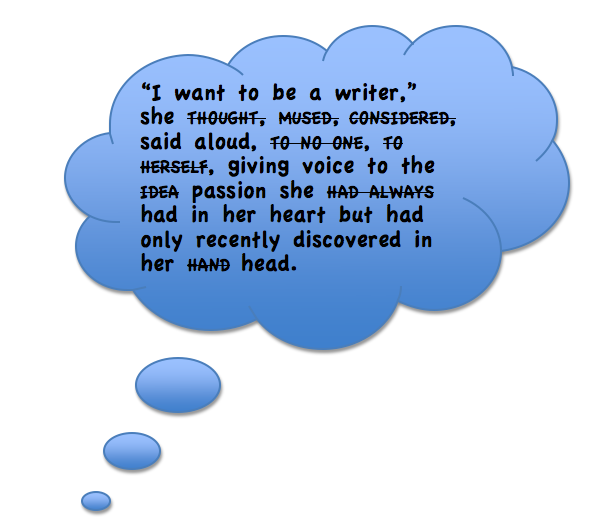
One of my favorite cartoons features a young woman, obviously nervous, seated next to a white-suited, white-haired caricature of Samuel Clemens. Above her head floats a thought bubble,“‘I want to be a writer,’ she thought, mused, considered, said aloud, to no one, to herself, giving voice to the idea passion she had always had in her heart but had only recently discovered in her hand head.”

I also always wanted to be a writer, but the responsibility of writing stopped me. Writing was a task that I took very seriously. I had to write papers for courses I took. I had to write letters-personal and professional- and I had to write memos for work. Writing was a product that needed to be perfect. As a result, my writing duties had stifled my writing passion.

However, sixteen months ago I started this blog to share the ways I had increased the number of books in school classrooms. During the first month of entries, I wondered if I would have enough materials to write about on a blog about used books in class.

I am almost embarrassed to admit that what I have discovered is that writing is less product and more thinking. Sadly, I was an English teacher who required writing and encouraged students to write regularly in class, but who did not cognitively understand that writing is really a recording of thinking. I was always interested developing (and assigning) the prompt and collecting (and correcting) the final product. I did not fully understand the necessity of thinking as the most critical part of the writing until I began to write myself.

Now, as a convert to writing as thinking, I am using this post to encourage others to write in order to think.

October 19-20th, 2012 will be the National Day of Writing. The National Writing Project (NWP) is encouraging people to contribute to “What I Write” on their website:

What do you write or compose? Blog posts? Poems? Videos? Grocery lists, computer code, or song lyrics? Whatever you write, on Friday, October 19, use the hashtag #whatiwrite to share your compositions with the world as part of this year’s National Day on Writing.

National Council of Teachers of English (NCTE) has  links on their blog for people to read what authors say about why they write. The NYTimes Learning Network also has a page on their blog asking, “Post what, you ask? Well, could be…

  • Thoughts about what you write, whether it’s poetry, short stories, school essays, computer code, love notes, song lyrics or Facebook updates.
  • A link to some writing you want to show others.
  • A photo or drawing that illustrates something about writing, or illustrates something you’ve written.
  • Thoughts about things you’d like to write someday.
  • Notes on your writing process.
  • Thoughts on the role of writing in your life in general.
  • Advice about writing.
  • Links to good pieces about writers or writing

So, on Friday, October 19th, I will have my students create lists of topics they want to “think” about, topics* they want to explore in writing over the course of the year. We will collaborate on a master list using a Google doc that we can revisit over the course of the school year. I want my students to learn how to write, but more importantly, I want my students to learn how to write so they can think. I want they to feel free to write without constant assessment. I want them to write and read what they write to understand what they think. Hopefully, in this process they will discover that writing is not an academic responsibility, and that good writing is really good thinking. And I will imagine  thought bubbles over their heads as they write.

Share the hashtag #whatIwrite.

*Topic list created 10/18/2012

“It’s the Minotaur vs. Fenris”, I announce as the pair is selected from a name randomizer on the BarryFunEnglish website.

 Students look at their playing cards.
“Agility?” I ask.
“Fenris…a 4,” one student responds.
“Minotaur…a 3,” another student adds.

“Round One to Fenris!” we agree.

This monster smackdown game is taking place in the Hero & Monster English IV elective class. There are 16 students in the class, several of whom who petitioned our department for a class on mythology, monsters, and heroes this year. The class was created in response to their petition. During the first week of school, they wrote the essential questions they will be studying

  • What is the difference between a hero or monster?
  • What criteria do we use to determine who or what is a hero?
  • What criteria do we use to determine who or what is a monster?
  • Created Monsters (serial killers) vs. Monsters created (Boogey man; Monsters, Inc.)
    • Is there a difference? Why or why not?

In order to quickly provide them with a pantheon of mythological monsters, I devised this monster smackdown game where each student was first assigned one mythological monster. The monsters on the list originated in different cultures: Norse, Algonquian, Greek, Roman, Persian.

  • Minotaur
  • Wendigo
  • Scylla
  • Fenris
  • Medusa
  • Kraken
  • Sphinx
  • Charybdis
  • Cyclops
  • Furies
  • Basilisks
  • Sirens
  • The Hydra
  • Cerberus
  • Leviathan
  • Jörmungandr
  • Chimera
  • Manticore

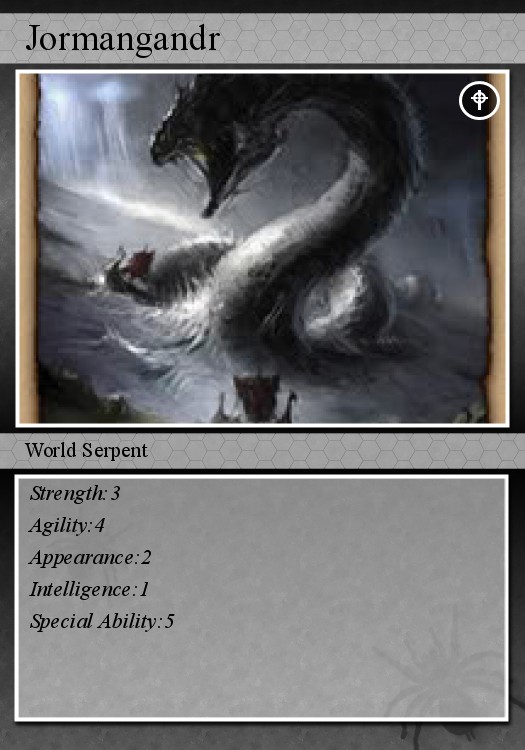
Each student had to research the monster and create a trading card. We used the template on the BigHugeLabs website. The student had to rate the monster on five qualities: agility, appearance, intelligence, strength, and a “special” or “hidden” talent on a scale of 1-5. One the cards were made, I printed them out on on card stock using a business card template (12 on a page). This was the most costly part of the exercise (time & ink). Before we played the smackdown, each student had one minute to “sell” the monster to the rest of the class, an advertisement for the proceeding game, and pass out that trading card to each classmate.

To play the monster smackdown, I placed each monster’s name into a randomizer. I used a virtual dice creator to call out the competitive quality being tested in the smackdown. What I did not tell the students was that they would be battling on a different location. These locations were also randomly selected and included:

  • nuclear power plant
  • frozen pond in a wilderness
  • aircraft carrier in the Indian Ocean
  • Wamogo High School’s senior parking lot
  • Drive-in movie theatre
  • Nevada Salt Flats
  • Mount Rushmore
  • Iceberg floating from the North Pole
  • Grand Canyon
  • Little Susie’s closet

Each monster had an opportunity to have his or her monster qualities tested against an adversary; students defended their individual monster’s abilities on different battlegrounds.

“Charybdis would so rule in the Grand Canyon,” yelled Jed, “He’s already a whirlpool!”
“But the Sirens would make him go mad with their singing,” Sam calmly replied, “he would swallow himself up.”
The class voted Sam’s as the better response.

There were contentious battles between Medusa and the Wendigo (malevolent cannibalistic spirit from Algonquian myths) and between the Scylla and the Kraken. My Sphinx was eliminated on round one (apparently being able to riddle is not all that great a monster power).

The winner of the monster smackdown was the Jormangandor, a “midgard” serpent that is so big he encircles the globe and holds onto his own tail.
“The world will end when he lets go of his tail!” proclaimed Eric.
“How can he fight then?” challenged Matt.
“I don’t know,” blustered Aaron, “but either way, he beats your Cerberus!”

The chief complaint about the game were from students who noted that some of their peers had not properly filled out their cards; spelling was not the only issue.
“This Medusa card is wrong. He has two ‘5’s rated -one for intelligence and one for appearance!” said Zach. He turned to confront the card-maker, “Look, if this game is going to work, you need to fill the card out properly.”
I said nothing; peer-to-peer correction is far more enduring than my suggestions.

There are a few changes I would make with regards to the scoring, but several of the students have offered to come up with a more complex system of rating and handicaps. I will also be investigating the Trading Card Creator on the Read,Write,Think website (NCTE) which allows for more detailed information on each subject; we still need to create our hero cards. Overall, the game received enthusiastic support, even from the principal who was found his way to the raucous activity that Friday morning. He left with a set of trading cards of his own.

We will be tackling “movie” monsters next. The list will include Dracula, the Balrog, Frankenstein’s Monster, Harry Potter’s Dementors, Godzilla, and King Kong. In keeping with that medium, students will make 30 second movie trailers using Animoto software. For that challenge, we will hold an Academy Awards of Movie Monsters.

The monster smackdown game provided students a quick review of monsters they encounter in literature, the allusions they need to comprehend complex texts. Already we have encountered the chimera in our reading of Frankenstein, “…because the powers of the latter were chimerical, while those of the former were real and practical, under such circumstances I should certainly have thrown Agrippa aside and have contented my imagination…” (ch 2).
“What does that mean?” I asked Steve, who had researched the Chimera.
“Changing and adding shapes to make something different? My monster changed shapes,” he replied hesitantly.
“Yes, to make something new and fantastic. Was your monster fantastic?”
“Of course,” he responded, “fantastic like me!”

These mythological monsters are the result of wildly imaginative stories from every culture; they are fanciful, fascinating, and fantastic…apparently, just like my seniors.

An interviewer can ask a question to get the answer he or she wants to hear. That may have been the case on September 2, 2012 when   CBS’s 60 Minutes  framed a question on educators and education. The interview featured Google chairman Eric Schmidt who was responding to questions about Sal Khan, founder of the Khan Academy. The educational enterprise Khan Academy began as a series of math video tutorials given by Khan for his nephew in 2004. Khan Academy expanded into its own YouTube channel to feature other disciplines including history, healthcare and medicine, finance, physics, chemistry, biology, astronomy, economics, cosmology, organic chemistry, American civics, art history, macroeconomics, microeconomics, and computer science. Schmidt was heaping praise on Sal Khan when he was asked, “He [Khan] was the guy to sort of make this happen? Why do you think it was him and not some person who was an educator, who had a background in this area?”

Schmidt’s response was incredibly disappointing:

“Innovation never comes from the established institutions. It’s always a graduate students or a crazy person or somebody with a great vision.”

With one sweeping over-generalization, Schmidt and the producers of 60 Minutes dismissed the efforts of our nation’s teachers as innovators inferring that outsiders, specifically outsiders from the business world, are better equipped to reform our education system.

Both Schmidt and the producers of 60 Minutes are wrong. Teachers are innovative.
Just look at the definition of “to innovate”:

1: to introduce as or as if new (as transitive verb)
2 (archaic) : to effect a change in
3: to make changes : do something in a new way

“To innovate” is conceptually connected to the verb “to teach”; teachers introduce content as new, effect a change in understanding, and encourage students to make changes in order to prepare for the future. Our nation’s public school system is an innovative effort; no other nation has so purposefully engaged in the enterprise of educating ALL children, regardless of ability or disability.

Apparently, Mr. Schmidt blanked on the relationship between his company and teachers who are familarizing students with Google’s mutiple applications. The Google Educator Academy is offered to teachers so they can better learn how to integrate Google products into classrooms. Of course, the Google Educator Academy also allows Google designers the opportunity to pick the brains of innovative educators as to what is needed in the classroom. For example, many teachers innovate with Google products in ways engineers did not anticipate. I doubt that when Google Maps programmers designed the software to provide directions on virtual maps that they anticipated teachers would use their program to create as virtual field trips to locations in literature. There are hundreds of these trips online including Jon Krakauer’s Into the Wild, Christopher Curtis’s The Watsons Go To Birmingham, or David Wiesner’s Flotsam. My own Grade 12 students have created their “journeys of life” dropping their pins and explanations on their own Google Maps. Everyday, teachers use the available technologies in ways the creators never imagined.

Teachers are not in the business of developing technologies. Developing technologies are in the purview of engineers, graduate students, or a Schmidt put it, some “crazy person”. Instead teachers innovate with creativity and flexibility everyday in the classroom to promote understanding for diverse learning styles. At any moment, a change in schedule (fire drill, student emergency) could require an immediate shift in plans, a demand for innovation. An elementary teacher needs to be prepared to walk into a classroom at any grade level armed with little else than a picture book and innovate a writing lesson for pen and paper or for an open software program. Subject area teachers need to be innovative in content areas: to deliver a memorable lesson on percentages with pizza (virtual or otherwise), or to implement a lesson on measuring area using nothing but paper clips (virtual or otherwise), or to create a lesson on character development using paper bag puppets or animation software. Before accepting the premise that teachers are not innovative, consider how you might engage 24 fifth graders right after a recess period. If you are not innovative, I can assure you that 45 minute period will be memorably exhausting and/or uncomfortable..

While I certainly appreciate Sal Khan’s innovative contributions of providing video tutorials, I would also like to point out that his method of delivering content takes place some distance away from the classroom. His Khan Academy is a great supplement or complement to education, but the Khan Academy cannot replace the role of the teacher in the classroom. Khan’s methodology of taping lectures is also not entirely innovative. Eric Mazur at Harvard developed Peer Instruction in the 1990s, and the birth of YouTube in 2007 saw a plethora of teachers providing lessons for students. The Flipped Classroom Movement, started by teachers, is currently adopting the practices and offering variations to Khan Academy. What does bear remembering is that Khan’s position as a hedge fund manager provided him the time, financing, and connections to develop and market his Academy’s method to deliver content. Teachers do not have those resources so readily available.

Finally, I would suggest to Mr. Schmidt that innovation most certainly does come from established institution of education, and that he need only look around the offices and boardrooms of Google to see how traditional education has directly benefitted his company. Every single person in these rooms has had an education from an established institution, yet they are considered innovators. The people at Google, however, are not under the same kind of pressure to innovate at least five (5) hours a day for a minimum of 180 days a year.  That grueling pace is what innovative teachers keep.

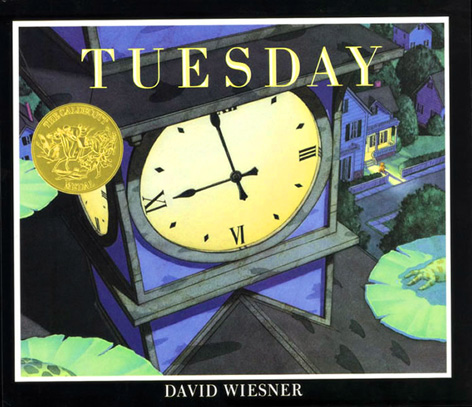
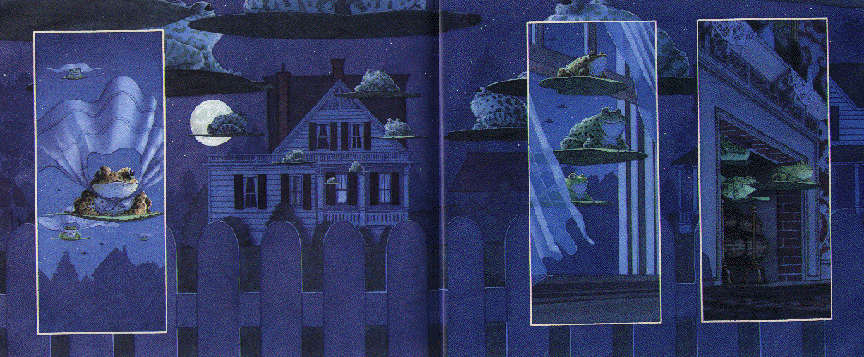
David Weisner’s Tuesday is one of the funniest picture books ever. Really. Watch the video. The funniest pictures, ever, hands down.  The few words in this picture book are only for context when an invasion of frogs floating on lily pads invade a small town on a Tuesday night.

I was so happy when I found a copy for $.25 at the New Milford Public Library book sale this summer. I have a well-worn hardcover of my own that I do not want to lose; this paperback will be perfect to share in class. Wiesner’s picture book is ideal to start the 9th grade mythology unit which leads up to students reading Homer’s Odyssey (Fitzgerald translation).

Our 9th grade curriculum centers on the idea that stories make us human, so our freshmen will spend the year studying the elements of stories and archetypes. For example, in each story they read, they will be able to identify the “call to action” and the moment the protagonist or hero “crosses the threshold”. They will recognize the “challenges” for the hero as being a repeated pattern, especially when the hero is confronted with “temptations”. The students will be familiar with the ideas of “redemption” and “atonement” as the hero travels on the journey from the comfort of the known world to the trials of the unknown world. They will develop an appreciation for the wisdom of the hero’s mentor and the importance of the “elixir” that helps the hero succeed.  They will look for these patterns in the stories they will read throughout high school.  They will review myths as traditional stories that are accepted as history which serve to explain a phenomenon. The flying frogs in Tuesday are most certainly a phenomenon.

We want the students to appreciate the “call to adventure” as demonstrated in the lily pads which lift the frogs from their “known” locale, the swamps and ponds outside the town to the “unknown” territories of living rooms. We want students to predict consequences as the  lilypads float the enthusiastic frogs literally “cross the threshold” of many of the homes.

We also want them to enjoy how Wiesner’s frogs cheerfully wave at disbelieving occupants or cavort using the lily pads as F-16s performing barrel rolls in backyard airspace, while other frogs sit comfortably and devise methods for changing channels in order to watch late night TV. We want them to note how all the frogs are “transformed” from their natural swampy state into comical caricatures.

The flight of the frogs is “challenged” by sheets hung on laundry lines or more directly by a slobbering guard dog. The frogs’ inexplicable journey is cut short when the “elixir” that made this incident possible mysteriously ends the spell. The frogs return to their “known” habitat. The mystery of the remaining lily pads scattered on the concrete roads and sidewalks all over town is wonderfully illustrated in the perplexed look on a detective’s face. Weisner uses a Orsen Welles look-alike in a rumpled raincoat who puzzles holding a dripping wet lily pad, a cadre of police officers and bloodhounds behind him ready to track down the invaders.

Tuesday, by David Wiesner (New York: Clarion, 1991)

Tuesday will provide the students an opportunity to “write  the myth” of what made the frogs fly. The student will need to reference the illustrations in the text as evidence in creating their own personal myth about the flying frogs. We are interested in the explanations the students will need to develop for why the lily pads floated so effortlessly from the pond.  How will the detective explain the limp lilypads strewn around the streets and sidewalks? What predictions do they have for the next possible phenomenon? Some early suggestions started in class are:

  • A new species of lilly pads grew legs and carried the frogs all over the town
  • The lily pads are lunar charged when the moon comes up, then when the sun comes up, the power wears off.
  • Lily pads were made radioactive when a battery fell off the space shuttle into their pond

David Wiesner’s picture book Tuesday provides my students an opportunity to identify universal story elements and create their own myths for the phenomenon of the hilarious frog invasion. This year is the year when they will recognize the elements of this story are the elements in all of literature.  Thus, the picture book Tuesday prepares students for the epic poem The Odyssey, where the equally magic flights and fantastic adventures of the hero Odysseus await their explanations.

But before we start out for Ithaca, we had to spend Tuesday with some frogs.