Archives For December 31, 2015

Wednesday night, January 13. 82nd Street branch of Barnes and Noble Booksellers, NYC:

After a full morning of delivering professional development to the K-12 grade literacy team combined with an afternoon working with 6th grade teachers, I was getting my literary reward. I was sitting in the second row at an author event, listening to the writer Colum McCann (Thirteen Ways of Looking, Let the Great World Spin) interview the writer Elizabeth Strout (Abide with Me, Amy and Isabelle).

"There are writers that leave porous holes [in their works] with air pockets for the reader," said Colum McCann, introducing Elizabeth Strout, whose novel I am Lucy Barton was recently released. "She whispers, 'trust me I m going to take you somewhere' and when we get there..she has told me secrets."

“There are writers that leave porous holes [in their works] with air pockets for the reader,” said Colum McCann, introducing Elizabeth Strout, whose novel I am Lucy Barton was recently released. “She whispers, ‘trust me I m going to take you somewhere’ and when we get there..she has told me secrets.”

McCann was interviewing Strout about her latest novel I am Lucy Barton and it was obvious that they both were happy to be having this intimate conversation in a room packed with their fan base.

I slid into a seat saved by my loyal friend Catherine-traveling  2 hours and 40 minutes after the aforementioned teacher PD- to hear McCann begin the interview with the question:

“Elizabeth, are you happy?”

“Yes,” replied Strout, and for a brief and worrisome moment it seemed as if the interview would end with that response, but McCann pushed a little more on the relationship writers have with their readers….and proved to be charmingly deft at teasing out ideas:

  • On writing a narrative: (McCann)“There is a agreement that the writer will tell you some thing you sort of knew… you knew that you sort of knew, but now you know it.”

  • On telling secrets:( McCann) “Any good story teller is saying to the reader come with me, and I’ll tell you something….an intimacy.”

  • On writing about a writer: (Strout) “I don’t know how I do what I do, that’s why writers are boring…”

  • On the process of writing: (Strout) “We just don’t know what we are doing…but I know who is charge.”

  • On how we know we are writers: (McCann) “I don’t think what we know what we are going to do…until we do it it’s only when people tell us what we’ve done that we know what we have done.”

As I listened, I thought of how all the effort I had expended that afternoon (from train, to shuttle, to subway, and run) had been worth it. So many of these statements by contemporary authors might seem oddly disconcerting for middle and high school students, and I began to wonder what was the best way to share what they were saying.

Teachers know that many students are convinced that novels spring, “Athena-like”, fully-formed from the mind of the author.
There is little regard for craft. The idea that authors say that they “don’t know,”and are waiting to hear from readers to know what their writing means strains credulity.

Paradoxically, many of these same students also believe that some readers -or at least all English teachers-make too much of what the author meant: too much of the symbols and motifs and themes in literature. They are quick to contend that maybe the author “did not know” and just wrote without a plan. They reject the notion of craft.

The conversation I was hearing suggested that that the relationship between a writer and the student does not need the English Teacher filter…and that teachers need to get out of the way. Whether or not students will find it…author’s craft is there.

But, I digress…and so did they.

Strout spoke of the experience of having her book Olive Kitteridge turned into a film:

McCann: “Directors come and actors come….and they put a language on what you have done…is that odd…? Do you think, Like T.S. Eliot That’s not what I meant at all?”

Strout: “No…they did a wonderful job. When I saw the character Henry, I thought,’I know that Henry…I made that Henry…'”

McCann: “And are there Lucy Barton’s walking about?”

Strout: “Sweetie…She’s fictional.”

Fiction aside, Strout commented on how she intentionally writes about people struggling with an real obstacle…and one real obstacle she includes is class.

“How do people fit into the world?” she asked. “I like to write about class…The poverty that does not let people belong to a community. They exist more now; They are hungry. So much of our literature does not want to talk about poverty.”

Her sentiment, I suspect, is what initially frustrates students when they complain about the steady diet of what they consider “depressing literature.”

Both Strout and Mcann saw the issue of class differently, and spoke about the power of literature in developing empathy.
“We know what it like in a world without it,” Strout responded to an audience member’s question, “Literature can make us understand briefly for a moment what it is like to be another…. than that would be a wonderful wonderful thing.”

The audience murmured their agreement, and Mccann echoed his opening question:

“So, Elizabeth, are you happy?”

“I am,” she responded.

We all were.

“Diametrically”

“Diametrically…May I have a definition, please?”

“completely; utterly”

“Diametrically…May I hear it in a sentence, please?”

“The debaters held diametrically opposed viewpoints.”

“Diametrically….D-I-A-M-E-T-R-T-R-I-C-A-L-L-Y…Diametrically.”

“That is correct.”

BeeThis past week, two 5th grade students from Carrigan Intermediate School went 24 rounds participating in the West Haven Public School District’s 35th annual Spelling Bee. In 20 minutes, they had defeated a series of challengers going head to head, word for word. Some of these words posed a challenge for anyone, regardless of grade:

“Hubris: H-u-b-r-i-s ”
“That is correct.”
“Infrastructure: I-n-f-r-a-s-t-r-u-c-t-u-r-e”
“That is correct.”
“Resilience: R-e-s-i-l-i-e-n-c-e”
      “That is correct.”

I am not sure who was more nervous….Me? (My first year coordinating this event at the district level) The parents ? The teachers? the  Board of Education members in attendance?


“Arboreal: A-r-b-o-r-e-a-l”
      “That is correct.”
“Commodious: C-o-m-m-o-d-i-o-u-s”
      “That is correct.”

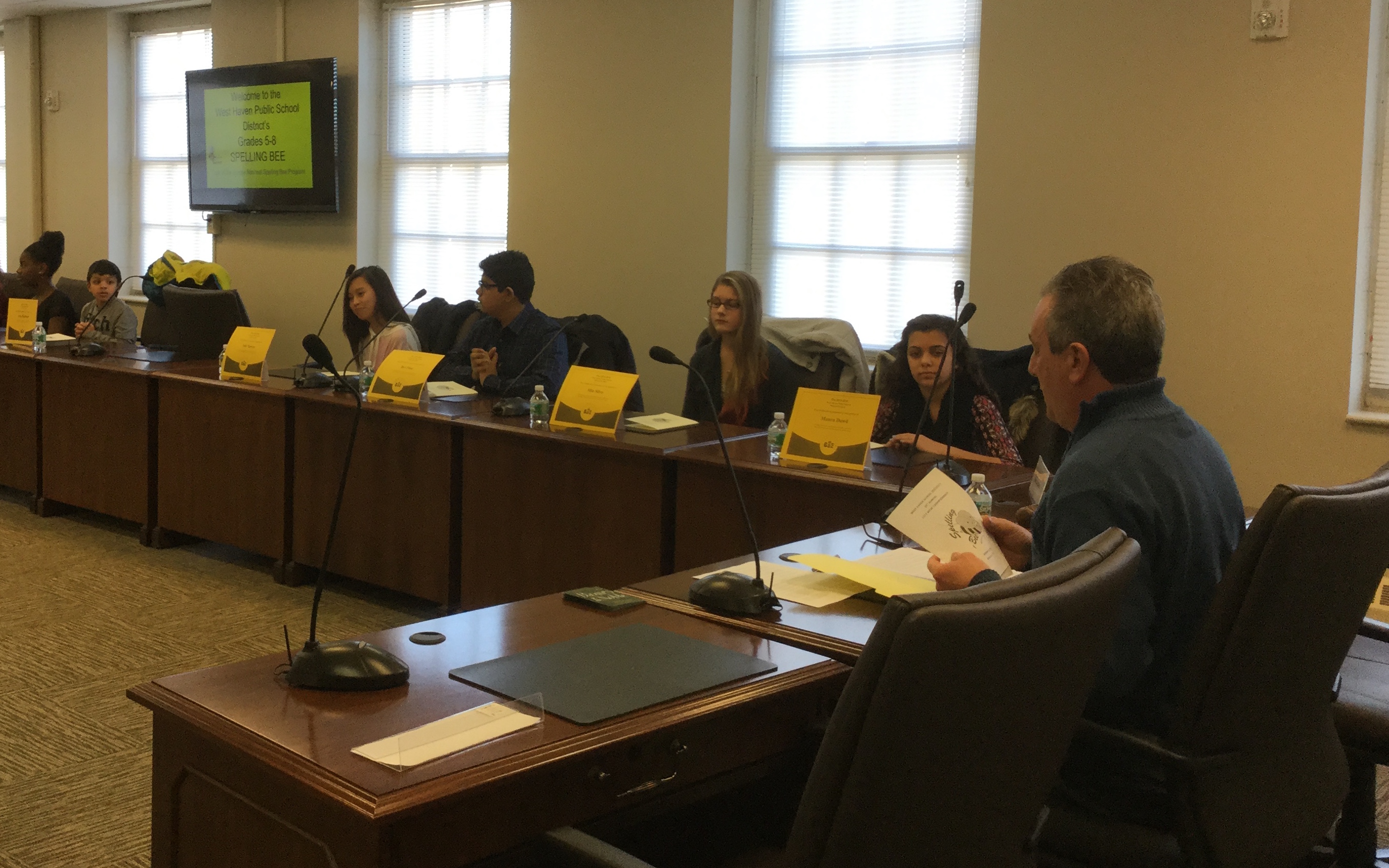
There were eight students who qualified for this district final. They had been bussed to the City Hall that morning, and they sat in office chairs reserved for members of the Board of Education. These chairs had never swiveled so nervously.

The Superintendent of Schools, Neil C. Cavallaro, was the moderator. After congratulating the students on reaching this final round, he began to read from the list of the words organized on the Scripps National Spelling Bee website.

West Haven Spelling Bee 2016

Six of the eight contestants waiting to spell in the West Haven Spelling Bee 2016

The tradition of qualifying for the National Spelling Bee began in 1925. The E.W. Scripps, a broadcasting company, took over sponsorship of the National Spelling Bee in 1941. The purpose:

Our purpose is to help students improve their spelling, increase their vocabularies, learn concepts, and develop correct English usage that will help them all their lives.

The sponsor for this year’s event for our school district is Quinnipiac University, a new sponsor for our region. They will be hosting the 2016 regional finals and sending a champion to the national finals held May 1-2. Our local spelling bee was set up to determine that champion who would go to the regional challenge. and the grade level winners received $25 gift certificates to Barnes and Noble from the schools’ PTA.

The final two challengers-two 5th graders -were a study in contrasts: Ayannah, calm and collected, facing off against Arin, confidently enthusiastic. The adults in the audience watching the contest sat mentally spelling each of the words or mouthing the spelling: “languish”, “germane”, “ostensibly”. The only sound coming from their area were the audible sighs of relief after each “That is correct” from the moderator.

The word “acoustics” proved to be too tricky for Ayannah. There was hush…and the audience sat riveted as Arin mastered “acoustics” and then spelled “molasses” correctly for the win. Cheers and applause erupted with the last “That is correct!” 5th grade Arin will move onto the regionals, and (hopefully) the national round.  He will be a great representative for the West Haven School District.

Watching our small event was akin to watching a sporting match, so it is no wonder that the National Spelling Bee is broadcast live on ESPN channels. Want to know how exciting a spelling be can be? Watch the final moments of last year’s Scripps National 2015 Spelling Bee, and try not to have your heart race:

“Tachycardia”
“May I have a definition, please?”
“an abnormally rapid heart rate”

Today is the third Monday in January, a national holiday commemorating Martin Luther King, Jr., and if you have not already seen Nancy Duarte’s visualization of Martin Luther King’s “I Have a Dream” speech, then here it is below on YouTube (or the Vimeo link here):

If you have not heard of Nancy Duarte or how she happened on this form of presentation, here is the her TED Talk link. In this presentation, she explains how she compared the simple “structure” of a story as first suggested by Aristotle (having a beginning, middle and end) to the structure suggested by Gustav Freytag’s in his story “pyramid”.

You may remember Freytag’s structure as something called a “plot mountain” from 4th or 5th grade:

250px-Freytags_pyramid.svg

Freytag diagrammed the strict dramatic structure that the Roman critic Horace defined in his Ars Poetica:

“Neue minor neu sit quinto productior actu fabula” (lines 189-190)

“A play should not be shorter or longer than five acts”

Good drama, Horace maintained, is based on a five act structure with an exposition, a rising action, a climax, a falling action and a denouement (unraveling or resolution) of the story. Freytag’s model provided the visual to Horace’s critical analysis.

Duarte praised Freytag’s visual in her TED Talk saying:

“I love this shape. So we talk about shapes. Story has an arc, well an arc is a shape. We talk about classical music, having a shapeliness to it. So I thought, hey, if presentations had a shape, what would that shape be? And how did the greatest communicators use that shape or do they use a shape?”

She wondered about this connection between story arc and how a presenter is the same as someone telling a story when she came up with the idea to overlay two great speeches to see if they followed the same story arc that Frytag suggested:

“So I took the obvious, I took Martin Luther King’s “I Have a Dream” speech, and I took Steve Jobs’ 2007 iPhone launch speech, I overlaid it over it, and it worked. I sat in my office, just astounded. I actually cried a little, because I was like, “I’ve been given this gift,” and here it is, this is the shape of a great presentation.

In her TED Talk, she explains how the shape of the both presentations follows the pattern established in Freytag’s pyramid.

Now, I could go one step further and make another connection from Duarte and Freytag to the Mathematical Practice Standards as outlined in the Common Core State Standards. These eight Mathematical Practice Standards “describe varieties of expertise that mathematics educators at all levels should seek to develop in their students.”

It is Mathematical Practice Standard #7 (MP7) that connects to Duarte’s visualization of text. It states that students should:

Look for and make use of structure.

In explaining how “mathematically proficient students look closely to discern a pattern or structure,” educators are developing the interdisciplinary and cross-curricular skills required to discover the patterns in other subjects as well, the patterns in literature and the patterns of history.

In her analysis of Martin Luther King’s speech, Duarte brought attention to the patterns created through his figurative language: the call and response, allusions, metaphors, etc., and she lays them out in multi-colored vertical bars for audiences to see. There is a geometric shape, there are patterns, and so, there is math.

From speeches as stories, to stories as visualized patterns, and to visualized patterns as part of mathematical practice, helping students understand the structure of  Martin Luther King, Jr’s speech can help them better appreciate the brilliance of his craft in both creating and then in delivering his unforgettable message, “I Have a Dream.”


BigShortThe film The Big Short based on a book by Michael Lewis– a funny but frustrating recap of the economic crisis of 2008. The last scenes of the film detailed the fallout using a voice over by Ryan Gosling playing the role of Jarred Varnett:

“The banks took the money the American people gave them and used it to lobby the Congress to kill big reform. And then America blamed immigrants and poor people. And this time… even teachers. And when all was said and done, only one single banker went to jail.” (PDF script)

I bolded “And this time… even teachers” because I was surprised to hear such a clear connection between a “they” and “blame teachers” when the film was entirely about the financial industry.

To be truthful, there was some highly entertaining educating going on in the film. The “teachers” were celebrities Margot Robbie (actress), Anthony Bourdain (cook, author) and Selena Gomez (singer, actress) who broke the 4th wall to “teach” audiences about credit-default swaps and collateralized debt obligations. But, as an educator, I have long suspected that teachers have been a convenient scapegoat, even before the No Child Left Behind (NCLB) initiatives.

Upon further investigation, “blaming the teachers” is not the only connection that is made between education and mortgage crisis. The film also highlights how several individual financial advisors saw the financial crisis coming, and then bet against the mortgage market (hence the name “The Big Short”).

In following the path of inquiry from mortgage fraud jumped to education, I found that the financial expert Steven Eisman (played by Christian Bale)  gave a speech in May of 2010 titled “Subprime Goes to College,” at the Ira Sohn Investment Research Conference.

Mother Jones reporter  wrote about the speech (May 2010) titled Steve Next Big Short: For-Profit Colleges He reported that  Eisman compared the for-profit education companies (ITT and Apollo Group) to, “seamy mortgage brokers who peddled explosive subprime loans over the past two decades.”

In his presentation (PDF) Eisman explained how federally guaranteed debt through Title IV student loans,one-quarter of the $89 billion in available, went to these companies that enrolled only 10 percent of the nation’s postsecondary students.

Kroll notes that in this speech -two years after the mortgage crisis, Eisman ended with a warning:

“Are we going to do this all over again? We just loaded up one generation of Americans with mortgage debt they can’t afford to pay back. Are we going to load up a new generation with student loan debt they can never afford to pay back? The industry is now 25 percent of Title IV money on its way to 40 percent…But if nothing is done, then we are on the cusp of a new social disaster.”

Eisman’s warning generated negative attention for him by April of 2011, reported in the CNN Money website, The article noted:

 The Citizens for Responsibility and Ethics in Washington (CREW) called upon the Securities and Exchange Commission to investigate whether Eisman had used his relationship with the Department of Education as a way to  “manipulate the market price” of for-profit education stocks.

By October of 2015, however,Eisman’s warning was being taken more seriously by other federal agencies. According to the Wall Street Journal Marketwatch Report:

The University of Phoenix (Apollo Group) was placed on probation by the US Department of Defense. They have barred recruiting on military bases and are active in “preventing troops from using federal money for classes.”

This must have an adverse impact on Apollo Group; net income growth for as of August 2015 was -131.88%.

Similarly, ITT Educational Services (ESI) reported their net income growth September 2015 as -83.65%. Truth in advertising might be part of the reason for the drop, one of the top bullets on the Consumer Information Page on the ITT website lists one powerful reason that potential students might not enroll:

Credits earned are unlikely to transfer.

The Inside Higher Ed website reporter Paul Fain also wrote about the souring relationship between ITT  and the Department of Education (10/20/15):

Troubles are deepening for ITT Educational Services, with the U.S. Department of Education on Monday announcing stricter financial oversight and reporting requirements on the embattled for-profit chain.

In a letter to the company, the department cited federal fraud allegations against two ITT executives and the company’s “failure of the general standards of financial responsibility” in justifying its decision to tighten the screws.

The attention Steven Eisman brought to the mortgage crisis eventually gave him credibility….and lots of money. He positioned this credibility towards another crisis…this one involving for-profit colleges.

Which starts a new line of inquiry as to who could get the blame this time? OR should audiences expect a repeat:  “And this time… even teachers.”