Archives For October 31, 2016

Dear National Council of Teachers of English (NCTE):

The 2016 NCTE Conference in Atlanta, Georgia, just concluded. This year the theme was “Faces of Advocacy”.

I would like to take this opportunity to do a little advocacy of my own.

The #NCTE Atlanta 2016 conference gave the nation’s English teachers an opportunity to exchange “words”….
have a word with…
get a word in edgewise…
hang on some one’s words…
or have the last word.

Every year, the NCTE conference brings together the nations’s (pre-school, primary, secondary, college) English teachers who traffic in words (vocabulary, root words, parts of speech, synonyms, figurative language, suffixes, etc.),

This conference began eleven days after the 2016 presidential election.

In several state, local and national campaigns, there were many words used by candidates on both sides of the aisle that were hurtful, that were fallacious, that were offensive. These words were highly visible on social media platforms and in the media; these words were highly visible to our students.

The multiple challenges to the use of hurtful, fallacious, or offensive words during the election was often met with derision by candidates, by candidate surrogates, or by media pundits on both sides of the aisle. Challengers were often told that candidates were “only joking” or just being “sarcastic.” There were publicized non-apologies :”I’m sorry if…” or “I’m sorry, but…”.

On occasion, words were retracted. “That meaning is not what I meant.”
Such retractions are linguistically precarious;  a challenge to word’s “meaning” does not negate what was expressed.

The “not what I meant” response conflicts with the definition of what a word means as “a unit of language, consisting of one or more spoken sounds or their written representation, that functions as a principal carrier of meaning.

words

In the 2016 election, many words were separated from their meanings.

Unfortunately, at this conference, NCTE, you did not offer any specific post-election guidance on this separation of word from meaning. At this conference you did not advocate for words and word meaning.

In all fairness, your conference theme (The Many Faces of Advocacy) was set years ago; its was months ago when the presenters were selected for sessions and the rooms assigned. In making these decisions, your organizing committee could not possibly have anticipated the current climate where the real political loser in this election would be words.

How then could NCTE support teachers as they proceed to teach words and their meanings to their students after this election?
How might NCTE prepare teachers in secondary schools to discuss understanding words that are spoken without meaning?
For example, how should NCTE guide teachers to help primary students understand the word meaning of a mean word?

Like the standard in Domain 3 of the Danielson Teacher Evaluation Rubric, NCTE, you could have exercised “Flexibility and Responsiveness” and “made an adjustment to respond to changing conditions.”

There could have been formal or informal opportunities for teachers to discuss their concerns about  hurtful words that were tossed about so publicly.
There could have been formal or informal opportunities for teachers to share strategies to deal with offensive words at multiple grade levels.
Finally, there could have been formal or informal opportunities for teachers to help their students in the future determine when, why, or how words are used to support fallacies.

NCTE, your oversight in not providing these opportunities is particularly ironic given the nation’s push for standards based curricula, where teachers of English are required to place emphasis at every grade level for evidence-based reading, writing, speaking, and listening. Students are expected to produce evidence-based responses that demonstrate precision in word choice (“Use precise language and domain-specific vocabulary to manage the complexity of the topic.”)  Word choice is explicit; students must comprehend and apply word meaning.

Instead, the campaigns of the 2016 election would have failed on any rubric that used evidence requirements for most state standards-based performance assessments.

In November 2017, when the conference moves to the City of St. Louis, NCTE, you could reaffirm your commitment to the mission statement which states:

“The Council promotes the development of literacy, the use of language to construct personal and public worlds and to achieve full participation in society, through the learning and teaching of English and the related arts and sciences of language.“

The phrase “use of language” in this mission statement refers to the use of words in a structured and conventional way. You should be prepared to defend the use of words in structured and conventional ways.

In summary,dear NCTE, when words are divorced from their meaning, they lose their power to communicate.
In 2017, we need to advocate for words.
Without word meaning, there is no reason to teach English.


Why should students be the only ones who have the opportunity to play games in class?

Game application programs are just as powerful an instructional  tool for teachers as they are for their students because game apps can deliver content to educators in an engaging and challenging way. Instead of sitting in professional development sessions, teachers can be like their students ….out of their seats trying to “beat the buzzer” with their response! 

Teams of teachers can challenge other teams of teachers on everything from best practices to trivia hidden in the student handbook, (just how well does everyone know the school dress code?) to organizing performance based assessments ( Choose: debate or poetry smack-down for Shakespeare?)

There are now multiple game applications that can easily deliver different kinds of content to teachers in grades K-12 and make professional development sessions memorable.

kahoot Kahoot! is just one of the game applications that can motivate teachers to participate. Teachers, like their students, can be highly motivated by the immediate competition these game apps create. Like their students, educators at all grade levels  do respond well to the points/rewards that game apps provide. And like their students, they can enjoy the immediate feedback the apps provided. This free, interactive platform records the results to the presenters, which can be used  to design the next level of professional development.

The Kahoot! website explains that their software allows educators the opportunity to:

“Create a fun learning game in minutes (called ‘kahoots’), made from a series of multiple choice questions.”

Once a game is made, it can be individualized with videos and images. Then, “Players answer on their own devices, while games are displayed on a shared screen.”

Another game application that can be used is Quizizz, another quiz, poll, or survey program that uses game graphics with feedback to promote learning. Like Kahoot!, this game app can be individualized for content with videos and images. The promotional material for Quizizz explains that, “Players answer on their own devices, while games are displayed on a shared screen to unite the lesson encouraging players to look up.”quizziz

I have used both the Kahoot! and Quizizz apps with teachers for professional development sessions.

Before using the game apps there were more than a few teachers who, exhausted from a day of teaching, would unenthusiastically go through the scheduled activity. 

But when they learned they could pull out their phones as a part of the presentation, they immediately became more engaged.  The teachers enrolled by using their phone for the quiz and began entering responses on their cell phones or tablets. In less than 20 minutes, I had covered the material that I wanted teachers to know and they remained highly engaged the entire time. They also learned how effective this tool could be if it was used in class on laptops or mobile devices.

When a quiz or survey or poll is created on the game platform, a PIN code is assigned so that everyone can join the activity. Then, the quiz is projected (LCD, Smartboard, Eno board, etc) at the front of the classroom where it can be seen by the whole class so the audience can play together in real-time. The game applications can be used on laptops or personal devices. Depending on which game application is used, devices can display color and symbol choices; the actual answer is viewed on the classroom screen.

A presenter can control the pace of the activity by setting a time limit for each question, which also allows time for information to process or for discussions to take place. As teachers answer questions, they are awarded points for correct answers and the timeliness of their responses. A scoreboard is displayed on the teacher’s screen. Watching that scoreboard with highly engaged teachers proves that nothing is better to incentivize others than a competition with inconsequential rewards!

Game applications can be used for all levels of ability, and the multiple choice option can be set for more than one correct answer. There are options to create discussion questions (“Which of these texts are best used for close reading ?”) or to create surveys (“What percentage of the midterm should contain objective-type questions?”)

I have used the game apps in particular to begin presentations on literacy by taking information from a research study such as Data from Kids Wireless Use Facts:

  • % of teenagers,13 -17, who “occasionally” access the Internet with tablets & mobile devices? (91%)
  • Over ___ % of parents said schools should make more use of mobile devices for education? (50%)

The data available in research studies can better inform teachers about the growing impact of technology on their students and the academic environment.

Digital apps like Kahoot! and Quizizz game platforms are the kind of technology that David Lassner, President of the University of Hawaii and informational technology expert, meant when he said,

“The real power of interactive technologies is that they let us learn in ways that aren’t otherwise possible or practical.”

The “us” in Lassner’s statement should not limited to the students. Teacher professional development with interactive technologies can be a critical part of a successful education program. It can be engaging. It can be challenging. It is practical, and it is certainly possible.

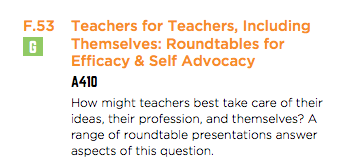
I will be presenting both of these game apps at the National Council of Teachers of English this coming Saturday, November 19th in Atlanta, Georgia. I will be basing the Kahoot! and Quizziz using information on teenagers and literacy. If you are down at NCTE, stop in at Table 7!screen-shot-2016-10-17-at-10-14-22-pm


screen-shot-2016-11-16-at-7-02-54-pm

F Sessions / 8:00–9:15 a.m. TABLE 7: “Get Your Phone App On!”

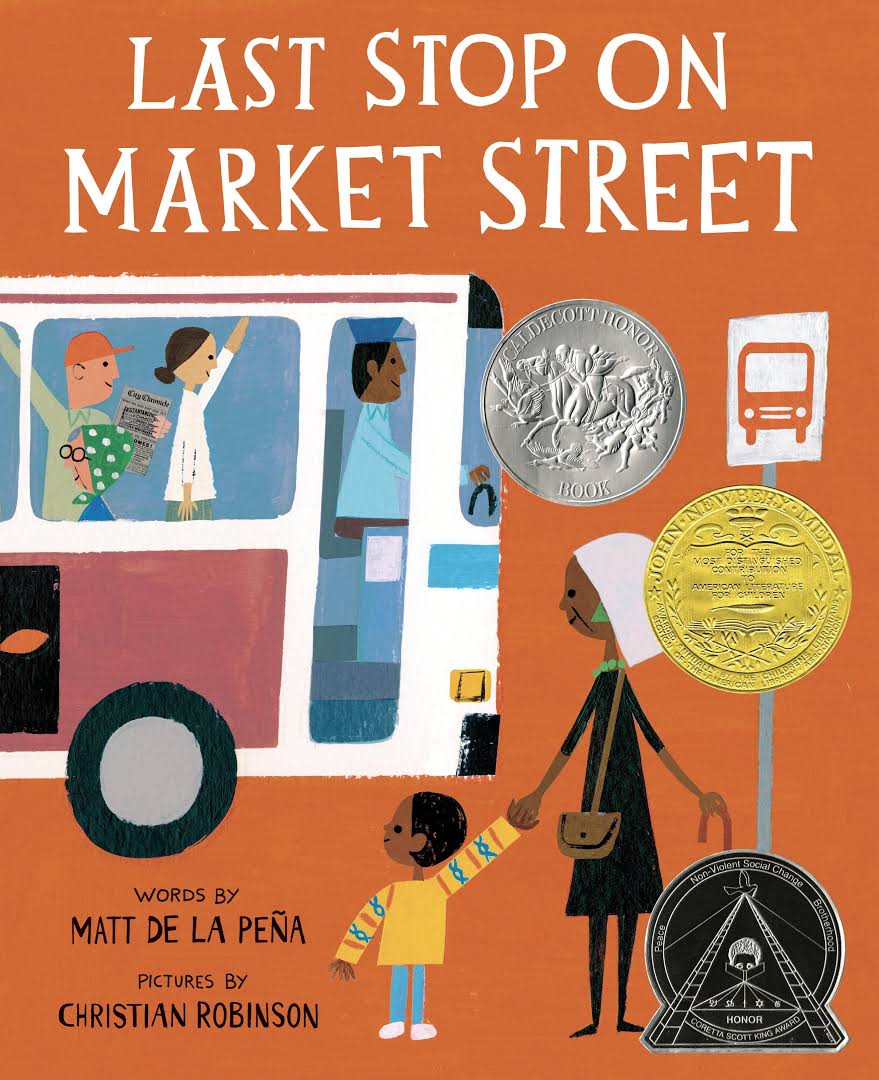
last-stop“…and what is that award for?” the boy asked pointing to the right corner of the book.

I was showing students in a 2nd grade class the cover of the picture book Last Stop on Market Street, written by American author Matt de la Peña and illustrated by Christian Robinson.

The boy was pointing to a black medallion, pasted under the silver foil award marking the  2016 Caldecott Honor and under the gold foil award marking the 2016 Newbery Medal. He was pointing to the shiny black circle that marked the Coretta Scott King Illustrator Honor, that lists the qualities of peace, non-violent social change, and brotherhood on its emblem.

“It has so many awards….and it’s only a few months old,” his classmate noted.

This fall, I have been reading Matt de la Peña’s story to students in different elementary grade levels.

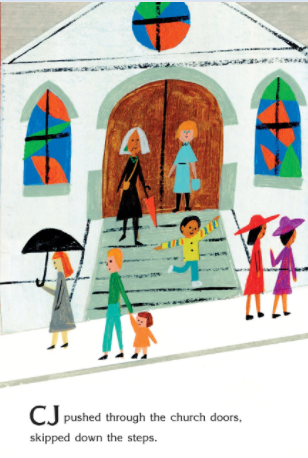
The students are hooked from the beginning when the picture book’s hero CJ bursts through the church doors, and into the rain that “smells like freedom.”

They notice the white trunks of the birch trees, drawn to look like they are “drinking through straw.” They like Nana’s sharp retort as she grows irritated with CJ’s questions.

“Boy, what do we need a car for? We got a bus that breathes fire.”

These repeated readings have made me aware that that CJ’s journey is a sophisticated journey. CJ travels through an urban landscape, a setting that is familiar to these students, but combined with same fantastic elements of an archetypal narrative pattern known as The Hero’s Journey. 

The Hero’s Journey or mono-myth was introduced by Joseph Campbell an American mythologist, who wrote in his most famous work The Hero with a Thousand Faces (1949):

“A hero ventures forth from the world of common day into a region of supernatural wonder: fabulous forces are there encountered and a decisive victory is won: the hero comes back from this mysterious adventure with the power to bestow boons on his fellow man.”

This narrative pattern of myth and legend has been followed by other characters on journeys. In the literary canon there are many examples such as  Odysseus (The Odyssey) and Bilbo Baggins (The Hobbit). The same narrative pattern is seen also in film with Dorothy in the Wizard of Oz and Luke Skywalker in the Star Wars trilogy.

Campbell drew parallels between these journeys of legend in literature and mythology with the journeys that everyday heroes make. He suggested that the everyone in life meets complications and obstacles, but it is the individual who goes through each of the stages and completes them successfully who society regards as a hero of any kind.

The Hero’s Journey follows a pattern of adventures that are generally organized in 12 stages. There is evidence that de la Peña’s little hero CJ experiences each stage, even in the short text (32 pages) of this picture book:

screen-shot-2016-11-03-at-10-24-53-pm1. Beginning in the Ordinary World

This is where the hero CJ begins his journey, oblivious of the adventures to come. We learn his his shortcomings; he complains  (“How come we don’t got a car?”) and he lacks the imagination of his Nana (“…he never saw a straw.”).

2. Call To Adventure

CJ’s adventure is a call to action, but the action is not clear until the end of the story.

3. Refusal Of The Call

Standing at the bus stop, CJ is uncomfortable.“How come we gotta…?” he complains to his Nana.

4. Meeting The Mentor

CJ’s  mentor figure is his Nana. She gives him whatever he needs: wise advice and self-confidence. She dispels his doubts and fears and gives him the strength and courage to continue his journey.

“Nana gave everyone a great big smile and a ‘good afternoon.’ She made sure CJ did the same.”

5. Crossing The Threshold

Climbing into the bus, CJ crosses the threshold between the world he is familiar with and that fantastic world which he is not. He climbs into the “…bus that breathes fire” and immediately the bus driver performs a magic trick with a coin.

6. Tests, Allies, Enemies

As every hero on a journey, CJ  needs to find out who can be trusted and who can not, and these characters on the bus initially seem a little sketchy.

“They sat right up front.
The man across the way was tuning a guitar.
An old woman with curlers was holding butterflies in a jar.”

CJ is out of his comfort zone and is confronted with challenges that help the reader gain a deeper insight into his character. The characters he meets are illustrated: the guitar player, Bobo, and the lady with butterflies, the boys with earphones, the blind man, and the blind man’s dog.

7. Approach To The Inmost Cave

In the mono-myth, the hero must make final preparations before taking that final leap into the great unknown. That comes about when the man with the guitar begins to play, and CJ follows the advice of a blind man:

“To feel the magic of music,” the blind man whispered, “I like to close my eyes.”

screen-shot-2016-11-03-at-10-24-24-pm8. Ordeal

By closing his eyes, CJ experiences the mono-myth’s “metaphorical resurrection” that (literally) grants him the hero’s insight:

“And in the darkness, the rhythm lifted CJ out of the bus, out of the busy city.
He saw sunset colors swirling over crashing waves.”

9. Reward 

During this stage, CJ is transformed into a new state, emerging with the prize or elixir. The background illustration by Robinson is not an urban landscape, but a full page spread of CJ’s imaginings. The prize or elixir is magic of music that activates his imagination.

“CJ’s chest grew full and he was lost in the sound and the sound gave him the feeling of magic.”

10. The Road Back

At this stage in this hero’s journey, CJ returns with his reward.  According to the pattern, he may still need one last push back into the Ordinary World. This is the moment before the Hero finally commits to the last stage of his journey,  moment in which he must choose some higher cause. Here, CJ notices the “Crumbling sidewalks and broken-down doors, graffiti-tagged windows and boarded-up stores,” a stark contrast to the beauty that the elixir of music provided.

11. Resurrection

This is the climax of the picture book, the “a-ha” moment. Responding to his disappointment, CJ’s Nana tells him,

“Sometimes, when you’re surrounded by dirt, you’re a better witness for what’s beautiful.”

Her knowledge has far-reaching consequences to his ordinary world.

He wondered how his Nana always found beautiful where he never thought to look.”

12. Return With The Elixir

This is the final stage of the Hero’s Journey, which is now revealed to have been a journey to a soup kitchen. On this journey, CJ has grown as a person; he has learned many things. He is a fresh hope to others, and, like his Nana, can offer a solution to problems.

“I’m glad we came.”

The final reward that he obtains may be literal or metaphoric. Ultimately the hero CJ will return to where he started, but he has a new point of view, one of empathy.

You can see Matt de la Peña reading selections from the book here:

In proposing The Hero’s Journey, mythologist Joseph Campbell suggested that everyone goes through a series of challenges in life, but it is only the hero who successfully meets each challenge at each stage of the journey.  CJ is the literal and archetypal hero of Last Stop on Market Street, reminding all audiences, young 2nd graders and adults, that the hero can be anyone who makes that challenging journey and who returns to bring hope to his or her community.

CJ’s reward is Nana’s approval to his statement, “I’m glad we came.”
She responds, “Me too, CJ. Now come on.”

CJ’s reward as a hero in completing his journey is captured for all audiences in a picture book by Matt de la Peña and Christian Robinson, in a picture book that is decorated with book awards.