Archives For November 30, 2016

The Common Core State Standards (CCSS) were released in 2009. They are now seven years old.

I will admit that I was not initially enthusiastic about the English Language Arts literacy standards. (see post)

I felt they were heavy in non-fiction…(no, wait.. heavy in “informational texts”).

The CCSS suggested a typical student should have a reading diet filled with informational texts because of the authentic kinds of reading they would do once they graduated, in the real world. The CCSS recommended that a ratio of 50:50 of fiction and informational texts in elementary school should shift to a 30:70 ratio of fiction to non-fiction by grade 12th. These ratios made me concerned that fiction would disappear.

I should not have worried.

The year 2016 has proven that the genre of fiction, a genre of invented or imagined stories, is thriving in the real world. Sometimes certain fictions are posing as informational text.

The year 2016 has been marked by the rise of fake news, hoaxes, propaganda, and disinformation that has circulated on news and social media platforms, fictions that have been developed intentionally or spread unintentionally.facts-not-fiction
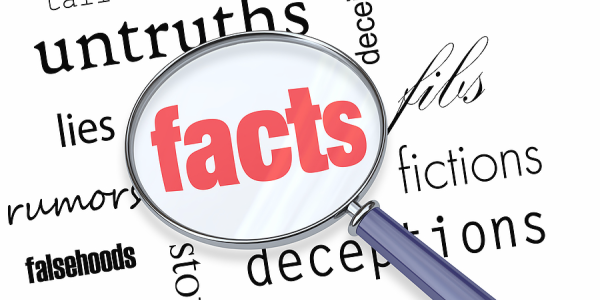
The growth of this kind of fiction may explain the decision of dictionary editors to award the word  post-truth as the 2016 word of the year. According to the Oxford Dictionary, post-truth is is defined as

“an adjective defined as ‘relating to or denoting circumstances in which objective facts are less influential in shaping public opinion than appeals to emotion and personal belief’.”

The decision by the editors of the Oxford Dictionary to chose the word post-truth is a decision that also highlights a phenomena studied by by Troy Campbell and Justin Friesen. Their experiments tested the relationship between facts, bias, and untestable beliefs.

The March 2015 issue of the Journal of Personality and Social Psychology, published their paper titled The Psychological Advantage of Unfalsifiability: The appeal of untestable religious and political ideologies. This research examined the circumspect methods people use to get away from fact(s) that contradict a deeply held belief.

Participants in the Campbell/Freisen’s experiments used facts to support or dispute a position. The experiments revealed that when the facts opposed a deeply held belief, the participants argued that facts did not matter but moral opinion did. But, when the facts were on their side, they more often stated that their opinions were fact-based and much less about morals.

“In other words,”Campbell/Freisen’s noted, “we observed something beyond the denial of particular facts: We observed a denial of the relevance of facts.” They concluded,

“…when people’s beliefs are threatened, they often take flight to a land where facts do not matter.”

One example of a land “where facts do not matter”, was the radio booth for the Diane Rehm Show on National Public Radio (NPR) on November 30th, 2016. Guest Scottie Nell Hughespolitical editor of RightAlerts.com and contributor to CNN appeared midway during the Diane Rehm’s show. Hughes was discussing the effective use of social media in bypassing more traditional media outlets to direct message. At 10:20, she made the claim that looking at facts is  “kind of like looking at ratings or looking at a glass of half-full water. Everybody has a way of interpreting them to be the truth or not true.” Then she stated:

“There’s no such thing, unfortunately, anymore of facts.”

Her statement was greeted with immediate derision by other journalists on the show. James Fallows of The Atlantic magazine shot back, “First I’ve got to pick my jaw up off the floor here. There are no objective facts? I mean, that is — that is an absolutely outrageous assertion.”

Hughes statement was hardly original; she may have been channeling her inner Friedrich Wilhelm Nietzsche who had also claimed (1887), “There are no facts, only interpretations.” But Fallows dismissed such philosophies on air, concluding:

“I believe that the job for the media and civil society now is essentially to say there are such things as facts.”

In contrast to Hughes, the use of facts as supporting evidence is essential to the CCSS. The CCSS recognized that 21st Century students would need to deal with an exponential growth in information, a future where rote memorization of facts cannot keep pace with knowledge that is doubling every year. As a result, the CCSS at each grade level outlines the skills students need to identify and to incorporate relevant facts they will use to write argumentative or explanatory responses.

For example, CCSS writing standards require students to:

“Develop the topic with well-chosen, relevant, and sufficient facts, extended definitions, concrete details, quotations, or other information and examples appropriate to the audience’s knowledge of the topic.” CCSS.ELA-LITERACY.W.9-10.2.B

In addition, the Common Core promotes the use of text-based evidence , gathered when  students “read closely” (aka: “close reading”):

“The Common Core emphasizes using evidence from texts to present careful analyses, well-defended claims, and clear information. Rather than asking students questions they can answer solely from their prior knowledge and experience, the standards call for students to answer questions that depend on their having read the texts with care.”

Prior knowledge or experience are no substitute for evidence. For the past seven years a common teachers’ refrain has been, “Can you show me where that evidence is in the text?”

All this hunting for text-based evidence may be the best training our students could have received as preparation for this post-truth world where pundits dismiss facts as unnecessary and media platforms promote factual inaccuracies through fake news.

Seven years ago, I could not imagine that I would be pleased about the Common Core, but the push for text-based evidence may be exactly what our students will need if educators are ever going to fulfill all those mission statements in student handbooks that outline how to make students into productive citizens and life-long learners.


John Glenn-Spaceman and Lollipopimage

A few days after John Glenn orbited our Earth three times, Mrs. Murphy gave each of us a lollipop to make an astronaut.

I was in kindergarten when she counted out three pipe cleaners and showed us how to carefully, carefully, carefully wrap them:

one fuzzy wire around the middle, three times for arms;

one fuzzy wire around the bottom, three times  for legs;

one fuzzy wire bent in circle around the top for the space helmet.

We were a classroom of John Glenns in different favors, with white pipe cleaner arms waving, cheering, pointing, celebrating.

We could not understand the vastness of space or the feats of engineering that had launched him into history, but we all imagined with our spacemen.

We were six; we understood the world was suddenly different.

My John Glenn, spaceman and lollipop, was orange, and I gave him to my father,

My father took this tribute and put it in his brief case, a high honor for a craft project. For years after, I would look to find my John Glenn in the brief case, buried beneath files and papers.

His arms and legs were always bent in celebration, and he still wore his space helmet.

Only his candy head showed his age, the clear cellophane wrapper protecting the orange-white powder and tiny shards of sparkling sugar.

“Space dust,” my father assured me, “he is made of space dust.”


Continue Reading…

If you Google the explorer John Cabot, you could get a web page from the website All About Explorers that states:

“In 1484, the explorerJohn Cabot moved back to England with his wife and eleven sons. He developed his own website and became quite famous for his charts and maps depicting a new route to the Far East. At this time he also introduced his half-brother Richard (whom the family always called “Ringo”) to his best friends, John, Paul, and George.”

While some facts in this information that might set off bells and whistles to educators-  or fans of The Beatles- there is recent research to suggest that many students in our middle school, high school, or college would not question the intrusion of technology into the life of this 15th Century explorer. After all, this website looks like a great source!

Stamford History Education Group (SHEG) report

A report released November 2016 tracked the research skills of students in middle, high school or college using a series of prompts. The study was conducted by the Stamford History Education Group (SHEG)  that “prototyped, field tested, and validated a bank of assessments that tap civic online reasoning.” The report, titled Evaluating Information: The Cornerstone of Civic Online Reasoning, details the methods SHEG used in order to test civic reasoning as well as:

“…the [students’] ability to judge the credibility of information that floods young people’s smartphones, tablets, and computers.”

The results of SHEG’s study indicated that many students are not prepared to distinguish accurate from inaccurate accounts or decide when a statement is relevant or irrelevant to a given point. SHEG noted:

“Our ‘digital natives’ may be able to fit between Facebook and Twitter while simultaneously uploading a selfie to Instagram and texting a friend. But when it comes to evaluating information that flows through social media channels, they are easily duped.”

The report concluded that students at all grade levels were unable to distinguish well-evidenced accounts from those unsupported by reasons and evidence or to tell good reasons from bad. In short, SHEG pronounced pronounced our nation’s students’ ability to research as “bleak”:

“For every challenge facing this nation, there are scores of websites pretending to be something they are not. Ordinary people once relied on publishers, editors, and subject matter experts to vet the information they consumed. But on the unregulated Internet, all bets are off.”

Educators should be concerned about this growth of fake information and how to keep this misinformation from spreading into student research. Even if the Internet gets better at shutting down fake news or inaccurate information, there will always be some bogus websites that will escape being shutdown.

screen-shot-2016-12-01-at-9-07-52-pmBut that  AllAboutExplorers website is one bogus website that should not be shut down.

AllAboutExplorers website for Research Practice:

Yes, there is plenty of misinformation on site. For example, on the Christopher Columbus page:

“Columbus knew he had to make this idea of sailing, using a western route, more popular. So, he produced and appeared on infomercials which aired four times daily. Finally, the King and Queen of Spain called his toll-free number and agreed to help Columbus.

Turns out that the misinformation on AllAboutExplorers is INTENTIONAL and all the misinformation on the site was created to serve an important educational purpose. The Aboutpage on the site states:

“AllAboutExplorers was developed by a group of teachers as a means of teaching students about the Internet. Although the Internet can be a tremendous resource for gathering information about a topic, we found that students often did not have the skills to discern useful information from worthless data.”

The educator authors Gerald Aungst,( Supervisor of Gifted and Elementary Mathematics in the Cheltenham School District in Elkins Park, PA) and Lauren Zucker,(Library Media Specialist in Centennial School District) created the site in 2006. Their collaboration has proven to be a prescient effort given the SHEG findings this month.

They created AllAboutExplorers, “to develop a series of lessons for elementary age students in which we would demonstrate that just because it is out there for the searching does not mean it is worthwhile.”

These educators wanted to make a point about finding useless information on a site that was designed to look believable. They note that “all of the Explorer biographies here are fictional” and that they purposefully mixied facts withinaccuracies, lies, and even downright absurdities.”

Some of the absurdities that have been mixed with facts on famous explorers include pages for:

  • Lewis & Clark Their dream didn’t become reality right away, however. It wasn’t until 1803, when Thomas Jefferson saw an intriguingly brief posting by Napoleon Bonaparte on Craig’s List for a large tract of land;
  • Sir Francis Drake: here he discovered an uncharted island called Java. The local drink, kofie (which we know as “coffee”) was rich and strong, and Drake soon fell in love with it. The locals also baked a cinnamon cake that was often paired with the drink;
  • Ferdinand Magellan: In 1519, at the age of only 27, he was supported by several wealthy businessmen, including Marco Polo, Bill Gates, and Sam Walton, to finance an expedition to the Spice Islands.

The authors have provided cautions not to use this site as a source of reference for research. There is even an “update” on the site that satirically mentions a lawsuit settlement on a claim that the information unfairly caused failing grades for students who used the information via the website. The authors can be followed on Twitter: @aaexplorersTheir website confirms SHEG report’s that states there “are scores of websites pretending to be something they are not.” There are also lesson plans designed to introduce students to the skills and concepts of good Internet researching:

The SHEG report should set off alarms for all educators who ask students to “look something up” in any discipline. The AllAboutExplorers website provides educators, particularly social studies educators, an opportunity to helping students to learn how to negotiate the Internet in research. Teaching students to explore the web appropriately and accurately can be improved by introducing students to the AllAboutExplorers website.