Archives For November 30, 1999

“Want to know the shortest poem in the world?” I asked my Advanced Placement students when they were overwhelmed with the epic poem Paradise Lost by John Milton. I wanted to use a related poem to demonstrate a close reading, one of the skills students should have in according to the Common Core Standards for English/Language Arts, but they needed a little fun.

“It’s called Fleas.”

I wrote the poem on the board:

Fleas

Adam
had’em

That’s it. Three words…actually two if you consider the contraction “had’em” as one word.

The poem attribution is generally given to Ogden Nash (1902-1971) although there are some who credit Shel Silverstein (1931-1999). An article by Eric Shackle, however, found the originator of the poem was Strickland Gillilan (1869-1954). The article notes:

“At last, after searching dozens of websites, we discovered the identity of the mystery poet. It was revealed on a US National Park Service website describing Mount Rainer National Park, in west-central Washington state. The Mt Rainier Nature News Notes of July 1, 1927 contained this brief item, tucked away as an end-of-column filler:

‘THE SHORTEST POEM
We like poetry but we cannot stand it in too large doses. The following, which according to its author, Strickland Gillilan, is the shortest poem existing, deals with the antiquity of “bugs”. It runs thus: Adam had em!'”

Authorship clarified, I asked my students, “So, what could you write about this poem?”

They stared at me. Surely I was joking…what kind of discussion or essay could a poem of this length generate?

After several minutes, however, here is what they came up with structurally:

  • iambic (duet?)
  • rhyming couplet
  • rhyme (am/em)
  • perfect internal rhyme (ad)
  • there is contraction
  • no punctuation
  • uneven number of letters; shorter first line

Here is what they came up on the topic of fleas:

    • Scientists have discovered that fleas probably fed on dinosaurs
    • Fleas feed on warm vertebrates’ blood
    • Fleas need Adam; Adam does not need fleas

Here is what they came up with figuratively:

  • the name in the first line establishes context
  • literary allusion: Adam from the Bible, the first man in literature
  • Eve was not mentioned, so the setting may be earlier than Genesis 2:20
  • the tone is casual and comical
  • the mood is humorous
  • Adam has fleas; the fleas don’t have Adam
  • the title is critical to the understanding of the message

Unanswered questions they had on the poem:

  • Could there have ever been just one flea?
  • Does Adam bathe?
  • Is the past tense verb “had” mean that he has cleaned up his act?

adam

Their conclusion?

  • Close reading three words yields a fun discussion;
  • Concise poetry captures the relationship between ancient man and an ancient insect pest.

Fleas– the world’s shortest poem!

muckRight about now, the last week of April, my Advanced Placement English Literature students are noticing a frantic tone creeping into my voice.

“No, finish this multiple choice practice FIRST, then complete the essay prompts. Any questions? No? Let’s go, now. Hurry….hurry….HURRY!!”
“Geez, you are so crabby lately,” notes one.

I am crabby; I understand the pressure they will be under during the AP exam in May, and I want them prepared. In contrast, they just want to be fourth quarter seniors.

These weeks are the “boot camp” weeks before the exam, and I am trying to improve their ability to respond quickly and decisively to a prompt. They will be writing three separate essays; each read by an audience of one, a reader who will grade hundreds of essays a day. They need to make a clear argument.

For practice, I offered a choice of four prompts to students. We just finished reading Eugene O’Neil’s A Long Day’s Journey into Night, and each prompt touched on one aspect of the play: the text, the characters, the theme. Rather than have them write a full essay response to a specific prompt, I had them write two separate opening and concluding paragraphs for their two chosen prompts. I gave them forty minutes to do both. The whining began immediately:

“I have a hard time just writing a beginning and an opening.”
“I always start in one place and end in another.”
“I need to write the middle or I can’t write the end!”

“That’s because you write to find out what you think,” I respond, “and that should show up in the introduction or the conclusion.”

Since the AP exam is a timed test, 120 minutes for three prompt analysis and response questions, timed practices are helpful. These truncated practice essays are incomplete and rough, but they do help students practice how to reconcile an introduction with a conclusion in a short time. In these hastily written drafts of beginnings and endings, I can help them distinguish their good ideas from linguistic clutter so an AP reader will better appreciate their argument. I do not want my students to make a thesis so hidden that the AP Reader is hunting for the “manifesto in the muck”.

What “muck” you ask? Essays cluttered with empty words:  a lot, kind of, sort of, actually, stuff, thing, very, really, quite

Essays cluttered with the muck of empty phrases:

  • Because of the fact of
  • The reason…is because

Essays cluttered with the muck of statements of the obvious:

  • The author uses diction and syntax to communicate his meaning.
  • The theme is the message the author is trying to communicate.
  • Words have meaning.

In one block period, the students wrote the truncated essays of introductions and conclusions in response to O’Neill’s semi-autobiographical play,  A Long Day’s Journey into Night.  We reviewed each draft to find the one powerful statement that publicly declared that student’s view, a statement that could get an AP reader’s attention. The prompts are in bold; student’s statements below each prompt:

PROMPT #1: Select a line you find especially memorable; analyze the reasons for its effectiveness.

  • When I read about this family, it reminded me of the advice, “only the strong survive’; the Tyrone family lives like a pack of animals, not a family.
  • If the characters in the play had the ability to leave behind their past, forget the things that made them lesser, they would be better off.

PROMPT #2: Describe how the author manages to give internal awakenings, discoveries, changes in consciousness the sense of excitement, suspense, and climax usually associated with external action.

  • James is struck with the conflict of having someone say his greatest fear is being in a class he does not think he belongs. 
  • The choice presented to each character is which moral or ethical barrier to shatter in order to overcome the cycle of insanity.
  •  Literature is an extension of human understanding and comes from our musings, our curiosities, and our imaginations.

PROMPT #3: Discuss the contribution scenes of social occasions reveal about the values of the characters and the society in which they live.

  • Whether these experiences dealt with alcohol abuse, substance abuse, or general unhappiness in life, all topics were acted out to be ignored or forgotten about, yet these [experiences] remained the most memorable. O’Neill wanted the conflicts to be pushed aside, which then caused the audience to latch on and never forget.
  • We seek out the approval and forgiveness of others when our own soul’s condition is purely of our own pilot.

PROMPT #4: Explain how the tragic figure functions as an instrument of the suffering of others and that the suffering brought upon others by that figure contributes to the tragic vision of the work.

  • In this way, each individual’s poisoned action spreads like a virus and affects all those in its proximity devouring them to the point of self destruction.
  • Edmund’s sickness is not just  source of unwanted strains on the family; it is an object to represent the family relationship.

When I come upon one of the above statements, in the beginning or the end of the draft, I can almost hear the “clink” that went on in the student’s head (and hand) as he or she drafted the essay.  At a point in the writing conferences that followed, a student will agree, “Yeah, that was when I figured out what I was writing about.” My experience is that students write their way into a thesis, and it is important for the student to recognize that statement, so he or she can parse away the clutter, removing the muck so that the AP Reader can find that statement too.

During this last week of AP English Literature practice, students will work at drafting responses to prose and poetry prompts. They will be writing their responses quickly, and I will still be crabby. But because of the practice, there will be less muck that covers a student’s manifesto in an AP literature essay response. After that, they can go back to being 4th quarter seniors.

60 of my students met their first Hamlet on stage at Yale Repertory Theatre in New Haven, Connecticut, this past week. Their Hamlet was the actor Paul Giamatti, who after speaking 40% of the play’s 4,042 lines (roughly 1,440), came out onto the stage for an audience talkback to speak a few more words to them.paul giamatti

“He looks tired,” on student remarked to me. The play had begun at 10:15 AM, and we were still sitting three and a half hours later as the actors and crew began to respond to questions.

If we thought they looked tired, the actors seemed surprised to see us still sitting there.
“Wow!” Polonius (Gerry Bamman) said as he sat, “You stayed!”

Students were curious about how the sets moved (“The stage has a large fly space.“). Students wondered how long the cast had rehearsed (“Eight weeks, a real luxury…”). Students wondered who was most like his or her character (“I understand Gertrude much more since I have a son”). Students asked about the creation of set pieces including a large portrait (“That’s an oil painting from a  photograph”).

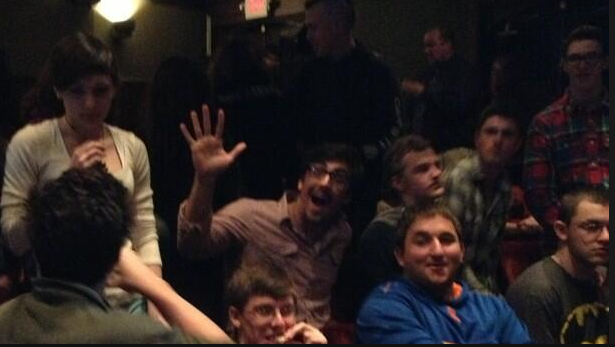
Of course, there was no stopping the students from calling attention to Giamatti’s role in Big Fat Liar, a film from their youthOne student stood to ask, “Did Hamlet remind you of Marty Wolf?” Giamatti laughed in response, “Well, maybe,…a little… except for the blue crap!”

Hamlet is a 12th grade text, and I asked students to take a survey after they returned to the school to see what they thought of this production. While the survey indicated that the teachers in our English department had done their job, the students indicated that seeing the play performed was very different that studying the play in class:

Shakespeare was meant to be live. Although the “perfection” of a movie is enhancing to the performance, it is unrealistic. I believe that watching a play live is important to seeing the different styles and methods possible.

It was fun and a lot better than just reading it in class, it made it come alive.

I did not think it was going to be as entertaining as it was. I also did not think I would find parts humorous, but I did.

This Hamlet was part of the WILLPOWER! series (funded by the National Endowment of the Arts). The website states:

WILL POWER! is Yale Repertory Theatre’s annual educational initiative in conjunction with one of its productions and features specially-priced tickets and early school-time matinees for middle and high school student groups. The program also includes free professional development for educators, study guides and post-performance discussions with members of the company.

One of the objectives of the WILLPOWER! series is to create new audiences, specifically younger audiences, for Shakespeare. Students who have attended a Shakespeare play may be more willing to attend another play when they are older; in other words, a favorable dramatic experience will yield future audiences for Yale Drama School graduates!

Seniors at intermission watching Hamlet at Yale Rep

Seniors at intermission watching Hamlet at Yale Rep

The survey indicated that this goal is being met with the WILLPOWER! series; my students are certainly willing to try another play:

The performance was a wonderful experience, especially since it was my first time to see Shakespeare.

I wouldnt mind going to another because it was so enjoyable that I didn’t even realize the 4 hours passing by.

I like the way that a play has a certain kind of vibe. It’s like a live concert, where there’s a certain kind of energy. It was like seeing a live performance of a film. I would especially like to see another Shakespeare because it is the way that he intended his works to be portrayed.

After seeing Hamlet so well done, it would definitely be worth going to see another one whether it be Shakespeare or a different kind of performance.

Perhaps the most satisfying moments of the actor’s talkback for teachers is hearing the actors say things that we wish our students would pay attention to in class. When Giammati was asked about how he felt about memorizing all those lines, he explained that he enjoyed learning the lines and playing on the open space of the stage.

When one student asked, “What part of the play did you like best?” Giamatti responded, “I enjoy the end, when Hamlet returns to the graveyard, until the end.” Then, thoughtfully, he added, “Shakespeare’s words begin to come through you if you let them.” (Honestly…you could hear the teachers in the audience swoon!)

But nothing was better than hearing the young Remsen Welsh (Player Prologue) explain how the director, James Bundy, had prepared her for her role. “It’s simple,” the actress gestured enthusiastically from the front of the stage. Facing the crowd of students twice her age, she cheerfully acknowledged, “He told me, ‘Suit the action to the word, the word to the action..’ and I did!”

Exactly.

A first Hamlet they will remember.

College Application Essay topics for 2013-2014 have been posted, and SURPRISE! Every prompt requires a narrative!

storyA recent news release by the Common Application, a non-profit widely used for college admissions by high school seniors at nearly 500 colleges and universities, explains the changes in essay prompts for 2013-14. The option to write about a topic of “your choice” has been dropped; the essay topics are:

  • Recount an incident or time when you experienced failure. How did it affect you, and what lessons did you learn?
  • Reflect on a time when you challenged a belief or idea. What prompted you to act? Would you make the same decision again?
  • Describe a place or environment where you are perfectly content. What do you do or experience there, and why is it meaningful to you?
  • Discuss an accomplishment or event, formal or informal, that marked your transition from childhood to adulthood within your culture, community, or family.

The irony of this decision should not be lost on anyone who remembers a blunt statement made by David Coleman, the current President of the College Board. In April of 2011 at a NY State Department of Education presentation on the Common Core, Coleman said, “As you grow up in this world, you realize people really don’t give a sh*t about what you feel or what you think.”

Well, apparently the College Application Board does care. Their prompts specifically ask college bound students what they feel or what they think. In fact, the College Application Board cares so much that they will allow students to expand their storytelling by an additional 150 words, increasing the word count from 500 to 650.

The decision by the College Application Board really is not that surprising.  on the Buffer blog called attention to research on reaction of the  the human brain to stories. He summarized a number of brain studies that indicate that the best learning comes from storytelling. One study by Uri Hasson from Princeton was published in an article titled “Speaker–Listener Neural Coupling Underlies Successful Communication” in the Proceedings of the National Academy of Sciences. The article discussed how subjects under study create empathetic bonds with listeners by using stories:

“When the woman spoke English, the volunteers understood her story, and their brains synchronized.  When she had activity in her insula, an emotional brain region, the listeners did too.  When her frontal cortex lit up, so did theirs. By simply telling a story, the woman could plant ideas, thoughts and emotions into the listeners’ brains.”

College bound seniors should take note of this research when they write; apparently a compelling story can be quite convincing. Luckily, they will have  plenty of practice with the narrative writing genre which is now back in favor with the adoption of the Common Core Literacy Standards. Anchor Writing Standard #3 for grades K-12 reads:

CCSS.ELA-Literacy.CCRA.W.3 Write narratives to develop real or imagined experiences or events using effective technique, well-chosen details and well-structured event sequences.

Curiously enough, one of the architects of the Common Core Literacy Standards was David Coleman before he took his position at the College Board.

Now the revised College Application Board form for 2013-14 states: “Some students have a background or story that is so central to their identity that they believe their application would be incomplete without it. If this sounds like you, then please share your story”

A word of caution, though. Don’t expect College Board President Coleman to care.

Today is Digital Learning Day! To mark the occasion, let me take you through a quick walkthrough of the halls of Wamogo Regional Middle/High School and give you a snapshot on how digital learning looks in the English classrooms grades 7-12. We have 1:1 computers in grades 7 & 8; in grades 9-12, we have a “bring your own digital device” policy. Here are the digital learning activities on Wednesday, February 6, 2013:

Grade 7: Students responded to a short story they read, “The Amigo Brothers”. They accessed the wiki (www.PBworks.com) in order to respond to “close reading” questions on the author’s use of figurative language. (Students are required to use evidence in their responses; digital copies of text helps student correctly add and cite evidence).

Grade 8: Students uploaded their reviews of the books (Mississippi Trial, 1955; Chains; The Greatest) they have been reading in literature circles to www.edmodo.com. These reviews are connected to the Common Core Writing Standard #6:

CCSS.ELA-Literacy.W.8.6 Use technology, including the Internet, to produce and publish writing and present the relationships between information and ideas efficiently as well as to interact and collaborate with others.

Grade 9: Students responded to a “writing on demand” journal prompt in preparation for the novel Of Mice and Men. This prompt is connected to the theme of hopes and dreams, and the students were asked:

What is your hope for life, your goal, or even your dream?  What do you think you want from the future? What would you live without, dream-wise?  What couldn’t you live without?

The students also posted their responses on a www.Edmodo.com discussion thread. Selections from responses included:

  • Something I couldn’t live with out would be my grandparents because they are like another set of parent to me, just better. They mean so much to me, that I really couldn’t see my life without them.
  • I hope to be a plant geneticist in the future, that is my hope but no matter what happens I would like to have a career involving plants and even if I can’t get a career in genetics I know it will always be a hobby of mine.
  • My house will be by the ocean, so close I can see it out of my kitchen window. I will grow old and drink coffee on my porch, while I read the paper and wave to my neighbors who walk by!
  • I could live without being famous around the world but I would like to be known town wise. I cannot live without family and their support in my decisions. They help me to stay confident and get through whatever I want to accomplish in life.
  • I think I could live without wanting a huge house or a huge boat “dream-wise”, but that still doesn’t mean I don’t want those things. I couldn’t live without music or my family.
  • My biggest hope and dream is to have a really big plot of land and have the world’s biggest tractor and a bunch of snowmobiles and ATV’s.
  • I want to be able to adopt kids from Uganda but also have my own, and I want to live in a nice house with a big yard. I want to work with little kids as a job.

10th grade Honors English students are reading Great Expectations. They took a quiz on www.quia.com, a software platform for timed quizzes. The College Prep English classes are reading Animal Farm. Today, they had to access “The International” MP3 and the www.youtube.video of the Beatle’s song “Revolution.

For homework tonight, students will write their own “protest” song.

Grade 11: Students can access the vocabulary list from the film The Great Debaters through the class wiki (www.pbworks.com) while the Advanced Placement English Language students watched a YouTube video of a Langston Hughes poem “I, Too, Sing America” read by Denzel Washington:

They prepared responses to the following questions which were posted on the class wiki:

  1.  To whom is the poet writing?  How do you know?
  2.  Choose one stanza and discuss what you feel is the key word in this stanza and explain why you chose this word?
  3.  What feelings does the poem create?  Which words create this feeling?

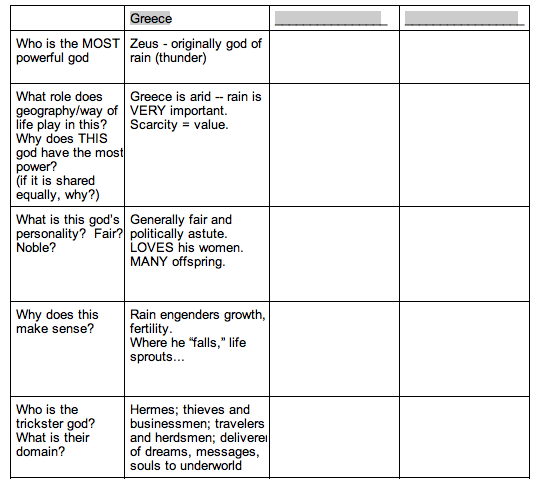
Grade 12: Students in the Grade 12 Mythology class accessed the following Google Doc Template and filled in the chart with their own research about the mythologies of different cultures. This activity meets the CCSS writing:

CCSS.ELA-Literacy.W.11-12.7 Conduct short research projects to answer a question; narrow or broaden the inquiry when appropriate; synthesize multiple sources on the subject

Screen Shot 2013-02-06 at 11.43.41 AM

The Film and Literature class “flips” the content by having students watch films for homework in order to discuss them during class. Tonight’s assignment? Watch the following YouTube clip and be ready for an open note quiz:

Students in the Advanced Placement English Literature class read the short story “Barn Burning” by William Faulkner that was embedded with a quiz on www.quia.com. They then created a list of four themes from the short story on a Google Doc. Each student selected a theme and placed his/her responses in the Google Drive folder to share with other members of the class. Examples included:

  • Actions we take with the grotesque: Shun? Avoid?

This story embodies an ultimate grotesque atmosphere. Even Colonel Satorius Snopes’ sisters are described as, “hulking sisters in their Sunday dresses” (2). These sisters are emulated throughout the story as disgusting, rotund, lethargic, and hog-like beings. This grotesque physical trait emulates the family’s condition in society. Satorius’ clothes are described as, “patched and faded jeans even too small for him.” (1).

  • Family over law or law over family

For the boy to go against his family in the end further proves his actions of courage and strength, and portrays the theme of law over family. “Then he began to struggle. His mother caught him in both arms, he jerking and wrenching at them. He would be stronger in the end, he knew that. But he had no time to wait for it” (10). His whole family is holding him back, but he chooses to go against all of them and do what is right.

This quick walkthrough demonstrating the use of technology in the English classrooms on one day demonstrates that for the teachers and students at Wamogo, everyday is a Digital Learning Day!

Busines_heroThe association of midterm exams with freezing is both literal (I teach in the Northeast) and figurative  (many students “freeze up” during an exam), so at the end of this semester, I took one of the writing standards from the Common Core State Standards  hoping at the very least to stop the “freeze” in the classroom during the exam. Instead of a multiple choice exam with essay questions, I prepared my 12th grade students to write an inquiry paper that would be due the morning of the exam. Yes, even those seniors who had repeatedly assured me that they will never go to college would be tasked with a three to five page paper academic paper that touched on the material that we had read over the course of the semester.

The Common Core State Standard I had in mind was ELA Literacy Standard W.11-12.7:

Conduct short as well as more sustained research projects to answer a question (including a self-generated question) or solve a problem; narrow or broaden the inquiry when appropriate; synthesize multiple sources on the subject, demonstrating understanding of the subject under investigation.

I admit, the draw for me was the “self-generated question”. We had started the “Hero or Monster” English elective brainstorming the following questions:

  • What is the difference between a hero or monster?
  • What criteria do we use to determine who or what is a hero?
  • What criteria do we use to determine who or what is a monster?

We read about monsters in Louis Stevenson’s  Dr. Jekyll and Mr. Hyde and Mary Shelley’s Frankenstein. We read excerpts from Milton’s  Paradise Lost, and we  studied the monsters of mythology (Cyclops, Widiego, Fenris, Leviathan).

We read about heroes in the Iliad and in Roger Rosenblatt’s essay The Man in the Water. We looked at Joseph Campbell’s study of The Hero’s Journey, and we created our own superheroes. Students also read an independent book and determined the hero (or anti-hero) in that text. Finally, we used current events to discuss the monsters and heroes in everyday life.

As the quarter came to a close,  each student had to come up with a “self-generated” question. I was happy to see how these texts had served to inform their line of inquiry. Questions included:

  • Was the hero really a hero before the monsters came along? Does the Hero need a Monster to be a hero?
  • How does our exposure to monsters when we are children inform our views of monsters when we grow up?
  • How does “bad parenting” figure in the development of a monster?
  • How has the criteria of strength in a hero changed since ancient times?

The students had two weeks to frame their questions and find evidence that would support their positions. Our “Bring Your Own Digital Device” (BYOD) policy was an important part of the organization and writing of the paper. Students had access to e-texts, and they had links to sources or discussions that we had placed on the class wiki during the semester. I created a Google doc folder and their papers were available for peer editing or for my comments as they worked. One night, I popped in on a few papers to see their progress. As I was leaving comments on one paper,  I saw the following text appear, “Mrs. Bennett, you are on my paper as I am writing….this is creeping me out.”  Creeping them out or not, I was able to provide guidance as they incorporated citations from the texts we had read in class into their arguments.

I am pleased to write that my gambit for this midterm exam worked. The papers are in, and many exceeded my expectations, proving that the writing standard 7 for grades 11 and 12 that requires a self-generated question is appropriate for this grade level.The self-generated question kept them more engaged because this was their inquiry, and as they wrote,  they came to conclusions that they incorporated into their papers:

Throughout the course of writing this paper, I have come to a surprising realization. It has come to my attention that the heroes that we idolize and fawn over (Hector, Achilles, etc.) are not always as heroic as the everyday, ordinary people who rise to the occasion when chaos ensues.

When Hector went into battle in the Iliad in ancient times, he may have had the same thought as the “Man in the Water” in 1982, the thought that “I might die doing this.” That thought did not stop either of them, and both men are still talked about; they are held high and admired. Time does not change our appreciation of heroes.

Some of these true monsters, (Satan of Paradise Lost and Victor of Frankenstein) have used their cunning ways to confuse or deceive the reader so they cannot be seen as the monsters they are.

The inquiry paper, which does permit the use of the pronoun “I”, has been a much easier way to teach academic research and improve a student’s understanding of an author’s intent. Furthermore, the research students included in their papers reflected a wide range of texts; papers were longer, and the evidence was organized according to information rather than the ubiquitous five-paragraph framework.  More than one student remarked how their fingers seemed to know what to write; more than one told me how the inquiry gave them ideas they found surprising.

While I may not yet know the impact of all the standards from the Common Core, I will state unequivocally that the self-generated question allowed me to successfully measure what students learned about heroes and monsters in both literature and in real-life. Correcting these papers has been less of an “ARRRG!” (insert monster voice) and more of a “Hurray!” (insert heroic cheer!).

tragedy“On Friday noon, July the twentieth, 1714, the finest bridge in all Peru broke and precipitated five travelers into the gulf below.”

That is the opening sentence from Thornton Wilder’s novel The Bridge of San Luis Rey. A monk who witnesses the fall of those travelers searches for answers as to whether the accident was simply chance or an act of the Divine. In writing The Bridge of San Luis Rey, Wilder was addressing the genre of tragedy which was defined by Aristotle in his Poetics as “an imitation of a serious act” in literature. The purpose of tragedy is to provide the reader, or viewer in the case of drama, an experience of loss without having to suffer what a fictional character suffers. Through his literature, Wilder, like the authors and playwrights before him, provided the experience and language to us to respond when there is a tragedy. Great literature does this well which may be why the literature taught in high school classrooms is, more often than not, tragedy.

Of course, tragedy is not always a popular curriculum choice. I am always being confronted by students,  “Why do we have to read such depressing books?” or “Why does every book we read in English have to be so sad?” Predictably, when I hand out a book for a whole class read, student will examine the cover, the length of the text, and ask, “So, who dies?” Through literature, students learn a number of different approaches or definitions of  tragedy. In grades 9-12, students are taught about Greek tragedy (Oedipus, Antigone, Medea) where fate or Nemesis cannot be avoided. They learn about catharsis, the purging of pity and fear, and pathos, the empathy one has for the tragic hero. Students are taught about how the Shakespearean tragedy (King Lear, Macbeth, Richard III) centers on the willful downfall of a character who brings about the destruction of others. We have also included a modern interpretation of tragedy by Otto Reinherdt as students read contemporary works of literature (Death of a Salesman, The Road):

“Tragic Man demands that an imperfect world conform to his notions of right and good, and he is defeated because discord, injustice, pain, and moral evil are the world’s warp and woof. The final paradox is man in his tragic vision saying, ‘I do not believe in the invincibility of evil but in the inevitability of defeat’.. . . But in the absoluteness of his commitment, the tragic hero triumphs in the very inevitability of his defeat.”

The indoctrination to tragedy as a “serious action imitated” begins early in the student’s educational career. In grade 5, whole class reads can be The Giver, a dystopian novel that features the euthanasia of a small child. In grade 6, students may read The Devil’s Arithmetic, a book that brings students closer to an authentic understanding of the Holocaust and the deaths of six million Jews. In young adult (YA) literature, there are so many stories about the deaths of pet dogs  (Old Yeller, Where the Red Fern Grows, Love that Dog) that author Gordon Korman fought back against that literary trope with his  YA novel, No More Dead Dogs. Our 7th grade reads that book as an opening bonding experience in September, but they also read Pearl Buck’s short story “The Big Wave” about a tsunami that wipes out a small coastal village in Japan. The recent tsunami in Japan gave our young readers a new appreciation for the tragedy caused by nature.

In high school curriculums everywhere, students decry the death of a character, “Why does the author make us like him and then kill him?” They rail against the death of Johnny in The Outsiders (grade 8); the death of Lenny in Of Mice and Men (grade 9); the death of Kat in All Quiet on the Western Front (Grade 10); the death of John Proctor in The Crucible  (Grade 11); and the death of Hamlet (Grade 12). They claim to want a happy ending.

But do English teachers force an unwanted genre on students? Do students hate tragedy? Not really. Look at the two most popular series of books students chose to read independently. The Harry Potter series began with two deaths, the sacrifice of Lily and James Potter for their infant son, Harry. Seven books later,  JR Rowling had bumped off over 50 characters, and one beloved owl Hedwig (although, admittedly the death of Bellatrix Lestrange was satisfying). Student loved these novels. In Suzanne Collin’s The Hunger Games trilogy, killing and death is a form of entertainment, an entertainment made even more horrific when teenagers are the assassins. In the first book, eleven “tributes” are killed on the first day of the games. The protagonist Katniss kills four tributes herself before she “wins” this round of games with Peeta; the deaths pile up as the series continues with Collins disposing of major characters at a furious clip. I cannot keep these books on my classroom shelf.

Ultimately, tragedy in literature prepares a reader for the experience of tragedy in life. My own first experience with death was from Louisa May Alcott in Little Women when the sickly Beth March finally succumbed to illness:

“As Beth had hoped, the `tide went out easily’, and in the dark hour before dawn, on the bosom where she had drawn her first breath, she quietly drew her last, with no farewell but one loving look, one little sigh.”

I remember reading and re-reading that passage over and over and thinking: “Had I read correctly? Were there only three March sisters left? How could Alcott do this to me?” Well, she did this to me and millions of other readers because in real life people die. Nice people. Good people. Young people. Beth’s death was not a tragedy in the literary sense, but the hole left by her death for the fictional family was “a serious act imitated in literature” like the many real deaths that leave holes in the lives of real families.

Our society confronts news that is tragic everyday.  The recent death of 20 schoolchildren and six teachers in a school shooting not far from where I teach just before the Christmas holiday season is a tragedy so horrific that many have been left speechless; I hear, “There are no words.” But there are words, words in great literature written to prepare us, from a young age through high school and beyond, for exactly this experience. Thornton Wilder’s fictional story of The Bridge of San Luis Rey concludes with a paragraph that offers his response to a tragedy. Through literature, Wilder provides a language for readers to respond to a tragedy such as the one in Newtown, Connecticut, and other heartbreaking events:

“We ourselves shall be loved for awhile and forgotten. But the love will have been enough; all those impulses of love return to the love that made them. Even memory is not necessary for love. There is a land of the living and a land of the dead and the bridge is love, the only survival, the only meaning.”

Here is how to add an informational text to appease the Common Core State Standards without throwing out literature. Find an exceptionally well-written piece of non fiction and use that informational text as a centerpiece for a thematic unit.

Here is my example: On January 13, 1982, Air Florida Flight 90 crashed into Washington DC’s 14th Street Bridge and plunged into the Potomac River. There had been a heavy snowstorm which had closed National Airport earlier that day. Improper de-icing procedures were credited as a major reason for the crash; 78 people were killed, four of these fatalities were motorists from the bridge who had been caught in the traffic jam caused by the storm. Only five people were rescued from the icy waters, and their rescue was broadcast live during the evening news. A news media crew, stuck in traffic only a few hundred yards away from the plane crash, filmed one rescuer’s memorable plunge to pull a flight attendant  from the icy water. I remember; I watched that happen live on the evening news.

Twelve days later Roger Rosenblatt’s piece The Man in the Water appeared in TIME magazine (January 25, 1982). His opening paragraph starts with an ordinary sentence, “As disasters go, this one was terrible but not unique, certainly not among the worst on the roster of U.S. air crashes” He continues to comment on the setting, “There was the unusual element of the bridge, of course, and the fact that the plane clipped it at a moment of high traffic, one routine thus intersecting another and disrupting both.” But then, there is a shift; Rosenblatt suddenly shifts into the kind of figurative imagery usually reserved for poetry:

“Washington, the city of form and regulations, turned chaotic, deregulated, by a blast of real winter and a single slap of metal on metal. The jets from Washington National Airport that normally swoop around the presidential monuments like famished gulls were, for the moment, emblemized by the one that fell; so there was that detail. And there was the aesthetic clash as well—blue-and-green Air Florida, the name a flying garden, sunk down among gray chunks in a black river.”

Rosenblatt’s purpose was not to comment of the disaster itself, but rather to focus on the actions of one individual who rescued other crash survivors floundering amid the frozen chunks of ice and crash debris floating in the Potomac. This individual Rosenblatt christened “The Man in the Water.”

“Balding, probably in his 50s, an extravagant moustache.) He was seen clinging with five other survivors to the tail section of the airplane. This man was described by Usher and Windsor as appearing alert and in control. Every time they lowered a lifeline and flotation ring to him, he passed it on to another of the passengers.”

Rosenblatt called attention to the other resuers in this disaster including, Donald Usher and Eugene Windsor, a park-police helicopter team and Lenny Skutnik who jumped from shore to drag flight attendant Priscilla Tirado to shore. But it is the “Man in the Water” that Rosenblatt immortalizes in the essay:

“When the helicopter came back for him, the man had gone under. His selflessness was one reason the story held national attention; his anonymity another. The fact that he went unidentified invested him with a universal character. For a while he was Everyman, and thus proof (as if one needed it) that no man is ordinary.”

I use this essay, which is anthologized in an English literature textbook, as the thematic centerpiece for the senior elective Hero or Monster. The essay sets up the essential question: What makes a hero?

There are other resources to use with this text. A National Geographic Video Plane Crash in the Potomac (credit – Discovery/ National Geographic channel Seconds From Disaster)

After reading this essay and watching the video, student are charged to consider what makes a hero in literature. The required reading for the thematic unit will including selections from the Iliad, James Thurber’s short story The Greatest Man in the World, Ken Kesey’s One Flew Over the Cuckoo’s Nest, and an independent reading book. Students will also read about the monomyth or hero’s journey and trace the journey of a hero in a book of their choice.

While Rosenblatt’s essay never identifies the man in the water, forensic experts determined that his name was Arland Dean Williams Jr. Of course, by not naming the man in the water, Rosenblatt suggests anyone can be a hero,and concludes in a memorable last line, “He was the best we can do.” Similarly, if informational texts are required in the Common Core State Standards, than including an essay of this caliber for our students is also the best we can do.

Jack Gantos stood on the steps of the altar at NYC Riverside Chapel blinking through large black glasses as he addressed the large crowd of educators who sat eager to hear him speak, “I feel compelled to throw a little fairy dust teaching into this…to educate and illuminate simultaneously.” Then, looking back at the large screen that projected the cover of his Newbery Award winning book, Dead End in Norvelt, he grinned broadly, “Yes, I wrote this book!”

Jack Gantos was the final keynote speaker at the Teachers College 83rd Saturday Reunion on Saturday, October 27th, and he was clearly enjoying this opportunity to talk about his evolution as a reader and as a writer.  The large screen projected other images, handwritten notes and neatly drawn “spy” maps. “Here are some pages from a journal I kept,” explained Gantos, “ and you should know, that the boy that wrote this journal in fifth grade is the same man who writes today.” And write he does. Gantos is the author of the Rotten Ralph series and several books dedicated to the character Joey Pigza. In addition to this most recent Newbery Award, Gantos has also won Michael L. Printz and Robert F. Sibert honors, and he has been a National Book Award Finalist.

“The very first award you give yourself to set the bar high,” he intoned earnestly. “What everybody needs to do is to honestly come to some sense of literary standards, and those standards are defined by your reading.”

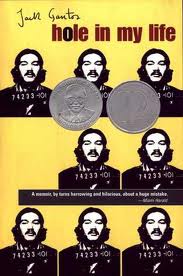
As a teacher, I am most familiar with Gantos’s memoir A Hole in My Life, which is a core text for our 12th grade Memoir elective. At 208 pages, the small paperback is much less intimidating than other memoirs, but its small size packs an amazing punch. With brutal honesty, Gantos details the year when just out of high school he became involved in smuggling drugs, and how he survived his prison sentence. A pattern of his prison mug shots covers the front of the text, and Gantos remarks about that picture early in the memoir:

“The prisoner in the photograph is me. The ID number is mine. Th ephoto was taken in 1972 at the medium-security Federal Correctional Institution in Ashland, Kentucky. I was twenty-one years old and had been locked up for a year already -the bleakest year of my life-and I had more time ahead of me” (3).

The memoir also chronicles Gantos’s development as a writer, and how, “dedicating himself more fully to the thing he most wanted to do helped him endure and ultimately overcome the worst experience of his life.” (Amazon)

I have one class set (30) of these memoirs, and I occasionally find additional copies at used book sales which indicates that the book is often assigned for summer reading.

When they read A Hole in My Life, many students have strong reactions to the prison scenes, which take place in the last third of the memoir. “This is NOT a kid’s book,” more than one of them has told me, “this guy cannot be a children’s author!”  They are notorious for trying to “protect” younger readers from any sordid incidents recounted in a book, and Gantos spares no details in describing some of the violent injuries he witnessed while working in the prison’s hospital ward. A Hole in My Life carries differences in age recommendations. Publisher’s Weekly suggests ages 12 and up, the book is a 2003 Bank Street – Best Children’s Book of the Year, and the Amazon recommendation is for ages 14 and up.

During his address, Gantos talked about the importance talking to teachers and students had in his creative process. Pointing to a picture of the cover, he said proudly, “This is the book that gets me into the front door of some high school where I can I get to talk about books and writing. This book is just like a key where I get to meet those high school kids.”

Usually, I usually assign the memoir to be read and discussed in literature circles and frequently students take these instructions to simply restate plot, “what happened? What happened next?” However, since Gantos was eager to share his structure with his audience, I may employ this strategy with this text. “When you think about a story,” he paused to show a graph projected on the big screen, ”you don’t think about the 50% invisible side called the structure. When I write, I draw 16 boxes and I fill them” he gestured to his sketches, “Beginning, middle,…action, story, character,” proving to this audience that their time pushing graphic organizers onto their students is still a worthwhile endeavor. As for the ending? “A book always has a double ending; the first is the physical ending, but the second is the emotional ending.” This is true in A Hole in My Life. Gantos relates the heartbreaking loss of his prison diary, written in between the lines of The Brother’s Karamazov, Gantos sharing the page space with the words of Dostoevsky. This diary was the more expensive the price to pay for his felonious actions, not the physical time he had spent behind bars.

He explained to his audience, “the reader wants to know how has the character been changed by an experience…the reader wants to have been inspired.” Gantos continued with more passion as he continued, “You read a book, and the next day, the book will be the same, but that you won’t. The that book will infects you and add to that little Library of Congress you have in your head.”

Gantos’s use of the Library of Congress, with the marble and beautiful domed ceiling as a metaphor for the reader’s brain is particularly vivid. The Library of Congress is the largest library in the world, with millions of books, recordings, photographs, maps and manuscripts in its collections. That powerful image is one every teacher in the room hopes for their students.  After all, what could be better than producing a nation of graduates who have the resources of Library of Congress readily available in their brains?

It’s Halloween…what is the most frightening story you have ever read?

“I busied myself to think of a story, — a story to rival those which had excited us to this task. One which would speak to the mysterious fears of our nature, and awaken thrilling horror — one to make the reader dread to look round, to curdle the blood, and quicken the beatings of the heart. ……. I thought and pondered — vainly. I felt that blank incapability of invention which is the greatest misery of authorship, when dull Nothing replies to our anxious invocations. Have you thought of a story?” (Shelley, Preface)

Yes. Frankenstein. Mary Shelley’s masterpiece drafted when she was18 years old.  Teaching Mary Shelley’s “ghost story” always elicits the most interesting responses from my students. I have taught the novel every year for the past 12 years to students in grades 10-12, in AP or unleveled curriculums, and the results are always satisfying.

Note: I did not say easy.
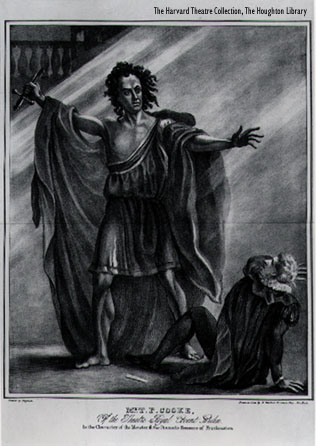
Since I am now familiar enough with the text and the pitfalls that catch most students, I know that I will need to summon an enormous amount of energy to begin teaching Frankenstein. First, there is the baggage of the pop culture monster with its green skin, bolted neck and squared boots. That baggage must be “unpacked” first. Then, there is Robert Walton’s epistolary start of the novel, coupled with Victor Frankenstein’s lengthy autobiography.  References to Cornelius Agrippa, Lake Geneva, and Galvanism are more stumbling blocks.

  • “So, where is the Monster?”
  • “When does this book get good?”
  • “I’m sorry, but this is just boring!”

Okay, Chapter Five.  On a dark and stormy night,

“With an anxiety that almost amounted to agony, I collected the instruments of life around me, that I might infuse a spark of being into the lifeless thing that lay at my feet. It was already one in the morning; the rain pattered dismally against the panes, and my candle was nearly burnt out, when, by the glimmer of the half-extinguished light, I saw the dull yellow eye of the creature open; it breathed hard, and a convulsive motion agitated its limbs”(Shelley, 5).

The Monster lives! Like the Creator in Genesis who “formed the man of dust from the ground and breathed into his nostrils the breath of life, and the man became a living creature” (Genesis 2:8), Shelley breathes life into her creation without regard to hard science.  In both stories, the empirical data or formulas, which led to these creations, express leaps of faith understood by the reader. The spark of life is imbued; the creation lives and breathes. The Creator of Genesis differs immediately from Victor when he, “planted a garden in Eden, in the east, and there he put the man whom he had formed”(Genesis 2:8), In contrast, the reader can hear Victor’s sudden gasp, “Beautiful!–Great God!” so repulsed is he once the creature comes to life. Victor weakly admits that all this work has been a failure, and comments almost apologetically, “The different accidents of life are not so changeable as the feelings of human nature” (Shelley, 5). Unfortunately, the creation has been loosed upon the earth; he will not easily be unmade simply because his creator has changed his mind.

Exhausted, Victor sleeps only to be wakened by

“when, by the dim and yellow light of the moon, as it forced its way through the window shutters, I beheld the wretch — the miserable monster whom I had created… His jaws opened, and he muttered some inarticulate sounds, while a grin wrinkled his cheeks. He might have spoken, but I did not hear; one hand was stretched out, seemingly to detain me, but I escaped, and rushed down stairs” (Shelley, 5).

Rejection! Abandonment! Isolation.

The Creator in Genesis does not abandon his creations, despite their disastrous decision to disobey. Rather, the reader finds this Creator “made for Adam and for his wife garments of skins and clothed them (Genesis 3:21) before banishing them from the Garden.Victor, in contrast, flees from the sound and the touch of the Monster who was trying to say….what? Creator?….Father?

  • Daddy.”
  • “Victor is a jerk.”
  • “He ran away because he didn’t want the responsibility.”

Exactly. And that is why Frankenstein gets to the heart of so many of the issues that our students, our culture, our world must deal with today. There are questions of responsibility. The responsibilities of a creator for the created can be extended to include the responsibilities of parents to children, of scientists to inventions, of writers to literature, of politicians to policies, and of pundits to sound bytes. What happens when the “creation” goes bad?

  • “If Victor kills the Monster, is it murder?”
  • “It’s Victor’s fault that the Monster is a murderer.”

Is the Monster a human? Shelley allows that the Monster eats, reads, and pines for a companion; he is alone, and miserable. A critical scene has the Monster pleading with Victor for a friend, a companion, a mate. Shelley has her Monster claim to have a soul; is the Monster a human? What makes a human a human?

  • Having a mate will mean monster babies!”
  • “Why didn’t Victor think about what the Monster would do?”
  • “This is just like Jurassic Park !”

Shelley’s novel also considers related ethical questions. These include what is the result of unleashing a new technology on earth? Because the technology exists to create, should the technology be used? How far should technology go in helping humanity?

In our brave new world, the “lyger” has been created because geographically separated tigers and lions can be crossbred in labs. Genetically altered crops are in the mainstream food source. These technological advancements have moved into our world with a ripple. But what of the advancements that will follow? Will human cloning become a reality, and will society deal ethically with clones? How far are we from artificial intelligence and should-or can- this intelligence be controlled? What does Frankenstein teach the reader about making ethical decisions today or in the near future? Why is literature such a great predictor for what will happen in the future?

We feel pathos. The Monster’s story is one of tragedy.

  • “Victor is the real monster.”
  • “I feel bad for the Monster…he didn’t want to be a Monster.”

By the end of the novel, my students have dealt with some very profound ideas. They have asked some very important questions about responsibility, humanity, and ethical behavior. They feel a sense of accomplishment in reading a difficult 19th Century text. They have confronted contemporary issues through literature, and isn’t that what is supposed to happen in the classroom?

Mary Shelley was only 18 years old when she attempted to answer some of the questions about the limits of man.  She was young and ambitious, like many of our students. Her “hideous progeny” is extraordinarily prescient; then novel is in every way a Modern Prometheus-a modern myth. Mary Shelley’s Frankenstein is a must read, and a cautiously frightening tale, for Halloween or for any other day.