Archives For November 30, 1999

Lucy Calkins

The difference between reading an article or a book by Lucy Calkins and hearing her speak in person is a difference that cannot be measured in nuances; the difference is measured in hearing the decibles of her passion.

On Saturday (3/24/12), at the 82nd Saturday Reunion held at the Teachers College at Columbia University in NYC, Calkins stood before a packed house of elementary and middle school teachers in the Nave at the Riverside Church to deliver her closing session, “Walking Courageously Forward in Today’s Common Core World: Literacy Instruction, School Reform and Visions of Tomorrow”.  Hours before the keynote address by children’s author Pamela Munoz Ryan, Calkins had been energetically wandering with a microphone to periodically announce the location of a second keynote address for K-1 teachers or explain a new voucher system for lunches to speed up the notoriously overcrowded lunch lines. She waved for  people to make room in the pews for others and directed her aides to circulate with pads of paper to gather e-mails of participants. (NOTE: Please, Ms. Calkins; get a Twitter account or just have us send our e-mails to a web address!)

According to the jam packed schedule of workshops, she then presented at 10 AM: “An Introduction to the Project’s Thinking About Common Core-Aligned Upper Grade Reading”. At 11AM she presented the workshop, “In the Complicated World of Today, What’s Changed and What’s Stayed the Same About the Teachers College Reading and Writing Project’s Ideas on Teaching Writing?”, and she was spotted checking in on other presentations during her “spare time”.  All this before delivering her final address back in the church at 1PM.  Calkins is already a one person educational seismic wave, which made her opening, a lifting of the lyric from a Carole King’s song, “I feel the earth move under my feet”, much more than metaphoric.

Lucy Calkins is the Founding Director of the Reading and Writing Project LLC and the  Teachers College Reading and Writing Project as well as the Robinson Professor in Children’s Literature at Teachers College where she co-directs the Literacy Specialist Program. She has authored several books about teaching writing, and she has recently co-authored a book, Pathways to the Common Core: Accelerating Achievement.

Much of the speech was directly lifted from her article, “Explore the Common Core” where she advocates for teachers to embrace the Common Core to be a “a co-constructor of the future of instruction and curriculum, and indeed, of public education across America.” She writes,

“As challenging as it must have been to write and finesse the adoption of the Common Core State Standards, that accomplishment is nothing compared to the work of teaching in ways that bring all  students to these ambitious expectations.The goal is clear.The pathway is not.”

In confronting one of the possible pathways, Calkins leveled her most serious criticism. She called attention to two of the Common Core State Standards (CCSS) authors who have emerged very publicly as spokespersons, David Coleman (Student Achievement Partners) and Susan Pimentel (Education First), and reminded the attendees that neither has been a classroom teacher. “What is alarming is that they feel empowered to continue to write the Common Core,” she declared. There are a growing number of CCSS support websites that illustrate her frustration, for example, Coleman’s well-documented lesson plans on the study of informational texts such as The Gettysburg Address with his explanations on videos are found at engageny.org.  Ironically, while most historians praise Lincoln for the brevity of this address and the precision of its language,  Coleman’s lesson design would have students spend six to eight sessions in a close reading of the speech. Calkins complained that  extended close readings like Coleman’s are “text dependent activities” and that there are “no questions that transfer to another piece” as well as the unreasonable commitment of time to one common text.

Her frustration also stems from the New York State’s Department of Education’s adoption of many of Coleman’s additions to the original CCSS in providing models for curriculum development. She sounded a loud chord of caution against Coleman and others who write “around the standards” in presenting their curriculum models. She rhetorically challenged Coleman, “Where is the evidence do you have,  David Coleman, that your method works? Where is the evidence that the close reading you describe is improving literacy?”

She then modeled a quick lesson on the poem “To a Daughter Leaving Home” by Linda Pasten, where she effectively refuted Coleman’s tedious approach of laboriously parsing every word in a text. She dismissed the notion that the discussion of any piece “ends at the four corners of the text,” adding that “one cannot infer or understand a metaphor without drawing from [one’s self].” Instead she recommended “sticking as CLOSELY to the text as possible, and in a response, have the student respond to the question ‘how do you know?'”.

Calkins also expressed concerns that in order to meet  CCSS “they [administrators] will add more…informational texts, more close reading. That will not work” she concluded emphatically.  Instead, “The problem facing schools is fragmentation and overload;” adding more to the teacher’s curriculum requirements will not be effective. Chiefly, she explained, the CCSS is, “not about a curriculum of compliance. This is about accelerating students, ramping up student achievement;” the CCSS is a “call for school reform.”

Because of CCSS, however, there will be enormous amounts of money spent on developing curriculum, resource materials, and testing. Authors of the CCSS, educational consultants, publishers, testing services are all looking to develop materials in order to help school systems meet the CCSS.  CCSS has spawned a new industry. Calkins detailed the anticipated expense of implementing the CCSS as $15.8 billion with $7 billion of the expense committed to technology so that students can complete testing online. When the “number one reason preventing student achievement is poverty”, in a time of shrinking budgets, Calkins described her discomfort with implementing  such costly programs and the inevitable auxiliary expenses that will be spent school district by school district in trying to meet the CCSS.

How can educators meet the CCSS in specific ways? “Students should have clear goals so they have a sense what is expected by gathering performance data,” Calkins advised, “Note what has changed with the student and [note] what changes are we expecting. A school should be able to identify [exemplars] what is expected at each grade level.” She also urged teachers to “embrace the call to nonfiction literacy” in order to build knowledge. “Change is hard,” she noted, “but research shows that fear will not make people change; the only effective way to change is through is support groups” suggesting that teachers need to collaborate in support groups to meet the CCSS.

Listening to Calkins was a more than a pep talk. Her reasoned approach to the CCSS was not born solely in the ivory towers of academia nor at a table of educational policy wonks. Her advice to read the CCSS as “gold” comes from her ongoing commitment to improving education coupled with her experience with  students and the teachers she supervises.

Had the audience the opportunity to respond to Lucy Calkin’s line of verse from the song “I Feel the Earth Move”, they could have easily chose another title from  from Carole King’s Tapestry album…”Where You Lead, I Will Follow.”

Current efforts to improve our students’ love of reading is allowing them the opportunity to choose what they want to read.  Since the amount of time available to teachers in a school year is finite, the inclusion of independent choice reading materials in a curriculum means that some things, usually whole class novels, have to go. In the case of our 9th grade students, the curriculum has been reduced to  three whole class reads: Romeo and Juliet, Speak, and Of Mice and Men. The remainder of the year is devoted to student choice, fiction and non-fiction. In other words, I am running a blended reading curriculum of student choice with whole class novels. I am convinced my students need this balanced approached to literacy.

Balancing between whole class novels and independent reading

Those who advocate student choice in the classroom make some excellent points. Last fall (2011), Kelly Gallagher (Readicide) in an audio interview with Mike McQueen on the Reading on the Run website said,

” I want to know does my child’s school have expectation that my child will read recreationally? Do they support that by giving kids time to read? Do they support that by giving kids interesting books to read not just academic books to read? Those are kind of questions that I would ask in looking at my child’s school.”

Gallagher’s most recent tweets on his KellyGtogo@Twitter demonstrate his continued campaign against language arts curriculum that are limited to whole class readings:

  • gr. 4-12: half the books our students read should be recreational in nature. We don’t want to raise test takers; we want to raise readers. 
  • more books = more reading = better reading. nothing happens without books.
  • Dear Common Core, where are recreational reading expectations? 

Yet, Gallagher still recognizes the importance of the whole class novel stating, “I am a proponent of academic reading, I do believe that kids should read you know, rich academic text. You know, I want my 9th graders to read Romeo and Juliet or my 12th graders to read Hamlet.”

There are, however, some educators who have eliminated whole class reading in an attempt to either engage students with choice only or as a differentiated approach to addressing reading levels in a class. In an article in Education Week  (7/2011) titled, Against the Whole Class Novel, Pam Allyn takes the position that whole class novels do not encourage reading and instead lead to alienation and isolation. She writes, “We have now reached a point at which teaching with neither the whole-class novel nor the basal reader, in which the whole class reads a selection together, is viable. We must end these practices. They are not benefiting our students.” She illustrates her position with the story of Sam who struggled with To Kill a Mockingbird saying, “…no way was this book a refuge for him, or an inspiration. It did not help him learn to read, nor did it help him to become a lifelong lover of text.”

Instead, Allyn suggests,

“If a student has found 16 blogs about boats, let him read those in school. And maybe that student will follow one of those blogs to a newspaper series about a regatta, or to Dove, Robin Lee Graham’s personal account of sailing around the world as a teenager. In these ways, our students will be exposed to a wider variety of genres than the whole-class novel ever allowed, and they will be more compelled to think critically across genres, as the common-core standards will require of them.”

While I agree with Allyn that not every book will make a student a lifelong reader, I believe she is clouding the issue of whole class reading with bad teaching of a whole class novel.Yes, it is true that some books are very difficult for reluctant or low level readers, so it is surprising that she suggests a student may choose Graham’s Dove  (RL 6.6) given her earlier reference the isolation a low level reader may have with to To Kill a Mockingbird (RL 5.6)  Regardless, a low level reader will struggle with a high level text unless there is some instruction or support. And while I agree that her suggestion of more inclusive reading materials (blogs, magazines, non-fiction) is important,  I also believe the communal experience that occurs in the reading of a whole class novel is equally important.

I am not suggesting the unit that beats a novel to death for week upon week, or what I refer to as the “it takes as long to read The Hobbit as it did Bilbo to get to his confrontation with the dragon, Smaug”. I am promoting the whole class novel experience where students work collaboratively to decode a text, share opinions, make comparisons, or criticize plot points. I promote the whole class novel with support for the low level readers and supplemental activities for the less engaged students. Reading levels should not limit student accessibility to a text when there is support available, for example, an audiobook. Please note: I did not say vocabulary and worksheets are supplemental activities.

Ideally, I advocate the whole class novel to capitalize on contexts or issues in other subject areas. Students can read All Quiet on the Western Front while they are studying World War I in Modern World History classes. Students can read Silent Spring as a companion piece to an enviormental studies course. Students can share the stories in Warriors Don’t Cry or Mississippi 1951 when they are studying a Civil Right’s unit. Whenever possible, I advocate a interdisciplinary read as a whole class novel.

I see great benefit in asking students to recall the themes, characters, settings or plot points with something they read earlier in their lives, particularly with the more complex texts at the middle or high school level. I will ask about the dystopia of The Giver when we read Brave New World, or the societies represented by animals in Charlotte’s Web when we read Animal Farm. A shared understanding of a previous reading experience with others provides immeasurable insights into a new reading experience.

Another argument for whole class reading comes from educator, Mrs_Laf in her blog post Confessions of an English Teacher who recently admitted that while, “I am the first person to champion individual and small group reading and used to be the first to decry the whole-class novel…I’m teaching a whole-class novel.”

She explains that her immersion into choice only reading resulted in many students selecting reading that did not challenge them. Students chose “fun books”, which she compared to beach reads noting that her students were not reading as closely as she wanted. In other words, “not all reading is the same.”  She decided that many students still needed to be taught to read a novel, just the same as students are taught to read a poem or short story. Her solution? Well, first she picks high interest books (The Hunger Games) which students purchase for annotation. Students make notes in the margin, put question marks next to the text they find confusing. In using this approach, “The trick is to get them to be patient with it.  This is a different kind of reading and we are reading for a different purpose.” Her point is a good one. Many students may need to be taught to read a more challenging text if all they read is what interests them.

I see reading as a community for my students as both academic and social.  I need to prepare students for the rigors of college and the real world since there is an expectation of cultural literacy  in our society. Students will encounter references to texts that compare relationships to the doomed Romeo and Juliet or the awkward Holden Caufield or the fair-minded  Atticus Finch or the the skin-flint Ebenezer Scrooge; they should understand those references. Teaching complex texts that students would not select independently ensures they can be included in conversations that extend beyond the classroom.

Teaching a whole class novel can be successful if, like any subject matter, students can be engaged. Language arts teachers need to seek a balance in in allowing for student choice while still teaching students how to read a challenging text. Every wave of innovation in teaching such as the recent calls for independent choice has an opposite one, such as traditional whole class novel instruction. Maintaining balance with these waves is what makes education successful. Balance means emotional stability; calmness of mind; harmony in the parts of a whole. Providing for independent choice plus whole class reading equals a balanced student.

Teenagers today read for pleasure just as much their parents-or grandparents- read when they were teens. This means that after all the time and effort dedicated by schools and publishers to increase student reading, the statistics show no increase in the number of teenagers who read for pleasure?

I find this a proposition just a little depressing.

65 years and no improvement in teens reading for pleasure? Why not?

An article in the January 2012 Language Magazine: The Journal of Education and Communication by Stephen Krashen titled “Reading for Pleasure” looks at data about the reading habits of high school students gathered from 1946 to the present in order to explain “why we should stop scolding teenagers and their schools.”  Krashen is a linguist and researcher in second language acquisition who promotes the use of free voluntary reading  which he says “is the most powerful tool we have in language education, first and second.”

Krashen looks at questionnaires given to 17 year olds by  National Assessment of Educational Progress (NAEP)  that asked if they read in their spare time.  Using this data, he determines that despite some improvement between 1946 and 1984, there has been a decline in teenage reading from 1984-2008, resulting in no net gain in reading for the past 65 years. He concludes that, “Contrary to popular opinion, there is no evidence that teenagers are less engaged in literacy activities today than teenagers of the past. Teenagers today do just as much book reading as teenagers did 65 years ago, and it appears that they are more involved in reading and writing in general when we include computer use in the analysis.”

That conclusion is really depressing. There have been considerable efforts to increase student reading on several fronts beginning in earnest with Rudolph Flesch’s Why Johnny Can’t Read: And What You Can Do about It  published in 1955. While this book dealt primarily with the methodology of teaching reading (phonics), the book’s message about the importance of literacy spike a nation’s interest in improving reading skills-an important step in student reading for pleasure. On the education front, the inclusion of   SSR (silent sustained reading) during the school day began over 30 years ago. One of the tenets of SSR is that students have the opportunity to choose materials to read. The practice of SSR has travelled from elementary to many middle and high schools in order to respond to student demands for choice. Finally, on the publishing front, there has been an explosion of  children and young adult literature in the past fifteen years: 3,000 young adult novels were published in 1997;  30,000 titles in 2009. In 2009, total sales exceeded 3 billion.

So, these quick examples suggest there is evidence there is heightened awareness about student reading for over 50 years, there is time provided in school, and there are materials published. Yet, there has been no increase in teenagers reading for pleasure?

Well, Krashen looks at the combined reading and writing habits of teenagers and notes that teenagers in the 2005 and 2010 NAEP reports spent more time on written interaction than on entertainment. Written interaction referred to social networking sites, and these figures are probably on the increase as access to the Internet on mobile devices increases. He writes that, “Communication with their peers is clearly important to them. In terms of total ‘voluntary reading and writing,’ teenagers in the 2005 report and the 2010 report are nearly even.” He concludes that, “’Kids these days’ appear to be reading and writing on their own an average of about an hour and a half a day.”

But student communication with their peers can be limited in vocabulary and scope. A recent student in Britain by Lancaster University’s Professor Tony McEnery who conducted research creating analysis of a database of teenage speech that suggested British teenagers had a vocabulary of just over 12,600 words compared with the nearly 21,400 words that the average person aged 25 to 34 uses. In other words, communication with peers does not increase vocabulary, and this study did not include texting adaptations of vocabulary with acronyms or shortened spelling. Yes, this study was conducted in Britain, but it is unlikely there is much difference in the vocabulary of American teens, other than that lovely accent.

Krashen is very clear to point out that students “are reading peer writing, not Hamlet or the Federalist Papers. And they are writing to each other, not composing essays comparing and contrasting Edgar Allen Poe with Longfellow.” But, I am not comforted that Krashen offers social communication as voluntary reading despite his claim that students experience cognitive development when they write on topics of deep personal concern.

I do agree, however, with Krashen’s claim  that “the true problem in literacy is not related to convincing reluctant teenagers to read: It is providing access to books for those living in poverty.”  I would go further to suggest that all schools, economically privileged or not, need to create reading material rich environments for students.

A classroom book cart in Grade 9 with high interest titles

Our 9th grade students are provided SSR time twice weekly (20-25 minutes/day) to read for pleasure. They may choose what they want to read. Often, a student will arrive in class without materials or, having just completed a book, looking for a recommendation. Our classroom libraries (book carts) are filled with high interest used books purchased for exactly this moment, and our school library is now connected to Overdrive which allows students to check out an ebook on a mobile device. This ability to capitalize on this moment of student’s interest with reading materials is critical to a successful reading program. The hope is that this will lead to continued reading for pleasure outside the classroom.

Krashen’s review of the data is depressing; I would have expected that given the amount of attention given to increasing teen reading for pleasure that there should have been a steady increase in reading habits from generation to generation.He cautions that negative attention given to this topic, including “dissing high school students”, is not the way to increase reading for pleasure. Teenagers by nature, regardless of their generation, should come to reading for pleasure through availability AND  choice. Just ask your mom, or grandma, can we do better?

I had read the The Rise of the New Groupthink by Susan Cain before its publication in “Week in Review” section of the Sunday NYTimes (1/15/12) because of a link sent to me by a fellow educator. After reading the article, I did several things

1. I made the article into a Reading for Information exercise for my 10th grade students who will read the article online (we have a school subscription) and respond to a series of multiple choice questions and three short answers (see bottom for PDF):

  • What evidence in the article demonstrates the author’s bias towards Groupthink?
  • Do you think the use of Groupthink will expand or contract in the future?
  • What has been your experience with Groupthink? Has this been a positive or negative experience?

2. I sent the link to my principal.

3. I wrote this blog.

In education today, collaboration is the buzz word of significance. Many lesson plans use the verb in generating objectives: “the students will collaborate to….” The recently adopted Language Arts Common Core Curriculum uses the verb in the College and Career Readiness Anchor Standard #6 for Writing: Use technology, including the Internet, to produce and publish writing and to interact and collaborate with others. 

While collaboration is not a skill of intellectual behavior important in learning on Bloom’s Taxonomy which is the Rosetta Stone for curriculum planning, many websites suggest that learning is enhanced through collaborating.  Andrew Churches’s website Educational Origami notes that, “Collaboration is a 21st Century skill of increasing importance and one that is used throughout the learning process. In some taxonomic levels the collaboration verbs are included as an element of Bloom’s Digital taxonomy and in others its is just a mechanism which can be use to facilitate higher order thinking and learning.”  In big bold letters in the middle of the page is the statement: Collaboration is not a 21st Century Skill, it is a 21st Century Essential.

Susan Cain argues a different position. Her concern about Groupthink is explained in business models; her most important example is in the creation of Apple. She offers one paragraph dedicated to collaboration in education:

“Our schools have also been transformed by the New Groupthink. Today, elementary school classrooms are commonly arranged in pods of desks, the better to foster group learning. Even subjects like math and creative writing are often taught as committee projects. In one fourth-grade classroom I visited in New York City, students engaged in group work were forbidden to ask a question unless every member of the group had the very same question.”
Is it any wonder that one of the questions I posed for the Reading for Information prompt dealt with the author’s bias? I would hope that her experience in that 4th grade classroom is one of anomaly, and I wish that Cain had spent more time in many classrooms and in different schools to test her position. My experiences with collaboration in the classroom is not one of sameness, but one where student strengths and weaknesses are most evident.
Recently, I assigned a creative paper where 9th grade students collaborating in groups of threes needed to update the trials of Odysseus with a new character “Fresheus” (freshman+Odysseus) and the trials he encounters during a school day (Polyphemus =bully, etc).  Watching the students test ideas, find a way to communicate outside the classroom (Google docs was the vehicle of choice), and revising their work, I had a clear sense of who was the “leader” in each team, who was the “aider” in each team, and who was there for the ride. In grading this particular essay, I awarded the project a number of points out 40 according to a rubric (ex: 32/40). I then multiplied that number by three (32 X3=96) and told the team members they had the total points (ex: 96) to divide anyway they wanted between the three members of the team. Most teams divided the points evenly, but two teams recognized the “slacker” and split the points accordingly; the slackers received D grades according to their teammates.The advantage for me was obvious-I had only eight papers to grade instead of 24, which meant a faster response time to the students. In addition, the quality of the papers did affirm that collaboration on this particular assignment was a successful strategy, but not all assignments are appropriate for collaboration.
I also know how painful it is for some of the shy, or marginalized members of the class to work with others. I have seen how a creative spirit or “out of the box” thinker is sometimes beaten down by more ordinary ideas offered by more average students. I work in a middle/high school and the social status of a student is baggage in collaboration…and I suspect social status might be baggage in business collaboration as well. However, educators know their students will be going out into the real world where Cain suggests Groupthink is dominating the corporate culture, where people are “corralled into endless meetings or conference calls conducted in offices that afford no respite from the noise and gaze of co-workers.” Educators must prepare students for this experience and challenge them to have their voices be heard in all forums-business, education, religion, politics, etc.
Cain’s clearest example of  successful collaboration is with Steve Jobs and Steve Wozniak. She writes, “Mr. Wozniak got the work done — the sheer hard work of creating something from nothing — he did it alone. Late at night, all by himself.” She notes that, “Mr. Wozniak wants to give his invention away free, but Mr. Jobs persuades him to co-found Apple Computer.”  Collaboration, for Cain, cannot generate an idea. There still needs to be that one creative spark to set other minds going…and that happens everyday in the classroom if the teacher knows how to pose the question and organize the response. The challenge for educators is to allow students the opportunity to work individually and collaboratively.
Interestingly enough, there is a commercial for Apple that I use in a (short) media study unit in order to show how celebrity endorsements impact consumers.  The text states:
Here’s to the crazy ones. The misfits. The rebels. The troublemakers. The round pegs in the square holes. The ones who see things differently. They’re not fond of rules. And they have no respect for the status quo. You can quote them, disagree with them, glorify or vilify them. About the only thing you can’t do is ignore them. Because they change things. They push the human race forward. While some may see them as the crazy ones, we see genius. Because the people who are crazy enough to think they can change the world, are the ones who do. – Apple Inc.
The people featured in the commercial were (in order): Albert Einstein, Bob Dylan, Martin Luther King, Jr., Richard Branson,John Lennon (with Yoko Ono), Buckminster Fuller, Thomas Edison, Muhammad Ali, Ted Turner, Maria Callas, Mahatma Gandhi, Amelia Earhart, Alfred Hitchcock, Martha Graham, Jim Henson (with Kermit the Frog), Frank Lloyd Wright and Pablo Picasso.
I believe that Groupthink would not have adversely impacted any of these individuals; they each confronted the naysayers of their time and proved those who doubted their genius wrong. So, Cain need not worry that Groupthink will stifle the artist because history has proved that the artist prevails-although sadly, sometimes this is post-humous. Cain’s short interaction with collaboration in a classroom referenced in one short paragraph in her article hopefully does not speak for all education. Today’s educator is charged with the responsibility  to develop each individual student’s skills to confront and navigate through the problems of the real world. Perhaps the best way to negate the adverse -or Orwellian-impact of Groupthink is to prepare students to effectively use collaboration as a tool in accomplishing a goal. Fortunately,  this generation utilizes the methods of collaboration as they already communicate on multiple platforms, some that were not available even two years ago.
Cain should also be aware that students, like artists, who know the rules do not necessarily adhere to them. Robert Frost stated, “To me freedom means riding easy in the harness”;  so might our next generation who with a growing familiarity with the rules of collaboration will move beyond the limitations -or the harness-that cause Cain concern. Regardless, there will be a new Steve Wozniak. She will labor independently until she meets a collaborator who will aide in her changing the world. She will have been a student. Educators, look for her!

The original purpose of this blog was to explain how used books were purchased in order to increase the classroom libraries at Wamogo Middle and High School, grades 7-12. The name of the blog, “Used Books in Class”, was initially chosen to indicate the condition of the texts. The term “used”, however, can also serve to mean how the text are used in class. In other words, how are the used books being used in the English Language Arts Classrooms at each grade level?

A carload of Used Books after a summer book sale!

In writing this blog, I have found myself increasingly commenting on English/language arts curriculum, lesson plans, and current issues in education. This means the purpose of the blog has grown to include topics that are all related to the use of reading materials in the classroom, and reading is the most important skill that students will need to be successful students at every grade level. Providing a wide variety of books-new and used- is critical to engaging readers.

To date, the used books purchased in the secondary markets have helped in four specific ways:

Used books have replaced copies at each grade level. Used books have been used to replace lost or damaged copies of books assigned to a particular curriculum. For example, there have been replacement copies of The Giver for Grade 7, Of Mice and Men in 9th grade, and Animal Farm in Grade 10. These titles are taught in almost every school system in Connecticut, and are titles that are relatively easy to find locally in the secondary market. These are also titles that are readily available in large quantities online on used book dealer sites such as Better World Books.

-Used books have increased selections for independent reading in classrooms. The English Department has incorporated more time for silent sustained reading (SSR) in class at each grade level, and classroom libraries have been increased to allow students the opportunity to choose books to read. For example, students in grade 9 are provided 40-45 minutes each week to read self-selected books during the school year. Students may choose a book from the school’s library media center, or choose a book from one of the carts in the classroom.  Titles vary in genre, subject and reading level in order to meet student interest. Students are responsible for blogging reviews about the books they read at least twice a quarter.

Other classes that take advantage of independent reading are the Advanced Placement English Language and English Literature classes. Students select independent reading that meets the critical standards of the Advanced Placement program. These selections range from the classics (Dostoevsky’s Crime and Punishment) to more contemporary titles (Roth The Plot Against America) and write responses to these books.

-Used books are added titles as “satellite texts”. English teachers have extended thematic units to include titles that complement a text from the literary canon. For example, the 11th grade thematic unit “Coming of Age” is usually associated with Salinger’s Catcher in the Rye. Purchasing used books have increased selections to include Sittenfield’s Prep, Cormier’s The Chocolate War, Lamb’s She’s Come Undone, Gibbons’s Ellen Foster, and Chbosky’s Perks of Being a Wallflower. Students select a text to explore the thematic idea through the lens of another author.

Score! A set of books for Grade 10

-Used books have allowed for the addition of new texts. The purchase of used books has expanded curriculum at several grade levels with high interest titles.  For example, Hosseini’s The Kite Runner, Coelho’s The Alchemist and Haddon’s The Curious Incident of the Dog in the Night-time (see picture) have been added to the World Literature curriculum in grade 10. In addition, Walls’s The Glass Castle has been added to Grade 12 Memoir class while Farmer’s The House of the Scorpion will be added to grade 7.

Ultimately, the re-stated purpose of this blog will be to continue to discuss the inclusion of specific used book titles in English/language arts classrooms as well as discuss how we are working to improve reading in and out of the classroom  at every grade level. Used books in class is also about using books in class to improve reading!

The literary canon is good for you.

So is broccoli.

Anyone who has tried to cajole a floret of broccoli into the mouth of a picky toddler can imagine a similar experience in trying to cajole a (male?) 10th grader to read a chapter of Brave New World on his own. “Read about John the Savage; understanding his alienation is  good for you!” a teacher pleads with conviction in an attempt to fatten students with enough prose, poetry, and drama for a lifetime in the perceived literary wasteland of adulthood.

“Eat your canon!” …literally.

Perhaps English teachers see the canon as a means to provide students with a common language in order to understand cultural comparisons to a “Scrooge”, a “Frankenstein” , or a “Mr. D’Arcy.” English teachers know the value in having students recognize the characterization of the human spirit as seen in the camaraderie in the relentless hunt for the white whale, in traveling west on Route 66 in a 1949 Hudson, or in the imagining the filth of the trenches in Paul Baumer’s no-mans land. English teachers firmly believe that students should know how the characters of Huck Finn, Hester Prynne and Gatsby reflect the tumultuous history of our nation, a nation students will inherit.

But perhaps English teachers need to go on a diet. While there are arguments to stuffing students full of great literature before sending them out into the real world, there is also an argument for allowing students the opportunity to bring their choices to the conversations about literature. The recent survey results from Grant Wiggins , co-author of Understand by Design, of 7300 high school students  indicates that English Language Arts is near the bottom in the ranking of “favorite” classes. Many students complaints were directed at the literary canon:

  • The books chosen have no true connection to my life.
  • I do not like to read the books given
  • Because the books do not interest me and I feel like we never learn anything applicable to the real world
  •  do like reading. I don’t like reading books that I am not interested in and we have to read books and stories that I don’t like.

The literary canon is not fixed nor limited to yellowing copies of Conrad’s Heart of Darkness (admittedly, my least favorite) or Drieser’s An American Tragedy. The canon is a living body of writing, continuously  replenished with contemporary stories with unforgettable characters: Lt. Jimmy Cross (The Things They Carried), Sethe (Beloved), Abaline Clark (The Help), and Hazel (Watership Down). Moreover, what spoke to one generation, may not speak to another. A body of great literature is on the increase, and some English teachers need to open the door even wider in order to include student choice. The banquet of traditional literary offerings must be limited as a matter of practicality; we simply cannot teach everything.

One way to combat the complaints about “books I don’t like” while including more texts is to offer satellite texts which are linked thematically to a whole class read. Perhaps a survey of student interest in themes or genre could determine the course of study, for example, a unit on monsters in literature could include a wide range of materials from picture books to JK Rowling’s characterization of  Voldemort to  the more complicated stories of Stevenson’s Dr. Jekyll and Mr. Hyde or Gardner’s Grendel.

English teachers should not feel the overwhelming responsibility for the selection of all class materials when so much literature is available today in so many different formats. Students should begin to take responsibility for contributing (appropriate) materials for their own interests or to share with others. Even a simple addition of a weekly SSR period to include student selections would counter the arguments that all books read in high school are boring. With ownership in selection, students could be more invested.

Back in 1999, several teachers and I attended a Broadway performance of Death of a Salesman with Brian Dennehy.  During the intermission a man, obviously moved by the production, stood several seats away sloppily wiping his eyes with a handkerchief. “I know this play,” he was repeating to himself trying to grasp at some memory that was buried long ago, “how do I know this play?”

Of course he knew the play, we scoffed!  We envisioned the high school English teacher who years ago had probably forced him to read a part of the drama in class. Maybe the man read the part of Biff or Bernard as the teacher would have had difficulties in providing access to a performance, live or taped. The man may have done well on the final test; he may have relieved when the teacher unit was over. The problems of Willie Loman probably were “boring” or seem distant and trivial to the man, a teenager in high school back in the 1960s.

Years later in the plush seating of the mezzanine on a Friday night performance, the language of Miller’s drama, long ago buried in the man’s brain, suddenly rushed  into the his consciousness. His visceral reaction to the production was enhanced by this recollection, but most likely, the man was finally at the age where Willie’s dilemma made sense to him. By the end of the play, the man was sobbing quietly, a testament to Miller’s ability to produce a catharsis.

This incident reinforced my belief that the literary canon is a lifelong experience, not one stop at the “all-you-should-eat”  high school buffet  and that maybe English teachers should stop panicking that students will never be exposed to great literature in their lives after high school. Quite frankly, the man would have sobbed with or without us.

Most teachers of English recognize the importance of the literary canon as record of experience handed from one generation to the next. But we need to be judicious and select those works that will engage students while meeting our criteria of preparing students for the real world. And in this digital age of multiple media platforms, we also need to let the students share what matters to them. This could be a frightening proposal for some of us as there is risk and uncertainty as to how implementing choice and moving away from the canon could be perceived by stakeholders. For others, however, student selection could be a natural part of the progression in education today. Our standards should be our belief in the stories we teach, our passion for their message, our knowledge of these texts.

In including the students in their education, how will the increase of student choice  be accessed? Along with student selection should come the implementing of meaningful, authentic assessments which Wiggins discusses at length in his survey findings.  I will address these in my next posting,”Why Don’t They Love English Like We Love English?” Part III.

I happen to love both the literary canon AND broccoli, so when I am confronted with someone who does not like either, I do my best to cajole them into trying “just a bite.” Sometimes a taste is convincing; sometimes it is not. However,  I will not stop trying offering because they “don’t like it”.  I know the value of both.  I also know that many an adult broccoli eater started out as a fussy toddler.

A recent post (11/17/11) on the “Granted, but…” blog by the Understanding by Design guru and co-author Grant Wiggins discussed a survey that received 7300 student responses from middle and high school students nationally. “I am a big fan of student surveys,” notes Wiggins, “How can we achieve educational goals without the student’s perspective? We cannot.”

Wiggins organized the survey “to be instructive for readers to see the results from our study of student academic experience, conducted for the past year.” The alarming results should put English teachers everywhere on alert.

While math was both the most favorite and least favorite subject on the list, English Language Arts “fared poorly overall: not near the top of favorite subjects and second to last in least favorite.”

Whaa…?
English was NOT a favorite subject?
English is a LEAST favorite subject?

Wiggins does point out that the results do not reflect a “normal” national sample. “All the responses came from schools with which we either had a past or working relationship; or with schools whose educators heard about the survey in workshops and asked to participate. As a result, the sample skews toward schools doing some amount of reform work, toward suburban rather than urban, and has no schools represented from the Pacific time zone.”

Gender was also a factor. Boys voted English as a least favorite more than girls.
Moreover, the gender gap in English was worse than the gap in math.

However, English teachers should take note.
English is NOT a favorite subject.
Actually, English is a LEAST favorite subject…further down on the survey than math.

Thankfully, Wiggins notes that the survey indicates that teachers are not the problem. For example, one comment is indicative of student opinion, “I was just never really interested into it. The subject does not appeal to me which makes it boring to me. I love the teachers just not the subject.”

Hmmm. So what are we English teachers doing wrong? Wiggins posts many of the survey responses to give teachers a general idea of how students feel. Reading and writing were the targets of student ire. Wiggins posted a plethora of student responses in the survey; I chose a few samples.

Complaints about reading summed up in student responses:
We don’t get to pick the books we read.
It is boring because all we read is boring books.

Complaints about writing summed up in student response:
Way too many essays

And the for the heart-breaking coup de grace:
I find it unnecessary for us to continue to take english (sic) classes all the way through high school because at this point we have learned everything that is required of a non-english (sic) major.

Well, he/she may be right…with the exception of knowing how to capitalize.

English teachers may or may not agree with these statements, but these sentiments do reflect the attitude of many of my students (grades 7-12) in a small rural school in Connecticut.
English is not their favorite subject either.

* sigh *

After reading student responses, Wiggins suggests, ” if you like the topic and are good at it, you like the subject.” In middle school and high school, English classrooms are staffed by those who had been successful readers and writers as students. However, a teacher’s comfort level with a discipline or a even teacher’s passion for a subject may not be enough to engage students, and the survey suggests that students dislike English because of the teaching, not because of the teacher.

So what might be the problem with the teaching?

  • English teachers may teach the way they learned (considered “old school”);
  • English teachers may love the literary canon (maybe too much?);
  • English teachers feel may compelled to correct (and correct and correct…);
  • English teachers feel obligated to quiz/test every book (was it only Sparknotes?);
  • English teachers may have too few “authentic” assessments.

Maybe the pressure of standardized testing is a factor? In Connecticut, our students write to a series of prompts after reading a non-fiction piece in Grade 8, and respond to a short story with four essays in Grade 10; this represents four years of preparation for state testing. We prepare for the test knowing-teacher and students alike-that writing these essays is formulaic. There is little that is authentic about this testing. For example, no business/industry will have employees read a non-fiction or fiction piece and respond with a timed drafted essay, beyond an interview, anyway. Similarly, the SAT has students draft a essay response to a prompt. Unfortunately, many colleges admit they do not consider the written portion of this exam. Students then wonder why they bother?

Wiggins suggests that “English teachers need to face some cold, hard facts as well: the work they assign is not of interest to most students, even good students – and, especially boys.” I do not need a survey in my school to confirm his findings about boys; I have lots of anecdotal information that confirms his results at every grade level, 7-12.

I will be looking more at Wiggins’ survey in my next blog and considering methods I might employ to help English claim a more favorable position in my own school. I know the importance of employing English skills in the real world today, and so do the other English teachers on my faculty. We need to discuss and determine how to get students to understand the vital importance of English without killing the love of English.

There is an anecdote about Thomas Edison whose most memorable invention was the light bulb. Apparently, this invention took  1,000 tries before he finally succeeded in developing a light bulb that worked. “How did it feel to fail 1,000 times?” a reporter asked. “I didn’t fail 1,000 times,” Edison responded. “The light bulb was an invention with 1,000 steps.”

Edison's successful light bulb was the result of 1000 failures

At 40 years old Edison already had a long list of successful patents. However, in his response, he framed his failures as steps in the invention process, and because of his persistence in learning from his failures as he developed the incandescent bulb, the opening of the 20th Century was bathed in light.

Edison’s story illustrates that learning starts in failure; attempts are steps to success.  Unfortunately, allowing for failure as a part of the learning process has become a major issue for educators as evidenced in the article by Paul Tough, “What if the Secret to Success Is Failure?” which was the cover story in the Sunday, September 14, 20011, education issue of the New York Times Magazine.

In the article, Tough interviewed both Dominic Randolph, the headmaster at the exclusive Riverdale Country School in New York, and David Levin, the co-founder of the Knowledge Is Power Program (KIPP), a national network of schools in 20 states, who also serves as the superintendent of the KIPP schools in New York City. Both educators argued for the inclusion of character building in order for students to achieve success in school but more importantly beyond school. In the article, Randolph referred to this quality as “grit”, something he explains he developed in his years of trial and error dropping out of college, working at low-paying jobs, and in traveling abroad. “’The idea of building grit and building self-control is that you get that through failure,’ Randolph explained. ‘And in most highly academic environments in the United States, no one fails anything.’”

Randolph has pushed Riverdale to adopted a character initiative and placed K.C. Cohen, the guidance counselor for the middle and upper schools, and Karen Fierst, a learning specialist in the lower school in charge of the initiative.  Both Cohen and Fierst admitted to Tough that they have experienced pressure from parents or guardians who have on occasion hindered a student’s opportunity to learn from failure.

Tough summarizes the  the problem as being one,

  “… for all parents, not just affluent ones. It is a central paradox of contemporary parenting, in fact: we have an acute, almost biological impulse to provide for our children, to give them everything they want and need, to protect them from dangers and discomforts both large and small. And yet we all know — on some level, at least — that what kids need more than anything is a little hardship: some challenge, some deprivation that they can overcome, even if just to prove to themselves that they can. As a parent, you struggle with these thorny questions every day, and if you make the right call even half the time, you’re lucky. But it’s one thing to acknowledge this dilemma in the privacy of your own home; it’s quite another to have it addressed in public, at a school where you send your kids at great expense.”

I would suggest, the expense of a school, namely tuition, is a small factor in this dilemma; all educators-public or private- confront this paradox daily. Like many of the administrators or teachers interviewed for the article, I have received calls from parents complaining about grading, teacher policies, or assignment(s) that have resulted in a failing grade. Some calls may merit intervention on my part as department chair, but more often the request by the parent is one to change a grade, to accept mediocre work, or to not hold a student accountable for an assignment. Many educators feel that the mantra made famous at at NASA, that  “failure is not an option”, has become an underlying educational principle in schools today.

I suggest that schools are the best places -the safest places-to learn the lessons of failure. In fact, I suggest that schools must allow students to learn how to fail. Teaching students to complete a task or assignment is akin to teaching students the scientific method, and the scientific method accepts failure as an outcome. Assignments require students to define, to gather, to form, to test, to analyze, and/or to interpret. In failing to complete an assignment successfully, a student should reflect. Maybe something went wrong with a calculation or with the method of studying, of completing the homework, of preparing the report, of relying on members of a team. Perhaps the student has incorrectly estimated the length of time a particular assignment will require. Possibly there was a lack of materials-or a book left home or a paper lost. Why an assignment’s response was a failure is part of the learning process. Instead,  failure to meet the requirements of an assignment has led to excuses, and the unfortunate reality of today is that increasingly, the excuses come from the parent or guardian. Failure should be an opportunity for a student to reflect and learn “what went wrong?” Intervention by a parent or guardian at this critical moment disrupts an important life lesson.

Of course, there are a myriad of support systems in schools state by state to help many students be successful. Connecticut requires several tiers to aiding students K-12 in Response to Intervention (RTI) programs. All states are federally mandated to provide special education programs. Most importantly, there are teachers in every school system nationwide who provide students with extra help, extra credit, and/or opportunities for re-takes or rewrites. All of these support systems are there to help private and public schools to prepare students to be productive citizens in the real world.

The real world, however, is often not as kind. The support services so prevalent in schools today do not exist for most high school graduates. Extra help may be difficult to find, extra credit projects do not exist, and federally mandated programs are limited in services to graduates. In preparing their students to meet the real world, Randolph and Levin have included character building in the academic day of their respective institutions citing a need to have students practice character traits that help them cope with failure. Tough’s article concludes that students need to learn to deal with failure “in order to lead happy and productive lives.”

In learning how failure can prepare them for life, students may need to develop the character  trait of  persistence, the same persistence exhibited by Edison to tackle a problem 1000 times. Want a more contemporary model? Then look at Michael Jordan who is quoted as saying, “I’ve missed more than 9000 shots in my career. I’ve lost almost 300 games. Twenty-six times I’ve been trusted to take the game winning shot and missed. I’ve failed over and over and over again in my life. And that is why I succeed.”

Students need to practice how to turn an experience of failing into a lesson for success, while parents need to allow their children the opportunities to learn how to deal with failure. Yes, failure in school can be emotionally painful, but failure to prepare students for real life is unconscionable.

Little Women was my first book relationship. My copy came to me one Christmas, and I spent most of my pre-teenage years rereading the novel, casting myself in the role of Jo, and waiting for Mr. Bhaer to find me and kiss me under the umbrella in the rain.  Louisa May Alcott wooed me with her dialogue and strong characterization. She did not coddle me as a reader. Beth’s tragic death was devastating and real; Jo’s rejection of Laurie which was so quickly followed by Amy’s acceptance was shocking. Alcott did not write to please me, she wrote what she found genuine, and I loved every moment spent reading her story. The opening dialogue established the characters of the four March girls. I still have it memorized by heart:

“Christmas won’t be Christmas without any presents,” grumbled Jo, lying on the rug.
“It’s so dreadful to be poor!” sighed Meg, looking down at her old dress.
“I don’t think it’s fair for some girls to have plenty of pretty things, and other girls nothing at all,” added little Amy, with an injured sniff.
“We’ve got Father and Mother, and each other,” said Beth contentedly from her corner.

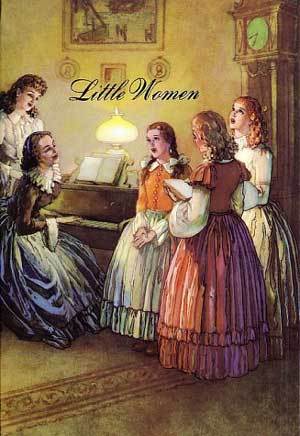
My copy of Little Women with the Louis Jambor illustrations

My copy was the Deluxe Illustrated Edition, January 28, 1947 Penguin Group  with Louis Jambor illustrations. I loved the illustrated color plates and the pen and ink drawings that accompanied many of the chapters. I clearly remember a little bird drawing that accompanied a chapter about Beth’s recovery from illness, but the cover was my favorite. This color painting shows all the girls gathered around the little spinet singing while Marmee played. Jo stands behind Marmee, while Amy and Beth sing opposite her with Meg’s back to the viewer.

So, it was with some concern that I noted that the Common Core recently released their language arts curriculum standards with suggested reading lists for grades 6-8. Little Women is on that list. I was hoping that Little Women was a just a suggestion, perhaps as an independent reading text, but a recent seminar I attended at the ISTE 2011 Conference (International Society of Technology in Education) in Philadelphia  confirmed a great fear that some educators will consider the novel a “teachable text”. The presenter at the seminar enthusiastically explained how many interesting links to Louisa May Alcott and her books could be researched by students. She demonstrated several different web quests dedicated to the study of Little Women and explained how these might be incorporated in language arts curriculum. I sat there horrified. I have no argument against a student choosing to research this novel or the author on her own. Perhaps the information will even deepen a reader’s love for the story. But to assign the Little Women?  Please, no!

If I had been assigned Little Women, would I have lingered over every page? Would I have felt that sense that Louisa May (she was too familiar to me to be called Alcott) was speaking to me, or would I have been looking for theme and symbols? Could I have been Jo if I was competing with other young girls who felt that same kinship with Jo? Would Little Women have been the same learning experience with an assigned vocabulary list? Would I have passed the multiple choice quiz or essay test?  Actually, my multiple readings would have assured a decent passing score, but would testing have assessed my deep relationship with the text?

Sadly, if well-intended educators are using the Common Core suggestions as texts to teach, Little Women will be placed in some curriculum. The novel is in the public domain, so digital texts can be accessed at no cost which makes the text attractive for low budgets. However, I shudder to think a student will be forced to read the novel rather than discover the story on her own. And although I am not gender-biased with literature, I would not assign this novel to pre-teen boys.

There are nine other texts suggested by the Common Core. The selection of these texts is an indication of the variety and the level of complexity that students should be reading in grades 6-8:
The Adventures of Tom Sawyer,
Mark Twain
A Wrinkle in Time, Madeleine L’Engle
The Dark Is Rising, Susan Cooper
Dragonwings, Laurence Yep
Roll of Thunder, Hear My Cry, Mildred D. Taylor
The People Could Fly,  Virginia Hamilton
The Tale of the Mandarin Ducks, Katherine Paterson
Eleven, Sandra Cisneros
Black Ships Before Troy: The Story of the Iliad, Rosemary Sutcliff

This list does offer variety, and the inclusion of The Adventures of Tom Sawyer offers a more challenging read for this level. I would also advocate that A Wrinkle in Time should be a suggestion for independent reading as well. But, please, teachers, assign any of the above texts and leave Little Women to the young reader who chooses to read the novel. The unforgettable story of  Meg, Jo, Beth and Amy March is for a reader to discover, not for the lesson plan.

One statement from the article by Alan Jacobs titled “We Can’t Teach Students to Love Reading” published in The Chronicle of Higher Education on July 31, 2011, grabbed my attention: “No novel or play or long poem will offer its full rewards to someone who consumes it in small chunks and crumbs. The attention it demands is the deep kind.”

I wonder if the authors of novels, plays, or long poems write with the intent of the reader receiving “full rewards”? What does “full rewards” mean anyway? I assume from the publication The Chronicle of Higher Education that Jacobs is talking about literature of the canon usually taught in at the college or college-prep level. At these levels, does “full rewards” mean the analysis, deconstruction and/or the synthesis of literature? Is the examination of his or her literature the goal of an author? I believe Jacobs cannot qualify what he means by “full rewards” because that quality cannot be standardized. I am also not convinced authors are seeking readers who read for “full rewards”. I think authors are seeking readers-all readers-any readers. Authors write for an audience.

There are audiences of middle and high school students who are required to read novels, plays, and long poems. The length and complexity of many of these works (ex: Catcher in the Rye, The Giver, Huckleberry Finn, All Quiet on the Western Front, Great Expectations, Of Mice and Men, The Scarlet Letter, The Odyssey, Death of a Salesman) in a curriculum means that units dedicated to a text can go for several weeks as teachers try to develop the kind of deep attention in their students for the “full rewards” that Jacob admires. For example, Shakespeare’s Macbeth takes a minimum of four weeks to teach. Consequently, by the end of the unit, everyone wants to kill Macbeth: characters, students and teacher alike. Yet, in those four weeks of intense study, students still will have not received the “full rewards” of the play according to Jacobs; they will have only grazed the surface of the tragedy in the “small chunks and crumbs” afforded by the school day calendar. Honestly, Shakespeare must roll in his grave over the plodding of innumerable classes trudging endlessly “To-morrow, and to-morrow, and to-morrow, Creeps in this petty pace from day to day…”. Was “full rewards” Shakespeare’s intent?

The goal of education should be to develop reading skills so that students should read successfully. Once students read successfully, measured by understanding the author’s message and appreciating the author’s style, then students may choose to read what they like, perhaps even what they love.

Teachers, myself included, tend to “over-teach” literature. Kelly Gallagher discusses the “over-teaching” of texts in his book Readicide, and poses the following question, “When you curl up with a book, do you do so with the idea of state mandated multiple choice tests? Do you pause at the end of every chapter so you can spend an hour answering a worksheet with mind-numbing answers?” He continues that adult readers would “never buy a book at Barnes and Noble if it came with mandated chapter by chapter exams….And we [adults] would never feel compelled to read if we [adults] had to complete a project after every book.” Gallagher maintains that these are the practices that are killing the love of reading; so, it is no wonder Jacobs can make the statement that the love of reading has been the pursuit of a limited number of adults.

I will concede that Jacobs does have a point, the “deep attention” that leads to his meaning of “full rewards” may be impossible to implement in a typical middle school/high school setting, but I would also venture that authors are not as concerned with “full rewards” as they are with communicating a message to an audience. By week two of Macbeth, most, if not all, students recognize that Macbeth has brought about his own tragic fall, that his wife is riddled with guilt, and the kingdom they have usurped cannot last. Shakespeare’s enduring legacy is his ability to communicate to a universal audience; “full rewards” may not necessary for students to appreciate the play, although “full rewards” could be an individual pursuit of a student who makes that choice.

Alan Jacobs’ theory of wringing the “full rewards” from a text is the reason middle school and high school students cannot be taught to love reading. Such teaching is fragmented and frustratingly slow for the teacher and student in school. Jacobs also recognizes that the love of reading has always been built on the choice of the reader; he discusses his own progress as an adult to develop his deep attention to reading. In contrast, Kelly Gallagher offers strategies to limit “over-teaching” and provide student choice earlier at the middle and high school level that may allow students to develop a love of reading on their own much earlier rather than later to develop “deep attention” to reading as adults. Love of reading should not be an out-of-school experience.