Archives For November 30, 1999

The headline in The New York Times (6/13/2013) was a little misleading, Study Gauges Value of Technology in Schools. The topic of gauging the value of technology is particularly significant given the investment by school districts everywhere in laptops, tablets, computer labs, Smartboards, whiteboards and projectors; but the article only referred to the use of technology in math or science.

The article by Motoko Rich referred to the “student survey data conducted in conjunction with the federal exams known as the National Assessment of Educational Progress,” This data was reviewed by the nonprofit Center for American Progress, which determined that middle school math students were using computers for math drills and other low level exercises. One of the more interesting points in the article noted that “no state was collecting data to evaluate whether technology investments were actually improving student achievement.” One of the problems noted in the report was the “lack of discrete learning goals” set by educators that results in the “use of devices in ways that fail to adequately serve students, schools, or taxpayers.”

When states do begin to collect data on the use of technology in the classroom, their studies should be broadened to include how technology is being used in other disciplines, specifically the language arts/English classrooms to facilitate writing.  In contrast to reports of math and science technology use, language arts teachers are using a multitude of digital platforms to facilitate communication between students; technology offers opportunities for students to engage in formal and informal writing at every grade level.

Multiple digital platforms such as blogs or wikis allow students to post responses to questions posed by teachers. Students can share essays in order to peer edit or collaborate on projects, or students can follow links and create data in surveys and respond to the data created.
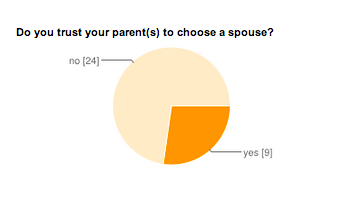
Screen Shot 2013-06-23 at 9.38.55 PMFor example, an assignment for 9th grade students as part of a Romeo and Juliet unit to respond to a writing prompt can use multiple digital platforms to generate sophisticated responses. The assignment was posted on EDMODO and contained data from a student/parent survey on arranged marriages that students and their parents had completed on a Google Doc form. The survey results were posted on PBWorks for students to access for homework. Students needed to review the scene where Lord Capulet arranges Juliet’s marriage to the Count Paris before writing a response. Each response that was posted was available for the class to review and to discuss.

The assignment’s directions read:

The worldwide wide divorce rate for arranged marriages is 4%; this could be due to cultural taboos regarding divorce.
Look at the data on the page that you and your parents created.
What differences do you notice in your attitudes towards arranged marriages?
Now, Consider how the Capulet’s choice of Paris for Juliet may have been the better choice.
Was Romeo and Juliet’s choice to follow their passion the right decision?
Should they have followed their parent’s wishes?

Respond in a well developed paragraph that includes:

  • Introductory sentence that gives your opinion;
  • evidence from the survey;
  • evidence from R&J;
  • Why this decision is important for future couples.

This assignment required a sophisticated analysis of data that the students had created, and an general analysis of characters from Shakespeare’s play.

Here are three responses generated by the prompt:

If Romeo and Juliet had listened to their parents almost all of this never would have happened. Even though just letting their parents choose would have solved everything, it was their decision. Romeo and Juliet had every right to choose their lives. Even the data from the survey shows that most children and parents don’t approve and less than 40% of people thought parents should choose. The Capulets didn’t know anything about their daughter and is trying to match her with someone who is completely wrong for her. This is why Eharmony uses Math equations because that is a lot more reliable than your parents.

In my opinion, Romeo and Juliet’s choice to follow their passion was the right choice. In the survey, some parents said that they could pick their child’s spouse. “I think I know my daughter well enough to know what kind of spouse she is looking for.” This parent has the same idea that Juliet’s did when they arranged for her and Paris to be married. Obviously in Juliet’s case, an arranged marriage did not work. She rebelled and went for Romeo. “Where is my Romeo?” was one of the first things Juliet said when she awoke from her sleep. Romeo and Juliet were love drunk and when they died they were both insanely happy. This is an important for future couples because if they’re in an arranged marriage it may end in death because one or both people are miserable.

I think that maybe Romeo and Juliet should have followed what their parents want. In our survey, 1/3 of the parents said they would be ok choosing their kid’s spouse, and 1/4 of us said that they would be ok with that. Romeo would still be in love with Rosaline, and he and Juliet would still be alive, their families would still be fighting but still they might have  been happy. If Juliet haven’t meet Romeo she might have fallen in love with Paris, and who knows that if Romeo and Juliet were married they wouldn’t have divorced?

While there may be some question as to the effectiveness of technology in the classroom, the language arts/English classroom must be included in future studies by NAEP and in each state. There are multiple ways that digital platforms are being used to facilitate discussion and the sharing of ideas in language arts/English is far more sophisticated than the use of technology to “simply drill math problems.”

Freshman year is hard: new school, new people, increased responsibilities, increased work load. By June, however, most freshmen feel a sense of accomplishment. They are 1/4 of the way through high school, and they are no longer intimidated by the urban legends of pool passes or promises of being stuffed in lockers by seniors.

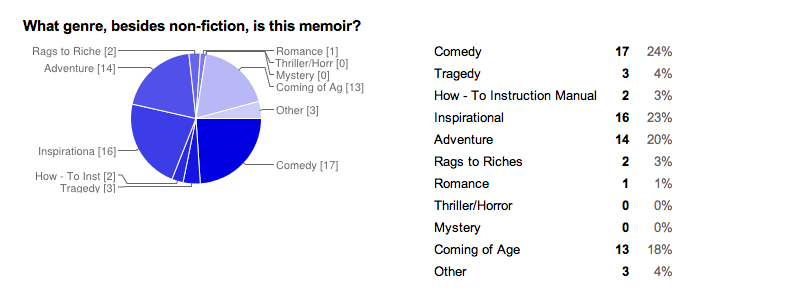
Successful completion of Grade 9 is indicated by a final grade, a percent that indicates the material student earned in each subject. There are other ways, however, to measure success and self-reflection is an excellent way to wrap-up the year. One way to have students to reflect is using a Google Doc form. The form can be tailored for subjective or objective questions. The quantitative data collected (checkboxes, multiple choice, polls, true/false) can be summarized in graphics (see picture below). Students can write longer responses in paragraph form or short answers.

Screen Shot 2013-06-19 at 9.47.21 PMGoogle Doc forms were used all year to measure student understanding or to allow students to record opinions. In September, the 9th grade had started with the theme “Journeys”, therefore, we returned to this theme to have them reflect on their year’s journey. They took this survey after they completed the final exam for credit points only.

The form was titled “My Memoir of 9th grade” and featured 10 questions that required the students to imagine writing a memoir or autobiography about 9th grade. Several of the responses were very “21st Century” addressing the complications of living with the temptations of social media, but other responses from students were timeless and not entirely different from the high school experiences of generations of students before them. Some responses were funny. Many were very clever.  At least one was alarming. Each response captured both a student’s self-awareness in reflecting on the year and a willingness to be critically, sometimes painfully, honest.

There were 79 responses to the questions; here are some highlights:

What is the title of your memoir?

  • No Procrastinating 
  • Thank God for 9th grade
  • The Spin-Cycle that this Year has Been
  • The Story of a Teenage Drama Queen: Or Something Like That

What is the significance of the title?

  • Like a spin-cycle on a washing machine, everything in my freshman year seemed to be moving very rapidly around me as I was caught up in it.
  • This means that the year was torture but in the end I have learned so much more than I did in middle school.
  • The significance is that some parts of this year will be wounds turning into scars that will be with me forever. The wounds weren’t caused by bad things but good things and that’s why I would want the ever lasting scars so I can remember.
  •  It shows how to get through 9th grade without being stupid like some other people because they could do something stupid and not make it through the year and will have to repeat it sophomore year.
  • It is the first level of your high school campaign.
  • I want my memoir to be named the dirt road because a dirt road is bumpy and rough this had been one of the hardest years for me and I want to show that by showing that the road is bumpy and hard to drive on and this year has been bumpy and hard and there is no way to make it go by any faster.

To what novel, myth, epic, fairy tale, or other non-fiction work will critics compare your story? WHY? What is the connection?

  • I’d compare it to Icarus. I’m not the best at listening
  • Of Mice and Men because I go through struggles that many other people are going through at some times I mostly feel like the main character George because sometimes I have to clean up my friends or my own mistakes and live with them behind me.
  • They will compare this story to Phaeton because he has something great that he is using to proceed but it might be the end of him.
  • Probably The Odyssey because of some of the trickery.
  • This can be compared to Hercules because people always told him he couldn’t do it, but in the end he finished strong no matter what other people thought.
  • This would be like The Odyssey because of my constant battle with each teacher in every class, some harder than others.
  • The Wizard of Oz because I always get home in the end. And being here really makes me realize that there is NO place like home. (Not that I hate school I’m just really over it by June)

What would the synopsis or description say? What is your memoir about?

  • This memoir is all about freshman who find out high school isn’t as easy as middle school.  They have to grow up to get all their work done, and not to mention worry about other stuff like sports, extracurricular activities, and friends.
  • My memoir is about my experience in 9th grade and how I got to where I am now. (Maturity, strength, knowledge, etc.)
  • Basically the adventures of this year but in more detail, the fast flying year for a 9th grader who has had fun on field trips and days when there has been a sub or no work.
  • i think it would say that if you are stressed out in high school and need some metaphorical advice then read this book.
  • A young man new to the world of high school embarks on the greatest adventure to see how any ways he could get in trouble. You will be with him in the ups the downs the tragedy the success.

What is your protagonist’s (your) greatest challenge or conflict? What is the goal?

  • The Internet, so alluring and wonderful, but deadly and destructive to my career.
  • The weakness that interfered with my goal is that I was too overwhelmed with after school activities that I had no time to do my homework. I think by next year I’ll figure out.
  • Annoying kids
  • Weaknesses include: being annoying and clingy, losing your best friend over something that you don’t even know what happened like really what happened ugh, being lied to about important things, holding extremely long grudges, and being bothered by simple memories from like years ago, and never having enough video games.
  • Not wanting to talk to new people at first.

What strengths help your protagonist (you) succeed?

  • Some days I just do the work to get through it, not because I actually care about it. You’ve got to keep going through the stuff you don’t like to get to the stuff you do like.
  • My strength is my stubbornness because no matter what the challenge I refuse to give up.
  • Probably not having a phone, that stunk so I made sure I did all of my work to try and get it back.
  • I have a great ability to focus when I wants to. I need a little bit of a push to get going but after that it’s smooth sailing.
  • Time management.
  • Getting sleep helped me succeed alot because I could never focus when I was tired.
  •  My family and my teacher.

Self-reflection is a great way to have students express what they feel they learned, and a Google Doc form is easily created and accessed. The student answers are digitally recorded and because of the Google Docs platform, these responses will be available for the freshmen in 2016, when they are graduating seniors. Hopefully their entire high school experience remains 0% horror!

boringMany educators use Twitter to communicate as part of personal learning networks (PLN). I appreciate the means to share messages with other educators, but I am sometimes alarmed by some of the tweets I read. The brevity of 140 characters does not allow for nuances. The tweet is, by design, blunt.
Example #1: Most teachers do not share a professional language. And they don’t share prof lang with students. 
I wonder, “Really? Is there evidence to support this claim?”
Example #2: Freedom—for educators and parents—is necessary, but not sufficient, for excellent schools
I think, “Define Freedom. Define sufficient. Define excellent.”
These tweets are made of some sentiment that begins an argument, but they are so brief and banal that they cut off debate.
Such was the case this week when prominent author and educator Dr. Tony Wagner paraphrased a statement made by Education Secretary Arne Duncan (week May 21, 2013) in a response on his twitter feed.  Wagner is the first Innovation Education Fellow at the Technology & Entrepreneurship Center at Harvard; he is a former high school teacher, K-8 principal, and a university professor in teacher education. Wagner’s tweet read:

“‘Too many high school students are dropping out, not because school is too hard, but because it’s too easy @arneduncan’ Wrong! It’s boring!” @DrTonyWagner.

While I disagree with Duncan’s generalization that schools are too easy, I was even more disturbed by Wagner’s response, about school, “It’s boring!”
I hear this complaint enough from students before they read the class novel or before we start the unit. I did not expect to hear it from Wagner.
Students say “this is boring” so much that I will not let them use the word “boring” any more.
But, is school boring?
Is it?
I take issue with Wagner’s claim. I would like to debate this.
As someone who attended Mr. Orontias’s History and Geography class in 1970, I can confidently say I have experienced boring. His 45 minute lecture delivered in a monotone right after lunch was not in a time space continuum; the clock hands did not move.
I know boring.
In contrast, my students’ high school today is not boring. As examples, I offer the following:
  • We have a Bring Your Own Technology (BYOT) initiative;
  • We employ student driven learning with choice on reading, topics, and presentation;
  • We include project based assessments and encourage reflection on tests.
We do, however, require that students do schoolwork. They practice math problems. They do research. They must complete reading assignments. They have deadlines. Some of this work is repetitious; some of this work is tedious. Some rote learning may be necessary to develop background knowledge before students can engage in active participation or collaboration.
So, when I hear from students that they are “bored” with school, often what they are saying is “schoolwork is not fun.”
This is not unexpected. A great deal of time is spent everyday in “not fun” activities inside school, just as a number of “not fun” activities are required in the real world.
I sympathize, but the reality is that not every lesson in school is fun. Education objectives require students to work rather than have the teachers be the engine of the classroom.
Wagner is one of the innovative educators who promotes education to incorporate more real world problems, reforming education to prepare students with 21st Century skills in order to engage students in meaningful enterprises. Whatever innovations are developed by education reformers like Wagner, students will experience frustrations, and experience failures. There will be efforts expended by teachers and students successfully and unsuccessfully. Work will be necessary, and some of that work will not be fun. If the goal of schools is to prepare students to learn the value of work, to prepare students for the workforce, work should be applauded, even if the work is not fun, or if the work is “boring.”
Arne Duncan’s statement that high school students are dropping out because schools are too easy is a gross overstatement. How easy will the real world be for those high school dropouts?
Similarly, Wagner’s accusation that high school is boring is infuriatingly terse, using only 20 out of Twitter’s 140 characters. How bored will students be if they drop out and cannot find fulfilling employment?
There are isolated cases of students who may write code for some fabulous new social media or video game that goes viral, but those are isolated. A high school diploma is necessary for even the most menial employment.
Today’s schools are not boring. Today’s schools are preparing students for work environments just like schools have done in decades past. Historically, teachers do not predict the job market, instead they prepare students with the fundamentals so that their students may create the job market. Some of that preparation is not fun; it is work, and in student lingo, it is boring.
Stating this needs more than a pithy remark that negates the efforts of teachers who are engaging students with 21st Century skills, with active rather than passive instruction.
Education has come a long way since my experience in the 1970s because of the efforts of education reformers like Dr. Wagner. Forty years ago, education came in primarily in the form of direct instruction. We sat in rows and listened to lectures, and yes, that was boring.
Except for the day that Mr. Orontias stepped into the wastebasket.
That was not boring at all.

Six years ago, the video “Shift Happens” (2007) was featured at our school’s professional development day. I clearly remember one take-away:

We are currently preparing students for jobs that don’t exist using technologies that do not exist in order to solve problems we don’t even know are problems yet.

The video was created by Karl Fisch, and modified by Scott McLeod. The slides provided statistics on the rapid exponential growth in population and in information, highlighting the differences between the present and what was successful in the past, specifically England’s position on the world stage in 1900. Several slides are alarming in calling attention to the building tsunami of information available to students with examples such as ” there is more information in a week’s worth of the The New York Times than what an average person knew in the 1700s”. Since 2007, there have been several updated versions of “Shift Happens” uploaded to YouTube; there have also been many imitations.

I thought of this video this week when I drove past a sign on a large office building: Strategic Information Technologies.

“What does that mean?” I asked my friend Catherine, “Is the technology stategic because of geography? Strategic because of a choice of software or hardware?” I continued, “I don’t know what a ‘strategic information technologist’ does…Is this one of the unknown new jobs were are ‘preparing’ our 21st Century students to take?” I referenced the video.

“That’s ridiculous!” Catherine responded, “The people who ‘prepared’ us for the 21st Century were not worried about what new jobs would be available in our future. In fact,” she continued, “they taught us what they knew…what they thought we should know, and we are doing just fine.”

I was startled. Could a “Shift Happens” video place a misguided emphasis on adjusting skills and content in order to prepare students for the unidentified problems they don’t even know are problems yet?

“After all,” she continued, “We are the generation that created these new technologies that we didn’t know would exist today.”

When I reflect on her statement I think about how my favorite teachers in grades K-12  (Sister Ella, Mrs. Rowland, Miss Montessi) were not obsessed with preparing me for some unidentified job in the future. Instead, their collective obsession was to prepare me with basic skills and content so that I could be a productive member of society  I was taught to think, to read well, write well, speak well, know math, appreciate history, recognize science, and, since I attended Catholic school, recite my Catechism.

Perhaps, educators cannot predict the future for their students, but educators can address trends. For example, in 1957, the American public began to reconsider how the role of public education may contribute to winning the Space Race with the Soviets once Sputnik had been released. The investments in education made as a consequence resulted in increased scientific advancements and many spin-off technologies. In contrast, however, predictions such as those at the 1964 NY World’s Fair of a future with flying cars, jet packs, vacation trips to Mars and beyond, underwater cities, and robot laborers have never came to fruition.

Similarly, Karl Fisch’s video alerted educators to the rapid changes in education and the global implications in preparing students for the real world. He wrote:

“…it’s a different world out there. A world whereanyone’s ideas can quickly spread if they happen to strike a chord.”
This was certainly true of the “Shift Happens” video which had great success without “a large company or a huge public relations effort to make an impact.” Fisch continued:
This is just one of the reasons that I believe our schools need to change. They need to change to reflect this new world, this flatter world, this information-abundant, globally connected, rapidly changing, technology super-charged world that they are going to spend the rest of their lives in.

Fisch made no silly “predictions” like those at the NY World’s Fair. Instead, his video served to bring attention to trends that require an increase in the skills of  communication and sharing information.

In order to communicate and to share, students from grades K-12 must think, read well, write well, and speak well regardless as to what predictions are being made about new industries or technologies. In trying to anticipate the future, educators must not discount how the generations of students who learned these important skills became the graduates who are now responsible for evolving changes of the present.

Shift is not an entirely new enterprise on the world stage, for example,  the Renaissance, the Enlightenment, the Reformation, the Industrial Revolution are all examples of global “shifts”. In the six short years since the “Shift Happens” video, Facebook has replaced MySpace as the world’s most formidable social network; Twitter has evolved into a powerful communication tool. The role of educators is not  to predict the next Steve Jobs or Bill Gates or company that will spawn new jobs or dominate an industry or the next “shift”. Instead, the role of educators must be to continue to teach those skills of thinking, reading, writing, and speaking well that contributed to the “shift” that is happening for our students.

There is no surprise that “Shift Happens”, and the students who are prepared to think, to read well, to write well, and to speak well will not be surprised either.

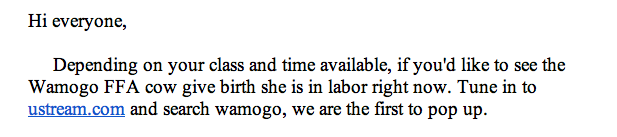
“[WamogoAll] If you want to see our cow give birth right now..” was the tagline for the e-mail in my in box last Thursday afternoon. I teach in a “Ag-ed” or  agricultural education school in the Northwestern Corner of Connecticut, so the contents in the e-mail were not surprising:

Screen Shot 2013-03-21 at 12.00.48 PM

The ability for me to watch the live birth of this calf from my office in another part of the building was certainly an example of how 21st Century learning is fully integrated for students and staff alike. Under the direction of our administration and with the support of our Board of Education, our small district has taken the integration of technology very seriously, and in four short years, we have gone from chalkboards to Smartboards, from pencil to netbook, and from worksheets to flipped classrooms. There is technology used in every classroom in every discipline every day.

One of the buzzwords in education is the work authentic, and teachers work hard to make connections from the content in class to the real world.

In order to be accredited as a school offering 21st Century skills, a school must offer authentic experiences. The schools are rated on:

The curriculum emphasizes depth of understanding and application of knowledge through:

  • authentic learning opportunities both in and out of school
  • informed and ethical use of technology.

Teachers’ instructional practices support the achievement of the school’s 21st century learning expectations by:

  • applying knowledge and skills to authentic tasks
  • integrating technology.

The Wamogo High School program with its chapter of the National FFA Organization and Agricultural Education accomplishes both with authentic educational experiences supported with technology.

I paid closer attention to the video monitor as the noise from the barn came over the computer’s speaker.  I watched as students gathered around the stall, and then saw Lori, the animal science teacher, jump in to calm the cow and rearrange the straw for bedding. Suddenly, three or four students and the culinary arts teacher  formed a line behind the cow, and in an unrehearsed routine, began helping Lori with the birth. I took a screen shot.

Screen Shot 2013-03-21 at 12.35.50 PM

The first “pull”!

“Pull,”Lori urged, and I saw there was a gentle movement from the line-up behind the cow. I took another screen shot.

Screen Shot 2013-03-21 at 12.35.37 PM

The second “pull!”

“Pull”, Lori cried again, and the movement became more obvious.

Suddenly there was a jostle, and the gap between the cow and the line of helpers became larger. All eyes were on the calf laying slick and newborn on the hay. I took another screen shot.

Screen Shot 2013-03-21 at 12.36.28 PM

…and the new calf sits in the hay.

A few minutes later, there was came a breathless and garbled announcement over the speakers from a student about “… here”; there was no need for clarity. Given our students’ familiarity with texting, everyone knew what had happened anyway.

The combination of technology (Ustream, screenshots) in broadcasting and recording the birth of the newest member of the agricultural program with old-fashioned “hands on” physical labor illustrates 21st Century authentic learning.

I posted several of the screen shots on Twitter. Almost immediately I was retweeted by UStream; in seconds, Wamogo had gone viral!

Cow and calf meeting for the first time.

Cow and calf meeting for the first time.

There has been a seamless integration of technology into the vocational agriculture program at my high school. The students who participate in the program are involved in a time honored occupation, an occupation responsible for civilization as humans moved from roles of hunter-gatherers to farmers. They just know how to Tweet, post, email, blog, Instagram, Facebook, Tumblr, or stream a live TV feed to show what they know as well!

Wamogo's newest "student"

King Philippe III – he is her 3rd calf and this is a royal names themes year.

PS: Oh, and the maple candy made by the students is ready to sell; they just tweeted a picture:

pic.twitter.com/urOTXJpaUK


The teachers at the professional development session were visibly frustrated; I could hear the irritation in their comments. The presentation on the use of digital technology was to help them improve digital literacy across the content areas, but many of the sites in the demonstration were blocked by the school’s Internet filter. I sympathized with their frustration because just three years ago, I was like them. Three years ago, our school’s Internet filter blocked everything.blocked youtube

Back then, members of my English department were finding excellent resources to use to teach the novels All Quiet on the Western Front, The Crucible, and the memoir Night. Unfortunately, many of these resources were unavailable because they were on YouTube or had descriptors such as “witchcraft in Salem, Massachusetts” or “Nazi” that were blocked by our filters. The filters were useless to a large degree since many of the students knew a variety of different strategies to get around each filter. So, the irony was that the students had access where the teachers did not.

Furthermore, the students were having a rich and very authentic experience of using the Internet outside of school. Once they came into our building, however, they were detached from the very technology that they would need to use in their future. Our school web filters  created an “un-authentic” web experience for our students. We were losing the opportunity to teach them digital citizenship because they were not digital citizens.

Fortunately, our administration took the position that teaching our students 21st Century skills meant that they should have access to the Internet in a technology rich learning experience. The filters were minimized. Our acceptable use policy was enforced, and teachers and students had access to the Internet resources.

We moved from exclusively computer lab use to 1:1 netbooks in English/Social Studies to a “Bring Your Own Digital Device” (BYOD) over the course of the next two years, and now, two years later, I can testify that unblocking the Internet has not created a problem for teachers or students. Yes, the students can watch YouTube videos, but they also make videos and share them with other students. They make videos for our “Friendship and Respect” Assemblies and share these on YouTube; they watch Oscar winning films for Film and Literature Class that are on YouTube; they embed YouTube videos into their blogs.

Furthermore, our students have access to the Internet to meet the state adopted Common Core Literacy Standard:

CCSS.ELA-Literacy.CCRA.W.6 Use technology, including the Internet, to produce and publish writing and to interact and collaborate with others.

Of course, our students are not perfect, and their behaviors using the Internet at school are not always tied to curriculum. I once came upon a group of young men huddled around a computer screen one morning. They were watching a video, and as I grew closer, I could hear a voice say, “She’s a beauty…” and another agree, “Oh, I want her!” I feared the worst, but when  I came up behind them to see what was on the screen, I got a eyeful of a 2006 Ford F250 XLT Powerstroke Turbo Diesel Pick Up Truck. Curriculum? No. Authentic experience? Yes.

The frustrated teachers who were sitting in the professional development asked what steps they could take to have their administrators review acceptable use policies and open the Internet filters for their students. They discussed looking at other school districts’ acceptable use policies. Perhaps there might be some testimony about the success of unlocking an Internet filter?

This post is one such testimony, and I offer this to any teacher that is looking to “unblock” the Internet in order to engage students in developing 21st Century skills. We are already in the second decade of this 21st Century, and the skills necessary to use the Internet are becoming more valuable in this Information Age. According to the 2012 data, using the Internet is a real world experience for 2,405,518,376 people. That is 1/3 of the world’s population, and there has already been a 566% increase in use since the beginning of the new millenium.

Our students are counted in those numbers already. While they use the Internet outside of school for social media; they should be taught to use the Internet for education and productivity in school. So once they have access to YouTube, they can never go back…they will only go forward.

Today is Digital Learning Day! To mark the occasion, let me take you through a quick walkthrough of the halls of Wamogo Regional Middle/High School and give you a snapshot on how digital learning looks in the English classrooms grades 7-12. We have 1:1 computers in grades 7 & 8; in grades 9-12, we have a “bring your own digital device” policy. Here are the digital learning activities on Wednesday, February 6, 2013:

Grade 7: Students responded to a short story they read, “The Amigo Brothers”. They accessed the wiki (www.PBworks.com) in order to respond to “close reading” questions on the author’s use of figurative language. (Students are required to use evidence in their responses; digital copies of text helps student correctly add and cite evidence).

Grade 8: Students uploaded their reviews of the books (Mississippi Trial, 1955; Chains; The Greatest) they have been reading in literature circles to www.edmodo.com. These reviews are connected to the Common Core Writing Standard #6:

CCSS.ELA-Literacy.W.8.6 Use technology, including the Internet, to produce and publish writing and present the relationships between information and ideas efficiently as well as to interact and collaborate with others.

Grade 9: Students responded to a “writing on demand” journal prompt in preparation for the novel Of Mice and Men. This prompt is connected to the theme of hopes and dreams, and the students were asked:

What is your hope for life, your goal, or even your dream?  What do you think you want from the future? What would you live without, dream-wise?  What couldn’t you live without?

The students also posted their responses on a www.Edmodo.com discussion thread. Selections from responses included:

  • Something I couldn’t live with out would be my grandparents because they are like another set of parent to me, just better. They mean so much to me, that I really couldn’t see my life without them.
  • I hope to be a plant geneticist in the future, that is my hope but no matter what happens I would like to have a career involving plants and even if I can’t get a career in genetics I know it will always be a hobby of mine.
  • My house will be by the ocean, so close I can see it out of my kitchen window. I will grow old and drink coffee on my porch, while I read the paper and wave to my neighbors who walk by!
  • I could live without being famous around the world but I would like to be known town wise. I cannot live without family and their support in my decisions. They help me to stay confident and get through whatever I want to accomplish in life.
  • I think I could live without wanting a huge house or a huge boat “dream-wise”, but that still doesn’t mean I don’t want those things. I couldn’t live without music or my family.
  • My biggest hope and dream is to have a really big plot of land and have the world’s biggest tractor and a bunch of snowmobiles and ATV’s.
  • I want to be able to adopt kids from Uganda but also have my own, and I want to live in a nice house with a big yard. I want to work with little kids as a job.

10th grade Honors English students are reading Great Expectations. They took a quiz on www.quia.com, a software platform for timed quizzes. The College Prep English classes are reading Animal Farm. Today, they had to access “The International” MP3 and the www.youtube.video of the Beatle’s song “Revolution.

For homework tonight, students will write their own “protest” song.

Grade 11: Students can access the vocabulary list from the film The Great Debaters through the class wiki (www.pbworks.com) while the Advanced Placement English Language students watched a YouTube video of a Langston Hughes poem “I, Too, Sing America” read by Denzel Washington:

They prepared responses to the following questions which were posted on the class wiki:

  1.  To whom is the poet writing?  How do you know?
  2.  Choose one stanza and discuss what you feel is the key word in this stanza and explain why you chose this word?
  3.  What feelings does the poem create?  Which words create this feeling?

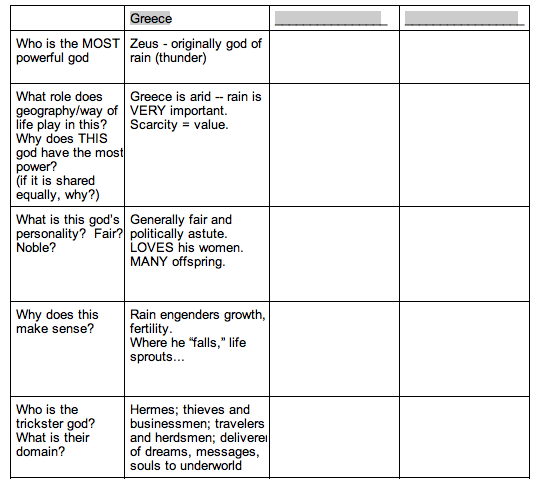
Grade 12: Students in the Grade 12 Mythology class accessed the following Google Doc Template and filled in the chart with their own research about the mythologies of different cultures. This activity meets the CCSS writing:

CCSS.ELA-Literacy.W.11-12.7 Conduct short research projects to answer a question; narrow or broaden the inquiry when appropriate; synthesize multiple sources on the subject

Screen Shot 2013-02-06 at 11.43.41 AM

The Film and Literature class “flips” the content by having students watch films for homework in order to discuss them during class. Tonight’s assignment? Watch the following YouTube clip and be ready for an open note quiz:

Students in the Advanced Placement English Literature class read the short story “Barn Burning” by William Faulkner that was embedded with a quiz on www.quia.com. They then created a list of four themes from the short story on a Google Doc. Each student selected a theme and placed his/her responses in the Google Drive folder to share with other members of the class. Examples included:

  • Actions we take with the grotesque: Shun? Avoid?

This story embodies an ultimate grotesque atmosphere. Even Colonel Satorius Snopes’ sisters are described as, “hulking sisters in their Sunday dresses” (2). These sisters are emulated throughout the story as disgusting, rotund, lethargic, and hog-like beings. This grotesque physical trait emulates the family’s condition in society. Satorius’ clothes are described as, “patched and faded jeans even too small for him.” (1).

  • Family over law or law over family

For the boy to go against his family in the end further proves his actions of courage and strength, and portrays the theme of law over family. “Then he began to struggle. His mother caught him in both arms, he jerking and wrenching at them. He would be stronger in the end, he knew that. But he had no time to wait for it” (10). His whole family is holding him back, but he chooses to go against all of them and do what is right.

This quick walkthrough demonstrating the use of technology in the English classrooms on one day demonstrates that for the teachers and students at Wamogo, everyday is a Digital Learning Day!

Three years ago, I was a part of a team of teachers and several administrators, including our current superintendent of schools, who attended the Florida Educational Technology Conference Screen Shot 2013-02-02 at 5.59.23 PM(FETC) as professional development to meet the coming demands for the 21st Century skills of communication, collaboration, critical thinking and creativity. Our rural Regional School District #6 is small (under 1000 students total) tucked away in the pastoral splendor of the Northwest Corner of Connecticut. The regional high school (Wamogo Middle/High School) is a vocational agricultural school that brings in one-third of the population from surrounding communities. We have a cow, pigs, lambs, and fish on the high school campus at any given time of the year. Despite our rustic roots, we had a committed technology team that was willing to support early adopters of technology in the classroom.

When we attended this FETC in 2010, we were overwhelmed with the amount of educational technology that was competing for our attention; the exhibit floor was awash in hardware and software. We came home laden with flyers, booklets, and pamphlets. We took notes. We followed up links and websites. The experience was mind-boggling and exhausting.

This January (2013), several of us returned to FETC. The exhibit floor was still awash with hardware and software, but we were far more savvy. That is because in three short years our district invested in the necessary hardware and training for 21st Century educational skills. There are Smartboards in every classroom, a netbook 1:1 initiative in the elementary and middle schools, and iPads for faculty and staff. The high school is in its first year of a “bring your own digital device” policy. For two years now, we have had an EDCamp style professional development for our faculty and staff (K-12) to share what we have learned individually and collectively.

Consequently, during this FETC conference we were already familiar with the technologies featured in many of the sessions, and we could add to our knowledge base without feeling completely overwhelmed. In three years we learned the basics for wikis, blogs, podcast, vodcasts, screencasts, and websites. So, when we attended this FETC, we were prepared for the presentations and concurrent sessions that featured platforms we use daily such as Livebinders, Edmodo, WordPress, and Google apps. We were reassured that the open source software platforms we chose to use three years ago are still major players in education. We learned new ways to use technologies to help us assess, organize, and deliver content.

We attended keynotes that discussed the future of education:

  • Google Global Education Evangelist Jaime Casap spoke on “Unleashing the Power of the Web in Education”. His presentation focused on the power of collaboration and the rapidly changing way our students access and use information. “Your Smartphone?” he predicted with a laugh, “one day will be in a thrift store, purchased by some hipster as a nostalgic decorative touch.” The standardized test did not have a place in his vision of education.
  • Educational Consultant & Author, Dr. David Sousa, (How the Brain Learns, How the Brain Learns to Read, How the Brain Influences Behavior, and Brainwork: The Neuroscience of How We Lead Others), gave an address titled “Designing Brain Friendly Schools in the Age of Accountability”. His talk emphasized the importance of physical movement in learning, the needs for sleep for healthy cognitive processing, while dismissing the notion that anyone can “multi-task” effectively. “Multi-tasking three or four things means doing three or four things poorly,” he admonished those in the tech-connected audience who raised their hands as multi-taskers. He dismissed the standardized test as unnecessary.
  • Executive Director, Institute of Play, Katie Salen (Professor in the School of Computing and Digital Media at DePaul University) spoke on “Connected Learning: Activating Games, Design and Play”. This keynote offered video from students engaged in designing and playing games in different content areas. She explained that games allow students to “learn how to fail up” using immediate feedback and experience to reengage in a game. She dismissed standardized tests as “unimportant and that’s ok.”

While each keynote speaker addressed the role of technology in education differently, none of them saw the standardized test as a means to access what students were doing. There was no standardized tests in their visions of education. They rejected the idea of standardization entirely, speaking instead of collaboration and individual exploration. In contrast to the speeches, however, the exhibit floor was filled with software and hardware from the giants of the standardized testing industry: McGraw-Hill, Pearson, and Global Scholar. The juxtaposition of what was being said in the keynote speeches about standardized testing with the marketing of materials by testing companies on the exhibit floor illustrates a huge conflict in the use of technology in education today: How will our schools systems be measured in this age of information? What will be important for our students to know? How will we measure these skills? The economic implications for testing companies cannot be ignored; they want a place at the local, state, and federal table where the education budget is being discussed.

Of course, our small district does not have the solutions to these questions, but what we do have is a sense of confidence in the tools of education technology. The attendees at this year’s FETC conference are confident that our school district is on the right track in providing an education with an emphasis on the 21st Century skills. We will be collaborating with our fellow faculty members, communicating what we learned, critically thinking about how to use technology in our classrooms in order to enhance our students creativity.

While we were attending, we met members of a neighboring school district who were attending FETC for the first time. We recognized the glassy-eyed look of a first visit; they claimed to be “overwhelmed.” They also told us that they were attending because, “we saw what you all had done. We are here because of you!”

In three years, the teachers in Regional School District # 6  have achieved competence and confidence in the use of technology because of our administration, our regional Board of Education, and the Superintendent’s commitment to the future of education. As one science teacher tweeted during a session he was attending, “Don’t mean to brag, but I’m lighting this social media seminar up. Props to Region 6 for giving me the freedom to communicate.”

forbesFobes recently published a feature article/photo spread, 30 Educators under 30:The Millennials Overhauling Education And Leaving No Child (Or Teacher) Behind by Meghan Casserly, 12/7/2012. The lead in for the article read:

The 30 Gen-Yers on our list are innovators, advocates, thought-leaders and reformers. Through outreach initiatives and engineering they’re committed, like my mom, to giving kids everywhere the best chance at success. They’re committed to making the lives of teachers like her just a little bit easier, whether through technology that saves them precious minutes communicating with parents or helps them use data analytics to track performance more efficiently than traditional paper grade books ever could.

A series of slick, glossy photos of well-dressed, smiling bright-eyed entrepreneurs and CEOs followed. Readers were advised to, “Click through the gallery for the 30 men and women who are disrupting education from top to bottom.” Disrupting? Is that what needs to happen to education? To disrupt? To disrupt means:

1. To throw into confusion or disorder;
2. To interrupt or impede the progress, movement, or procedure of;
3. To break or burst; rupture.

Disrupting is a perplexing choice if the purpose of the article is to praise the contributions these individuals are making to the business of education. When students disrupt a class, they are given detentions. The choice of the verb is contradictory because in the next sentence readers are encouraged “to visit their websites and reach out to congratulate them, to give them well-deserved credit for their hard work.” Are we being asked to congratulate disruption?

I did visit some of the websites mentioned in the photospread, and I do want to express my thanks to the CEOs who provide free and well-designed software programs. Specifically, I noted the photos of  Nic Borg, 26, Cofounder and CEO, Edmodo; Sam Chaudhary, 26, and Liam Don, 26, Co-founders of ClassDojo; and Andrew Sutherland, 23, Founder, Quizlet.  I will agree that these products contribute positively to my classroom environment. None of their products are “disruptive”.

The photos of these four product founders and their 26 smiling cohorts confirmed that all were vibrantly under 30, so I concede the “30 under 30” part of the headline. And yes, all 30 individuals are associated with the business of education, but they are not educators. These 30 individuals are educreators. The difference? Educators are in classrooms….Educreators are not.

Educators are in the classroom designing lessons, developing assessments, grading papers, contacting parents, posting bulletin boards, collecting data, analyzing data, meeting with teachers, collaborating with special education teachers, organizing supplies, selecting resources, and adjusting plans every minute of ever school day, and in most cases, for hours before or after school. In short, educators teach.

All Edu-creators have been in classrooms…as students. One edu-creator featured in the article spent three years in a classroom for Teach for America, one year more than the required two years of service. Each of the edu-creators has a product to improve education, but that does not make them educators. They are not in the classroom teaching; many are marketing a product for the classroom.

There has been an explosion of educreations that parallels the expansion of technology in the classroom. Many of these educreations from educreators are offered free or in “lite” versions. Ultimately, these products will make money for their founders and CEOs; there will be subscriptions or advertisements that generate revenue for these ’30 under 30″, and that is how capitalism works. A good product will sell, and many of these are good products. However, these products are tools for educators to use, not replacements for educators themselves.

Other members of the “30 under 30” are contributing to education policy by serving on boards, writing books, or being advocates for non-profits. These roles are also important, but again, these educreators have little practical experience to anticipate the problems that even the smallest changes in policy can have in the classroom. For example, a change in a state endorsed teacher evaluation system can result in thousands of hours for training evaluators and teachers  to meet new requirements, and those new requirements will be modified numerous times until an evaluation system proves effective. The effect of policy on the individual teacher or classroom is rarely witnessed; instead, policymakers are focused on the collection of “data”, not the hundreds of personal stories policy creates.

Comments under the article decry the lack of teachers. As Becky D succinctly  states:

I think it an egregious oversight that this list doesn’t include a single practicing educator.

Meghan Casserly’s response?

Educators obviously impact hundreds if not thousands of students over the course of their careers–and I looked for ways to weigh that against some of the other people on this list. Particularly for teachers under 30, it was extremely difficult to compare them in any apples-to-apples way. That said, there were some amazing teachers nominated who I was sure fit the bill—only to find out they were already 30!

So, are we to take from this comment that there are no real educators under 30 who are overhauling education and leaving no child behind? Perhaps there are no “amazing teachers” under 30 immediately visible to Casserly because they are so busy designing lessons, developing assessments, grading papers, contacting parents, posting bulletin boards, collecting data, analyzing data, meeting with teachers, collaborating with special education teachers, organizing supplies, selecting resources, and adjusting plans every minute of every school day that they simply do not have the time to create new educational software programs, run advocacy groups, or write educational policy. They are teachers, and they are real educators. They will not be featured in a Forbes magazine article about overhauling education because they are engaged in the time-consuming and productive activity of building skills and improving understanding for students of all ages.

What did Casserly get right with this article? She suggests that if the reader does get to meet one of the featured “30 under 30”, that the reader should ask, “…what teacher they have to thank for helping them land on our pages.” I agree;  their educators would be proud of the success of their former students, their own educreations.

The National Council of Teachers of English Annual Convention and the Council on English Leadership Convention begin this weekend (11/15-21) at the MGM Grand in Las Vegas, and I am so delighted to have the opportunity to present with my fellow faculty member, Stephanie Pixley, at three separate sessions. We are able to present to other teachers because of the great support and training our Regional School District #6 (Administration and Board of Education) has given its teachers in the use of technology in classrooms to improve student learning and develop 21st Century skills.

Wamogo High School in Litchfield, Connecticut, is a 1:1 Bring Your Own Digital Device (BYOD) school for grades 9-12, and we are learning everyday how our students’ use of technology has helped us differentiate our instruction, increase our students’ independence, and allow us to provide authentic tasks for our students. Last year, we used netbooks in our English and Social Studies classes and found how successfully technology could be used in reading and writing workshops at every grade level. This year, those netbooks have been moved to grades 7 and 8 for their use, and the high school students either provide their own devices or rent one from the school’s technology department..

The first session we will be offering is devoted to Cormac McCarthy’s novel The Road. We will feature work that the students have completed in using Abraham Maslow’s “Hierarchy of Needs” as a way to analyze characters in this post-apocalyptic novel. We will be demonstrating how our students, “Explore the poetic language of survival in Cormac McCarthy’s The Road the potential of 21st century connectivity and collaboration, and the use of mysteries to enhance students’ critical thinking abilities as presenters share literature experiences in three high school classrooms.”

Navigating the Mind: The Road Meets Maslow’s Hierarchy
Time:  Saturday 11/17 8:00 AM – 9:15 AM
Level:  Secondary (9-12)
Topic of Interest: Literature
Location:  Studio Room 6, Grand Arena, Main Floor by Grand Garden Arena, MGM Grand

The other two sessions will be offered to the Council on English Leadership:

You Ain’t Nothing but a Blog Hound
Monday 11/19 4-5:00 PM
D.3 Room 106

Description: You may already know that a blog platform offers students at all grade levels an opportunity to engage in an authentic writing experience in or outside the classroom. This workshop demonstrates the use of a blog platform for students to engage in thoughtful discussion on whole class or independent reading. This workshop will also feature how to organize, moderate, and assess both blog posts and comments on a variety of blog platforms. There will also be a focus on improving a student’s awareness of audience and purpose in a written response, and strategies will be provided so student comments are more sophisticated than a standard “I liked what you wrote.”

Writer’s Workshop Graduates to High Tech Literature Circles
Tuesday  11/20 10-11:00 AM
F.2  Room 106

Description: This session will feature strategies used in the teaching of writing at the middle and high school levels using a variety of 2.0 technologies, including blogs, wikis, and document sharing software. The emphasis will be on providing examples of differentiated student-centered activities that will develop independence in the writer’s transition from middle school to high school. High-tech writing provides opportunities for student accountability, group collaboration, and whole class communication

(NOTE: This session was presented this at Literacy for All Convention, 11/5 & 11/6 in Providence, RI)

We are looking forward to presenting and attending the wonderful selection of sessions over the next few days. This is certainly a wonderful opportunity for our own professional development and a chance for us to showcase our small but very forward thinking school district-Regional School District #6 !