Archives For November 30, 1999

I am passing out Brave New World to the 10th graders.
“Is there an audiobook for this?” a student asks.
“Why not just read the book?” I respond.
“I can’t read this without help,” explains the student.
“I’ll see,” I sigh.

I admit that in the past I had been a little frustrated at these requests. I felt as though the students were sometimes “cheating” at reading. I felt they were not technically “reading”, the complex cognitive process of decoding symbols in order to construct or derive meaning. They were “listening”, where they  make an effort to hear  or to heed something. However, I have become slowly converted in the use of audiotexts for difficult texts because I have seen how effective they are as a resources in my classrooms.
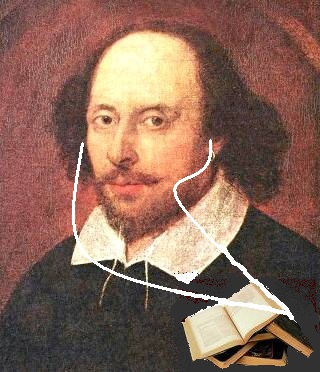
"To audiotext or not to audiotext?"

The reason for considering the use of an audiotext  is what I call the problem of “voice”. What students may be telling me when they say they need help is that they do not hear the voice of an author (narrator) or the voice of a character while reading a text. A good reader can hear voice as he or she reads, but the struggling reader may need an audiotext to provide that voice.

The use of audiotexts in our English/language arts classrooms has been gradual as we build up our resources. There are a limited number hard copies of required texts in the school  library, so we look for resources available on the web. The use of the audiotext in whole class reads has been particularly effective with short passages, poems or plays.  For example, there is an excellent audio version of The Adventures of Huckleberry Finn available for free on the site Loud Lit.org. The narrator is particularly good with the voices of Jim and Huck, (hear Ch. 2)  and the site provides the page by page text as a “read-along”. The problems of Twain’s use of dialect are minimized once the students can hear the language. Equally good on this site is the audio-text for Jack London’s “To Build a Fire” which we have used in a 9th grade short story unit.

Additionally, YouTube provides a multitude of poetry readings from T.S. Eliot reading his The Love Song of J. Alfred Prufrock to animated versions of Billy Collin’s poems “The Dead” and “Forgetfulness”.

However,  I still wondered, was I educationally sound in incorporating these audiotexts in the classroom? (pun intended)

The question of audio text vs. written text has been studied for the past 40 years as audiotexts have grown in accessibility and popularity. In 1977, Walter Kintsch and Ely Kozminsky conducted an experiment where “48 college students either listened to or read 3 tape-recorded stories, each about 2,000 words in length. Immediately after processing each story, students wrote a summary in 60–80 words. A comparison of the summaries written after reading with those written after listening revealed only minor differences” (Journal of Educational Psychology).

More recently, a study conducted in 2003 in six high schools in the Northeast posed the question, “Does the use of audio texts with and without a comprehension strategy enhance the content acquisition for high school students with mild cognitive disabilities enrolled in US government classes in self contained settings?” They used audio textbooks and a reading comprehension strategy (SLiCK) and concluded that “that audio text books can be an effective tool to for increasing content acquisition for secondary students with mild disabilities.”  The original hypothesis that the experimental group with the added intervention of SLiCK would out perform the audio book and control group, was not proved since there was no significant difference between the two experimental groups. Instead, the findings suggest “that the use of audio books for students with mild disabilities can improve content acquisition and increase understanding of content on students’ grade level and student independence with reading assignments.” The study was featured in an article (9/12/11) in Forbes by Olga Khazan titled, Is Listening to Audio Books Really the Same as Reading? Khazan suggested that the findings demonstrating the improvement in comprehension need not be limited to students with mild disabilities.

Apparently, how students receive information is not as different as one might think. University of Virginia psychology professor Dan Willingham, was also featured in the Forbes article saying, “There isn’t much individual variance in the way people absorb information.The way this is interpreted is that once you are good at decoding letters into sound, which most of us are by the time we’re in 5th or 6th grade, the comprehension is the same whether it’s spoken or written.”

While the physical text can be helpful for a student to re-read or annotate,  the audiotext can help with the prosody or musicality of words. With a good audiotext, “Someone who knows the meaning can convey a lot through prosody,” Willingham states, “if you’re listening to a poem, the prosody might help you.”  The same is true for reading a play. When we read the play Macbeth in class, I reach for the dramatized audio version (on cassette tape) by Caedmon featuring Anthony Quayle as Macbeth. The students do read the text aloud themselves, but then have an opportunity to hear the play’s lines spoken with the dramatic nuances and intonations that make Shakespeare’s language meaningful.

I am not the only one who weighs whether the written text or audiotext are the same experience. An informal survey (1950 total votes) that was recently organized on Goodreads.com asked:

If you’ve listened to an audiobook, can you say that you have “read” the book? Are they the same?

1.Both equally valid, but different.

915 votes (47%)
2.Yes, they’re essentially interchangeable.

749 votes (38%)
3.No, it’s not the same at all.

286 votes (15%)
While this informal survey indicates that I have the majority of Goodreads readers support the use of the audiotext as a valid way to “read” a text, I am very aware that not all materials are available in audio format. My students still need the ability to read many different types of writing-textbooks, informational texts, forms, etc. as well as the fiction, drama, and poetry taught in the English/language arts classroom. Therefore, in my classrooms, the audiotext is used as a support for a written text, not as a replacement.
My students enjoy hearing a story told to them, not unlike the stories told to them when they were younger, which is not unlike the way stories first began. The audio tradition is not such a technological marvel. The audiotext goes far back, way before written language, when the ancient storyteller was the audiotext. Today, our students are listeners around digital campfires.

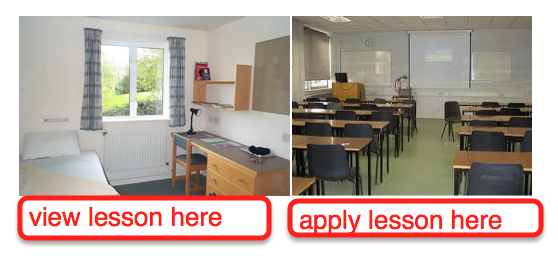
The wiki allows us to link students to resources on the web (texts, audio texts, websites) available 24/7 for Grade 9.

The English Department teachers operate in  “Wiki Wonderland” at Wamogo High School; all class materials for English classes, and other disciplines as well, for grades 7-12 are available 24/7 on our class wikis using the PBWorks platform.

Syllabus link for AP English Literature with University of Connecticut Early College Experience course-Grade 12

Our school does have the paid subscription based on the number of students assigned to each wiki so that there is an additional level of security for students, however, the use of a wiki does not require a subscription. There are numerous wiki platforms, (Google, Wetpaint, Wikispaces, etc) and most have free classroom editions with limitations on design and security features.

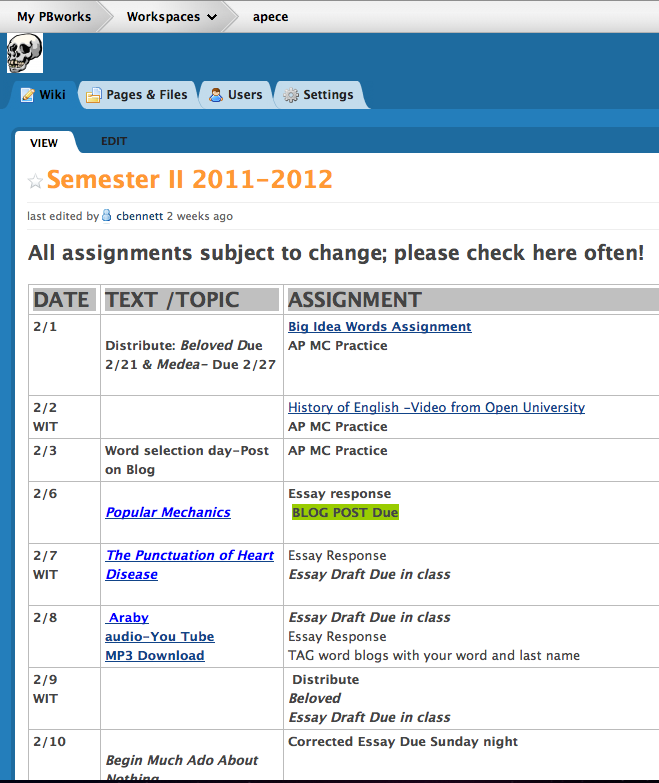
English Department teachers  use either the assignment page template or insert a table (see below) to post a schedule of activities by week, quarter, or semester.  We are able to link materials on any page in the wiki itself, to a link on the Internet or to a document that has been uploaded. The wiki also allows us to embed videos, audio clips, animations, pictures, and other widgits on a page; we often have students comment on these embedded masterial by responding directly on  the page.

A lesson or unit can be completely organized on a wiki page (directions, resources, responses) so that students may work independently, in or outside class. Organizing materials, pages and files, on the wiki for ease of use by student/parent  is probably the most challenging task for each teacher.

Using the wiki meant that we are moving towards a “blended classroom” of in class and online learning. For the past two years, we have been very happy with the wiki in class. Plus, we thought by using the wikis that we were “cutting edge”.
Then came the flipped classroom.
The flipped classroom is organized so content usually delivered in a classroom is posted as homework , and the homework given to provide students some practice with content is completed in class. This approach allows a teacher the opportunity to devote more time working with students rather than lecturing or demonstrating a particular skill.

So, English Department teachers are now trying to incorporate the flip. There are some challenges, however; English is not a “content driven” class. In fact, the skills a student is taught at the elementary level are the same  that are taught at the high school level: reading, writing, speaking, listening. The process of aquiring these skills in English is not so much a sequence, like a staircase, as it is a weave, like cloth. Students improve these skills of reading, writing, speaking, listening by exposure to increasingly complex  content. There are more challenging texts, more sophisticated vocabulary, and more rigor with grammar as the student moves through an eductional system.

A simile in the picture book Quick Like a Cricket is the same literary device as a simile in Arthur Miller’s Death of a Salesman, a theme in E.B. White’s Charlottes’ Web can be as universal as a theme from Dostoevsky’s  Crime and Punishment, and a rhyme scheme by Shel Silverstein can be as clever as a rhyme scheme by Shakespeare.  English is a discipline of warp (writing structure) and woof (writing style) that is centered on the application and practice of skills rather than the aquisition of a body of facts. The collection of information (content) belongs more to history, mathematics, science and social sciences.
That said, how does a flipped English classroom work? What can easily be flipped?

Currently, we are trying to develop grammar lessons into a flipped model. New grammar content can be created and/or uploaded for overnight viewing (adverbial clauses) as well as remediation (capitalization of the letter “I” when used as a pronoun). Materials placed online for the flipped classroom have the  added benefit of having materials available for review if a student forgets one of the rules in our complex language.

Since many of our students do less and less assigned reading for homework, our English Department teachers are dedicating more time in class to active reading, read alouds, and silent sustained reading in class. In a sense, we have flipped the reading activity to the classroom. However, providing instructional class time for reading means that a focus must be on having students responding to the texts effectively. At present, many responses to literature are begun in class, completed for homework and then peer- reviewed in class to prepare for the final polish before turning the response in the following day.

We have also organized our independent reading materials by unit (coming of age, people in conflict), and each book’s summary, book reviews, and a selection of passages from books have been placed online on the wiki so that a student may “shop” for a text outside the classroom rather than waste time perusing the classroom library looking for a book.

So far, those are the successes our teachers have had with the flipped classroom model; we will be experimenting this year with using the flip model for vocabulary, providing context materials for literature (not front-loading, however!), and promoting texts.

At present, I do not anticipate that the English classrooms in my department will be completely flipped, just as our English classrooms are not completely blended. Yet, the degree to which blended learning with resources on the wiki for instruction in and outside class is being influenced by the principles of the flipped classroom I cannot say. I do know that more and more of our instruction is taking place online, and because we are adopting the methods of blending or flipping instruction, teaching English in the 21st century means the teachers must be more flexible, almost gymnastic, than ever before.

Beware the Ides of March!
March Madness!
Mad as a March Hare!

Why so much warning about March?
Well, here in Connecticut, our students are preparing for the Connecticut Mastery Tests (CMT) in grades 3-8 and the Connecticut Academic Performance Test (CAPT) in grade 10 which are given every March. While every good teacher knows that “teaching to the test” is an anathema, there is always that little nagging concern that there should be a little practice in order to anticipate performance on a standardized test. So, we “practice” to the test.

In English, 10th grade students participate in a Response to Literature section of the test where they read a selected fiction story (2,000-3,000 words; RL 10th) and respond to four questions that ask:

  • a student’s initial reaction;
  • to note a character change or respond to a quote;
  • to make a connection to another story, life experience, or film;
  • to evaluate the quality of the story.

Unfortunately, an authentic practice for this test is time consuming, requiring 70 minutes which includes the reading of the story and the four essays, roughly a full hand-written page response to each question. Needless to say, our students do not like multiple practice tests for the CAPT, so developing the skills needed to pass the Response to Literature must be addressed throughout the school year.

When practice time does arrive,  students can be “deceived” into CAPT practice through technology. We have been trying two abbreviated practice approaches using our class netbooks where students actively read a text using hyperlinks or use quiz/test taking software. In these practice assessments the student responses are typed and shorter in length, but still cover the same questions. A hyperlinked test practice, including the sharing of results, can be done in one  40 minute class period.
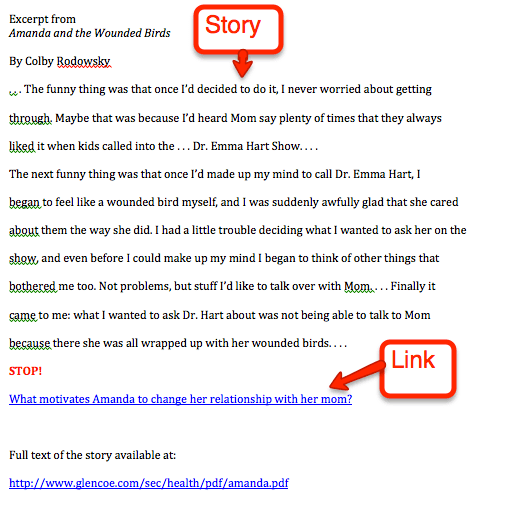
In the first approach, we select a short story that can be read in under 15 minutes and embed questions at critical points in the text that are tied directly to the Response to Literature questions. The students then respond to these questions as they read. The easiest software to use in creating a hyperlinked text is Google Documents using the “form” option to create individual questions. Each question’s URL link can be hyperlinked at specific moments in the text. An example is seen below. Multiple choice , scale or grid question are alternate selections that can be embedded in a story in order to provide a quick snapshot of a group’s understanding by looking at the “show summary of responses” option once the assessment is complete. There are many short stories in the public domain which can be posted on a site such as Google Docs for  student access in order to not conflict with copyright laws.

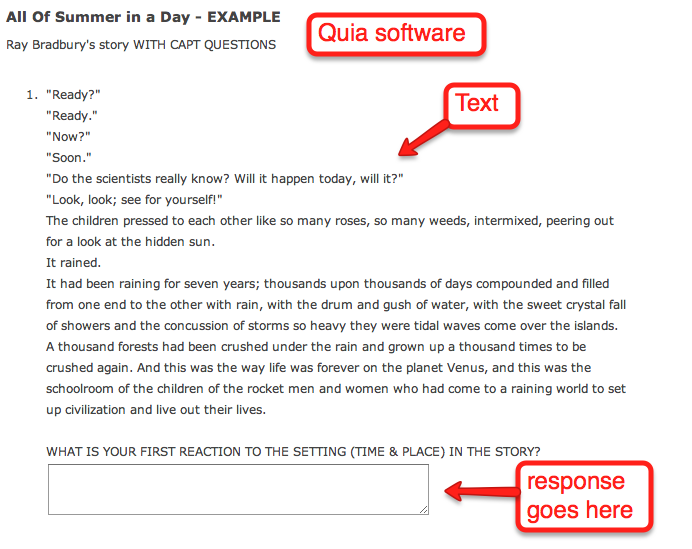
The second approach uses quiz and test taking software, such as Quia, where a teacher can paste sections of the text with question posed at the end of each section. Ray Bradbury’s All of Summer in a Day  (under Creative Commons license) is one story we are currently using for CAPT practice next week; the practice test (section seen below) can be taken at http://www.quia.com/quiz/3525412.html

The use of hyperlinks to monitor student understanding or to practice a procedure that will be helpful in a standardized test is not difficult to implement. Teachers are able to choose the kinds of questions and the placement of questions at critical sections of a text, and students like the ability to respond as they read in short answers rather than in practice essays.

While there is nothing that can be done to stop the onslaught of tests that come in March, the embedded hyperlink provides ways to satisfy that urge to practice and still engage the students.  You can even try a hyperlink response to a text by clicking here!

See? Wasn’t that easy?

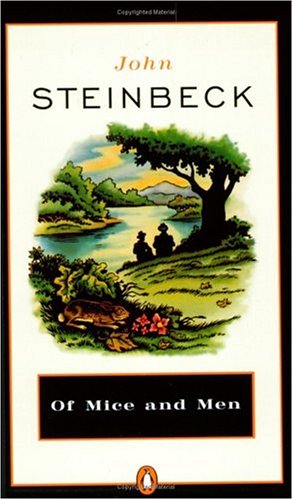
Our English classrooms have been provided net books to use in class this year, making each classroom  a 1:1 classroom. Teachers have been using these net books for student blogs with seniors, or in responses to literature. The Freshman class was blogging about Of Mice and Men using Google’s Blogger software. The combination of reading with authentic writing was the incentive for one of my New Year’s resolutions in 2012, to improve student blogging beyond the “I like your post” response.

Our 9th grade team blogs are organized across the grade; students from different class periods or with different teachers collaborate as a team on the blog. For this assignment, we developed four journal questions in order to engage the students in discussions related to the universal themes of  Steinbeck’s novel; questions were centered on the ideas of goals, dreams, loneliness, privacy, and companionship. These journals were posted two or three days apart as students read the novel in class during silent sustained reading (SSR) or at home. An audio tape of the book was also available for some students who needed support with reading independently.

In order to begin the discussions, students first needed to post a response to each journal question, then they need to respond to another teammate’s post. Since the goal was to improve student responses to another student’s post, a set of criteria was suggested to help student in their response:

Good Student Response to another student on a blog will be:

  • thoughtful
  • consistently positive
  • respectful

Good Student Response to another student on a blog will also:

  • clearly add to the original discussion (compare, contrast, contribute, ask questions)
  • take advantage of the medium (linking, video, audio)
  • follow the standards of good writing

There were four journal prompts to Of Mice and Men; student responses to another student’s post are below each journal prompt:

Journal One:  What is your hope for life, goal, or even dream?  What do you think you want from the future?  Not the fairytale, but the reality?   What could you live without, dream-wise?  What couldn’t you live without? What matters, what are your priorities?

Patrick, I think your blog is good! It shows that you really want to be stable with your life. That you don’t need big things but you just need the things that make you happy and not stressful. We both don’t want to be stressed out and that’s something that a lot of people don’t want I think!

Sean, I think that my house would be similar to yours. I too would like to live in the woods away from big cities and government. I think it would be great to live in a log cabin style house with a large woodstove too. It would really give off that self dependent feeling, were you would have to chop your own wood, and produce many of your necessities.

Sara, It seems to me that you seem to know what you want to do when you grow up. Well, I have no idea really, so I envy you. I am disappointed to see you would move away from here, I love it here. good luck with all your plans!

Journal Two:  Do you have a pet? a younger sibling or cousin?  If so, describe your feelings and relationship with them.  If not, what do you think it would be like to have them?  How do/would you feel as the one on whom they depend?  How important do you think it is to care for or nuture others?  Do you want to be a mother/father?  Why?  What do you think about the role of parents, brothers, sisters, and family?

Johnny, I think you need to appreciate your sisters a little bit more!! Even though they can be a pain, they’re still always there for you and won’t leave your side.

I am commenting on Regan’s post: She did a very good job, she went into detail about each question such as when she explains how it makes her feel “It makes me feel good when he looks up to me and tries to do stuff that I do because It lets me know that I do have an effect on his life and when he does.” It is simular to mine because our brothers act the same way, she gets along with her brother too and we both have younger brothers.

 I’m commenting on Sara’s…I can definitely relate to when people say they want a sibling and you’re thinking ‘NO WAYYY….’ because they haven’t lived with one their whole life! But I’m also the same way with how I realize that I do have an effect on my little brother’s life and choices… it just wakes you up and helps you make good decisions.
Journal Three:    How important is privacy and space to you?  Can having privacy get too much like being lonely?  What about being with people all the time?  Which is worse, being always with or always without others?  How much alone vs. social time do YOU need?  Why?  When do you most need each (alone/social)?

I agree with you, Zach. Like when I was around mt best friend. We did EVERYTHING together. At first, it didn’t really bother either one of us. We where content always being in each others business. We knew EVERYTHING about each other. And by accident one of us (not saying who), spilled a big secret. That’s why it’s not a good idea to be around the same person ALL the time!

Riley I think your take on privacy is very good. I agree with you about how there are times that you dont want to be around people and if you are it can be annoying and distracting at a time where you’re trying to do your homework. What are some times that you do like being around people? Would you rather be alone or with someone else? Overall, you did a good job, those are just some things you could have included.
Journal Four:  What would you do to avoid losing your dream?  Are dreams easy to replace?  What would life be like if you didn’t have a goal, dream, or hope?  Can others take away your dream or not?
I am responding to Taylor’s blog. I have similar dreams to Taylor’s, how I dream of what I like to do. I dream a lot about going to the beach with my friends. Also I agree with Taylor’s thought of dreams being “easily replaceable”. I think that some dreams are hard to replace if they mean a great deal to you. Other than that dreams come and go very often. I also agree with Taylor that life without goals will not be very boring and you would not have anything to achieve!
 Agreed, Emily. I haven’t really thought about it that way, but after hearing your opinion, I have to say, I agree. If your dream doesn’t come true, it means that your destiny lies somewhere else. Unfortunately, destiny rules over dreams. Just like with Lennie, it wasn’t his destiny to “tend to the rabbits”, he was too strong and dumb to do that.
Ultimately, there has been some improvement in student responses on the blog. Many students wrote thoughtful responses which indicates that they understood that simply praising another writer’s blog was not sufficient. Students did like reading the post responses, however, I was actually surprised how empowered some of the students became and did not anticipate how seriously they would enforce the criteria in the original posts.
The only problem I see here is that you did not describe how you look up to your family… Everything else is very well done. I see no errors in spelling and no errors with how you described the way they acts, but remember to try and stay on topic” 
Your blog was good but it was not 200 words and it needs more detail so you should answer more questions in your blog to make it flow and so you make it longer and to answer the question more clearly.”
One month into the New Year 2012, and the 9th grade students are improving their ability to respond on a blog with something other than “good work!”
I’d say that is “great work”…but I obviously need to improve on my response!

 Why don’t schools routinely tap their best teachers to organize and deliver custom-tailored professional development to their peers?

This was the question posed  by Nancy Flanagan regarding teacher professional development in an article  titled , “Who’s Developing Whom?” posted in  this week’s Education Week Teacher (1/28/2012).

Well, in response to her question, I would like to suggest that she visit my school (virtually, of course) where faculty, staff, and students have collaborated in delivering excellent professional development opportunities on several occasions this past year (2011) .

But first, some background is in order. Less than four years ago, Regional School District #6 in CT was just a small rural school district with limited technology. There were shared computer labs, overhead projectors, and TVs in every room. Now we are a district with Smartboards in every classroom, with a netbook 1:1 initiative for designated classrooms, with iPads for teachers, all combined with a “bring your own digital device” policy at the middle and high school. More importantly, however, our faculty and staff has been trained in the use multiple platforms for collaboration such as wikis, and blogs; and we are completing our transition using Google educator apps. How did this shift happens?
First our administration, a dedicated superintendent and cooperative principals, with the blessings of our regional school board, concentrated efforts to increase the hardware necessary to meet the needs in delivering 21st Century instruction.  Then, the technology specialists in the elementary schools and  library media specialist at the high school joined forces to create a super-technology team: Alisha, Amy and Abbe (with an acronym AAA-a triple A threat!). They have organized professional development in our district on the ED Camp model, which is described on the Ed Camp wiki website as “a free (or very cheap), democratic, participant-driven professional development for teachers.” This model allows teachers to post sessions they will host on a grid that designates time and session locations. A video on the Ed Camp website details the procedure.
During this past school year, our district has utilized the Ed Camp model to allow any teacher who would like to share their expertise or simply discuss a problem with fellow staff or faculty members; we have also included students who have expertise in some software to offer sessions in this model.

In her commentary  “Who’s Developing Whom” Flanagan put in clips from a Twitter stream which could represent any number of districts; several years ago, ours probably would have been included:

@BreaktheCurve (Craig Jerald): Never been able to figure out why teachers don’t revolt & protest against time-wasting PD

@TeacherBeat (Stephen Sawchuk, of Education Week): I wrote a whole series on this last year. PD terrible, districts don’t even know what they spend on it

Flanagan notes that, “There is a dominant mindset that Professional Development (caps intentional) is something delivered to teachers, rather than cultivated by them, as practitioners striving to improve their practice. Professional Development assumes that someone knows better than a teacher.” 

That is a problem that is changing. Mindshift,a website by KQED (NPR affiliate) in Northern California reposted a education blog by Shelly Blake-Plock titled “21 Things That Will be Obsolete in 2020”  The post was written in December 2009, and according to the website, “Blake-Plock says he’s seeing some of these already beginning to come to fruition.”

Out of the 21 things that will be obsolete that he listed,  #14 and #15  caught my eye:

“14. EDUCATION SCHOOLS THAT FAIL TO INTEGRATE TECHNOLOGY
This is actually one that could occur over the next five years. Education Schools have to realize that if they are to remain relevant, they are going to have to demand that 21st century tech integration be modeled by the very professors who are supposed to be preparing our teachers.

15. PAID/OUTSOURCED PROFESSIONAL DEVELOPMENT
No one knows your school as well as you. With the power of a PLN (professional learing networks) in their back pockets, teachers will rise up to replace peripatetic professional development gurus as the source of schoolwide professional development programs. This is already happening.”

Teachers in hands on professional development in Region 6 in CT; tech specialist on right in the picture!

Flanagan asks, “Will teachers really learn something new if it’s not fed to them by a talking head in front of a room? Would they waste time, if it wasn’t structured for them?” If our administration was worried about this, they now have evidence that teachers not only learned something new, but that many teachers worked harder during the Ed Camp model of professional development than ever before.

Please read the description of our professional development experience (“Starting the Year with Teacher-Driven Professional Development”) on the AAA Team’s blog (RSD6 Tech Times) to know that, ” Teachers exceeded our expectations in creating sessions, even creating an extra column when they ran out of rooms….Concurrent sessions were held throughout the day by our teachers on the following topics:

Google Maps, Macs, Digital Storytelling with StoryBird/Photostory,  Edmodo, Screencasting, Livebinders, Photoshop, Fakebook, Photo editing, blogging, Twitter, World Book, Windows Movie Maker, Quia, Quizlet, Apps, Lexia, , Discovery Education, SuccessNet, Kidblog, Skype, Literature Videoconferencing, and  Prezi.”
And did I mention that our small, one-man IT department was there to facilitate this great success?

There are are some who anticipate that teacher to teacher professional development may be difficult because of teacher egos, and Flanagan warns that, “There can also be a false elitism around teacher-led professional development–the ‘who does she think she is?’ syndrome. While teachers are perfectly willing to swipe good ideas and practices shared by colleagues in the lunchroom, a teacher who’s put his reputation on the line for a respected credential standing in front of the room violates some teachers’ sense of egalitarianism’.” However, Flanagan’s anticipated concerns did not materialize, and our experience was quite to the contrary. There were many surprises within the faculty as to the level of expertise some teachers had developed because of a particular interest or demand. Our Region 6 Ed Camp model of professional development brought new appreciation and respect to the many faculty members and students who shared their expertise.

Finally, Flanagan asks, “What would happen if teacher development happened internally, entirely site-based and tailored to particular schools and populations? It would require demonstrated, deep teacher expertise in instruction and curricular issues. Which could shift the balance of power. And it would cost very little.” She’s right; the teachers and administrators with the help of a team of technology specialists in Region 6 have the exercised the power, found the teacher to teacher model a great professional development experience,  and received excellent usable training at very minimal cost.

Is a writing a blog as valuable a writing experience as writing an academic term paper? Can the writing of a blog be made academically more rigorous in order to compete with the more traditional term paper? Or does the blog vs. term paper argument cloud a more critical academic problem… that our students do not read well enough to write in either format?

Matt Richtel, a reporter who writes about technology in education in the NY Times, recently published a piece, Blogs vs. Term Papers (1/20/12) regarding Duke University’s English professor Cathy N. Davidson’s embrace of the blog in place of the traditional term paper.  He writes that, “Professor Davidson makes heavy use of the blog and the ethos it represents of public, interactive discourse. Instead of writing a quarterly term paper, students now regularly publish 500- to 1,500-word entries on an internal class blog about the issues and readings they are studying in class, along with essays for public consumption.”

The traditional term paper in any number of disciplines of prescribed lengths of 5, 7, 10 or more pages has been centered for decades on a standard formula incorporating thesis, evidence, argument and conclusion.  In the article, Davidson expresses her dislike for formula writing, including the five paragraph essay taught in middle and high schools and claims that, “This mechanistic writing is a real disincentive to creative but untrained writers.”  She notes that, “It’s a formula, but good writing plays with formulas, and changes formulas.”

Davidson is not alone. Ritchel claims that “across the country, blog writing has become a basic requirement in everything from M.B.A. to literature courses.” This movement from term paper to blog has many academics up in arms.

Running parallel to this argument of academic writing was the position offered by William H. Fitzhugh, author and founder of The Concord Review, a journal that publishes high school students’ research papers. In the NY Times article, Fitzhugh discussed how high school educators “shy away from rigorous academic writing, giving students the relative ease of writing short essays.”  Fitzhugh makes the argument that students are required to read less which directly impacts their ability to write well.

Fitzhugh wrote about academic writing in  Meaningful Work for American Educator (Winter 2011-2012) taking the position that reading is at the core of good academic student writing; “To really teach students how to write, educators must give them examples of good writing found in nonfiction books and require students to read them, not skim them, cover to cover.” Good writing reflects knowledge and understanding that comes from reading, not skimming. Fitzhugh recommends that, “Reading nonfiction contributes powerfully to the knowledge that students need in order to read more difficult material—the kind they will surely face in college. But more importantly, the work of writing a research paper will lead students to read more and become more knowledgeable in the process. As any good writer knows, the best writing emerges from a rich store of knowledge that the author is trying to pass on. Without that knowledge and the motivation to share it, all the literacy strategies in the world will not make much difference.”

From my experiences in the classroom, I see the veracity of both Davidson and Fitzhugh’s positions. I believe that the form of student writing is not the problem, and the blog vs. term paper debate, at least at the high school level where I teach, is not as controversial as at the college level.  My job is to teach students to write well, and a great deal of my average school day is currently given to encouraging students to write in these multiple formats in order to prepare them for the real world.  I know that students can be taught to write well in term papers, blogs, essays, letters or any other format.However, the students need to read well in order to write well about a topic. The conundrum is that unless today’s high school students are provided time in class, they do not read the material.

A student’s inability to read independently for homework results in a reduction in both the amount of reading assigned and the class time to process the reading.  Students who do not read well at the high school level are unprepared for the rigors of college curriculum which requires much more independent reading in non-fiction. Ultimately, the problem for teachers in high school is not the form in which students write.  The problem is getting students to both read and understand assigned readings that come from many disciplines-fiction and non-fiction. Only then can the blog vs. term paper debate be addressed as a measure of academic writing.

I had read the The Rise of the New Groupthink by Susan Cain before its publication in “Week in Review” section of the Sunday NYTimes (1/15/12) because of a link sent to me by a fellow educator. After reading the article, I did several things

1. I made the article into a Reading for Information exercise for my 10th grade students who will read the article online (we have a school subscription) and respond to a series of multiple choice questions and three short answers (see bottom for PDF):

  • What evidence in the article demonstrates the author’s bias towards Groupthink?
  • Do you think the use of Groupthink will expand or contract in the future?
  • What has been your experience with Groupthink? Has this been a positive or negative experience?

2. I sent the link to my principal.

3. I wrote this blog.

In education today, collaboration is the buzz word of significance. Many lesson plans use the verb in generating objectives: “the students will collaborate to….” The recently adopted Language Arts Common Core Curriculum uses the verb in the College and Career Readiness Anchor Standard #6 for Writing: Use technology, including the Internet, to produce and publish writing and to interact and collaborate with others. 

While collaboration is not a skill of intellectual behavior important in learning on Bloom’s Taxonomy which is the Rosetta Stone for curriculum planning, many websites suggest that learning is enhanced through collaborating.  Andrew Churches’s website Educational Origami notes that, “Collaboration is a 21st Century skill of increasing importance and one that is used throughout the learning process. In some taxonomic levels the collaboration verbs are included as an element of Bloom’s Digital taxonomy and in others its is just a mechanism which can be use to facilitate higher order thinking and learning.”  In big bold letters in the middle of the page is the statement: Collaboration is not a 21st Century Skill, it is a 21st Century Essential.

Susan Cain argues a different position. Her concern about Groupthink is explained in business models; her most important example is in the creation of Apple. She offers one paragraph dedicated to collaboration in education:

“Our schools have also been transformed by the New Groupthink. Today, elementary school classrooms are commonly arranged in pods of desks, the better to foster group learning. Even subjects like math and creative writing are often taught as committee projects. In one fourth-grade classroom I visited in New York City, students engaged in group work were forbidden to ask a question unless every member of the group had the very same question.”
Is it any wonder that one of the questions I posed for the Reading for Information prompt dealt with the author’s bias? I would hope that her experience in that 4th grade classroom is one of anomaly, and I wish that Cain had spent more time in many classrooms and in different schools to test her position. My experiences with collaboration in the classroom is not one of sameness, but one where student strengths and weaknesses are most evident.
Recently, I assigned a creative paper where 9th grade students collaborating in groups of threes needed to update the trials of Odysseus with a new character “Fresheus” (freshman+Odysseus) and the trials he encounters during a school day (Polyphemus =bully, etc).  Watching the students test ideas, find a way to communicate outside the classroom (Google docs was the vehicle of choice), and revising their work, I had a clear sense of who was the “leader” in each team, who was the “aider” in each team, and who was there for the ride. In grading this particular essay, I awarded the project a number of points out 40 according to a rubric (ex: 32/40). I then multiplied that number by three (32 X3=96) and told the team members they had the total points (ex: 96) to divide anyway they wanted between the three members of the team. Most teams divided the points evenly, but two teams recognized the “slacker” and split the points accordingly; the slackers received D grades according to their teammates.The advantage for me was obvious-I had only eight papers to grade instead of 24, which meant a faster response time to the students. In addition, the quality of the papers did affirm that collaboration on this particular assignment was a successful strategy, but not all assignments are appropriate for collaboration.
I also know how painful it is for some of the shy, or marginalized members of the class to work with others. I have seen how a creative spirit or “out of the box” thinker is sometimes beaten down by more ordinary ideas offered by more average students. I work in a middle/high school and the social status of a student is baggage in collaboration…and I suspect social status might be baggage in business collaboration as well. However, educators know their students will be going out into the real world where Cain suggests Groupthink is dominating the corporate culture, where people are “corralled into endless meetings or conference calls conducted in offices that afford no respite from the noise and gaze of co-workers.” Educators must prepare students for this experience and challenge them to have their voices be heard in all forums-business, education, religion, politics, etc.
Cain’s clearest example of  successful collaboration is with Steve Jobs and Steve Wozniak. She writes, “Mr. Wozniak got the work done — the sheer hard work of creating something from nothing — he did it alone. Late at night, all by himself.” She notes that, “Mr. Wozniak wants to give his invention away free, but Mr. Jobs persuades him to co-found Apple Computer.”  Collaboration, for Cain, cannot generate an idea. There still needs to be that one creative spark to set other minds going…and that happens everyday in the classroom if the teacher knows how to pose the question and organize the response. The challenge for educators is to allow students the opportunity to work individually and collaboratively.
Interestingly enough, there is a commercial for Apple that I use in a (short) media study unit in order to show how celebrity endorsements impact consumers.  The text states:
Here’s to the crazy ones. The misfits. The rebels. The troublemakers. The round pegs in the square holes. The ones who see things differently. They’re not fond of rules. And they have no respect for the status quo. You can quote them, disagree with them, glorify or vilify them. About the only thing you can’t do is ignore them. Because they change things. They push the human race forward. While some may see them as the crazy ones, we see genius. Because the people who are crazy enough to think they can change the world, are the ones who do. – Apple Inc.
The people featured in the commercial were (in order): Albert Einstein, Bob Dylan, Martin Luther King, Jr., Richard Branson,John Lennon (with Yoko Ono), Buckminster Fuller, Thomas Edison, Muhammad Ali, Ted Turner, Maria Callas, Mahatma Gandhi, Amelia Earhart, Alfred Hitchcock, Martha Graham, Jim Henson (with Kermit the Frog), Frank Lloyd Wright and Pablo Picasso.
I believe that Groupthink would not have adversely impacted any of these individuals; they each confronted the naysayers of their time and proved those who doubted their genius wrong. So, Cain need not worry that Groupthink will stifle the artist because history has proved that the artist prevails-although sadly, sometimes this is post-humous. Cain’s short interaction with collaboration in a classroom referenced in one short paragraph in her article hopefully does not speak for all education. Today’s educator is charged with the responsibility  to develop each individual student’s skills to confront and navigate through the problems of the real world. Perhaps the best way to negate the adverse -or Orwellian-impact of Groupthink is to prepare students to effectively use collaboration as a tool in accomplishing a goal. Fortunately,  this generation utilizes the methods of collaboration as they already communicate on multiple platforms, some that were not available even two years ago.
Cain should also be aware that students, like artists, who know the rules do not necessarily adhere to them. Robert Frost stated, “To me freedom means riding easy in the harness”;  so might our next generation who with a growing familiarity with the rules of collaboration will move beyond the limitations -or the harness-that cause Cain concern. Regardless, there will be a new Steve Wozniak. She will labor independently until she meets a collaborator who will aide in her changing the world. She will have been a student. Educators, look for her!

One statement in Grant Wiggins’s review of the survey he gave to 7300 students from middle and high school students nationally was particularly infuriating to me. He had posed the question, “What was the most interesting work/task/project you had last year in school?” In reviewing the student responses, (73 of which were posted on the blog), Wiggins casually noted that  “..almost nothing from English or Math was highlighted.”

How can this be?

English and math classes did not offer interesting tasks or projects? Really? I cannot speak for math, but as an English teacher,  I feel bit defensive. English teachers of the students in this study could not find “interesting” ways to teach grammar or literature or writing skills?

Wiggins does state that the “results do not reflect a ‘normal’ national sample” since the schools that participated were either directly involved with his Understanding by Design workshops or requested to be involved in the survey. Sadly, the evidence from the students posted on the blog does seem to support this point; a class project, a series of responses dedicated to Lord of the Flies, was one of only several English/Language Arts assessments that made the list of the ” most interesting work/task/project you had last year in school?”

Familiarity breeds contempt? Do students enjoy disciplines other than English because these disciplines are more active?

I wonder if this a problem of familiarity. Students are programmed what to expect in English/Language Arts classes, and according to this study, so are the teachers.

Consider that every one of the students responding has had to take an English/Language Arts class for each year he or she is in school. The focus of curriculum in these classes, regardless of grade level, is the improvement of student skills in reading, writing, and speaking. That’s it. Year after year of  reading, writing, and speaking. Yes, the work becomes more complex, but the work in English is fairly routine. Students read. Students write. Students speak.

There are other disciplines that are sequential, a series of prescribed steps that build on knowledge. For example,  a student must understand addition before moving onto multiplication.  The acquisition of reading, writing, and speaking skills, however, is measured differently. A student will encounter the comma long before he or she understands its function in a sentence. A student will decode a metaphor well before he or she knows what the literary term means. A student will decipher the meaning of a word in context in reading without the aid of a dictionary.

English is not really sequential set of knowledge steps but a weave-a continuous layering of warp and woof. Students are initiated in improving the skills of  reading, writing, and speaking in pre-school and continue to develop these skills at each grade level.

Could students simply be tired of the “same old same old”? Do they not appreciate the importance of the skills they learned in the English/Language Arts classroom?

The standards in the Language Arts Common Core follow a sequence of growing complexity, but ultimately is the Kindergarten Standard (K.RL.1) “With prompting and support, ask and answer questions about key details in a text” that much different from the Grade 12 Standard (12.RL.1) ” Cite strong and thorough textual evidence to support analysis of what the text says explicitly as well as inferences drawn from the text, including determining where the text leaves matters uncertain”?

These standards require that during a student’s 13 years in education, there must be multiple opportunities to cite, analyze, respond, write, and speak. English/Language Arts teachers must develop assessments that move students to meeting these standards. Other disciplines may assess a student’s ability to build, demonstrate, create, or illustrate with a “hands on” approach. Certainly, English/Langauge Arts can have students build (a character), demonstrate (a vocabulary word’s meaning), create (a film), illustrate (a chapter), but ultimately the student skill assessed is aligned with standards that measure continued improvement on the skills of reading, writing, and speaking. Ultimately the conundrum English /Language Arts teachers face is the skill used is the skill being tested; including a 3rd dimension- engaging in the physicality of English/Language Arts- is not required by Common Core standards. One could simply meet each standard with pen and paper, with “words, words, words”…

Take for example, some of the student responses to the survey’s prompt “what was the most interesting work/task/project you had last year in school?”:

  • Building a house. This was interesting because I had to make something new everyday and the project always had soemthing[sic] to work on and i never got bored.
  • We are currently dissecting a fetal pig in Biology.  It is interesting because dissections are a very good chance to see how an organism works firsthand.
  • A mock trial in my Business and Personal Law course was the most interesting work I’ve had to do.
  • Made a rocket car for Metal
  • The lemonade game in economics. We got to run a sim of a lemonade company.
  • testing the PH levels of water of the pond at our school.
In reading the responses to the survey, students exude an obvious enjoyment that comes from engaging in assessments in which they worked “hands-on”; many times their engagement was physical and interactive. Of course, the lessons learned in English/Language Arts classrooms, the skills of reading, writing, and speaking, contribute directly to success in all other disciplines. But, students do not consider these important skills when rating “interesting work”.
So what can English/Language Arts teachers do to move up on the scale of the most “interesting work” in high school? Obviously, we need to think about making our assessments meaningful beyond the (hand?) printed word. We need to consider how our students will write, read, and speak after high school, and in this relatively new century, digital mediums offer up a myriad of possibilities. Communication can extend beyond the classroom walls, work can be more collaborative, and speech is not limited to reading from index cards at a podium in class. Reading is now done in the “real world” on multiple platforms and support with diverse technologies (text-to-speech, definitions in context, etc) can level the reading in a classroom. Film and audio resources are plentiful for both viewing, but more importantly, for student production. Research can be accomplished without the limitations (24/7 access to material) that have stymied past generations. Simply put, English/Language Arts teachers have the resources to increase student engagement in new ways and to use the digital platforms that are increasingly used for education and business in the real world. If not, the pen is still mightier than the (_____)-you fill in the blank.
Studies in psychology show that on the vast majority of occasions, the less familiar we are with someone or something, the more we are inclined to like them. The “new” is almost always more exciting than the “routine”. So, students may become biased with “familiarity” against English/Language Arts class because they are continuously acquainted with the objectives of improving reading, writing, and speaking skills. Perhaps it is this familiarity that keeps English off the “most interesting work” list as students jettison literature studies, grammar games, and speeches for new experiences in less familiar disciplines.
Regardless, English teachers everywhere can take some small comfort knowing that  there would not be a list at all if it was not for the English/Language Arts classroom…after all, students had to use “word, words, words” to write their responses. If only the students would spell correctly!

The New Year 2012 is here, and there is nothing more promising then a new calendar of opportunities. Now is the time to take stock of student progress and make plans for the second half of the year. Now is the traditional time to make a resolution. What resolution do I want to keep?

Resolution 2012

RESOLUTION: Assign less student writing that will be seen by the teacher alone.

Currently, the routine standard is student writing to teacher—teacher corrections back to student. So, why should a student’s writing be limited to this repeated stale volley of paper?

Classrooms, particularly language arts classrooms, are designed to be safe areas for students to engage in repeated practice. Unfortunately, that means school are limited in duplicating the demands of authentic world experiences. Yet, schools are charged with the responsibility of preparing students to become “productive citizens in an ever changing and dynamic society” (to paraphrase school mission statements everywhere…)  So, what can I resolve to do with the remainder of this school year  to try to make the student’s experience a real world experience?

I resolve to break the “assign, grade, return” cycle of student writing as much as possible.

The  purpose of writing is to communicate ideas, opinions,and/or information, and that purpose does not change once a student leaves school.The only differences may be that post-school writing will be on varied platforms, perhaps to wider audiences, or  limited in breadth or depth in ways that are not seen in the classroom.
Therefore, I resolve to assign writing that can be viewed by larger and diverse audiences, audiences outside the walls of the classroom.

I specifically resolve to:

-use persuasive  prompts in order to have students develop the skills to articulately express their opinions, and then share those opinions through different media;
-continue student blogging while encouraging students to write to each other on blogs beyond the standard “I liked what you wrote” response;
-place student presentations on school websites instead of limiting them to class time by posting links, QR codes, or embedding powerpoints for public viewing;
-use collaborative essays to improve transitions and organization in group assignments;
-encourage students to submit creative work to forums that actively seek to publish original work.

These five resolutions to make writing real in 2012 should also help me control the paperwork load and allow me the opportunity to give students the feedback they need in a more timely manner.

I also resolve not to grade everything a student writes, because sometimes students need to practice without penalties. That is also a real word experience.