Archives For November 30, 1999

What better way to celebrate International Women’s Day 2013 but to pay tribute to Canadian author Margaret Atwood? Poet, novelist, lecturer, inventor, tweeter, and celebrity ice hockey goalie, Atwood’s achievements in each of these roles is accomplished with wit, grace, and aplomb.
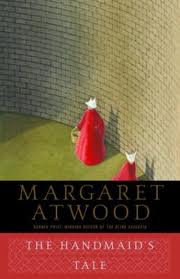
Handmaid's tale

There are other earlier covers, but this one is my personal favorite.

My Advanced Placement English Literature class just finished reading her novel, The Handmaid’s Tale. The novel is set in the dystopia of Gilead, where in response to political and ecological upheaval, a quasi-Christian theocracy is organized in the eastern section of the United States. Astute Sparknote writers, graduates of Harvard, recognized many of the landmarks in the novel’s setting (the brick wall, the gymnasium) as that of their alma mater, an indication of Atwood’s wry sense of irony. In the novel, fertility is an obsession. Rituals and “ceremonies” are enforced; offenders and outliers are publicly executed or sent to labor in toxic waste dumps. The main character Offred, who had a daughter before the establishment of the Republic of Gilead, is valued only for her ability to reproduce.

Because of the mature themes, The Handmaid’s Tale is often taught in senior high school classes. The title is often suggested on the exam for the open-ended Question #3 on the AP Literature exam which means other schools assign the book. There are always plenty of copies available in the secondary market. Our classroom library has over 60 copies from a variety of library book sales and thrift stores. I have spent under $100.00 in adding this title to our curriculum; I’d like to think that Atwood might be pleased with this “ecological” way to have students read the text despite her loss of possible retail revenue. However, if one wanted a new copy, they are available at Amazon for $10.20 paperback or an audio recording by Claire Danes is available  at Audible.com  for $24.95.

When we discuss the clothing that marks the different “castes” of people in Gilead,  I always use the endpaper story Atwood published in the New York Times Magazine published “When Afghanistan Was at Peace”

Six years after our trip, I wrote ”The Handmaid’s Tale,” a speculative fiction about an American theocracy. The women in that book wear outfits derived in part from nuns’ costumes, partly from girls’ schools’ hemlines and partly — I must admit — from the faceless woman on the Old Dutch Cleanser box, but also partly from the chador I acquired in Afghanistan and its conflicting associations. As one character says, there is freedom to and freedom from. But how much of the first should you have to give up in order to assure the second? All cultures have had to grapple with that, and our own — as we are now seeing — is no exception. Would I have written the book if I never visited Afghanistan? Possibly. Would it have been the same? Unlikely.”

Dutch Cleanser

The combination of the Dutch Cleanser girl with the chador is the inspiration for Offred’s clothing; the story and the visual always sparks a discussion on the symbolic effect of clothing.

My students always argue about the genre of The Handmaid’s Tale. This year there were a number of votes for political science book, others for a dystopian love story; no one said science fiction. Atwood would be relieved; she has always drawn the distinction between science fiction and her writing which she calls “speculative fiction”. Several of my students also read the other books Oryx and Crake and The Year of The Flood that are speculative fiction.

Here is Atwood with her take on the genre of specultive fiction.

The conclusion of The Handmaid’s Tale ends in an allusion to the story of Orpheus and Eurydice:

“We may call Eurydice forth from the world of the dead, but we cannot make her answer; and when we turn to look at her we glimpse her only for a moment, before she slips from our grasp and flees.”

After we finished the novel, the class read Atwood’s poem Eurydice. I asked them what they thought.

  • “There is a sense of longing in both.”
  • “The language is so similar. There is the white curtain…the gauze.”
  • “‘It is not through him you will get your freedom’ is just like
    from and freedom to…that is Offred’s problem”
  • “We could have just read the poem! They’re almost the same!”

One other area of speculative fiction where Atwood has shared her thoughts is on the topic of modernity…and Zombies. In an interview on George Stroumboulopoulos Tonight, Atwood was quite clear on the limits of Zombie stories:

“No zombie story is ever told from the zombie point of view… they’re not narrative…they don’t have language and that impedes one from telling a story.”

Outside of fiction, Atwood has also written about debt. Her non-fiction book Payback: Debt and the Shadow Side of Wealth came from her 2008 Massey Lectures. Not surprisingly, her interest in debt began in from her study of Victorian Literature. In an interview with Suzanne Ellis, CityLine “Margaret Atwood On Payback And The Concept Of Debt”  Atwood discussed how the Victorian stories that are on the surface about love and romance are really all about financial arrangements:

“In [Jane Austen’s] Sense and Sensibility, Marianne can’t marry the love of her life because he needs to marry a rich person. He doesn’t have any money. She’s devastated by that and gets a bad cold,” Atwood muses. “You start following the money in these novels and it takes you to the most amazing places. Where did Heathcliff get the money that he uses to buy Wuthering Heights, or I should say to gamble the owner of it out of it? How does he do that? We’re not quite sure but it’s something pretty shady.”

The book was made into a documentary and released in the spring of 2012. The New York Times critic A.O. Scott opens his film review with the premise of the documentary:

A glance at the headlines from Europe, the news from Washington or this month’s bills will confirm that we live in an age of debt. Debt, a concept at once straightforward and almost metaphysically complex, is a source of personal, national and global anxiety, and forms a link between the individual and the worldwide economic system.

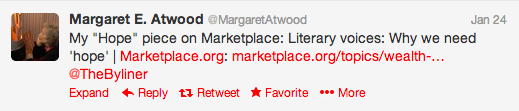
While the film did not receive critical acclaim, Atwood’s ability to connect herself and link to the world through Twitter is often lauded.  She is an avid twitterer with 383,430 followers and over 15,000 tweets of her own. She links to political issues, comments on travels, and gives recipe advice:


Screen Shot 2013-03-08 at 11.06.17 AM Screen Shot 2013-03-08 at 11.07.07 AM Screen Shot 2013-03-08 at 11.08.58 AM Screen Shot 2013-03-08 at 11.09.56 AM

She also is the inventor of the “long pen”, a device that allows her to attend book signings from distances and sign books “virtually”. When she is tired of traveling to sign books, she can now meet her adoring public in virtual space and provide them with an authentic signature. Fortunately, I saw her before the “long pen” at a Barnes and Noble reading/book signing for her short story collection Moral Disorder. She was amazingly articulate; in the 40 minute talk, she never hesitated or once said “um”.

And just when you thought that Atwood could not be more accomplished, she starred in a video explaining “How to Stop a Hockey Puck” for the comedian reporter Rick Mercer. I put the video below. (Too bad her “Dance Party Video” was removed from YOUTube for copyright violations.)

So, on this International Woman’s Day, let’s hear a cheer for Margaret Atwood!

She writes. She tweets. She scores!

Mash-up are usually the blending of music from two or more sources. However a different mash-up was featured in a story by National Public Radio (NPR) where street signs in New York City were rewritten into Haiku poetry, Haiku Traffic Signs Bring Poetry To NYC Streets. This story illustrated how a mashup could be made of a very basic informational text with a strict poetic form. “Caution: Oncoming Traffic” was expanded into a poem of  of 5 syllables/7 syllable/5 syllables of “8 million swimming/The traffic rolling like waves/Watch for undertow.” In the NPR story,

“Traffic warning street signs written as haiku are appearing on poles around the five boroughs, posted by the New York City Department of Transportation. The poems and accompanying artwork were created by artist John Morse.”

Screen Shot 2013-03-03 at 5.35.21 PM Screen Shot 2013-03-03 at 5.35.31 PM Screen Shot 2013-03-03 at 5.35.39 PM

NYC’s Department of Transportation hoped the signs would catch new eyes in order to communicate important information. The unusual combination of graphics and verse on street signs presented pedestrians with additional information, a different point of view. The reordering of information is just one example of how presenting information in a different genre also provides new writing opportunities for new audiences.

Since the English Language Arts Common Core is rattling its standards calling for an increase in informational texts, the 9th grade curriculum is including a non-fiction unit where students choose a non-fiction text of their own to read. The CCSS  require this increase based on:

“…extensive research establishing the need for college and career ready students to be proficient in reading complex informational text independently in a variety of content areas. Most of the required reading in college and workforce training programs is informational in structure and challenging in content…”

Our students may choose a text to read on topics that range from animal or adventure topics to travel or war. There are titles that have been made available in bulk on the secondary market, such as public library book sales or thrift stores and added to our classroom book carts. The books purchased for $1.00 each (see how) include:

  • Girl Interrupted-Keysen
  • Guts-Paulsen
  • Tuesdays with Morrie-Albom
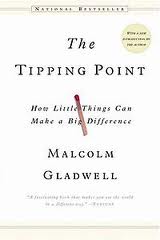
  • The Tipping Point– Gladwell
  • Left for Dead-Nelson
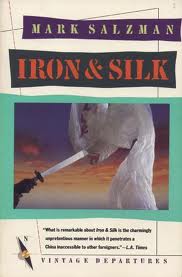
  • Iron and Silk-Salzman
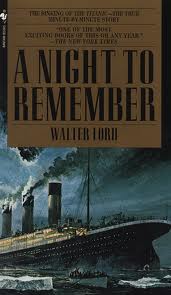
  • A Night to Remember-Lord
  • Hiroshima-Hersey
  • The Teammates-Halberstam

iron and silk Night to remember dog year Tipping

There are also a number of books that deal with animal literature that are stocked on the classroom book cart. Many of these texts will also be available for the senior elective, “Critter Lit”:

  • With Love from Baghdad-Kopelman
  • Tell Me Where It Hurts-Trout
  • Seabiscuit-Hillebrand
  • Winterdance– Paulsen
  • A Dog Year-Katz
  • Wesley the Owl-O’Brien
  • Alex and Me-Royte
  • Modoc-Helfer
  • The Pig Who Sang to the Moon-Masson

Students may chose from these titles or another non-fiction choice though the school library, which also offers the online book shelf Overdrive. The students organize themselves into thematic groups while the unit runs for four weeks (block schedule) with some overlap during the standardized testing weeks. The students spend time reading in class, and they organize themselves into thematic groups. Rather than respond in essays or traditional research papers, the students are given an opportunity to create genre mash-ups.

First, to prepare for writing mash-ups, the students generated a list of the kinds of non-fiction writing they see everyday including:

  • License plate
  • Newspaper article
  • Letter to the editor
  • Ad
  • food labels
  • Menu
  • Directions
  • Q&A Interview
  • Diary
  • Weather report
  • Sports report
  • Billboard
  • Tweet
  • Blog post
  • Directions

Next, the mini-lessons that begin each class are quick( 5-10 minutes) and focus on the characteristics of a particular genre from the list so that students can create rewrite each text in that genre. For example, students review how information is arranged on a food label before creating a “food label” for the books they are reading. Students read billboards and street signs before creating the same.  After each mini-lesson, students write about their text in the assigned genre and use a Google Docs folder to develop a portfolio of authentic writing. The result is a portfolio of mash-ups of informational texts rewritten by students into other genres.

Like the haiku and street sign mash-up, these mashups will still communicate essential information. Students can write about the texts they choose to read in the authentic genres they encounter everyday.

Finally, when April comes around, the students may try writing their essential information in poetry: sonnets, limericks, villanelles and even haikus. After all, April is National Poetry Month!

There are many great reasons to teach at the high school level: no outdoor recess duty, college level content, plus, a teacher never has to choose a “line leader”. Best of all, there are no bulletin board requirements.

While most elementary school classroom walls are crammed with colorful thematic cut-outs (apples, shamrocks, stars), high school walls are monochromatic. While middle school classrooms have student work displayed regularly, an essay hung in September will curl and fade on the wall of a high school classroom twisting in the air like an ancient leaf of papyrus.

Generally speaking, high school teachers do not spend a lot of time decorating the classroom. Subject content or motivational posters are the wall covering of choice, unchanged for the requisite 181 days of instruction. Perhaps it is inevitable that teachers who share classrooms do not personalize classrooms.

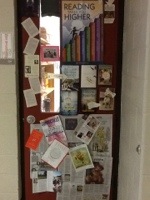
However, for one brief part of the 3rd grading quarter, Read Across America Week (February 25-March 1st) changed the decorating habits of the faculty at Wamogo Middle/High School.

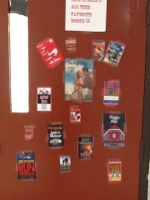
English teacher door...a wide rang of reading complete with motivational poster!

English teacher door…a wide rang of reading complete with motivational poster!

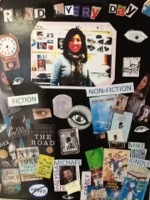
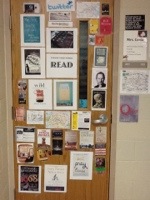
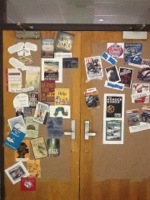
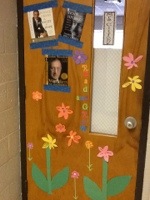
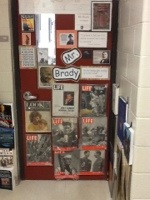
In a collective effort to demonstrate the importance of reading to students, teachers from every discipline decorated their classroom doors with materials they have read or are currently reading.

20130301-112618.jpg

When sharing a door meant less space, this resource room teacher used a poster.

Social Studies (Gr 7) had this door and the side wall as well!

Social Studies (Gr 7) had this door and the side wall as well! The genre range (politics-humor-sports) was astounding!

20130301-112656.jpg

The Art teacher door centered around the command “READ”.

20130301-112713.jpg

Health and Physical Ed teacher revealed a “retro” fondness for the books that contributed to her growing up including Erich Segal’s “Love Story”

20130301-112741.jpg

Alternative education students had to walk through a double door display! Students selected the books they read as well in this display.

20130301-112806.jpg

The resource room mixed decorative flowers with John Wooden “On :Leadership”

20130301-112843.jpg

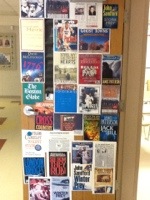
One Social Studies teacher took the assignment to heart by hanging what he reads, quite literally, onto the door and walls….He was considered the “winner!”

Admittedly, when the “Doors of Wamogo” was announced, there was a little hesitation. What would go on the door? When was this “due”?

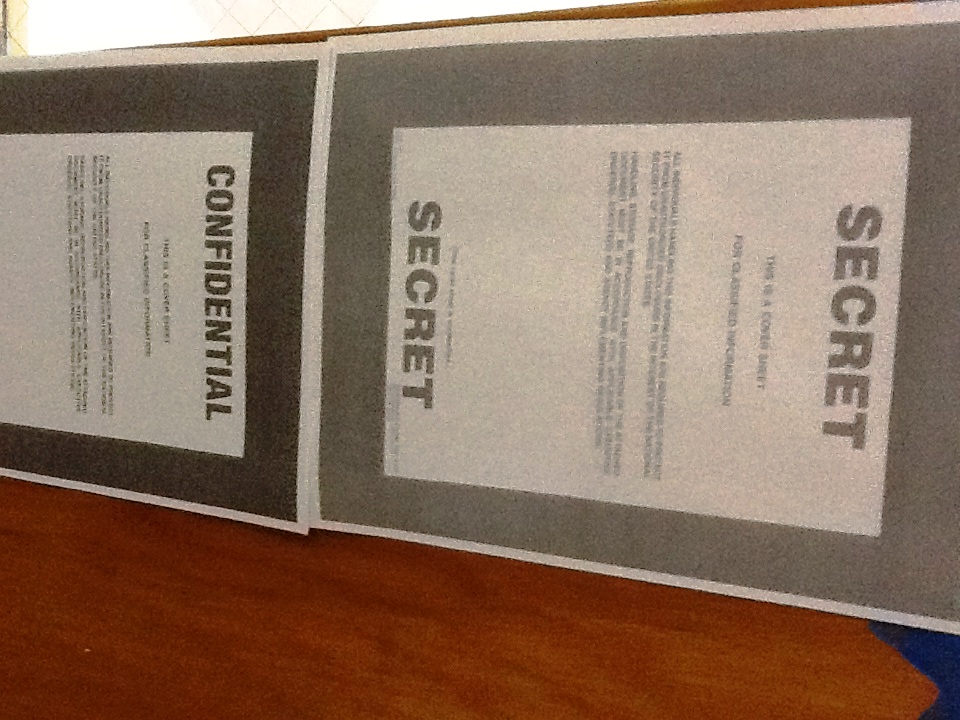
Finally, a few brave souls stepped up. First, there was the Social Studies teacher, an Army Reserve Colonel, who started by hanging “classified” documents on his door. His display was followed by the Business and Career Department teacher, also a basketball coach, who hung sports magazines and the cover of a Bobby Knight memoir.

The English Department members, the Literary Specialist, and the media center Librarian displayed a range of the reading, from Where the Wild Things Are to Great Expectations.

As the week went on, the competition became a little more intense. Finally,  the Grade 8 Social Studies teacher simply emptied out his bookshelf and placed all his favorite texts alongside the door in addition to the door.

Side shot of the "Classified" materials read by a Social Studies teacher

Side shot of the “Classified” materials read by a Social Studies teacher

Perhaps one of the more interesting outcomes was the sharing of titles between faculty and staff. “Oh, I loved that book!” one teacher would say to another. “This is a hard book, but well worth the effort,” said one teacher. “Yes, we read this in our ‘book club’!” exclaimed another. “Who is the Jody Picoult freak?” questions a science fiction reader. “How much Stephen King can you read?” was the retort.

20130301-112826.jpg

Math teacher places “Put Me in the Zoo” on his door; hopefully. this says more about his new baby daughter than the classes!

Students had a chance to look at all the titles: assigned reading from high school that they currently are reading (Romeo and Juliet, Animal Farm), political/history books, and sports memoirs. There were magazine covers, newspaper mastheads, and comic strips. Blogger, WordPress, Twitter, Facebook logos were prominent, social media as informational texts.

So what the “Doors of Wamogo”  created for Read Across America Day in our small rural school was a very large window. The doors provided a window into the lives of our faculty, a window for our students to see us as readers, and for our students to see what books made us successful.

These doors illustrate how reading gave each teacher and staff member a chance to at the window of opportunity; reading = individual success.

We had so much fun, we might try decorating again next year!

Happy Read Across America Day, 2013!

20130301-112923.jpg

Taking the playfulness of a Dr. Seuss motif to heart with replicas of books shared by students.

According to literary legend, Ernest Hemingway wrote a six word short story in response to a bet:

Screen Shot 2013-02-26 at 3.58.31 PM

So when my Advanced Placement English Literature class was suddenly shortened one day last week due to a  delayed opening, I thought that I would do a close reading on this famous short story. After all, how long could a discussion on six words last? I was confident there would certainly be enough time for each of them to craft an essay as well.

The usual procedure for close readings in class is to have a volunteer “read aloud” while students annotate their copies of the text. The text is also displayed on the SMARTboard so that notes can be added and shared with all members of the class.

After they settled down with copies, Sam volunteered to read. We listened and paused. I started to ask, “So how did Ernest Hemingway, the author of this short story, convey his meaning?” when I was cut off.

“Whose baby died?” asked Alexis. She had no notes on her page.

“The baby died?” Connor responded, “I thought this was about a tag sale.”

“Why do you say that?” I asked, “Look at the evidence in the text.”

“Because people who have tag sales put in ads, and the ads are short,” replied Connor.

“But that is why the ad is short,” Alexis retorted, “the parents are so upset, they cannot write a long ad to sell the baby’s shoes.”

“Where are parents in the text?” I demanded.

“I agree with Alexis,” said Sam, “the shoes were ‘never worn’. The baby is dead.”

“OK,” I agreed, ” the words ‘never worn’ are in the text, but…”

“But the baby shoes could have been a gift that was the wrong size,” interrupted Natalie.

We were drifting off in our discussion. I had chosen the story because of its brevity, but I also had considered how well the text responded to the Publisher’s Criteria for the English/Language Arts Common Core Standards:

The Common Core State Standards place a high priority on the close, sustained reading of complex text, beginning with Reading Standard 1. Such reading focuses on what lies within the four corners of the text. It often requires compact, short, self-contained texts that students can read and re-read deliberately and slowly to probe and ponder the meanings of individual words, the order in which sentences unfold, and the development of ideas over the course of the text.

This was a “compact, short, self-contained texts that students can read and re-read deliberately.” The students were beginning to probe the meanings of individual words, but they were drifting.  They were bringing up tag sales, upset parents, and poor present gifting;  we were far off the four corners of this text.

For a moment, a very brief moment, I consider that we were moving away from the goals of the Common Core to work with the text. However, they were so quickly engaged, that I grew far more interested in listening to how close to they were to determining Hemingway’s purpose. Hemingway had selected six specific words to excite the reader’s imagination. My students were not wrong in their suggestions, they were using his text to understand, to create meaning. They were working with Hemingway’s language and responding to his inferences.

Their written drafts also leapt beyond the evidence, much like the discussion:

  • “They have waited nine months in anticipation for this day, and that morning a pair of shoes, no larger than the size of a plum, arrived in the mail, a gift from an aunt. They run to the hospital; they cry, they yell, they cry, but their baby is dead. ‘Get rid of those shoes.’ He writes in the paper, “For sale: baby shoes, never worn.’ Auntie will be sad.”
  • “…whether it’s a parent/ guardian or a thief trying to make money, it is obvious from the syntax that the shoes need to go.”
  • “‘For sale’ is a general coupling of words that comes from a particular type of person….a person low on monetary resources or one who wants to get rid of something…”
  • “…by saying the word ‘never’, that means the parents have never had a baby and will never have a baby…never is finite”
  • “In reality, Hemingway’s story is less of a story and more of a jumping off point. The six words are a choke point, like that of an hourglass stretching of in infinity in either direction.”

These drafts, hastily written in response to the story, ranged from 2-3 handwritten pages; far more than the six words that stimulated their ideas. The students wrote furiously until the bell rang, and then begged for more time to finish.

Certainly, their responses could be judged by the CCSS criteria, “Student knowledge drawn from the text is demonstrated when the student uses evidence from the text to support a claim about the text.” However, their responses in discussion and in essays offer significant proof that the ideas that started in text cannot be limited by clocks or “four corners”.

test

Standardized testing in Connecticut begins next month. The 10th grade students who are taking a reading comprehension practice test all look like they are engaged. Their heads are bent down; they are marking the papers.  I am trying to duplicate test taking conditions to prepare them for these exams. I also want to compare the scores from this assessment to one taken earlier in the year to note their progress.

Next month, these these students will sit in the same seats, for the same amount of time, perhaps using the same pen or pencil, but they are not the “same”. That is because they are adolescents. They are going through physical changes. They are going through emotional changes. They are are going through a period of social adjustment. Outwardly, they may look calm, but the turbulence inside is palpable.

I imagine if I could tune into their inner monologues, the cacophony would be deafening:

  • “…missed the bus!!!! No time for breakfast this morning…”
  • “…this is the biggest zit I have ever had!…”
  • “…not ready for the math test tomorrow…”
  • “….did I make the team?…”
  • “…why didn’t I get that part in the play?…”
  • “…I forgot the science homework!..”
  • “…When this test was over, I’ve got to find out who he is taking to the dance!..”
  • “…what am I going to do when I grow up?..”
  • “…should I get ride home or should I take the late bus?…”
  • “…Is she wearing the same shirt as me?…”

These students take the practice assessment like other classes of students before them. Unlike generations of students before them, however, social media makes a significant contribution to their behavior. Their access to social media updates with Facebook posts, tweets, or text messages exacerbates the turmoil and creates a social, emotional, hormonal slurry that changes hourly. 

And very soon, in one of those hours, these students will take a real state standardized test.

These factors may explain why the highs and lows of my data collection for several students bear a closer resemblance to an EKG rather than a successful corporate stock report. I may not want to count the results of an assessment for a student because I know what may have gone wrong on that day. However, the anecdotal information I have for a given student on a given day student is not recorded in the collection of numbers; measuring student performance is exclusively the number of items right vs. the number of items wrong.

Yet, there is still truth in the data. When the individual student results are combined as a class, student A’s bad day is mitigated by Student B’s good day. The reverse may be true the following week. Averaging Student A’s results with all the other members of the class, neutralizes many of the individual emotional or hormonal influences. Collectively, the effects of adolescence are qualified, and I can analyze a group score that measures understanding. Ultimately, the data averaged class by class, or averaging a student’s ups and downs, is more reliable in providing general information about growth over time.

Although I try to provide the ideal circumstances in order to optimize test scores, I can never exclude that social, emotional, hormonal slurry swirling in each of their heads. I know that the data collected on any given day might be unreliable in determining an individual student’s progress. I cannot predict the day or hour when a student should take a test to measure understanding.

How unfortunate that this is exacty what happens when students take a state standardized test on a predetermined date during an assigned hour, regardless of what turmoil might be going on in their lives. How unfortunate when that the advocates of standardized testing are never in the classroom to hear the voices in the adolescent students’ internal monologues:“….I am so tired!…..When will this be over?…Does this test really show what I know?”

In keeping my classroom libraries filled with books, the trends I notice are not necessarily trends in book buying, but trends in book discarding. After exams, midterms or finals, assigned titles are discarded to make room on a bookshelf or in a school locker for new required reading. Following trends means knowing that three to four months after the curriculum unit ended, an assigned title begins to crowd its way onto the bookshelves of thrift stores such as Goodwill or St. Vincent’s or the Salvation Army.

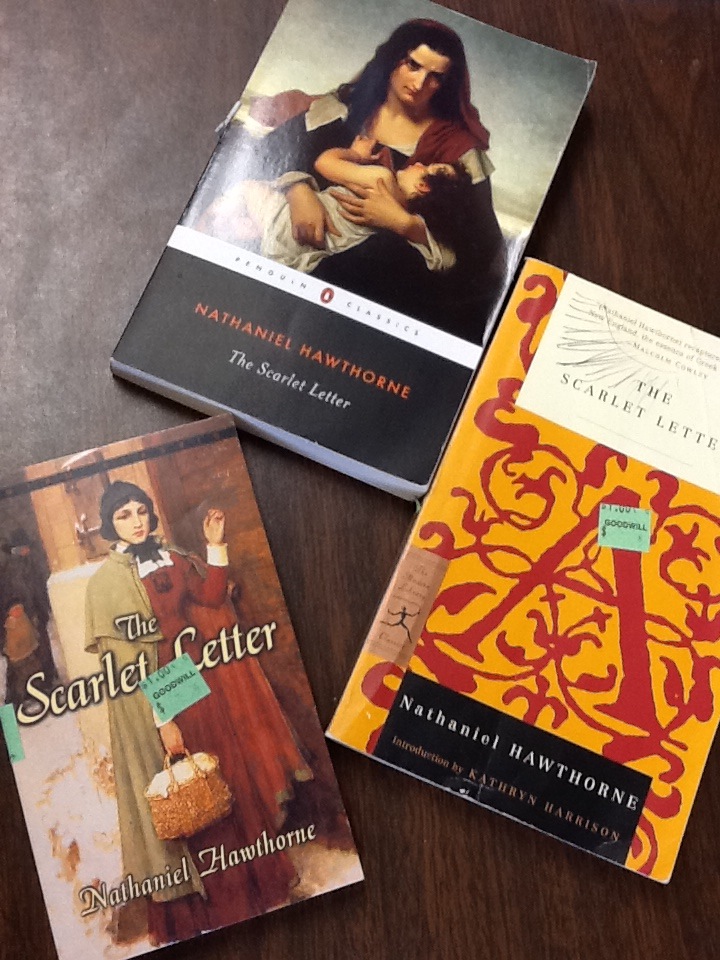
Three copies of "The Scarlet Letter" on the shelf at Goodwill. All new; never opened!

Three copies of “The Scarlet Letter” on the shelf at Goodwill this past week. All new; never opened, bearing their $1.00 each price tags.

Since Puritans are usually up for discussion in September in American History coursework, many English departments turn to Nathaniel Hawthorne’s novel The Scarlet Letter for their Advanced Placement or college bound students as a complementary read. Therefore, I was not surprised when, during this last week of January, copies of The Scarlet Letter began appearing, not in single copies, but in droves. I expected as much. The Scarlet Letter represents the “not keeping” trend. While a student may hesitate for a millisecond before placing The Great Gatsby or To Kill a Mockingbird or Catcher in the Rye in the “throw away” pile, I imagine there is universal delight in discarding The Scarlet Letter, a delight only exacerbated by discarding its equally loathed curriculum companion, Arthur Miller’s The Crucible.

The mention of The Scarlet Letter may set off groans. Woe to the teacher who attempts this book without the iron cast-backbone or the determination of an evangelist. Readers of The Scarlet Letter will need to be converted, and it is only the fear and damnation of another scarlet letter that keeps them plodding on, the scarlet “F”!

The tone of the book is set immediately with the opening line:

A throng of bearded men, in sad-colored garments and gray, steeple-crowned hats, intermixed with women, some wearing hoods, and others bareheaded, was assembled in front of a wooden edifice, the door of which was heavily timbered with oak, and studded with iron spikes.

Looking further down the page for some relief from the gloom, the reader should notice that he or she is being directly addressed, as if from a pulpit delivering a parable or allegory:

Finding it so directly on the threshold of our narrative, which is now about to issue from that inauspicious portal, we could hardly do otherwise than pluck one of its flowers and present it to the reader. It may serve, let us hope, to symbolize some sweet moral blossom, that may be found along the track, or relieve the darkening close of a tale of human frailty and sorrow.

Yes, Hawthorne will be delivering this sermon for 192 pages in the Dover Thrift Edition ($3.15).

Students are aware that this classic will improve SAT scores with the challenging vocabulary and complex structures of 19th Century prose, but they still seek help beyond the classroom. There are Sparknotes, Schmoop notes, E-Notes, Cliff Notes, and Bookrags available for this text, so as a result, the paperback text on the thrift store shelf may never have been opened. The copies available at thrift stores are generally pristine copies. I imagine they were purchased by parents who dutifully picked up the book because of a syllabus of some sort. Maybe this was a summer reading choice, a particularly deadening assignment. Actually, the effort in purchasing this text could have been avoided, because the text itself is online at no less than six places:

And there are free audio versions at:

But we still teach The Scarlet Letter, and our paperback collection of The Scarlet Letter distributed in class is comprised of at least 10 different editions. No student is on the same page number when the text is read aloud in class in order to share the conflicts between Dimmesdale, Hester Prynne, and Chillingsworth. Interestingly, what seems initially complex to the student is eventually understood as a really a ripping good love triangle of sex, intrigue, and irony. Once they see Hawthorne laying out hypocrisies of the Puritan society, they are more genuinely engaged. Plus, there is the lovely child Pearl, and they grow to sympathize for her.

In order to engage students in assessments, our Grade 11 teacher has organized “self-directed” projects for students to choose  and some of these have included:

  • Create a song telling the ballad of Hester Pyrnne.  You may compose the song, or write new words for an existing melody.  Share the song with the class either live or via audio or videotape.
  • Think of a sin associated with Dimmesdale and Chillingworth.  Create a badge that uses a letter or other symbol to represent the sin.  In addition, use art, needlework, or some other craft to make the badge reveal something about the man’s character, interests, or profession.  Write an explanatory caption or paragraph to accompany the badge.
  • Choose music to be the score for a film version of the novel.  Choose music for at least five major scenes.  Write explanatory notes for each selection

The harvesting of The Scarlet Letter texts from thrift store shelves is best from January-March. I can add as many as 10-12 copies during these months. Competition for the title grows during the summer, and the books are often more dog-earred by then.

But with all the negativity, why teach The Scarlet Letter? Because Hawthorne provides a bridge from this historical period to ours by using the empathy that is generated in fiction. Our brains are wired for stories more than facts, and reading The Scarlet Letter helps our students identify with characters in order to understand the politics and policies of this turbulent time when our nation was still in its infancy. Additionally, his story serves as a springboard for other stories. According to Canadian author Margaret Atwood, “The roots of totalitarianism in America are found, I discovered, in the theocracy of the 17th Century. The Scarlet Letter is not that far behind [the novel] The Handmaid’s Tale, my take on American Puritanism.”

Oh, and yes. We also assign The Handmaid’s Tale.

A startled Macbeth exclaims, “The Thane of Cawdor Lives! Why do you dress me in borrowed robes?” (1.3.109) as he receives the news that verify the Witches’ prophesy. Shakespeare’s tragedy centers on this valiant warrior, a man whose “o’er riding ambition” brings death to those who surround or oppose him, and a man who brings on his own damnation.

Sound familiar? Well, yes. This is also the plot of the original Netflix production of House of Cards, an American remake of the successful British political mini-series based on a book by Michael Dobbs. In this series, Francis Underwood (Macbeth) played by Kevin Spacey is the calculating Majority Whip of the House of Representatives; Claire Underwood (Lady Macbeth) played by Robin Wright is his conniving wife. Director David Fincher’s mini-series is for educators only with a TV-MA rating, because, “This wicked political drama penetrates the shadowy world of greed, sex, and corruption in modern D.C.”  The plot similarities to Shakespeare’s play are not literal, but rather they are in the same desire for the golden round or, in the case of the television series, the American presidency.house of cards

Of course, I am not the first to point out these parallels; there are multiple reviewers, bloggers, commenters who have called attention to the Shakespearean qualities in characters and plot line. What I am finding particularly interesting is the inclusion of the many images from the play artfully placed in each episode. For example, Claire’s jarring encounter with the old woman in a graveyard while she was jogging is one. “You should not be here,” the hag appears suddenly warns Claire, “Show some respect here.” The incident resonates much like the specter of the witches, a constant presence in the play. Later, Claire’s $20 handout to a beggar outside a hotel is rejected. The beggar turns the bill into an origami bird, tossing it at Claire’s feet the following day. She leans down and collects up the bird, but that incident pulls Claire into a “spell” of origami folding. Later, Claire is seen neatly folding paper into small figures. The viewer wonders, what was the power of that beggar?

The crimes mount; the murder of a hapless politician, lured into a media trap set up by Francis, is underscored with images of dripping water from a leaky faucet. That same faucet is repaired by Claire, echoing Lady Macbeth’s chilling statement, “A little water clears us of this deed”(2.2.64) Another repeated theme connects Claire to the frightening Lady Macbeth who, in urging  Macbeth assassinate the king, declares that if she had a child, she would, ”have pluck’d my nipple from his boneless gums, And dash’d the brains out, had I so sworn as you…” (1.7.16-17). Claire grows obsessed with her childless state, but when she confronts and makes contact with a pregnant adversary, the viewer can positively feel the fetus recoil in horror from the touch.

Additionally, the references to sleep merge the language of Shakespeare and the images from House of Cards. Yes, both Francis and Claire Underwood “sleep around”, but the sleep that is the “balm of hurt minds, great nature’s second course” (2.2.36) is missing. Claire has nightmares, Francis is exhausted. “You look tired,” says she. “I am beat,” says he; they are weary and haunted.

Even the camerawork mimics the framework of the play. Francis delights in engaging the audience in his conspiracies, breaking the fourth wall by delivering his thoughts in folksy soliloquies. His first lines are delivered as he stares into the camera over the body of a dog that has been hit by a car, “There are two kinds of pain. The sort of pain that makes you strong, or useless pain. The sort of pain that’s only suffering. I have no patience for useless things.” He then strangles the dog.

When I teach the play Macbeth, I try to make the characters relevant to my students. I make comparisons to world dictators past and present, I mention mobsters and thugs, I bring up warlords.

I ask my students, “Do you think there are Macbeths today?”  “Yes,” they respond, sometimes calling on names from current events.

Unfortunately the rating on House of Cards prevents my sharing this slick contemporary series with my students despite how well the drama picks up the themes and images of Shakespeare’s “Scottish play”.  Perhaps that is best; they are not prepared to evaluate this cynical treatment of democracy. The show is an illustration of a ruthless Macbeth, one that Shakespeare would have wanted, a frightening political operative of our time.

The teachers at the professional development session were visibly frustrated; I could hear the irritation in their comments. The presentation on the use of digital technology was to help them improve digital literacy across the content areas, but many of the sites in the demonstration were blocked by the school’s Internet filter. I sympathized with their frustration because just three years ago, I was like them. Three years ago, our school’s Internet filter blocked everything.blocked youtube

Back then, members of my English department were finding excellent resources to use to teach the novels All Quiet on the Western Front, The Crucible, and the memoir Night. Unfortunately, many of these resources were unavailable because they were on YouTube or had descriptors such as “witchcraft in Salem, Massachusetts” or “Nazi” that were blocked by our filters. The filters were useless to a large degree since many of the students knew a variety of different strategies to get around each filter. So, the irony was that the students had access where the teachers did not.

Furthermore, the students were having a rich and very authentic experience of using the Internet outside of school. Once they came into our building, however, they were detached from the very technology that they would need to use in their future. Our school web filters  created an “un-authentic” web experience for our students. We were losing the opportunity to teach them digital citizenship because they were not digital citizens.

Fortunately, our administration took the position that teaching our students 21st Century skills meant that they should have access to the Internet in a technology rich learning experience. The filters were minimized. Our acceptable use policy was enforced, and teachers and students had access to the Internet resources.

We moved from exclusively computer lab use to 1:1 netbooks in English/Social Studies to a “Bring Your Own Digital Device” (BYOD) over the course of the next two years, and now, two years later, I can testify that unblocking the Internet has not created a problem for teachers or students. Yes, the students can watch YouTube videos, but they also make videos and share them with other students. They make videos for our “Friendship and Respect” Assemblies and share these on YouTube; they watch Oscar winning films for Film and Literature Class that are on YouTube; they embed YouTube videos into their blogs.

Furthermore, our students have access to the Internet to meet the state adopted Common Core Literacy Standard:

CCSS.ELA-Literacy.CCRA.W.6 Use technology, including the Internet, to produce and publish writing and to interact and collaborate with others.

Of course, our students are not perfect, and their behaviors using the Internet at school are not always tied to curriculum. I once came upon a group of young men huddled around a computer screen one morning. They were watching a video, and as I grew closer, I could hear a voice say, “She’s a beauty…” and another agree, “Oh, I want her!” I feared the worst, but when  I came up behind them to see what was on the screen, I got a eyeful of a 2006 Ford F250 XLT Powerstroke Turbo Diesel Pick Up Truck. Curriculum? No. Authentic experience? Yes.

The frustrated teachers who were sitting in the professional development asked what steps they could take to have their administrators review acceptable use policies and open the Internet filters for their students. They discussed looking at other school districts’ acceptable use policies. Perhaps there might be some testimony about the success of unlocking an Internet filter?

This post is one such testimony, and I offer this to any teacher that is looking to “unblock” the Internet in order to engage students in developing 21st Century skills. We are already in the second decade of this 21st Century, and the skills necessary to use the Internet are becoming more valuable in this Information Age. According to the 2012 data, using the Internet is a real world experience for 2,405,518,376 people. That is 1/3 of the world’s population, and there has already been a 566% increase in use since the beginning of the new millenium.

Our students are counted in those numbers already. While they use the Internet outside of school for social media; they should be taught to use the Internet for education and productivity in school. So once they have access to YouTube, they can never go back…they will only go forward.

College Application Essay topics for 2013-2014 have been posted, and SURPRISE! Every prompt requires a narrative!

storyA recent news release by the Common Application, a non-profit widely used for college admissions by high school seniors at nearly 500 colleges and universities, explains the changes in essay prompts for 2013-14. The option to write about a topic of “your choice” has been dropped; the essay topics are:

  • Recount an incident or time when you experienced failure. How did it affect you, and what lessons did you learn?
  • Reflect on a time when you challenged a belief or idea. What prompted you to act? Would you make the same decision again?
  • Describe a place or environment where you are perfectly content. What do you do or experience there, and why is it meaningful to you?
  • Discuss an accomplishment or event, formal or informal, that marked your transition from childhood to adulthood within your culture, community, or family.

The irony of this decision should not be lost on anyone who remembers a blunt statement made by David Coleman, the current President of the College Board. In April of 2011 at a NY State Department of Education presentation on the Common Core, Coleman said, “As you grow up in this world, you realize people really don’t give a sh*t about what you feel or what you think.”

Well, apparently the College Application Board does care. Their prompts specifically ask college bound students what they feel or what they think. In fact, the College Application Board cares so much that they will allow students to expand their storytelling by an additional 150 words, increasing the word count from 500 to 650.

The decision by the College Application Board really is not that surprising.  on the Buffer blog called attention to research on reaction of the  the human brain to stories. He summarized a number of brain studies that indicate that the best learning comes from storytelling. One study by Uri Hasson from Princeton was published in an article titled “Speaker–Listener Neural Coupling Underlies Successful Communication” in the Proceedings of the National Academy of Sciences. The article discussed how subjects under study create empathetic bonds with listeners by using stories:

“When the woman spoke English, the volunteers understood her story, and their brains synchronized.  When she had activity in her insula, an emotional brain region, the listeners did too.  When her frontal cortex lit up, so did theirs. By simply telling a story, the woman could plant ideas, thoughts and emotions into the listeners’ brains.”

College bound seniors should take note of this research when they write; apparently a compelling story can be quite convincing. Luckily, they will have  plenty of practice with the narrative writing genre which is now back in favor with the adoption of the Common Core Literacy Standards. Anchor Writing Standard #3 for grades K-12 reads:

CCSS.ELA-Literacy.CCRA.W.3 Write narratives to develop real or imagined experiences or events using effective technique, well-chosen details and well-structured event sequences.

Curiously enough, one of the architects of the Common Core Literacy Standards was David Coleman before he took his position at the College Board.

Now the revised College Application Board form for 2013-14 states: “Some students have a background or story that is so central to their identity that they believe their application would be incomplete without it. If this sounds like you, then please share your story”

A word of caution, though. Don’t expect College Board President Coleman to care.

Of course, I received multiple links to the NY TimesMacbeth Mashup“from fellow English teachers, and yes, I thought that Claire Needell Hollander wrote a very funny piece. Yes, I believe students should be exposed to Shakespeare regularly, with or without the recommendations of the Common Core State Standards (CCSS). But, Macbeth for seventh and eighth graders? No!  That is just wrong. Wrong on theme, wrong for content, and very wrong for 11 and 12 year olds.

Hollander began her feature article making a great point about classroom dynamics:

“We say the classroom, as if an ideal classroom exists that somehow resembles every other classroom in America. In reality, every classroom has its own dynamic, and every class I’ve ever taught looks different from every other class. Perhaps more important, they also sound different.”

She is right. A chemistry of personalities creates a different dynamic in every classroom. The age of those personalities is also a factor. As I read the piece, however, I grew more and more frustrated. Macbeth features witches, warfare, murder, and, like most Shakespeare plays, sexual language. The word “blood” is repeated 41 times over the course of the play. Even the play itself is cursed; actors will not say the name of the play in the theatre. Many critics consider this Shakespeare’s “darkest play”.

Hollander herself questioned the appropriateness of this play for middle school students. She writes:

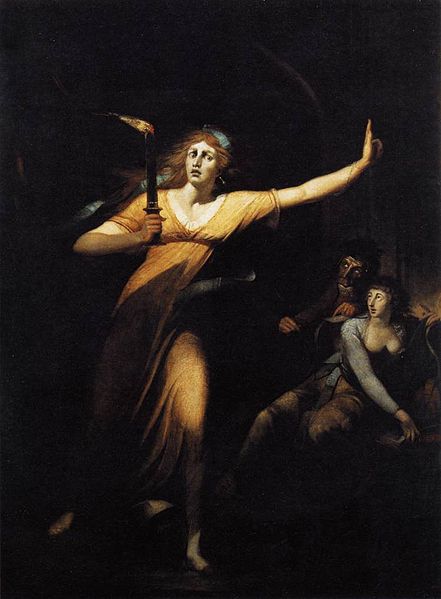
Lady Macbeth

John Henry Fuseli/ Johann Heinrich Füssli, Lady Macbeth Sleepwalking. Musée du Louvre, Paris Date: 1784. Creative Commons. Lady Macbeth driven to madness and suicide because her guilt in participating in the murder of King Duncan which leads to the murder of the guards, Macduff’s family, Banquo, and others…the stuff that nightmares are made upon.

“The kids have copies of the play with a modern English version on one side, but this isn’t easy either.”

“Tears of hilarity. Maybe middle school is too young for “Macbeth.”

Maybe? Definitely! So, why choose Macbeth?

Apparently, Hollander was attempting to satisfy a recommendation for archaic language for the secondary level in the English Language Arts Common Core. This is explained in Appendix A Language Conventionality and Clarity:

Texts that rely on literal, clear, contemporary, and conversational language tend to be easier to read than texts that rely on figurative, ironic, ambiguous, purposefully misleading, archaic, or otherwise unfamiliar language (such as general academic and domain-specific vocabulary).

In other words, the CCSS state that students should be exposed to complex diction, and the CCSS has made specific recommendations for grade 8 including:

  • Little Women by Louisa May Alcott (1869)
  • The Adventures of Tom Sawyerby Mark Twain (1876)
  • “The Road Not Taken” by Robert Frost (1915)

Hollander could consider the how the wording in CCSS Reading Standard 8  should guide her in selecting material for her combined seventh and eighth graders:

Analyze how a modern work of fiction draws on themes, patterns of events, or character types from myths, traditional stories, or religious works such as the Bible, including describing how the material is rendered new.

So many students come to high school without the necessary content to understand many of Shakespeare’s allusions. Perhaps the students know little about King Arthur and the Knights of the Round Table; why not Malory’s Morte d’Arthur? Or understanding the Pantheon of Greek Gods and Goddesses would be helpful; why not Edith Hamilton’s Greek Mythology?  Beowulf is usually taught in grade 10; the opening begins, “He was spawned in that slime, /Conceived by a pair of those monsters born/ Of Cain, murderous creatures banished/ By God, punished forever for the crime/ Of Abel’s death” (Raffel). Student should know this Biblical story of Cain and Abel. Students must come to high school prepared with the content needed to understand increasingly complex texts.

So why choose Macbeth? In fact, why choose Shakespeare at all? Ultimately, by not considering the recommendations of the CCSS to saturate students with the grade appropriate texts in our rich literary tradition, Hollander leaves them ill-prepared for Shakespeare at the high school level, when they are more mature to appreciate his themes.

So please, leave Macbeth, with his nihlism, his “...tale/Told by an idiot, full of sound and fury,/Signifying nothing” for older students.  Please leave Lady Macbeth with “…the smell of the blood still” where “all the perfumes of Arabia will not sweeten this little hand”, and leave Macbeth for high school. Besides, if Hollander is trying to meet the recommendations of the Common Core, she should leave Macbeth where the Common Core placed it, as a complex texts for 9th and 10th grades. The noisy mashup of Macbeth will still be crude and rowdy and demanding; but the students will be older, and these few additional years of maturity are necessary for dark tragedy in “the Scottish play”.