Archives For November 30, 1999

Teenagers today read for pleasure just as much their parents-or grandparents- read when they were teens. This means that after all the time and effort dedicated by schools and publishers to increase student reading, the statistics show no increase in the number of teenagers who read for pleasure?

I find this a proposition just a little depressing.

65 years and no improvement in teens reading for pleasure? Why not?

An article in the January 2012 Language Magazine: The Journal of Education and Communication by Stephen Krashen titled “Reading for Pleasure” looks at data about the reading habits of high school students gathered from 1946 to the present in order to explain “why we should stop scolding teenagers and their schools.”  Krashen is a linguist and researcher in second language acquisition who promotes the use of free voluntary reading  which he says “is the most powerful tool we have in language education, first and second.”

Krashen looks at questionnaires given to 17 year olds by  National Assessment of Educational Progress (NAEP)  that asked if they read in their spare time.  Using this data, he determines that despite some improvement between 1946 and 1984, there has been a decline in teenage reading from 1984-2008, resulting in no net gain in reading for the past 65 years. He concludes that, “Contrary to popular opinion, there is no evidence that teenagers are less engaged in literacy activities today than teenagers of the past. Teenagers today do just as much book reading as teenagers did 65 years ago, and it appears that they are more involved in reading and writing in general when we include computer use in the analysis.”

That conclusion is really depressing. There have been considerable efforts to increase student reading on several fronts beginning in earnest with Rudolph Flesch’s Why Johnny Can’t Read: And What You Can Do about It  published in 1955. While this book dealt primarily with the methodology of teaching reading (phonics), the book’s message about the importance of literacy spike a nation’s interest in improving reading skills-an important step in student reading for pleasure. On the education front, the inclusion of   SSR (silent sustained reading) during the school day began over 30 years ago. One of the tenets of SSR is that students have the opportunity to choose materials to read. The practice of SSR has travelled from elementary to many middle and high schools in order to respond to student demands for choice. Finally, on the publishing front, there has been an explosion of  children and young adult literature in the past fifteen years: 3,000 young adult novels were published in 1997;  30,000 titles in 2009. In 2009, total sales exceeded 3 billion.

So, these quick examples suggest there is evidence there is heightened awareness about student reading for over 50 years, there is time provided in school, and there are materials published. Yet, there has been no increase in teenagers reading for pleasure?

Well, Krashen looks at the combined reading and writing habits of teenagers and notes that teenagers in the 2005 and 2010 NAEP reports spent more time on written interaction than on entertainment. Written interaction referred to social networking sites, and these figures are probably on the increase as access to the Internet on mobile devices increases. He writes that, “Communication with their peers is clearly important to them. In terms of total ‘voluntary reading and writing,’ teenagers in the 2005 report and the 2010 report are nearly even.” He concludes that, “’Kids these days’ appear to be reading and writing on their own an average of about an hour and a half a day.”

But student communication with their peers can be limited in vocabulary and scope. A recent student in Britain by Lancaster University’s Professor Tony McEnery who conducted research creating analysis of a database of teenage speech that suggested British teenagers had a vocabulary of just over 12,600 words compared with the nearly 21,400 words that the average person aged 25 to 34 uses. In other words, communication with peers does not increase vocabulary, and this study did not include texting adaptations of vocabulary with acronyms or shortened spelling. Yes, this study was conducted in Britain, but it is unlikely there is much difference in the vocabulary of American teens, other than that lovely accent.

Krashen is very clear to point out that students “are reading peer writing, not Hamlet or the Federalist Papers. And they are writing to each other, not composing essays comparing and contrasting Edgar Allen Poe with Longfellow.” But, I am not comforted that Krashen offers social communication as voluntary reading despite his claim that students experience cognitive development when they write on topics of deep personal concern.

I do agree, however, with Krashen’s claim  that “the true problem in literacy is not related to convincing reluctant teenagers to read: It is providing access to books for those living in poverty.”  I would go further to suggest that all schools, economically privileged or not, need to create reading material rich environments for students.
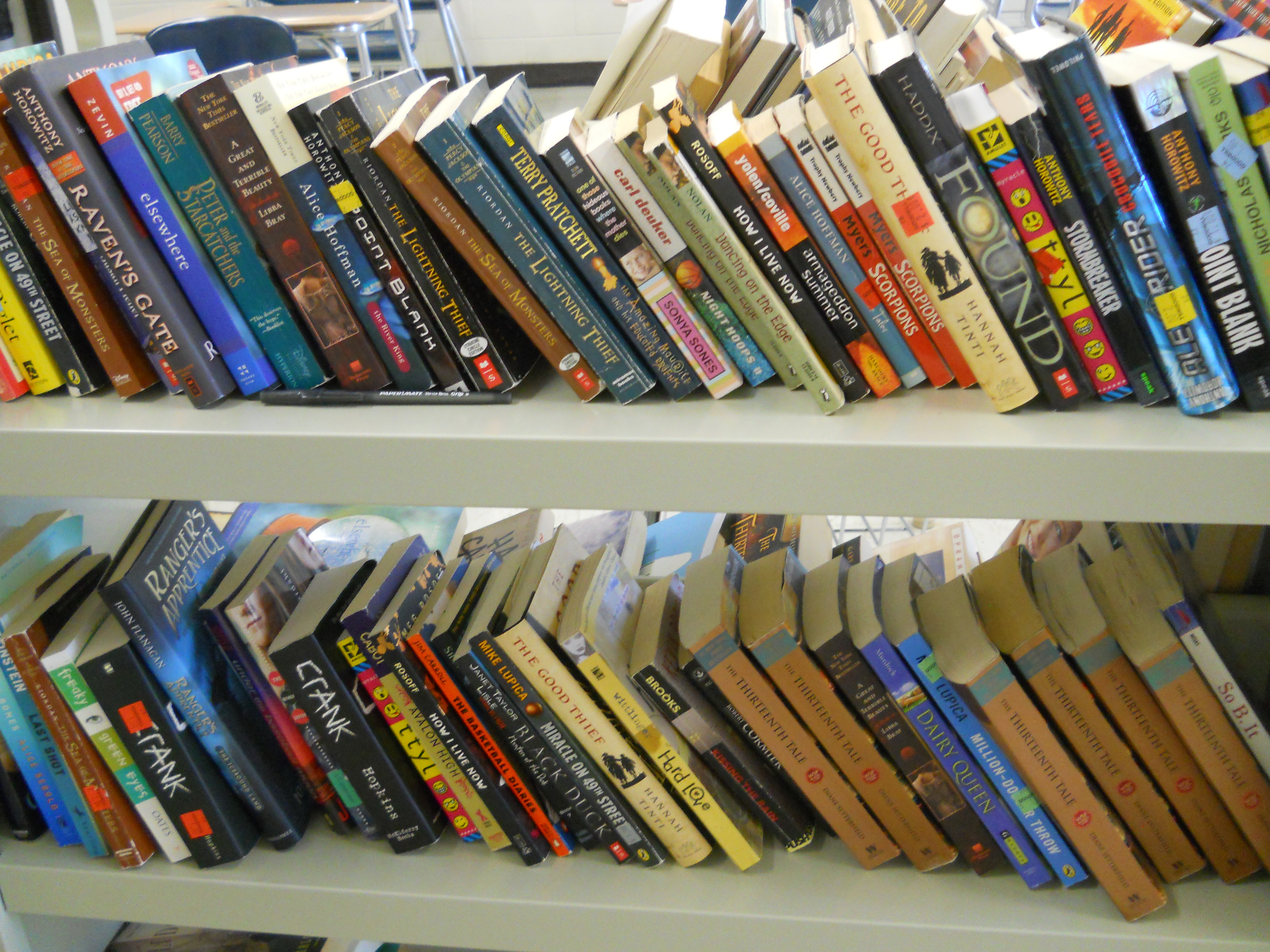
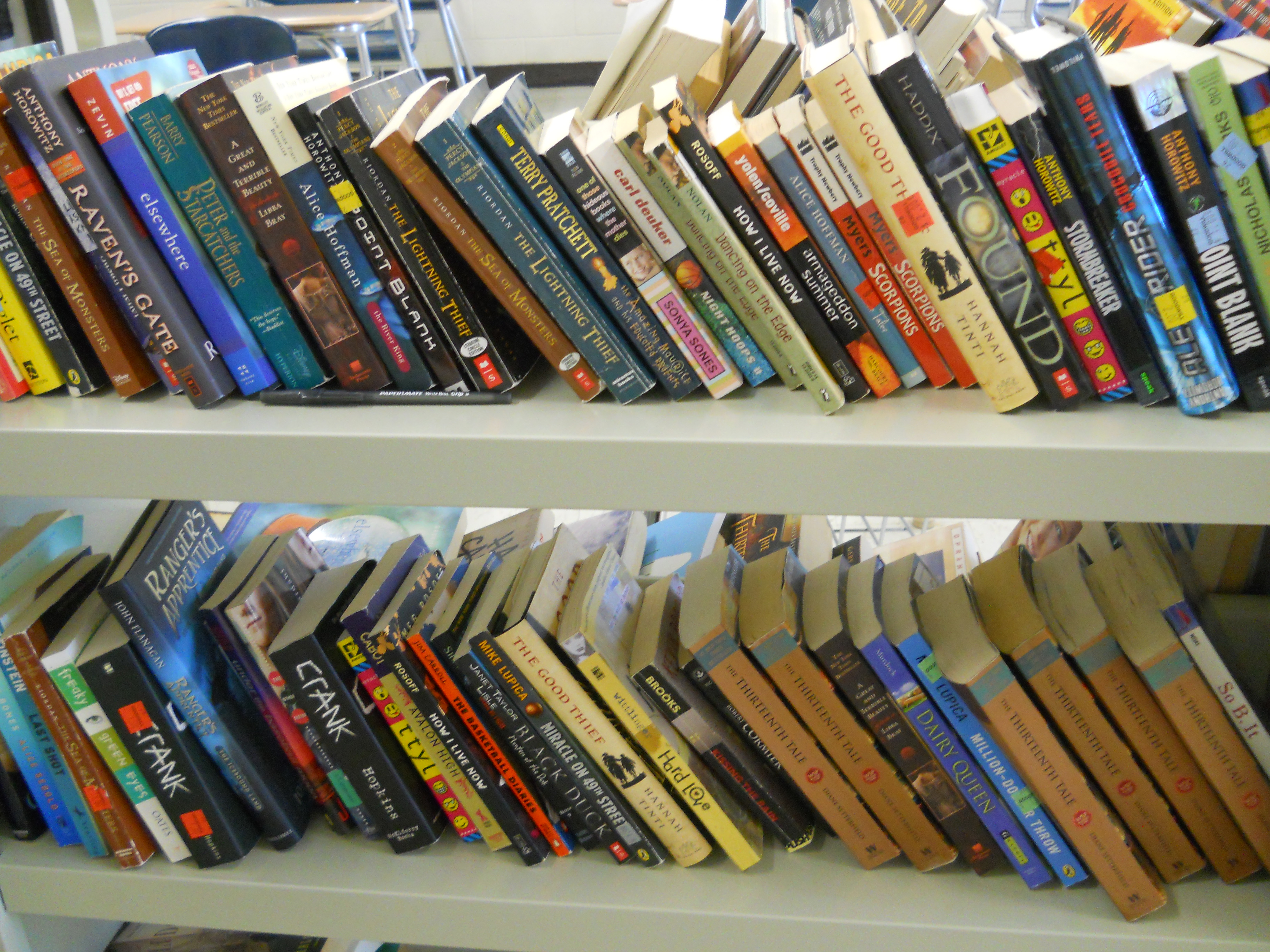
A classroom book cart in Grade 9 with high interest titles

Our 9th grade students are provided SSR time twice weekly (20-25 minutes/day) to read for pleasure. They may choose what they want to read. Often, a student will arrive in class without materials or, having just completed a book, looking for a recommendation. Our classroom libraries (book carts) are filled with high interest used books purchased for exactly this moment, and our school library is now connected to Overdrive which allows students to check out an ebook on a mobile device. This ability to capitalize on this moment of student’s interest with reading materials is critical to a successful reading program. The hope is that this will lead to continued reading for pleasure outside the classroom.

Krashen’s review of the data is depressing; I would have expected that given the amount of attention given to increasing teen reading for pleasure that there should have been a steady increase in reading habits from generation to generation.He cautions that negative attention given to this topic, including “dissing high school students”, is not the way to increase reading for pleasure. Teenagers by nature, regardless of their generation, should come to reading for pleasure through availability AND  choice. Just ask your mom, or grandma, can we do better?

Honestly? I am not surprised about the recent drop in the verbal SAT scores. At least once a day, I will hear a student grouse,”I hate to read.” I hear students whine about the length of books. I have students ask in class, “Are Spark Notes available for this book?” Too many students skim the first and last pages to feign understanding. Too many students admit they have not finished a book they started. Too many students prefer to watch the movie than read the book.
Teachers in my English Department are not surprised when we get the results of reading check quizzes. Sadly, we have come to realize that student would rather fail a quiz then spend time reading to prepare themselves.

Why?

Well, reading is a sedentary and solitary activity. Reading demands attention. Reading contends with the demands for student time in and out of school including sports, school club activities, employment. Reading requires uninterrupted blocks of time.

Technology now complicates how reading is accomplished. Students can be engaged in reading through any one of a multitude of digital devices. These platforms, however, are not exclusively reading platforms. A book needs time to “hook” a reader; a device can interrupt that introductory period.  A student can simply click over to another stream of graphics and information should there be a hiccup in reading attentiveness.

In short, with all the demands and digital distractions, many students are experts at gathering information, but simply have not practiced reading.

According the the Washington Post article, What the Decline in SAT Scores Really Means by Valerie Strauss, “Newly released SAT scores [2011] show that scores in reading, writing and even math are down over last year and have been declining for years. And critical reading scores are the lowest in 40 years.” the total drop in critical reading was three points. Even more alarming was the statistic that, “critical reading scores in 1972 were 530; today they are 514.”

So, how do teachers combat this trend? What steps can teachers implement to try to correct the falling scores and move them in the opposite direction? Since teachers cannot control those factors outside our classrooms, I suggest teachers control reading in our classrooms. Against the cacophony of today’s hyper-connected world, teachers must carve out class time for quiet reading. Teachers, especially language arts teachers, must also allow for student choice.

Quiet time in the classroom may be the only time a student can read without distractions, and teacher supervision can contribute to creating this atmosphere.  Quiet time in the classroom can provide an opportunity for a book to capture a student’s interest, for a author’s voice to take hold of the imagination. Even short periods of time, 10-20 minutes a day twice a week, will yield roughly 15-30 hours of quiet reading time during school year. More time means more practice, and there is a well-established correlation of reading time with high standardized tests scores.  Equally important is allowing students to have the authentic experience of choosing  what they read.

As early as 1988, a seminal study titled Growth in Reading and How Children Spend Their Time Outside of School published in the Reading Research Quarterly followed the the academic success of  5th grade students who read voluntarily (Anderson, R., Fielding, L., & Wilson, P.). The study noted that “It was also discovered through these same interviews that students who were in schools where they were given opportunities to read self-selected materials and were given access to materials that they were personally interested in reading were more likely to engage in voluntary reading than those in classrooms where these practices were not evident.” A follow-up article to this study by Linda G. Fielding and P. David Peterson offered a layman’s argument for voluntary reading in the article Reading Comprehension: What Works (Fielding_Pearson_1994). The 1988 study and follow up in 1994 made the argument that the critical time to create voluntary readers was in grades 5 and 6. However, with the trend of decreasing reading scores, all grades should adopt the recommendations of the study.

So, while teachers may not be surprised in the drop in the SAT reading score, they may be surprised to find out that the solution was outlined in the research published 23 years ago. That solution is to give students the chance to read in class, the chance to choose a book to read. To practice reading is critical to the practice of teaching.

This first day of October in Connecticut was not emblematic of classic cool crisp fall days. Instead, a blanket of humidity hung over the rain-soaked state which received another several inches the night before the Saturday book sales in Brookfield and Washington.  Separated by 17 miles but sharing the same weather, the make-up of the two sales could not have been more different.

Brookfield Library

I arrived several minutes early to the Brookfield Public Library and found volunteers poking a rain-saturated tent that was bowed holding several gallons of water and looming precariously over a table. Fortunately, the bulk of the sale was held indoors in the community room.  Tables were filled with books; boxes were stacked below. This year residents donated generously and as a former resident myself, I was also familiar with many of the volunteers who year after year tirelessly support the library. They were very helpful with other patrons, (“Jodi Picoult books? Oh, we have as many as you want…take them, take them all, please!”). They restacked tables and manned the checkout tables very efficiently. Some titles were misplaced (non-fiction slipped into the fiction section and vice versa) which meant that a careful perusing of the titles was necessary.  However, this strategy could also be a clever sales ploy, so I spent time and examined books on every table on the off chance there would be a misplaced book that I could use. Such diligence paid off because I found copies of Bill Bryson’s A Walk in the Woods on five separate tables.

Five additional copies brings the classroom library total to 75 copies for the English II classes

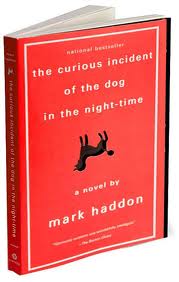
Bargains at this sale included five copies of Mark Haddon’s The Curious Incident of the Dog in the Night-Time, four copies of Alice Walker’s The Color Purple, and two copies of Toni Morrison’s The Bluest Eye. There were also multiple copies of Mark Salzman’s Lost in Place from a town-wide read several years ago. I also turned up a boxful of copies of Khaled Hossani’s The Kite Runner but left them for others; we already have a class set!  The presence of multiple copies means, of course, that Brookfield has many book groups (I am speaking from personal experience). Only book clubs can explain the multiple copies of titles such as Elizabeth Strout’s Olive Kitterage, and Sue Monk Kidd’s The Secret Life of Bees. Other excellent finds in the young adult section included Nancy Farmer’s The House of the Scorpion, M.T. Anderson’s Feed, and Jarry Spinelli’s Stargirl. I filled two bags.

Washington, CT-Gunn Library

In contrast, the book sale at Washington’s Gunn Library was filled with singular copies of books. The basement of this deceptively large library was filled to capacity with books, which was surprising given the steady stream of people leaving with bags filled with books. Titles were displayed along the walls on well-marked shelves and on tables, and the variety of titles was impressive. There was an array of biographies, history, fiction, self-help and cookbooks, but duplicate copies of titles were almost impossible to find.  Performing arts literature was subdivided into music, art and dance on an overflowing table. Romance was relegated to two boxes under the fiction paperback table. A section of the sale at the entrance was dedicated to autographed copies of books. Rare books were provided a separate space. All of these genres contained singletons. Considering the number of solo copies, one wonders about the reading habits of the residents of Washington.  Is breadth of literature a community goal? Do they pass single copies from resident to resident rather than buy in bulk? Is this book sale a giant exchange site?

In any event, there were excellent new choices to add to the memoir class shelves including Ying Ma’s Chinese Girl in the Ghetto and Meredith Hall’s Without a Map: A Memoir. There were also new copies of Ishmael Beah’s A Long Way Gone, Anthony Swofford’s Jarhead and Michael Paterniti’s Driving Mr. Einstein. The young adult’s section included a copy of Suzanne Collins’s Gregor the Overlander. Needed titles located included Bobbie Anne Mason’s In Country, Arthur Miller’s Death of Salesman, Zora Neale Hurston’s Their Eyes Were Watching God  and Leslie Marmon Silko’s Ceremony. In addition, I located a a copy of Tim O’Brien’s Going after Cacciato and Cormac MacCarthy’s Cities of the Plain to add to English III independent reads. Volunteers at the sale were also efficient re-stacking the tables throughout the morning, while wisely choosing to keep their distance from the heavily trafficked children’s section.

The difference in titles available from each of these communities in the Northwest corner of Connecticut could not have been more different, but I spent the exact same amount at each (about $62.00)  for almost the exact same number of books. In total, I purchased 111 books for $123.50. It was the best of book sale days; it was the worst of weather starts for October.

The New Fairfield Public Library Book Sale  took place on a lovely fall day; a crisp and cool Connecticut beauty of a day. Unfortunately, the sale also took place in the same locale where the local highway department was painting the parking lot lines at the front of the building,  and where the soccer club practice with team coordinators were handing out team jerseys at the back of the building. The actual book sale was held in a meeting room and a small entry hallway. At 10:00 AM, shopping at the sale was challenging between finding a spot to park outside and negotiating cramped quarters inside.

There were, however, some bargains to be had. Browsing was a shared experience with several other buyers; I would remove a box piled with books to one section, while another person would replace that box with another. Crawling along the front hallway floor which held boxes of trade paperbacks, I was able to locate copies of Codetalkers by Joseph Bruchac and A Yellow Raft in Blue Water-Michael Dorris for the Contemporary Native American unit that is being taught this month in Grade 11. I was also able to add to our curriculum collection:

The Giver- Lois Lowery
Night-Elie Wiesel
The Great Gatsby-F. Scott Fitzgerald
Lord of the Flies-William Golding
Brave New World-Aldous Huxley
The Road-Cormac McCarthy
The Handmaid’s Tale- Margaret Atwood

An independent choice book for Grade 11.

The “score” of the morning was a new copy of Winter’s Bone by Daniel Woodrell.  This is the fourth copy I have found this summer, and the book will be placed in the “Coming of Age” unit in Grade 11 as an independent choice novel. The School Library Journal reviewed this book for high school students saying, “In the poverty-stricken hills of the Ozarks, Rees Dolly, 17, struggles daily to care for her two brothers and an ill mother. When she learns that her absent father, a meth addict, has put up the family home as bond, she embarks on a dangerous search to find him and bring him home for an upcoming court date. Her relatives, many of whom are in the business of cooking crank, thwart her at every turn, but her fight to save the family finally succeeds. Rees is by turns tough and tender. She teaches her brothers how to shoot a shotgun, and even box, the way her father had taught her. Her hope is that these boys would not be dead to wonder by age twelve, dulled to life, empty of kindness, boiling with mean.”  When I read the novel, images of the witches from Macbeth came to mind!

For the independent reading shelves, I also located a copy of Dairy Queen by Catherine Gilbert Murdock, Book Two The Ruins of Gorlan in The Ranger’s Apprentice Series by John Flanagan , After by Francine Prose, and Ape House by Sara Gruen (surprising since this is a recent release).

New Fairfield’s sale offered far more hardcover fiction texts than trade paperbacks, and the children’s picture books were overflowing the small table to which they had been assigned. This could be an indication of a shift in population to more elementary aged choices….the New Fairfield babies are growing up!

Once I brought my two baskets to the counter, the volunteers at the checkout were gracious and accommodating. They were prepared with bags for purchases, and at my request  one quickly designed a receipt for me. (“Last year, I had a pile of receipts, but no one need them, wouldn’t you know?”)

Hardcovers were $2.00, trade paperbacks were $1.00, and small paperbacks were $.50. Sunday was “Bag day”-all books in a bag for $10.00.  I purchased only trade and small paperback on this trip and spent $26.00 for 32 books. These will be added to the school’s “book flood“.

The volunteers picked a perfect weekend for people looking for book bargains. Perhaps next year there will be better coordination of traffic outside the library and inside the sale so the efforts of the Friends of the New Fairfield Public Library are fully supported.

Classrooms are several feet deep in a “book flood” at the Wamogo Middle and High School.

Junior classroom library created with used books

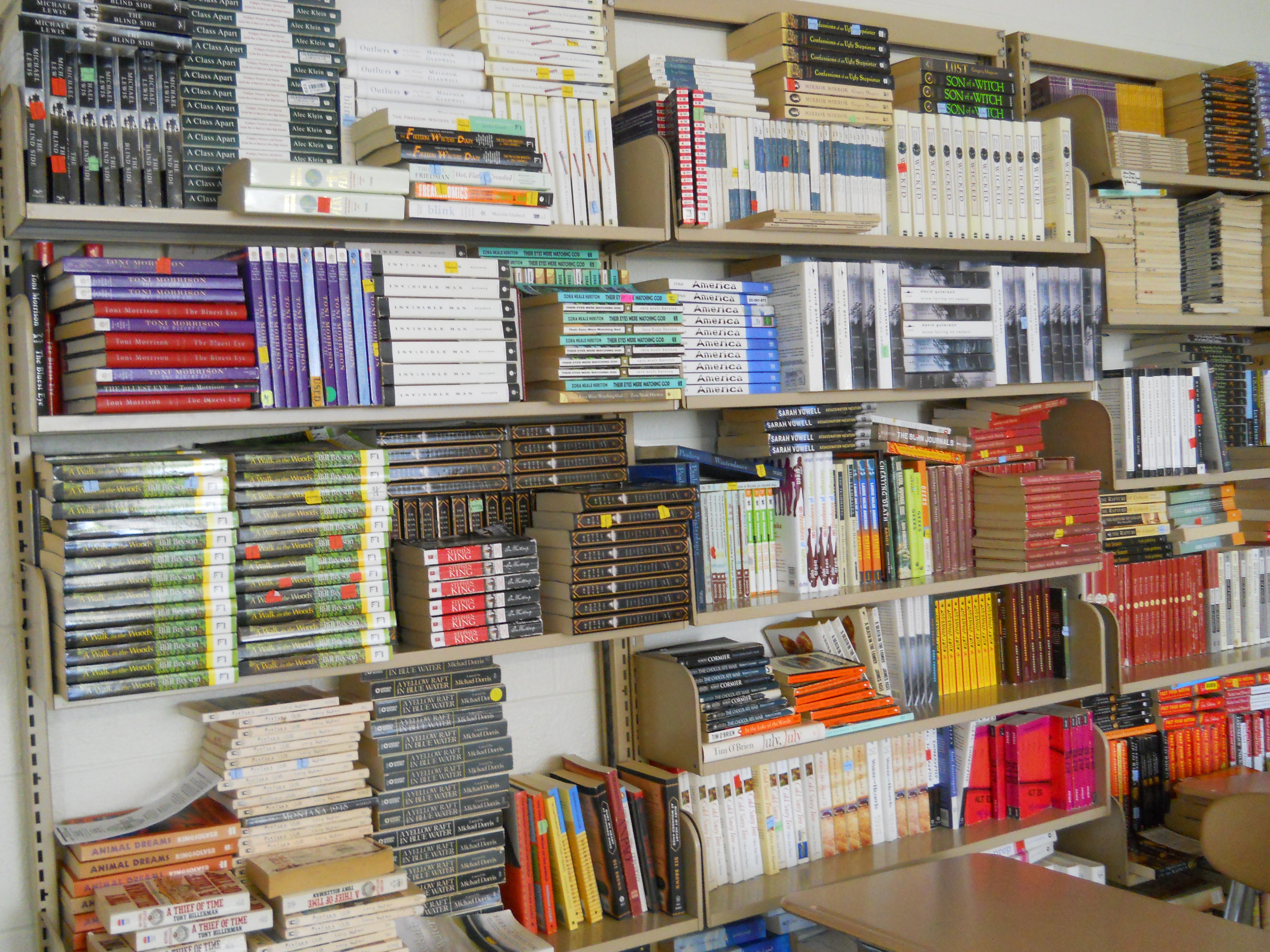
While there has been a torrent of late summer rains that have closed roads and delayed schools in the Northwest corner of Connecticut, our students are experiencing a deluge of an entirely different nature. Gently used books spill over in classroom bookcases; they slop on to counters and swamp several double-sided carts.

The term “book flood” is used by Kelly Gallagher in Readicide.  He states, “Let me be clear: if we are to have any chance of developing a reading habit in our students, they must be immersed in a K­12 ‘book flood’–a term coined by researcher Warwick Elley (1991)” (43). Book flood is a theory, recently tested in countries (Fiji, Sri Lanka, Singapore) where English is not part of the culture.  The theory is that students exposed to quantities of literature will learn English as a second language more effectively.

The abstract for The Potential of Book Floods for Raising Literacy Levels by Warwick B. Elley states that “the evidence is now strong that it is possible to double the rate of reading acquisition of Third World primary school pupils with a ‘Book Flood’ of about 100 high-interest books, per class, and short teacher training sessions. The benefits for reading skill and enthusiasm are consistent across diverse cultures, mother tongues and age levels, and they appear to generate corresponding improvements in children’s writing, listening comprehension, and related language skills. Such skills are typically found to develop very slowly under traditional textbook styles of teaching.”

Gallagher suggests that American educators do the same in their classrooms by asking, “Do students at your school have access to a wide range of interesting reading materials? Is providing access to interesting text a priority among your administration and faculty? Are students on your campus immersed in a book flood? Are we giving them every opportunity, via reading, to build vital knowledge capital?” (49).

Well, we are.

11th grade choices that accompany the Contemporary War unit with The Things They Carried

Over the course of one year (June 2010-2011), the Wamogo English Department had added 2,500 books previously used books to the classroom collections. Many of these books are familiar titles that are taught in grades 9-12 (EX: The Great Gatsby, Lord of the Flies, Animal Farm, Speak, The Glass Castle, A Lesson before Dying, The Bean Trees, To Kill a Mockingbird, The Handmaid’s Tale) or titles taught in  grades 7 & 8 (EX: Stargirl, Nothing but the Truth, The Giver, The Light in the Forest, The Outsiders, No More Dead Dogs).

Additionally, class sets of books (20 -30 copies) that were already purchased as new books were expanded with used copies for each student at grade level. For example, the 10th grade library started with 20 copies of The Kite Runner. After two years, there are now 116 copies for 10th graders, one for every student, plus all teachers and teachers’ aides. There are also 15 copies of A Thousand Splendid Suns for students who would like to read another novel by Khaled Hossani. Similarly, 20 copies of Mark Haddon’s The Curious Incident of the Dog in the Night-Time were purchased new in 2009. An additional 67 used copies have been added since; 13 more copies will make a grade level set of 100 copies.

Books offered to Advanced Placement English Literature students for independent reading

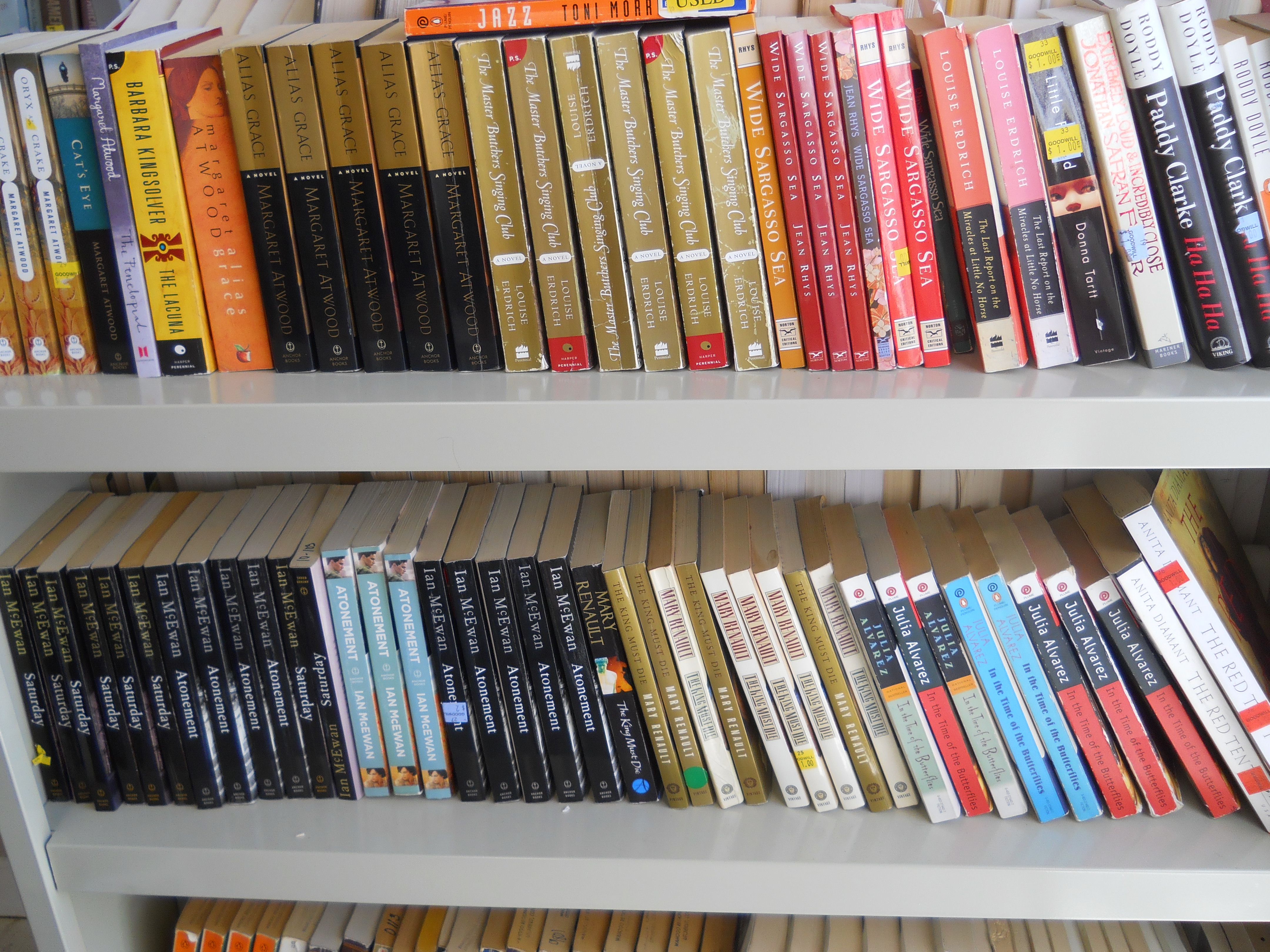
In order to offer independent choices for the Advanced Placement English Literature and English Language classes, newer titles have been added including multiple copies (4-30) of  The Plot Against America, Alias Grace, The Adventures of Kavalier and Clay, Middlesex, The Story of Edgar Sawtelle, The Poisonwood Bible, In Cold Blood, Love in the Time of Cholera, Paddy Clarke Ha-Ha,  Dinner at the Homesick Restaurant, The Elegance of the Hedgehog, Cold Mountain, Ironweed, The Wide Sargasso Sea, Gertrude and Claudius, Atonement, The Hours, and The Memory Keeper’s Daughter.

There are thematically connected texts for 10th grade World Literature such as a unit centered on adolescents growing up in conflict. These books include A Long Way Gone, The Power of One, What is the What, and First They Killed My Father. Students can choose to read one of these titles in literature circles. There are also thematically connected texts for non-fiction (A Walk in the Woods, Into the Wild, The Perfect Storm, Touching the Void, The Hungry Ocean, Between a Rock and a Hard Place) and fiction  (The Bluest Eye, Their Eyes Were Watching God, The Color Purple, Invisible Man, The Known World, Monster, Precious, Native Son) for students in English III American literature to read independently or in groups.

10th grade "choice" books for Adolescents in Conflict unit

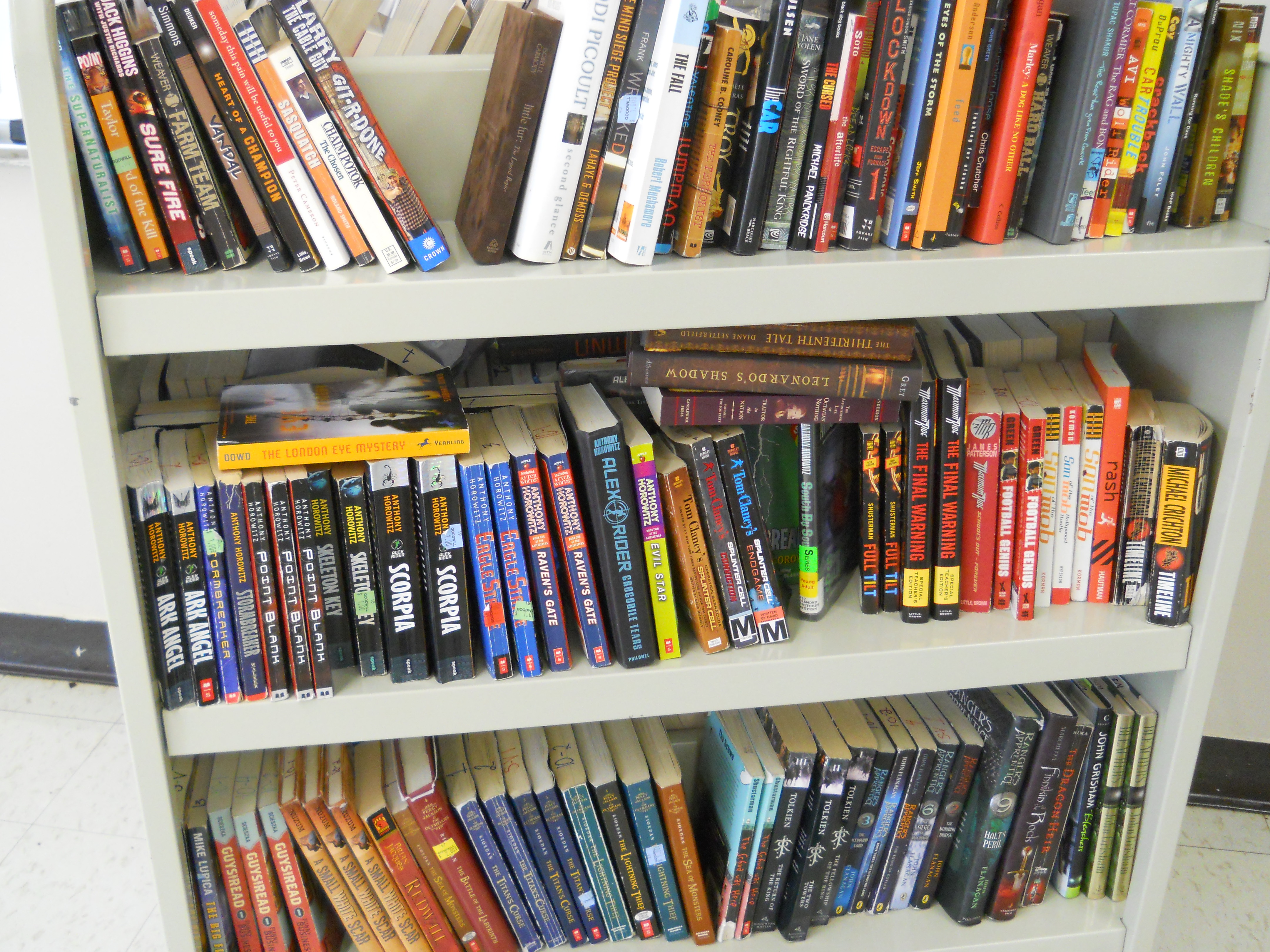
But, it is in the area of providing book choice for independent reading that the largest gains have been made in the classroom collections. There are book series (Percy Jackson and the Olympians, The Ranger’s Apprentice, Maximum Ride) available for 9th students to choose during Silent Sustained Reading (SSR) sessions. There are many different titles from popular teen authors: Meg Cabot, Anthony Horowitz, Jodi Picoult, Sarah Dessen and Scott Westerfield.

There are several (5-10) copies of books such as The Lovely Bones, Dairy Queen, So Be It, Where the Heart Is, and The Thirteenth Tale. There are pairs of books such as The Chosen, The Good Thief, Bad Kitty, Shadow of the Wind, Sleeping Freshmen Don’t Lie, Prom, and Life As We Knew It. There are single copies of The London Eye Mystery, The Off Season, The Compound, The Maze Runner, Black Duck, and Copper Sun.

Independent reading texts for SSR Grade 9

More Independent SSR choices for Grade 9

At the conclusion of the summer of 2011, after trips to thrift stores and public library book sales throughout Connecticut, another 1,700 copies of books have been added to our shelves at a cost of  approximately $2,300.00.

The “book flood” straining the banks of Wamogo’s classroom shelves is, as Gallagher suggests, wide-ranging; it is a flood saturated with interesting material to read. Our students are now inundated with titles; our teachers have an overflow of suggestions. We have created the one flood in which I could happily watch students drown.

Many literacy experts recommend that the first step in designing a reading program is seek information on the reading habits of students or to survey the students. So, on Day 2 of school, 76 freshmen at Wamogo High School in Connecticut took a survey, 16 questions (taken from Kelly Gallagher’s Readicide) prepared on Google Docs, titled, “How I Feel about Reading”. Their responses to the survey were candid and may, in fact, represent the reading habits of high school  students in the class of 2016 in general.

The first question was encouraging. 2/3 of the students responded positively to the question “I think reading is fun” by checking off “usually” or “sometimes”. However, this statistic means that 33% said they “rarely” thought reading is fun. Hopefully, providing choice and support with Silent Sustained Reading (SSR) will improve attitudes towards reading.

64% do understand the importance of reading when asked if  “being a good reader is important for success in school”; 34% indicated “sometimes” while only 2% were in the negative. In responding to this question, the students included the following interesting observations.

  • “I think reading is worthwhile because there are so many types of books in the world. Whether they are feeding you information or keeping you entertained books are definitely worthwhile!”
  • “It’s fun to read a good book. you totally get sucked into the book and you don’t even realize your reading. Reading is important because usually, jobs require you know how to read. and some jobs require that you read a lot. reading also strengthens grammar, spelling, writing, reading, and even the way you talk.”

The best response was to this question was, “It’s [reading] like a movie in your head, and I think that it is great to be able to imagine what the setting looks like, along with other things like the characters. It’s like the perfect world that you wish you where in. Sometimes I even think of myself as the main character, and it’s just amazing what you feel when you get into a book.” Such enthusiasm, however, was countered with the practical statement, “It [reading]  makes you sleep.”

While  71% felt strongly that “being a good reader is important for success in life,” and 24% chose  “sometimes”,  the number of those in the negative unexpectedly rose to 5%.

Students were also asked in the survey as to how they choose a book. Their advice centered on the length of books, covers, and topics:

  • “When I want to find a good book, I always check the back of the book where there is a short summary of it to see if it interests me. I also look to see who the author is and if I have read anything by them yet. Sometimes I ask my friends if they had read it and if they have a recommendation about it. And last but not least I check the pages on the middle and see if I am ok with the work type, and if I understand everything.”
  • “I like books about people who have gone through tragedies and are just moving on from it. I also like the books that have a little romance in it, and if they take place during the summer.”
  • “When is time for me to read a good book, I know that I don’t want to stop reading because it’s very good book.Sometimes when its not good book it takes me more time then anything. But I love books that are very interesting.”
  • “When I want to find a good book, I look at the length or the cover… sometimes I will go to a page and turn to it and see if it makes sense… and if the cover looks good.”
  • “Find a small book, (like 200 pages) and it has to be the right topic.”
  • “Go to the library and look for what I like in a good book. I usually look at the cover, the title, and the paraphrase on the back.”

Students also recommended books. Titles that received multiple votes (4 or more recommendations) included:

Hatchet
The Hunger Games
S0 Be It
Sleeping Freshmen Never Lie
Compound
The Maze Runner
The Rangers Apprentice series
Percy Jackson and the Olympians series (any title)

Copies of all of the above titles have been added to the 9th grade classroom library through used book sales, especially copies of books in the Percy Jackson and the Olympians series. These books, and several hundred others, are on (2) portable carts in the classroom ready for SSR periods.

Sadly, the most depressing statistic came from the results of the question, “I read every day and look forward to my reading time”. Here, only 9% of 9th grade students replied “usually” in contrast to the 91% of student who responded “sometimes” or “rarely”.

The goal is to change that particular statistic this year!

The impending arrival of Hurricane Irene made many of the good people of Fairfield County a little insane. I have watched Connecticut, the “land of steady habits”, develop a paranoid streak since the advent of 24/7 weather coverage. Media hyped hysteria ensues whenever a storm-summer or winter- approaches. So, there was no surprise in witnessing gridlock for the gas stations and deteriorating conditions in grocery aisles this weekend.

Instead of confronting the hysteria, I traveled to the Friends of the Bethel Public Library’s annual summer sale (August 27-29, 2011) where I found calm and order among the patrons quietly shopping for books, videos, records, DVDs and other media.

This sale was held in a large room in the municipal center across the street from the Bethel Public Library. I know the room as the “GP” room (general purpose) since I attended grades 7 & 8 in this building; I even performed on the stage which housed the young adult collection of books for sale!

The books were organized on tables by genres, and there were signs on each table that indicated genre. There were very few “misplaced” books; obviously the organizers know their titles.  The fiction tables were a mix of hardcover and trade copies, and they were not in any particular order. I was an early attendee of the sale, and there were several boxes of fiction trade books under the tables. I imagine the volunteers planned on filling in the tables with these books as the sale went on, and there were many volunteers already busy at work. These volunteers demonstrated a remarkable resistance to apocalyptic predictions of  weathermen; one even was quite confident that the sale would go on as scheduled on Sunday despite the predictions of tropical storm winds and steady rain.

Books for the Wamogo classroom libraries from the Bethel Library Book Sale

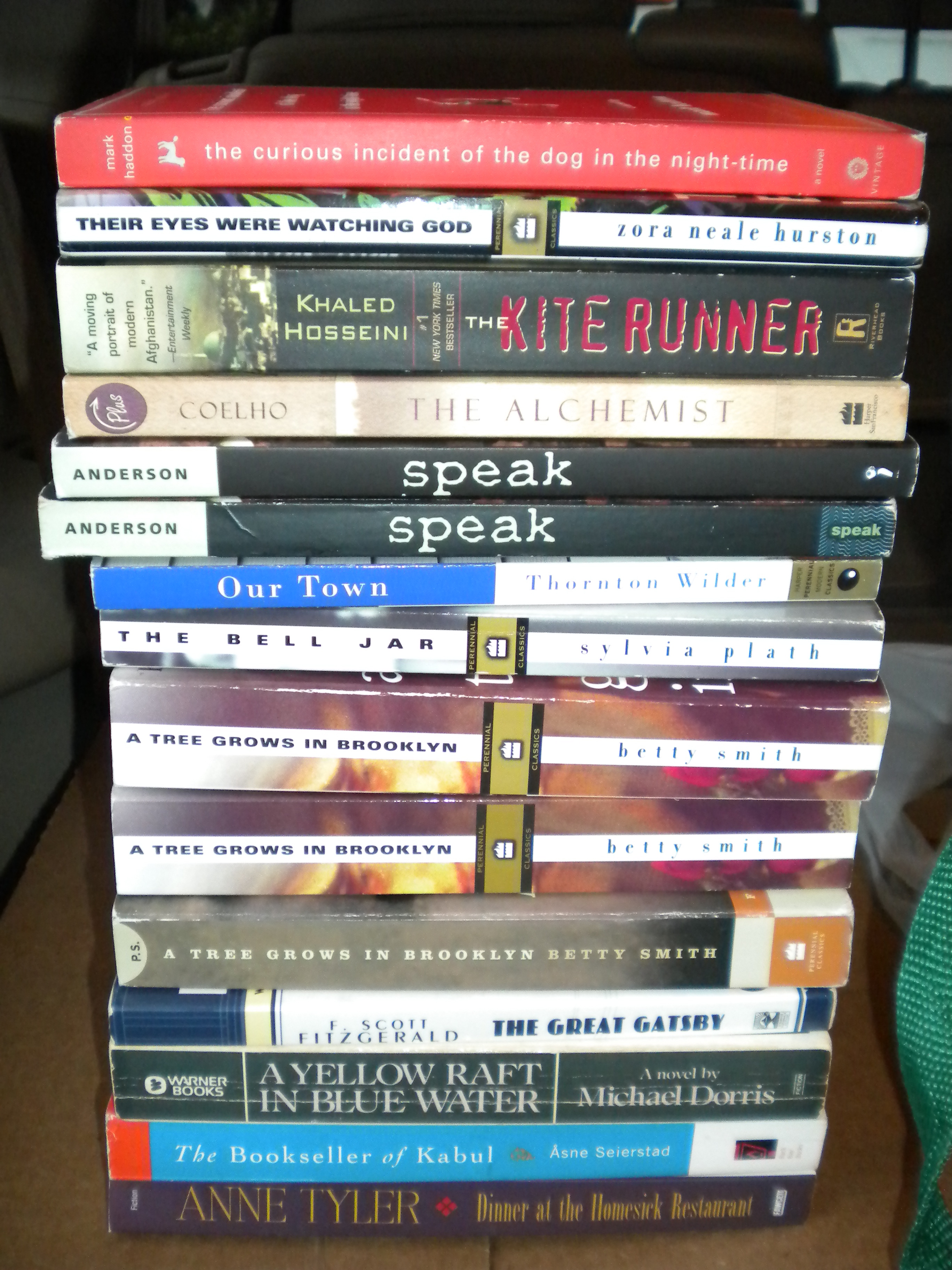
There were many good books at the sale that I can add to the classroom libraries. There were three new copies of A Tree Grows in Brooklyn by Betty Smith, a copy of Yellow Raft in Blue Water by Michael Dorris, and a copy of Anne Tyler’s Dinner at the Homesick Restaurant for independent reading by juniors. There were also copies of books that we teach including:

Speak by Laurie Halse Anderson
The Kite Runner by Khaled Houssani
The Curious Incident of the Dog in the Night-Time by Mark Haddon
The Great Gatsby by F. Scott Fitzgerald
Our Town by Thornton Wilder

There were also five copies of classic story The Light in the Forest by Conrad Richter which we use in our Native American unit in Grade 8. The coming of age story was published in 1953, and combines historical places and incidents centered in Northeastern Ohio in the 1750s. The book has been in continued use in middle school curriculum largely due to Richter’s ability to  portray the consequences of hostilities between the Native Americans and early European settlers of the American Midwest.

In little under 30 minutes, I picked up 72 books for $105.00; prices ranged from .50 -$2.00. The retail price at Amazon for the 15 books in the picture above would have been $158.38. My cost for these 15 books PLUS  57 other books was $105.00.

Community book sales provide an opportunity for a buyer to do a little cultural study on the reading habits of its residents. Obviously, Bethel residents enjoy fiction and the number of cookbooks was greater than the number of military history books. However, the biggest surprise was the number of tables dedicated to the genre of romance novels. I grew up in Bethel (on Grand Street from 1972-1980), and I would never have suspected that the town has developed such “passionate” interests!

I received a postcard to remind me of the upcoming sale, but I had already planned to attend since the sale was also listed on BookSaleFinder.com . Even Hurricane Irene could not stop the calm and dedicated volunteers of the Friends of the Bethel Public Library from succeeding in putting on a great sale with donated books.

Two years ago, the senior English classes at Wamogo High School were reorganized to provide student choice in electives. One of the choices offered is Memoir, a class where students read two or three assigned memoirs and create their own memoirs in response to prompts-ex: “My Favorite Food Memory” or “That’s Me in the Photo”. Students are also required to read memoirs independently. Because of the used book market, we are able to offer a wide selection of memoirs and allow for student choice.

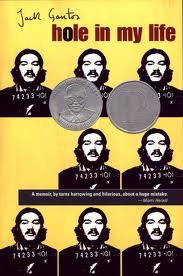
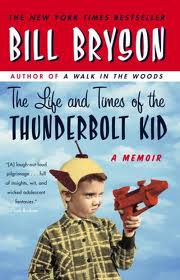
The department had previously purchased a class set  (20-30 copies) of A Hole in My Life by Jack Gantos, Angela’s Ashes by Frank McCourt, The Glass Castle by Jeanette Walls, and The Life and Times of the Thunderbolt Kid by Bill Bryson. These memoirs have been assigned as the course texts over the past two years. I have added at least 10 additional copies of each of these titles through the secondary market.

I have also purchased a minimum of 4 to 20 copies of the following books in the secondary market to offer students to read independently:

Lucky by Alice Sebold
Running with Scissors by Augusten Burroughs
Lost in Place by Mark Salzman
Iron and Silk by Mark Salzman
A Girl Named Zippy by Haven Kimmel
A Million Little Pieces by James Frey
Ambulance Girl: How I Saved Myself By Becoming an EMT by Jane Stern
Beautiful Boy: A Father’s Journey Through His Son’s Addiction by David Sheff
West with the Night by Beryl Markham
This Boy’s Life: A Memoir by Tobias Wolff
A Heartbreaking Work of Staggering Genius by Dave Eggers
The Liar’s Club by Mary Karr
Heat: An Amateur’s Adventures as Kitchen Slave, Line Cook, Pasta-Maker, and Apprentice to a Dante-Quoting Butcher in Tuscany  by Bill Buford
All over but the Shoutin’ by Rick Bragg
The Tender Bar: A Memoir by J. R. Moehringer
A Child Called “It”: One Child’s Courage to Survive by Dave J. Pelzer
Don’t Let’s Go to the Dogs Tonight: An African Childhood by Alexandra Fuller
Merle’s Door: Lessons from a Freethinking Dog by Ted Kerasote
Marley & Me  by John Grogan
Hypocrite in a Pouffy White Dress
by Susan Jane Gilman
The Road to Coorain by Jill Ker Conway
Waiting For Snow in Havana by Carlos Eire
It’s Not about the Bike: My Journey Back to Life by Lance Armstrong

If the average cost of each of the above books is around $12.00 (trade copy), four new copies of each of the 23 titles above would have cost $1,104.00. In contrast, by purchasing four of the 23 titles above for $1.00, our total cost is $92.00. That marks a savings of $1012.00. Furthermore, students have the opportunity to try out texts that might interest them at little expense to the department.

I have started to collect other titles that are starting to find their way onto used book tables:
Lit by Mary Karr
Infidel by Ayaan Hirsi Ali
Look Me in the Eye: My Life with Asperger’s by John Elder Robison
Escape by Carolyn Jessop and Laura Palmer
The Other Wes Moore: One Name, Two Fates by Wes Moore
Autobiography of a Face by Lucy Grealy and Ann Patchett

Investment so far on these six titles? $11.00 total.

12th graders are particularly interested in authors that discuss life-changing decisions since they themselves are in the process of making many life-changing decisions. Many of my students are already adults (18 years or older), so I am comfortable providing memoirs that would not be recommended for younger students. The variety of personal experience offered in memoirs informs students about the real world; for some students, authentic voices are more credible than standard high school fiction selections.

One statement from the article by Alan Jacobs titled “We Can’t Teach Students to Love Reading” published in The Chronicle of Higher Education on July 31, 2011, grabbed my attention: “No novel or play or long poem will offer its full rewards to someone who consumes it in small chunks and crumbs. The attention it demands is the deep kind.”

I wonder if the authors of novels, plays, or long poems write with the intent of the reader receiving “full rewards”? What does “full rewards” mean anyway? I assume from the publication The Chronicle of Higher Education that Jacobs is talking about literature of the canon usually taught in at the college or college-prep level. At these levels, does “full rewards” mean the analysis, deconstruction and/or the synthesis of literature? Is the examination of his or her literature the goal of an author? I believe Jacobs cannot qualify what he means by “full rewards” because that quality cannot be standardized. I am also not convinced authors are seeking readers who read for “full rewards”. I think authors are seeking readers-all readers-any readers. Authors write for an audience.

There are audiences of middle and high school students who are required to read novels, plays, and long poems. The length and complexity of many of these works (ex: Catcher in the Rye, The Giver, Huckleberry Finn, All Quiet on the Western Front, Great Expectations, Of Mice and Men, The Scarlet Letter, The Odyssey, Death of a Salesman) in a curriculum means that units dedicated to a text can go for several weeks as teachers try to develop the kind of deep attention in their students for the “full rewards” that Jacob admires. For example, Shakespeare’s Macbeth takes a minimum of four weeks to teach. Consequently, by the end of the unit, everyone wants to kill Macbeth: characters, students and teacher alike. Yet, in those four weeks of intense study, students still will have not received the “full rewards” of the play according to Jacobs; they will have only grazed the surface of the tragedy in the “small chunks and crumbs” afforded by the school day calendar. Honestly, Shakespeare must roll in his grave over the plodding of innumerable classes trudging endlessly “To-morrow, and to-morrow, and to-morrow, Creeps in this petty pace from day to day…”. Was “full rewards” Shakespeare’s intent?

The goal of education should be to develop reading skills so that students should read successfully. Once students read successfully, measured by understanding the author’s message and appreciating the author’s style, then students may choose to read what they like, perhaps even what they love.

Teachers, myself included, tend to “over-teach” literature. Kelly Gallagher discusses the “over-teaching” of texts in his book Readicide, and poses the following question, “When you curl up with a book, do you do so with the idea of state mandated multiple choice tests? Do you pause at the end of every chapter so you can spend an hour answering a worksheet with mind-numbing answers?” He continues that adult readers would “never buy a book at Barnes and Noble if it came with mandated chapter by chapter exams….And we [adults] would never feel compelled to read if we [adults] had to complete a project after every book.” Gallagher maintains that these are the practices that are killing the love of reading; so, it is no wonder Jacobs can make the statement that the love of reading has been the pursuit of a limited number of adults.

I will concede that Jacobs does have a point, the “deep attention” that leads to his meaning of “full rewards” may be impossible to implement in a typical middle school/high school setting, but I would also venture that authors are not as concerned with “full rewards” as they are with communicating a message to an audience. By week two of Macbeth, most, if not all, students recognize that Macbeth has brought about his own tragic fall, that his wife is riddled with guilt, and the kingdom they have usurped cannot last. Shakespeare’s enduring legacy is his ability to communicate to a universal audience; “full rewards” may not necessary for students to appreciate the play, although “full rewards” could be an individual pursuit of a student who makes that choice.

Alan Jacobs’ theory of wringing the “full rewards” from a text is the reason middle school and high school students cannot be taught to love reading. Such teaching is fragmented and frustratingly slow for the teacher and student in school. Jacobs also recognizes that the love of reading has always been built on the choice of the reader; he discusses his own progress as an adult to develop his deep attention to reading. In contrast, Kelly Gallagher offers strategies to limit “over-teaching” and provide student choice earlier at the middle and high school level that may allow students to develop a love of reading on their own much earlier rather than later to develop “deep attention” to reading as adults. Love of reading should not be an out-of-school experience.

In my inbox this past week was an article by Alan Jacobs titled “We Can’t Teach Students to Love Reading” published July 31, 2011, in The Chronicle of Higher Education. The title grabbed my attention; I rankled seeing the combination of “We Can’t Teach” with the word “Reading.” I have been reflecting on his argument and on one statement in particular:  “No novel or play or long poem will offer its full rewards to someone who consumes it in small chunks and crumbs. The attention it demands is the deep kind.”
But first, let me address the title.
The “We” in the title could  mean many different stakeholders: parents, teachers, administrators, education policy makers, academics. For the purposes of this response, however, I will generalize “We” to mean the teachers in the classrooms; those “boots on the ground” educators.
We can’t teach students to love reading does not mean that we cannot teach students to read, or to read better, or to appreciate what they read. I would argue that no one can teach anyone to love something or someone; love is a choice of the heart or the mind.
But that is not Jacob’s argument. He argues that there have always been people who read deeply as opposed to the shallow readers or grazers of information. He suggests that literacy today is not altogether different than the practice of literacy from the Middle Ages through the 20th Century. There have always been few readers in the past who engaged in long and focused reading, states Jacobs,  “Serious ‘deep attention’ reading has always been and will always be a minority pursuit.”
As a high school English teacher, I confront readers and non-readers every day in the classroom. Most students do not read with “serious deep attention.” I also appreciate how difficult deep reading is for my students given the hyperactive environments of school and the hyper-connected environments after school: digital devices are distracting; sports are demanding; jobs may be necessary. However, reading is the skill that is paramount in education.
So, I believe schools must carve out time for reading. I believe that teachers and administrators need to set aside time for reading in all disciplines. I believe adjustments must be made to schedules in order to provide quiet time for students to read, and for teachers to demonstrate how one can read deeply in such environments. Once students have developed the skills to read and acquired a positive attitude towards reading through practice, they may choose to read out-of-school. They may read for fun.
The National Assessment of Educational Progress (NAEP) found that “students who read for fun almost every day outside of school scored higher on NAEP assessment of reading achievement than children who read for fun only once or twice a month,” and much higher than students who did not read for fun at all.
I also believe that teachers should offer student choice in reading as suggested in Kelley Gallagher’s Readicide (a philosophy which is the driving force behind this blog) at every opportunity.  We should allow for student choice in reading coupled with reading for fun, as Gallagher says, “not for analyzing the author’s tone…not for the multiple choice question. Reading for fun.”
At the middle school and high school levels, we can offer students a choice of contemporary coming of age novels when they are assigned JD Salinger’s Catcher in the Rye. We can offer students a chance to read real life adventures when they are assigned Homer’s The Odyssey. Or, we can simply let students pick a book they want to read. These combination of factors can help improve student reading.
Jacobs himself admits he has “retrained his brain” and recovered his ability to read deeply through the technology of the e-book; he speculates that students who have, “never seriously read for information or for understanding, or even for delight—can learn how.” Yet, we owe our students the opportunity to develop a desire to read for fun beyond the school day, since Jacobs notes that, “Slow and patient reading…. properly belongs to our leisure hours.”
There are many factors which lead Jacobs to his conclusion, “All this is to say that the idea that many teachers hold today, that one of the purposes of education is to teach students to love reading—or at least to appreciate and enjoy whole books—is largely alien to the history of education.” While Jacobs may be correct about teachers and education’s historical role in contributing to the love of reading, there are teachers today who are promoting choice, providing time, and welcoming new technologies in improving student reading. Perhaps their response to Jacobs could be in an article titled, “We Can Make Students Better Readers Who Have Developed ‘Deep Attention’ By Offering Time and Choice.” Deep reading should not be a minority pursuit.