
Archives For November 30, 1999

Book Choice Questions

March 1, 2014 — 1 Comment

book loveIndependent reading in our school grades 7-12 means students read books of their own choosing, make recommendations, and keep records of what they read. Recently, however, one of the English teachers in my department suffered a concussion and while the substitutes delivered the curriculum (John Steinbeck’s Of Mice and Men and Laurie Halse Anderson’s Speak), student independent reading had fallen out of regular practice.

Our latest substitute (Natalie) is an enthusiastic graduate of our high school school who has a BS degree in Creative Writing. She has been serious in tackling her lack of experience in the classroom through her best characteristic…she asks questions. She asks a lot of questions.

One of the latest questions she asked was about independent reading. When I expressed my concerns about having the practice reestablished, she seemed doubtful. I suggested that she have students use books they read independently to make connections with the most recent whole class novels.

“You can ask them if they can make a generic ‘coming of age’ connection between Speak and a book of their choosing,” I suggested.

“But what if they choose a book that doesn’t have that connection? What if they choose a book that is too young for them?” she continued, “or a book that they already read? How do I know what they should be reading?”

I recognized her questions; I had those same questions myself several years ago.

So, I sat her down and showed her the following Penny Kittle video that is available through Heinemann Publishers on YouTube under the title “Why Students Don’t Read What is Assigned in Class”:

She had the same reaction I did when I first saw that video.

“Wow,” she said, “I get it. They should read what they want.”

Question answered.

My department is just noticing the benefits after a few years of implementing book choice. We are lucky to have an 80 minute block schedule with the luxury of offering 15-30 minutes a class for Silent Sustained Reading (SSR) independent choice books. We have large classroom libraries with high interest titles and a wonderful school library (with Overdrive e-books available)  to offer students choice in what they read. When we tell students to pull out their SSR book, they are prepared and settle in to read.

Some classes suggest that a book be in a particular genre. Our English IV-Memoir class reads memoirs or biographies. The English II class is based on World Literature, and students read at least one book during the year by an author who is not American. The critical requirement is that each student chooses a book. There is no leveled reading; students can choose a book below their reading ability or they can attempt a book above their lexile level. They learn what to choose to read because they have control of what they want to read.

Penny Kittle, an English teacher and literacy coach at Kennett High School in North Conway, New Hampshire, wrote a guide to helping students read independently titled Book Love. In this text, Kittle offers strategies to help teachers increase the volume of what students read and to deepen student thinking about what they read.

One of the strategies several of our teachers use is to have students respond to reading through the software Shelfairi (Amazon) where they record what they are reading and make connections to other books. I can organize each class in virtual groups and pose general questions for responses. These short responses prepare me for conferences or allow me to respond directly on the software with links or information or suggestions. For example, the English IV Mythology/Fantasy class reads mythologies or fantasies, and I posed a simple question last week and left quick responses for a conference:

How are you doing with your book? What are the connections to myth/fantasy that can you make?

STUDENT: Eragon: So far I am doing well with this book. My book connects with mythology because it is about Eragon who finds a stone which ends up being a dragon egg, and he bonds with the dragon over time. He and Saphira (the dragon) learn to communicate with one another and have a good connection. Saphira and Eragon create a good relationship with one another.

My response: This is a great fantasy…and a series. This novel has elements of the hero’s journey: http://www.thewritersjourney.com/hero’s_journey.htm

STUDENT: Ranger’s Apprentice-The Royal Ranger: Good. I have 10 pages left until its over. Its the final book in the series. There is a giant myth that rangers have special and mystical powers. But that is just false. They are just super stealthy which gives them the appearance of just appearing out of no where.

My response: Now what will you read? Another series?

STUDENT: The Alchemist: The Alchemist is a good book. It has to do more with fantasy than mythology, but there is a myth about a treasure in the pyramids.

My response: And the “stones” have a story behind them as well. Did you know this book is on the NY Times Bestseller list for 291 weeks?

While there are multiple software platforms for sharing book choices, I also find that the features on Shelfari are helpful in having students “shop” for books (without purchasing) and/or write responses using evidence. There are tabs for a book’s Description, a Ridiculously Simplified Synopsis, Characters/People, Quotes, and First sentence. There are recommendations and reviews by other readers for each title as well. The student responses can agree or refute other reviews; they can add information to a book’s page as well.

Regardless of platform, sharing what students choose to read is critical to helping them develop a love of reading. The advertisement for Kittle’s Book Love states,

“Books matter.  Stories heal.  The right book in the hands of a kid can change a life forever.  We can’t wait for anyone else to teach our students a love of books—it’s up to us and the time is now.  If not you, who?”

And that is a very good question.

In New England this winter and in many other areas of the United States, we are experiencing the Polar Vortex, a phenomenon of cold-core low-pressure areas that strengthen during the winter. That is the scientific explanation for the record cold of early 2014.

A literary lens would suggest this uncomfortable freeze is akin to Dante’s ninth circle of Hell detailed in the Inferno section of The Divine Comedy. This last inner circle of Hell is reserved for those whose sins are related to treachery. The ninth circle is divided into four sections, and all sinners are trapped in the frozen lake, Cocytus. Satan himself is frozen waist deep in the lake with an icy wind ensuring his immobility.

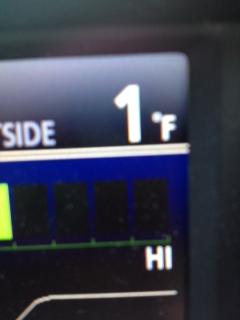
That icy wind sound familiar? Looking at my dashboard this morning, I noted the following temperature reading:

photo (18)Welcome to Hell!

Robert Frost, a New England man himself, considered the destructive power of cold and ice in his short poem “Fire and Ice” (read here by Richard Burton)

Fire and Ice

Some say the world will end in fire,
Some say in ice.
From what I’ve tasted of desire
I hold with those who favor fire.
But if it had to perish twice,
I think I know enough of hate
To say that for destruction ice
Is also great
And would suffice.

Frost’s association of fire with desire is recognizable. There are fires of passion or fires to make something “pure”. One symbol for knowledge is a lamp on fire, and a warm place by the fire is welcome during this recent freeze. Ending in fire may mirror the beginning, if one holds to the Big Bang Theory.

In contrast, his association of ice with hate creates a hostile tone. This association is also recognizable, describing someone as having  an icy heart or with ice in his/her veins leaves an unpleasant impression. The break-up song “Cold as Ice” by Foreigner lyrics state, “You’re as cold as ice/You’re willing to sacrifice our love…”. Economically, there is the dreaded “black ice,” a costly force of destruction on roads that sends thousands of vehicles to body shops annually. Scenes like these have played out all too frequently this year:

One final destructive power of ice to consider is the “melting” danger. National Geographic featured interactive maps in the story If All the Ice Melted  demonstrating what North America and the other six continents would look like if all the ice in the world melted. The result would increase the sea level by an estimated 216 feet.

Screenshot 2014-02-28 08.06.12

Frost’s short poem suggests that destruction by either ice or fire has the same result. However, I would like to point out that in the above-mentioned ice-melting scenario, my home would finally be waterfront, possibly with an ocean view!

Continue Reading…

There are waves from England that reach America’s shores.

There are literary waves.
George Orwell’s Animal Farm was published in America in 1946.

There are musical waves.
The Beatles came to America in 1964.

George Orwell used satire as a commentary on Communism in the USSR and the rise of Stalin in his allegory Animal Farm.

John Lennon used the lyrics in the song Revolution as a response to the increase of protests against the Vietnam War, specifically student riots in Paris in May of 1968.

Satire, politics, protests….so many connections. Why not share them in class?
Why not share the Beatles’ song Revolution while students read Orwell’s Animal Farm?

“Revolution”

You say you want a revolution
Well you know
We all want to change the world
You tell me that it’s evolution
Well you know
We all want to change the world
But when you talk about destruction
Don’t you know you can count me out

Don’t you know it’s gonna be alright
Alright, alright

You say you got a real solution
Well you know
We don’t love to see the plan
You ask me for a contribution
Well you know
We’re doing what we can
But if you want money for people with minds that hate
All I can tell you is brother you have to wait (Revolution lyrics continued…)

After we read first chapter of Animal Farm aloud in class, I played the video of the Beatles performing the song Revolution. For some, this was the first time they had ever heard the song; for some, this was the first time they had seen the Beatles perform.

After watching the video, I posted an assignment to use the power of music – “to write a song for your cause.” The directions given to the students were:

You say you want a Revolution….?
Well, you have to write your song!! (for extra credit)

Step 1: Identify your cause. What makes you angry? What do you see as a problem in society? What is your Pet Peeve? What would you like to change about your world? This can be something big or little.

Step 2: The power of music! To persuade people to join your revolution, (like Major’s Beasts of England) you have to write a song.

Step 3: Share your lyrics, and we will join you in song (karaoke tunes preferred)

Their protest songs came in. In their songs the students protested: homework, English class (*sigh*), the school parking lot ban on underclassmen, bad weather, cafeteria food, Twilight movies, dirt clods in the hallways from steel-toed boots, the ban on cupcakes in class, and (and there were several of these), Justin Bieber.

While their songs were unlikely to inspire a revolution, they did appreciate the power of music in communicating a message. Their reactions to their own songs of protest were positive, but they admitted that their songs did not have the same power as the Beatle’s Revolution. They recognized Orwell’s statement on the power of song in Animal Farm “The Beasts of England” sung at the end of Chapter One. That song (sung to the tune of My Darling Clementine) was a take-off on the famous socialist anthem, The Internationale:

Beasts of England, Beasts of Ireland,
Beasts of every land and clime,
Hearken to my joyful tidings
Of the Golden future time.

Soon or late the day is coming,
Tyrant Man shall be o’erthrown,
And the fruitful fields of England
Shall be trod by beasts alone…….(continued )

 “…The singing of this song threw the animals into the wildest excitement…. And then, after a few preliminary tries, the whole farm burst out into Beasts of England in tremendous unison….” (Ch1:Orwell)

Orwell was demonstrating how the lyrics in a song could motivate. The student protest songs, however, were more entertaining than motivating. The Beatle’s song Revolution is both entertaining and motivating, a song written four years after their momentous arrival in America.

From the moment the Beatles disembarked from Pan-Am flight 101 on February 7, 1964, they were a force in American music. Yet, according to TIME magazine’s story, Beatlemania Begins: The Beatles First U.S. Visit to Play Ed Sullivan, the Beatles were surprised by how their music had made thousands of frenetic fans:

Just before 1:30 p.m., Flight 101 taxied to a stop outside the terminal and the aircraft door popped open. An explosion of cheers and screams rang out as the crowd stormed forward….

“We heard that our records were selling well in America,” George [Harrison] noted, “but it wasn’t until we stepped off the plane … that we understood what was going on. Seeing thousands of kids there to meet us made us realize just how popular we were there.”

Their first appearance on The Ed Sullivan Show (February 9) featured a set list that set fans shrieking:

  • All My Loving 
  • Till There Was You (Sue Raney cover)
  • She Loves You 
  • I Saw Her Standing There 
  • I Want to Hold Your Hand

Those five songs began the domination of pop music charts, coined the term “Beatlemania”, and changed the culture of a generation. The Beatles proved the power of music, so our protest song assignment capitalized on student awareness of this power. The students shared what they would protest if given the opportunity. They had a chance to make connections between two genres, between a set of music lyrics and a set of lyrics from a novel-both of which were penned by Englishmen.

This was also an opportunity for me to highlight the Beatles. Students watched and listened to a recording of the “Fab Four” who created a revolution in music here in America; they saw those “lads from Liverpool” who invaded America from England many Yesterday’s ago.

The English I Honors teacher in my department recently suffered a serious concussion; no reading or writing for several weeks. Her classes must go on, however, and the new unit on John Steinbeck’s Of Mice and Men is next in the curriculum.  A long term substitute is scheduled for next week, and the students could easily read the novel before her arrival.

Moreover, there is a packet of information and worksheets in the file cabinet with background information on the 1930s and the author, John Steinbeck. The practice of providing such a lengthy introduction, however, is associated with “over-teaching”, a practice now discouraged in the Common Core English Language Arts Standards. In statewide tests students will have to meet the standards of the Common Core, and they will encounter texts from many different sources. The recommendation is that students should practice “close reading” where they can independently mine the language of the text for meaning:

“Students who meet the Standards readily undertake the close, attentive reading that is at the heart of understanding and enjoying complex works of literature. They habitually perform the critical reading necessary to pick carefully through the staggering amount of information available today in print and digitally” (ELA Common Core)

The 9th graders could be staggering indeed; they have just completed a unit on Greek tragedy using Oedipus the King. Some students might suffer whiplash in the jump from 5th Century BCE Ancient Greece to 20th Century California in the Salinas Valley. There needed to be a powerful “bridge” to prepare students for this leap in time and ensuing debate between free will and fate.  What could be accomplished without the teacher directed lecture, especially if the teacher is not available? What format could saturate students in an environment of the 1930s?

A few minutes of research on YouTube provided an answer; I could have a substitute show students several versions of the Bing Crosby’s song recording of Yip Harburg and Jay Gorney’s anthem for the Great Depression, “Brother, Can You Spare a Dime?”

The historical accuracy of some of the photos in this first rendition may be questionable, but the message of an average man’s struggle to find employment in the early 1930s is made very clear. The second version below is a sing-a-long-version that is particularly good as a karaoke opportunity. After watching the first version, all students sang along, some with more gusto than others, following Crosby’s cadence in the second version:

After singing, the students reviewed the lyrics:

“Brother, Can You Spare a Dime”

lyrics by Yip Harburg, music by Jay Gorney (1931)

They used to tell me I was building a dream, and so I followed the mob,
When there was earth to plow, or guns to bear, I was always there right on the job.
They used to tell me I was building a dream, with peace and glory ahead,
Why should I be standing in line, just waiting for bread?

Once I built a railroad, I made it run, made it race against time.
Once I built a railroad; now it’s done. Brother, can you spare a dime?
Once I built a tower, up to the sun, brick, and rivet, and lime;
Once I built a tower, now it’s done.

Brother, can you spare a dime?

Once in khaki suits, gee we looked swell,
Full of that Yankee Doodly Dum,
Half a million boots went slogging through Hell,
And I was the kid with the drum!

Say, don’t you remember, they called me Al; it was Al all the time.
Why don’t you remember, I’m your pal?

Buddy, can you spare a dime?

Once in khaki suits, gee we looked swell,
Full of that Yankee Doodly Dum,
Half a million boots went slogging through Hell,
And I was the kid with the drum!

Say, don’t you remember, they called me Al; it was Al all the time.
Say, don’t you remember, I’m your pal?

Buddy, can you spare a dime?

These lyrics provided students an opportunity to “close read” the context of the Great Depression, particularly in the lyrics “Once in khaki suits, gee we looked swell” and “Half a million boots went slogging through Hell.” While they understood that after the stock market crash there were unemployed men who had helped in the building of railroads and towers, more than one student made the connection that there are currently soldiers who have returned from serving in Iraq or Afghanistan who have not found employment either. Their brief discussion was enough to set up Steinbeck’s tale of Lennie and George, who share a dream of finding employment to be independent farmers raising rabbits.

Once the background was established, students could then read the novel independently, the way the Common Core recommends in the reading standards. Additionally, the long-term substitute can now complete the leap from classical to contemporary tragedy without having to dwell on historical context. The only downside might be getting rid of “Brother, Can You Spare a Dime?”… a song-worm now in their brains!

Screen Shot 2013-12-22 at 10.51.28 PMSeveral of the 12th graders had taken the elective of Drama Class for their English IV because they did not think they would have to read. They were wrong; they read Our Town. A few of the 12th graders had taken the elective of Drama for their English class because they did not think they would have to write. They were wrong. They had journals. What was most surprising was the number of 12th graders who did not think that they had to act…or memorize lines.

As a precaution, the drama class teacher chose the play Snow White and the Seven Dwarves as their final production in the hopes that since the students already knew the plot, “They could always ad-lib.”

The play was cast with some additional dwarves (“Shorty” and “Weepy”) increasing the company to accommodate the number of students in the class. Rehearsals began, but the progress was slow. The principal parts were invested, but the dwarves were not, and their large numbers cluttered the small classroom stage area. They missed entrances, missed cues, missed lines, and when they were on set, they stood swaying or whispered so loudly as to drown out the lines of others. They were collectively the most awkward set of gigantic dwarves ever to inhabit a stage.

Nevertheless, the production was scheduled for appearances at three local elementary schools two days before the winter break. Props were prepared, costumes fitted, and sound cues burned onto a CD. Then, an ice storm two weeks before performance caused a car pile-up, and the drama club teacher was left with a concussion. She could not be in school; the students were on their own, and I was left to supervise.

There was a “dress rehearsal” the morning of the show; it was, as all dress rehearsals go, a disaster. “I don’t think you should take them,” advised a student who was watching. I had a sinking feeling; perhaps she was right. But, as the adage says, “The show must go on!”

Our first stop was in the elementary school gym, a cavernous space.
“You are going to have to be loud,” I cautioned, as members of the cast set up the magic mirror. Just then the announcements came on.

“Good morning,” chirped a little voice over the speakers, “Today is Thursday, December 19th…..” The announcements continued with students from the elementary school listing off birthdays, lunch menu details, and finally, the Pledge of Allegiance.

“Guys,” interrupted the most uncooperative dwarf to the other cast members, “listen to them….I mean…they’re so innocent! We can’t screw up now!” The others looked startled. There was no turning back; there was only forward movement, and that forward movement was going to have to be kid-friendly. For the first time since the auditions, they were quiet, and in that moment of recognition, the 22 students in drama class became a theatre troupe. I was certainly not a factor; this was entirely their decision. They had been prepared by their drama teacher for this moment, but they had never truly risen to the occasion. As they watched the audience of elementary school students file in, the gravity of their roles became real. The show was going on…

“Once upon a time….” the narrator began, and each cast member found their place on the gym floor stage. They recalled lines locked in the file drawers of recent memory or ad-libbed as needed. The Mirror told the Evil Queen she was no longer the most beautiful, the huntsman let Snow White run away, the dwarves found Snow White in their cottage, and the Evil Queen tricked Snow White with a poisoned apple.

There were plenty of errors. The sound cue for the Evil Queen (never used before) drowned out her entrance, the poisoned apple rolled into the hands of some smaller audience members, and when the Prince first kissed Snow White on the hand, there was a critique from an audience member who called out, “Now, that was lame.” But when the Prince finally kissed Snow White with “love’s first kiss”, there were cheers from the crowd, and an astonished cast stood together, hand in hand, taking their first (and again, unrehearsed) bow.

Piling on the bus to perform at the next elementary school, the cast was all business. During the 30 minute ride, they practiced lines and advised each other on what should happen for the next show. They were serious.

The next two performances at other elementary schools became more polished as students internalized their roles. They naturally changed their staging moving from gym floor to library floor. The Evil Queen tossed her hair with anger and the Prince strode onto the stage with more confidence. The dwarves were still cluttering the stage, and each time Doc announced the “death” of Snow White, they were unconcerned. While they were not “actors”, they were a source of comic relief, intentionally or not.

So, I watched the holiday miracle of 2013 repeated three times that day. The students in drama class at each school were applauded, and later that afternoon there were e-mails from the principals that offered praise.

The holiday season is a time for miracles. Their drama teacher should have been there to witness this one, but for now the videos will have to suffice. The end of 2013 has ended on a high note for those seniors. Heigh-ho to 2014!

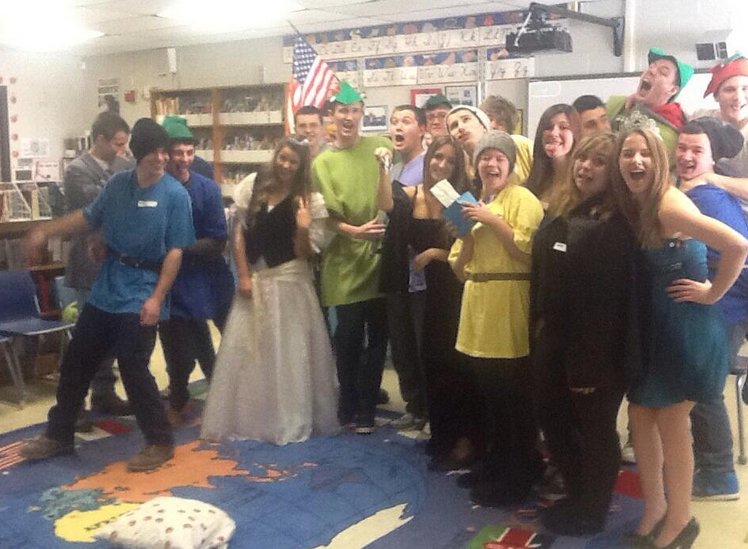
Cast photo!

Cast photo!

Christmas storyThe holidays are here and network television takes full advantage of our want to replay our favorites, to stir memories, or to remind us of our childhood. Perhaps no film is more nostalgic than the 1983 film A Christmas Story based on a novel by Jean Shepard, In God We Trust, All Others Pay Cash. Director Bob Clark and writer Leigh Brown also collaborated on the screenplay for this time piece of the 1940s that highlights one family’s battles with Oldsmobiles, coal-burning furnaces, and spotty electrical wiring. The film is also a timeless story of a young boy’s obsession for toy, a Red Ryder B.B. gun, for Christmas from Santa Claus, the guarantor of all secret wishes.

The casting of actor Darren McGavin (The Old Man), actress Melinda Dillon (Mother), and the young Peter Billingsley, as the bespectacled Ralphie, was perfect, but it is the voice of Shepard himself narrating the story that makes the movie so memorable. The viewer sees the events through Shepard’s eyes and hears his emotional range as he reflects on this one momentous Christmas season. In recalling his youth, he is at turns indignant (“Ovaltine? A crummy commercial?”)  terrified (“Scut Farkus staring out at us with his yellow eyes. He had yellow eyes! So, help me, God! Yellow eyes!”), and determined (“No! No! I want an Official Red Ryder Carbine-Action Two-Hundred-Shot Range Model Air Rifle!”)

The visual laughs abound in the story: Flick’s tongue stuck frozen to the flagpole, Miss Shields’ morphing into a witch, and the camera closing in on Santa’s boot as he shoves Ralphie down the slide into a soft pile of cloth snowballs. But it is the language, Shephard’s script, that gives the film its enduring appeal. Long after December, I have heard people quote lines from the film such as:

  • Fra-gee-lay. That must be Italian.
  • It… It ’twas… soap poisoning!
  • Only I didn’t say “Fudge.” I said THE word, the big one, the queen-mother of dirty words, the “F-dash-dash-dash” word!
  • But those who did it know their blame, and I’m sure that the guilt you feel is far worse than any punishment you might receive.
  • You’ll shoot your eye out, kid.

Not only are the lines marvelous in construction, but the vocabulary in Shepard’s recounting is of the highest caliber, with many words worthy of an SAT rating, for example:

“We plunged into the cornucopia quivering with desire and the ecstasy of unbridled avarice.”

“Over the years I got to be quite a connoisseur of soap. My personal preference was for Lux, but I found Palmolive had a nice, piquant after-dinner flavor – heady, but with just a touch of mellow smoothness.”

“Sometimes, at the height of our revelries, when our joy is at its zenith, when all is most right with the world, the most unthinkable disasters descend upon us.”

“Mothers know nothing about creeping marauders burrowing through the snow toward the kitchen where only you and you alone stand between your tiny, huddled family and insensate evil.”

When a word is not suitable, Shephard turns Shakespeare-like and creates his own:

“Gradually, I drifted off to sleep, pranging ducks on the wing and getting off spectacular hip shots.”

Shephard also preserves the language of a different, perhaps more polite, time when a more conscious effort was made to create substitutes for profanity. The actor McGavin peppers the “Old Man’s” frustration with all things mechanical: nincompoop, dadgummit, keister, and for cripes sake, as well as more colorful expletive sound-a-likes: You wart mundane noodle! You shotten shifter paskabah! You snort tonguer! Lame monger snaffa shell cocker!

The script is also filled with a myriad of examples of figurative language guaranteed to please any English teacher. Here is an opportunity to teach students the power of similes:

“My kid brother looked like a tick about to pop!”
“Randy lay there like a slug! It was his only defense!”
“He looks like a deranged Easter Bunny.”

Shephard’s metaphors are also exceptional. These are constructions of “dictional elegance”, the rare combination of the sacred and profane:

“In the heat of battle my father wove a tapestry of obscenities that as far as we know is still hanging in space over Lake Michigan.”

“Lovely, glorious, beautiful Christmas, upon which the entire kid year revolved.”

“First-nighters, packed earmuff-to-earmuff, jostled in wonderment before a golden, tinkling display of mechanized, electronic joy!”

“Next to me in the blackness lay my oiled blue steel beauty.”

122208lampleg

My personal favorite metaphor of all time centers on the infamous lamp, a prize won by Ralphie’s father who in one hilarious sequence, digs wild-eyed through packing material in a large wood carton. He uncovers a tribute to all things burlesque:  a glass leg adorned with a fishnet stocking and a fringe shade covering the upper thigh. As Ralphie stands, slack-jawed in admiration staring at the lamp, his alarmed mother shoves him back into the kitchen. Ruefully Shephard intones:

Only one thing in the world could’ve dragged me away from the soft glow of electric sex gleaming in the window.

So, during the next 24 hour marathon showing of A Christmas Story, when you tune in for the memories, to watch the exceptional acting and the period piece visuals, pay attention to the language that makes the film so unforgettable. You may even develop an appreciation for Ralphie’s theme essay on “A Red Ryder BB gun with a compass in the stock, and this thing which tells time.

Poetry. Sheer poetry, Ralph! An A+!

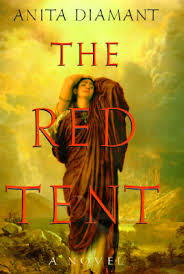
red tentMany of my students do not know Old Testament stories other than “Noah’s Ark” and “Adam and Eve”. There is the occasional biblical teen scholar who may be able to recount the origin a pillar of salt (Lot’s wife) or maybe there will be a student who saw the musical Joseph and the Amazing Technicolor Dreamcoat and make a patriarchal connection. For the most part, students are not up to date on Methuselah or even which of the brothers killed the other (Cain or Abel). They are far more likely to ask, “So, where did all the other people come from if Eve was the only woman?”

Fortunately, The Red Tent, a novel by Anita Diamant (1997) does address other women of the Old Testament. Her fictionalized version of the story of Dinah, daughter of Leah and Jacob, is based on in a brief but particularly violent and gruesome incident in the Book of Genesis. In the King James Version of the Bible, Dinah is known as the daughter who is “defiled” by Shechem, a prince, who then wanted to marry her (Genesis 34: 1-3):

1 And Dinah the daughter of Leah, which she bare unto Jacob, went out to see the daughters of the land.

2 And when Shechem the son of Hamor the Hivite, prince of the country, saw her, he took her, and lay with her, and defiled her.

3 And his soul clave unto Dinah the daughter of Jacob, and he loved the damsel, and spake kindly unto the damsel.

Dinah’s brothers, sought vengeance for the attack on their sister. They tricked Shechem and his family, claiming to come in peace, and exacted their punishment by killing the royal family and all males in the city:

26 And they slew Hamor and Shechem his son with the edge of the sword, and took Dinah out of Shechem’s house, and went out.

27 The sons of Jacob came upon the slain, and spoiled the city, because they had defiled their sister.

This horrific incident is explained very differently in the Diamant’s fictional retelling, as are many other familial incidents, from Dinah’s point of view. The rivalry between Rachel and Leah, the rivalry between Jacob and Esau, and the rivalry between the sons of Joseph, Dinah’s younger brother, are rich with detail and dialogue. The sparse accounts given in the Old Testament are fleshed out in this compelling narrative, with the women center stage, a striking contrast to the male-dominated biblical text.

Several of my female students in Advanced Placement English Literature choose to read The Red Tent as an independent choice, and their response is not unlike other female student responses chronicled in the article “The Wandering Womb at Home in The Red Tent: An Adolescent Bildungsroman in a Different Voice” by Holly Blackford. In this review, Blackford writes about the female students’ enthusiasm for the book:

So emotional about the story of The Red Tent that they can barely speak, and indeed continually interrupt one another, they cite the way in which the contemporary novel revises the patriarchal story of Jacob; represents the concerns of girls in terms of emotion and relationship; and details the entire lifecycle of girl-to-woman through engaging first-person narration:
  Carol: There are certain books I just can’t put down.
      Laticia: Seriously, I’ll read until like three in the morning . . .
      Interviewer: Like what?
      Carol: Like The Red Tent!

Blackford also points out that this revision of an ancient text  comes at a time when girls are, “hungering for an exploration of female-centered myths, deities, worlds, and power-structures.” Her claim in The Alan Review (March, 2005) is that books like The Red Tent:

“… appeal to adolescent women and grow their appreciation for contemporary women’s literature that speaks “in a different voice” (Gilligan) from the more masculine canon they expect in their school curriculum.”

There are about 20 copies of The Red Tent on the class independent book cart, all purchased at book sales for $1.00 each. Picador USA publishers produced an oversized text, about 2″ taller than a standard trade paperback; on the AP English Lit book cart’s top shelf, these copies stick out. The cover art, designed and illustrated by Honi Werner, is also eye-catching. Students always pick up the book with interest.

“What’s this about?” one asks.
“Read the back,” I reply.
“‘...told in Dinah’s voice, this novel reveals the traditions and turmoil of ancient womanhood-the world of the red tent,’ (*pause suspiciously*)…is this a ‘chick book’?”
“Yes,” I chuckle, “this is most definitely a chick book….probably the ultimate chick book, of ALL chick books.”

How else to describe a story that centers on celebrating the onset of womanhood?

After they read any independent book, the AP students are required to write an essay. The essay prompt this quarter for any book they choose is taken from the AP released exam list of questions:

In retrospect, the reader often discovers that the first chapter of a novel or the opening scene of a drama introduces some of the major themes of the work. Write an essay about the opening of the first chapter of a novel in which you explain how it functions in this way. *hint: the lens you use is the lens from the conclusion of the novel*

Students who choose to read Diamant’s The Red Tent will certainly want to return to the beginning to explain how Dinah’s life story begins and ends with the women who loved and supported her.  They will also have had a “crash course” on the Book of Genesis, which is the source of many other literary allusions. While The Red Tent is not great literature, this novel sets many female students looking for equally compelling contemporary novels about women, with or without that “chick book” label.

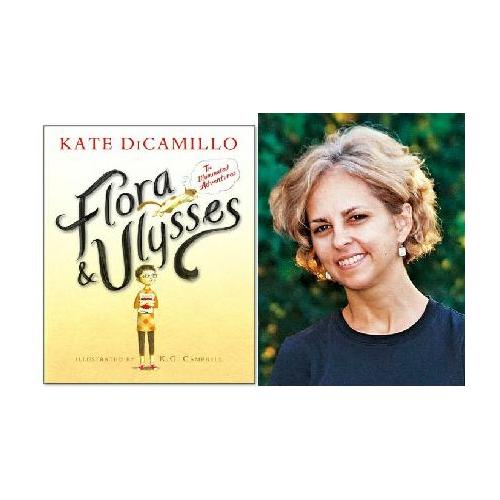
Kate DiCamillo stood in the nave of Riverside Cathedral, her curly hair barely visible over the podium, her voice clear and strong as she delivered the keynote address for the 85th Teacher’s College Reading and Writing Project Reunion (October 19, 2013).

She was exactly as advertised from the information on her website, “I am short. And loud.”

kate-dicamillo-floraandulyssestheilluminatedadvent-68She addressed the packed house of literacy teachers, some 2000 strong, who knew her as the author of Because of Winn-Dixie (a Newbery Honor book), The Tiger Rising (a National Book Award finalist), and The Tale of Despereaux (winner of the 2003 Newbery Medal), but her morning speech was about her latest book, Flora and Ulysses. She set the stage with her opening proclamation:

“This story begins as stories often do with a vacuum cleaner.”

Not just any vacuum cleaner. The vacuum at the center of this story was a 1952 tank Electrolux 2000, a treasured appliance belonging to DiCamillo’s mother. How treasured? DiCamillo joked that when her mother who was ill moved to be with her in Minneapolis, Minnesota, she worried more about the safe delivery of the Electrolux to the new home more than her own personal safety.”I want you to know that you can have the Electrolux when I am gone,” her mother told her. “It’s a really good vacuum cleaner,” she said and added, “The cord is extra long…and its retractable.”

The audience of teachers laughed; DiCamillo’s dry delivery in describing her mother’s attachment to a housecleaning appliance was part retrospective for the older teachers and part kitsch for the newer ones. “Remember the Hoover?” DiCamillo quoted her mother as saying, “that Hoover was useless!” But as she recounted how her mother’s illness progressed, the appreciation for this appliance took on new significance. “I really hope you will take the Electrolux,” her mother told her, “that makes me feel better.” So when her mother passed way, DiCamillo did take the Electrolux, but put it in the garage through that winter.

She spoke how in those dark days after her mother’s death, she found comfort in a poem by Rainer Maria Rilke, from Rilke’s Book of Hours: Love Poems to God and she read the lines from the short poem:

“God speaks to each of us as he makes us,
then walks with us silently out of the night.
These are the words we dimly hear:

You, sent out beyond your recall,
go to the limits of your longing.
Embody me.

Flare up like a flame
and make big shadows I can move in.
Let everything happen to you: beauty and terror.
Just keep going. No feeling is final.
Don’t let yourself lose me.

Nearby is the country they call Life.
You will know it by its seriousness.

Give me your hand.”

She reflected that when her mother was dying, she had held her mother’s hand in comfort, an action profoundly different from all the ways her mother had taken her hand when she was younger. The crowd was visibly moved by this retelling of the loss of her mother, but in typical DiCamillo storytelling fashion, her speech then veered off to include the death of a squirrel.

Shifting from the pathos for her mother, DiCamillo recounted that one day, a dying squirrel had chosen the front steps of her home as the last stop on his final journey. His eyes were open, yet unseeing; his chest dramatically heaving with his last breaths.
“I didn’t want him to suffer and die on my front steps,” she bemoaned.
So, she called a friend.
“‘There’s a squirrel on my front steps…He’s dying’,” she told her friend (Carla), “‘what should I do?'”
The advice she received from her gentle and humane friend appalled her.
“‘Do you have a shovel…and a tee shirt?'” asked Carla.
DiCamillo admitted that she had a shovel, but that she “moved away from the front door so the squirrel would not hear what was being said.”
“‘Put the tee shirt over the squirrel, and I will come over and hit him with the shovel,’ replied Carla.”

Fortunately, before that plan could be executed, the squirrel had crawled away.
“He may have heard us, or he had moved to get away from my presence,” said DiCamillo. The same people who had been tearing up from from the death of her mother and the power of the Rilke poem were now laughing out loud; the cathartic shift in emotions had been seamless.

DiCamillo then told the audience that she considered her reaction to the dying squirrel was not unlike the reaction of E.B.White in an essay he published in The Atlantic, “The Death of a Pig”:

 “He came out of the house to die. When I went down, before going to bed, he lay stretched in the yard a few feet from the door. I knelt, saw that he was dead, and left him there: his face had a mild look, expressive neither of deep peace nor of deep suffering, although I think he had suffered a good deal. I went back up to the house and to bed, and cried internally – deep hemorrhagic intears.”

“White claimed that his novel Charlotte’s Web was not connected to this essay…but could this event,” DiCamillo speculated, “have been more?”
She paused to consider their mutual despair over loss.
“He wanted to keep the pig alive….I wanted to keep the squirrel alive.”

And in that instant, a cathedral full of teachers understood that great ideas do not happen in (pardon the pun) a vacuum. DiCamillo’s speech illustrated how the three seemingly unconnected elements in her keynote address were the elements of story she combined in her latest book Flora and Ulysses.

In this story, there is a vacuum, a squirrel, a shovel, and several lines of the Rilke poem.
To be more specific, there is the near death experience of the squirrel, mistakenly sucked up by the Ulysses 2000; there is a comic-book superhero aficionado who intervenes; and there are several drafts of meta-physical squirrel poetry.  The story has the “beauty and terror” from the Rilke poem as well as the giving of a hand for comfort. There are what DiCamillo terms, “eccentric, endearing characters” presented in a format that combines print with comic book styled illustrations. Like the keynote address, the novel plucks at both the heart and the funny bone; it is a wonderful story.

The biography on DiCamillo’s website reads, “I write for both children and adults, and I like to think of myself as a storyteller.” Listening to her speak, I cannot think of her as anything else.

The rain set early in to-night,
The sullen wind was soon awake,
It tore the elm-tops down for spite,
And did its worst to vex the lake:

In other words, “It was a dark and stormy night.” Thus begins the poet’s Robert Browning’s dark and disturbing dramatic monologue, Porphyria’s Lover, a portrait of a madman that is wonderful to read with students around Halloween. I usually use an audio recording that I can play, and I pause the recording twice as we listen.

The unnamed narrator of the poem sits in a cold cabin, a rendezvous with his lover, Porphyria, who “glides in” as she

…shut the cold out and the storm,
And kneeled and made the cheerless grate
Blaze up, and all the cottage warm;

The narrator’s isolation in the gloomy setting takes on the tone of an illicit romance as Porphyria removes her wet clothing in order to

… let the damp hair fall,
And, last, she sat down by my side
And called me.

But when the recalcitrant narrator does not respond, Porphyria increases her ardent attentions

She put my arm about her waist,
And made her smooth white shoulder bare
And all her yellow hair displaced,
And, stooping, made my cheek lie there,
And spread, o’er all, her yellow hair,
Murmuring how she loved me-

Porphyria’s devotion to the narrator is extreme, expressed in his words “passion”  and “worshipped.” He acknowledges that she could “give herself to me forever” even as she had “come through wind and rain” for this meeting.  This “surprise”

Made my heart swell, and still it grew
While I debated what to do.
That moment she was mine, mine, fair,
Perfectly pure and good:

The narrator revels in this epiphany; Porphyria’s devotion is at its zenith. His reaction seems predictable to my students, and they eagerly anticipate  the romantic tumble they have expected since Porphyria entered the cabin. After all, the word “lover” is in the title.

Yet, the next five lines take a decidedly different turn. The narrator dispassionately admits,

…I found
A thing to do, and all her hair
In one long yellow string I wound
Three times her little throat around,
And strangled her.

Here is where I pause the recording as my students take a moment to comprehend what they have read. Their reactions generally follow this script:

“Wait a minute!”
“What did he do?”
“He ...killed her?”
What is going on here?”

I direct them back to the poem so they can hear the voice of the narrator explain his actions, and his explanation is chilling. “No pain felt she;” the narrator continues, as if to assure my students, “I am quite sure she felt no pain.” As if to prove his judgment, he opens her closed eyes, loosens the hair from her throat, and places a “burning kiss” upon her cheek. Again, the students react in shock:

“This guy is sick!”
“He KISSED her??”
“Ewwww…”
“Why did he do it?”

Why did he do it indeed? The narrator calmly continues to explain his reasons as Porphyria’s head, limp and lifeless, leans upon his shoulder,

The smiling rosy little head,
So glad it has its utmost will,
That all it scorned at once is fled,
And I, its love, am gained instead!

The narrator’s twisted logic in claiming Porphyria’s life in a moment of pure love is so perverse that students are horrified. The final shocker comes as the narrator confidently claims that the murder of Porphyria was something desirable,

Her darling one wish would be heard.
And thus we sit together now,
And all night long we have not stirred,
And yet God has not said a word! –

“He’s a monster.”
“He’s crazy.”
“He is insane.”

Browning’s poem that chronicles a deadly obsession is an excellent addition to the Halloween literary repertoire. The high interest monologue engages students in the “close reading” required by the Common Core.

A close reading can be accomplished by dividing the poem into sections and asking students to identify if the line can be placed into categories:

  • establishing setting
  • poetic technique (metaphor, personification)
  • character development
hair-piece-ponytail-with-draw-string-613-bleach-blonde-longer-length-ponytail-20-inches--401-p

Blonde hair!

Students are encouraged to make adjustments based on their group discussions or to create their own categories.  Once they have categorized the lines, they create large posters that “illustrate” the lines literally or symbolically. They draw or use images that they find online or use photos; then they share the posters which are hung around the room and explain how these details serve the author’s purpose in creating an unforgettable character who is a madman.

Come this Halloween, if you are looking for a poem to send shivers down the spines of your students, try Robert Browning’s “Porphyria’s Lover”.

Try not to think that this frightening portrayal of insanity was created by the husband of Elizabeth Barrett Browning, famous for the poem “How Do I Love Thee? Let Me Count the Ways.”

You can save that sonnet for Valentine’s Day!

Banned Book Week is held annually during the last week of September in order to bring attention to the controversial practice of banning books, but an exhibit at the New York Public Library is proclaiming the same message through March 24, 2014. The exhibit “The ABCs of It: Why Children’s Books Matter”  celebrates the development of children’s literature in picture books, in chapter books, and in young adult literature.

The exhibit which opened on June 24th, is curated by Leonard S. Marcus who has also curated exhibitions at the Eric Carle Museum of Picture Book Art in Massachusetts, where he is also a founding trustee. This comprehensive exhibit is a must see and does not shy away from controversies in providing…

an examination of why children’s books are important: what and how they teach children, and what they reveal about the societies that produced them. Through a dynamic array of objects and activities, the exhibition celebrates the extraordinary richness, artistry, and diversity of children’s literature across cultures and time.

The differences in opinion on the role of children’s literature are raised at the exhibit’s entrance. Should children’s literature be foremost a means to deliver lessons of morality? (as Cotton Mather urged the Bible on young Puritans) Should children’s literature “delight and entertain”? (as John Locke believed with Aesop’s fables) Or should children’s literature tell the bare truth, not tales that “cover truth with a veil”? (Jean-Jacques Rousseau). From fairy tales to the Suzanne Collins’s The Hunger Games Trilogy, the controversy rages on, and the exhibit presents them all.

Screen Shot 2013-10-01 at 11.01.32 PM

A life-size set of “Goodnight, Moon” at the New York Public Library

There are tributes to William Blake’s poetry, Lewis Carroll’s Through the Looking Glass, and a original copy of Janette Sebring Lowrey’s The Pokey Little Puppy. One large panel features the rhyming words (Sam I am & green eggs and ham) of Theodore Geisel (Dr. Seuss). Along another long wall are the serial contributions of publisher Edward Stratemeyer: Bobbsey Twins, Hardy Boys, Tom Swift, and Nancy Drew. There is a tribute to comic books complete with silhouettes of Marvel and DC heroes, and tribute to books successfully made into films. A glass case holds the original Pooh, Piglet, Kanga, Roo, and Tigger from A.A Milne’s 100 Acre Woods; Eric Carle’s colorful panels (Brown Bear, Brown Bear and others) glow brightly in the cases. Pictures of the exhibit are on the New York Public Library’s Facebook Page and the NYTimes slide show review.

There is a wall that bears the distinctive outline of one of Maurice Sendak’s “Wild Things” around the corner from a life-size set of Margaret Wise Brown’s Good Night, Moon, waiting for the quiet old lady to whisper “hush”. You can listen to E.B. White read the last chapter of Charlotte’s Web, and try not to sob when hearing him say the line, “It is not often that someone comes along who is a true friend and a good writer. Charlotte was both.”

The exhibit also points out the role of children’s literature in politics or in nation building.  On one wall of the exhibit, there is a sculpted relief of the world surrounded by three quotes; each quote makes an important point about the significance of children’s literature. The first quote is by Noah Webster from an essay titled “On the Education of Youth in America,” American Magazine, New York, December 1787:

“The Education of youth is, in all governments, an object of the first consequence. The impressions received in early life usually form the character of individuals, a union of which forms the general character of a nation.”

Political writer, author, and developer of the dictionary, Webster was an early advocate for education as key to America’s growth and development.  The next quote, however, gives the viewer pause…and a few chills:

“Education is a weapon whose effects depend on who holds it in his hands and at whom it is aimed.”
Interview with H. G. Wells -September 1937- said by Joseph Stalin

Similarly, the last quote does demonstrate how in astute political hands, children’s literature can be a powerful propaganda tool:

“Rise up children and learn to be free independent children of China, learn how to wrest this freedom from the yoke of Japanese imperialism, and transform yourself into masters of a new era.”
Mao Zedong from the Journal Children of the Border Areas- 1938

These voices provide a serious reminder that children’s literature is more than board books, rhymes, and fairy tales. There are powerful messages in these stories; some so powerful that they have banned. For example, there is Munro Leaf’s story of the peace loving Ferdinand, the Bull which “caused an international controversy” when it was first published; banned in Spain the book was burned in Nazi Germany. Exposing those horrors of the Holocaust is a copy of Art Spiegelman’s breakthrough graphic novel Maus.

Marcus’s exhibit presents the questions and controversies about children’s literature, but does not provide answers. The exhibit has examples of how this genre of literature can contain both powerful political tools and playful trivial entertainment. There is no answer to the exhibit’s opening questions as to whether children’s literature is a means to educate, a means to enforce a moral code, or a source of joy. On seeing the stories of childhood so beautifully arranged, I opt for joy.

At the end, a large screen posts a continuing stream of Jeopardy-styled quiz questions in an interactive, and serious time-killing, activity.
I stood answering questions (“curiouser and curiouser= Cheshire Cat” or “Lyle, Lyle Crocodile= The House on 88th Street“) for some time before a young boy noted, “Hey, you’re pretty good at this..”

“Thanks,” I said, “I really like these books.”

“So do I,” he responded before leaving.

Thanks for making that moment possible, New York Public Library. Continue Reading…