Archives For November 30, 1999

If nothing else, the Common Core State Standards’ (CCSS) contribution to the academic lexicon will be the renaming of the genre known as non-fiction to a larger genre of informational texts. This renaming expanded the genre to include many forms of reading: textbooks, letters, speeches, maps, brochures, memoirs, biographies, and news articles, to name a few.

So where to find these informational texts? What is appetizing enough to make middle school students want to read a story, and then, answer the questions to check their understanding? What kind of high interest texts appeal to high school students who prefer to “Google” or “Sparknote” answers rather than read a text closely? What multi-media elements could be added to make an informational text palatable enough to be consumed by all levels of readers?

Screen Shot 2013-11-11 at 6.30.17 PM

The 2:12 video for accompanies the story

Well, teachers should look no further than the October 1, 2013, New York Times‘ feature article dedicated to Doritos Tortilla Chip titled That Nacho Dorito Taste. This short feature article combined photography and graphics;  a short video: and even shorter text that combined to provide an explanation on how this particular food is engineered so that “you can’t eat just one.”

The article is timely since the CCSS  requires that the student diet of reading should be 70% informational texts and 30% fiction by the time they graduate from high school.  The Literacy Standards specifically address reading in math, science, social studies, and the technical areas and recommends the increase in reading informational texts be completed in these classes. One of the technical areas content area classes could be a culinary arts class, a marketing class, or a health science class, but consider this particular informational text as scrumptious for any class.

In organizing this story, New York Times reporter Michael Moss, who also narrates the embedded video, interviewed food scientist Steven A. Witherly, author of “Why Humans Like Junk Food,” in order to better understand how all of the chemical elements combine in the Nacho Cheese Doritos chip to make it alluring to our taste buds.  According to Witherly, the mixing of flavors on this particular chip is purposeful:

 “What these are trying to do is excite every stinking taste bud receptor you have in your mouth.”

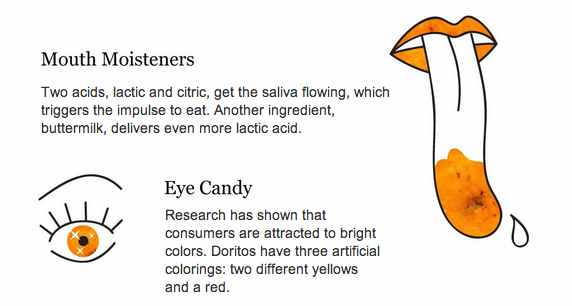
The graphics for the article by Alicia DeSantis and Jennifer Daniel are cleverly combined with photographs by Fred R. Conrad, also from the The New York Times. A separate page layout with the graphic/photo mix delivers tidbits of information about the Dorito chip. Each detail is organized by topic, as this example shows:
Screen Shot 2013-11-10 at 9.46.47 PM

A teacher does not even have to work at organizing questions for students to answer since the New York Time Learning Network, a free educational blog offered by the paper, organized an entire lesson plan on this article. The lesson is titled 6 Q’s About the News | The Science Behind Your Craving for Doritos, organized by Katherine Schulten. The questions on the blog include:

WHAT is psychobiology?
WHAT is “dynamic contrast”?
HOW do the acids in Doritos work on the brain?

WHAT is “sensory-specific satiety”?

WHERE do half the calories in Doritos come from, and, according to the graphic, HOW does that work on the brain?

WHY is “forgettable flavor” so important to Doritos’ success?

The higher order questions invite students to consider:

Now that you know the formula behind Doritos, are you more likely to eat more or less of them? WHY?
HOW many processed foods do you eat a day?
WHAT might a graphic explaining the effects of this food look like?

So go ahead. Read the Nacho Cheese Doritos article. See how irresistible an informational text can be. Once you read one this good, you will be searching to find another!

Every student can learn and perform differently in any given classroom. A hypothetical classroom of 24 hypothetical students is still a hypothetical classroom of diversity, with 24 individual combinations of learning styles.  Teachers should differentiate for a wide variety of learners and prepare for all students, especially those who have with dissimilar interests and abilities. How dissimilar? Consider this video of a toddler’s dance recital that went viral as an example:

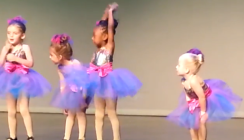
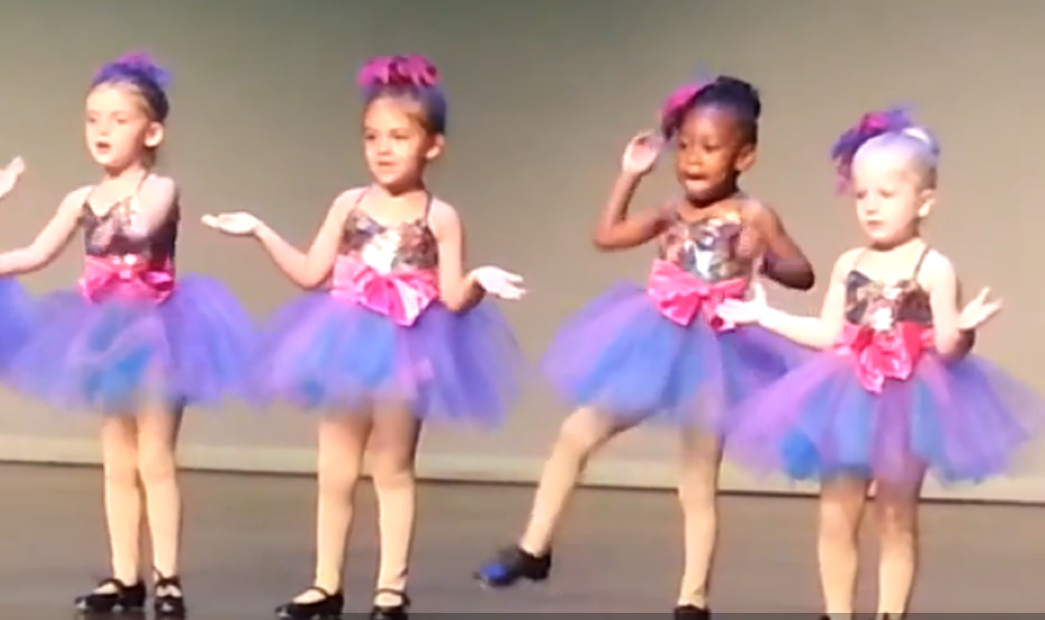
There is obviously a “lesson plan” for this recital. The dance instructor’s objective for the recital is to have all the dancers perform the same dance routine to the song “Broadway Baby”. The routine has been choreographed, as evidenced by the photos, with simple arm movements and tap steps.

Screen Shot 2013-11-03 at 10.14.41 AM

Dancer #3 loosely following the routine…

At the stage right section of the chorus line, the four little girls in their festive tutus catch the attention of the videographer in the audience. He records the performance in which three out of four dancers are dedicated to staying in step and following the routine they had practiced.

Three of the four dancers synchronize their arm and toe-tapping movements; they obviously know the steps of dance routine.  Their performance, in contrast, is juxtaposed with the animated interpretation of another dancer whose enthusiasm for performance is both charming and comical.

Screen Shot 2013-11-03 at 10.15.39 AM

…singing and dancing her interpretation…

This dancer, let’s call her Dancer #3 (third from the left), is whole-heartedly performing her own distinctive dance steps and arm movements while still loosely following the choreographed routine. As the other dancers in the chorus line follow and conform according to scripted direction, Dancer #3 dances to her own distinctive beat.

Screen Shot 2013-11-03 at 10.10.11 AM

….expressing herself in movement…

The members of the audience are heard laughing in the background of the video. It is probably safe to say that in the audience watching the recital were the anxious parents, relatives, and friends of all the little girls in the chorus line.

Screen Shot 2013-11-03 at 10.10.58 AM

…and celebrating her difference…

Each audience member was rooting for their special dancer on stage, and depending on the point of view, each dancer was wonderful. Dancer #3’s family and friends, however, have the evidence to prove that their little girl’s performance was matchless.

Now consider how every classroom has has at least one Dancer #3. All teachers must be prepared to instruct a student or set of students like her who may differ in how they learn and perform. These differences are usually addressed under the educational theory of  learning styles, and there are numerous different theories about how these styles impact how individuals learn.. One theory (Fleming, 2001) suggests that all learners use one of three common learning styles: visual, auditory, and kinesthetic. Another theory  (Gardner) suggests that there are seven different learning styles for learners:

  • Visual (spatial): learning using pictures, images, and spatial understanding.
  • Aural (auditory-musical): learning using sound and music.
  • Verbal (linguistic): learning using words, both in speech and writing.
  • Physical (kinesthetic): learning using your body, hands and sense of touch.
  • Logical (mathematical): learning using logic, reasoning and systems.
  • Social (interpersonal): learning in groups or with other people.
  • Solitary (intrapersonal): learning alone through self-study.

Education theorists may suggest even more learning styles, but whatever the learning style, teachers must be prepared to meet all the needs of all the learners in their classrooms. The most recent discussion about learning styles provides the evidence that that all learners benefit when a multitude of learning styles are addressed in a classroom. The education reformer John Hattie uses many studies in his work Visible Learning, and he places little regard on the practice of individually matching a learning style to each learner. He notes that such a practice is only is 41% effective. That effectiveness of addressing learning styles is increased, however, when all there are a multitude of learning styles used regularly in a classroom for all learning styles. There is a positive result when all students are stimulated to listen (aural), to watch (visual), and to move (kinesthetic) in class whenever there is new learning. Since addressing all the learning styles is the basis for differentiation in the classroom, teachers must be prepared with activities that stimulate all students.

Screen Shot 2013-11-03 at 10.13.00 AM

…while drawing admiration from fellow dancers

Going back to the video and watching the energy of Dancer #3, her teacher would be well-advised to increase kinesthetic learning activities in class whenever possible. Perhaps because of her young age, Dancer #3 is not self-conscious about herself, providing the clearest example of a kinesthetic learner whose learning style is expressed through movement. That expression made a positive contribution to the recital if it is measured by the reaction of the audience and measured by the littlest dancer to the right who had been watching Dancer #3 out of the corner of her eye.  The final frames show this small dancer turn in admiration to the other dancers at a job well done; she holds her hand out as if to congratulate the exuberant Dancer #3. They smile at each other in delight.

Key to understanding the importance of celebrating student differences is recognizing that this video would not have been the viral hit viewed by millions if Dancer #3 had danced the routine exactly as her dancing teacher had choreographed. Instead, Dancer #3 tapped and sang what she learned and demonstrated her own learning style; she elevated the group’s performance to a different level by dancing to a different beat.

Her dance is a celebration of difference, and also a “heads up” to her teacher(s)…. better get ready!

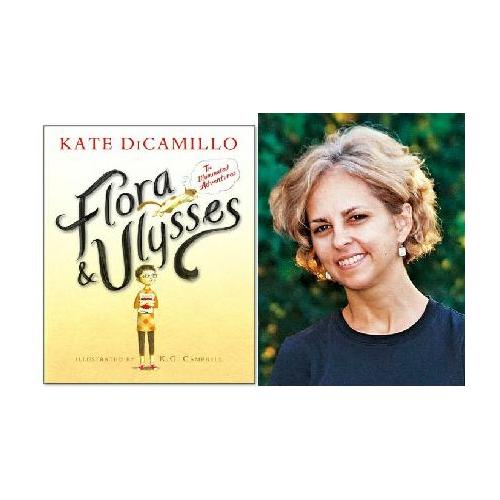
Kate DiCamillo stood in the nave of Riverside Cathedral, her curly hair barely visible over the podium, her voice clear and strong as she delivered the keynote address for the 85th Teacher’s College Reading and Writing Project Reunion (October 19, 2013).

She was exactly as advertised from the information on her website, “I am short. And loud.”

kate-dicamillo-floraandulyssestheilluminatedadvent-68She addressed the packed house of literacy teachers, some 2000 strong, who knew her as the author of Because of Winn-Dixie (a Newbery Honor book), The Tiger Rising (a National Book Award finalist), and The Tale of Despereaux (winner of the 2003 Newbery Medal), but her morning speech was about her latest book, Flora and Ulysses. She set the stage with her opening proclamation:

“This story begins as stories often do with a vacuum cleaner.”

Not just any vacuum cleaner. The vacuum at the center of this story was a 1952 tank Electrolux 2000, a treasured appliance belonging to DiCamillo’s mother. How treasured? DiCamillo joked that when her mother who was ill moved to be with her in Minneapolis, Minnesota, she worried more about the safe delivery of the Electrolux to the new home more than her own personal safety.”I want you to know that you can have the Electrolux when I am gone,” her mother told her. “It’s a really good vacuum cleaner,” she said and added, “The cord is extra long…and its retractable.”

The audience of teachers laughed; DiCamillo’s dry delivery in describing her mother’s attachment to a housecleaning appliance was part retrospective for the older teachers and part kitsch for the newer ones. “Remember the Hoover?” DiCamillo quoted her mother as saying, “that Hoover was useless!” But as she recounted how her mother’s illness progressed, the appreciation for this appliance took on new significance. “I really hope you will take the Electrolux,” her mother told her, “that makes me feel better.” So when her mother passed way, DiCamillo did take the Electrolux, but put it in the garage through that winter.

She spoke how in those dark days after her mother’s death, she found comfort in a poem by Rainer Maria Rilke, from Rilke’s Book of Hours: Love Poems to God and she read the lines from the short poem:

“God speaks to each of us as he makes us,
then walks with us silently out of the night.
These are the words we dimly hear:

You, sent out beyond your recall,
go to the limits of your longing.
Embody me.

Flare up like a flame
and make big shadows I can move in.
Let everything happen to you: beauty and terror.
Just keep going. No feeling is final.
Don’t let yourself lose me.

Nearby is the country they call Life.
You will know it by its seriousness.

Give me your hand.”

She reflected that when her mother was dying, she had held her mother’s hand in comfort, an action profoundly different from all the ways her mother had taken her hand when she was younger. The crowd was visibly moved by this retelling of the loss of her mother, but in typical DiCamillo storytelling fashion, her speech then veered off to include the death of a squirrel.

Shifting from the pathos for her mother, DiCamillo recounted that one day, a dying squirrel had chosen the front steps of her home as the last stop on his final journey. His eyes were open, yet unseeing; his chest dramatically heaving with his last breaths.
“I didn’t want him to suffer and die on my front steps,” she bemoaned.
So, she called a friend.
“‘There’s a squirrel on my front steps…He’s dying’,” she told her friend (Carla), “‘what should I do?'”
The advice she received from her gentle and humane friend appalled her.
“‘Do you have a shovel…and a tee shirt?'” asked Carla.
DiCamillo admitted that she had a shovel, but that she “moved away from the front door so the squirrel would not hear what was being said.”
“‘Put the tee shirt over the squirrel, and I will come over and hit him with the shovel,’ replied Carla.”

Fortunately, before that plan could be executed, the squirrel had crawled away.
“He may have heard us, or he had moved to get away from my presence,” said DiCamillo. The same people who had been tearing up from from the death of her mother and the power of the Rilke poem were now laughing out loud; the cathartic shift in emotions had been seamless.

DiCamillo then told the audience that she considered her reaction to the dying squirrel was not unlike the reaction of E.B.White in an essay he published in The Atlantic, “The Death of a Pig”:

 “He came out of the house to die. When I went down, before going to bed, he lay stretched in the yard a few feet from the door. I knelt, saw that he was dead, and left him there: his face had a mild look, expressive neither of deep peace nor of deep suffering, although I think he had suffered a good deal. I went back up to the house and to bed, and cried internally – deep hemorrhagic intears.”

“White claimed that his novel Charlotte’s Web was not connected to this essay…but could this event,” DiCamillo speculated, “have been more?”
She paused to consider their mutual despair over loss.
“He wanted to keep the pig alive….I wanted to keep the squirrel alive.”

And in that instant, a cathedral full of teachers understood that great ideas do not happen in (pardon the pun) a vacuum. DiCamillo’s speech illustrated how the three seemingly unconnected elements in her keynote address were the elements of story she combined in her latest book Flora and Ulysses.

In this story, there is a vacuum, a squirrel, a shovel, and several lines of the Rilke poem.
To be more specific, there is the near death experience of the squirrel, mistakenly sucked up by the Ulysses 2000; there is a comic-book superhero aficionado who intervenes; and there are several drafts of meta-physical squirrel poetry.  The story has the “beauty and terror” from the Rilke poem as well as the giving of a hand for comfort. There are what DiCamillo terms, “eccentric, endearing characters” presented in a format that combines print with comic book styled illustrations. Like the keynote address, the novel plucks at both the heart and the funny bone; it is a wonderful story.

The biography on DiCamillo’s website reads, “I write for both children and adults, and I like to think of myself as a storyteller.” Listening to her speak, I cannot think of her as anything else.

The rain set early in to-night,
The sullen wind was soon awake,
It tore the elm-tops down for spite,
And did its worst to vex the lake:

In other words, “It was a dark and stormy night.” Thus begins the poet’s Robert Browning’s dark and disturbing dramatic monologue, Porphyria’s Lover, a portrait of a madman that is wonderful to read with students around Halloween. I usually use an audio recording that I can play, and I pause the recording twice as we listen.

The unnamed narrator of the poem sits in a cold cabin, a rendezvous with his lover, Porphyria, who “glides in” as she

…shut the cold out and the storm,
And kneeled and made the cheerless grate
Blaze up, and all the cottage warm;

The narrator’s isolation in the gloomy setting takes on the tone of an illicit romance as Porphyria removes her wet clothing in order to

… let the damp hair fall,
And, last, she sat down by my side
And called me.

But when the recalcitrant narrator does not respond, Porphyria increases her ardent attentions

She put my arm about her waist,
And made her smooth white shoulder bare
And all her yellow hair displaced,
And, stooping, made my cheek lie there,
And spread, o’er all, her yellow hair,
Murmuring how she loved me-

Porphyria’s devotion to the narrator is extreme, expressed in his words “passion”  and “worshipped.” He acknowledges that she could “give herself to me forever” even as she had “come through wind and rain” for this meeting.  This “surprise”

Made my heart swell, and still it grew
While I debated what to do.
That moment she was mine, mine, fair,
Perfectly pure and good:

The narrator revels in this epiphany; Porphyria’s devotion is at its zenith. His reaction seems predictable to my students, and they eagerly anticipate  the romantic tumble they have expected since Porphyria entered the cabin. After all, the word “lover” is in the title.

Yet, the next five lines take a decidedly different turn. The narrator dispassionately admits,

…I found
A thing to do, and all her hair
In one long yellow string I wound
Three times her little throat around,
And strangled her.

Here is where I pause the recording as my students take a moment to comprehend what they have read. Their reactions generally follow this script:

“Wait a minute!”
“What did he do?”
“He ...killed her?”
What is going on here?”

I direct them back to the poem so they can hear the voice of the narrator explain his actions, and his explanation is chilling. “No pain felt she;” the narrator continues, as if to assure my students, “I am quite sure she felt no pain.” As if to prove his judgment, he opens her closed eyes, loosens the hair from her throat, and places a “burning kiss” upon her cheek. Again, the students react in shock:

“This guy is sick!”
“He KISSED her??”
“Ewwww…”
“Why did he do it?”

Why did he do it indeed? The narrator calmly continues to explain his reasons as Porphyria’s head, limp and lifeless, leans upon his shoulder,

The smiling rosy little head,
So glad it has its utmost will,
That all it scorned at once is fled,
And I, its love, am gained instead!

The narrator’s twisted logic in claiming Porphyria’s life in a moment of pure love is so perverse that students are horrified. The final shocker comes as the narrator confidently claims that the murder of Porphyria was something desirable,

Her darling one wish would be heard.
And thus we sit together now,
And all night long we have not stirred,
And yet God has not said a word! –

“He’s a monster.”
“He’s crazy.”
“He is insane.”

Browning’s poem that chronicles a deadly obsession is an excellent addition to the Halloween literary repertoire. The high interest monologue engages students in the “close reading” required by the Common Core.

A close reading can be accomplished by dividing the poem into sections and asking students to identify if the line can be placed into categories:

  • establishing setting
  • poetic technique (metaphor, personification)
  • character development
hair-piece-ponytail-with-draw-string-613-bleach-blonde-longer-length-ponytail-20-inches--401-p

Blonde hair!

Students are encouraged to make adjustments based on their group discussions or to create their own categories.  Once they have categorized the lines, they create large posters that “illustrate” the lines literally or symbolically. They draw or use images that they find online or use photos; then they share the posters which are hung around the room and explain how these details serve the author’s purpose in creating an unforgettable character who is a madman.

Come this Halloween, if you are looking for a poem to send shivers down the spines of your students, try Robert Browning’s “Porphyria’s Lover”.

Try not to think that this frightening portrayal of insanity was created by the husband of Elizabeth Barrett Browning, famous for the poem “How Do I Love Thee? Let Me Count the Ways.”

You can save that sonnet for Valentine’s Day!

The education reformers often look back to see what lessons can be learned from the past in order to direct the future, and the recent article in The Wall Street Journal  “Why Tough Teachers Get Good Results” (9/27/2013) by Joanne Lipman integrates current research to the old-fashioned teaching techniques of her former music teacher, Jerry Kupchynsky. After creating a nostalgic portrait of a demanding educator, Lipman posed the questions, “What did Mr. K do right? What can we learn from a teacher whose methods fly in the face of everything we think we know about education today, but who was undeniably effective?“ She continued:

Comparing Mr. K’s methods with the latest findings in fields from music to math to medicine leads to a single, startling conclusion: It’s time to revive old-fashioned education. Not just traditional but old-fashioned in the sense that so many of us knew as kids, with strict discipline and unyielding demands. Because here’s the thing: It works.

In responding to her own questions, Lipman listed out the eight factors that were the hallmark of Kupchynsky’s teaching style, a style that Lipman admits would be controversial. She writes, “Today, he’d be fired.”

The tenets of Kupchynsky teaching method were summarized by Lipman as:

  • 1. A little pain is good for you.
  • 2. Drill, baby, (kill and) drill.
  • 3. Failure is an option.
  • 4. Strict is better than nice.
  • 5. Creativity can be learned.
  • 6. Grit trumps talent.
  • 7. Praise makes you weak…
  • 8.…while stress makes you strong.

I also grew nostalgic reading the article. I doubt Kupchynsky ever had to mention his objective. He never was mandated to place the Common Core Teaching Standards in a visible location at all times or worry about collecting data from formative assessments to inform his instruction. This was a man who knew his discipline and was disciplined in his teaching. The evidence was in the success of his students:

Some were musicians, but most had distinguished themselves in other fields, like law, academia and medicine. Research tells us that there is a positive correlation between music education and academic achievement.

This story about Jerry Kupchynsky’s teaching came to mind when I heard Teacher’s College Reading and Writing Project  (TCRWP) Director Lucy Calkins speak this past Saturday at Columbia University at the 85th Reunion (10/19/2013).

Calkins offered an afternoon session about “Leading From Within: Turning Schools into Places Where Everyone’s Learning Curve Is Sky High” and her opening wry comment, “This session could be titled ‘Staying Alive in a Toxic World’,” was met with appreciative laughter by the audience of educators jammed into the large meeting room.

Calkins immediately addressed the reform efforts, teacher evaluation programs, and the Common Core State Standards.  “We cannot control what happens to us,” she stated clearly, “but we can control our reactions.”

She discussed how her acceptance of the Common Core, detailed in her book Pathways to the Common Core, has put her on the outs with many education reformers, and she acknowledged with some frustration that the “350 billion on tests and technology…nothing left for support for teachers and kids,” angers many educators.

Against these controversies, she asked, “Is there a way for us to move students/our work forward?”  and she explained that in trying to find that way, many opportunities have been presented to TCRWP, and that the pressures in this environment, “Can lead you to do really problematic things.”

She paused for a moment and then said, “Sometimes to say ‘no’ is good.”

The room was quiet as the teachers in the crowded room considered what Calkins meant.

“The ‘nos’ protect your brand,” she said emphatically, “the ‘nos’ define your brand. If you do not say no, then you have no brand…but we must be evidence based when we say ‘no’.”

Lipman’s music teacher Kupchynsky had a brand.  I imagine he said “no” quite a bit. Consider how easily “no” fits into seven of the eight ways his brand was defined. For example, “no pain, no gain” is the same as “a little pain is good for you.” Even the idea that “creativity can be learned” refutes the commonly held belief that people are born with creativity or they are not.

The Kupchynsky model worked because he knew his discipline and the direction he wanted for his students; he had a brand.

The Calkins model works because she knows her discipline and the direction she takes as she pushes the teacher leaders at the TCRWP; she has a brand.

noThe toughest teacher in the room, however, does not have to employ the Kupchynsky methods of teaching; given today’s climate, the behaviors detailed in the article could lead to a dismissal.  The toughest teacher in the room can be quiet and unassuming, yet someone who is passionate and skilled in a discipline.

The toughest teacher in the room has a brand, and like all brands, one that is defined by “nos”. The toughest teacher in the room says “no” to excuses from any stakeholder that stops student achievement in the classroom.  The result can be a brand of teaching that possesses the “unyielding demands” like those made by Kupchynsky, the brand of teaching that provides evidence reported in a newspaper article some twenty years later by a former student.

messy-desk_2637008b

Research shows that chaos can lead to creativity

Own a messy desk?

Envy the organized?

Fear criticism from the orderly?

Well, be ashamed no longer. A messy desk can be a sign of creativity. A recent article in the NYTimes What a Messy Desk Says about You  (September 22, 2013) centered on a study at the University of Minnesota that compared the neat office environments of individuals with the messy office environments of others. The research shows that imagination favors the cluttered.

This may be particularly encouraging to those who, despite having invested in fancy organization systems, are unable to maintain the uncluttered look of an office in a magazine or catalogue spread.

I am particularly happy to read the results of this study since the mound of papers on my desk from September to June is never completely dissipated. A good week of planning lessons and grading papers creates a small foothill; a bad week mimics a towering mudslide. Reading that apologies for the mess are not necessary for my desk’s appearance is vindication.

As evidence, researchers under the supervision of behavioral scientist Kathleen D. Vohs organized an experiment using college students.  The students were placed in in adjacent office spaces and given a series of tasks to complete. One of the offices was “exquisitely neat”; in contrast, the other office was “wildly cluttered”.  The students filled out questionnaires that had nothing to do with the study and after several minutes, were dismissed. As the students left the two different surroundings, they were offered the choice of an apple or a chocolate bar. As expected, those emerging from the tidy location chose the healthy apple; those who spent even a short time in chaos grabbed the chocolate bar.

The experiment, however, produced unexpected results when those college students were placed again in those messy or neat offices and asked to dream up new uses for Ping-Pong balls:

Those in messy spaces generated ideas that were significantly more creative, according to two independent judges, than those plugging away in offices where stacks of papers and other objects were neatly aligned.

According to the results that were  published online last month in Psychological Science, the theory that a chaotic environment can only produce more chaos has been brought into question. Dr. Vohs and her co-authors conclude in the study, “Disorderly environments seem to inspire breaking free of tradition, which can produce fresh insights.” Apparently, an office with all the things out of the box can lead to thinking that is out of the box.

The school year is new, and there will be challenges ahead. I look at my own messy desk and consider that the pile of papers on my desk may be the secret to producing new and creative solutions. Where glossy magazine spreads are a minimalist tease, the desk in my office reflects the clutter of my challenging day. Where Ikea has failed, this small study has given me hope.

Take that, Martha Stewart, and hand me that bar of chocolate!

The viral video that came through my e-mail last week had nothing to do with cats. Instead, this video showed the singer and actress Kristen Chenoweth sharing a duet with an audience member. Apparently, this opportunity is extended to concert goers on a regular basis by Chenoweth who invites a member of the audience to sing the Elphaba role in the duet, “For Good” from the musical Wicked (Music and Lyrics by Stephen Schwartz; based on the book Wicked by Gregory Maguire).

On this particular night, the selected audience member was Sarah Horn, a voice teacher, who as fate would have it was wearing a green shirt and a floor length green skirt with straight hair and black rimmed glasses. Horn noted in her recollection of being chosen, “How much more Elphaba-looking can a regular gal get?”

Horn strode across the stage of the Hollywood Bowl; she towered over the petite Chenoweth and, with the glee of a child opening the best present ever,  proclaimed to delight of the crowd, “I’m on stage with Kristen Chenoweth!”

The music began with Chenoweth firmly in control. “I’m Glinda,” she said, and began singing her duet’s part:

I’ve heard it said
That people come into our lives for a reason
Bringing something we must learn
And we are led
To those who help us most to grow
If we let them
And we help them in return
Well, I don’t know if I believe that’s true
But I know I’m who I am today
Because I knew you…

There was a pause in the music, and Chenoweth put up her hand to indicate she had one more verse to sing. “Still me,” she said. The crowd giggled, and she completed her verse:

Like a comet pulled from orbit
As it passes a sun
Like a stream that meets a boulder
Halfway through the wood
Who can say if I’ve been changed for the better?
But because I knew you
I have been changed for good

Then Chenoweth stepped back. Sarah Horn stepped in, and the song took off when Horn’s clear voice began:

It well may be
That we will never meet again
In this lifetime
So let me say before we part
So much of me
Is made from what I learned from you
You’ll be with me
Like a handprint on my heart
And now whatever way our stories end
I know you have re-written mine
By being my friend…

There was an immediate response from the crowd; Horn was amazing! The conductor of the Los Angeles Philharmonic Orchestra stopped to turn around (twice) to see who was singing. One imagines him thinking, Is this a plant?
But the best reaction comes from Chenoweth, whose delight at having so capable a voice to sing this duet with is clearly visible to the viewer.

That moment is captured on a handheld camera, but what makes the recording is so powerful is that it captures the moment of risk. The ever-gracious Chenoweth is practiced in taking this risk. There are many videos on YouTube that place her onstage in other concert venues with an audience member singing “For Good.” These recordings capture her saying “Still me…” at the musical pause at the end of the first verse; she knows how to coach the selected partner when to begin. The moment a new Elphaba opens her mouth, Chenoweth wants to make sure she enters on the right musical cue.

Sarah Horn hit that musical cue entrance, and every other musical note after that, to the delight of the crowd and to Chenoweth. She accepted the challenge that Chenoweth offered and took a risk. Chenoweth’s enthusiasm was matched in the power of their duet and the praise she heaped on Horn at the end.

The word risk has a dark side; according to the Merriam Webster Online Dictionary, risk means: “the possibility that something bad or unpleasant (such as an injury or a loss) will happen.” There was certainly the great possibility that Sarah Horn might have failed; her reputation as a voice coach was out for judgment. That great risk, however, was matched with great reward. To date the video has just about 3 million hits, and Horn had her experience published on the Broadway World blog.

The same can be said for those teachers and coaches that offer their students the opportunity to take a risk. The lyrics of “For Good” reflect the ideals of education where “we must learn”; where “we are led” in order “to grow.” In schools, teachers and coaches empower students to risk being noticed on a variety of stages: the classroom, the auditorium, the athletic fields, etc. They practice to prepare the student to take a risk. They encourage their students to risk what may be the criticism of others. They signal the student to “the cue” that starts the risk, and they may have the opportunity to delight in watching the student succeed.

Teachers and coaches who support students know that a school environment is protected space, and that failure in the protective space of a school provides an ideal space to practice risk. Yet there are moments when the teacher or the coach, like Chenoweth on the video, must step back for the student step to forward into “the the possibility of danger”.  

Risk empowers students. Risk changes students. Risk prepares students for real life. Teachers and coaches who allow students the opportunity for risk are like those “Glindas” to their student “Elphabas” in a different kind of duet, but a duet with the same message as the lyrics of the song:

(Glinda):
And because I knew you…
(Elphaba):
Because I knew you…
(Both):
Because I knew you…
I have been changed for good…

“Inconceivable!” Rigor

September 3, 2013 — 4 Comments

Some of best lines in the film The Princess Bride are given to the assassin-for-hire Vizzini. For those unfamiliar with this classic film, Vizzini’s repeated use of the word “inconceivable” is finally challenged by the vengeance-seeking swordsman Inigo Montoya while they stand overlooking a cliff watching the Dread Pirate Roberts climb in pursuit:

[Vizzini has just cut the rope The Dread Pirate Roberts is climbing up]
Vizzini: (enraged)  HE DIDN’T FALL? INCONCEIVABLE!
Inigo Montoya: You keep using that word. I do not think it means what you think it means.

I believe the same misunderstanding is happening when education reformers overuse the word “rigor”. This word is tossed about by education reformers who do not demonstrate an understanding of what rigor means. To clear up any confusion, here are three definitions of rigor according to Vocabulary.com:

1 n excessive sternness
“the rigors of boot camp”
Synonyms:
hardness, harshness, inclemency, rigorousness, rigour, rigourousness, severeness, severity, stiffness
Type of:
sternness, strictness
uncompromising resolution

“Excessive sternness” sounds like a  workhouse/boarding school from a Charles Dickens novel, while “boot camp” is an altogether different kind of training. Both interpretations are not tied to 21st Century skills. How do education reformers who  create the rigor of “uncompromising resolution” help to make students career and college ready when cooperation and collaboration are part of 21st Century skills?

The second meaning:

2. n something hard to endure
Synonyms:
asperity, grimness, hardship, rigorousness, rigour, rigourousness, severeness, severity
Types:
sternness
the quality (as of scenery) being grim and gloomy and forbidding
Type of:
difficultness, difficulty
the quality of being difficult

“Something hard to endure” is how many high school students do feel, enduring school as a requirement.  Many employ a degree of “difficult-ness” in order to stop class. “Grimness” and “hardship” are not qualities that encourage students to do well or succeed. Education reformers who seek to make schools “forbidding” with rigor sound as though they want to eliminate schools.

The third meaning:

3. n the quality of being valid and rigorous
Synonyms:
cogency, rigour, validity
Type of:
believability, credibility, credibleness
the quality of being believable or trustworthy

Here at last is a definition that addresses one quality needed for education- “validity”. Yes, there should be validity to information in school and a way to measure student understanding of information in order to be credible. A synonym to validity is “the property of being strong and healthy in constitution”. Education reformers should substitute rigor with validity in order to promote better attitudes towards improving education.

So how did rigor become so misused? In 2008, education advocate Tony Wagner called for a new definition of “rigor” according to 21st Century criteria. In an article published in ASCD Magazine titled “Rigor Redefined” he indicated that:

 “It’s time to hold ourselves and all of our students to a new and higher standard of rigor, defined according to 21st-century criteria. It’s time for our profession to advocate for accountability systems that will enable us to teach and test the skills that matter most. Our students’ futures are at stake.”

Wagner suggested the following criteria:

  1. Critical Thinking and Problem Solving
  2.  Collaboration and Leadership
  3. Agility and Adaptability
  4.  Initiative and Entrepreneurialism
  5. Effective Oral and Written Communication
  6.  Accessing and Analyzing Information
  7.  Curiosity and Imagination

Note that there is nothing about severity or harshness in Wagner’s recommendations for rigor in education. Unfortunately, the Draconian definition from Vocabulary.com is the one that most often captures the attitude of education reformers and politicians who call for tougher standards, increased testing, and more (home) work in order to create an impression of rigor in making school more demanding. Their misuse of what Wagner sought by using the word rigor fails to include higher order thinking skills, problem solving or the significance of imagination.

Therefore, when education reformers misuse the word rigor to mean more demanding lessons or tests so difficult that students cannot possibly succeed, I propose teachers respond with by saying the word “Inconceivable!”

When education reformers misuse the word rigor as a means to evaluate student or teacher performance with tools that only measure basic comprehension skills without addressing any creative problem solving, I propose teachers respond again with the word “Inconceivable!”

And if education reformers continue to misuse the word rigor to describe what is lacking in curriculum at every grade level, I propose teachers stop and correct the reformers, with or without Inigo Montoya’s accent, and say, “You keep using that word …I do not think you know the meaning of that word!”

My school district completed four days of first class professional development that began with a visit from Dave Burgess, the author of Teach Like a Pirate and ended with faculty-led collaborative committees organizing for an accreditation visit from the New England Association of Schools and Colleges (NEASC).  In four short days, the veteran teachers adjusted, organized classrooms, and prepared the first week of lessons. The administrators indicated that schools were off to a “great start”  while the facility management personnel finished polishing the floors and touching up wall paint. One group however, looked different.

teacher appleThe new teachers’ eyes glazed over. Although some have taught for years in other districts, each one has been lost in the labyrinth of our hallways at least once this past week. There are at least fifty names they still need in order to match staff to academic disciplines and a number of faces before they begin to match their attendance rolls with students. The location of materials for various units of study has yet to be established; boxes are unopened in their classrooms.

In short, they are whelmed. Merriam-Webster online defines whelmed as

1. to turn (as a dish or vessel) upside down usually to cover something : cover or engulf completely with usually disastrous effect
2. to overcome in thought or feeling : overwhelm

According to the dictionary, there is no “over” in being “overwhelmed”. Watching the newest members of the faculty trying to mentally sort through the information they had taken in the past four days reminded me of how I felt my first few years of teaching. Putting “over” with whelmed seemed redundant; I was “engulfed completely” my first years of school as well.

Twenty-three years later, I am less whelmed by the start of school, but I still have to adapt. There are always new materials, new changes to schedules, new students to get to know. In 2013-2014 there is also a new state mandated teacher evaluation system and a set of new tests will be rolled out this year to measure the new Common Core State Standards. For these new-to-district teachers, the flood of information in the early days of the school year must seem insurmountable. There is research, however, that indicates with three years of practice, teachers develop strategies for being effective in improving student achievement in the classroom.

In particular, there is research that demonstrates that “teachers in their first and, to a somewhat lesser extent, their second year tend to perform significantly worse in the classroom” (Rivkin, Hanushek, and Kain -2005). In a follow-up interview to this study, Kati Haycock was quoted in Education Next as saying,

“And experience does matter for inexperienced teachers. As a group, first-year teachers tend to be less effective than those with even a little more experience, and effectiveness tends to climb steeply for any given cohort of teachers until it begins to plateau after a few years. According to research by Eric Hanushek and others, disproportionate exposure to inexperienced teachers contributes to the achievement gap.”

How a teacher develops on a learning curve is significant for both the teacher and the students, which is why the story from Mokoto Rich of the New York Times At Charter Schools, Short Careers by Choice (8/26/2013) flies in the face of both anecdotal data and research studies. The article addressed the high turnover rate of teachers in charter schools by first highlighting the story of 24 year-old teacher, Tyler Dowdy. With two completed years of teaching behind him, Dowdy is “exploring his next step, including applying for a supervisory position at the school.” The article described him as someone, “who is already thinking beyond the classroom, wants something more.” His interest in education appeared cursory, “I feel like our generation is always moving onto the next thing,” he said, “and always moving onto something bigger and better.”

Supporting Dowdy’s lack of commitment to the profession, was the statement by Wendy Kopp, founder of  Teach for America (TFA)  who said,

“Strong schools can withstand the turnover of their teachers…The strongest schools develop their teachers tremendously so they become great in the classroom even in their first and second years.”

Kopp’s claims, however, have little credibility considering her own lack of classroom experience. While she has taken TFA from a $22 million dollar enterprise in 2003 to a $244 million dollar business in ten years before her departure this year as CEO, there is no record of her creating or delivering lessons to students herself. She has not had the experience of developing or implementing classroom management skills, a major cause of much teacher turnover.  Teachers, new and old, experience first-hand the fallacies in her argument. Yes, during the first years, teaching can be greatly improved, but that does not mean a new teacher has become “great”. Like so many educational reformers without classroom experience, Kopp dismisses critical teacher training as something that can be condensed, like TFA’s five week summer teacher preparation program.

A five week training for TFA is luxurious compared to the two and a half weeks of training over the summer for other teacher training programs, such as the YES Prep program like Dowdy’s, where new teachers “learn common disciplinary methods and work with curriculum coordinators to plan lessons.” Yet, these teachers from these accelerated programs will look the way new recruits in my district look, glazed and anxious. These teachers will soon learn the importance of experience. They will understand that the only way to learn how to teach is to practice teaching over and over and over….in spite of being whelmed.

Back to school soon, eh?
Gotta go back to work?
The long vacation almost over?

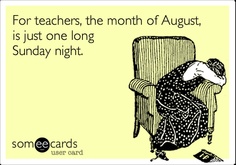
August sunday nightI hear these comments from friends and relatives the last days of August. Acquaintances who pass with a quick “How are you?” any other time of year, now take time to gloat and ask, “Back to the grind, right?” Apparently, they are under the impression that I have not thought about school these past weeks of relaxed responsibility. To the contrary, for the past eight weeks, I continued to think about school.

While summer vacation allowed me the opportunity to catch up on reading for pleasure, some of the books I read this summer (The Fault in Our Stars by Jon Green, When She Woke by Hillary Jordan),  are ones I plan to share with my students. Summer allowed me the opportunity be a student and to take classes to improve my understanding of instructional strategies. Cris Tovani’s book, Do I Really Have to Teach Reading? was particularly interesting as a resource to share with content area teachers.  Finally, during the summer I had long stretches of uninterrupted time to think and to write.  Consequently, the activities I pursued in the summer are not unlike the activities I pursue during the school year. The difference is that I do not have to complete reading or writing during July’s halcyon days at the almost breakneck speed I use from September to June. Even in these days of leisure, the classroom is never far from my mind. August’s arrival signals an end to the unhurried pace practiced by those in other professions.

For teachers, there is a great deal of physical preparation to teach: preparing the classroom, preparing the materials, and preparing the kidneys to go hours on end. There is also the emotional preparation for the highs and lows that will follow for the next 38 weeks of school. Teachers know that setting the right tone on Mondays can make  a huge difference on the academic success of a school week. Which brings me to the importance of Sunday night.

Sunday night is for planning.

Those hours before the beginning of any school week are fraught with detailed lists of necessary supplies, schedules for delivering instruction, and aggressive strategies to beat other teachers to the copier on Monday mornings.

Those few hours before the Monday morning announcements are also exciting as planned lessons, packed with potential, sit ready to be deployed. Sunday nights are full of promise.

Therefore, August is the Sunday night of the school year. Teachers mentally planned bulletin boards, unpacked supplies, arranged classroom furniture, and put their last touches on unit plans before they set a foot in their classroom. On that first day of school-that first day of the week- their preparations will pay off.

So, yes, to those who have asked; the long vacation is over. But going “back to school”? I really never left.