Archives For November 30, 1999

The teachers at the professional development session were visibly frustrated; I could hear the irritation in their comments. The presentation on the use of digital technology was to help them improve digital literacy across the content areas, but many of the sites in the demonstration were blocked by the school’s Internet filter. I sympathized with their frustration because just three years ago, I was like them. Three years ago, our school’s Internet filter blocked everything.blocked youtube

Back then, members of my English department were finding excellent resources to use to teach the novels All Quiet on the Western Front, The Crucible, and the memoir Night. Unfortunately, many of these resources were unavailable because they were on YouTube or had descriptors such as “witchcraft in Salem, Massachusetts” or “Nazi” that were blocked by our filters. The filters were useless to a large degree since many of the students knew a variety of different strategies to get around each filter. So, the irony was that the students had access where the teachers did not.

Furthermore, the students were having a rich and very authentic experience of using the Internet outside of school. Once they came into our building, however, they were detached from the very technology that they would need to use in their future. Our school web filters  created an “un-authentic” web experience for our students. We were losing the opportunity to teach them digital citizenship because they were not digital citizens.

Fortunately, our administration took the position that teaching our students 21st Century skills meant that they should have access to the Internet in a technology rich learning experience. The filters were minimized. Our acceptable use policy was enforced, and teachers and students had access to the Internet resources.

We moved from exclusively computer lab use to 1:1 netbooks in English/Social Studies to a “Bring Your Own Digital Device” (BYOD) over the course of the next two years, and now, two years later, I can testify that unblocking the Internet has not created a problem for teachers or students. Yes, the students can watch YouTube videos, but they also make videos and share them with other students. They make videos for our “Friendship and Respect” Assemblies and share these on YouTube; they watch Oscar winning films for Film and Literature Class that are on YouTube; they embed YouTube videos into their blogs.

Furthermore, our students have access to the Internet to meet the state adopted Common Core Literacy Standard:

CCSS.ELA-Literacy.CCRA.W.6 Use technology, including the Internet, to produce and publish writing and to interact and collaborate with others.

Of course, our students are not perfect, and their behaviors using the Internet at school are not always tied to curriculum. I once came upon a group of young men huddled around a computer screen one morning. They were watching a video, and as I grew closer, I could hear a voice say, “She’s a beauty…” and another agree, “Oh, I want her!” I feared the worst, but when  I came up behind them to see what was on the screen, I got a eyeful of a 2006 Ford F250 XLT Powerstroke Turbo Diesel Pick Up Truck. Curriculum? No. Authentic experience? Yes.

The frustrated teachers who were sitting in the professional development asked what steps they could take to have their administrators review acceptable use policies and open the Internet filters for their students. They discussed looking at other school districts’ acceptable use policies. Perhaps there might be some testimony about the success of unlocking an Internet filter?

This post is one such testimony, and I offer this to any teacher that is looking to “unblock” the Internet in order to engage students in developing 21st Century skills. We are already in the second decade of this 21st Century, and the skills necessary to use the Internet are becoming more valuable in this Information Age. According to the 2012 data, using the Internet is a real world experience for 2,405,518,376 people. That is 1/3 of the world’s population, and there has already been a 566% increase in use since the beginning of the new millenium.

Our students are counted in those numbers already. While they use the Internet outside of school for social media; they should be taught to use the Internet for education and productivity in school. So once they have access to YouTube, they can never go back…they will only go forward.

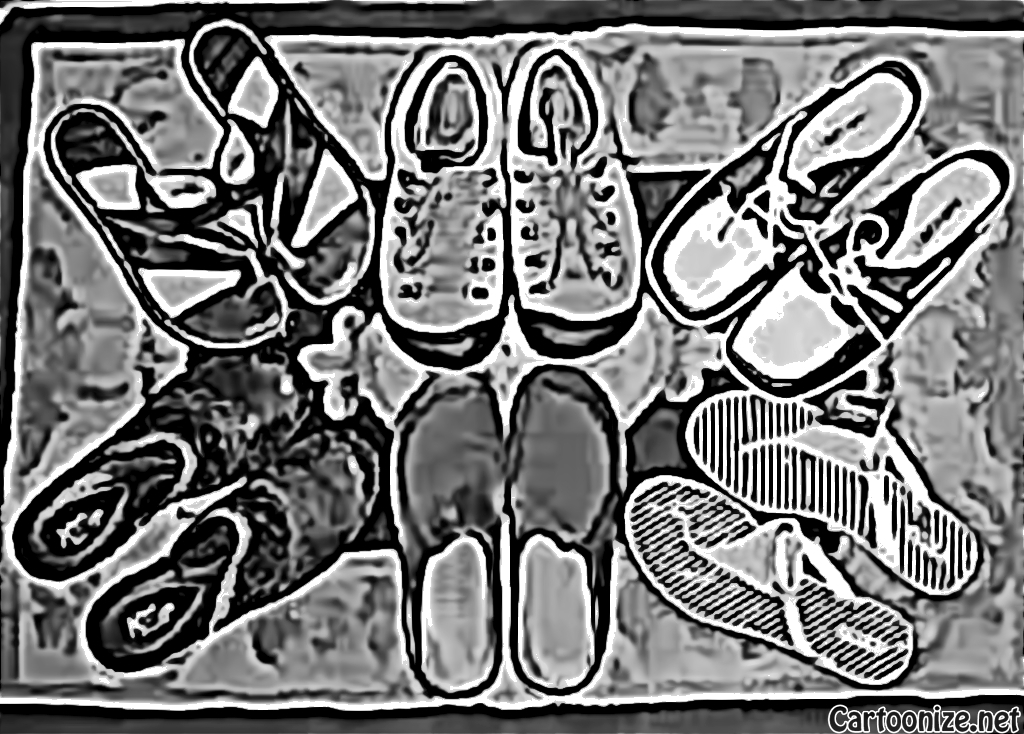
Sensible shoes dominate the NCTE Conference.

Spotting an English teacher in the crowds moving through the glitzy MGM Conference Center in Las Vegas is easy. Just look for the sensible shoes.

English teacher stamina is the stuff of legend, built up through hours of standing in front of a class, negotiating the space between groups of students and book bags tossed casually on the  classroom floor. We have perfected the quick sprint down a hallway to the copier for extra copies of a quiz or test.  Yes, we have learned from experience the necessitiy of wearing sensible, comfortable shoes. Our footwear choices came from our hard fought classroom experience, and that training was key to participation at the National Council of Teachers of English Conference (NCTE) since the MGM conference center has cavernous corridors and sessions are scattered over several acres of property. We walk, we walk, and we walk…quickly! There are hundreds of sessions, and only a few days to share new ideas and improvements to pedagogy.

“Dreams. Connect. Ignite.” is the motto of this NCTE 102nd Conference. While I have not personally witnessed much in the way of dreaming, the igniting is thankfully limited to the videos of pyrotechnics that are an element in the  Cirque de Soleil show “Ka.”. But I have participated in and witnessed plenty of connecting. My year of tweeting on Twitter has paid off!

Twitter gives teachers the opportunity to communicate with other teachers; to form communities of educators who ” follow” other educators. This is a very individualized form of professional development since I can pick those educators who are most helpful to me in helping me improve my practice. While I am attending sessions, I tweet what I am learning as notes to myself and to others.I  use the hashtag #NCTE12 to share my thoughts with other attendees. I have discovered many educators through the English Companion Ning and specific Twitter streams with hashtags such as  #engchat, #edchat, and #sschat. I follow the Twitter stream of conferences I attend, and my own school district’s stream #rsd6.

Here at the conference I have met other educators with whom I have been communicating over the past year, and the conversations we have had face to face are simply an extention of what we have been saying online. I have enthusiastically shared my use of Twitter with other attendees; “Look, you have to get on Twitter and follow this (speaker, educator)!” I greet those who tweet to me or follow me with the same enthusiasm I would greet old teaching companions. Meeting at this conference, we are free of the 140 character limit, the constant trimming of thought. Face to face we can complete a sentence without an abbreviation or a hashtag.

There are so many offerings at this conference that am I rushing from session to session. I do try and pay attention, however, to those who pass me in the maze of hallways and lobbies, scanning a name tag looking to see if one of attendees passing me might be one of my twitter “friends.” How do I know who to look at? Well, first, I look at the shoes.

The National Council of Teachers of English Annual Convention and the Council on English Leadership Convention begin this weekend (11/15-21) at the MGM Grand in Las Vegas, and I am so delighted to have the opportunity to present with my fellow faculty member, Stephanie Pixley, at three separate sessions. We are able to present to other teachers because of the great support and training our Regional School District #6 (Administration and Board of Education) has given its teachers in the use of technology in classrooms to improve student learning and develop 21st Century skills.

Wamogo High School in Litchfield, Connecticut, is a 1:1 Bring Your Own Digital Device (BYOD) school for grades 9-12, and we are learning everyday how our students’ use of technology has helped us differentiate our instruction, increase our students’ independence, and allow us to provide authentic tasks for our students. Last year, we used netbooks in our English and Social Studies classes and found how successfully technology could be used in reading and writing workshops at every grade level. This year, those netbooks have been moved to grades 7 and 8 for their use, and the high school students either provide their own devices or rent one from the school’s technology department..

The first session we will be offering is devoted to Cormac McCarthy’s novel The Road. We will feature work that the students have completed in using Abraham Maslow’s “Hierarchy of Needs” as a way to analyze characters in this post-apocalyptic novel. We will be demonstrating how our students, “Explore the poetic language of survival in Cormac McCarthy’s The Road the potential of 21st century connectivity and collaboration, and the use of mysteries to enhance students’ critical thinking abilities as presenters share literature experiences in three high school classrooms.”

Navigating the Mind: The Road Meets Maslow’s Hierarchy
Time:  Saturday 11/17 8:00 AM – 9:15 AM
Level:  Secondary (9-12)
Topic of Interest: Literature
Location:  Studio Room 6, Grand Arena, Main Floor by Grand Garden Arena, MGM Grand

The other two sessions will be offered to the Council on English Leadership:

You Ain’t Nothing but a Blog Hound
Monday 11/19 4-5:00 PM
D.3 Room 106

Description: You may already know that a blog platform offers students at all grade levels an opportunity to engage in an authentic writing experience in or outside the classroom. This workshop demonstrates the use of a blog platform for students to engage in thoughtful discussion on whole class or independent reading. This workshop will also feature how to organize, moderate, and assess both blog posts and comments on a variety of blog platforms. There will also be a focus on improving a student’s awareness of audience and purpose in a written response, and strategies will be provided so student comments are more sophisticated than a standard “I liked what you wrote.”

Writer’s Workshop Graduates to High Tech Literature Circles
Tuesday  11/20 10-11:00 AM
F.2  Room 106

Description: This session will feature strategies used in the teaching of writing at the middle and high school levels using a variety of 2.0 technologies, including blogs, wikis, and document sharing software. The emphasis will be on providing examples of differentiated student-centered activities that will develop independence in the writer’s transition from middle school to high school. High-tech writing provides opportunities for student accountability, group collaboration, and whole class communication

(NOTE: This session was presented this at Literacy for All Convention, 11/5 & 11/6 in Providence, RI)

We are looking forward to presenting and attending the wonderful selection of sessions over the next few days. This is certainly a wonderful opportunity for our own professional development and a chance for us to showcase our small but very forward thinking school district-Regional School District #6 !

The impending Hurricane Sandy did little to stop over 2000 teachers from attending the 83rd Saturday Reunion at Teacher’s College at Columbia University on Saturday, October 27. Taking up the microphone in a set of informal welcoming remarks, Lucy Calkins complimented the crowd that had gathered in the Nave in Riverside Church, “So many of you have come here…instead of clearing out storm drains or without stocking up on toilet paper. You have weathered the trip despite the predictions of this ‘Franken-storm’.” The crowd laughed appreciatively.

“Yes. We are in a storm,” she continued with growing seriousness. “Today, we are in a ‘Perfect Storm’ in education, and we must learn to travel these hurricane winds and sail.”

Calkins was referencing the convergence of the Common Core State Standards with educational reform efforts that emphasize standardized testing. Newly designed teacher evaluations tied to single metric tests combined with cuts in funding for public school education because of a stagnent economy have also contributed to this ‘Perfect Storm’. This audience understood her metaphor.

Lucy Calkins is the Founding Director of the Reading and Writing Project LLC and the Teachers College Reading and Writing Project as well as the Robinson Professor in Children’s Literature at Teachers College where she co-directs the Literacy Specialist Program.

Co-authors Lucy Calkins, Mary Ehrenworth and Christopher Lehman all led sessions at the 83rd Saturday Reunion of the Teachers College Reading and Writing Project on Saturday, October 27, 2012

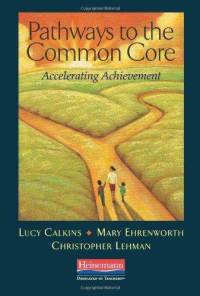
At a session that followed her welcoming remarks titled, “Implementing the Common Core: What’s Working, in Big Exciting Ways, to Engine Dramatic Reforms,” Calkins explained that she would not be delivering a big keynote at this conference on the Common Core, despite her belief that she considers this “most important document in the history of American education.” Instead, she plans to take time off from teaching to tour the country speaking on the Common Core and the book she co-authored, Pathways to the Common Core, in ordercto help school districts with the real work of accelerating students to perform at the level required by the Common Core, noting that “85% of our students are not there.”

Calkins also expressed her concerns that our nation’s history of large-scale educational reform is not good. “We have been sent many times to reform school,” she continued, “we have to be worried that this [Common Core] may be just one more reform.” However, Calkins stated that what works in this particular reform’s effort is the “absolute and total appreciation that what will make the difference is the teacher.” She directly confronted all the teachers in attendance and directed, “You need to be knowledgeable, and read the actual Common Core, not the ‘Publisher’s Guide to the Common Core’.” Her concerns at this conference echo her remarks in March 2012 at the 82nd Saturday reunion where she specifically called out David Coleman, co-founder and CEO of Student Achievement Partners  and who, according to Pathways to the Common Core, “received a  four-year 18 million dollar grant from the GE Foundation to develop materials and do teacher training around the CCSS” (6). Coleman has since moved on to take a position as the President of the College Board. Pathways to the Common Core, co- authored with Mary Ehrenworth and Christopher Lehman, details concerns that this enormous grant and any additional grant money will result supporting those who are “spelling out implications and specifying what they wish the Common Core had said,”(5). Already there has been a growing body of materials that contradict the intentions of the standards:

“There will certainly be additional materials and documents that emerge following this new round of money, with the potential to make similar claims as the Publisher’s Criteria for the Common Core Standards in English Language Arts and Literacy, Grades 3-12 (Coleman and Pimentel 2011)  and the Rubrics for Evaluating Open Education Resources (OER) Objects (Achieve 2011). When documents are presented as if they’ve gone through the process of review and been ratified by the states on subcommittees, it is troubling”(6).

Calkins reminded participants that the crucial difference will be the professional teachers who bring colleagues into their work to build a community of teachers, and that this community should know the Common Core standards.

Turning to the topic of her session, Calkins also explained that some of the most exciting work that was recently taking place on the Common Core  at the Teachers College was with their work with students in argument and debate.

She described the success teachers at the Reading and Writing Project were having with students who participated in read-aloud by gathering evidence for one position or another. For example, students had listened to a reading of The Stray and took notes on different positions. Following the basic rules of debate, students were given the opportunity to caucus with those who held their opinions before debating or refuting their debate partner’s position. In order to model the process with Shel Silverstein’s The Giving Tree, teachers taking one position that the tree was strong stood to caucus with like-minded participants, while those seated conferred with those who agreed with the different opinion that the tree was weak. Calkins directed teachers to stand, sit, debate or caucus, modeling how this might work in a classroom in one 45-50 minute period. She showed several video clips showed students participating in the same process demonstrating the success of using these techniques. “The results were fantastic,” Calkins exclaimed as the videos played, “so exciting to see the students gathering evidence and using the text in their arguments.”

What was evident during her sessions at this conference was that during this ‘Perfect Storm’ in education, Calkins is confidently empowering teachers to sail through what seems to feel like hurricane force changes in the profession. Her efforts in preparing teachers to navigate these new challenges can help insure that while these controversial storms may rage outside, inside the classroom day after day, the teacher is prepared to be the captain of the ship.

Dear Governor Dannel Malloy:

I forgive you for the inflammatory comments about teachers in your State of the State speech delivered last February (2/8/12),   “In today’s system basically the only thing you have to do is show up for four years.  Do that, and tenure is yours.” After all, I  have said some pretty unflattering things about politicians these past few years. Let us agree that professions should not be demonized.

Instead, I would rather provide you with an example of  great professional development for educators by discussing the value of the Connecticut Summer Institute which is a part of the Connecticut Writing Project. Eleven dedicated teachers from different school districts in the State of Connecticut have spent the past four weeks this summer (July 9-August 3, 2012) at the Connecticut Summer Institute organized and taught by Bryan R Crandall  at Fairfield University. These were elementary, middle school and high school teachers, social studies and English, willing to spend a good portion of their summer vacations (for graduate credit) learning how to improve student literacy through writing from 8:30-3:30 daily. A variety of guest speakers  also visited the Summer Institute and shared their writing experiences; there was a a journalist, an author, a poet, and veterans including  co-director Julie Roneson of past Connecticut Writing Project programs. This program is associated with the National Writing Project, an organization dedicated to improving writing at every grade level. The NWP website states:

Writing is essential to communication, learning, and citizenship. It is the currency of the new workplace and global economy. Writing helps us convey ideas, solve problems, and understand our changing world. Writing is a bridge to the future.