Archives For November 30, 1999

Saki

Author H.H. Munro also known as Saki

H.H. Munro was the NYTimes crossword across clue last week, and as it so often happens, I just happened to be talking about H.H. Munro to the sophomore English class these first days of school. Just name dropping Saki, his pseudonym, caught their attention.
“What kind of a name is that?” they asked.
When I told them he might have been referring to the Saki monkey, a small South American primate, they concurred that he had chosen a cool pen name. 

Saki’s short stories open our World Literature course which complements the Modern World History course offered the same year. Our students will be reading complex texts required by the English Language Arts Common Core State Standards (CCSS), and  complex texts are those that meet four criteria:

1) Meaning: Multiple levels of meaning (such as satires, in which the author’s literal message is intentionally at odds with his or her underlying message).
(2)  Structure: Complex, implicit, and (particularly in literary texts) unconventional structures.
(3) Language: Figurative, ironic, ambiguous, purposefully misleading, archaic or otherwise unfamiliar language
(4) Knowledge Demands: Everyday knowledge and familiarity with genre conventions required; cultural and literary knowledge useful.

Saki’s work meets the CCSS criteria above, but I have learned that the practice of close reading never follows the lengthy tortuous path suggested by Common Core developers who have no classroom experience. My students stray.

The text selected was “The Interlopers”. (SPOILER ALERT For those of you who are unfamiliar with the story and want to read it before I reveal the plot twist, link to the text. There is also an audio-text.)

To prepare students, but careful not to “overteach” before reading, I gave students slips of paper with 25 words from the story. The slips including some of the more difficult vocabulary (languor, succor, marauder) and some plot details (woodland, feud, detest). Some of the students sorted the words alphabetically, but others grouped words that shared some commonality. After a few minutes of discussion, we joined together to predict what the story would be about using the grouped words; there would be a dispute in the forest that was linked to some feud, just like the feud in Romeo and Juliet.
Then we read the story.

Thirteen minutes later, some heads shot up. They had reached Saki’s iconic last word…”wolves!”

“Wolves!” one student questioned, “does that mean they die?”
There was much stirring. Some seemed surprised; others seemed confused.
In contrast, I thought the ending was obvious. Two men, trapped under a tree, end a bitter feud over forest land only to eaten by wolves.

Several, but not all, of my students thought differently.

“They weren’t rescued?” asked Kailey, “but one of them said he had men that would be there to rescue them in the forest.”
“He was bluffing,” responded Logan. “He was trying to scare the other guy when they first met.”
“But there was a gun,” pointed out Stephan, “one could have used the gun.”
“They had their arms ‘pinioned’,” I responded, trying to slip in another vocabulary word, “pinioned means to tie up the arms of…”
“They could have wriggled out when they saw the wolves,” insisted Stephan, “the rush of adrenaline would make them so strong, they could un-pinion their arms.”
“But there is no evidence to show that,” I responded. “The last word is their last word because the wolves come upon them.”

I had thought the story was straightforward. There were no flashbacks, and no change in setting. This was, according to Aristotle, a story that demonstrated unity of time, unity of place, and unity of action.

Yet the conversations in the room showed the text’s complexity. Saki’s The Interlopers has all the elements suggested by the CCSS. There is the figurative language in the character Ulrich’s statement, “We have quarrelled like devils all our lives over this stupid strip of forest, where the trees can’t even stand upright in a breath of wind.” There is the ironic wish, “If only on this wild night, in this dark, lone spot, he might come across Georg Znaeym, man to man, with none to witness – that was the wish that was uppermost in his thoughts.” There is also the multiple meaning in the revenge sought by man and the revenge exacted by Nature. Our close reading should have been “textbook”. The evidence proved the characters’ demise…or did it? I began to consider the renegade students’ position.

“See,” insisted Kailey, “look at the text, Georg says he has seven men out with him before the tree fell. These seven men would hear their screaming.”
“Yes, there would be screaming. Their last words were, ‘AHHH!!! OUCH!!! THAT HURTS!!'”Jay yelled.
“But that does not mean they were definitely eaten,” corrected Kai, “this guy Saki wants you to make up your mind.”

Which is true. Saki does not end the story with screams of pain or with tales of rescue. He trusts the reader to use evidence to make up his or her own mind. Several of my students did not want to see Ulrich and Georg meet their demise, especially when they had settled their long standing feud.

The class discussion continued with each piece of evidence for the “eaten by wolves” side being countered by evidence from the “escaped with their lives” side. The students were definitely close reading, but they were exploiting Saki’s ambiguity to defend their differing positions. A case could be made for both.

Yes, they understood the importance of irony in the story, and yes, they were familiar with plot twists, but they still held out hope. Saki had made them care for these characters in the 2100 words of this short story. He had given just the right amount of contradictory information to leave room for just a sliver of hope. A 99 and 44/100’s sort of hope.

Did they hold out hope because of their youth? Aristotle suggests that, “Youth is easily deceived because it is quick to hope.” Yet, Aristotle is also credited with saying, “Hope is the dream of a waking man.” 

In retrospect, Saki himself would probably have enjoyed their commentary. I discovered too late for the discussion that Saki has been quoted as saying, “A little inaccuracy sometimes saves a ton of explanation.”

Continue Reading…

JaneEyre-300x253

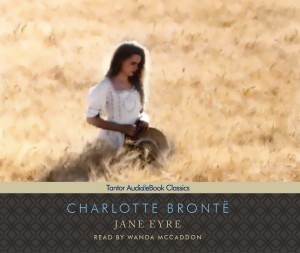
Jane Eyre audio offered by SYNC YA

This summer I have been visiting the family estate at Gateshead, the harsh boarding school Lowood, and the Gothic mansion called Thornfield Hall through the audio download of Charlotte Bronte’s Jane Eyre courtesy of SYNC YA. This free audiobook uses Overdrive software which is on both my computer and my mobile phone. As the recording of Jane Eyre is about eight hours long, the ability to move from device to device has proved most helpful in finishing the book.

This is not my first experience with this novel. I read the book when I was a teenager, and, like Jane, I fell in love with Mr. Rochester. Years later, I taught the book later to Advanced Placement students and marveled at Jane’s independence, her morality, and her ability to emphatically say “No” to the persistently persuasive Rochester.  Now, I am struck by Jane’s role as a governess and how Bronte characterizes attitudes towards that profession in Victorian England.

At one of Rochester’s soirees, Bronte has the spoiled but beautiful Blanche Ingram recount how she and her brother and sister, tormented their governesses and tutors as as they grew up. The incident begins when Blanche’s mother, Mrs. Ingram, calls the guests’ attention to Jane, isolated in a corner of the room. “I have just one word to say of the whole tribe,” whispers Blanche’s mother loud enough for Jane to hear, “they are a nuisance.”

Blanche cheerfully counters:

Not that I ever suffered much from them; I took care to turn the tables. What tricks Theodore and I used to play on our Miss Wilsons, and Mrs. Greys, and Madame Jouberts! Mary was always too sleepy to join in a plot with spirit. The best fun was with Madame Joubert: Miss Wilson was a poor sickly thing, lachrymose and low-spirited, not worth the trouble of vanquishing, in short; and Mrs. Grey was coarse and insensible; no blow took effect on her.

Not satisfied with those affronts to those poor teachers, Bronte has Blanche continue the list the indignities inflicted on one particular governess who was subjected to especially bad behavior from the Ingram children:

But poor Madame Joubert! I see her yet in her raging passions, when we had driven her to extremities–spilt our tea, crumbled our bread and butter, tossed our books up to the ceiling, and played a charivari with the ruler and desk, the fender and fire-irons. Theodore, do you remember those merry days?”

Blanche’s condemnation of those who tried to educate her backfires; Bronte’s desire to have the reader dislike this rival for Rochester’s affection is deliberate. Jane’s quiet moral intelligence wins out in the end.

Listening to the story, I considered that Bronte was making a case for the importance of education as a means to rise out of poverty. Jane’s education at the Lowood Institute, a boarding school, was hazardous and purchased at a terrible price. Her classmate, Helen, dies because of the stark conditions at Lowood, mirroring the real-life death of Bronte’s sister, Maria, who died from tuberculosis contracted because of hunger, cold, and privation at Cowan Bridge School. Despite the treacherous conditions, however, Bronte revisits the theme of education’s importance as it provided the character Jane with an independent profession. She is hired to teach Rochester’s ward Adele, and she proves to be a successful governess.

The conflict between Bronte’s belief that education was one way for a young woman to earn a small income, to have a marketable profession, clashes with the upper classes’s view of the teaching profession in 1847. Therefore, how disappointing to read polls (2009-2012) about contemporary economics of the teaching profession that demonstrate that a century and a half later, not much has changed. According to The Economix blog on the NYTimes, “Does it Pay to Become a Teacher?”, salary  may reduce attracting high quality graduates to the teaching profession:

The average primary-school teacher in the United States earns about 67 percent of the salary of a average college-educated worker in the United States. The comparable figure is 82 percent across the overall Organization for Economic Cooperation and Development (O.E.C.D.). For teachers in lower secondary school (roughly the years Americans would call middle school), the ratio in the United States is 69 percent, compared to 85 percent across the O.E.C.D. The average upper secondary teacher earns 72 percent of the salary for the average college-educated worker in the United States, compared to 90 percent for the overall O.E.C.D.

The findings also point out that teachers in the USA teach over 1000 hours annually, an amount well over the hours of their international peers. That number does not include time for preparation, training, or assessing. The article concludes:

Given the opportunity costs of becoming a teacher instead of using your college degree to enter another, more remunerative field, are the psychic rewards of teaching great enough to convince America’s best and brightest to become educators?

Bronte was one of England’s best and brightest who advocated education, but Bronte knew that teaching was not an economically successful profession. Jane Eyre only becomes financially independent when a relative leaves her a fortune; she only becomes wealthy when she confesses, “Reader, I married him.”

Over 150 years after Charlotte Bronte’s novel, the teaching profession still has its critics; there are real life Mrs. Ingrams and Blanches who hold the profession in contempt. There are also economic drawbacks to choosing the profession, as demonstrated in the O.E.C.D poll.

In the 21st Century, the teaching profession should be desirable to those who aspire to teach, but who, like Jane, want to be financially independent. Teachers should not have to wait for a Mr. Rochester in order to prosper.

There are organized containers of books, spines out for easy browsing, that sit in rows on well-spaced tables. There are signs that mark the genres (fiction, travel, nature, self-help, romance, etc) for targeted shopping. I notice there is a lovely older woman who shadows me anxiously; she is trying to take my heavy load of books to a table for “lay-away” so that I can shop easier. I smile politely and refuse her help; I don’t want to belabor the point that my bags weigh as much as she does. She seemed disappointed. As I looked back I considered that perhaps I had been mistaken; her biceps were very defined! Yes, tidiness and a cadre of very fit efficient elders ready to provide assistance are the hallmarks of the Friends of the New Milford Library Book Sale in New Milford, Connecticut.

The sale is held in the New Milford High School on Route 7, and the hours for 2013 are:

Thursday, July 11th –
Early Bird, $5.00 – 9am-10am
Doors open @ 9am – 7pm close
Friday, July 12th: 10am – 7pm
Saturday, July 13th:10am – 5pm
Sunday, July 14th – HALF PRICE DAY!: 10am – 3pm

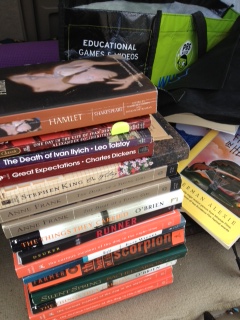
In 20 minutes, I had two bags (totaling $31) filled with books used at different grade levels. Note the three copies of Mark Haddon’s The Curious Incident of the Dog in the Nighttime (photo) which retails at Amazon for $12.41. Three new copies of this book would retail for $37.23. I got these three lightly used copies and all of the other books pictured in the photo for $6.31 LESS than the cost of the three new copies. The Curious Incident of the Dog in the Nighttime is in our Grade 10 World Literature course, and our students enjoy the narration by the autistic boy who uses Sherlock Holmes’s deductive reasoning to solve a mystery.

photo (20)

Stack of books used in our curriculum; additional independent reading books in the other bag

Other big finds that are in the photo included copies of Tim O’Brien’s The Things They Carried, a copy of Stephen King’s On Writing, and Nancy Fisher’s The House of the Scorpion. There are many other “finds” in the bag next to the neat stack of books.

When I shop at these local sales, I think about how each town’s book sale is a small sociological study. If one could speculate about the interests of the people of New Milford, one would conclude:

  1. There are some serious, diehard James Patterson fans;
  2. There is a dedicated interest in nature, animals, and travel (althought this is the first year I did not find a single copy of Bill Bryson’s A Walk in the Woods);
  3. The entire back half of the area illustrates that children have access to books at all levels.

Finally, I feel it is worthy to note, but rather awkward to say, that there were at least 10 cartons of the Books for Dummies series. I am not saying anything about New Milfordites here…. I’m just sayin’.

Check out was a breeze; receipts for teachers were pre-prepared, and I made a beeline for the door so that lovely elderly woman wouldn’t try to help me carry my bags back to my car. Her energy was making me look bad!

Connecticut had an average of over nine inches of rain this June, a mixed blessing. The cool temperatures and constant downpours had a direct impact on the dress code, and the beach attire favored by high school females (and appreciated by young high school males) was not a distraction. Furthermore, the temperatures in the classroom were cool, and the dark skies meant that lighting in the classroom was ideal for showing films to wrap up the year.

The weather, however, did dampen opportunities to teach one of my favorite poems by William Wordsworth, The Tables Turned. The poem is a plea to the reader to throw down the books with poems that try to capture nature, the art that mimics nature, or the science that tries to explain nature:

The Tables Turned

AN EVENING SCENE ON THE SAME SUBJECT (1798)

Up! up! my Friend, and quit your books;
Or surely you’ll grow double:
Up! up! my Friend, and clear your looks;
Why all this toil and trouble?

The sun above the mountain’s head,
A freshening lustre mellow
Through all the long green fields has spread,
His first sweet evening yellow.

Books! ’tis a dull and endless strife:
Come, hear the woodland linnet,
How sweet his music! on my life,
There’s more of wisdom in it.

And hark! how blithe the throstle sings!
He, too, is no mean preacher:
Come forth into the light of things,
Let Nature be your teacher.

She has a world of ready wealth,
Our minds and hearts to bless—
Spontaneous wisdom breathed by health,
Truth breathed by cheerfulness.

One impulse from a vernal wood
May teach you more of man,
Of moral evil and of good,
Than all the sages can.

Sweet is the lore which Nature brings;
Our meddling intellect
Mis-shapes the beauteous forms of things:—
We murder to dissect.

Enough of Science and of Art;
Close up those barren leaves;
Come forth, and bring with you a heart
That watches and receives.

When I teach the poem, I do what is now called “close reading”, a strategy favored by the Common Core State Standards, by having students pay attention to particular images, text structure, and word choice in order to determine an author’s purpose. The process can be a bit tedious, but in this case, I want them to feel a little hostile about “dissecting” the poem.

“What does the poem mean?” I will press them, “What is Wordworth’s purpose?”

“Nature is good?”  (Maybe)

“Poems can make us appreciate nature?” (Perhaps)

“We cannot capture Nature in books?” (Possibly)

“We should ditch our books and go outside?” Absolutely! 

And to the delight of everyone, I instruct my students to close up their books and go outside so that we can “let Nature be your Teacher”. That is the entire lesson. A poem, an analysis, and a trip outdoors that obeys the author’s intent.

Hopefully, next June will give us the day when the  “sun above the mountain’s head/A freshening lustre mellow” lets us upend the tables and go outside to engage with Nature in order to “watch and receive” and leave close reading overturned.

What better way to celebrate International Women’s Day 2013 but to pay tribute to Canadian author Margaret Atwood? Poet, novelist, lecturer, inventor, tweeter, and celebrity ice hockey goalie, Atwood’s achievements in each of these roles is accomplished with wit, grace, and aplomb.

Handmaid's tale

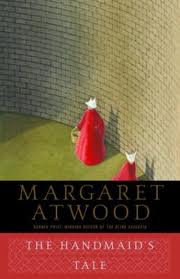
There are other earlier covers, but this one is my personal favorite.

My Advanced Placement English Literature class just finished reading her novel, The Handmaid’s Tale. The novel is set in the dystopia of Gilead, where in response to political and ecological upheaval, a quasi-Christian theocracy is organized in the eastern section of the United States. Astute Sparknote writers, graduates of Harvard, recognized many of the landmarks in the novel’s setting (the brick wall, the gymnasium) as that of their alma mater, an indication of Atwood’s wry sense of irony. In the novel, fertility is an obsession. Rituals and “ceremonies” are enforced; offenders and outliers are publicly executed or sent to labor in toxic waste dumps. The main character Offred, who had a daughter before the establishment of the Republic of Gilead, is valued only for her ability to reproduce.

Because of the mature themes, The Handmaid’s Tale is often taught in senior high school classes. The title is often suggested on the exam for the open-ended Question #3 on the AP Literature exam which means other schools assign the book. There are always plenty of copies available in the secondary market. Our classroom library has over 60 copies from a variety of library book sales and thrift stores. I have spent under $100.00 in adding this title to our curriculum; I’d like to think that Atwood might be pleased with this “ecological” way to have students read the text despite her loss of possible retail revenue. However, if one wanted a new copy, they are available at Amazon for $10.20 paperback or an audio recording by Claire Danes is available  at Audible.com  for $24.95.

When we discuss the clothing that marks the different “castes” of people in Gilead,  I always use the endpaper story Atwood published in the New York Times Magazine published “When Afghanistan Was at Peace”

Six years after our trip, I wrote ”The Handmaid’s Tale,” a speculative fiction about an American theocracy. The women in that book wear outfits derived in part from nuns’ costumes, partly from girls’ schools’ hemlines and partly — I must admit — from the faceless woman on the Old Dutch Cleanser box, but also partly from the chador I acquired in Afghanistan and its conflicting associations. As one character says, there is freedom to and freedom from. But how much of the first should you have to give up in order to assure the second? All cultures have had to grapple with that, and our own — as we are now seeing — is no exception. Would I have written the book if I never visited Afghanistan? Possibly. Would it have been the same? Unlikely.”

Dutch Cleanser

The combination of the Dutch Cleanser girl with the chador is the inspiration for Offred’s clothing; the story and the visual always sparks a discussion on the symbolic effect of clothing.

My students always argue about the genre of The Handmaid’s Tale. This year there were a number of votes for political science book, others for a dystopian love story; no one said science fiction. Atwood would be relieved; she has always drawn the distinction between science fiction and her writing which she calls “speculative fiction”. Several of my students also read the other books Oryx and Crake and The Year of The Flood that are speculative fiction.

Here is Atwood with her take on the genre of specultive fiction.

The conclusion of The Handmaid’s Tale ends in an allusion to the story of Orpheus and Eurydice:

“We may call Eurydice forth from the world of the dead, but we cannot make her answer; and when we turn to look at her we glimpse her only for a moment, before she slips from our grasp and flees.”

After we finished the novel, the class read Atwood’s poem Eurydice. I asked them what they thought.

  • “There is a sense of longing in both.”
  • “The language is so similar. There is the white curtain…the gauze.”
  • “‘It is not through him you will get your freedom’ is just like
    from and freedom to…that is Offred’s problem”
  • “We could have just read the poem! They’re almost the same!”

One other area of speculative fiction where Atwood has shared her thoughts is on the topic of modernity…and Zombies. In an interview on George Stroumboulopoulos Tonight, Atwood was quite clear on the limits of Zombie stories:

“No zombie story is ever told from the zombie point of view… they’re not narrative…they don’t have language and that impedes one from telling a story.”

Outside of fiction, Atwood has also written about debt. Her non-fiction book Payback: Debt and the Shadow Side of Wealth came from her 2008 Massey Lectures. Not surprisingly, her interest in debt began in from her study of Victorian Literature. In an interview with Suzanne Ellis, CityLine “Margaret Atwood On Payback And The Concept Of Debt”  Atwood discussed how the Victorian stories that are on the surface about love and romance are really all about financial arrangements:

“In [Jane Austen’s] Sense and Sensibility, Marianne can’t marry the love of her life because he needs to marry a rich person. He doesn’t have any money. She’s devastated by that and gets a bad cold,” Atwood muses. “You start following the money in these novels and it takes you to the most amazing places. Where did Heathcliff get the money that he uses to buy Wuthering Heights, or I should say to gamble the owner of it out of it? How does he do that? We’re not quite sure but it’s something pretty shady.”

The book was made into a documentary and released in the spring of 2012. The New York Times critic A.O. Scott opens his film review with the premise of the documentary:

A glance at the headlines from Europe, the news from Washington or this month’s bills will confirm that we live in an age of debt. Debt, a concept at once straightforward and almost metaphysically complex, is a source of personal, national and global anxiety, and forms a link between the individual and the worldwide economic system.

While the film did not receive critical acclaim, Atwood’s ability to connect herself and link to the world through Twitter is often lauded.  She is an avid twitterer with 383,430 followers and over 15,000 tweets of her own. She links to political issues, comments on travels, and gives recipe advice:

Screen Shot 2013-03-08 at 11.06.17 AM Screen Shot 2013-03-08 at 11.07.07 AM Screen Shot 2013-03-08 at 11.08.58 AM Screen Shot 2013-03-08 at 11.09.56 AM

She also is the inventor of the “long pen”, a device that allows her to attend book signings from distances and sign books “virtually”. When she is tired of traveling to sign books, she can now meet her adoring public in virtual space and provide them with an authentic signature. Fortunately, I saw her before the “long pen” at a Barnes and Noble reading/book signing for her short story collection Moral Disorder. She was amazingly articulate; in the 40 minute talk, she never hesitated or once said “um”.

And just when you thought that Atwood could not be more accomplished, she starred in a video explaining “How to Stop a Hockey Puck” for the comedian reporter Rick Mercer. I put the video below. (Too bad her “Dance Party Video” was removed from YOUTube for copyright violations.)

So, on this International Woman’s Day, let’s hear a cheer for Margaret Atwood!

She writes. She tweets. She scores!

"Dawn spread her rosy fingers..."

“Dawn spread her rosy fingers…”

Our 9th grade classes have been reading Robert Fitzgerald’s excellent translation of The Odyssey. At the beginning of every book, “young Dawn spreads her fingertips of rose to make heaven bright”. My students have heard this phrase so often that they chorus back to me “fingertips of rose” when we read aloud. One morning this past week, I raced up the hill to school to get my iPad so I could capture this picture of the “rosy fingers” and put it on the class wiki.

We dutifully started The Odyssey with the “Invocation to the Muse” and Books 1-4, but the Telemachus “coming of age” story did not really capture their interest. Meeting Odysseus in Book 5 did not improve their respect for the “worthy man of twists and turns.” Once we read Book 9,  the meeting with the Cyclops, Polyphemus, their interest was revived. Apparently, they enjoy a good story of man-eating monster as much as previous generations from 2020 years ago.

I have only been able to locate about a dozen copies of this translation in the secondary market, so we did have to buy a class set. These replaced a worn set of the Richmond Lattimore translation. There will be an audio version of the Fitzgerald translation available in November 2013 I will be ordering so I will finally be able to hear how to pronounce all those Greek names!.

Our final project for the Odyssey is a narrative that students complete called “The Wamogossey: A Day in the Life of a Freshman at Wamogo High School.” Happily,  writing narratives are once again favored in curriculum aligned to the Common Core State Standards:

CCSS.ELA-Literacy.W.9-10.3 Write narratives to develop real or imagined experiences or events using effective technique, well-chosen details, and well-structured event sequences.

The inclusion of the narrative confirms what most writing teachers recognize, that writing a narrative gives a students a better appreciation for reading a narrative.

In writing The Wamogossey, we allow students to organize themselves as individual narrators or in groups of two or three. Our instructions to the students are based on the following premise:

You and your partners are to create a modern equivalent of The Odyssey. The setting is Wamogo High School; the hero a 9th grader – Fresheus or Freshiope.

Your character must make their way through a day at school, facing modern equivalents of the Lotus Eaters, Cyclops, Sirens, and all that Odysseus encountered. The goal is simply to get home alive, where the or she can relax and feel safe.You must mirror Odysseus’ adventures, including how he solves the problems (trickery, patience, skill, self-control, etc).  The essential nature of the obstacles must be the same, in the same order, but set in modern Wamogo.

Each student in a group working on The Wamogossey is required to write three adventures: a single narrator needs three (3) adventures; two people writing the Wamogossey need six (6) adventures; three members of the group need nine (9) adventures. This organization assures that there is an equal sharing of responsibilities regardless as to the size of the group. They compose the narrative on Google Docs; each narrator writing in a different color ink.

In addition, to assure fairness in grading, we allow students to have some feedback on the distribution of points. The project is assigned a base grade (EX: 40 points) Once the project is graded based, that number is multiplied by the number of students in group. For example a project worth 40 points may be awarded only 34 points. If there were three members of the group, then there are 34 X 3 points available, or a total of 102 points. The members of the group then determine a fair distribution of points; slackers are usually “outed” by members of their group. We rarely need to intervene.

The Wamogossey narratives must begin with an invocation to their muse. These are usually very personal and often reflect that we have a vocational agricultural program. For example, from this year’s submissions:

Sing in me, Brandon,
and help me tell the story of tractors, you, skilled in all ways of contending,
the fixing, harried for hours on end,
after the break downs and endless driving in the field.
I saw the end of the last row of corn
and learned that good crops come slowly
and weathered many bitter days
in the early morning cold, while I fought only
to save my life, to get home to the barn.
But not by will nor valor could I save all the gas I use,
Of these adventures, Brandon, tell about me in my school day, lift the great song again.
Begin when the alarm rang, calling me to adventure, when all I hungered for was for home, my  Farm All tractors, and being ready…

In addition to the modernized twists of Homer’s plot, each adventure needs an epithet (“grey-eyed goddess”) and one Homeric simile. My students call these similes “enough already; we get the point” similes.There is also extra credit for using vocabulary from The Odyssey.

So far, several of The Wamogossey entries parallel Odysseus’s adventure very nicely. One student’s encounter with “Eaganphemus” (the Cyclops/our principal) is clever:

Encounter with the Cyclops- Book 9
I was hurrying to class, I was going so fast, I felt like I was in a race car, and the people around me are in a fuzz.  All of a sudden, I saw the huge Eaganphemus standing in my way. I almost slammed into him, my wheels spinning so fast. I tried to get around him, but I couldn’t  But, I happened to have M&M’s in my pocket, so I threw them at him. He seemed overwhelmed! He tried to catch all of them at once!! Once he was trying to gobble them down I raced past, now that he was distracted. I somehow survived getting past him.

As the semester ends next week, the students will have finished their hero’s journey. Odysseus will return to Ithaka and to Penelope, and, yes, another “Dawn will spread her rosy fingers…”.  I may get to run up the hill again to snap another picture.

Screen Shot 2013-01-09 at 4.41.58 PM

Wikipedia photo -Elie Wiesel

By my calculations, at the mid-point of the school year, many World History classes are studying World War II. Should these classes want to increase their use of an informational text in English or Social Studies curriculum, I suggest Elie Wiesel’s noteworthy speech The Perils of Indifference.

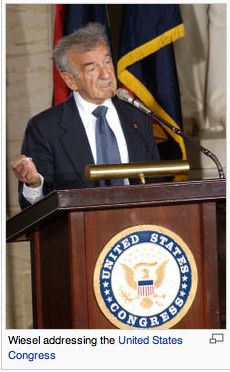
Wiesel delivered this speech to Congress on April 12, 1999. The speech is 1818 words long and connects Wiesel’s experience at the concentration camp at Aushwitcz with the genocides of the late 20th Century using a single powerful word: indifference.

In his speech, Weisel states clearly:

Indifference, then, is not only a sin, it is a punishment. And this is one of the most important lessons of this outgoing century’s wide-ranging experiments in good and evil.

Our English Department has used this speech in the past as a complement to Wiesel’s memoir Night which has been a used as a whole class read.  This year, we are giving Night to the Social Studies classes. They will adopt this memoir in order to increase the assigned informational text reading in their discipline mandated by the Literacy Common Core State Standards in History and Social Studies (CCSS). The English Department will still offer supplemental texts  that students can choose to read independently.

When he gave this speech, Wiesel had come before the US Congress to thank the American soldiers and the American people for liberating the camps at the end of World War II. Wiesel had spent nine months in the Buchewald/Aushwitcz complex. His mother and sisters had been separated from him when they first arrived: “Eight short, simple words… Men to the left, women to the right”; these family members were killed in the ovens. He and his father survived starvation, disease, and the deprivation of spirit. His father eventually succumbed, and Wiesel guiltily admits at the end of the memoir that at his father’s death he felt relieved.

Eventually, Wiesel felt compelled to testify against the Nazi regime, and he wrote the memoir Night to bear witness against the genocide which killed his family and six million Jews. His speech was delivered 54 years after he was liberated by American forces.

His gratitude to these American forces is what opens the speech, but after the opening paragraph, Wiesel seriously admonishes America to do more to halt genocides all over the world. By not intervening on behalf of those victims of genocide, he states clearly, we are indifferent to their suffering:

Indifference, after all, is more dangerous than anger and hatred. Anger can at times be creative. One writes a great poem, a great symphony, one does something special for the sake of humanity because one is angry at the injustice that one witnesses. But indifference is never creative.

My students have always been struck by Wiesel’s juxtaposition of anger and creativity. More than one has agreed pointing to making a “good” creation: an amazing song about an ex-boyfriend or a painting slapped together with passion. They also do not want to be treated indifferently. Yet, Wiesel makes them think beyond themselves:

Indifference is not a beginning, it is an end. And, therefore, indifference is always the friend of the enemy, for it benefits the aggressor — never his victim, whose pain is magnified when he or she feels forgotten. The political prisoner in his cell, the hungry children, the homeless refugees — not to respond to their plight, not to relieve their solitude by offering them a spark of hope is to exile them from human memory. And in denying their humanity we betray our own.

I remember several years ago, one student in my English 10 class, Rick, was particularly bright, fun, and full of daring. He also had an exceptional understanding of math and statistics. That January, I introduced the memoir Night as I had in previous years by providing a little background information.

“Six million Jews were killed during the Holocaust,” I recited off from my list of facts.

“What?” a startled Rick looked up. “Six million?” He was aghast. “That can’t be right.” He looked around at his classmates. “Six million?” They looked at him blankly. “Come on,” he was looking for some support, “That can’t be right.”

“Why?” I asked.

“Do you know how many six million things are?” He was indignant.

“Six million people,” I responded.

“People, yes. People, six million is a lot of people….” Rick was clearly operating with a different level of understanding from his more placid classmates. He understood six million as quantity; he did understand what six million things would look like if stacked up. Other students stirred in their seats.  “No way….six million,” he repeated growing more agitated. “How? How did anyone let this happen?” he asked; he was half-rising out of his seat. “Did we know?”

“Yes,” I remember saying. I do remember explaining that, yes, America did know that Hitler had concentration camps, and that more documentation collected after the war indicated that many of our military and political leaders knew about these camps. That is one of the points from Wiesel’s speech.

I pointed out to the class that the Holocaust was only one example of genocide; that there were others. In fact, that there was recently a genocide in Darfur. Rick sat down; he was overwhelmed. He was capable of understanding numerically the devastation of the Holocaust, and he was clearly upset. “Why do we let this happen?” he asked. I remember his voice was so sad, so full of disbelief.

In The Perils of Indifference, Wiesel asks

Does it mean that we have learned from the past? Does it mean that society has changed? Has the human being become less indifferent and more human? Have we really learned from our experiences? Are we less insensitive to the plight of victims of ethnic cleansing and other forms of injustices in places near and far?

Wiesel’s rhetorical questions echo Rick’s “Did we know?” In trying to respond, Wiesel makes the reader uncomfortable the way Rick was uncomfortable. Creating this kind of emotional impact on a reader is the reason Wiesel’s speech should be taught.

The Common Core State Standards (CCSS) demand that students read informational texts but does not require specific texts. Wiesel’s The Perils of Indifference contains the information and rhetorical devices that meet the text complexity criteria of the CCSS. More specifically, Wiesel’s message is necessary if we want our students to confront the conflicts in this new 21st Century. Our students must be prepared to question why “deportation, the terrorization of children and their parents be allowed anywhere in the world?“

Our humanity should demand nothing less.

It’s Halloween…what is the most frightening story you have ever read?

“I busied myself to think of a story, — a story to rival those which had excited us to this task. One which would speak to the mysterious fears of our nature, and awaken thrilling horror — one to make the reader dread to look round, to curdle the blood, and quicken the beatings of the heart. ……. I thought and pondered — vainly. I felt that blank incapability of invention which is the greatest misery of authorship, when dull Nothing replies to our anxious invocations. Have you thought of a story?” (Shelley, Preface)

Yes. Frankenstein. Mary Shelley’s masterpiece drafted when she was18 years old.  Teaching Mary Shelley’s “ghost story” always elicits the most interesting responses from my students. I have taught the novel every year for the past 12 years to students in grades 10-12, in AP or unleveled curriculums, and the results are always satisfying.

Note: I did not say easy.

Since I am now familiar enough with the text and the pitfalls that catch most students, I know that I will need to summon an enormous amount of energy to begin teaching Frankenstein. First, there is the baggage of the pop culture monster with its green skin, bolted neck and squared boots. That baggage must be “unpacked” first. Then, there is Robert Walton’s epistolary start of the novel, coupled with Victor Frankenstein’s lengthy autobiography.  References to Cornelius Agrippa, Lake Geneva, and Galvanism are more stumbling blocks.

  • “So, where is the Monster?”
  • “When does this book get good?”
  • “I’m sorry, but this is just boring!”

Okay, Chapter Five.  On a dark and stormy night,

“With an anxiety that almost amounted to agony, I collected the instruments of life around me, that I might infuse a spark of being into the lifeless thing that lay at my feet. It was already one in the morning; the rain pattered dismally against the panes, and my candle was nearly burnt out, when, by the glimmer of the half-extinguished light, I saw the dull yellow eye of the creature open; it breathed hard, and a convulsive motion agitated its limbs”(Shelley, 5).

The Monster lives! Like the Creator in Genesis who “formed the man of dust from the ground and breathed into his nostrils the breath of life, and the man became a living creature” (Genesis 2:8), Shelley breathes life into her creation without regard to hard science.  In both stories, the empirical data or formulas, which led to these creations, express leaps of faith understood by the reader. The spark of life is imbued; the creation lives and breathes. The Creator of Genesis differs immediately from Victor when he, “planted a garden in Eden, in the east, and there he put the man whom he had formed”(Genesis 2:8), In contrast, the reader can hear Victor’s sudden gasp, “Beautiful!–Great God!” so repulsed is he once the creature comes to life. Victor weakly admits that all this work has been a failure, and comments almost apologetically, “The different accidents of life are not so changeable as the feelings of human nature” (Shelley, 5). Unfortunately, the creation has been loosed upon the earth; he will not easily be unmade simply because his creator has changed his mind.

Exhausted, Victor sleeps only to be wakened by

“when, by the dim and yellow light of the moon, as it forced its way through the window shutters, I beheld the wretch — the miserable monster whom I had created… His jaws opened, and he muttered some inarticulate sounds, while a grin wrinkled his cheeks. He might have spoken, but I did not hear; one hand was stretched out, seemingly to detain me, but I escaped, and rushed down stairs” (Shelley, 5).

Rejection! Abandonment! Isolation.

The Creator in Genesis does not abandon his creations, despite their disastrous decision to disobey. Rather, the reader finds this Creator “made for Adam and for his wife garments of skins and clothed them (Genesis 3:21) before banishing them from the Garden.Victor, in contrast, flees from the sound and the touch of the Monster who was trying to say….what? Creator?….Father?

  • Daddy.”
  • “Victor is a jerk.”
  • “He ran away because he didn’t want the responsibility.”

Exactly. And that is why Frankenstein gets to the heart of so many of the issues that our students, our culture, our world must deal with today. There are questions of responsibility. The responsibilities of a creator for the created can be extended to include the responsibilities of parents to children, of scientists to inventions, of writers to literature, of politicians to policies, and of pundits to sound bytes. What happens when the “creation” goes bad?

  • “If Victor kills the Monster, is it murder?”
  • “It’s Victor’s fault that the Monster is a murderer.”

Is the Monster a human? Shelley allows that the Monster eats, reads, and pines for a companion; he is alone, and miserable. A critical scene has the Monster pleading with Victor for a friend, a companion, a mate. Shelley has her Monster claim to have a soul; is the Monster a human? What makes a human a human?

  • Having a mate will mean monster babies!”
  • “Why didn’t Victor think about what the Monster would do?”
  • “This is just like Jurassic Park !”

Shelley’s novel also considers related ethical questions. These include what is the result of unleashing a new technology on earth? Because the technology exists to create, should the technology be used? How far should technology go in helping humanity?

In our brave new world, the “lyger” has been created because geographically separated tigers and lions can be crossbred in labs. Genetically altered crops are in the mainstream food source. These technological advancements have moved into our world with a ripple. But what of the advancements that will follow? Will human cloning become a reality, and will society deal ethically with clones? How far are we from artificial intelligence and should-or can- this intelligence be controlled? What does Frankenstein teach the reader about making ethical decisions today or in the near future? Why is literature such a great predictor for what will happen in the future?

We feel pathos. The Monster’s story is one of tragedy.

  • “Victor is the real monster.”
  • “I feel bad for the Monster…he didn’t want to be a Monster.”

By the end of the novel, my students have dealt with some very profound ideas. They have asked some very important questions about responsibility, humanity, and ethical behavior. They feel a sense of accomplishment in reading a difficult 19th Century text. They have confronted contemporary issues through literature, and isn’t that what is supposed to happen in the classroom?

Mary Shelley was only 18 years old when she attempted to answer some of the questions about the limits of man.  She was young and ambitious, like many of our students. Her “hideous progeny” is extraordinarily prescient; then novel is in every way a Modern Prometheus-a modern myth. Mary Shelley’s Frankenstein is a must read, and a cautiously frightening tale, for Halloween or for any other day.

One of my favorite final exam questions to assign is a creative narrative assigned to sophomores who are challenged with reading World Literature. The prompt is  based on an imaginary literary awards ceremony that celebrates all of the literature read during the year. I cannot claim this is an original idea; a fellow teacher, Trish,  gave me the prompt several years ago when we both taught sophomores, and the results have never disappointed.

What our imaginary literary awards ceremony might look like!

The prompt asks the student to chose any three characters from the literature read in class as candidates for “The Most Interesting Character of the Year”Award, the coveted MIC. This question is provided to the students at least one day before the exam so that students have time to select the characters and collect evidence.When the students spend a class period preparing for the exam, they are provided a 3X5 index card to write down the quotes and any other evidence they may wish to incorporate in the essay. The card is stapled onto the essay; students who do not use a card lose five points on the essay response.

The student must write a self-nomination speech in the voice of each character in which the character discusses his or her motivations; relationships with other characters; and accomplishments and/or failures.  Each character must also compares/contrasts himself or herself against the other nominees. The name of the work (underlined or in quotes), the author of the work, and at least one quote from the literary work said by or about each nominee is also required. Students are cautioned that they must use MLA style for the integration and and citation of evidence.

While I hate grading a stack of final exam essays, this particular prompt always provides some interesting responses. Rarely is there a combination of characters repeated. Furthermore, although there are plenty of Macbeths, Beowulfs and Paul Bauers, there are an equal number of minor or obscure characters. For example, there have been nominating speeches from the Porter in Macbeth, the airman in Yeat’s An Irish Airman Foresees His Death; one student even wrote from the perspective of Bulleye, Bill Sykes’s dog in Oliver Twist.

There have been students who include details from the ceremony itself (“Live from Hollywood!”), decribing the location or decorations. Several students have had the nominees deliver their nomination speeches from a red carpet area, and many students choose another character, classmate, celebrity act as the evening’s emcee; others use a twist on the American Idol model. Students have included dialogue between characters during the ceremony, while other students have had characters hurl insults at each other.

For example, one student had the witches from Macbeth serving as the evening’s emcees who introduced each nominated character saying, “By the pricking of my thumbs, one more wicked than the other comes.” Another had a “fierce and reckless Grendel” prowling in the audience in order “to snatch thirty audience members from their slumber” when he was suddenly called up to the podium to deliver his own nomination. His monosyllabic charming and tearful self- nomination speech (“You like me!”) was interrupted when the band began to play, and the student wrote that Grendel once again became that “powerful monster, living down/ In the darkness, [who]  growled in pain, impatient/ As day after day the music rang /Loud In that hall,” and charged off the stage with his prey. Another student had Fagin from Oliver Twist give his nomination speech performing magic and juggling tricks while the Artful Dodger led a group of pickpockets through the audience.

My favorite response came two years ago when a student nomintaed Napoleon from Animal Farm and placed him on the dias where he was heckling Heathcliff  from Wuthering Heights and Jack from Lord of the Flies as each gave a self-nominating speech. Suddenly, a flash of lightning blinded the audience for several seconds, and when they had regained a view of the dias, only two nominees remained. Napoleon, like so many of Stalin’s government officials, had mysteriously vanished!

Students never have any trouble filling three full pages of content for this essay response. I grade each of the three essays holistically with special attention given to the incorporation of quotes as evidence and the motivations of each of the nominees. An “A” response would:

  • Demonstrate a clear understanding of the assignment’s purpose (writes in each character’s voice)
  •  Evaluate relevant significant points of view (character, audience)
  • Gather and integrate sufficient, credible, relevant evidence (minimum on quality quote) and cites evidence correctly (MLA)
  • Use standards of English correctly (particular attention to mini-lesson topics) including spelling and capitalization (titles, character names)

Recently, we were aligning our curriculum with the 10th Grade Language Arts Common Core Standards when we came upon standard W.9-10.3: Write narratives to develop real or imagined experiences or events using effective technique, well-chosen details, and well-structured event sequences. The narrative is not a form we generally use in grade 10, so as we were puzzled if we addressed this standard at any point in our curriculum, we remembered the Most Interesting Character Award essay. We determined that this essay allows us to meet standard W.9-10.3 without designing a new lesson/assignment.

I do not require students to pick a winner for this exam question, in fact, I think it is easier for them to write with no winner in mind. No pre-determined winner allows them to write the ultimate cliff-hanger….”and the award goes to_____?”

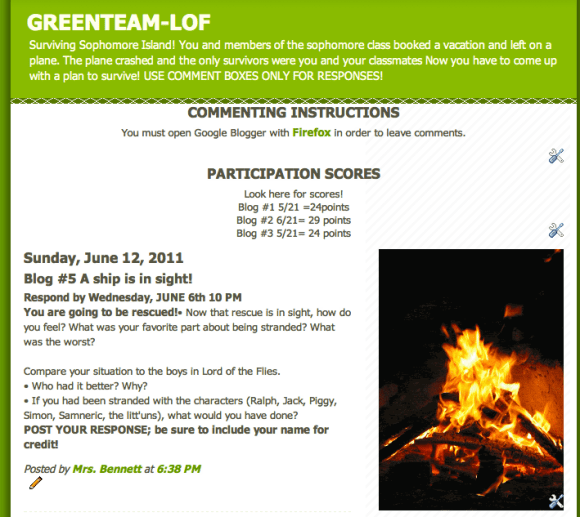
YOU AND MEMBERS OF THE SOPHOMORE CLASS BOOKED A VACATION AND LEFT ON A PLANE. UNFORTUNATELY, THE PLANE CRASHED AND THE ONLY SURVIVORS WERE YOU AND YOUR CLASSMATES. NOW YOU HAVE TO COME UP WITH A PLAN TO SURVIVE! 

This is the bold notice at the top of each of five blogs that the grade 10 teachers organized for teaching William Golding’s novel Lord of the Flies. This survival game is played in the English World Literature course at the end of the school year. The intent is to engage an entire grade level of 10th grade students in discussing a text without the limitations of the class schedule.

The game is simple: there are five teams (red, yellow, blue, green and orange) that are invited to a blog to respond to posts within a short period. Once the students are sorted onto teams (2 or three in each class period on one team), they respond to a post on their team’s blog using the comment box. Points are awarded on the percentage of team participants who respond to a blog post, and the winning team receives a 100% test grade.

The five posts on each blog are scenarios adapted from a number of similar activities I have found on the Internet. We used Blogger for our platform without much difficulty last year; this year their new interface has been glitchy, but since the game is about survival of the fittest, we have soldiered on! Each post deals with a scenario similar to the daily experiences of Ralph, Piggy, Jack and the choirboys, etc. The posts are uploaded over the course of a  two week period.

Post #1 deals with a list of 15-20 resources that were “recovered from the plane.” The post asks students to comment individually, “What do you do now?”

Post #2 poses the next complication suggesting that a giant storm seriously damaged their resources, “So, what happened to the supplies you gathered yesterday?” (ex: Bed Sheets: blew away in the storm last night; mosquito netting: large gashes/holes created by trees in the storm)
“What do you and your fellow survivors do now? What supplies do you have remaining? How are you using these remaining supplies?”

Post#3 Provides directions for shelter, fire and potable water. The post reads, “While you and some members of your group were building the shelters, digging the fire pit, and setting up the water supply; two (2) of your members decide that they are tired of working and want to go swimming instead. What do you do with the slackers in your group?”

Post #4 begins, “You wake up on the third morning to find that half of the food you had taken from the plane and gathered since is gone. Either some sort of animal has taken it, or one of your group members has taken it and hidden it for himself or herself. You start out the day suspicious of the other members of the group – and hungry!
• What sorts of rules/procedures are you going to put in place to make sure your food and water supplies do not get stolen or contaminated?
• Now that you are suspicious of your other group members, how are you going to act around them? Are you going to be able to continue to work together? What is your plan for discovering who took the food? What will you do with that person when you find him or her?”

Post #5 is the final opportunity for students to participate. The post reads, “A ship is in sight! You are going to be rescued! Now that rescue is in sight, how do you feel? What was your favorite part about being stranded? What was the worst? Compare your situation to the boys in Lord of the Flies. Who had it better? Why? If you had been stranded with the characters, what would you have done?”

This year’s comments were similar to responses from previous years with team members discussing suggestions for survival:

  • Nobody goes off exploring alone, pretty much NOBODY GOES ANYWHERE ALONE. We don’t know what’s on the island but if we stay together and work as one, unified, force; we will get off of this island alive. There’s no doubt in my mind that we WILL get off of this island. 
  • Water will be gathered by our “plastic bags” that we have laid out in a hole, held together by rocks. The water will be collected by nearby dewey grass etc. The rest of our plastic bags will be placed in a hole on top of a cup-or carved out fruit shell if cups are not available. 
  • The food has already been taken. Yes, it is maddening that one on our own team would have taken food from their own, but what can you do? I would move on, with a warning that if this ever happens again, whomever dared to steal twice will be exiled.
  • To deal with the ones that aren’t helping, we should put dead fish in their beds and then we’ll see who doesn’t wanna work then. 🙂 
  • Our slackers on the other hand will be banned from any rations of food caught by our hunters. The only way to become accepted is to find food elsewhere, and make sure (the slackers) they are able to feed the rest of the group.
  • To keep the fire going there should be a 2 person shift, and while one sleeps the other maintains the fire. The shift will be rotated i.e. 2 new people every night. 
  •  im surviving so as long as the slackers arent affecting me then they’re not my problem, if they were affecting me then id prbably end up killing them in a survival situation
  •  You never know who it could be so there’s always that feeling of suspicion while you’re near and working with the other group members
  • For the slackers, they can continue to eat the food and stay in the shelters. Karma will get em.
While Golding did not write Lord of the Flies as an adventure story that is in the same genre as Robert Louis Stevenson’s  Robinson Crusoe or Robert Zemeckis’s film Castaway with Tom Hanks, there are elements of survival that make the book appealing to 10th graders. Once they are placed on “Sophomore Island,” the Blogger platform lets them communicate their expectations as to what might happen in the unlikely event they were marooned with classmates. Not surprisingly, they often found themselves frustrated and caught in similar power struggles as those between Jack and the hunters and Ralph and Piggy. Once they are on “Sophomore Island” they discover Golding’s real reason for the novel, for the Lord of the Flies who challenges them by asking, “I’m the reason why it’s no go? Why things are the way they are?”  Their virtual experience on “Sophomore Island” helps them understand why Ralph would weep “for the end of innocence.”