Archives For November 30, 1999

Kate DiCamillo stood in the nave of Riverside Cathedral, her curly hair barely visible over the podium, her voice clear and strong as she delivered the keynote address for the 85th Teacher’s College Reading and Writing Project Reunion (October 19, 2013).

She was exactly as advertised from the information on her website, “I am short. And loud.”
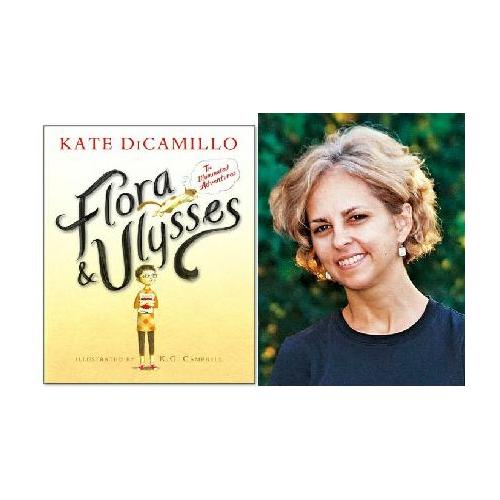
kate-dicamillo-floraandulyssestheilluminatedadvent-68She addressed the packed house of literacy teachers, some 2000 strong, who knew her as the author of Because of Winn-Dixie (a Newbery Honor book), The Tiger Rising (a National Book Award finalist), and The Tale of Despereaux (winner of the 2003 Newbery Medal), but her morning speech was about her latest book, Flora and Ulysses. She set the stage with her opening proclamation:

“This story begins as stories often do with a vacuum cleaner.”

Not just any vacuum cleaner. The vacuum at the center of this story was a 1952 tank Electrolux 2000, a treasured appliance belonging to DiCamillo’s mother. How treasured? DiCamillo joked that when her mother who was ill moved to be with her in Minneapolis, Minnesota, she worried more about the safe delivery of the Electrolux to the new home more than her own personal safety.”I want you to know that you can have the Electrolux when I am gone,” her mother told her. “It’s a really good vacuum cleaner,” she said and added, “The cord is extra long…and its retractable.”

The audience of teachers laughed; DiCamillo’s dry delivery in describing her mother’s attachment to a housecleaning appliance was part retrospective for the older teachers and part kitsch for the newer ones. “Remember the Hoover?” DiCamillo quoted her mother as saying, “that Hoover was useless!” But as she recounted how her mother’s illness progressed, the appreciation for this appliance took on new significance. “I really hope you will take the Electrolux,” her mother told her, “that makes me feel better.” So when her mother passed way, DiCamillo did take the Electrolux, but put it in the garage through that winter.

She spoke how in those dark days after her mother’s death, she found comfort in a poem by Rainer Maria Rilke, from Rilke’s Book of Hours: Love Poems to God and she read the lines from the short poem:

“God speaks to each of us as he makes us,
then walks with us silently out of the night.
These are the words we dimly hear:

You, sent out beyond your recall,
go to the limits of your longing.
Embody me.

Flare up like a flame
and make big shadows I can move in.
Let everything happen to you: beauty and terror.
Just keep going. No feeling is final.
Don’t let yourself lose me.

Nearby is the country they call Life.
You will know it by its seriousness.

Give me your hand.”

She reflected that when her mother was dying, she had held her mother’s hand in comfort, an action profoundly different from all the ways her mother had taken her hand when she was younger. The crowd was visibly moved by this retelling of the loss of her mother, but in typical DiCamillo storytelling fashion, her speech then veered off to include the death of a squirrel.

Shifting from the pathos for her mother, DiCamillo recounted that one day, a dying squirrel had chosen the front steps of her home as the last stop on his final journey. His eyes were open, yet unseeing; his chest dramatically heaving with his last breaths.
“I didn’t want him to suffer and die on my front steps,” she bemoaned.
So, she called a friend.
“‘There’s a squirrel on my front steps…He’s dying’,” she told her friend (Carla), “‘what should I do?'”
The advice she received from her gentle and humane friend appalled her.
“‘Do you have a shovel…and a tee shirt?'” asked Carla.
DiCamillo admitted that she had a shovel, but that she “moved away from the front door so the squirrel would not hear what was being said.”
“‘Put the tee shirt over the squirrel, and I will come over and hit him with the shovel,’ replied Carla.”

Fortunately, before that plan could be executed, the squirrel had crawled away.
“He may have heard us, or he had moved to get away from my presence,” said DiCamillo. The same people who had been tearing up from from the death of her mother and the power of the Rilke poem were now laughing out loud; the cathartic shift in emotions had been seamless.

DiCamillo then told the audience that she considered her reaction to the dying squirrel was not unlike the reaction of E.B.White in an essay he published in The Atlantic, “The Death of a Pig”:

 “He came out of the house to die. When I went down, before going to bed, he lay stretched in the yard a few feet from the door. I knelt, saw that he was dead, and left him there: his face had a mild look, expressive neither of deep peace nor of deep suffering, although I think he had suffered a good deal. I went back up to the house and to bed, and cried internally – deep hemorrhagic intears.”

“White claimed that his novel Charlotte’s Web was not connected to this essay…but could this event,” DiCamillo speculated, “have been more?”
She paused to consider their mutual despair over loss.
“He wanted to keep the pig alive….I wanted to keep the squirrel alive.”

And in that instant, a cathedral full of teachers understood that great ideas do not happen in (pardon the pun) a vacuum. DiCamillo’s speech illustrated how the three seemingly unconnected elements in her keynote address were the elements of story she combined in her latest book Flora and Ulysses.

In this story, there is a vacuum, a squirrel, a shovel, and several lines of the Rilke poem.
To be more specific, there is the near death experience of the squirrel, mistakenly sucked up by the Ulysses 2000; there is a comic-book superhero aficionado who intervenes; and there are several drafts of meta-physical squirrel poetry.  The story has the “beauty and terror” from the Rilke poem as well as the giving of a hand for comfort. There are what DiCamillo terms, “eccentric, endearing characters” presented in a format that combines print with comic book styled illustrations. Like the keynote address, the novel plucks at both the heart and the funny bone; it is a wonderful story.

The biography on DiCamillo’s website reads, “I write for both children and adults, and I like to think of myself as a storyteller.” Listening to her speak, I cannot think of her as anything else.

House of the ScorpionThere they were. Four used copies of Nancy Farmer’s The House of the Scorpion, and they were my find of the day at the Friends of the Danbury Public Library Fall Book Sale last weekend in Danbury, Connecticut. The unmistakeable bright red-orange and black spines were scattered in the author-alphabetized “F” section of the fiction offerings. They should have been in the young adult (YA) section, but a volunteer’s shelving error was probably why they were still available when I arrived. In this case, chance favored me.

I first became acquainted with Farmer’s science fiction novel two summers ago when I heard the plot involved cloning. I was looking for YA literature that could be used as a companion pieces to  Frankenstein; novels that incorporated many of the ethical questions raised by recent advances in the science of cloning. Science fiction was the genre that offered the most obvious choices. Farmer herself recognizes how science fiction anticipates the problems created by real science, saying:

“Science fiction allows you to approach a lot of social issues you can’t get to directly. If you wrote a book about how cloning is horrible, it would read like a sermon and no one would pay attention to it. “

The genre of science fiction is amazingly prescient in predicting technological advances.  H. G. Wells’ offered  The First Men in the Moon in 1901, 68 years before Neil Armstrong exited Apollo 11 and took steps on the lunar surface.  Digital books, submarines, droids and robots were features in science fiction novels before they became real nouns in our vocabulary. Credit for dreaming up the Internet is given to a wide spectrum of  fiction writers, from Mark Twain to Arthur C. Clarke, and manipulating human life has its genesis with 18 year old Mary Shelley’s Frankenstein. Therefore, Farmer is following the successful literary tradition of predicting man’s future. Her prediction takes the form of another dystopia, the equivalent of a political science crash course in failed nation-states for young readers.

Her opening mimic another great science fiction read, Aldous Huxley’s Brave New World. His great satire’s opening scene is in a factory that is manufacturing embryos. With streamlined industrialized precision, conveyor belts carry embryos that are then deprived of oxygen in order to create a caste of mindless workers. Farmer borrows some of Huxley’s ideas and begins her story with images that recall that frightening scenario:

A dull, red light shown on the faces of the workers as they watched their own arrays of little glass dishes. Each one contained a drop of life. (1.2)

In addition, Farmer’s predictions of a territory between the United States and Mexico controlled by drug cartels is plausible. That is the setting for her “coming of age” story of a young clone named Matt. The medical breakthroughs that create Matt, a clone of the drug lord El Patrón, are also feasible. Matt is unaware that his life is both protected by his status as the clone for the most powerful man in the land of Opium and endangered by El Patrón’s mortality…and at 146 years old, El Patrón is very mortal.

Farmer combines the issues of organ-harvesting, the economics of drug use, and adds a few Zombies for an exciting read that contains several amazing plot twists. I remember my jaw dropping…I didn’t see one twist coming at all. Farmer’s inventiveness with plot and skills as a storyteller resulted in the book receiving both a National Book Award for Young Adult Literature and a Newbery Honor in 2002. 

Last year, we offered 7th grade independent choices in literature circles centered on their interest in dystopias. The House of the Scorpion was one title offered along with other science fiction novels including Orson Scott Card’s Ender’s Game, M.T. Anderson’s Feed, Neil Shusterman’s Unwind, and several of Scott Westerfield’s selections from his Pretties series. Students fresh from reading Suzanne Collins’s The Hunger Game Trilogy were ready for other predictions for the future, and those who had not completed the series were given the opportunity to read these as well.

The cost for the four gently used copies at the book sale was $8.00; copies normally retail for $8.10, so this was a “buy one get three free” bargain in comparison. Based on other used book sales, we now have a class set (30) of The House of the Scorpion. The novel could be an all class read, however, as some of the topics in the novel require mature readers, we opt to make this and the novel Feed independent choice books.

The ethical questions raised in Frankenstein and The House of the Scorpion makes them good companion pieces, but that is not the only reason to pair them together. Our English Department’s essential question is “What does it mean to be human?” Literature gives students the language and the models for answering that question. The Monster in Frankenstein and the protagonist Matt in The House of the Scorpion are “non-human” characters that make students consider that being human may not be limited by the definitions in science, but by the possibilities in science fiction.

Banned Book Week is held annually during the last week of September in order to bring attention to the controversial practice of banning books, but an exhibit at the New York Public Library is proclaiming the same message through March 24, 2014. The exhibit “The ABCs of It: Why Children’s Books Matter”  celebrates the development of children’s literature in picture books, in chapter books, and in young adult literature.

The exhibit which opened on June 24th, is curated by Leonard S. Marcus who has also curated exhibitions at the Eric Carle Museum of Picture Book Art in Massachusetts, where he is also a founding trustee. This comprehensive exhibit is a must see and does not shy away from controversies in providing…

an examination of why children’s books are important: what and how they teach children, and what they reveal about the societies that produced them. Through a dynamic array of objects and activities, the exhibition celebrates the extraordinary richness, artistry, and diversity of children’s literature across cultures and time.

The differences in opinion on the role of children’s literature are raised at the exhibit’s entrance. Should children’s literature be foremost a means to deliver lessons of morality? (as Cotton Mather urged the Bible on young Puritans) Should children’s literature “delight and entertain”? (as John Locke believed with Aesop’s fables) Or should children’s literature tell the bare truth, not tales that “cover truth with a veil”? (Jean-Jacques Rousseau). From fairy tales to the Suzanne Collins’s The Hunger Games Trilogy, the controversy rages on, and the exhibit presents them all.

Screen Shot 2013-10-01 at 11.01.32 PM

A life-size set of “Goodnight, Moon” at the New York Public Library

There are tributes to William Blake’s poetry, Lewis Carroll’s Through the Looking Glass, and a original copy of Janette Sebring Lowrey’s The Pokey Little Puppy. One large panel features the rhyming words (Sam I am & green eggs and ham) of Theodore Geisel (Dr. Seuss). Along another long wall are the serial contributions of publisher Edward Stratemeyer: Bobbsey Twins, Hardy Boys, Tom Swift, and Nancy Drew. There is a tribute to comic books complete with silhouettes of Marvel and DC heroes, and tribute to books successfully made into films. A glass case holds the original Pooh, Piglet, Kanga, Roo, and Tigger from A.A Milne’s 100 Acre Woods; Eric Carle’s colorful panels (Brown Bear, Brown Bear and others) glow brightly in the cases. Pictures of the exhibit are on the New York Public Library’s Facebook Page and the NYTimes slide show review.

There is a wall that bears the distinctive outline of one of Maurice Sendak’s “Wild Things” around the corner from a life-size set of Margaret Wise Brown’s Good Night, Moon, waiting for the quiet old lady to whisper “hush”. You can listen to E.B. White read the last chapter of Charlotte’s Web, and try not to sob when hearing him say the line, “It is not often that someone comes along who is a true friend and a good writer. Charlotte was both.”

The exhibit also points out the role of children’s literature in politics or in nation building.  On one wall of the exhibit, there is a sculpted relief of the world surrounded by three quotes; each quote makes an important point about the significance of children’s literature. The first quote is by Noah Webster from an essay titled “On the Education of Youth in America,” American Magazine, New York, December 1787:

“The Education of youth is, in all governments, an object of the first consequence. The impressions received in early life usually form the character of individuals, a union of which forms the general character of a nation.”

Political writer, author, and developer of the dictionary, Webster was an early advocate for education as key to America’s growth and development.  The next quote, however, gives the viewer pause…and a few chills:

“Education is a weapon whose effects depend on who holds it in his hands and at whom it is aimed.”
Interview with H. G. Wells -September 1937- said by Joseph Stalin

Similarly, the last quote does demonstrate how in astute political hands, children’s literature can be a powerful propaganda tool:

“Rise up children and learn to be free independent children of China, learn how to wrest this freedom from the yoke of Japanese imperialism, and transform yourself into masters of a new era.”
Mao Zedong from the Journal Children of the Border Areas- 1938

These voices provide a serious reminder that children’s literature is more than board books, rhymes, and fairy tales. There are powerful messages in these stories; some so powerful that they have banned. For example, there is Munro Leaf’s story of the peace loving Ferdinand, the Bull which “caused an international controversy” when it was first published; banned in Spain the book was burned in Nazi Germany. Exposing those horrors of the Holocaust is a copy of Art Spiegelman’s breakthrough graphic novel Maus.

Marcus’s exhibit presents the questions and controversies about children’s literature, but does not provide answers. The exhibit has examples of how this genre of literature can contain both powerful political tools and playful trivial entertainment. There is no answer to the exhibit’s opening questions as to whether children’s literature is a means to educate, a means to enforce a moral code, or a source of joy. On seeing the stories of childhood so beautifully arranged, I opt for joy.

At the end, a large screen posts a continuing stream of Jeopardy-styled quiz questions in an interactive, and serious time-killing, activity.
I stood answering questions (“curiouser and curiouser= Cheshire Cat” or “Lyle, Lyle Crocodile= The House on 88th Street“) for some time before a young boy noted, “Hey, you’re pretty good at this..”

“Thanks,” I said, “I really like these books.”

“So do I,” he responded before leaving.

Thanks for making that moment possible, New York Public Library. Continue Reading…

“Are you upstairs hiding with a book?” my mother was exasperated as she called up the stairs.
“No-oo..” I would reply, stashing the copy of The Sign of the Twisted Candles, The Password to Larkspur Lane or The Secret in the Old Attic under the covers.
My mother would be looking for me for some chore I had left undone, but the lure of those yellow-spined mystery books was so hard for me to combat. I would succumb and lose track of time, and responsibilities, the minute I picked up one of the mysteries.

I was Nancy Drew addicted.

From the day I found my first copy at age eight under the Christmas tree, I read every Nancy Drew title available, a total 46 titles by the time I completed eighth grade.

“So, how’s that little blue roadster?” my father would ask, passing me while I was lost in a mystery.
“Oh! You are going to ruin your eyes,” my mother would complain finding me reading by hall light.

The contradictory message from my parents to read or not to read while feeding my addiction with new editions of Nancy Drew for birthdays and other holidays only heightened my regard for the series. Nancy Drew was the dessert to my reading diet, the forbidden fruit during Saturday chores, the delicious temptation to finish “just one more chapter” before falling asleep.

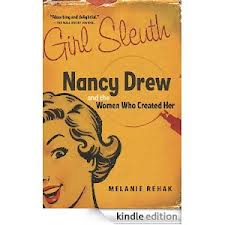
Girl SleuthSo, I was delighted when at a public library book sale I came across a “used” brand new copy of Girl Sleuth, Nancy Drew and the Women Who Created Her by Melanie Rehak.

Here was the story of Nancy’s origins, the brainchild of Edward Stratemeyer (1862-1930) who developed and ran a syndicate of writers of children’s fiction. I have only recently come to understand how much Stratemeyer influenced generations of young readers, myself included, by producing book series specifically geared to their interests.

He created the Tom Swift and The Hardy Boys series. He was responsible for the adventures of Nan, Bert, Flossie and Freddie in The Bobbsey Twins. Early in his writing career, Stratemeyer recognized that writing under different pseudonyms and with different publishers, he could offer more books each year. Unable to keep up with the demand for his stories, he began to outsource his work by hiring writers to complete stories he had outlined. By 1905, his book publishing syndicate mirrored the Henry Ford model of assembly linewriting; Stratemeyer editing the work of other writers who filled in the details from his summary notes.

It was Edward Stratemeyer that conceived of the young girl detective, and he developed five plots that he could offer a writer who could meet his exacting standards. Originally, the character Nancy Drew was named Stella Strong, and one of the plots that Stratemeyer developed was for Stella Strong at Mystery Towers:

How Stella visited the old Tower House and met the rich and eccentric maiden ladies, Patricia and Hildegarde Forshyne, who were much disturbed by unusual happenings about the place. She learns that some relatives are trying to get possession of the Forshyne fortune  Stella was once made a prisoner, but turned the tables and made a startling exposure (112).

Stratemeyer suggested other names for his new sleuth: Nell Cody, Nan Nelson, Diana Dare, Helen Hale, Nan Drew. The decision to expand Nan to Nancy was made by the publishing company Grosset & Dunlap who were enthused by this chance to have books for the growing market for young female readers. Stratemeyer had already decided that the pseudonym Carolyn Keene would be used for the series; each book would sell for fifty cents with two cents royalty going to his syndicate. From a number of applicants, he selected Mildred Wirt Benson, a “convention-flouting journalist” and agreed to pay her $125 for each manuscript (114). She, like all other writers in the Stratemeyer syndicate, signed away all rights to the stories and character.

Rehak’s extensive research clearly shows that Wirt was responsible for developing the character of Nancy Drew from the beginning. When Edward Stratemeyer passed away suddenly after the launch of the first Nancy Drew mystery, his daughter Harriet Stratemeyer Adams, took over the editing and eventually, the supervision of all things Nancy Drew. It was Wirt, however, who fleshed out the Nancy’s character against the backdrop of the Great Depression in 1930. Her Nancy was popular in school with two devoted friends, Bess and George. She was intelligent and attractive, moving stylishly between tweed suits and a “party frock of blue crepe which matched her eyes”. Blue was also the color of her little shiny roadster, a gift from her supportive father, Carson Drew. The mother figure, housekeeper Hannah Gruen, was also Wirt’s idea; the boyfriend Ned Nickerson came later in the series.

In recounting the success of the Nancy Drew series, Rehak notes that Wirt “later confessed  that Nancy Drew was “everything she -or any girl, in fact-wanted to be, and then some” (117). Rehak’s recounting of the success of the series is dampened by the deteriorating relationships in the Stratemeyer family, reduced pay for Wirt, and Harriet’s demands to keep the syndicate’s ghost writers from claiming their authorship.

Rehak also explores the other media ventures that featured Nancy Drew: TV series, movies, graphic novels, and a sordid connection to Playboy magazine.  Harriet’s control of her family’s publishing company’s intellectual property kept many of the writers like Wirt from claiming authorial attribution.

Subsequent revisions of Nancy Drew get less exploration by Rehak, who has little praise for the “loud flashy plots and clothing and crushes” that recent publishers have tried in order to “revamp the sleuth” (311). Nancy Drew’s back story is well organized by Rehak and a must read for all her fans who knew that it was not the plot that made the book exciting, but rather the “pleasure comes from her [Nancy Drew’s] autonomy, her taking events into her own hands”(307).

Rehak concludes with the feminist view that Nancy Drew was a guide for the ages as many of the problems for women (equal pay, inadequate day care, etc) still exist:

Nancy DrewThanks to Mildred and Harriet and the generation of women and girls who glimpsed in Nancy Drew a vision of what they might be someday, it doesn’t look like the sleuth is going away anytime soon, which is a good thing. There are fighting days still ahead of us, and we’re going to need her (314).

Perhaps this is why my memories of Nancy Drew are so salient, and my addiction forgivable. While my chores waited, Mildred Wirt Benson and Harriet Stratemeyer Addams offered me, and thousands of young girls like me, a role model.

So, Mom, I really was not hiding upstairs with a book…I was growing up.

JaneEyre-300x253

Jane Eyre audio offered by SYNC YA

This summer I have been visiting the family estate at Gateshead, the harsh boarding school Lowood, and the Gothic mansion called Thornfield Hall through the audio download of Charlotte Bronte’s Jane Eyre courtesy of SYNC YA. This free audiobook uses Overdrive software which is on both my computer and my mobile phone. As the recording of Jane Eyre is about eight hours long, the ability to move from device to device has proved most helpful in finishing the book.

This is not my first experience with this novel. I read the book when I was a teenager, and, like Jane, I fell in love with Mr. Rochester. Years later, I taught the book later to Advanced Placement students and marveled at Jane’s independence, her morality, and her ability to emphatically say “No” to the persistently persuasive Rochester.  Now, I am struck by Jane’s role as a governess and how Bronte characterizes attitudes towards that profession in Victorian England.

At one of Rochester’s soirees, Bronte has the spoiled but beautiful Blanche Ingram recount how she and her brother and sister, tormented their governesses and tutors as as they grew up. The incident begins when Blanche’s mother, Mrs. Ingram, calls the guests’ attention to Jane, isolated in a corner of the room. “I have just one word to say of the whole tribe,” whispers Blanche’s mother loud enough for Jane to hear, “they are a nuisance.”

Blanche cheerfully counters:

Not that I ever suffered much from them; I took care to turn the tables. What tricks Theodore and I used to play on our Miss Wilsons, and Mrs. Greys, and Madame Jouberts! Mary was always too sleepy to join in a plot with spirit. The best fun was with Madame Joubert: Miss Wilson was a poor sickly thing, lachrymose and low-spirited, not worth the trouble of vanquishing, in short; and Mrs. Grey was coarse and insensible; no blow took effect on her.

Not satisfied with those affronts to those poor teachers, Bronte has Blanche continue the list the indignities inflicted on one particular governess who was subjected to especially bad behavior from the Ingram children:

But poor Madame Joubert! I see her yet in her raging passions, when we had driven her to extremities–spilt our tea, crumbled our bread and butter, tossed our books up to the ceiling, and played a charivari with the ruler and desk, the fender and fire-irons. Theodore, do you remember those merry days?”

Blanche’s condemnation of those who tried to educate her backfires; Bronte’s desire to have the reader dislike this rival for Rochester’s affection is deliberate. Jane’s quiet moral intelligence wins out in the end.

Listening to the story, I considered that Bronte was making a case for the importance of education as a means to rise out of poverty. Jane’s education at the Lowood Institute, a boarding school, was hazardous and purchased at a terrible price. Her classmate, Helen, dies because of the stark conditions at Lowood, mirroring the real-life death of Bronte’s sister, Maria, who died from tuberculosis contracted because of hunger, cold, and privation at Cowan Bridge School. Despite the treacherous conditions, however, Bronte revisits the theme of education’s importance as it provided the character Jane with an independent profession. She is hired to teach Rochester’s ward Adele, and she proves to be a successful governess.

The conflict between Bronte’s belief that education was one way for a young woman to earn a small income, to have a marketable profession, clashes with the upper classes’s view of the teaching profession in 1847. Therefore, how disappointing to read polls (2009-2012) about contemporary economics of the teaching profession that demonstrate that a century and a half later, not much has changed. According to The Economix blog on the NYTimes, “Does it Pay to Become a Teacher?”, salary  may reduce attracting high quality graduates to the teaching profession:

The average primary-school teacher in the United States earns about 67 percent of the salary of a average college-educated worker in the United States. The comparable figure is 82 percent across the overall Organization for Economic Cooperation and Development (O.E.C.D.). For teachers in lower secondary school (roughly the years Americans would call middle school), the ratio in the United States is 69 percent, compared to 85 percent across the O.E.C.D. The average upper secondary teacher earns 72 percent of the salary for the average college-educated worker in the United States, compared to 90 percent for the overall O.E.C.D.

The findings also point out that teachers in the USA teach over 1000 hours annually, an amount well over the hours of their international peers. That number does not include time for preparation, training, or assessing. The article concludes:

Given the opportunity costs of becoming a teacher instead of using your college degree to enter another, more remunerative field, are the psychic rewards of teaching great enough to convince America’s best and brightest to become educators?

Bronte was one of England’s best and brightest who advocated education, but Bronte knew that teaching was not an economically successful profession. Jane Eyre only becomes financially independent when a relative leaves her a fortune; she only becomes wealthy when she confesses, “Reader, I married him.”

Over 150 years after Charlotte Bronte’s novel, the teaching profession still has its critics; there are real life Mrs. Ingrams and Blanches who hold the profession in contempt. There are also economic drawbacks to choosing the profession, as demonstrated in the O.E.C.D poll.

In the 21st Century, the teaching profession should be desirable to those who aspire to teach, but who, like Jane, want to be financially independent. Teachers should not have to wait for a Mr. Rochester in order to prosper.

Screen Shot 2013-06-05 at 4.32.55 PMWhile some of my students have no problem cracking open a good book over the summer, others might prefer an audio text. That is why when I found the SYNC audiobook website, I was delighted to spread the word (and recorded voices) about great literature available all summer long. I have challenged my students to read (listen) with me all summer!

SYNC has organized a summer full of classics paired with young adult (YA) texts that are similar in theme. Each pairing is available only for a download for a short period of time, but once a reader downloads the MP3 files, the audiobook is available for listening at any time.

The software that makes this offer possible is  Overdrive Media Software that can be installed on a computer (compatible with Windows and Mac) or through an Overdrive App on a mobile device (compatible with iOS, Android, BlackBerry, Windows Phone 7).

Visit the OverDrive website to download the App or Software.

I have already listened to the full cast production of Shakespeare’s The Tempest, and enjoyed the dramatization. My familiarity with this play (I teach this every fall to my Advanced Placement Literature students) may influence how I think a student hearing the production for the first time might understand the plot. I hope they can follow some of the plot intricacies.

Screen Shot 2013-06-05 at 4.29.30 PMI was surprised that the play was paired with Of Poseidon, a romantic fantasy involving a independent and beautiful Emma and her strange encounters with the incredibly handsome Gaylen.  I would have paired this book with Romeo and Juliet because the inferences about clan conflicts are too frequent not to imagine “two houses both alike in dignity, in the fair ocean where we lay our scene.” This debut novel by Anna Banks addresses mermaid lore, the legend of Atlantis, and forbidden love on the Jersey Shore. Unlike the TV show, listeners are 75% into the book before the first kiss; there is a great deal of “raising her chin with his fingers” and “cheek-stroking” to keep romantics hopeful. The reader (Rebecca Gibel) was also excellent, lacing some of the more exclamatory phrases with the right amounts of sarcasm or ruefulness.  My only complaint was that this novel is the first in a series. As I got closer to the end of the recording, I began to realize that this novel was the “introductory”, a sentiment seconded by this reviewer:
This book also ends in a most inopportune place. I get it – we’re being set up for the second book – but this book sort of has this massive reveal and then BAM we’re at the end. I’d seen enough people’s reactions, though, to expect it, so I wasn’t quite as upset as some readers have been with the abrupt ending. Still, not a whole lot is resolved in this book, and I have a problem with a book that didn’t seem to have much of a point aside from setting up for the next one. (Merin; Amazon Book Review)

Complaining about a free download, however, seems ungrateful. Like the reviewer, I enjoyed the novel very much, so much that I was annoyed when all the loose ends were not resolved. Obviously, this is one way for SYNC to market additional texts. In this case, the strategy will work; I probably will purchase the sequel.

The schedule for titles downloads during this summer is listed below:

May 30 – June 5, 2013
Of Poseidon by Anna Banks, read by Rebecca Gibel (AudioGO)
The Tempest by William Shakespeare, read by a Full Cast (AudioGO)

June 6 – June 12, 2013
The Incorrigible Children of Ashton Place, Book 1: The Mysterious Howling by Maryrose Wood, read by Katherine Kellgren (HarperAudio)
Jane Eyre by Charlotte Brontë, read by Wanda McCaddon (Tantor Audio)

June 13 – June 19, 2013
The Raven Boys by Maggie Stiefvater, read by Will Patton (Scholastic Audiobooks)
Bless Me, Ultima by Rudolfo Anaya, read by Robert Ramirez (Recorded Books)

June 20 – June 26, 2013
Once by Morris Gleitzman, read by Morris Gleitzman (Bolinda Audio)
Letter From Birmingham Jail by Martin Luther King, Jr., read by Dion Graham (christianaudio)

June 27 – July 3, 2013
Rotters by Daniel Kraus, read by Kirby Heyborne (Listening Library)
Frankenstein by Mary Shelley, read by Jim Weiss (Listening Library)

July 4 – July 10, 2013
Carter Finally Gets It by Brent Crawford, read by Nick Podehl (Brilliance Audio)
She Stoops to Conquer by Oliver Goldsmith, read by a Full Cast (L.A. Theatre Works)

July 11 – July 17, 2013
The Peculiar by Stefan Bachmann, read by Peter Altschuler (HarperAudio)
Oliver Twist by Charles Dickens, read by Simon Vance (Tantor Audio)

July 18 – July 24, 2013
Grave Mercy by Robin LaFevers, read by Erin Moon (Recorded Books)
Hamlet by William Shakespeare, read by a Full Cast (L.A. Theatre Works)

July 25 – July 31, 2013
The False Prince by Jennifer A. Nielsen, read by Charlie McWade (Scholastic Audiobooks)
The Prince and the Pauper by Mark Twain, read by Steve West (Blackstone Audio)

Aug 1 – Aug 7, 2013
Death Cloud by Andrew Lane, read by Dan Weyman (Macmillan Audio)
The Adventures of Sherlock Holmes by Arthur Conan Doyle, read by Ralph Cosham (Blackstone Audio)

Aug 8 – Aug 14, 2013
Enchanted by Alethea Kontis, read by Katherine Kellgren (Brilliance Audio)
Through the Looking Glass by Lewis Carroll, read by Miriam Margolyes (Bolinda Audio)

Aug 15 – Aug 21, 2013
Sold by Patricia McCormick, read by Justine Eyre (Tantor Audio)
Let Me Stand Alone by Rachel Corrie, read by Tavia Gilbert (Blackstone Audio)

I am looking forward to a summer full of great audiotexts, and I hope my students will take advantage as well. Thank you, SYNC!

2013-06-09 18.00.17

The contents of the $7/box

There is no official “start” to the summer book sale season, but one great place to whet an appetite is at the Friends of the Byram Shubert Library in Greenwich, Connecticut.

This sale is usually held the 2nd weekend in June at the St. Paul’s Lutheran Church across the street. Book Sale Finder advertises the sale as “Exceptional”, “Well worth the trip!” and “Great Prices!”

Suffice to say, the sale was as advertised.

The Friday Preview night sells hardcovers $3, softcovers $2, small paperbacks .50 or 3/$1. On Saturday, prices are reduced to hardcovers $2, softcovers $1, small paperbacks 5/$1, children’s .25-.50. But it is on Sunday, a Bargain hunter’s delight, that there is a  “bag and box” sale $5/bag, $7/box or 2 boxes/$10.

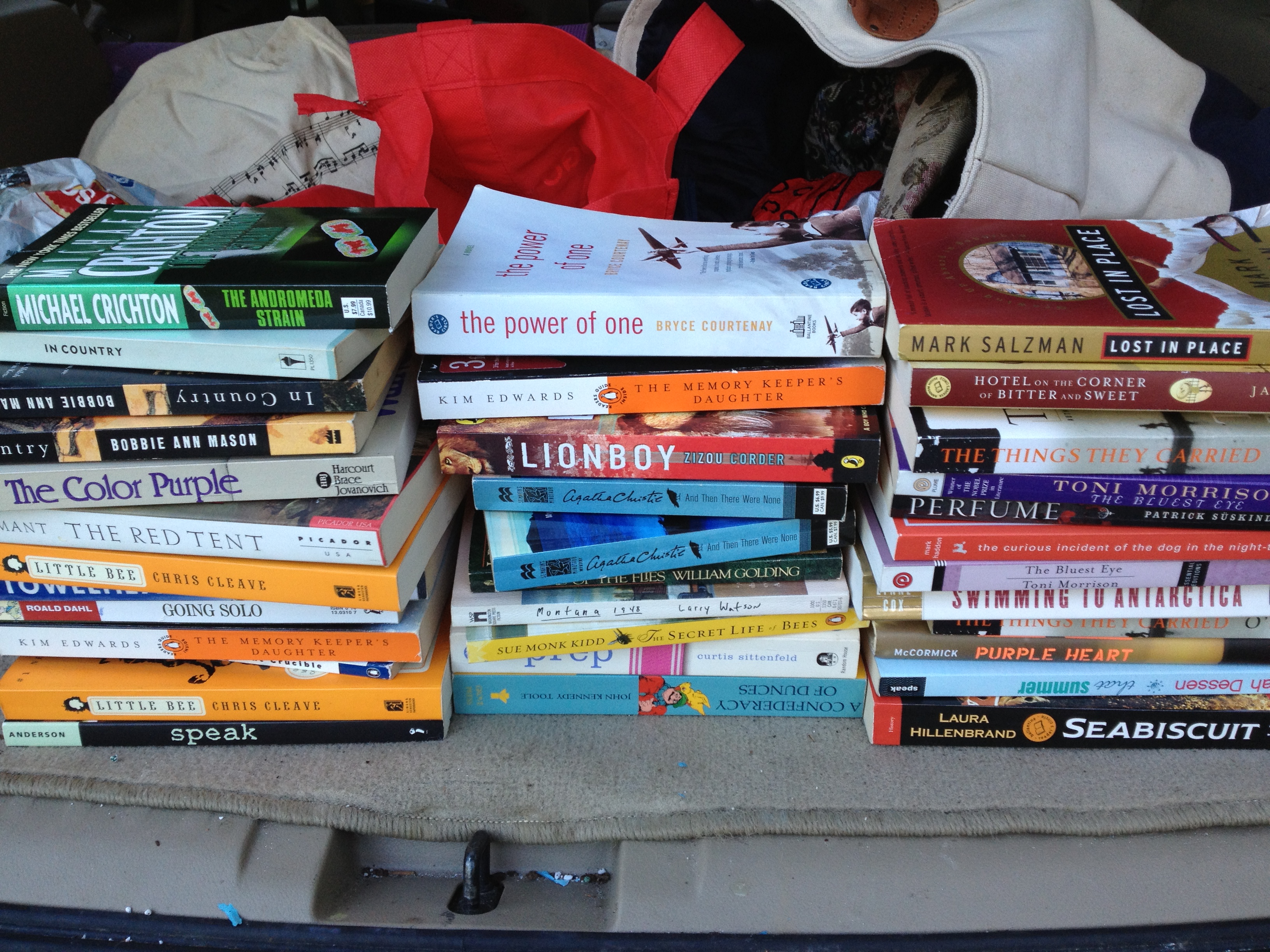
I went in the last few hours on Sunday, and the tables were still tidy. The fiction was plentiful, but the non-fiction and young adult choices very picked over.  Nevertheless, in 20 minutes, I selected 34 great titles that I placed in a box provided by the Friends of the Library.

13 copies of books outlined in our curriculum mapping

13 copies of books outlined in our curriculum mapping

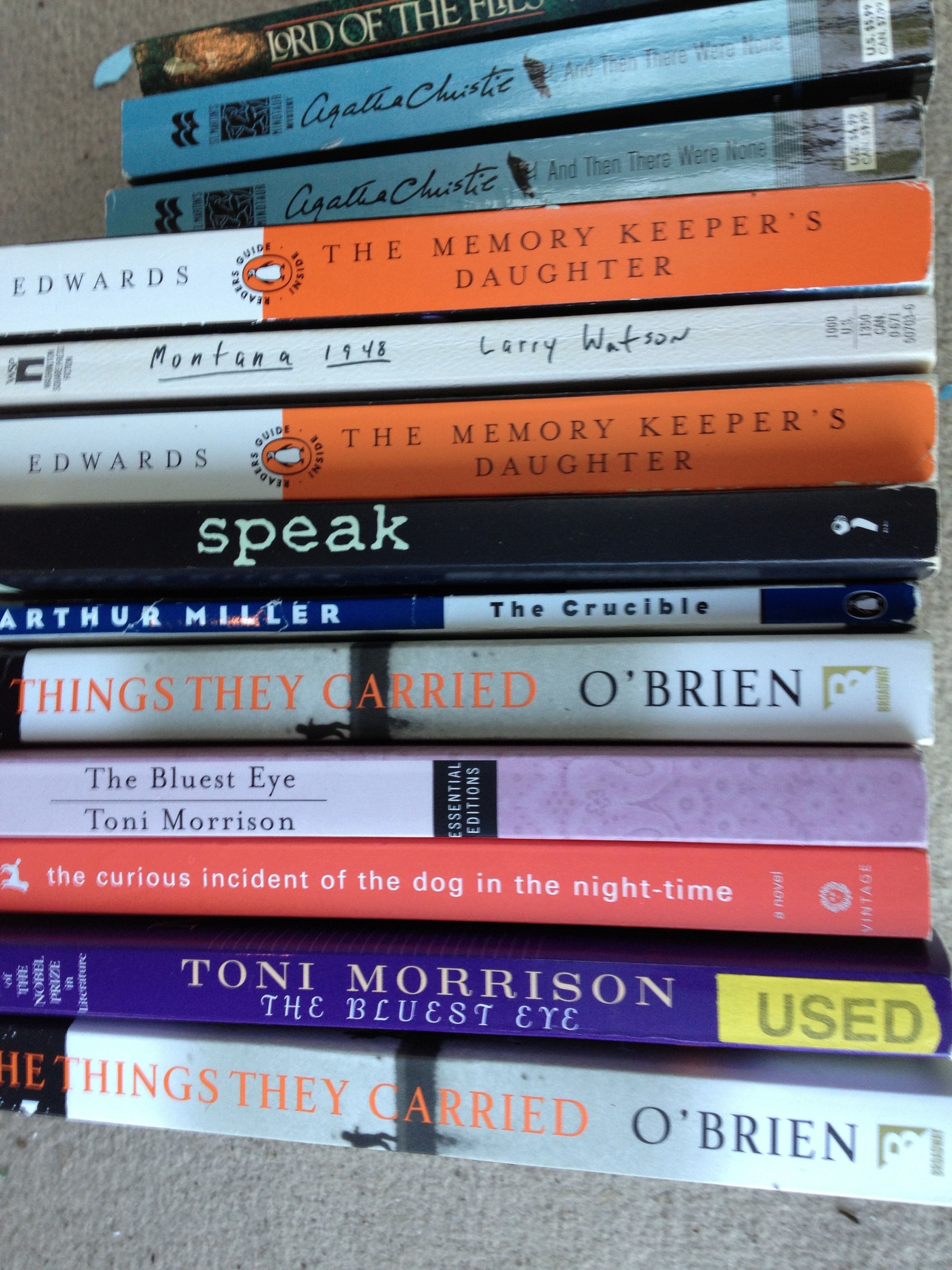
On the tables I grabbed titles we offer in our Grade 11 Vietnam War literature unit: 3 copies of In Country by Bobbie Ann Mason and and 2 copies of Tim O’Brien’s The Things They Carried.  There were also books assigned in our curriculum for Grade 10 World Literature: Mark Haddon’s The Curious Incident of the Dog in the Night Time and William Golding’s Lord of the Flies. Finally, two clean copies of Agatha Christie’s And Then There Were None will be placed in our grade 8 mystery unit. Summer reading for the Advanced Placement English Language is Kim Edward’s The Memory Keeper’s Daughter while Toni Morrison’s The Bluest Eye is one of the choices offered to these students during the school year.

The 13 books I found outlined in our curriculum mapping would normally retail for $139.00 if purchased new. The additional 21 books in the box will be added as independent reads in classroom libraries or suggested as “satellite reads” to complement a whole class novel.

34 books for $7.00? That is an amazing bargain. The 2013 summer used book sale season is off to a great start!

boringMany educators use Twitter to communicate as part of personal learning networks (PLN). I appreciate the means to share messages with other educators, but I am sometimes alarmed by some of the tweets I read. The brevity of 140 characters does not allow for nuances. The tweet is, by design, blunt.
Example #1: Most teachers do not share a professional language. And they don’t share prof lang with students. 
I wonder, “Really? Is there evidence to support this claim?”
Example #2: Freedom—for educators and parents—is necessary, but not sufficient, for excellent schools
I think, “Define Freedom. Define sufficient. Define excellent.”
These tweets are made of some sentiment that begins an argument, but they are so brief and banal that they cut off debate.
Such was the case this week when prominent author and educator Dr. Tony Wagner paraphrased a statement made by Education Secretary Arne Duncan (week May 21, 2013) in a response on his twitter feed.  Wagner is the first Innovation Education Fellow at the Technology & Entrepreneurship Center at Harvard; he is a former high school teacher, K-8 principal, and a university professor in teacher education. Wagner’s tweet read:

“‘Too many high school students are dropping out, not because school is too hard, but because it’s too easy @arneduncan’ Wrong! It’s boring!” @DrTonyWagner.

While I disagree with Duncan’s generalization that schools are too easy, I was even more disturbed by Wagner’s response, about school, “It’s boring!”
I hear this complaint enough from students before they read the class novel or before we start the unit. I did not expect to hear it from Wagner.
Students say “this is boring” so much that I will not let them use the word “boring” any more.
But, is school boring?
Is it?
I take issue with Wagner’s claim. I would like to debate this.
As someone who attended Mr. Orontias’s History and Geography class in 1970, I can confidently say I have experienced boring. His 45 minute lecture delivered in a monotone right after lunch was not in a time space continuum; the clock hands did not move.
I know boring.
In contrast, my students’ high school today is not boring. As examples, I offer the following:
  • We have a Bring Your Own Technology (BYOT) initiative;
  • We employ student driven learning with choice on reading, topics, and presentation;
  • We include project based assessments and encourage reflection on tests.
We do, however, require that students do schoolwork. They practice math problems. They do research. They must complete reading assignments. They have deadlines. Some of this work is repetitious; some of this work is tedious. Some rote learning may be necessary to develop background knowledge before students can engage in active participation or collaboration.
So, when I hear from students that they are “bored” with school, often what they are saying is “schoolwork is not fun.”
This is not unexpected. A great deal of time is spent everyday in “not fun” activities inside school, just as a number of “not fun” activities are required in the real world.
I sympathize, but the reality is that not every lesson in school is fun. Education objectives require students to work rather than have the teachers be the engine of the classroom.
Wagner is one of the innovative educators who promotes education to incorporate more real world problems, reforming education to prepare students with 21st Century skills in order to engage students in meaningful enterprises. Whatever innovations are developed by education reformers like Wagner, students will experience frustrations, and experience failures. There will be efforts expended by teachers and students successfully and unsuccessfully. Work will be necessary, and some of that work will not be fun. If the goal of schools is to prepare students to learn the value of work, to prepare students for the workforce, work should be applauded, even if the work is not fun, or if the work is “boring.”
Arne Duncan’s statement that high school students are dropping out because schools are too easy is a gross overstatement. How easy will the real world be for those high school dropouts?
Similarly, Wagner’s accusation that high school is boring is infuriatingly terse, using only 20 out of Twitter’s 140 characters. How bored will students be if they drop out and cannot find fulfilling employment?
There are isolated cases of students who may write code for some fabulous new social media or video game that goes viral, but those are isolated. A high school diploma is necessary for even the most menial employment.
Today’s schools are not boring. Today’s schools are preparing students for work environments just like schools have done in decades past. Historically, teachers do not predict the job market, instead they prepare students with the fundamentals so that their students may create the job market. Some of that preparation is not fun; it is work, and in student lingo, it is boring.
Stating this needs more than a pithy remark that negates the efforts of teachers who are engaging students with 21st Century skills, with active rather than passive instruction.
Education has come a long way since my experience in the 1970s because of the efforts of education reformers like Dr. Wagner. Forty years ago, education came in primarily in the form of direct instruction. We sat in rows and listened to lectures, and yes, that was boring.
Except for the day that Mr. Orontias stepped into the wastebasket.
That was not boring at all.

sunThe paradox of summer reading:  Read=pleasure or Read=work.

All students should read at least one book this summer and practice the independent reading skills they have used the whole school year. They should receive credit for reading over the summer, but to give credit means an assessment. An assessment comes dangerously close to committing Readicide,(n): The systematic killing of the love of reading, often exacerbated by the inane, mind-numbing practices found in schools.

Anecdotally, 50% of students will read for fun. The other 50% will skim or Sparknote to complete an assignment, or they will not read at all for a variety of reasons: “it’s boring”, “too much work”, “I hate to read.”  Many students avoid books creating a “reading-free zone” from June through August. In addition, there are some parents who openly complain that assignments over the summer interfere with family vacation plans.

But there are many parents who understand the importance of reading. They could be frustrated all summer as they responsibly hound their children to do their summer assignments rather than wait until the last minute.

Summer reading is fun for some, but summer reading is a hassle for others. Why bother, indeed?

Well, research clearly demonstrates that summer reading is important in maintaining reading skills at every grade level. A meta-analysis (1996) of 39 separate studies about the effects of summer on student learning came to the conclusion that summer reading was critical to stopping the “summer slide”. Without summer reading, there could be a loss equaling about one month on each grade-level equivalent scale. Students would be playing a cognitive “catch-up” through November each school year.

In “The Effects of Summer Vacation on Achievement Test Scores: A Narrative and Meta-Analytic Review” by H. Cooper, B. Nye, K. Charlton, J. Lindsay and S. Greathouse, there were several key findings:

 At best, students showed little or no academic growth over the summer. At worst, students lost one to three months of learning.
 Summer learning loss was somewhat greater in math than reading.
 Summer learning loss was greatest in math computation and spelling.
 For disadvantaged students, reading scores were disproportionately affected and the achievement gap between rich and poor widened.

There have been studies since 1996 that confirm the findings of the meta-analysis, so, summer reading cannot be optional if students are to maintain their skills and progress as readers. The problem for teachers is how to engage the 50% who will not read over the summer. My English Department has tried the following:

  • One summer, we tried an assigned book route. We used a multiple choice quiz to measure student comprehension. The results were average to below average. Most students hated having to read an assigned book.
  • One summer, we tried the dialectical journal kept by a student on either an independent book choice or an assigned book (see post). The results were mixed with 25% students not completing the journal or completing the journal so poorly that we were chasing students for work past the due date and well into the end of the first quarter.
  • One summer, we tried the “project of your choice” in response to a “book of your choice”, but then we were buried in a pile of projects, with a wide variable in the quality of these projects.

So, this summer (2013) we are again trying something different in the hopes of finding a better measurement for summer reading. We are giving students their choice in reading fiction or non-fiction. The incoming 7th and 8th graders choose a book for the summer, and the school will provide that book. Students who will be entering grades 9 -11, may checkout a book from an extensive list organized by our school media specialist or any other book they choose.

Summer reading will be assessed with a writing assignment when all students return in September. The questions will align with standardized test essay questions (CAPT, SAT) and students may have the book in hand or notes from the book; students who read early in the summer will have the same advantages as students who read later in the summer, or the night before the writing prompt:

Essay question(s) for a work of FICTION read over the summer:
How does the main character change from the beginning of the story to the end? What do you think causes the change?
How did the plot develop and why?
How did the main character change? What words or actions showed this change?

Essay question(s) for a work of NON-FICTION read over the summer:
If this book was intended to teach the reader something, did it succeeded? Was something learned from reading this book, if so what? If not, why did the book fail as a teaching tool?Was there a specific passage that had left an impression, good or bad? Share the passage and its effect on the reader.

This assessment will be given the second week in September, and while there is a concern that writing is not as effective in measuring a student’s reading comprehension, at minimum this assessment will give the English Department members a chance to teach a writing prompt response.

Students who are in honors level or Advanced Placement courses will still have required reading. For example, incoming 9th grade honor students will read The Alchemist and The Book Thief while 12th grade Advanced Placement English Literature Students will be given the choice to read three of the following five titles: Bel Canto, The Story of Edgar Sawtelle, The Poisonwood Bible, Little Bee, or A Thousand Splendid Suns.

Before students leave for the summer, we plan on putting books into as many hands as possible. We will encourage students to organize themselves with book buddies, a suggestion from a post by Christopher Lehman, having them organize who they will be reading alongside, someone who they could talk with about their reading. The students have Shelfari accounts and can communicate online during the summer. We will promote our own reading book sites and include an audiobook site SYNC that pairs a young adult novel with a classic each week during the summer. For example, August 1 – 7, 2013 will feature Death Cloud by Andrew Lane, read by Dan Weyman (Macmillan Audio) with The Adventures of Sherlock Holmes by Arthur Conan Doyle, read by Ralph Cosham (Blackstone Audio). We will post information about summer reading on our websites, and send out Remind 101 notices.

While the research clearly demonstrates that summer reading is important, how students accomplish summer reading assignments during vacation time is a paradox. Should we assess reading for pleasure, or should students be left on their own and possibly lose reading skills?  Quiz them in September or lose them to the summer slide? No right answer, but good evidence to continue the tradition of summer reading.

Catcher-in-the-rye-red-cover“I heard about this book called ‘Catcher in the Rye,” said Peyton. She was lining up a “book buddy” extra credit assignment to read with Madison.
I reached for two dog-eared copies with the familiar brick red cover, “Meet Holden Caufield,” I said.

Requests for Catcher in the Rye happen every year. Since we do not teach the novel as a whole class read, I am always happy to see the many copies we have circulating for independent reading. J.D. Salinger passed away in 2010, almost sixty years after his bildungsroman, (coming of age story) of a young man’s wanderings one day in New York City captured the angst of late adolescence for an audience familiar with that angst. Houlden Caufield’s voice was unlike any other, and readers adopted the book with a fervor that bordered on fanaticism. As evidence, there are well-worn copies at every used book sale.

In most high schools today, Catcher in the Rye has a reputation, a cult status. Its “banned book” pedigree  interests both conformist and non-conformists. According to World.edu:

Between 1961 and 1982, The Catcher in the Rye was the most censored book in high schools and libraries in the United States. In 1981, it was both the most censored book and the second most taught book in public schools in the United States.

Many of my students know about the book’s banning history from the South Park episode from Season 14: The Tale of Scrotie McBoogerballs.  In this episode, the students at South Park Elementary are given copies of Catcher in the Rye and learn that the book is “filthy, is inappropriate, and made a guy shoot the king of hippies.”
“Can we PLEASE read this book now?” Cartman pleads.
(View at: http://www.southparkstudios.com/clips/267355/lets-read-it-now )
Very quickly, however, the South Park students learn that 60 years after its publication, the language and themes in the story of Holden Caufield’s day are tame by today’s standards; they are dumbfounded and more than a little annoyed that anyone would consider the book inappropriate. My students have expressed the same puzzlement.

With only one major book to his credit, Salinger still commands the media’s attention. A tweet last week by OpenCulture linked the video below of the reclusive 91-year-old Salinger out for a stroll in Windsor, Vermont (2010):

Under the video, Open Culture also posted a series of anecdotes about Salinger, for example, a story about Nicholas Carr (Is Google Making Us Stupid?)

Nicholas Carr, who was working behind the circulation desk at the college library one summer when “a tall, slender, slightly stooped man” walked in. He remembers his boss whispering, “That’s J.D. Salinger”:

Holy crap, I thought. I just saw J.D. Salinger.

About ten minutes later Salinger suddenly reappeared at the desk, holding a dollar bill. I went over to him, and he said he needed change for the Xerox machine. I took his dollar and gave him four quarters.

That’s my claim to fame: I gave J.D. Salinger change for a buck.

Another recent news item on Salinger was published in the New York Times April 23, 2013, “The Young Salinger, Mordant Yet Hopeful” by Dave Itzkoff. The article described that a recent discovery of nine letters by a 22-year-old Salinger “revealed himself to be as playful, passionate and caustic as Holden Caulfield, the self-questioning adolescent who would become his most enduring creation.” The letters refer to other stories “unpublished and presumably lost works from this period”, tantalizing clues that will set Salinger fans hoping for yet unpublished materials to surface.

Salinger’s reclusiveness fascinates my students. In this day and age, his deliberate choice for isolation starkly contrasts from their uber-connected world of social media. Ironically, social media is a place where Holden thrives today. There are several facebook pages devoted to him. A Google map of his adventures complete with quotes details each step of his journey from the Wicker Bar at the Seton Hotel through the Central Park Zoo and into the Museum of Natural History. He would probably appreciate the myriad of Sparknotes, or Schmoop Notes, that help students who fail to complete assigned reading, or fail to listen to the audio book as available on YouTube. Holden has a Twitter account, @holdencaulfield, and a Tumblr account.  A  blog post on Flavorwire in July 2012 lists 10 Things Holden Caulfield Hates About Everyone including phonies:

“You never saw so many phonies in all your life, everybody smoking their ears off and talking about the play so that everybody could hear and know how sharp they were.”

Predictable, we know. But no Holden Caulfield hate list would be complete without it.

Holden is out there mingling with audiences of this connected age, and now he is mingling with two more. Heads down, they are engrossed with his misadventures during our 20 minute silent sustained reading period.
“How’s Holden?” I ask quietly.
“Good,” they chorus without looking up. They have been caught by Salinger, caught by The Catcher in the Rye.