
Hurricane Irene knocked out the power in Connecticut for two days, and when I found myself with unobligated time…I piled up a stack of books and read, happily companioned by a humming generator. One novel was a used copy of The Maze Runner by James Dashner (purchased from the Bethel Public Library Book Sale), and the book’s action paralleled the raging storm outside.
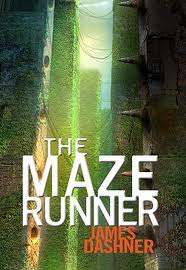
A teenager fights to survive in popular YA novel
This young adult (YA) novel is built on the premise that teenage boys (and one girl) are “tested” in a lethal maze in order to determine the best candidates to confront a deadly plague. The hero Thomas fights to save his life and the life of his friends from an unknown enterprise that exploits their talents for staying alive. I knew the book was one of a number of popular teenage novels (The Hunger Games trilogy, Matched, Unwind) which feature adolescents confronting, and in some cases toppling, dystopic societies. Many of these titles have recently come under criticism by book reviewers, the most notorious criticism came from the Wall Street Journal critic Meghan Cox Gurdon in her June 11th article, “Darkness Too Visible”. The subtitle, “Contemporary fiction for teens is rife with explicit abuse, violence and depravity. Why is this considered a good idea?” summarized her concerns with this genre, a genre which is growing both in popularity and titles.
I recognize that I am late to the party responding to Gurdon’s article, but as I read The Maze Runner, I found myself wondering what makes this genre so objectionable. While the descriptions of some of the deaths in the maze were graphic, I did not find them any less graphic than several of the scenes in Charles Dickens’ Oliver Twist.
I read Oliver Twist as an adolescent because that was one of the few books cataloged for young adults. Early in the story, the supervisor of chimney sweeps, Mr Gamfield, is introduced as he, “…bestowed a blow on his [donkey’s] head, which would inevitably have beaten in any skull but a donkey’s.” Shortly after showcasing this bit of animal cruelty, Gamfield bemoans the laziness of his chimney sweeps, young orphans forced to work in appalling conditions. He admits to lighting fires while they are cleaning the chimneys because, “It’s humane too, gen’lmen, acause, even if they’ve stuck in the chimbley, roasting their feet makes ’em struggle to hextricate theirselves.” What makes Dickens’ description so horrific is that child labor was accepted during the Industrial Revolution, and many young chimney sweeps choked and suffocated because of the coal dust.
At the conclusion of Oliver Twist the compassionate Nancy is killed by her lover Bill Sykes who, convinced she has betrayed him,
“…grasped his pistol. The certainty of immediate detection if he fired, flashed across his mind even in the midst of his fury; and he beat it twice with all the force he could summon, upon the upturned face that almost touched his own.She [Nancy] staggered and fell: nearly blinded with the blood that rained down from a deep gash in her forehead; but raising herself, with difficulty, on her knees, drew from her bosom a white handkerchief- Rose Maylie’s own- and holding it up, in her folded hands, as high towards Heaven as her feeble strength would allow, breathed one prayer for mercy to her Maker.”
To this day, I remember quite clearly how graphically Dickens portrayed Nancy’s murder.
As an alternative to current contemporary YA offerings, Gurdon recommends that teenagers should read Betty Smith’s A Tree Grows in Brooklyn. I agree with her; I loved the story and re-read how the daughter of Irish immigrants, Francie, struggled to complete her desire to be a writer. Francie’s challenges included being spat upon and ridiculed by the other immigrants in the neighborhood; her aunt was ostracized as a whore. Her father Johnny was a charming alcoholic, who eventually developed pneumonia and died in a street gutter. Her mother Katie, however, was a remarkably strong woman. In one chapter, she saved Francie by shooting the child-rapist/murderer who was molesting her. The novel is not overtly graphic, apparently a selling point for Gurdon, but Smith did not shy away from mature topics of sexuality, abuse, and xenophobia.
Both of these classic stories refer to real human experiences in a specific time and place; both Dickens and Smith focus the reader’s attention on poverty, alcoholism, and criminal behavior. So one would think that Gurdon would appreciate the autobiographical novel The Absolutely True Diary of a Part-Time Indian by Sherman Alexie. But it was towards Alexie that Gurdon was most critical.
While noting that many of the books for contemporary teens have been challenged, she stated,
“A number of young-adult books made the Top 10 in 2010, including Suzanne Collins’s hyper-violent, best-selling Hunger Games trilogy and Sherman Alexie’s prize-winning novel, The Absolutely True Diary of a Part-Time Indian. ‘It almost makes me happy to hear books still have that kind of power,’ Mr. Alexie was quoted saying; ‘There’s nothing in my book that even compares to what kids can find on the Internet.’
Oh, well, that’s all right then. Except that it isn’t. It is no comment on Mr. Alexie’s work to say that one depravity does not justify another. If young people are encountering ghastly things on the Internet, that’s a failure of the adults around them, not an excuse for more envelope-pushing.”
Gurdon should recognize that Alexie was pointing out the obvious. Today’s students are digital pioneers encountering all manner of “ghastly things” on the Internet, and they are quite capable of maneuvering around adult supervision. Gurdon’s snide response smacks of censorship. She would remove his hilarious and heartbreaking narrative from readers who could experience the trials of growing up as a contemporary full-blooded Indian. Isn’t that what fiction is supposed to do? Inform the reader about new and challenging experiences?
Today’s generation of teen readers faces difficult challenges, and authors imagine what the future might be.The world is rapidly dominated by technology, and many of these authors question whether our love of technology will ultimately defeat us. These authors share the same concerns expressed in Aldous Huxley’s Brave New World. Today’s generation of readers is experiencing political turmoil watching emerging democracies clash with totalitarian regimes. These authors share the same concerns expressed in George Orwell’s 1984. Imagined dystopias are not new to literature; dark visions of the future serve to warn readers what might be.
Besides, I want my students to read. Many of the contemporary YA novels with dark themes are particularly attractive to reluctant readers. These reluctant readers are often male who prefer stories with action and/or adventure; offering them the more complex novels of generations past ( Treasure Island, The Iliad, The Count of Monte Cristo) would frustrate them. Yet, engaging these readers is critical to the development their reading comprehension skills. They should be able to choose, as all good readers choose, what they like to read.
Yes, today’s teens read dark literature. But so did their parents, and so did their parents’ parents, and so on back to the the cave. The most horrific stories of rape, mutilation, incest, torture, and the depravity that Gurdon condemns are plentiful in the stories found in Greek mythology, Grimms’ Fairy Tales, and, yes, even the Bible. Guerdon complains that, “No family is obliged to acquiesce when publishers use the vehicle of fundamental free-expression principles to try to bulldoze coarseness or misery into their children’s lives.” However, the history of literature, from the ancient world to the present, would suggest that readers’ fascination for darkness in stories has created the market for publishers, not the other way around. To answer her question, “Why is this considered a good idea?”, I believe reading stories, all kinds of stories, is a good idea. I want my students to read many, many books. I support their independance in selecting novels, dark literature or not. They will probably choose a few that I would deem of poor quality, but that is their choice. I want them on a life-long journey of reading.
So, while Tropical Storm Irene raged and her rains steadily filled local ponds and streams, I was totally engaged in a dark story of a teen who fights all manners of obstacles, man-made and nature, in order to survive. How appropriate.







 Used Books in Class