This past week, I wrote a blog post that critiqued the results of The National Assessment of Educational Progress (NAEP) 2013 test. There was a 2% growth in reading scores over the past 41 years for students at age 17.
A 2% increase.
That’s all.
Billions of dollars, paper piles of legislation, incalculable time…..and the result has been an abysmal 2% increase.

In a subsequent post, I wrote how NAEP also provided data to prove independent reading was the key to improving test scores. NAEP reported that students who claimed to read for fun scored higher on standardized tests with the obvious conclusion that the more time a student spent reading, the higher the student’s score. This information, included in a report that demonstrated a failure of reading programs, offered a possible solution for increasing reading scores: adopt a no-cost, read for fun initiative in order to improve results.

I tweeted out the the link to my post:

2013 NAEP Tests show only 2% growth in reading by age 17 UNLESS students “read for fun”

I received this tweet in response:

 http://www.reading-rewards.com is a lovely site to use when you want to encourage kids to read for fun

So, I went to the Reading Rewards website, but I had some concerns. The headline banner read:“The Reward is in the Reading”, certainly a noble sentiment. However, below this banner was the text that read:

Parents & Teachers:
We know all about the rewards that reading offers, but sometimes our more reluctant readers need a little extra incentive. The Reading Rewards online reading log and reading incentive program helps make reading fun and satisfying. Find more about Reading Rewards’s benefits for parents and teachers.

The concept of an incentive program or reading for “rewards” is not reading for fun. Reading for pleasure should be the only incentive, and offering incentive programs can be counter-productive. Consider education advocate Alfie Kohn‘s explanation of his research that illustrates why incentivized reading programs are not successful:

The experience of children in an elementary school class whose teacher introduced an in-class reading-for-reward program can be multiplied hundreds of thousands of times:

The rate of book reading increased astronomically . . . [but the use of rewards also] changed the pattern of book selection (short books with large print became ideal). It also seemed to change the way children read. They were often unable to answer straight-forward questions about a book, even one they had just finished reading. Finally, it decreased the amount of reading children did outside of school.

Notice what is going on here. The problem is not just that the effects of rewards don’t last. No, the more significant problem is precisely that the effects of rewards do last, but these effects are the opposite of what we were hoping to produce. What rewards do, and what they do with devastating effectiveness, is to smother people’s enthusiasm for activities they might otherwise enjoy.

Kohn’s explanation in his A Closer Look at Reading Incentive Programs (Excerpt from Punished by Rewards 1993/1999) illustrates the problems that develop for late middle school and high school teachers (gr 7-12) experience once elementary students have experienced a reward program with their reading. Students who are conditioned to read for any kind of reward develop a Pavlovian response. They learn to expect a reward; once the reward is removed, however, they lose interest.

Sadly, most students are already in a “quid pro quo” educational experience. Even in elementary school, students are conditioned to want a grade for every activity. Matt Groening, creator of The Simpsons poked fun of this conditioned response for constant feedback in one episode when Springfield’s teachers went out on strike, and a distraught Lisa begged her mother, Marge, to “grade her”:

“Grade me! Look at me! Evaluate and rank me!
I’m good, good, good and oh so smart!
GRADE ME!”

LISA: "Grade me! Look at me! Evaluate and rank me! I’m good, good, good and oh so smart! GRADE ME!"

LISA: “Grade me! Look at me! Evaluate and rank me! I’m good, good, good and oh so smart! GRADE ME!”

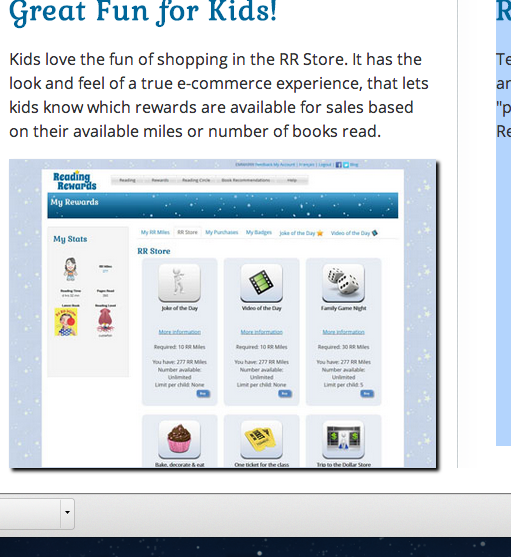
While grades are not the currency for this website, Reading Rewards is perfectly positioned to be a commercial enterprise with language on the site promoting the RR “store” and “e-commerce”.  This initial shopping experience may be for some trinket in a teacher’s box, a homework pass, or a pizza party, but the potential for “shopping” on this site is certainly a possibility.

Here is the promotional text for teachers:
Screen Shot 2013-07-10 at 10.43.43 AM

The website advises teachers what items to have for students to “purchase”, and even suggests major retailers i-Tunes and Amazon:

Reward Ideas
Teachers and parents can create any reward they want and define how many RR miles are required to “purchase” each reward. Here are some ideas of Rewards selected by many of our users:

  • Movie night at home
  • Movie in the theater
  • Family game night
  • Sleepover with friends
  • Trip to the dollar store
  • Prize draw from a treasure box
  • Extra tickets for a classroom raffle
  • The right to choose the dessert after dinner
  • Make/decorate/eat cupcake session
  • Amazon credit
  • iTunes credit
  • Game console time

Again, Kohn believes that in teaching students to read, incentives should not be used. Instead he notes:

But what matters more than the fact that children read is why they read and how they read.  With incentive-based programs, the answer to “why” is “To get rewards,” and this, as the data make painfully clear, is often at the expense of interest in reading itself.

So while the key to independent reading is the key to raising reading scores, students should not be raising profits for software companies as well. There are other features on this software that are admirable. The site includes places for reading logs, creating reading wish lists, and peer sharing reviews, but those features could be accomplished on a (free) blog or wiki without the distractions of prizes or rewards.

I do not fault the teacher who was well-intended when she tweeted out this website. She wants students to read for fun. The NAEP report proves that independent reading can effectively raise scores when the reading is self-motivated reading for pleasure. Teachers should question, however, when reading for fun is linked to reading with “funds”.

The release of the National Assessment of Educational Progress (NAEP) Progress Report for 2012  (“Nation’s Report Card”) provides an overview on the progress made by specific age groups in public and private schools in reading and in mathematics since the early 1970s. The gain in reading scores after spending billions of dollars, countless hours and effort was a measly 2% rise in scores for 17-year-olds. After 41 years of testing, the data on the graphs show a minimal 2% growth. After 41 years, Einstein’s statement, “Insanity is doing the same thing repeatedly and expecting different results,” is a confirmation that efforts in developing effective reading programs have left the education system insane.

The rather depressing news from NAEP in reading scores (detailed in a previous blog) could be offset, however, by information included in additional statistics in the report. These statistics measure the impact of “reading for fun” on student test scores. Not surprisingly, the students who read more independently, scored higher. NAEP states:

Results from previous NAEP reading assessments show students who read for fun more frequently had higher average scores. Results from the 2012 long-term trend assessment also reflect this pattern. At all three ages, students who reported reading for fun almost daily or once or twice a week scored higher than did students who reported reading for fun a few times a year or less

The irony is that reading for fun is not measured in levels or for specific standards as they are in the standardized tests. For example, the responses in standardized tests are measured accordingly:

High Level readers:

  • Extend the information in a short historical passage to provide comparisons (CR – ages 9 and 13)
  • Provide a text-based description of the key steps in a process (CR)
  • Make an inference to recognize a non-explicit cause in an expository passage (MC – age 13)
  • Provide a description that includes the key aspects of a passage topic (CR – ages 9 and 13)

Mid Range Readers:

  • Read a highly detailed schedule to locate specific information (MC – age 13)
  • Provide a description that reflects the main idea of a science passage (CR – ages 9 and 13)
  • Infer the meaning of a supporting idea in a biographical sketch (MC – ages 9 and 13)
  • Use understanding of a poem to recognize the best description of the poem’s speaker (MC)

Low Level Readers:

  • Summarize the main ideas in an expository passage to provide a description (CR – ages 9 and 13)
  • Support an opinion about a story using details (CR – ages 9 and 13)
  • Recognize an explicitly stated reason in a highly detailed description (MC)
  • Recognize a character’s feeling in a short narrative passage (MC – age 13)

(CR Constructed-response question /MC Multiple-choice question)

Independent reading, in contrast, is deliberately void of any assessment. Students may choose to participate in a discussion or keep a log on their own, but that is their choice.  The only measurement is a student’s willingness to volunteer the frequency of their reading, a form of anecdotal data.

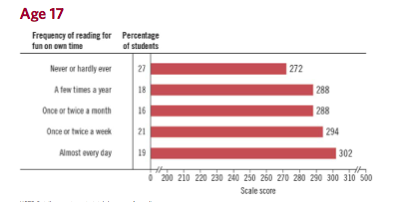
According to the graph below (age 17 only), students who volunteered that they read less frequently were in the low to mid-level ranges in reading. Students who volunteered that they read everyday met the standards at the top of the reading scale.

Graph showing that 17-year-olds who read for fun score higher on standardized tests

#1 Graph showing that 17-year-olds who read for fun score higher on standardized tests

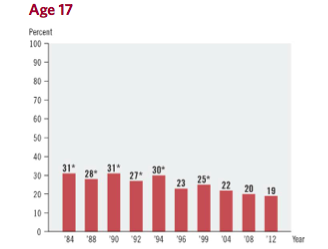
Sadly, this NAEP data recorded a decline in reading for fun over the last 17 years-exactly the age of those students who have demonstrated only a 2% increase in reading ability. The high number of independent readers (“reading for fun”) was in 1994 at 30%.

Steady decline  in the number of 17- year-old students who say that they  "read for fun."

#2 Steady decline in the number of 17- year-old students who say that they “read for fun.”

So what happened the following years, in 1995 and 1996, to cause the drop in students who read voluntarily? What has happened to facilitate the steady decline?

In 1995 there were many voices advocating independent reading: Richard Allington, Stephen Krashen, and Robert Marzano. The value of independent reading had been researched and was being recommended to all districts.

Profit for testing companies or publishing companies, however, is not the motive in independent reading programs.There are no “scripted” or packaged or leveled programs to offer when students choose to “read for fun”, and there is no test that can be developed in order to report a score on an independent read. The numerical correlation of reading independently and higher test scores (ex: read 150 pages=3 points) is not individually measurable; and districts, parents, and even students are conditioned to receiving a score. Could the increase of reading programs from educational publishers with leveled reading box sets or reading software, all implemented in the early 1990s, be a factor?

Or perhaps the controversy on whole language vs. phonics, a controversy that raged during the 1990s, was a factor? Whole language was increasingly controversial, and reading instructional strategies were being revised to either remove whole language entirely or blend instruction with the more traditional phonics approach.

The sad truth is that there was plenty of research by 1995 to support a focus on independent “reading for fun” in a balanced literacy program, for example:

Yet seventeen years later, as detailed in the NAEP report of 2012, the scores for 17-year-old students who read independently for fun dropped to the lowest level of 19%. (chart #2)

While the scores from standardized testing over 41 years according to the NAEP report show only 2% growth in reading, the no cost independent “reading for fun” factor has proven to have a benefit on improving reading scores. Chart #1 shows a difference of 30 points out of a standardized test score of 500 or a 6% difference in scores between students who do not read to those who read daily. Based on the data in NAEP’s report, reading programs have been costly and yielded abysmal results, but letting students choose to “read for fun” has been far less costly and reflects a gain in reading scores.

The solution to breaking this cycle is given by the authors of The Nation’s Report Card. Ironically, these authors are assessment experts, data collectors, who have INCLUDED a strategy that is largely anecdotal, a strategy that can only be measured by students volunteering information about how often they read.

The choice to include the solution of “reading for fun” is up to all stakeholders-districts, educators, parents, students. If “reading for fun” has yielded the positive outcomes, then this solution should take priority in all reading programs. If not, then we are as insane as Einstein said; in trying to raise reading scores through the continued use of reading programs that have proven to be unsuccessful, we are “doing the same thing repeatedly and expecting different results.”

In my youth I thought Nights in White Satin by the Moody Blues (1967) was a song about knights who galloped on horseback wearing white satin, so I am no longer surprised when the attraction of a song’s melody overrides my understanding of the lyrics.
Such is the case with Bruce Springsteen’s Born in the USA (1984).
This song rates a spin up on the volume of my car radio or a little dance in the kitchen to that driving beat when the CD is playing.
Born in the USA..ay” I will sing along with Bruce, Clarence Clemons and the E-Street Band*, “I was born in the USA..ay.”
I had always thought that this was a paean to America.
Then I read the lyrics.

Born in the USA

Born down in a dead man’s town
The first kick I took was when I hit the ground
You end up like a dog that’s been beat too much
Till you spend half your life just covering up

Born in the U.S.A.
I was born in the U.S.A.
Born in the U.S.A.

Got in a little hometown jam so they put a rifle in my hand
Sent me off to a foreign land to go and kill the yellow man

Born in the U.S.A.
I was born in the U.S.A.
Born in the U.S.A.

Come back home to the refinery
Hiring man says “Son if it was up to me”
Went down to see my V.A. man
He said “Son don’t you understand now”

I had a brother at Khe Sahn fighting off the Viet Cong
They’re still there he’s all gone
He had a woman he loved in Saigon
I got a picture of him in her arms now

Down in the shadow of the penitentiary
Out by the gas fires of the refinery
I’m ten years burning down the road
Nowhere to run ain’t got nowhere to go

Born in the U.S.A.
I was born in the U.S.A.
Born in the U.S.A.
I’m a long gone Daddy in the U.S.A.
Born in the U.S.A.
Born in the U.S.A.
Born in the U.S.A.
I’m a cool rocking Daddy in the U.S.A.

*E-street Band

  • Roy Bittan – piano, synthesizer
  • Danny Federici – organ, glockenspiel, piano on “Born in the U.S.A.”
  • Garry Tallent – bass
  • Steven Van Zandt – acoustic guitar, mandolin, harmony vocals
  • Max Weinberg – drum
(sorry about the advertisement!)
Springsteen’s Born in the USA is not a tribute,  but is instead a grim recollection of a man’s hard life in America; a life that began in abuse, involved a scuffle with the law, a tour in Vietnam, the loss of a friend at Khe Sahn, the return home to unemployment, and a life that still has the shadow of a penitentiary hovering over him as a possible end.

The poetry in the lyrics are a collision with the song’s percussive call to celebrate.
The quick-march tempo complements the song’s narrator’s movement; he is still moving, running, on an endless search for truth that Springsteen says is the true American way.
That truth, however, is full of irony.
While elements of the “American Dream” have eluded him, he remains stubbornly proud of his heritage.
While his service in Vietnam is not reciprocated by a grateful nation, he remains stubbornly proud of his country.
While there is the looming shadow of a penitentiary or unemployment at the refinery, the man has chosen to move down the road in a country where such movement is possible.
While he drifts with Nowhere to run, ain’t got nowhere to go, there is pride in American independence in the last line, I’m a cool rocking daddy in the U.S.A. 
Trust Springsteen to capture the paradox of America, a place where fate and the land of opportunity collide. That collision is captured in this song where we are left hopeful that something good will happen to the man who, despite the odds, remains proud to have been Born in the USA.

birthday11July 3rd is this blog’s third anniversary.

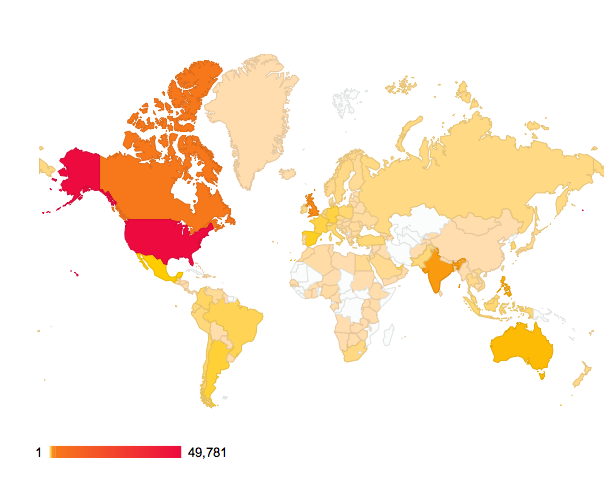
WrdPress provides a map of where visitors accessed this blog.

WrdPress provides a map of where visitors accessed this blog since 2012.

One way of determining whether this three year venture has been successful is to look at the overwhelming amount of statistical information provided by the host of this site, WordPress.com. To date, the stat page notes that there have been over 70,000 hits, the most popular search term has been Of Mice and Men, the most popular post has been Teaching Elie Weisel’s Night with Choice Books, and the most frequently used category for this teacher, not surprisingly, has been EDUCATION.

The other way to determine the success of this blog, however, is to reflect on how well writing has served as my own professional development for the past 36 months. In writing each post, I have tried to find links that support or refute a position. I have searched and researched all elements of the Common Core State Standards; read journals or policy statements from educators and education reformers; and cited hundreds of quotes, graphics, and statistics to support my ideas. Even if no one read this blog, the writing experience has been important.

Many of the ideas for blog posts come from links provided by other educators on Twitter. Many ideas come from the students in my classes or from news stories that are related to education reform. Then there are the ideas I have while I walk with fellow educator on weekends.
For example, I will notice how the ripples on the pond create an interesting pattern, and I will casually remark, “that reminds me of how students can create ripples when they discuss their book choices!”
“Well, that’s a great idea for a blog post!” she will respond.

I have discovered that I have little control over my need to write; that the impulse to set things into print is hard to ignore. In addition, the motivation to write comes at the most inconvenient times, often late in the evening, and I have seen many digital clocks click into the AM hours of the morning as I polish a piece.
“Are you still awake?” my husband complains.
“Just finishing,” and I huddle to hide the glow of the screen while I reflect and revise.

Nothing has taught me more about how to teach writing than my writing this blog. Nothing.
Nothing has made me appreciate how hard it is to meet the deadlines and requirements of assignments given to students. Nothing.
Nothing has made me more aware of how important developing confident writers is in preparing students for the real world. Nothing.

My friend, who also writes on her own blog, often quotes the scientist Louis Pasteur who said,

“In the fields of observation chance favors only the prepared mind.”

On this third anniversary, I am confident that writing on this blog has helped me to become a more informed educator. Writing what I think about education prepares me to say what I think when I am at leadership meetings, or department meetings, or when I am teaching. I am primed to discuss any number of issues related to education because my mind has been prepared, and the chances that I will talk about these education issues is more than good.

On this blog’s third anniversary, I am convinced that the best professional development I have is to write what I think.

July 2013 marks the 150th anniversary of the Civil War’s Battle of Gettysburg. There has been a great deal of preparation to commemorate this event, and last September (2012), I heard the following brief story on National Public Radio (NPR) Morning Edition:

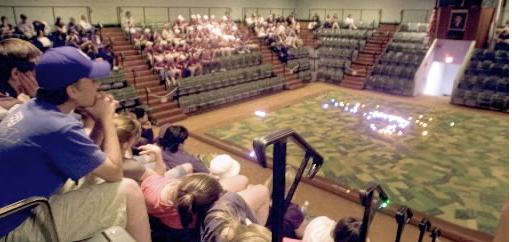
Good morning. I’m Steve Inskeep. This may be the closest you can ever get to owning your own Civil War battlefield. Generations of tourists saw a map at Gettysburg, Pennsylvania – 29 feet on each side laid on the floor. This relief map features electric lights to show the battle. The Pittsburgh Post Gazette says after building a new visitor’s center, the National Park Service is auctioning off the old map. Not one person has made an offer, though bidding started at $5.

What? I was shocked! The Gettysburg electrical map was for sale? For $5.00?

The electrical Gettysburg Map had been the highlight of our family vacation to Gettysburg Battlefield National Park in Pennsylvania in 1970. The Visitors Center’s map covered a huge portion of the floor and the electrical lights depicted troop movements during the three day battle that had raged in and around the small town of Gettysburg, Pennsylvania,N from July 1–3, 1863. Different colored lights separated the positions of the Union Army of the Potomac from the Army of Northern Virginia. We watched the lights change and understood how the generals manuvered their troops during this turning point of the Civil War. My father had paid the admission, an unusual treat, so that we could watch the lights on the topographical recreated hillsides flicker as they had in the evenings that hot July. Countless tourists had also paid to see the electrical map before it was retired in 2009, packed up, and indignantly placed on the auction block. As I listened to the NPR story, I thought that putting the map up for sale on EBAY seemed an anathema.

My family had camped for two nights that summer at Gettyburg, our campfire mimicked the lights of campfires that had lit the late night troop encampments a century earlier. The Carpenter’s rendition of “Close to You” had played on the car’s radio repeatedly during the day, but at night, when my father strummed “When Johnny Comes Marching Home” on the guitar, the area seemed haunted as we imagined the lives of the soldiers who took part in the deadly battles of the Civil War.

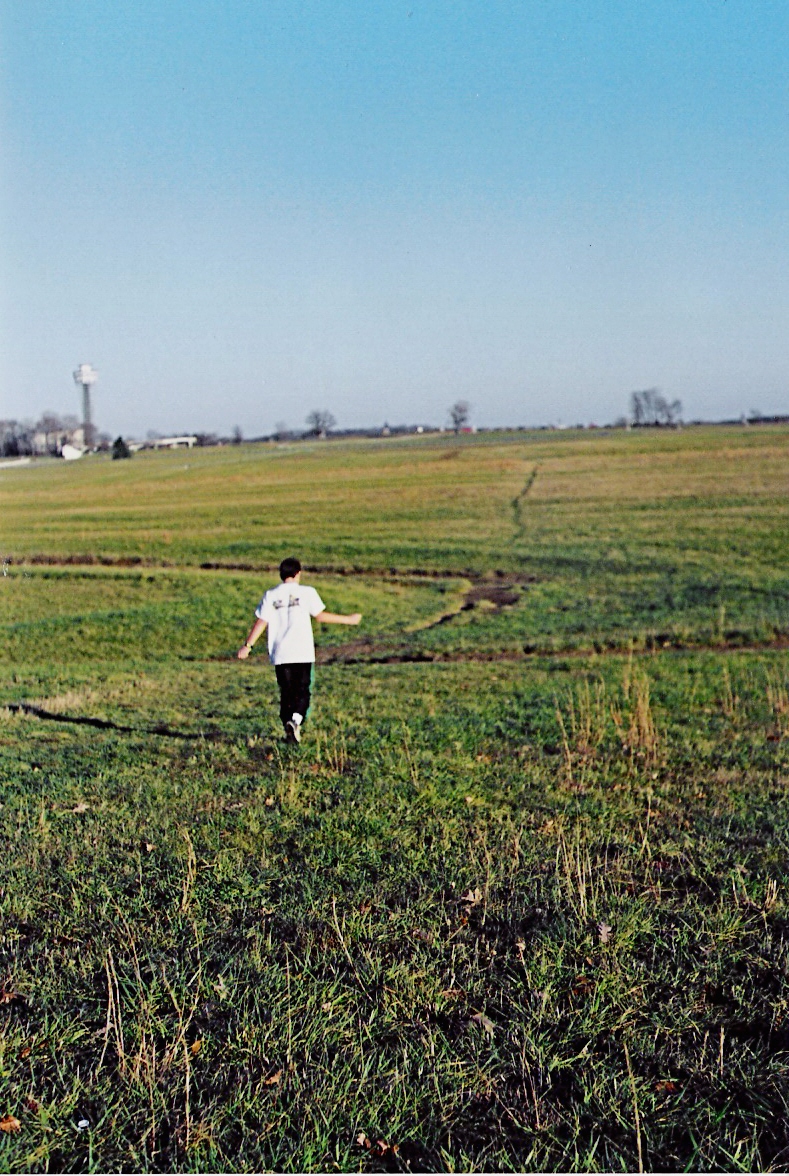
By day we travelled from monument to monument in our ’68 VW van. When we arrived at Seminary Ridge, we saw the expanse of fields where Major General George Pickett led his troops the last day of battle. Because of the electrical map, we knew exactly what had happened to the soldiers who had advanced under heavy fire from the Union’s artillery. We tumbled out of the  van and ran out into the field, imitating Pickett’s Charge, the high-water mark of the Confederacy. We fell as so many soldiers did in that last ditch effort to break through the Union Army’s lines.

Walking Pickett's Charge

Walking Pickett’s Charge…

standing at Pickett's Charge

or standing at Pickett’s Charge.

Years later,  I took my own two sons to Gettysburg, and I tried to have them rush the field, recreating Pickett’s Charge just as my family had done years earlier. Instead my sons casually walked out into the open.
“Come on!” I encouraged, “You have to run to charge!” But they would have none of that behavior.
Discouraged, I walked them back to the car.
As I closed our car door, a van drove up into the parking lot next to us.
A tumble of bodies spilled out of the side door; several boys and girls raced out from the parking lot.
“Pickett’s Charge!” they yelled out in unison and were soon sprinting out onto the field.
“You see?” I turned to my boys who watched dumbfounded, “That’s the family I want to be with!”

My boys did love the electrical map, however, seeing the lights in action. When we returned home, they were inspired enough to build a map of their own. Listening to the NPR report, I grew concerned. If the map was not sold on EBAY, would it be destroyed? What could possibly replace such inspiration? Apparently, I was not alone with my concerns. When the map was dismantled and placed in storage, a website Save the Electric Map sprang up. There are pages were people posted their own memories of their visits. The history of the map, additional photos, and petition forms to save the map (and to drop admission fees) are also linked on the site.

Happily, the map was purchased for a little over $14,000 in October of 2012 by another map enthusiast Scott Roland. He has enlisted the help of the Gettysburg Campus HACC college student volunteers to complete the necessary electrical updates and controller programming. The Hanover Evening Sun reported on 6/14 that the map will again go on display for visitors. The article Electric Map Owner Partners with Gettysburg HACC Students for Renovations had an interview with Tom Lepp, mechatronics instructor in the industrial technologies department, to explain how the repairs will be made:

“The decision was made to refit the map with new electrical components rather than repair the existing wiring and lights due to the condition of the existing components, which are over 50 years old. The electrical system also suffered significant damage when the map was sectioned for removal and throughout the process of moving. This left the aged wiring in need of serious repair and damaged a number of lights. The original lights are difficult to service, repair, and source parts for. Many lights and lenses for lights are severely damaged or missing. The replacement lights, while providing ease of service, will preserve the aesthetics of the original lamps.”

There will be other families on summer vacations who will sit around campfires after touring the Gettysburg battle sites. There will be other families who will spill from their cars and spontaneously recreate Pickett’s Charge. And I am happy to report that the Gettysburg electrical map that was rescued from destruction will continue to illuminate the troop positions and visually tell the story to future generations so they may better understand the significance of this battle in our nation’s history. You will still have to pay an admission, but these memories are priceless.

I recently had to write a position statement on assessment and evaluation.  The timing of this assignment, June 2013, coincided with the release of the National Assessment of Educational Progress (NAEP) Progress Report for 2012. This “Nation’s Report Card” provides an overview on the progress made by specific age groups in public and private schools in reading and in mathematics since the early 1970s.

Since NAEP uses the results of standardized tests, and those standardized tests use multiple choice questions, here is my multiple choice question for consideration:

Based on the 2012 NAEP Report results, what difference(s) in reading scores separates a 17-year-old high school student in 1971 from a 17-year-old high school student in 2012?

a. 41 years
b. billions in dollars spent in training, teaching, and testing
c. a 2 % overall difference in growth in reading
d. all of the above

You could act on your most skeptical instincts about the costs and ineffectiveness of standardized testing and make a calculated guess from the title of this blog post or you could skim the 57 page report (replete with charts, graphs, graphics, etc) that does not take long to read, so you could get the information quickly to answer correctly: choice “D”.

Yes, 41 years later, a 17-year old scores only 2% higher than a previous generation that probably contained his or her parents.

There have been billions of dollars invested in developing reading skills for our nation’s children. In just the last twelve years, there has been the federal effort in the form of Reading First, the literacy component of President Bush’s 2001 “No Child Left Behind” Act. Reading First initially offered over $6 billion to fund scientifically based reading-improvement efforts in five key early reading skills: phonemic awareness, phonics, fluency, vocabulary, and comprehension. The funding of grants for students enrolled in kindergarten through grade three in Title I Schools began in 2002-2003.

There have been individual state initiatives that complement Reading First, funded by state legislatures, such as:

There have been efforts to improve literacy made by non-profit educational corporations/foundations such as The Children’s Literacy Initiative, the National Reading Panel, and a Born to Read initiative from the American Library Association. In addition, there have been a host of policy statements from The National Council of Teachers of English and programs offered by the National Writing Project that have helped to drive attention towards the importance of reading.

All of these initiatives drove publishers of educational materials to create programs, materials and resources for educators to use. Unfortunately, the question of which reading program would prove most effective (Direct Instruction, Reading Recovery, Success for All and others) became a tangled controversy as charges of conflicts of interest between the consultants who had been hired by the Department of Education (DOE) and who trained teachers and state department of education personnel had also authored reading programs for curriculum. Fuel to this controversy was added when a review in 2006 by the DOE’s Inspector General suggested that the personnel in the DOE had frequently tried to dictate which curriculum schools must use with Reading First grant money.

Trying to improve our our students’ reading scores has been the focus so much so that our education systems have been awash in funding, materials, initiatives and controversies since 2001 in our collective to improve reading for students…and the result?

The result is a measly 2% of growth in reading for those leaving our school systems.

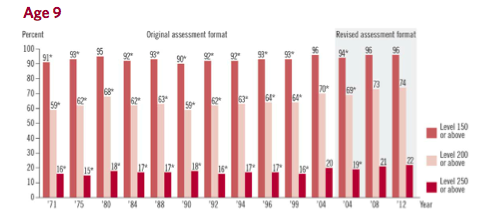
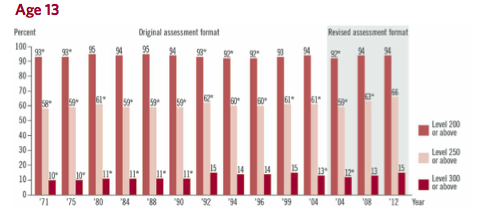
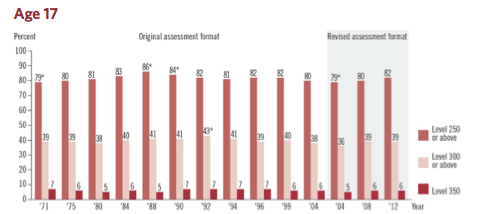
The evidence for this statement has been tracked by NAEP, an organization that has been assessing the progress of  9-, 13-, and 17-year-olds in reading. The graphs below taken from the NAEP report measure annual growth at each age level at the high level 250, mid level 200, and low level 150 of reading.  There are other levels measured for highest or lowest achieving students, but the levels measured on the graphs levels are correlated to the following descriptions:

LEVEL 250: Interrelate Ideas and Make Generalizations
Readers at this level use intermediate skills and strategies to search for, locate, and organize the information they find in relatively lengthy passages and can recognize paraphrases of what they have read. They can also make inferences and reach generalizations about main ideas and the author’s purpose from passages dealing with literature, science, and social studies. Performance at this level suggests the ability to search for specific information, interrelate ideas, and make generalizations.

LEVEL 200: Demonstrate Partially Developed Skills and Understanding
Readers at this level can locate and identify facts from simple informational paragraphs, stories, and news articles. In addition, they can combine ideas and make inferences based on short, uncomplicated passages. Performance at this level suggests the ability to understand specific or sequentially related information.

LEVEL 150: Carry Out Simple, Discrete Reading Tasks
Readers at this level can follow brief written directions. They can also select words, phrases, 9 or sentences to describe a simple picture and can interpret simple written clues to identify a common object. Performance at this level suggests the ability to carry out simple, discrete reading tasks.

Screen Shot 2013-06-29 at 7.52.04 PM

The NAEP report does offer some positive developments. For example, from 1971-2012, reading scores for 9-year-olds have seen an increase of 5% in students reading at the lower (150) level, an increase of 15% for students reading at mid-range (200), and an increase of 6% for students reading at the higher (250) level.

Screen Shot 2013-06-29 at 7.52.16 PMSimilarly, reading scores for 13-year olds have increased 8% for students reading at mid-level, and 5% for students at the higher level. Scores for student reading at the lower level, however, saw a negligible increase of only 1%.

At this point, I should note that the NAEP report does contain some positive finding. For example, the measurements indicate that the gaps for racial/ethnic groups did narrow in reading over the past 41 years. According to the report:

Even though White students continued to score 21 or more points higher on average than Black and Hispanic students in 2012, the White – Black and White – Hispanic gaps narrowed in comparison to the gaps in the 1970s at all three ages. The White – Black score gaps for 9- and 17-year-olds in 2012 were nearly half the size of the gaps in 1971.

Unfortunately, even that positive information should be considered with the understanding that most of these gains for racial and ethnic groups were accomplished before 2004.

Finally, for students leaving public and private school systems, the overall news is depressing. Any gains in reading in ages 9 and 13, were flattened by age 17. The growth for students reading at higher level dropped from 7% to 6%, while the  percentage of mid-range readers remained the same at 39%. The gains of 3% were in the scores of lower range readers, from 79% to 82%. Considering the loss of 1% at the higher end, the overall growth in measurement is that measly 2%.

Screen Shot 2013-06-29 at 7.55.37 PM

That’s it. A financial comparison would be a  yield $.02 for every dollar we have invested. Another comparison is that for every 100 students, only two have demonstrated improvement after 13 years of education.

Assessing the last 12 of the 41 years of measuring reading initiatives illustrates that there has been no real progress in reading as measured by standardized tests in our public and private education institutions grades K-12. NAEP’s recounting of the results after considerable funding, legislation, and effort, is as Shakespeare said, “a tale…full of sound and fury, signifying nothing.”

Continue Reading…

The headline in The New York Times (6/13/2013) was a little misleading, Study Gauges Value of Technology in Schools. The topic of gauging the value of technology is particularly significant given the investment by school districts everywhere in laptops, tablets, computer labs, Smartboards, whiteboards and projectors; but the article only referred to the use of technology in math or science.

The article by Motoko Rich referred to the “student survey data conducted in conjunction with the federal exams known as the National Assessment of Educational Progress,” This data was reviewed by the nonprofit Center for American Progress, which determined that middle school math students were using computers for math drills and other low level exercises. One of the more interesting points in the article noted that “no state was collecting data to evaluate whether technology investments were actually improving student achievement.” One of the problems noted in the report was the “lack of discrete learning goals” set by educators that results in the “use of devices in ways that fail to adequately serve students, schools, or taxpayers.”

When states do begin to collect data on the use of technology in the classroom, their studies should be broadened to include how technology is being used in other disciplines, specifically the language arts/English classrooms to facilitate writing.  In contrast to reports of math and science technology use, language arts teachers are using a multitude of digital platforms to facilitate communication between students; technology offers opportunities for students to engage in formal and informal writing at every grade level.

Multiple digital platforms such as blogs or wikis allow students to post responses to questions posed by teachers. Students can share essays in order to peer edit or collaborate on projects, or students can follow links and create data in surveys and respond to the data created.

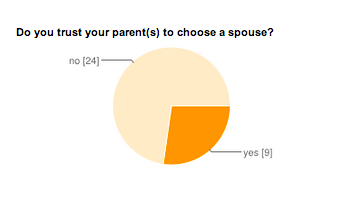
Screen Shot 2013-06-23 at 9.38.55 PMFor example, an assignment for 9th grade students as part of a Romeo and Juliet unit to respond to a writing prompt can use multiple digital platforms to generate sophisticated responses. The assignment was posted on EDMODO and contained data from a student/parent survey on arranged marriages that students and their parents had completed on a Google Doc form. The survey results were posted on PBWorks for students to access for homework. Students needed to review the scene where Lord Capulet arranges Juliet’s marriage to the Count Paris before writing a response. Each response that was posted was available for the class to review and to discuss.

The assignment’s directions read:

The worldwide wide divorce rate for arranged marriages is 4%; this could be due to cultural taboos regarding divorce.
Look at the data on the page that you and your parents created.
What differences do you notice in your attitudes towards arranged marriages?
Now, Consider how the Capulet’s choice of Paris for Juliet may have been the better choice.
Was Romeo and Juliet’s choice to follow their passion the right decision?
Should they have followed their parent’s wishes?

Respond in a well developed paragraph that includes:

  • Introductory sentence that gives your opinion;
  • evidence from the survey;
  • evidence from R&J;
  • Why this decision is important for future couples.

This assignment required a sophisticated analysis of data that the students had created, and an general analysis of characters from Shakespeare’s play.

Here are three responses generated by the prompt:

If Romeo and Juliet had listened to their parents almost all of this never would have happened. Even though just letting their parents choose would have solved everything, it was their decision. Romeo and Juliet had every right to choose their lives. Even the data from the survey shows that most children and parents don’t approve and less than 40% of people thought parents should choose. The Capulets didn’t know anything about their daughter and is trying to match her with someone who is completely wrong for her. This is why Eharmony uses Math equations because that is a lot more reliable than your parents.

In my opinion, Romeo and Juliet’s choice to follow their passion was the right choice. In the survey, some parents said that they could pick their child’s spouse. “I think I know my daughter well enough to know what kind of spouse she is looking for.” This parent has the same idea that Juliet’s did when they arranged for her and Paris to be married. Obviously in Juliet’s case, an arranged marriage did not work. She rebelled and went for Romeo. “Where is my Romeo?” was one of the first things Juliet said when she awoke from her sleep. Romeo and Juliet were love drunk and when they died they were both insanely happy. This is an important for future couples because if they’re in an arranged marriage it may end in death because one or both people are miserable.

I think that maybe Romeo and Juliet should have followed what their parents want. In our survey, 1/3 of the parents said they would be ok choosing their kid’s spouse, and 1/4 of us said that they would be ok with that. Romeo would still be in love with Rosaline, and he and Juliet would still be alive, their families would still be fighting but still they might have  been happy. If Juliet haven’t meet Romeo she might have fallen in love with Paris, and who knows that if Romeo and Juliet were married they wouldn’t have divorced?

While there may be some question as to the effectiveness of technology in the classroom, the language arts/English classroom must be included in future studies by NAEP and in each state. There are multiple ways that digital platforms are being used to facilitate discussion and the sharing of ideas in language arts/English is far more sophisticated than the use of technology to “simply drill math problems.”

Connecticut had an average of over nine inches of rain this June, a mixed blessing. The cool temperatures and constant downpours had a direct impact on the dress code, and the beach attire favored by high school females (and appreciated by young high school males) was not a distraction. Furthermore, the temperatures in the classroom were cool, and the dark skies meant that lighting in the classroom was ideal for showing films to wrap up the year.

The weather, however, did dampen opportunities to teach one of my favorite poems by William Wordsworth, The Tables Turned. The poem is a plea to the reader to throw down the books with poems that try to capture nature, the art that mimics nature, or the science that tries to explain nature:

The Tables Turned

AN EVENING SCENE ON THE SAME SUBJECT (1798)

Up! up! my Friend, and quit your books;
Or surely you’ll grow double:
Up! up! my Friend, and clear your looks;
Why all this toil and trouble?

The sun above the mountain’s head,
A freshening lustre mellow
Through all the long green fields has spread,
His first sweet evening yellow.

Books! ’tis a dull and endless strife:
Come, hear the woodland linnet,
How sweet his music! on my life,
There’s more of wisdom in it.

And hark! how blithe the throstle sings!
He, too, is no mean preacher:
Come forth into the light of things,
Let Nature be your teacher.

She has a world of ready wealth,
Our minds and hearts to bless—
Spontaneous wisdom breathed by health,
Truth breathed by cheerfulness.

One impulse from a vernal wood
May teach you more of man,
Of moral evil and of good,
Than all the sages can.

Sweet is the lore which Nature brings;
Our meddling intellect
Mis-shapes the beauteous forms of things:—
We murder to dissect.

Enough of Science and of Art;
Close up those barren leaves;
Come forth, and bring with you a heart
That watches and receives.

When I teach the poem, I do what is now called “close reading”, a strategy favored by the Common Core State Standards, by having students pay attention to particular images, text structure, and word choice in order to determine an author’s purpose. The process can be a bit tedious, but in this case, I want them to feel a little hostile about “dissecting” the poem.

“What does the poem mean?” I will press them, “What is Wordworth’s purpose?”

“Nature is good?”  (Maybe)

“Poems can make us appreciate nature?” (Perhaps)

“We cannot capture Nature in books?” (Possibly)

“We should ditch our books and go outside?” Absolutely! 

And to the delight of everyone, I instruct my students to close up their books and go outside so that we can “let Nature be your Teacher”. That is the entire lesson. A poem, an analysis, and a trip outdoors that obeys the author’s intent.

Hopefully, next June will give us the day when the  “sun above the mountain’s head/A freshening lustre mellow” lets us upend the tables and go outside to engage with Nature in order to “watch and receive” and leave close reading overturned.

Freshman year is hard: new school, new people, increased responsibilities, increased work load. By June, however, most freshmen feel a sense of accomplishment. They are 1/4 of the way through high school, and they are no longer intimidated by the urban legends of pool passes or promises of being stuffed in lockers by seniors.

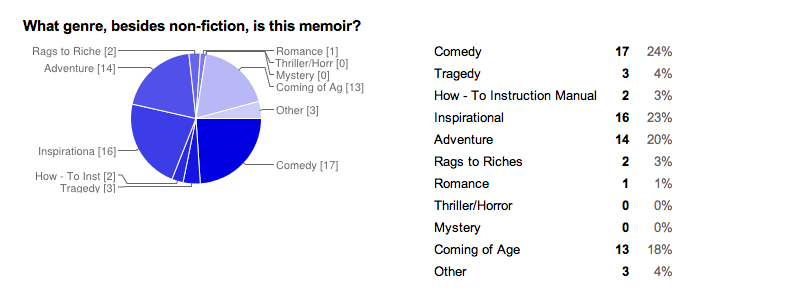
Successful completion of Grade 9 is indicated by a final grade, a percent that indicates the material student earned in each subject. There are other ways, however, to measure success and self-reflection is an excellent way to wrap-up the year. One way to have students to reflect is using a Google Doc form. The form can be tailored for subjective or objective questions. The quantitative data collected (checkboxes, multiple choice, polls, true/false) can be summarized in graphics (see picture below). Students can write longer responses in paragraph form or short answers.

Screen Shot 2013-06-19 at 9.47.21 PMGoogle Doc forms were used all year to measure student understanding or to allow students to record opinions. In September, the 9th grade had started with the theme “Journeys”, therefore, we returned to this theme to have them reflect on their year’s journey. They took this survey after they completed the final exam for credit points only.

The form was titled “My Memoir of 9th grade” and featured 10 questions that required the students to imagine writing a memoir or autobiography about 9th grade. Several of the responses were very “21st Century” addressing the complications of living with the temptations of social media, but other responses from students were timeless and not entirely different from the high school experiences of generations of students before them. Some responses were funny. Many were very clever.  At least one was alarming. Each response captured both a student’s self-awareness in reflecting on the year and a willingness to be critically, sometimes painfully, honest.

There were 79 responses to the questions; here are some highlights:

What is the title of your memoir?

  • No Procrastinating 
  • Thank God for 9th grade
  • The Spin-Cycle that this Year has Been
  • The Story of a Teenage Drama Queen: Or Something Like That

What is the significance of the title?

  • Like a spin-cycle on a washing machine, everything in my freshman year seemed to be moving very rapidly around me as I was caught up in it.
  • This means that the year was torture but in the end I have learned so much more than I did in middle school.
  • The significance is that some parts of this year will be wounds turning into scars that will be with me forever. The wounds weren’t caused by bad things but good things and that’s why I would want the ever lasting scars so I can remember.
  •  It shows how to get through 9th grade without being stupid like some other people because they could do something stupid and not make it through the year and will have to repeat it sophomore year.
  • It is the first level of your high school campaign.
  • I want my memoir to be named the dirt road because a dirt road is bumpy and rough this had been one of the hardest years for me and I want to show that by showing that the road is bumpy and hard to drive on and this year has been bumpy and hard and there is no way to make it go by any faster.

To what novel, myth, epic, fairy tale, or other non-fiction work will critics compare your story? WHY? What is the connection?

  • I’d compare it to Icarus. I’m not the best at listening
  • Of Mice and Men because I go through struggles that many other people are going through at some times I mostly feel like the main character George because sometimes I have to clean up my friends or my own mistakes and live with them behind me.
  • They will compare this story to Phaeton because he has something great that he is using to proceed but it might be the end of him.
  • Probably The Odyssey because of some of the trickery.
  • This can be compared to Hercules because people always told him he couldn’t do it, but in the end he finished strong no matter what other people thought.
  • This would be like The Odyssey because of my constant battle with each teacher in every class, some harder than others.
  • The Wizard of Oz because I always get home in the end. And being here really makes me realize that there is NO place like home. (Not that I hate school I’m just really over it by June)

What would the synopsis or description say? What is your memoir about?

  • This memoir is all about freshman who find out high school isn’t as easy as middle school.  They have to grow up to get all their work done, and not to mention worry about other stuff like sports, extracurricular activities, and friends.
  • My memoir is about my experience in 9th grade and how I got to where I am now. (Maturity, strength, knowledge, etc.)
  • Basically the adventures of this year but in more detail, the fast flying year for a 9th grader who has had fun on field trips and days when there has been a sub or no work.
  • i think it would say that if you are stressed out in high school and need some metaphorical advice then read this book.
  • A young man new to the world of high school embarks on the greatest adventure to see how any ways he could get in trouble. You will be with him in the ups the downs the tragedy the success.

What is your protagonist’s (your) greatest challenge or conflict? What is the goal?

  • The Internet, so alluring and wonderful, but deadly and destructive to my career.
  • The weakness that interfered with my goal is that I was too overwhelmed with after school activities that I had no time to do my homework. I think by next year I’ll figure out.
  • Annoying kids
  • Weaknesses include: being annoying and clingy, losing your best friend over something that you don’t even know what happened like really what happened ugh, being lied to about important things, holding extremely long grudges, and being bothered by simple memories from like years ago, and never having enough video games.
  • Not wanting to talk to new people at first.

What strengths help your protagonist (you) succeed?

  • Some days I just do the work to get through it, not because I actually care about it. You’ve got to keep going through the stuff you don’t like to get to the stuff you do like.
  • My strength is my stubbornness because no matter what the challenge I refuse to give up.
  • Probably not having a phone, that stunk so I made sure I did all of my work to try and get it back.
  • I have a great ability to focus when I wants to. I need a little bit of a push to get going but after that it’s smooth sailing.
  • Time management.
  • Getting sleep helped me succeed alot because I could never focus when I was tired.
  •  My family and my teacher.

Self-reflection is a great way to have students express what they feel they learned, and a Google Doc form is easily created and accessed. The student answers are digitally recorded and because of the Google Docs platform, these responses will be available for the freshmen in 2016, when they are graduating seniors. Hopefully their entire high school experience remains 0% horror!

Dad-Peg, Colleen, Colette -59

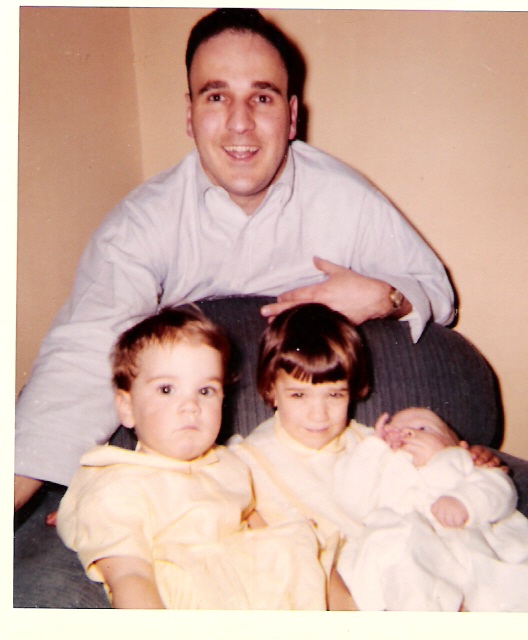
Dad with first three daughters (I am in the middle); we were fortunate to have his read alouds more frequently

My father was a reader, and he read bedtime stories to us. Of course, the older children, my four sisters and I, will recollect many more occasions when my father read a bedtime story while the younger children, the remaining four, have fewer memories. Yes, there were nine of us, and the limited number of hours after work combined with the challenges in getting a houseful of children through meals, chores, and school work, made story time with our father less and less frequent. When he did have the time and energy to read aloud, however, we were mesmerized. Part actor-all salesman, he knew how to make a story come alive.

He had read very broadly when he was a child because he had been confined for long periods to hospital beds due to a handicapped leg. He was knowledgeable on the children and young adult literature available from 1928 on, and he was quick to make a recommendation.

“The black spot!” he would dramatically intone, “in the Tavern of the Black Dog, it was the blind man who delivered the the black spot!” This was enough to send shivers into me and me over into Robert Louis Stevenson’s Treasure Island.

“Madame Defarge…” he would growl, “Madame Defarge and her knitting.” He would lower his voice conspiratorially, daring me to discover the dark secrets of Charles Dickens’s Madame Defarge from A Tale of Two Cities years before it was assigned in high school.

He started my sisters and me on A.A. Milne’s House at Pooh Corner reading different stories aloud before we went to bed. “Poohsticks” was our collective favorite, and we demanded the tale because of the way he would read the funniest line in the story. The characters from Pooh Corner were playing a game that involved tossing sticks over one side of the bridge and running to the opposite side waiting to see whose stick would be first to float out from under a bridge. My father would read each character’s voice with only a shade of difference in voice, but he understood how to create suspense from Milne’s language:

“It’s coming!” said Pooh.
“Are you sure it’s mine?” squeaked Piglet excitedly.
“Yes, because it’s grey. A big grey one. Here it comes!
A very–big–grey—- Oh, no, it isn’t, it’s Eeyore.”
And out floated Eeyore.

He would pause there for our mutual astonishment and laughter. No matter how often he told this story, we were surprised and delighted to find that Eeyore had been bounced into the the river, and that once he was “washed” over to the riverbank, Piglet would make the obvious conclusion:

“Oh, Eeyore, you are wet!” said Piglet, feeling him.

My father read folklore to us. He read Uncle Remus’s tongue twisting dialect of B’rer Rabbit and B’rer Bear, and so we knew the allusion of “tossing someone in dat brier-patch”. We learned how to never bet against a turtle, a lesson from Remus’s Old Man Tarrypin, or the famous race between turtle and hare from Aesop. We learned about John Bunyan and his blue ox, Babe; Pecos Bill and the rattlesnake; and the Legend of Sleepy Hollow.

He started me on the Bobbsey Twin series, and after addicting me to Freddie, Flossie, Nan and Bert, he recommended other series: the Boxcar Children, the Hardy Boys, and finally Nancy Drew.

“How was The Sign of the Twisted Candles?  Nancy’s little blue coupe?” he would ask. “The Password to Larkspur Lane?” He seemed so knowledgable, I was convinced he had read every one, not realizing the successful formula that the Carolyn Keene enterprise used was reused in every mystery. Nancy would solve the crime and discuss the solution with her father, Carson Drew; I would retell the solution to mine.

My father also gave me Little Women at the exact right age, and I am convinced that Louisa Alcott’s story was a “girl” book he had read. He was familiar with feminine concerns of the March girls perhaps because he had several older sisters himself, but he knew the details about Jo’s ambitions to be a writer, and Mr. Baer’s umbrella too well to have only a passing understanding.

I tore through the canon he knew, and soon he was floundering a bit with suggestions. One night, he  tossed a copy of Alistair MacLean’s The Guns of Navarone at me after we had watched the movie on TV. At age 12, I became a reader of espionage, and we found mutual enjoyment from Clive Cussler, Robert Ludlam, and Ken Follett.

He also listened to suggestions from others, and one Christmas I found a copy of Madeline L’Engle’s A Wrinkle in Time before it had received the Newbery Award. He knew enough about me to know that I would love the story, and I did. I loved to read.

Group Camping with KKC '76

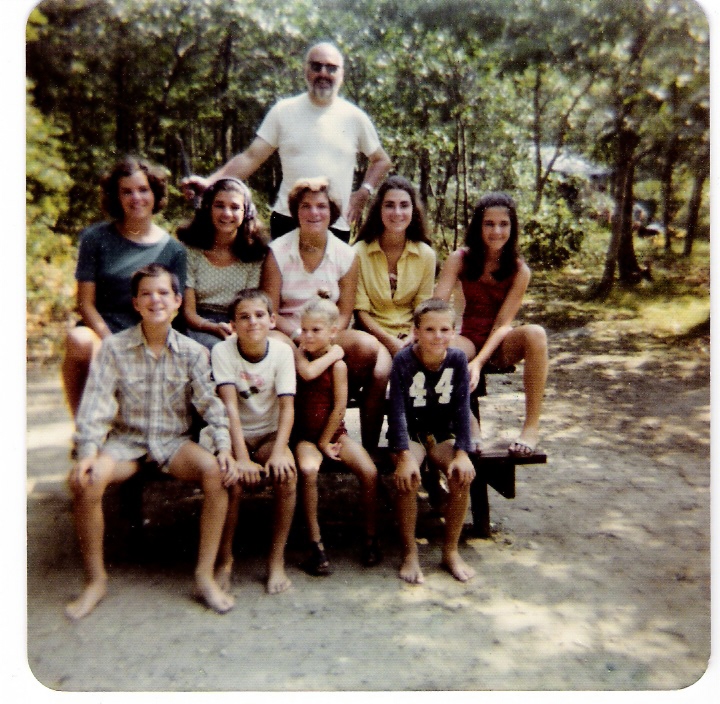
Dad with his nine (six girls; three boys) on a camping trip.

Kevin K. Connolly passed away in 1990 at the age of 62, leaving a void in all his children’s lives that we try to fill with stories about him. When I read “Poohsticks” aloud to my own sons, I heard his voice.

There are many gifts a father can give a child, but a love of reading is a powerful gift. On this Father’s Day, I pay tribute to the man who gave me life, and who made that life infinitely richer by making me a reader. Thank you, Dad; you were a great reader, you were an amazing father.