Screen Shot 2013-06-05 at 4.32.55 PMWhile some of my students have no problem cracking open a good book over the summer, others might prefer an audio text. That is why when I found the SYNC audiobook website, I was delighted to spread the word (and recorded voices) about great literature available all summer long. I have challenged my students to read (listen) with me all summer!

SYNC has organized a summer full of classics paired with young adult (YA) texts that are similar in theme. Each pairing is available only for a download for a short period of time, but once a reader downloads the MP3 files, the audiobook is available for listening at any time.

The software that makes this offer possible is  Overdrive Media Software that can be installed on a computer (compatible with Windows and Mac) or through an Overdrive App on a mobile device (compatible with iOS, Android, BlackBerry, Windows Phone 7).

Visit the OverDrive website to download the App or Software.

I have already listened to the full cast production of Shakespeare’s The Tempest, and enjoyed the dramatization. My familiarity with this play (I teach this every fall to my Advanced Placement Literature students) may influence how I think a student hearing the production for the first time might understand the plot. I hope they can follow some of the plot intricacies.

Screen Shot 2013-06-05 at 4.29.30 PMI was surprised that the play was paired with Of Poseidon, a romantic fantasy involving a independent and beautiful Emma and her strange encounters with the incredibly handsome Gaylen.  I would have paired this book with Romeo and Juliet because the inferences about clan conflicts are too frequent not to imagine “two houses both alike in dignity, in the fair ocean where we lay our scene.” This debut novel by Anna Banks addresses mermaid lore, the legend of Atlantis, and forbidden love on the Jersey Shore. Unlike the TV show, listeners are 75% into the book before the first kiss; there is a great deal of “raising her chin with his fingers” and “cheek-stroking” to keep romantics hopeful. The reader (Rebecca Gibel) was also excellent, lacing some of the more exclamatory phrases with the right amounts of sarcasm or ruefulness.  My only complaint was that this novel is the first in a series. As I got closer to the end of the recording, I began to realize that this novel was the “introductory”, a sentiment seconded by this reviewer:

This book also ends in a most inopportune place. I get it – we’re being set up for the second book – but this book sort of has this massive reveal and then BAM we’re at the end. I’d seen enough people’s reactions, though, to expect it, so I wasn’t quite as upset as some readers have been with the abrupt ending. Still, not a whole lot is resolved in this book, and I have a problem with a book that didn’t seem to have much of a point aside from setting up for the next one. (Merin; Amazon Book Review)

Complaining about a free download, however, seems ungrateful. Like the reviewer, I enjoyed the novel very much, so much that I was annoyed when all the loose ends were not resolved. Obviously, this is one way for SYNC to market additional texts. In this case, the strategy will work; I probably will purchase the sequel.

The schedule for titles downloads during this summer is listed below:

May 30 – June 5, 2013
Of Poseidon by Anna Banks, read by Rebecca Gibel (AudioGO)
The Tempest by William Shakespeare, read by a Full Cast (AudioGO)

June 6 – June 12, 2013
The Incorrigible Children of Ashton Place, Book 1: The Mysterious Howling by Maryrose Wood, read by Katherine Kellgren (HarperAudio)
Jane Eyre by Charlotte Brontë, read by Wanda McCaddon (Tantor Audio)

June 13 – June 19, 2013
The Raven Boys by Maggie Stiefvater, read by Will Patton (Scholastic Audiobooks)
Bless Me, Ultima by Rudolfo Anaya, read by Robert Ramirez (Recorded Books)

June 20 – June 26, 2013
Once by Morris Gleitzman, read by Morris Gleitzman (Bolinda Audio)
Letter From Birmingham Jail by Martin Luther King, Jr., read by Dion Graham (christianaudio)

June 27 – July 3, 2013
Rotters by Daniel Kraus, read by Kirby Heyborne (Listening Library)
Frankenstein by Mary Shelley, read by Jim Weiss (Listening Library)

July 4 – July 10, 2013
Carter Finally Gets It by Brent Crawford, read by Nick Podehl (Brilliance Audio)
She Stoops to Conquer by Oliver Goldsmith, read by a Full Cast (L.A. Theatre Works)

July 11 – July 17, 2013
The Peculiar by Stefan Bachmann, read by Peter Altschuler (HarperAudio)
Oliver Twist by Charles Dickens, read by Simon Vance (Tantor Audio)

July 18 – July 24, 2013
Grave Mercy by Robin LaFevers, read by Erin Moon (Recorded Books)
Hamlet by William Shakespeare, read by a Full Cast (L.A. Theatre Works)

July 25 – July 31, 2013
The False Prince by Jennifer A. Nielsen, read by Charlie McWade (Scholastic Audiobooks)
The Prince and the Pauper by Mark Twain, read by Steve West (Blackstone Audio)

Aug 1 – Aug 7, 2013
Death Cloud by Andrew Lane, read by Dan Weyman (Macmillan Audio)
The Adventures of Sherlock Holmes by Arthur Conan Doyle, read by Ralph Cosham (Blackstone Audio)

Aug 8 – Aug 14, 2013
Enchanted by Alethea Kontis, read by Katherine Kellgren (Brilliance Audio)
Through the Looking Glass by Lewis Carroll, read by Miriam Margolyes (Bolinda Audio)

Aug 15 – Aug 21, 2013
Sold by Patricia McCormick, read by Justine Eyre (Tantor Audio)
Let Me Stand Alone by Rachel Corrie, read by Tavia Gilbert (Blackstone Audio)

I am looking forward to a summer full of great audiotexts, and I hope my students will take advantage as well. Thank you, SYNC!

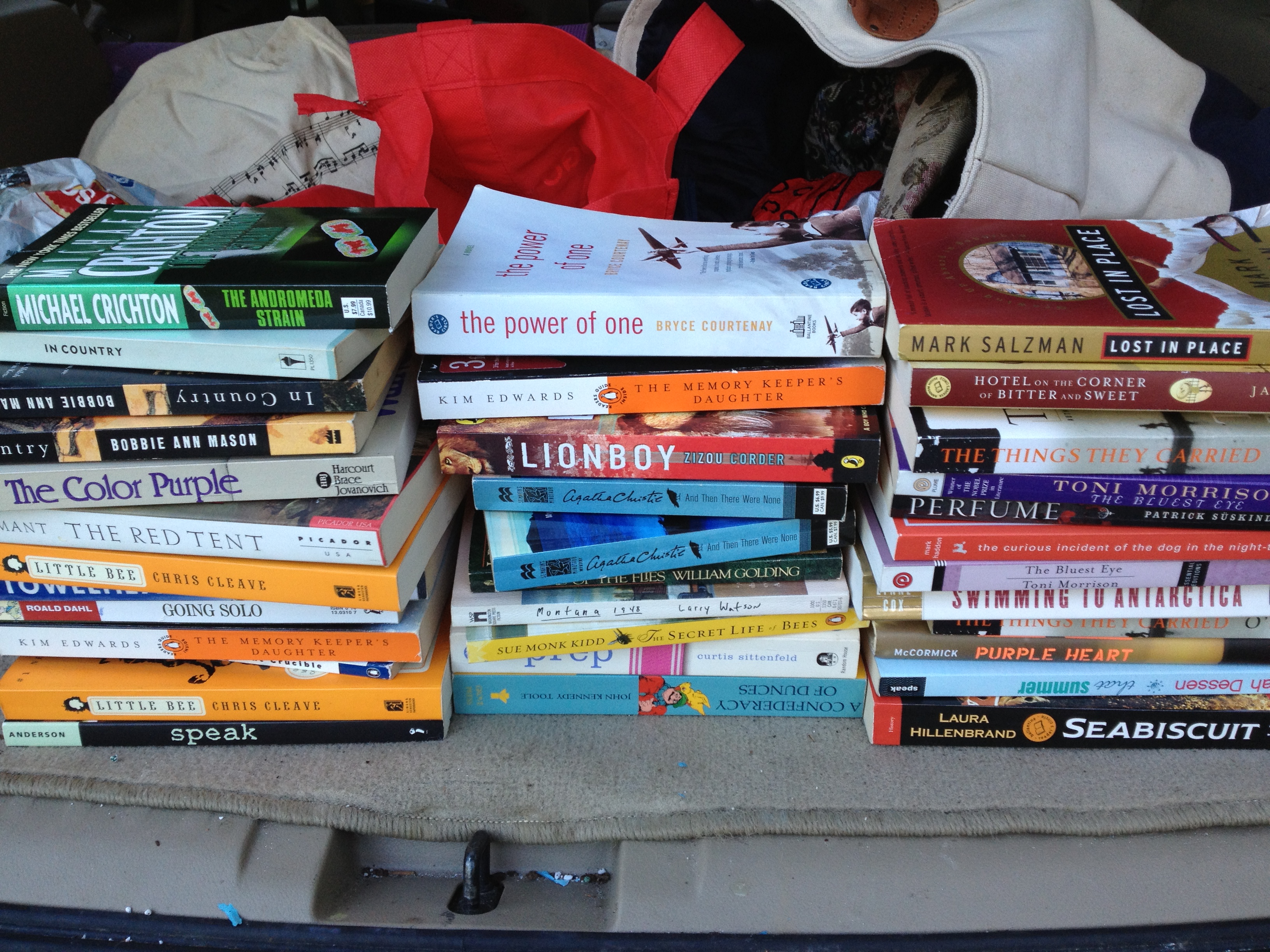
2013-06-09 18.00.17

The contents of the $7/box

There is no official “start” to the summer book sale season, but one great place to whet an appetite is at the Friends of the Byram Shubert Library in Greenwich, Connecticut.

This sale is usually held the 2nd weekend in June at the St. Paul’s Lutheran Church across the street. Book Sale Finder advertises the sale as “Exceptional”, “Well worth the trip!” and “Great Prices!”

Suffice to say, the sale was as advertised.

The Friday Preview night sells hardcovers $3, softcovers $2, small paperbacks .50 or 3/$1. On Saturday, prices are reduced to hardcovers $2, softcovers $1, small paperbacks 5/$1, children’s .25-.50. But it is on Sunday, a Bargain hunter’s delight, that there is a  “bag and box” sale $5/bag, $7/box or 2 boxes/$10.

I went in the last few hours on Sunday, and the tables were still tidy. The fiction was plentiful, but the non-fiction and young adult choices very picked over.  Nevertheless, in 20 minutes, I selected 34 great titles that I placed in a box provided by the Friends of the Library.

13 copies of books outlined in our curriculum mapping

13 copies of books outlined in our curriculum mapping

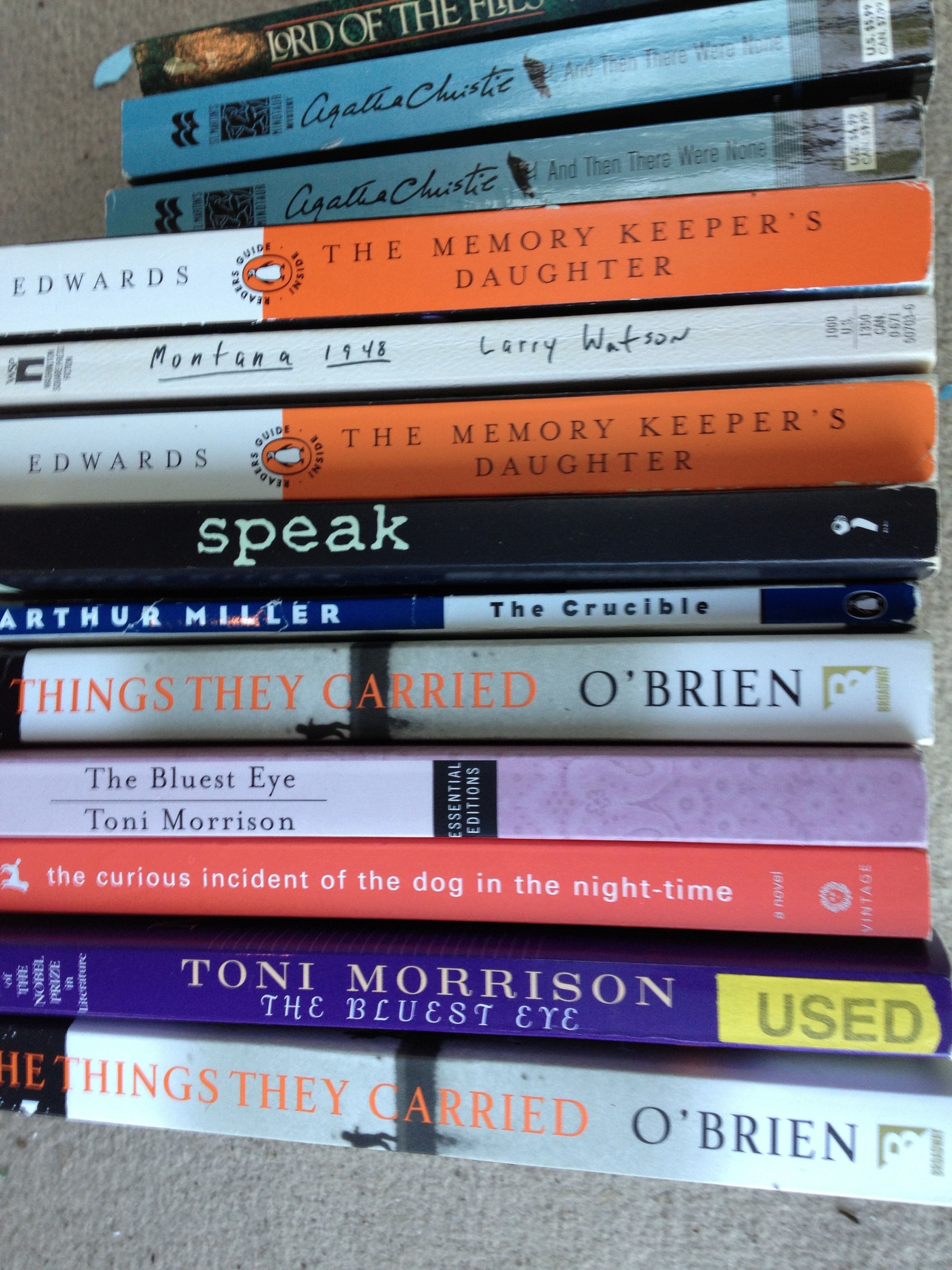
On the tables I grabbed titles we offer in our Grade 11 Vietnam War literature unit: 3 copies of In Country by Bobbie Ann Mason and and 2 copies of Tim O’Brien’s The Things They Carried.  There were also books assigned in our curriculum for Grade 10 World Literature: Mark Haddon’s The Curious Incident of the Dog in the Night Time and William Golding’s Lord of the Flies. Finally, two clean copies of Agatha Christie’s And Then There Were None will be placed in our grade 8 mystery unit. Summer reading for the Advanced Placement English Language is Kim Edward’s The Memory Keeper’s Daughter while Toni Morrison’s The Bluest Eye is one of the choices offered to these students during the school year.

The 13 books I found outlined in our curriculum mapping would normally retail for $139.00 if purchased new. The additional 21 books in the box will be added as independent reads in classroom libraries or suggested as “satellite reads” to complement a whole class novel.

34 books for $7.00? That is an amazing bargain. The 2013 summer used book sale season is off to a great start!

The students at Wamogo Middle/High School in Litchfield, CT, have been making “friendship and respect” videos this year at each grade level. These music video are shown at school assemblies and have become very popular with the students.

At the last assembly, one of the emcees tossed out a challenge, “Maybe the teachers will make a video next time!?”

Well, we did.

With a little help from a green screen, 27 members of the faculty representing a wide variety of disciplines jumped into the nearby closet wearing the big “W” (for Wamogo). Students in the video production class watched and filmed in amazement as, bearing some artifact from a particular subject area, each teacher donned a flowing red cape.

These teachers bravely risked their dignity, and their secret identities, in order to bring you the following video:

Next year? The other half of the faculty!

 I hear the chatter from elementary school teachers: 
  • They can’t wait for reading!
  • Oh, they love to read!
  • When we have to cancel reading, they are so disappointed.

Yet, what happens when I get the ninth graders in my class? I hear:

  • Reading is so boring.
  • I hate to read.
  • I don’t like reading.

What caused the change in students’ attitude towards reading?

97%

Reading Speed Limit?

I have been attending graduate courses on reading instruction for pre-K-6 in order to find out the reason for the shift in attitudes. One of the textbooks used was Guiding Readers and Writers (Grades 3-6), a 672 page tome packed with information written by authors Irene Fountas and Gay Su Pinnell. The 2001 edition reflected the ideal reading and writing workshop schedule; 3.5 hours of uninterrupted reading and writing daily.So, how did the instructional strategies for elementary students in the Fountas and Pinnell book prepare students for grades 7-12 ?

The Fountas and Pinnell strategies use a Benchmark Assessment System that allowed for leveled literacy intervention for very early readers. Texts were rated (A to K) on their difficulty for the reader in fluency and comprehension at instructional or independent levels. Each level suggests a percentage of accuracy that a student should achieve before moving to the next level, for example:

 For levels A to K, a text read at 90%-94% accuracy (with satisfactory or excellent comprehension) is considered an instructional level text. That means that the student can read it effectively with teacher help–a good introduction, prompting, and discussion).

For levels A to K, a text read at 95%-100% accuracy (with satisfactory or excellent comprehension) is considered to be an independent level text. That means that the student can read it without help. Reading at the independent level is extremely valuable because the reader gains fluency, reading “mileage,” new vocabulary, and experience thinking about what texts mean (comprehension).

Fountas and Pinnel are very clear that these percentages should not be fixed, stating:

We wouldn’t want anyone to interpret these percentages in a rigid way, of course. A child might read one text at 91% and then experience a few tricky words in the next book and read it with 89%.

They also note that reading broadly increases a student’s vocabulary, and they suggest that schools could mandate their own policies in insuring that students reading smoothly and easily with satisfactory accuracy and comprehension before moving to the next level.

I heard, however, a number of literacy specialists/instructors from elementary schools in my classes representing different districts in the state explaining, “We hold students to a 97% accuracy rate before moving them on” or “I would not move a student who isn’t reading at a 95%-97% accuracy rate.” Are these literacy specialists/instructors misreading the Fountas and Pinnell book? Furthermore, is a district’s adherence to this 97% accuracy rule hurting students as they transition to the higher grade levels? If a student is directed to read only those books that can be read at 97% or even a 91% or 89% accuracy, what happens when he or she is handed a required text that is above his or her reading level?

The problems in reading accuracy are clearly evident in when students enter middle school, and they are handed textbooks and whole class novels from the literary canon. Richard Allington, a past president of the International Reading Association and the National Reading Conference, wrote an article that directly addressed the problem of difficult texts for the journal Voices from the Middle (May 2007, NCTE) titled, “Intervention All Day Long: New Hope for Struggling Readers “ In this article, Allington makes the argument that districts should not mandate the same grade level texts for readers of varying ability:

This means that districts cannot continue to rely on one-size-fits-all curriculum plans and a single-period, daily supplemental intervention to accelerate struggling readers’ academic development. Districts cannot simply purchase grade-level sets of materials—literature anthologies, science books, social studies books—and hope to accelerate the academic development of students who struggle with schooling. There is no scientific evi- dence that distributing 25 copies of a grade-level text to all students will result in anything other than many students being left behind.

He argues for an extension of the 97% accuracy rate using easier texts and explains that the more difficult texts at the middle and high school levels will have many more words per page than the texts in elementary school. He notes that in a book of 250 and 300 running words on each page, 97% accuracy would mean 7–9 words will be misread or unreadable on every page:

 In a 20-page chapter, the student would encounter 140–180 words he or she cannot read. And typical middle school textbooks have twice as many words per page, creating the possibility that a reader reading at 97% accuracy would be unable to correctly read 14–20 words per page or 250–400 words per chapter.

As a result, Allington argues that struggling readers will not be helped by reading these texts, regardless as to the amount of support.
The very texts that are supposed to be a resource for a discipline’s content, “won’t help them learn to read.”  Many upper grade level texts are  textbooks are  heavy, difficult to read with all the subject specific vocabulary embedded in passages; the different fonts, pictures, and information boxes may confuse a poor reader.

I am, however, a little skeptical about Allington’s point regarding students who miss words in texts. I am not sure that the multiplication factor Allington uses to calculate the number of words missed since words are repeated in a novel.  Yes, a student may miss “purloined” on page 12, and on page 17, but should that word be counted twice? There is a context that eventually brings about an understanding; by the third “purloined” a student may have a better understanding of the word because of that context. As an additional concern, requiring a 97% accuracy rate would stop most middle/high school literature programs that use whole class texts. For example, we teach Romeo and Juliet to our 9th graders, and the accuracy rate for Shakespeare, even for teachers with Master degrees in English, is about 80%. Yet, year after year, as we read the play aloud, students do understand generally what is going on. Perhaps some literature is as the poet T.S. Eliot wrote, “Poetry communicates before it is understood.”

On the other hand, Allington has every reason to be concerned that students entering middle school and high school will encounter texts that are complex with high exile levels.  These texts will not be modified to accommodate struggling readers, instead the Common Core State Standards (CCSS) are moving in the opposite direction with Lexile levels being raised at all grade levels. Allington’s concerns are not the concerns for publishers who want to meet the CCSS in order to sell as many textbooks as possible. Ultimately, a 97% accuracy rate is not realistic with the materials in each subject area at the middle school and high school levels.

The students who have been swimming in the shallow end of the reading pool throughout their elementary school experience are suddenly tossed into the deep end of literature and informational texts when they hit middle school. The aforementioned elementary literacy specialists/instructor’s adherence to the 97% accuracy with Fountas and Pinnell benchmark assessments limit students to highly filtered reading experiences as opposed to challenging students to develop their own strategies when they encounter difficult texts. More practice with difficult reading materials should be part of an elementary school literacy regimen, just like a batter at the plate who must learn how to swing at a number of different kinds of pitches; not every pitch comes in the strike zone over the plate, and not every book is at a prescribed accuracy rate.

Requiring every student read at a 97% accuracy rate was not the intention of the Fountas and Pinnell directives, but the directives of others may be contributing to the comments I hear from my grade 9 students that “Reading is so boring” or “I hate to read.” A steady diet of the same level of reading caused by requirements to achieve a 97% (or A+) accuracy may hem in or deaden a student’s independent nature or curiosity. Furthermore, when a student gets to middle school, the requirement to read at 97%, or any literacy rate, is not enforced in all disciplines; students who have been spoon-fed reading materials may feel betrayed. Their 97% or A+ reading excellence is suddenly plunged to lower percentiles, which ultimately results in much lower grades. Any confidence or trust a struggling reader may have developed with purified texts is quickly lost, and “I hate to read” is the result.

Maybe they don’t hate to read; maybe with years of preparation at 97%, they are unprepared for any other speed.

boringMany educators use Twitter to communicate as part of personal learning networks (PLN). I appreciate the means to share messages with other educators, but I am sometimes alarmed by some of the tweets I read. The brevity of 140 characters does not allow for nuances. The tweet is, by design, blunt.
Example #1: Most teachers do not share a professional language. And they don’t share prof lang with students. 
I wonder, “Really? Is there evidence to support this claim?”
Example #2: Freedom—for educators and parents—is necessary, but not sufficient, for excellent schools
I think, “Define Freedom. Define sufficient. Define excellent.”
These tweets are made of some sentiment that begins an argument, but they are so brief and banal that they cut off debate.
Such was the case this week when prominent author and educator Dr. Tony Wagner paraphrased a statement made by Education Secretary Arne Duncan (week May 21, 2013) in a response on his twitter feed.  Wagner is the first Innovation Education Fellow at the Technology & Entrepreneurship Center at Harvard; he is a former high school teacher, K-8 principal, and a university professor in teacher education. Wagner’s tweet read:

“‘Too many high school students are dropping out, not because school is too hard, but because it’s too easy @arneduncan’ Wrong! It’s boring!” @DrTonyWagner.

While I disagree with Duncan’s generalization that schools are too easy, I was even more disturbed by Wagner’s response, about school, “It’s boring!”
I hear this complaint enough from students before they read the class novel or before we start the unit. I did not expect to hear it from Wagner.
Students say “this is boring” so much that I will not let them use the word “boring” any more.
But, is school boring?
Is it?
I take issue with Wagner’s claim. I would like to debate this.
As someone who attended Mr. Orontias’s History and Geography class in 1970, I can confidently say I have experienced boring. His 45 minute lecture delivered in a monotone right after lunch was not in a time space continuum; the clock hands did not move.
I know boring.
In contrast, my students’ high school today is not boring. As examples, I offer the following:
  • We have a Bring Your Own Technology (BYOT) initiative;
  • We employ student driven learning with choice on reading, topics, and presentation;
  • We include project based assessments and encourage reflection on tests.
We do, however, require that students do schoolwork. They practice math problems. They do research. They must complete reading assignments. They have deadlines. Some of this work is repetitious; some of this work is tedious. Some rote learning may be necessary to develop background knowledge before students can engage in active participation or collaboration.
So, when I hear from students that they are “bored” with school, often what they are saying is “schoolwork is not fun.”
This is not unexpected. A great deal of time is spent everyday in “not fun” activities inside school, just as a number of “not fun” activities are required in the real world.
I sympathize, but the reality is that not every lesson in school is fun. Education objectives require students to work rather than have the teachers be the engine of the classroom.
Wagner is one of the innovative educators who promotes education to incorporate more real world problems, reforming education to prepare students with 21st Century skills in order to engage students in meaningful enterprises. Whatever innovations are developed by education reformers like Wagner, students will experience frustrations, and experience failures. There will be efforts expended by teachers and students successfully and unsuccessfully. Work will be necessary, and some of that work will not be fun. If the goal of schools is to prepare students to learn the value of work, to prepare students for the workforce, work should be applauded, even if the work is not fun, or if the work is “boring.”
Arne Duncan’s statement that high school students are dropping out because schools are too easy is a gross overstatement. How easy will the real world be for those high school dropouts?
Similarly, Wagner’s accusation that high school is boring is infuriatingly terse, using only 20 out of Twitter’s 140 characters. How bored will students be if they drop out and cannot find fulfilling employment?
There are isolated cases of students who may write code for some fabulous new social media or video game that goes viral, but those are isolated. A high school diploma is necessary for even the most menial employment.
Today’s schools are not boring. Today’s schools are preparing students for work environments just like schools have done in decades past. Historically, teachers do not predict the job market, instead they prepare students with the fundamentals so that their students may create the job market. Some of that preparation is not fun; it is work, and in student lingo, it is boring.
Stating this needs more than a pithy remark that negates the efforts of teachers who are engaging students with 21st Century skills, with active rather than passive instruction.
Education has come a long way since my experience in the 1970s because of the efforts of education reformers like Dr. Wagner. Forty years ago, education came in primarily in the form of direct instruction. We sat in rows and listened to lectures, and yes, that was boring.
Except for the day that Mr. Orontias stepped into the wastebasket.
That was not boring at all.

sunThe paradox of summer reading:  Read=pleasure or Read=work.

All students should read at least one book this summer and practice the independent reading skills they have used the whole school year. They should receive credit for reading over the summer, but to give credit means an assessment. An assessment comes dangerously close to committing Readicide,(n): The systematic killing of the love of reading, often exacerbated by the inane, mind-numbing practices found in schools.

Anecdotally, 50% of students will read for fun. The other 50% will skim or Sparknote to complete an assignment, or they will not read at all for a variety of reasons: “it’s boring”, “too much work”, “I hate to read.”  Many students avoid books creating a “reading-free zone” from June through August. In addition, there are some parents who openly complain that assignments over the summer interfere with family vacation plans.

But there are many parents who understand the importance of reading. They could be frustrated all summer as they responsibly hound their children to do their summer assignments rather than wait until the last minute.

Summer reading is fun for some, but summer reading is a hassle for others. Why bother, indeed?

Well, research clearly demonstrates that summer reading is important in maintaining reading skills at every grade level. A meta-analysis (1996) of 39 separate studies about the effects of summer on student learning came to the conclusion that summer reading was critical to stopping the “summer slide”. Without summer reading, there could be a loss equaling about one month on each grade-level equivalent scale. Students would be playing a cognitive “catch-up” through November each school year.

In “The Effects of Summer Vacation on Achievement Test Scores: A Narrative and Meta-Analytic Review” by H. Cooper, B. Nye, K. Charlton, J. Lindsay and S. Greathouse, there were several key findings:

 At best, students showed little or no academic growth over the summer. At worst, students lost one to three months of learning.
 Summer learning loss was somewhat greater in math than reading.
 Summer learning loss was greatest in math computation and spelling.
 For disadvantaged students, reading scores were disproportionately affected and the achievement gap between rich and poor widened.

There have been studies since 1996 that confirm the findings of the meta-analysis, so, summer reading cannot be optional if students are to maintain their skills and progress as readers. The problem for teachers is how to engage the 50% who will not read over the summer. My English Department has tried the following:

  • One summer, we tried an assigned book route. We used a multiple choice quiz to measure student comprehension. The results were average to below average. Most students hated having to read an assigned book.
  • One summer, we tried the dialectical journal kept by a student on either an independent book choice or an assigned book (see post). The results were mixed with 25% students not completing the journal or completing the journal so poorly that we were chasing students for work past the due date and well into the end of the first quarter.
  • One summer, we tried the “project of your choice” in response to a “book of your choice”, but then we were buried in a pile of projects, with a wide variable in the quality of these projects.

So, this summer (2013) we are again trying something different in the hopes of finding a better measurement for summer reading. We are giving students their choice in reading fiction or non-fiction. The incoming 7th and 8th graders choose a book for the summer, and the school will provide that book. Students who will be entering grades 9 -11, may checkout a book from an extensive list organized by our school media specialist or any other book they choose.

Summer reading will be assessed with a writing assignment when all students return in September. The questions will align with standardized test essay questions (CAPT, SAT) and students may have the book in hand or notes from the book; students who read early in the summer will have the same advantages as students who read later in the summer, or the night before the writing prompt:

Essay question(s) for a work of FICTION read over the summer:
How does the main character change from the beginning of the story to the end? What do you think causes the change?
How did the plot develop and why?
How did the main character change? What words or actions showed this change?

Essay question(s) for a work of NON-FICTION read over the summer:
If this book was intended to teach the reader something, did it succeeded? Was something learned from reading this book, if so what? If not, why did the book fail as a teaching tool?Was there a specific passage that had left an impression, good or bad? Share the passage and its effect on the reader.

This assessment will be given the second week in September, and while there is a concern that writing is not as effective in measuring a student’s reading comprehension, at minimum this assessment will give the English Department members a chance to teach a writing prompt response.

Students who are in honors level or Advanced Placement courses will still have required reading. For example, incoming 9th grade honor students will read The Alchemist and The Book Thief while 12th grade Advanced Placement English Literature Students will be given the choice to read three of the following five titles: Bel Canto, The Story of Edgar Sawtelle, The Poisonwood Bible, Little Bee, or A Thousand Splendid Suns.

Before students leave for the summer, we plan on putting books into as many hands as possible. We will encourage students to organize themselves with book buddies, a suggestion from a post by Christopher Lehman, having them organize who they will be reading alongside, someone who they could talk with about their reading. The students have Shelfari accounts and can communicate online during the summer. We will promote our own reading book sites and include an audiobook site SYNC that pairs a young adult novel with a classic each week during the summer. For example, August 1 – 7, 2013 will feature Death Cloud by Andrew Lane, read by Dan Weyman (Macmillan Audio) with The Adventures of Sherlock Holmes by Arthur Conan Doyle, read by Ralph Cosham (Blackstone Audio). We will post information about summer reading on our websites, and send out Remind 101 notices.

While the research clearly demonstrates that summer reading is important, how students accomplish summer reading assignments during vacation time is a paradox. Should we assess reading for pleasure, or should students be left on their own and possibly lose reading skills?  Quiz them in September or lose them to the summer slide? No right answer, but good evidence to continue the tradition of summer reading.

Since the end of the Civil War, the last Monday in May has been set aside as Memorial Day, a day to honor all Americans who have died in military service for their country. There will be opportunities to celebrate by singing patriotic songs, wave flags in time with bands in parades, and eat barbecue.

There is, however, little to celebrate in the details of a death that occurs in military combat.  The specifics in a soldier’s death are painful to hear or to read, but our discomfort should not prevent us from acknowledging the depth and breadth of each soldier’s sacrifice. Many of the returning veterans from Iraq and Afghanistan are writing about their personal experiences and noting the sacrifices made by their fellow soldiers.  These veterans write memoirs and include stories about friends who were killed. They recall their intimate thoughts when they themselves confronted death. They write about the grisly horrors they witnessed in war. Some write about people they killed in conflict. Some fictionalize accounts of their military experiences.  Brian Turner writes poetry.

Brian Turner was an infantry team leader with the 3rd Stryker Brigade Combat Team, 2nd Infantry Division from November 2003 where he served in Iraq. He already had an MFA from the University of Oregon before he joined to serve seven years in the U.S. Army. His first book of poetry, Here, Bullet, chronicles his time in Iraq. In the video below, he reads the title poem at Bowdoin College (November 29, 2005) in a film by documentary filmmaker Eric Herter, sponsored by From the Fishouse, an online audio archive of emerging poets, http://www.fishousepoems.org.

Here, Bullet

If a body is what you want
then here is bone and gristle and flesh.
Here is the clavicle-snapped wish,
the aorta’s opened valves, the leap
thought makes at the synaptic gap.
Here is the adrenaline rush you crave,
that inexorable flight, that insane puncture
into heat and blood.

(continue on his site…)

Our 11th graders review this poem and several other Turner poems when they read Tim O’Brien’s novel The Things They Carried, another piece of literature that is dedicated to the sacrifices made by soldiers during war. O’Brien’s connected short stories about an Army platoon during the Vietnam War also comes from his personal experience. In both works, images are painfully raw; some of the language in each is vulgar. Our students appreciate the authenticity and the authority of these voices in capturing the images of war. In O’Brien’s stories and in Turner’s poetry, war does not provide reasons for celebration other than the celebration of war’s end and the return of soldiers to their homes.

Consequently, Turner’s poetry does not give the reader the parade, picnic, or flag waving poetry that people recall in images about Memorial Day. His poetry is a painful tribute; an agonizing truth that people must remember. His poetry reminds us that our freedom has been purchased at a cost, and that cost may be through another’s suffering. His voice reminds us why we should never forget that cost, why there is a Memorial Day.

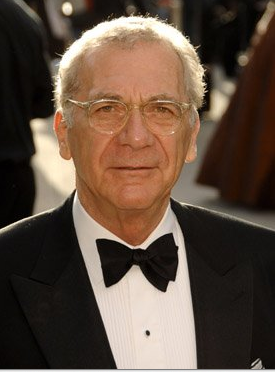
Tis the season of commencement addresses. Speeches brief and not so brief, exhorting graduates to go forth and improve the world. The people who deliver these addresses are often famous, coming from all walks of life; actors, writers, politicans, musicians, military leaders are de rigor for commencement addresses. One address was given by director, actor, and producer Sydney Pollack at Binghamton University in 2003.

Screen Shot 2013-05-22 at 8.09.07 PM

Sydney Pollack (IMDB.com)

Beginning in the 1960s, Pollack represented a blend of Hollywood celebrity and artist.  His famous films included This Property Is Condemned (1966), the hit comedy Tootsie (1982), and the award winning Out of Africa (1985) which garnered him two Oscars:  Best Direction and Best Picture. Pollack also produced the films The Talented Mr. Ripley (1999) and Cold Mountain (2003). He was honored with the John Huston Award from the Directors Guild of America in 2000 as a “defender of artists’ rights” before he died in 2008.

Two paragraphs from his commencement address were posted in the NYTimes in a feature piece by Sam Dillon titled Commencement Speeches; Reflections on War, Peace, and How to Live Vitally and Act Globally (6/1/2003). When I read this section of his address, I was inspired to use his ideas as the objective for a film and literature English elective for the senior class.

In two paragraphs, Pollack articulated the power of fiction as a tool for developing compassion:

  “We all live rather prescribed and narrow lives. I’m just this one white guy, 60-something years old. I’ll never be anything else except older. I’ve got one set of kids. I’ve got one wife. That’s it for me. But then, there’s this great, great library of experiences that’s housed in the liberal arts. Fictional worlds created that I can put on like this gown or coat, eyes that I can borrow to see the world.

      I can be a black housewife. I can be a king. I can be a C.I.A. spy. I can be a warrior. I can learn what it is like to be tried and convicted, to confess, to win the beautiful girl, lose the beautiful girl. It’s a way of understanding the world that functions beyond intellect and it teaches and touches through feeling and experience even when that experience is part of the imagination. Compassion finally is the great gift of literature. Fiction, and by that I mean the aesthetic creation of all artificial worlds, must persuade you to interpret the world with compassion.”

The fictional worlds that Pollack created in his films are similar to those worlds created by a reader experiencing fiction. Film, however, demands a combination of sight and sound in order to communicate a story, and the talented Pollack knew how to manipulate those elements to make the viewer surrender self to the emotional highs and lows in a retelling of a story.  For example, his, “aesthetic creation of all artificial worlds” used various points of view to make viewers feel as through they were flying in a biplane over the African Savannah in this clip from Out of Africa:

Making a film is a collaborative activity that includes actors actesses, cinematographers, producers, editors, and directors. Even the credits for the shortest film scroll with a multitude of oddly-named professions: key grips, gaffers, and best boys. Literature, by contrast, is created as a singular, intimate activity; the author’s words stimulating the reader’s imagination. Both creative processes are studied in the Film and Literature course offered to 12th graders.

In the film part of the course, students are made aware of the technical elements in film making. They learn to recognize the differences between diegetic and non-diegetic sound. They learn how to notice a cinematographer’s or film editor’s use of the rule of thirds. They learn to identify long shots, establishing shots, and extreme close-ups. They watch John Ford’s Stagecoach and notice his use of natural lighting in many scenes. They watch Orson Welles’s Citizen Kane and comment on the use of light for transitions from scene to scene. They watch Frank Darabont’s  The Shawshank Redemption and deconstruct the lighting in the mise-en-scene of the prison break.

In the literature section of the course, the students study how Milos Forman recreated the character of R.P. McMurphy from Ken Kesey’s text One Flew Over the Cuckoo’s Nest in a film of the same name. They analyze the authentic dialogue of adolescent males in Steven King’s short story The Body, a story that eventually became the film Stand By Me. By the end of the course, the students agree that at the heart of every great movie, all technical elements aside, must be a good story.

Pollack understood how a story is shared in literature between the writer and reader, and he allowed viewers to become the characters: the housewives, kings, spys, warriors he mentioned in his commencement address. He understood that film exacerbates sensory experiences that aid in developing empathy, an empathy that can lead to compassion. In his work in the film industry, he also proved that creating compassion is also the great gift of film since film lets us “borrow eyes to see the world.”

The two paragraphs in Pollack’s commencement address in 2003 served as the genesis to the Film and Literature course now running at my high school, but they could just as easily serve as the objective for any literature course; fiction persuades us to learn compassion. In our increasingly connected, contentious, and competitive world, learning compassion through story is a skill worth developing.

Tributes for teachers during Teacher Appreciation Week are welcome coming just as the school year comes to a close when very tired teachers are looking back to see student progress over the past eight months. Many of the tributes are touching, and some are comical. Comedy was the intent of the The Late Show with David Letterman, when the producers invited ten (10)  Teach For America teachers to deliver Letterman’s Top Ten List. In introducing the selected ten teachers, Letterman prefaced the performance with his own tribute,

“My God! If there is a future, it is in the hands of our teachers doing thankless work day after day (APPLAUSE) …..and by the way thankless is the wrong word… we should be grateful, eternally grateful, for the work these people do…”

After his heart-felt introduction, each of the ten Teach for American teachers stepped forward to deliver one entry on the list:

The Top 10 Reasons I Decided to Become a Teacher

  • 10. I hope to live up to the teachers who inspired me. . .like Ms. What’s Her Name
  • 9. It’s no fun saying the Pledge of Allegiance every day by myself.
  • 8. Honestly, I didn’t pay much attention the first time through school.
  • 7. Kids need to know the moon landing was faked. 
  • 6. If I could make a difference in just one student’s life–well, that wouldn’t be a very good average. 
  • 5. The glamour. 
  • 4. You work long hours, but at least the pay is bad.
  • 3. Hoping to teach in an all song-and-dance high school, like on “Glee.” 
  • 2. In the summer, I can watch all you losers go to the office. 
  • 1. I want to help kids talk good. 

This very funny video was posted on the Teach for America website, listing participating teachers as members of the Class of ’13. Teach for America is a not for profit organization established in 1990 under a proposal by Wendy Kopp. The original objective is explained on their website:

We recruit a diverse group of leaders with a record of achievement who work to expand educational opportunity, starting by teaching for two years in a low-income community.                 

Teach for America sent 500 teachers to low-income schools in its first year. To date, over 33,000 have completed the program, however, Teach for America has come under some criticism for the “temporary” nature of the assignments. Two years of teaching is not enough, argued David Greene in an editorial featured in the New York Times (4/30/13),Invitation to a Dialogue: The Art of Teaching”:

Corps members should intern for a year under the supervision of a talented mentor teacher, then teach for at least four years, not two. That may discourage some. Good. We want career teachers. A “temp” work force does not improve education or erase the achievement gap. Rather it helps to create havoc in schools desperately trying to gain stability, a key factor in any school’s success.

Greene explained that he has served in the past as a mentor to Teach for America corps members, and that he has seen their “tears, anxieties, heartaches, successes and achievements.” He claims, however, that the preparation for these teachers now includes “simple, formulaic scripts” instead of letting these teachers be “creative, independent, spontaneous, practical and rule-bending.” He noted:

Scripts and rules and models strictly followed cannot replace what the best teachers have: practical wisdom. In our anti-teacher world and scripted teaching climate perpetuated by corporate reformers, what room is there for the teachers we want for our kids?

Greene cautioned that the today’s Teach for America has “morphed into more of a leadership institute”, with too little classroom experience to inform the members as they move quickly from the classroom into higher levels in education administration and in educational reform.

Letterman’s producers must be applauded for focusing attention on teachers during Teacher Appreciation Week, but in the future, they might consider a different group to represent teachers. Perhaps they could recruit seasoned veteran teachers who made this career choice, or if new teachers are what they want, they might look to spotlight new teachers who do not have the benefits of training and continuing support from Teach for America. Or, they might look to recruit the teacher described below in a letter published in the NYTimes written by Derl Clausen, a high school student, in a response to Greene’s editorial:

He walks in five minutes late to first period, half-shaven, cup of coffee in hand. He walks over to the white board, his stage, puts his coffee down, and looks into the eyes of every student. He’s not given the best students, and so his standardized test scores are average. Instead, they leave with something more; they leave inspired.

He tells them about life: the challenges, the problems, the reason he’s half-shaven. He turns “Romeo and Juliet” into a lesson on love, algebra into a philosophy discussion, and science into an art appreciation class. Vocabulary, equations and historical dates will enter and leave children’s memories, but the inspiration, motivation and wisdom that he gives them will remain throughout their lives.

It’s that teacher who is worth the five-minute wait, the smell of coffee — and if anyone questions his half-shaven beard, he’ll learn a whole lot more about life.

Clausen’s describes a teacher who goes “off script”, a teacher that fits Greene’s observation that, “Often it is the least orthodox teacher who most engages and excites students.” Clausen’s portrait could be a choice worth of a Top Ten List, or maybe even a guest appearance. Clausen and the half-shaved teacher as guests on The Late Show with David Letterman for Teacher Appreciation Week 2014? Not a satirical list, but one real teacher-student relationship as part of a Teacher Appreciation Week “Top Ten”.

Catcher-in-the-rye-red-cover“I heard about this book called ‘Catcher in the Rye,” said Peyton. She was lining up a “book buddy” extra credit assignment to read with Madison.
I reached for two dog-eared copies with the familiar brick red cover, “Meet Holden Caufield,” I said.

Requests for Catcher in the Rye happen every year. Since we do not teach the novel as a whole class read, I am always happy to see the many copies we have circulating for independent reading. J.D. Salinger passed away in 2010, almost sixty years after his bildungsroman, (coming of age story) of a young man’s wanderings one day in New York City captured the angst of late adolescence for an audience familiar with that angst. Houlden Caufield’s voice was unlike any other, and readers adopted the book with a fervor that bordered on fanaticism. As evidence, there are well-worn copies at every used book sale.

In most high schools today, Catcher in the Rye has a reputation, a cult status. Its “banned book” pedigree  interests both conformist and non-conformists. According to World.edu:

Between 1961 and 1982, The Catcher in the Rye was the most censored book in high schools and libraries in the United States. In 1981, it was both the most censored book and the second most taught book in public schools in the United States.

Many of my students know about the book’s banning history from the South Park episode from Season 14: The Tale of Scrotie McBoogerballs.  In this episode, the students at South Park Elementary are given copies of Catcher in the Rye and learn that the book is “filthy, is inappropriate, and made a guy shoot the king of hippies.”
“Can we PLEASE read this book now?” Cartman pleads.
(View at: http://www.southparkstudios.com/clips/267355/lets-read-it-now )
Very quickly, however, the South Park students learn that 60 years after its publication, the language and themes in the story of Holden Caufield’s day are tame by today’s standards; they are dumbfounded and more than a little annoyed that anyone would consider the book inappropriate. My students have expressed the same puzzlement.

With only one major book to his credit, Salinger still commands the media’s attention. A tweet last week by OpenCulture linked the video below of the reclusive 91-year-old Salinger out for a stroll in Windsor, Vermont (2010):

Under the video, Open Culture also posted a series of anecdotes about Salinger, for example, a story about Nicholas Carr (Is Google Making Us Stupid?)

Nicholas Carr, who was working behind the circulation desk at the college library one summer when “a tall, slender, slightly stooped man” walked in. He remembers his boss whispering, “That’s J.D. Salinger”:

Holy crap, I thought. I just saw J.D. Salinger.

About ten minutes later Salinger suddenly reappeared at the desk, holding a dollar bill. I went over to him, and he said he needed change for the Xerox machine. I took his dollar and gave him four quarters.

That’s my claim to fame: I gave J.D. Salinger change for a buck.

Another recent news item on Salinger was published in the New York Times April 23, 2013, “The Young Salinger, Mordant Yet Hopeful” by Dave Itzkoff. The article described that a recent discovery of nine letters by a 22-year-old Salinger “revealed himself to be as playful, passionate and caustic as Holden Caulfield, the self-questioning adolescent who would become his most enduring creation.” The letters refer to other stories “unpublished and presumably lost works from this period”, tantalizing clues that will set Salinger fans hoping for yet unpublished materials to surface.

Salinger’s reclusiveness fascinates my students. In this day and age, his deliberate choice for isolation starkly contrasts from their uber-connected world of social media. Ironically, social media is a place where Holden thrives today. There are several facebook pages devoted to him. A Google map of his adventures complete with quotes details each step of his journey from the Wicker Bar at the Seton Hotel through the Central Park Zoo and into the Museum of Natural History. He would probably appreciate the myriad of Sparknotes, or Schmoop Notes, that help students who fail to complete assigned reading, or fail to listen to the audio book as available on YouTube. Holden has a Twitter account, @holdencaulfield, and a Tumblr account.  A  blog post on Flavorwire in July 2012 lists 10 Things Holden Caulfield Hates About Everyone including phonies:

“You never saw so many phonies in all your life, everybody smoking their ears off and talking about the play so that everybody could hear and know how sharp they were.”

Predictable, we know. But no Holden Caulfield hate list would be complete without it.

Holden is out there mingling with audiences of this connected age, and now he is mingling with two more. Heads down, they are engrossed with his misadventures during our 20 minute silent sustained reading period.
“How’s Holden?” I ask quietly.
“Good,” they chorus without looking up. They have been caught by Salinger, caught by The Catcher in the Rye.