Archives For November 30, 1999

60 of my students met their first Hamlet on stage at Yale Repertory Theatre in New Haven, Connecticut, this past week. Their Hamlet was the actor Paul Giamatti, who after speaking 40% of the play’s 4,042 lines (roughly 1,440), came out onto the stage for an audience talkback to speak a few more words to them.paul giamatti

“He looks tired,” on student remarked to me. The play had begun at 10:15 AM, and we were still sitting three and a half hours later as the actors and crew began to respond to questions.

If we thought they looked tired, the actors seemed surprised to see us still sitting there.
“Wow!” Polonius (Gerry Bamman) said as he sat, “You stayed!”

Students were curious about how the sets moved (“The stage has a large fly space.“). Students wondered how long the cast had rehearsed (“Eight weeks, a real luxury…”). Students wondered who was most like his or her character (“I understand Gertrude much more since I have a son”). Students asked about the creation of set pieces including a large portrait (“That’s an oil painting from a  photograph”).

Of course, there was no stopping the students from calling attention to Giamatti’s role in Big Fat Liar, a film from their youthOne student stood to ask, “Did Hamlet remind you of Marty Wolf?” Giamatti laughed in response, “Well, maybe,…a little… except for the blue crap!”

Hamlet is a 12th grade text, and I asked students to take a survey after they returned to the school to see what they thought of this production. While the survey indicated that the teachers in our English department had done their job, the students indicated that seeing the play performed was very different that studying the play in class:

Shakespeare was meant to be live. Although the “perfection” of a movie is enhancing to the performance, it is unrealistic. I believe that watching a play live is important to seeing the different styles and methods possible.

It was fun and a lot better than just reading it in class, it made it come alive.

I did not think it was going to be as entertaining as it was. I also did not think I would find parts humorous, but I did.

This Hamlet was part of the WILLPOWER! series (funded by the National Endowment of the Arts). The website states:

WILL POWER! is Yale Repertory Theatre’s annual educational initiative in conjunction with one of its productions and features specially-priced tickets and early school-time matinees for middle and high school student groups. The program also includes free professional development for educators, study guides and post-performance discussions with members of the company.

One of the objectives of the WILLPOWER! series is to create new audiences, specifically younger audiences, for Shakespeare. Students who have attended a Shakespeare play may be more willing to attend another play when they are older; in other words, a favorable dramatic experience will yield future audiences for Yale Drama School graduates!
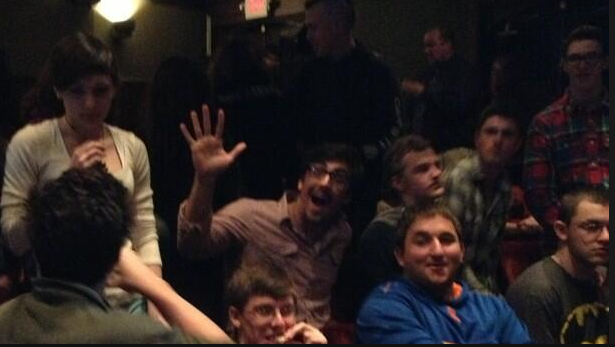
Seniors at intermission watching Hamlet at Yale Rep

Seniors at intermission watching Hamlet at Yale Rep

The survey indicated that this goal is being met with the WILLPOWER! series; my students are certainly willing to try another play:

The performance was a wonderful experience, especially since it was my first time to see Shakespeare.

I wouldnt mind going to another because it was so enjoyable that I didn’t even realize the 4 hours passing by.

I like the way that a play has a certain kind of vibe. It’s like a live concert, where there’s a certain kind of energy. It was like seeing a live performance of a film. I would especially like to see another Shakespeare because it is the way that he intended his works to be portrayed.

After seeing Hamlet so well done, it would definitely be worth going to see another one whether it be Shakespeare or a different kind of performance.

Perhaps the most satisfying moments of the actor’s talkback for teachers is hearing the actors say things that we wish our students would pay attention to in class. When Giammati was asked about how he felt about memorizing all those lines, he explained that he enjoyed learning the lines and playing on the open space of the stage.

When one student asked, “What part of the play did you like best?” Giamatti responded, “I enjoy the end, when Hamlet returns to the graveyard, until the end.” Then, thoughtfully, he added, “Shakespeare’s words begin to come through you if you let them.” (Honestly…you could hear the teachers in the audience swoon!)

But nothing was better than hearing the young Remsen Welsh (Player Prologue) explain how the director, James Bundy, had prepared her for her role. “It’s simple,” the actress gestured enthusiastically from the front of the stage. Facing the crowd of students twice her age, she cheerfully acknowledged, “He told me, ‘Suit the action to the word, the word to the action..’ and I did!”

Exactly.

A first Hamlet they will remember.

003-Great-Gatsby

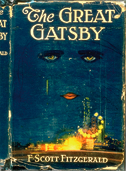
Charles Scribner’s and Son issued the first hardback edition in April 1925, adorning its cover with a painting of a pair of eyes and lips floating on a blue field above a cityscape.

The Great Gatsby film is coming out soon….” the English teacher said to me, “Can you believe Gatsby is almost 90?”

Wait, 90? The Great Gatsby is almost 90? That debonair, handsome American icon we met in his 30’s could be well over 100 years old?

“He had one of those rare smiles with a quality of eternal reassurance in it, that you may come across four or five times in life. It faced, or seemed to face, the whole external world for an instant and then concentrated on you with an irresistible prejudice in your favor. It understood you just as far as you wanted to be understood, believed in you as you would like to believe in yourself.”

F. Scott Fitzgerald began writing his great American novel in 1922, with some of the elements surfacing in the story “Absolution” in the June 1924 issue of the magazine The American Mercury.  During the years 1923–1924, Fitzgerald, his wife Zelda, and their baby daughter, Frances “Scottie”,  traveled from New York to the French Riviera, where the novel was finished. Fitzgerald went through several revisions between 1923 to 1925 before the  novel was finally published.

According to Brant Mangum in a publication from Virginia Commonwealth University: 

Fitzgerald’s ambitious goal as he approached the composition of The Great Gatsby was to “write something new–something extraordinary and beautiful and simple + intricately patterned.”

The reaction of the critics was harsh; one early review ran with the headline:

 “F. SCOTT FITZGERALD’S LATEST DUD.”

Praise, however came from recognized writers T. S. Eliot, Edith Wharton and Willa Cather. Ten days after the book came out, Maxwell Perkins, Fitzgerald’s editor, sent the telegram: “SALES SITUATION DOUBTFUL EXCELLENT REVIEWS.” The first printing of 20,870 copies was a slow seller; Scribner’s printed another 3,000 copies four months late and finished the run. According to an article Living on $500,000 a Year: What F. Scott Fitzgerald’s tax returns reveal about his life and times by William J. Quirk in American Scholar over 12 million copies have been sold, with approximately 300-400 hundred thousand sold annually. However, Fitzgerald never did match his famous protagonist’s wealth:

“Royalties from The Great Gatsby totaled only $8,397 during Fitzgerald’s lifetime. Today Gatsby is read in nearly every high school and college and regularly produces $500,000 a year in [F. Scott Fitzgerald’s daughter] Scottie’s trust for her children.”

Fitzgerald died young, age 44, in December of 1940.

“His estate was solvent but modest—around $35,000, mostly from an insurance policy. The tax appraisers considered the copyrights worthless. Today, even multiplying Fitzgerald’s estate by 30, it would not require an estate tax return.”

He did write other novels, stories, essays, but The Great Gatsby remains his most important addition to the canon. So why call this work the great American novel?

Jonathan Yardley makes his case by calling attention to the distinctively American elements in the novel in the Washington Post book review Gatsby”: The Greatest Of Them All (1/2/07) writes:

In an extraordinarily compressed space — the novel is barely 50,000 words long — Fitzgerald gives us a meditation on some of this country’s most central ideas, themes, yearnings and preoccupations: the quest for a new life, the preoccupation with class, the hunger for riches and “the last and greatest of all human dreams…”

Our contemporary American obsession with celebrity and wealth is obvious to students who are assigned The Great Gatsby. Our nation’s economy  from boom through a recent recession, echoes the experience the heady times of the  Roaring 20’s before the Great Depression. The narrative style is engaging and packed with imagery. Anyone who spent time in a high school literature classroom over the past 50 years can recall taking notes on Fitzgerald’s metaphors and complex symbols. Mangum discusses these in his essay:

 The green light, which carries meaning at every level of the story–as Gatsby’s go-ahead sign, as money, as the “green breast of the new world,” as springtime–is strategically placed in chapters one, five, and nine. The eyes of T.J. Eckleburg “brood on over the solemn dumping ground,” which is the wasteland that America has become (514).

The appeal of Jay Gatsby’s character is explained in a chapter in America: A Self-Made Country by political commentator Chris Matthews. He writes:

“The reader, like Nick Carraway, comes to like this guy. We love his dream  because we have, all of us, shared something very much like it. Gatsby for me is undeniably the great American novel. We celebrate its hero and his “heightened sensitivity” to the promise of life. his “extraordinary gift for hope”, his “romantic readiness” because we as a country share every bit of it” (20).

The final passage of the novel is Fitzgerald’s commentary on the American dream. Nick’s final stream of consciousness:

“Gatsby believed in the green light, the orgastic future that year by year recedes before us. It eluded us then, but that’s no matter—tomorrow we will run faster, stretch out our arms farther. . . . And then one fine morning—
So we beat on, boats against the current, borne back ceaselessly into the past.”

Such imagery naturally lends itself to the movie screen, and The Great Gatsby has had more than its fair share of remakes:

  • 2000:  Mira Sorvino, Toby Stephens, Paul Rudd (made for TV)
  • 1974: Robert Redford, Mia Farrow, Bruce Dern
  • 1949: Alan Ladd, Betty Field, Macdonald Carey
  • 1926: Warner Baxter, Lois Wilson, Neil Hamilton 

Now, the latest version is coming May (2013), when the Australian film director Baz Lurhman will put his spin on this American story:

Once more, Jay Gatsby will be glamorously immortalized in his youth; this time digitally mastered rather than in celluoid.

However, should someone want to try an even newer genre in order to experience a 21st Century Gatsby, there is the Nintendo Great Gatsby Game that can be played on a computer. While Gatsby is fixed forever as young and ambitious, he now is also amazingly spry for his years! ( “to jump, move arrow keys together right and left”)

For an “Old Sport”, Gatsby wears his age well.

There are many great reasons to teach at the high school level: no outdoor recess duty, college level content, plus, a teacher never has to choose a “line leader”. Best of all, there are no bulletin board requirements.

While most elementary school classroom walls are crammed with colorful thematic cut-outs (apples, shamrocks, stars), high school walls are monochromatic. While middle school classrooms have student work displayed regularly, an essay hung in September will curl and fade on the wall of a high school classroom twisting in the air like an ancient leaf of papyrus.

Generally speaking, high school teachers do not spend a lot of time decorating the classroom. Subject content or motivational posters are the wall covering of choice, unchanged for the requisite 181 days of instruction. Perhaps it is inevitable that teachers who share classrooms do not personalize classrooms.

However, for one brief part of the 3rd grading quarter, Read Across America Week (February 25-March 1st) changed the decorating habits of the faculty at Wamogo Middle/High School.

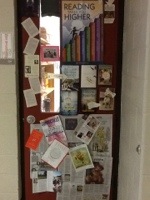
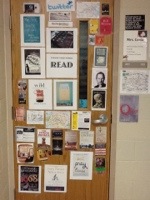
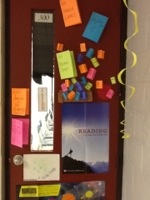
English teacher door...a wide rang of reading complete with motivational poster!

English teacher door…a wide rang of reading complete with motivational poster!

In a collective effort to demonstrate the importance of reading to students, teachers from every discipline decorated their classroom doors with materials they have read or are currently reading.

20130301-112618.jpg

When sharing a door meant less space, this resource room teacher used a poster.

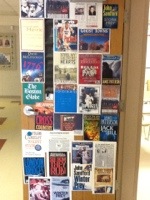
Social Studies (Gr 7) had this door and the side wall as well!

Social Studies (Gr 7) had this door and the side wall as well! The genre range (politics-humor-sports) was astounding!

20130301-112656.jpg

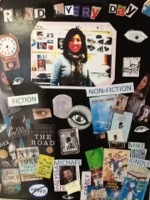
The Art teacher door centered around the command “READ”.

20130301-112713.jpg

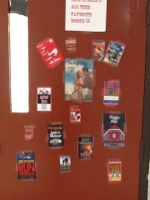
Health and Physical Ed teacher revealed a “retro” fondness for the books that contributed to her growing up including Erich Segal’s “Love Story”

20130301-112741.jpg

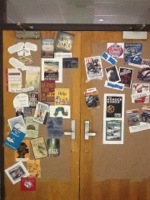
Alternative education students had to walk through a double door display! Students selected the books they read as well in this display.

20130301-112806.jpg

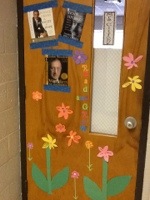
The resource room mixed decorative flowers with John Wooden “On :Leadership”

20130301-112843.jpg

One Social Studies teacher took the assignment to heart by hanging what he reads, quite literally, onto the door and walls….He was considered the “winner!”

Admittedly, when the “Doors of Wamogo” was announced, there was a little hesitation. What would go on the door? When was this “due”?

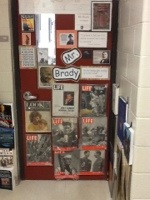
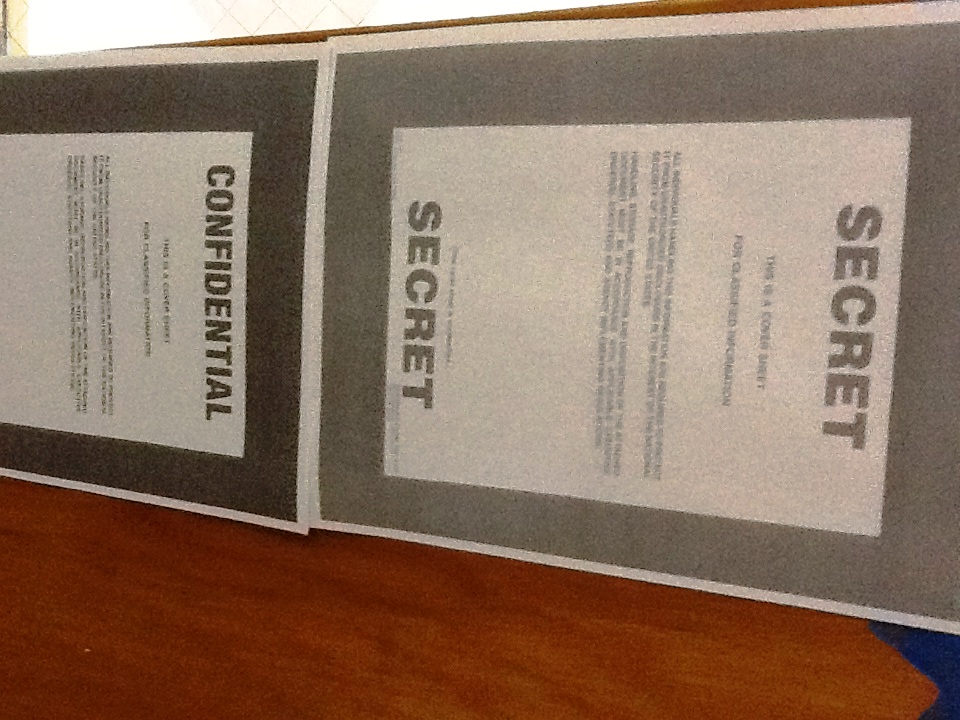
Finally, a few brave souls stepped up. First, there was the Social Studies teacher, an Army Reserve Colonel, who started by hanging “classified” documents on his door. His display was followed by the Business and Career Department teacher, also a basketball coach, who hung sports magazines and the cover of a Bobby Knight memoir.

The English Department members, the Literary Specialist, and the media center Librarian displayed a range of the reading, from Where the Wild Things Are to Great Expectations.

As the week went on, the competition became a little more intense. Finally,  the Grade 8 Social Studies teacher simply emptied out his bookshelf and placed all his favorite texts alongside the door in addition to the door.

Side shot of the "Classified" materials read by a Social Studies teacher

Side shot of the “Classified” materials read by a Social Studies teacher

Perhaps one of the more interesting outcomes was the sharing of titles between faculty and staff. “Oh, I loved that book!” one teacher would say to another. “This is a hard book, but well worth the effort,” said one teacher. “Yes, we read this in our ‘book club’!” exclaimed another. “Who is the Jody Picoult freak?” questions a science fiction reader. “How much Stephen King can you read?” was the retort.

20130301-112826.jpg

Math teacher places “Put Me in the Zoo” on his door; hopefully. this says more about his new baby daughter than the classes!

Students had a chance to look at all the titles: assigned reading from high school that they currently are reading (Romeo and Juliet, Animal Farm), political/history books, and sports memoirs. There were magazine covers, newspaper mastheads, and comic strips. Blogger, WordPress, Twitter, Facebook logos were prominent, social media as informational texts.

So what the “Doors of Wamogo”  created for Read Across America Day in our small rural school was a very large window. The doors provided a window into the lives of our faculty, a window for our students to see us as readers, and for our students to see what books made us successful.

These doors illustrate how reading gave each teacher and staff member a chance to at the window of opportunity; reading = individual success.

We had so much fun, we might try decorating again next year!

Happy Read Across America Day, 2013!

20130301-112923.jpg

Taking the playfulness of a Dr. Seuss motif to heart with replicas of books shared by students.

According to literary legend, Ernest Hemingway wrote a six word short story in response to a bet:

Screen Shot 2013-02-26 at 3.58.31 PM

So when my Advanced Placement English Literature class was suddenly shortened one day last week due to a  delayed opening, I thought that I would do a close reading on this famous short story. After all, how long could a discussion on six words last? I was confident there would certainly be enough time for each of them to craft an essay as well.

The usual procedure for close readings in class is to have a volunteer “read aloud” while students annotate their copies of the text. The text is also displayed on the SMARTboard so that notes can be added and shared with all members of the class.

After they settled down with copies, Sam volunteered to read. We listened and paused. I started to ask, “So how did Ernest Hemingway, the author of this short story, convey his meaning?” when I was cut off.

“Whose baby died?” asked Alexis. She had no notes on her page.

“The baby died?” Connor responded, “I thought this was about a tag sale.”

“Why do you say that?” I asked, “Look at the evidence in the text.”

“Because people who have tag sales put in ads, and the ads are short,” replied Connor.

“But that is why the ad is short,” Alexis retorted, “the parents are so upset, they cannot write a long ad to sell the baby’s shoes.”

“Where are parents in the text?” I demanded.

“I agree with Alexis,” said Sam, “the shoes were ‘never worn’. The baby is dead.”

“OK,” I agreed, ” the words ‘never worn’ are in the text, but…”

“But the baby shoes could have been a gift that was the wrong size,” interrupted Natalie.

We were drifting off in our discussion. I had chosen the story because of its brevity, but I also had considered how well the text responded to the Publisher’s Criteria for the English/Language Arts Common Core Standards:

The Common Core State Standards place a high priority on the close, sustained reading of complex text, beginning with Reading Standard 1. Such reading focuses on what lies within the four corners of the text. It often requires compact, short, self-contained texts that students can read and re-read deliberately and slowly to probe and ponder the meanings of individual words, the order in which sentences unfold, and the development of ideas over the course of the text.

This was a “compact, short, self-contained texts that students can read and re-read deliberately.” The students were beginning to probe the meanings of individual words, but they were drifting.  They were bringing up tag sales, upset parents, and poor present gifting;  we were far off the four corners of this text.

For a moment, a very brief moment, I consider that we were moving away from the goals of the Common Core to work with the text. However, they were so quickly engaged, that I grew far more interested in listening to how close to they were to determining Hemingway’s purpose. Hemingway had selected six specific words to excite the reader’s imagination. My students were not wrong in their suggestions, they were using his text to understand, to create meaning. They were working with Hemingway’s language and responding to his inferences.

Their written drafts also leapt beyond the evidence, much like the discussion:

  • “They have waited nine months in anticipation for this day, and that morning a pair of shoes, no larger than the size of a plum, arrived in the mail, a gift from an aunt. They run to the hospital; they cry, they yell, they cry, but their baby is dead. ‘Get rid of those shoes.’ He writes in the paper, “For sale: baby shoes, never worn.’ Auntie will be sad.”
  • “…whether it’s a parent/ guardian or a thief trying to make money, it is obvious from the syntax that the shoes need to go.”
  • “‘For sale’ is a general coupling of words that comes from a particular type of person….a person low on monetary resources or one who wants to get rid of something…”
  • “…by saying the word ‘never’, that means the parents have never had a baby and will never have a baby…never is finite”
  • “In reality, Hemingway’s story is less of a story and more of a jumping off point. The six words are a choke point, like that of an hourglass stretching of in infinity in either direction.”

These drafts, hastily written in response to the story, ranged from 2-3 handwritten pages; far more than the six words that stimulated their ideas. The students wrote furiously until the bell rang, and then begged for more time to finish.

Certainly, their responses could be judged by the CCSS criteria, “Student knowledge drawn from the text is demonstrated when the student uses evidence from the text to support a claim about the text.” However, their responses in discussion and in essays offer significant proof that the ideas that started in text cannot be limited by clocks or “four corners”.

In keeping my classroom libraries filled with books, the trends I notice are not necessarily trends in book buying, but trends in book discarding. After exams, midterms or finals, assigned titles are discarded to make room on a bookshelf or in a school locker for new required reading. Following trends means knowing that three to four months after the curriculum unit ended, an assigned title begins to crowd its way onto the bookshelves of thrift stores such as Goodwill or St. Vincent’s or the Salvation Army.

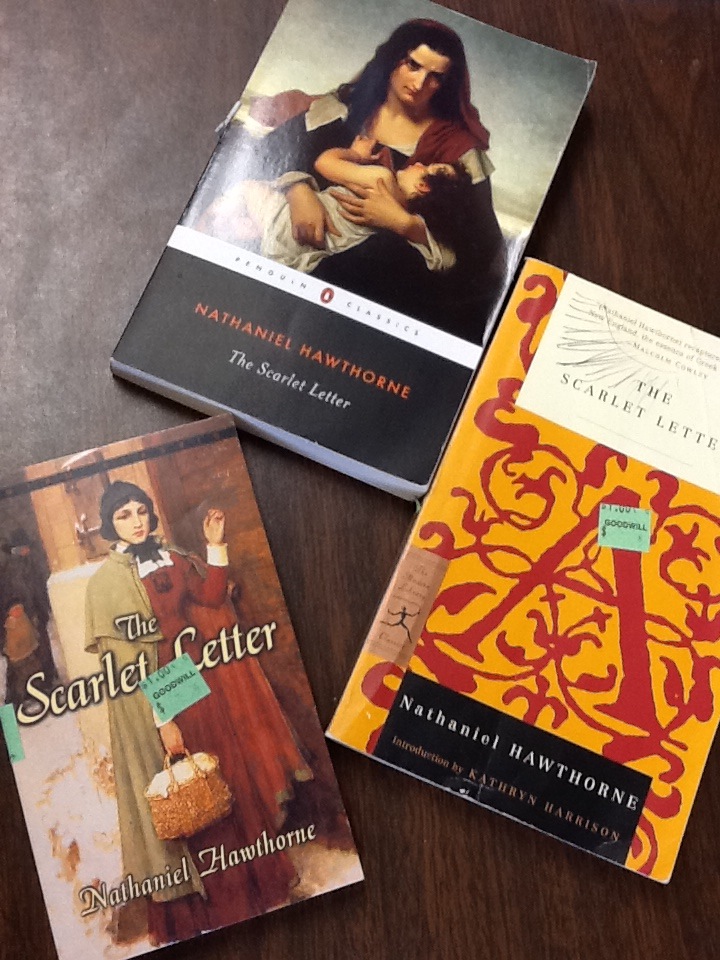
Three copies of "The Scarlet Letter" on the shelf at Goodwill. All new; never opened!

Three copies of “The Scarlet Letter” on the shelf at Goodwill this past week. All new; never opened, bearing their $1.00 each price tags.

Since Puritans are usually up for discussion in September in American History coursework, many English departments turn to Nathaniel Hawthorne’s novel The Scarlet Letter for their Advanced Placement or college bound students as a complementary read. Therefore, I was not surprised when, during this last week of January, copies of The Scarlet Letter began appearing, not in single copies, but in droves. I expected as much. The Scarlet Letter represents the “not keeping” trend. While a student may hesitate for a millisecond before placing The Great Gatsby or To Kill a Mockingbird or Catcher in the Rye in the “throw away” pile, I imagine there is universal delight in discarding The Scarlet Letter, a delight only exacerbated by discarding its equally loathed curriculum companion, Arthur Miller’s The Crucible.

The mention of The Scarlet Letter may set off groans. Woe to the teacher who attempts this book without the iron cast-backbone or the determination of an evangelist. Readers of The Scarlet Letter will need to be converted, and it is only the fear and damnation of another scarlet letter that keeps them plodding on, the scarlet “F”!

The tone of the book is set immediately with the opening line:

A throng of bearded men, in sad-colored garments and gray, steeple-crowned hats, intermixed with women, some wearing hoods, and others bareheaded, was assembled in front of a wooden edifice, the door of which was heavily timbered with oak, and studded with iron spikes.

Looking further down the page for some relief from the gloom, the reader should notice that he or she is being directly addressed, as if from a pulpit delivering a parable or allegory:

Finding it so directly on the threshold of our narrative, which is now about to issue from that inauspicious portal, we could hardly do otherwise than pluck one of its flowers and present it to the reader. It may serve, let us hope, to symbolize some sweet moral blossom, that may be found along the track, or relieve the darkening close of a tale of human frailty and sorrow.

Yes, Hawthorne will be delivering this sermon for 192 pages in the Dover Thrift Edition ($3.15).

Students are aware that this classic will improve SAT scores with the challenging vocabulary and complex structures of 19th Century prose, but they still seek help beyond the classroom. There are Sparknotes, Schmoop notes, E-Notes, Cliff Notes, and Bookrags available for this text, so as a result, the paperback text on the thrift store shelf may never have been opened. The copies available at thrift stores are generally pristine copies. I imagine they were purchased by parents who dutifully picked up the book because of a syllabus of some sort. Maybe this was a summer reading choice, a particularly deadening assignment. Actually, the effort in purchasing this text could have been avoided, because the text itself is online at no less than six places:

And there are free audio versions at:

But we still teach The Scarlet Letter, and our paperback collection of The Scarlet Letter distributed in class is comprised of at least 10 different editions. No student is on the same page number when the text is read aloud in class in order to share the conflicts between Dimmesdale, Hester Prynne, and Chillingsworth. Interestingly, what seems initially complex to the student is eventually understood as a really a ripping good love triangle of sex, intrigue, and irony. Once they see Hawthorne laying out hypocrisies of the Puritan society, they are more genuinely engaged. Plus, there is the lovely child Pearl, and they grow to sympathize for her.

In order to engage students in assessments, our Grade 11 teacher has organized “self-directed” projects for students to choose  and some of these have included:

  • Create a song telling the ballad of Hester Pyrnne.  You may compose the song, or write new words for an existing melody.  Share the song with the class either live or via audio or videotape.
  • Think of a sin associated with Dimmesdale and Chillingworth.  Create a badge that uses a letter or other symbol to represent the sin.  In addition, use art, needlework, or some other craft to make the badge reveal something about the man’s character, interests, or profession.  Write an explanatory caption or paragraph to accompany the badge.
  • Choose music to be the score for a film version of the novel.  Choose music for at least five major scenes.  Write explanatory notes for each selection

The harvesting of The Scarlet Letter texts from thrift store shelves is best from January-March. I can add as many as 10-12 copies during these months. Competition for the title grows during the summer, and the books are often more dog-earred by then.

But with all the negativity, why teach The Scarlet Letter? Because Hawthorne provides a bridge from this historical period to ours by using the empathy that is generated in fiction. Our brains are wired for stories more than facts, and reading The Scarlet Letter helps our students identify with characters in order to understand the politics and policies of this turbulent time when our nation was still in its infancy. Additionally, his story serves as a springboard for other stories. According to Canadian author Margaret Atwood, “The roots of totalitarianism in America are found, I discovered, in the theocracy of the 17th Century. The Scarlet Letter is not that far behind [the novel] The Handmaid’s Tale, my take on American Puritanism.”

Oh, and yes. We also assign The Handmaid’s Tale.

Of course, I received multiple links to the NY TimesMacbeth Mashup“from fellow English teachers, and yes, I thought that Claire Needell Hollander wrote a very funny piece. Yes, I believe students should be exposed to Shakespeare regularly, with or without the recommendations of the Common Core State Standards (CCSS). But, Macbeth for seventh and eighth graders? No!  That is just wrong. Wrong on theme, wrong for content, and very wrong for 11 and 12 year olds.

Hollander began her feature article making a great point about classroom dynamics:

“We say the classroom, as if an ideal classroom exists that somehow resembles every other classroom in America. In reality, every classroom has its own dynamic, and every class I’ve ever taught looks different from every other class. Perhaps more important, they also sound different.”

She is right. A chemistry of personalities creates a different dynamic in every classroom. The age of those personalities is also a factor. As I read the piece, however, I grew more and more frustrated. Macbeth features witches, warfare, murder, and, like most Shakespeare plays, sexual language. The word “blood” is repeated 41 times over the course of the play. Even the play itself is cursed; actors will not say the name of the play in the theatre. Many critics consider this Shakespeare’s “darkest play”.

Hollander herself questioned the appropriateness of this play for middle school students. She writes:

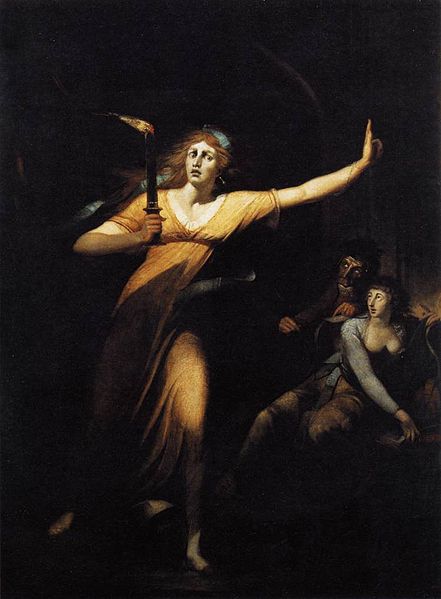
Lady Macbeth

John Henry Fuseli/ Johann Heinrich Füssli, Lady Macbeth Sleepwalking. Musée du Louvre, Paris Date: 1784. Creative Commons. Lady Macbeth driven to madness and suicide because her guilt in participating in the murder of King Duncan which leads to the murder of the guards, Macduff’s family, Banquo, and others…the stuff that nightmares are made upon.

“The kids have copies of the play with a modern English version on one side, but this isn’t easy either.”

“Tears of hilarity. Maybe middle school is too young for “Macbeth.”

Maybe? Definitely! So, why choose Macbeth?

Apparently, Hollander was attempting to satisfy a recommendation for archaic language for the secondary level in the English Language Arts Common Core. This is explained in Appendix A Language Conventionality and Clarity:

Texts that rely on literal, clear, contemporary, and conversational language tend to be easier to read than texts that rely on figurative, ironic, ambiguous, purposefully misleading, archaic, or otherwise unfamiliar language (such as general academic and domain-specific vocabulary).

In other words, the CCSS state that students should be exposed to complex diction, and the CCSS has made specific recommendations for grade 8 including:

  • Little Women by Louisa May Alcott (1869)
  • The Adventures of Tom Sawyerby Mark Twain (1876)
  • “The Road Not Taken” by Robert Frost (1915)

Hollander could consider the how the wording in CCSS Reading Standard 8  should guide her in selecting material for her combined seventh and eighth graders:

Analyze how a modern work of fiction draws on themes, patterns of events, or character types from myths, traditional stories, or religious works such as the Bible, including describing how the material is rendered new.

So many students come to high school without the necessary content to understand many of Shakespeare’s allusions. Perhaps the students know little about King Arthur and the Knights of the Round Table; why not Malory’s Morte d’Arthur? Or understanding the Pantheon of Greek Gods and Goddesses would be helpful; why not Edith Hamilton’s Greek Mythology?  Beowulf is usually taught in grade 10; the opening begins, “He was spawned in that slime, /Conceived by a pair of those monsters born/ Of Cain, murderous creatures banished/ By God, punished forever for the crime/ Of Abel’s death” (Raffel). Student should know this Biblical story of Cain and Abel. Students must come to high school prepared with the content needed to understand increasingly complex texts.

So why choose Macbeth? In fact, why choose Shakespeare at all? Ultimately, by not considering the recommendations of the CCSS to saturate students with the grade appropriate texts in our rich literary tradition, Hollander leaves them ill-prepared for Shakespeare at the high school level, when they are more mature to appreciate his themes.

So please, leave Macbeth, with his nihlism, his “...tale/Told by an idiot, full of sound and fury,/Signifying nothing” for older students.  Please leave Lady Macbeth with “…the smell of the blood still” where “all the perfumes of Arabia will not sweeten this little hand”, and leave Macbeth for high school. Besides, if Hollander is trying to meet the recommendations of the Common Core, she should leave Macbeth where the Common Core placed it, as a complex texts for 9th and 10th grades. The noisy mashup of Macbeth will still be crude and rowdy and demanding; but the students will be older, and these few additional years of maturity are necessary for dark tragedy in “the Scottish play”.

"Dawn spread her rosy fingers..."

“Dawn spread her rosy fingers…”

Our 9th grade classes have been reading Robert Fitzgerald’s excellent translation of The Odyssey. At the beginning of every book, “young Dawn spreads her fingertips of rose to make heaven bright”. My students have heard this phrase so often that they chorus back to me “fingertips of rose” when we read aloud. One morning this past week, I raced up the hill to school to get my iPad so I could capture this picture of the “rosy fingers” and put it on the class wiki.

We dutifully started The Odyssey with the “Invocation to the Muse” and Books 1-4, but the Telemachus “coming of age” story did not really capture their interest. Meeting Odysseus in Book 5 did not improve their respect for the “worthy man of twists and turns.” Once we read Book 9,  the meeting with the Cyclops, Polyphemus, their interest was revived. Apparently, they enjoy a good story of man-eating monster as much as previous generations from 2020 years ago.

I have only been able to locate about a dozen copies of this translation in the secondary market, so we did have to buy a class set. These replaced a worn set of the Richmond Lattimore translation. There will be an audio version of the Fitzgerald translation available in November 2013 I will be ordering so I will finally be able to hear how to pronounce all those Greek names!.

Our final project for the Odyssey is a narrative that students complete called “The Wamogossey: A Day in the Life of a Freshman at Wamogo High School.” Happily,  writing narratives are once again favored in curriculum aligned to the Common Core State Standards:

CCSS.ELA-Literacy.W.9-10.3 Write narratives to develop real or imagined experiences or events using effective technique, well-chosen details, and well-structured event sequences.

The inclusion of the narrative confirms what most writing teachers recognize, that writing a narrative gives a students a better appreciation for reading a narrative.

In writing The Wamogossey, we allow students to organize themselves as individual narrators or in groups of two or three. Our instructions to the students are based on the following premise:

You and your partners are to create a modern equivalent of The Odyssey. The setting is Wamogo High School; the hero a 9th grader – Fresheus or Freshiope.

Your character must make their way through a day at school, facing modern equivalents of the Lotus Eaters, Cyclops, Sirens, and all that Odysseus encountered. The goal is simply to get home alive, where the or she can relax and feel safe.You must mirror Odysseus’ adventures, including how he solves the problems (trickery, patience, skill, self-control, etc).  The essential nature of the obstacles must be the same, in the same order, but set in modern Wamogo.

Each student in a group working on The Wamogossey is required to write three adventures: a single narrator needs three (3) adventures; two people writing the Wamogossey need six (6) adventures; three members of the group need nine (9) adventures. This organization assures that there is an equal sharing of responsibilities regardless as to the size of the group. They compose the narrative on Google Docs; each narrator writing in a different color ink.

In addition, to assure fairness in grading, we allow students to have some feedback on the distribution of points. The project is assigned a base grade (EX: 40 points) Once the project is graded based, that number is multiplied by the number of students in group. For example a project worth 40 points may be awarded only 34 points. If there were three members of the group, then there are 34 X 3 points available, or a total of 102 points. The members of the group then determine a fair distribution of points; slackers are usually “outed” by members of their group. We rarely need to intervene.

The Wamogossey narratives must begin with an invocation to their muse. These are usually very personal and often reflect that we have a vocational agricultural program. For example, from this year’s submissions:

Sing in me, Brandon,
and help me tell the story of tractors, you, skilled in all ways of contending,
the fixing, harried for hours on end,
after the break downs and endless driving in the field.
I saw the end of the last row of corn
and learned that good crops come slowly
and weathered many bitter days
in the early morning cold, while I fought only
to save my life, to get home to the barn.
But not by will nor valor could I save all the gas I use,
Of these adventures, Brandon, tell about me in my school day, lift the great song again.
Begin when the alarm rang, calling me to adventure, when all I hungered for was for home, my  Farm All tractors, and being ready…

In addition to the modernized twists of Homer’s plot, each adventure needs an epithet (“grey-eyed goddess”) and one Homeric simile. My students call these similes “enough already; we get the point” similes.There is also extra credit for using vocabulary from The Odyssey.

So far, several of The Wamogossey entries parallel Odysseus’s adventure very nicely. One student’s encounter with “Eaganphemus” (the Cyclops/our principal) is clever:

Encounter with the Cyclops- Book 9
I was hurrying to class, I was going so fast, I felt like I was in a race car, and the people around me are in a fuzz.  All of a sudden, I saw the huge Eaganphemus standing in my way. I almost slammed into him, my wheels spinning so fast. I tried to get around him, but I couldn’t  But, I happened to have M&M’s in my pocket, so I threw them at him. He seemed overwhelmed! He tried to catch all of them at once!! Once he was trying to gobble them down I raced past, now that he was distracted. I somehow survived getting past him.

As the semester ends next week, the students will have finished their hero’s journey. Odysseus will return to Ithaka and to Penelope, and, yes, another “Dawn will spread her rosy fingers…”.  I may get to run up the hill again to snap another picture.

Screen Shot 2013-01-09 at 4.41.58 PM

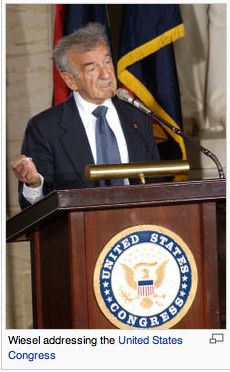
Wikipedia photo -Elie Wiesel

By my calculations, at the mid-point of the school year, many World History classes are studying World War II. Should these classes want to increase their use of an informational text in English or Social Studies curriculum, I suggest Elie Wiesel’s noteworthy speech The Perils of Indifference.

Wiesel delivered this speech to Congress on April 12, 1999. The speech is 1818 words long and connects Wiesel’s experience at the concentration camp at Aushwitcz with the genocides of the late 20th Century using a single powerful word: indifference.

In his speech, Weisel states clearly:

Indifference, then, is not only a sin, it is a punishment. And this is one of the most important lessons of this outgoing century’s wide-ranging experiments in good and evil.

Our English Department has used this speech in the past as a complement to Wiesel’s memoir Night which has been a used as a whole class read.  This year, we are giving Night to the Social Studies classes. They will adopt this memoir in order to increase the assigned informational text reading in their discipline mandated by the Literacy Common Core State Standards in History and Social Studies (CCSS). The English Department will still offer supplemental texts  that students can choose to read independently.

When he gave this speech, Wiesel had come before the US Congress to thank the American soldiers and the American people for liberating the camps at the end of World War II. Wiesel had spent nine months in the Buchewald/Aushwitcz complex. His mother and sisters had been separated from him when they first arrived: “Eight short, simple words… Men to the left, women to the right”; these family members were killed in the ovens. He and his father survived starvation, disease, and the deprivation of spirit. His father eventually succumbed, and Wiesel guiltily admits at the end of the memoir that at his father’s death he felt relieved.

Eventually, Wiesel felt compelled to testify against the Nazi regime, and he wrote the memoir Night to bear witness against the genocide which killed his family and six million Jews. His speech was delivered 54 years after he was liberated by American forces.

His gratitude to these American forces is what opens the speech, but after the opening paragraph, Wiesel seriously admonishes America to do more to halt genocides all over the world. By not intervening on behalf of those victims of genocide, he states clearly, we are indifferent to their suffering:

Indifference, after all, is more dangerous than anger and hatred. Anger can at times be creative. One writes a great poem, a great symphony, one does something special for the sake of humanity because one is angry at the injustice that one witnesses. But indifference is never creative.

My students have always been struck by Wiesel’s juxtaposition of anger and creativity. More than one has agreed pointing to making a “good” creation: an amazing song about an ex-boyfriend or a painting slapped together with passion. They also do not want to be treated indifferently. Yet, Wiesel makes them think beyond themselves:

Indifference is not a beginning, it is an end. And, therefore, indifference is always the friend of the enemy, for it benefits the aggressor — never his victim, whose pain is magnified when he or she feels forgotten. The political prisoner in his cell, the hungry children, the homeless refugees — not to respond to their plight, not to relieve their solitude by offering them a spark of hope is to exile them from human memory. And in denying their humanity we betray our own.

I remember several years ago, one student in my English 10 class, Rick, was particularly bright, fun, and full of daring. He also had an exceptional understanding of math and statistics. That January, I introduced the memoir Night as I had in previous years by providing a little background information.

“Six million Jews were killed during the Holocaust,” I recited off from my list of facts.

“What?” a startled Rick looked up. “Six million?” He was aghast. “That can’t be right.” He looked around at his classmates. “Six million?” They looked at him blankly. “Come on,” he was looking for some support, “That can’t be right.”

“Why?” I asked.

“Do you know how many six million things are?” He was indignant.

“Six million people,” I responded.

“People, yes. People, six million is a lot of people….” Rick was clearly operating with a different level of understanding from his more placid classmates. He understood six million as quantity; he did understand what six million things would look like if stacked up. Other students stirred in their seats.  “No way….six million,” he repeated growing more agitated. “How? How did anyone let this happen?” he asked; he was half-rising out of his seat. “Did we know?”

“Yes,” I remember saying. I do remember explaining that, yes, America did know that Hitler had concentration camps, and that more documentation collected after the war indicated that many of our military and political leaders knew about these camps. That is one of the points from Wiesel’s speech.

I pointed out to the class that the Holocaust was only one example of genocide; that there were others. In fact, that there was recently a genocide in Darfur. Rick sat down; he was overwhelmed. He was capable of understanding numerically the devastation of the Holocaust, and he was clearly upset. “Why do we let this happen?” he asked. I remember his voice was so sad, so full of disbelief.

In The Perils of Indifference, Wiesel asks

Does it mean that we have learned from the past? Does it mean that society has changed? Has the human being become less indifferent and more human? Have we really learned from our experiences? Are we less insensitive to the plight of victims of ethnic cleansing and other forms of injustices in places near and far?

Wiesel’s rhetorical questions echo Rick’s “Did we know?” In trying to respond, Wiesel makes the reader uncomfortable the way Rick was uncomfortable. Creating this kind of emotional impact on a reader is the reason Wiesel’s speech should be taught.

The Common Core State Standards (CCSS) demand that students read informational texts but does not require specific texts. Wiesel’s The Perils of Indifference contains the information and rhetorical devices that meet the text complexity criteria of the CCSS. More specifically, Wiesel’s message is necessary if we want our students to confront the conflicts in this new 21st Century. Our students must be prepared to question why “deportation, the terrorization of children and their parents be allowed anywhere in the world?“

Our humanity should demand nothing less.

How to create indelible memories? Read aloud to children. Too much attention is focused on what to give to make a holiday meaningful, when this inexpensive and simple choice is available to anyone who can read: poem, picture book, story. I clearly remember my father reading “King John’s Christmas”  during the holidays on several occasions. So powerful is this memory, that I can hear his voice as I re-read the poem myself:

King John was not a good man —
He had his little ways.
And sometimes no one spoke to him
For days and days and days.

My father would always begin reading the poem by reciting the first four lines from memory. While his read alouds were not frequent, they were memorably dramatic. He had a gift for animating  words. Most of the stories he chose were something from his childhood. “King John’s Christmas” came from the collection Now We Are Six by the noted children’s author A.A.Milne, creator of Winnie the Pooh. King John was less than popular with his subjects, but he was hardly a villain:

And men who came across him,
When walking in the town,
Gave him a supercilious stare,
Or passed with noses in the air —
And bad King John stood dumbly there,
Blushing beneath his crown.

Screen Shot 2012-12-22 at 7.53.15 AM

Ernest Shepard’s illustration of King John, “blushing beneath his crown”

I remember how my father would stress the five syllables of “supercilious”; while we had never heard that word, his intonation told us that no one liked King John. He was a king so disliked that he was forced to send himself Christmas cards:

King John was not a good man,
And no good friends had he.
He stayed in every afternoon …
But no one came to tea.
And, round about December,
The cards upon his shelf
Which wished him lots of Christmas cheer,
And fortune in the coming year,
Were never from his near and dear,
But only from himself.

A.A. Milne was already an experienced writer before he created the children’s classic Winnie-the-Pooh. He had been an editor for Punch Magazine  and a playwright. He also had served in World War I from 1914-1919 as a signaling officer who saw his fair share of the frontlines. He was dismissed from the army after a fever, and during his recuperation he returned to playwriting. In 1920, his son Christopher Robin Milne was born, and Milne turned to writing for children. After some success with  poetry published in children’s poetry magazines, Milne sought out an illustrator from his days at Punch, Ernest Shepard. The collaboration produced When We Were Very Young and within the first eight weeks of publication, over 50,000 copies were sold here and in the UK.

Milne’s next effort featured short stories involving the childhood toys of Christopher Robin. The book was titled Winnie-the-Pooh, and recognizing how important Shepard’s illustrations were to the book, Milne offered him an unprecedented share in the royalties. The second book of poetry, Now We Are Six, was published in 1927, and “King John’s Christmas” is one of the 31 poems in that book. The illustrations again were Shepard’s.

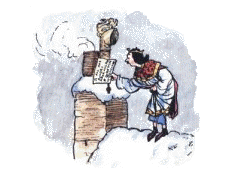
In stanza five of the poem, King John writes a lengthy Christmas wish list to Old Father Christmas, just before “He stole away upstairs and hung, A hopeful stocking out.”

Screen Shot 2012-12-22 at 7.52.46 AM

Shepard’s rendering of King John leaving his list, “..up the roof…
propped against the chimney stack”

King John’s list was full of things none of us would have requested, but my father would enthusiastically recite the list making each item seem so desirable:

“I want some crackers,
And I want some candy;
I think a box of chocolates
Would come in handy;
I don’t mind oranges,
I do like nuts!
And I SHOULD like a pocket-knife
That really cuts.
And, oh! Father Christmas, if you love me at all,
Bring me a big, red India-rubber ball!”

The desire for the “big, red India-rubber ball” was the clincher. Why a toy? Had King John never had this simple toy? Had all his Christmas lists been unanswered? Had Father Christmas never visited the king? Milne’s King John was characterized as “not a good man”, but would Father Christmas be so cruel as to withhold a gift at Christmas?

Sadly, yes. King John goes to his stocking on Christmas morning only to find an empty stocking. We imagined the already pathetic king holding a flat limp stocking as my father intoned:

King John said grimly: “As I feared,
Nothing again for me!”

My father would pause to let this discovery sink in. The poem was unimaginably sad to us, especially during the holiday, finding an empty stocking. Then he would read on as King John dismissed all the things on his list. He confesses he had not really wanted anything, all he wanted was the “big red, India-rubber ball”. Milne’s reference to the pocket knife was not the only “cut” delivered when King John comes to the conclusion he cannot be loved, even by the beneficent Father Christmas.

I haven’t got a pocket-knife —
Not one that cuts.
And, oh! if Father Christmas had loved me at all,
He would have brought a big, red India-rubber ball!”

Does Milne leave the reader with the memory of the pathetic king, abandoned by all at a magical time of the year? Of course not! King John “frowns” as he looks out his window at all the “happy bands of boys and girls all playing in the snow.” He stands alone, abandoned, and jealous of their joy, when suddenly, a small miracle occurs:

When through the window big and red
There hurtled by his royal head,
And bounced and fell upon the bed,
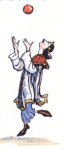
An India-rubber ball!

Screen Shot 2012-12-22 at 7.52.23 AM

“A big red, India-rubber ball!”

The final stanza is written in capital letters, as if shouted from the rooftops. My father would raise his voice as well in reading the poem’s conclusion:

AND OH, FATHER CHRISTMAS,
MY BLESSINGS ON YOU FALL
FOR BRINGING HIM
A BIG, RED
INDIA-RUBBER
BALL!

So, my thanks to the genius of A.A.Milne for writing the wonderful poem “King John’s Christmas” and to my father who read the poem and made such a powerful memories with all his read-alouds. MY BLESSINGS ON YOU FALL!

tragedy“On Friday noon, July the twentieth, 1714, the finest bridge in all Peru broke and precipitated five travelers into the gulf below.”

That is the opening sentence from Thornton Wilder’s novel The Bridge of San Luis Rey. A monk who witnesses the fall of those travelers searches for answers as to whether the accident was simply chance or an act of the Divine. In writing The Bridge of San Luis Rey, Wilder was addressing the genre of tragedy which was defined by Aristotle in his Poetics as “an imitation of a serious act” in literature. The purpose of tragedy is to provide the reader, or viewer in the case of drama, an experience of loss without having to suffer what a fictional character suffers. Through his literature, Wilder, like the authors and playwrights before him, provided the experience and language to us to respond when there is a tragedy. Great literature does this well which may be why the literature taught in high school classrooms is, more often than not, tragedy.

Of course, tragedy is not always a popular curriculum choice. I am always being confronted by students,  “Why do we have to read such depressing books?” or “Why does every book we read in English have to be so sad?” Predictably, when I hand out a book for a whole class read, student will examine the cover, the length of the text, and ask, “So, who dies?” Through literature, students learn a number of different approaches or definitions of  tragedy. In grades 9-12, students are taught about Greek tragedy (Oedipus, Antigone, Medea) where fate or Nemesis cannot be avoided. They learn about catharsis, the purging of pity and fear, and pathos, the empathy one has for the tragic hero. Students are taught about how the Shakespearean tragedy (King Lear, Macbeth, Richard III) centers on the willful downfall of a character who brings about the destruction of others. We have also included a modern interpretation of tragedy by Otto Reinherdt as students read contemporary works of literature (Death of a Salesman, The Road):

“Tragic Man demands that an imperfect world conform to his notions of right and good, and he is defeated because discord, injustice, pain, and moral evil are the world’s warp and woof. The final paradox is man in his tragic vision saying, ‘I do not believe in the invincibility of evil but in the inevitability of defeat’.. . . But in the absoluteness of his commitment, the tragic hero triumphs in the very inevitability of his defeat.”

The indoctrination to tragedy as a “serious action imitated” begins early in the student’s educational career. In grade 5, whole class reads can be The Giver, a dystopian novel that features the euthanasia of a small child. In grade 6, students may read The Devil’s Arithmetic, a book that brings students closer to an authentic understanding of the Holocaust and the deaths of six million Jews. In young adult (YA) literature, there are so many stories about the deaths of pet dogs  (Old Yeller, Where the Red Fern Grows, Love that Dog) that author Gordon Korman fought back against that literary trope with his  YA novel, No More Dead Dogs. Our 7th grade reads that book as an opening bonding experience in September, but they also read Pearl Buck’s short story “The Big Wave” about a tsunami that wipes out a small coastal village in Japan. The recent tsunami in Japan gave our young readers a new appreciation for the tragedy caused by nature.

In high school curriculums everywhere, students decry the death of a character, “Why does the author make us like him and then kill him?” They rail against the death of Johnny in The Outsiders (grade 8); the death of Lenny in Of Mice and Men (grade 9); the death of Kat in All Quiet on the Western Front (Grade 10); the death of John Proctor in The Crucible  (Grade 11); and the death of Hamlet (Grade 12). They claim to want a happy ending.

But do English teachers force an unwanted genre on students? Do students hate tragedy? Not really. Look at the two most popular series of books students chose to read independently. The Harry Potter series began with two deaths, the sacrifice of Lily and James Potter for their infant son, Harry. Seven books later,  JR Rowling had bumped off over 50 characters, and one beloved owl Hedwig (although, admittedly the death of Bellatrix Lestrange was satisfying). Student loved these novels. In Suzanne Collin’s The Hunger Games trilogy, killing and death is a form of entertainment, an entertainment made even more horrific when teenagers are the assassins. In the first book, eleven “tributes” are killed on the first day of the games. The protagonist Katniss kills four tributes herself before she “wins” this round of games with Peeta; the deaths pile up as the series continues with Collins disposing of major characters at a furious clip. I cannot keep these books on my classroom shelf.

Ultimately, tragedy in literature prepares a reader for the experience of tragedy in life. My own first experience with death was from Louisa May Alcott in Little Women when the sickly Beth March finally succumbed to illness:

“As Beth had hoped, the `tide went out easily’, and in the dark hour before dawn, on the bosom where she had drawn her first breath, she quietly drew her last, with no farewell but one loving look, one little sigh.”

I remember reading and re-reading that passage over and over and thinking: “Had I read correctly? Were there only three March sisters left? How could Alcott do this to me?” Well, she did this to me and millions of other readers because in real life people die. Nice people. Good people. Young people. Beth’s death was not a tragedy in the literary sense, but the hole left by her death for the fictional family was “a serious act imitated in literature” like the many real deaths that leave holes in the lives of real families.

Our society confronts news that is tragic everyday.  The recent death of 20 schoolchildren and six teachers in a school shooting not far from where I teach just before the Christmas holiday season is a tragedy so horrific that many have been left speechless; I hear, “There are no words.” But there are words, words in great literature written to prepare us, from a young age through high school and beyond, for exactly this experience. Thornton Wilder’s fictional story of The Bridge of San Luis Rey concludes with a paragraph that offers his response to a tragedy. Through literature, Wilder provides a language for readers to respond to a tragedy such as the one in Newtown, Connecticut, and other heartbreaking events:

“We ourselves shall be loved for awhile and forgotten. But the love will have been enough; all those impulses of love return to the love that made them. Even memory is not necessary for love. There is a land of the living and a land of the dead and the bridge is love, the only survival, the only meaning.”