Archives For October 31, 2011

Over the Thanksgiving weekend, Story Corps, “an independent nonprofit whose mission is to provide Americans of all backgrounds and beliefs with the opportunity to record, share, and preserve the stories of our lives”, organized a National Day of Listening.   Story Corps, whose stories are heard on National Public Radio (NPR) suggested that everyone reach out to their favorite teacher or mentor to say “Thank you for changing my life.”

Everyone has at least one favorite teacher. I have two.

I loved my 5th grade teacher, Mrs. Rowland, who made every task in class seem effortless. She was the Mary Poppins of my educational career who embodied the lyric, “in every task that must be done, there is an element of fun..” I was devastated when I had to leave her class midway through a school year to move to Connecticut. She was the teacher who impressed me in that short period of time as someone who visibly cared for each and every one of her students. My memories of the class are of a happy mixture of camaraderie and learning.
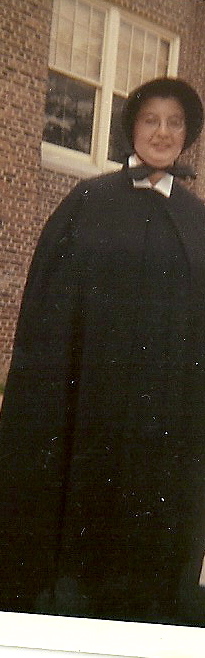
Sister Ella-1st Grade Teacher at Resurrection Elementary School in Rye NY, 1963

In contrast, my other favorite teacher, although I did not know this at the time, was the towering and imposing Sister Ella from first grade at Resurrection Elementary School in Rye, NY.

Sister Ella’s height was exaggerated by the dark pleated habit worn by the Sisters of Charity; yards of black fabric draped from her imposing shoulders to a breadth of an inch off the floor. Soaring atop this living obelisk was the commanding bonnet that framed a stern face and a set of steely black eyes. There was no hyperbole in seeing her as a Colossus; our small statures exaggerated her presence, but she could peer down on terrified parents as well. One glance from her could stop a speeding train, or more usefully, 33 six-year-olds lining up for recess…I am not exaggerating.

Sister Ella taught my classmates and me how to read. She accomplished this amazing feat with what I know now was an unsurpassed instinct for child psychology. At the beginning of the school year, she strategically placed the most challenging and difficult books, which I speculated by default must be the most interesting, well out of reach. We were allowed to access these treasures only by proving our reading prowess. The competitive streak in me was ignited at the onset of the school year, and so I speedily consumed the “easy readers” on the lower shelves as fast as I could. I poured through The Whales Go By, Sam the Firefly, and Go, Dog, Go. I plowed through the Dick and Jane series. I chugged through The Biggest Bear, Andy and the Lion and a multitude of Madeline stories. Determined to get to the prized collection ahead of the others, I lugged piles of books home to return them completed the following day.

Not all reading instruction was enjoyable. There was the tedious work in SRA workbooks which required a student read a nonfiction passage and answer multiple choice questions. Every student started at level purple, an infuriatingly slow level with terribly dull passages. Level Gold, the top level, was impossibly far away. Several months into SRA practice, I figured how to cheat by slipping the multiple choice answer keys from the next level into my workbook for easy access. Sister Ella caught on quickly, a terrifying moment in my nascent educational career. I was trembling when she silently moved me several levels ahead. In crossing out levels purple, blue, and green, she had acknowledged my frustration. I was promoted to level Aqua! I was skipped to the middle of the SRA series, my cheating days behind me.

By midyear, I had proved my reading was up to her exacting standards, and I was allowed to read the books from the top of the shelves while others students worked in more intermediate reading groups. She had correctly assessed my competitive nature and allowed me the freedom to read from the top shelf those books that I wanted. There were copies of  The Boxcar Children and the Bobbsey Twins series, Ginger Pye, and a copy of Charlotte’s Web.

By the end of the school year, the other students in class had joined me. Reading time was respected in 1st grade. We would read daily-quietly in groups or in read-alouds.  The Weekly Reader was introduced that year, I learned to appreciate reading the news as well.

Sister Ella had absolutely none of the warm characteristics that usually denote a first grade teacher, however, in retrospect, I came to recognize that her ability to stimulate intellectual curiosity in her students was above par. Her gift of reading has sustained me in all of my life’s activities. To foster a love of reading is the greatest gift a teacher can give. So, thank you Sister Ella.  I hope to do the same.

The holidays are upon us, so several of the writing projects at the high school have been “seasonal” in nature.
Journalism students have a running poll on pumpkin or apple pie (pumpkin is ahead). They have also asked faculty members to contribute a favorite Thanksgiving memory for a special holiday issue.
I will probably contribute my 17 years of memories sitting at the “kid” table.

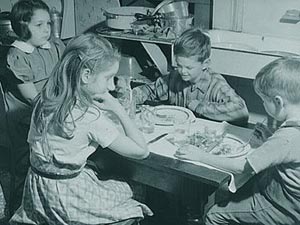
A traditional “kid’s” table at Thanksgiving needs at least one unhappy older kid. While this is not a photo of my family, this photo accurately captures the frustration of being excluded from the main table during the holiday meal. There are a plethora of similar photos available on the Internet!

The kid table is that humbling Thanksgiving tradition that separates the china from the melamine, the goblet from the tumbler, the ladder-back chair from the booster seat, in order to keep the adults from the five year old. The kid table is a table strategically placed within hearing distance, but not necessarily viewing distance, of the main table. The kid table is usually close enough for a surprise inspection by a suspicious aunt, but far enough away for a muffled paper napkin spitball contest. Should the conversation at the adult table increase in volume, burping contests are also an option.
The kid table is supervised by….well, more kids. Little kids are placed under the care of big kids. Little kids are usually delighted; big kids, not so much. Older cousins always recognize they are being exploited as unpaid babysitters.
Several of my students have also commented about their stints at the kid table. More than one has calculated the number of years it will take him or her to  travel the circuitous route from kid table to finally gaining a seat at the main table. I can sympathize. Ours is a large family and there were 14 cousins ahead of me, an accident of birth order that relegated me to the kid table my entire adolescence. A seat at the main table was in a distant horizon.
The main table! An affirmation of age. A holiday dinner free of toddlers and away from the din of childish chatter. The main table! With glowing candles on the table, crystal goblets filled with jeweled liquids and fresh flowers in the centerpiece…. The main table promised a meal free from spilled milk, piles of uneaten vegetables, and sticky sticky tablecloths.

Except there are adults at the main table as well…and good manners are expected.

While I sympathize with my students and all other adolescents stuck at the kid table this Thanksgiving, I would like them to consider the advantages of being able to sculpt mashed potato mountains, hang a spoon from one’s nose, and yes, engage in a paper napkin spitball fight.
When the year came for me to finally graduate from the kid table, it was time for me to host my own Thanksgiving dinner. My first Thanksgiving was for a small gathering of in-laws and nephews who were very few in number.While the dining table comfortably could seat a dozen adults, I still put a small kid table in the corner.

Traditions must continue.

There are standard “core” texts taught in English Language Arts classrooms, but should that text be the ONLY text students should be reading? Generally speaking, the pace for a book taught in class may be slower for some members of the class. There maybe a text, specifically a play by  Shakespeare where students cannot be expected to read by themselves. 183 teaching days in a school year does limit the number of texts a class can read as a group. Of course, a teacher can adjust the speed of unit dedicated to teaching a text, but occasionally a unit can stretch over seemingly endless weeks. Interruptions to a schedule (snow days, assemblies, etc.) can contribute to the “drag” on teaching a particular text.

So, how does a teacher keep up with student reading skills when the unit slows down? What to do to keep students reading independently? What to offer higher level readers when a taught text is lower than their reading ability? What to offer lower level readers when the taught text is to high? Use satellite texts!
Satellite texts are books that are connected to a taught text either by context or theme or author.  I wish I had coined this name, but full credit belongs to Stephanie, our grade 11 English teacher. In using satellite texts, she selects a multitude of texts and offers these to students to choose to read in conjunction with a taught text.

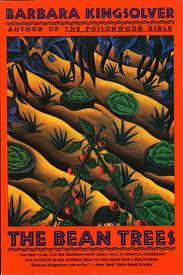
The core text or whole class novel for the Native American Influence and Culture unit in Grade 11

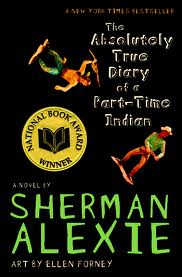
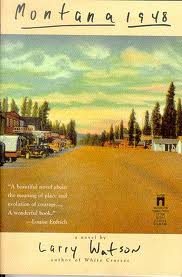
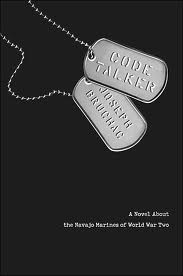
For example, for her unit on Native Americans Influence on Culture, Barbara Kingsolver’s novel The Bean Trees is the core text or whole class novel. Students are offered 10-15 other titles to read independently including (but not limited to)  Sherman Alexie’s The Absolutely True Diary of a Part-Time Indian or  Reservation Blues; Larry Watson’s Montana 1948; Louise Erdrich’s Love Medicine; Leslie Marmon Silko’s Ceremony; Tony Hillerman’s A Thief of Time; Dee Brown’s Bury My Heat at Wounded Knee; Kingsolver’s other two novels Pigs in Heaven and Animal Dreams; and Codetalker by Joseph Bruchac.

Independent reading choice or satellite text

Independent reading choice or satellite text

Independent reading choice or satellite text

Independent reading choice or satellite text

There are several ways to effectively use satellite texts to complement a taught text. The most obvious use in the above scenario is to have students compare and contrast the contexts, themes, and/or  characters between a whole class novel and the text they have chosen on their own. Stephanie can choose to have students work in literature circles, work with a book-buddy or communicate through blogs; she can have students work independently.
Satellite texts are the books that students can read during scheduled SSR period. Students are encouraged to set reading goals based on the number of pages in a text and their reading rate which is usually determined after reading the first 20 pages in a text. Satellite texts are not designed to provide assessments the same way that a taught text would; quizzes and tests should never be the focus. Instead, a satellite text is designed to increase opportunities to practice reading. Students may record their progress on an index card (# of pages read at a location, # of minutes) as a means of assessing their reading progress and reflect on this data.
Ideally, students should be able to draw comparisons (plot, character, theme, setting) from their satellite text to the text being taught. These comparisons can be made in class discussions or in written responses to the taught text. For example, students can draw conclusions about setting on a character’s coming of age or notice similarities in an author’s writing style. Contrasts can be made in recognizing differences by evaluating language or theme from the taught text to the satellite text.
Using satellite texts can expand a unit by an additional week, however, this additional time can provide some flexibility for a teacher in transitioning from one unit to another. Students in a class can be still be engaged in a book while the needs of a few students who need individual attention to improve understanding, or who may have make-up work, or who need more time to finish the taught text can be addressed. Using satellite texts is ideal for employing mini-lessons, or for transitioning from one unit to another that may overlap in theme or content.
Our classroom libraries are loaded with satellite texts purchased through the used book markets (thrift stores, public library book sales, online used book vendors) that sell books for $.50-$4.00. After two years of collecting, there are roughly 5-20 copies of each of the texts listed above; our total investment for this unit has been under $300.00.
Employing satellite texts in a classroom is a way to increase reading in the classroom and provide (limited) choice in texts. These books allow teachers the opportunities to expand reading beyond core texts…to increase a student’s reading experience….to infinity and beyond!

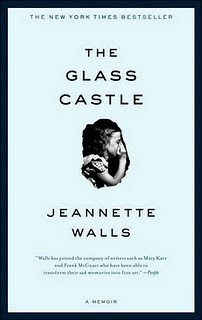
The second quarter of school has started, and The Glass Castle has been assigned to the seniors in Memoir class. There is much grumbling; “You’re kidding…we have to read a book when we are leaving in a few months????” (It’s November-graduation is in June) There is even more grumbling when I tell them they will need to do about five pages of responses; “You mean we have to write about a book when we are leaving in a few months???” (Again, it’s November-there are seven months to go).

There are about 50 copies in the book room-total investment of $250

So, I distribute the books, and I read aloud the opening paragraph,

“I was sitting in a taxi, wondering if I had overdressed for the evening, when I looked out the window and saw Mom rooting through a dumpster. It was just after dark. A blustery March wind whipped the steam coming out of the manholes, and people hurried along the sidewalks with their collars turned up. I was stuck in traffic two blocks from the party where I was heading. Mom stood fifteen feet away. She had tied rags around her shoulders to keep out the spring chill and was picking through the trash. It had been months since I laid eyes on Mom, and when she looked up, I was overcome with panic that she’d see me and call out my name. I slid down in the seat and asked the driver to turn around and take me home to Park Avenue” (3).

That certainly caught their attention.

Jeanette Walls, author and gossip columnist for MSNBC, incorporates both the misery of living in a dysfunctional family with the excitement and joys of childhood in her page-turner of a memoir. Chapter Two opens with the deadpan line-“I was on fire,” where Walls mater-of-factually recounts how she was set ablaze by the fire on the stove while cooking herself a hotdog at the young age of three. Her resilience is remarkable, but more remarkable is her generosity in the remembering her father who  employed the “skedaddle” staying one step ahead of the authorities, who bestowed stars as Christmas presents, and who promised a home to his children -a glass castle. Similarly, the portrayal of her mother as an talented artist who prized independence and who believed that “being homeless is an adventure” is unflinchingly honest.

I first bought 20 copies of The Glass Castle three years ago at the retail price of $10.50 each. This memoir was one of the first offered in the newly designed Memoir Class, in fact, the course was built around the book as a core requirement. Since then, there have been some 30+ copies added ranging in price from $.50-$2.00 from used book sales. The total investment for the 50 copies now in the book room is about $250.00. The book’s popularity with area readers makes it relatively easy to find at Goodwill and public library book sales.

After the students were introduced to the book, I showed a short video of Walls with her mother. At first, several of my students were outraged that Walls would admit to avoiding her mother who appeared so desperate. Indeed that was Walls’s fear when she first drafted the memoir, but as the students read the text, they have become more forgiving and understanding. In the memoir parental failure was complicated by a toxic mixture of mental illness and alcohol, problems unfortunately not unknown to some of the students. The video helped to reassure them that Walls is not the heartless daughter they initially believed.

Walls is a great storyteller in the genre of non-fiction. Her episodes in the The Glass Castle recalls to mind the work of the great fiction writer Tolstoy who famously stated, “Happy families are all alike; every unhappy family is unhappy in its own way. ” Walls combines the happy and the unhappy in an engaging read….especially since there are seven months left in the school year.

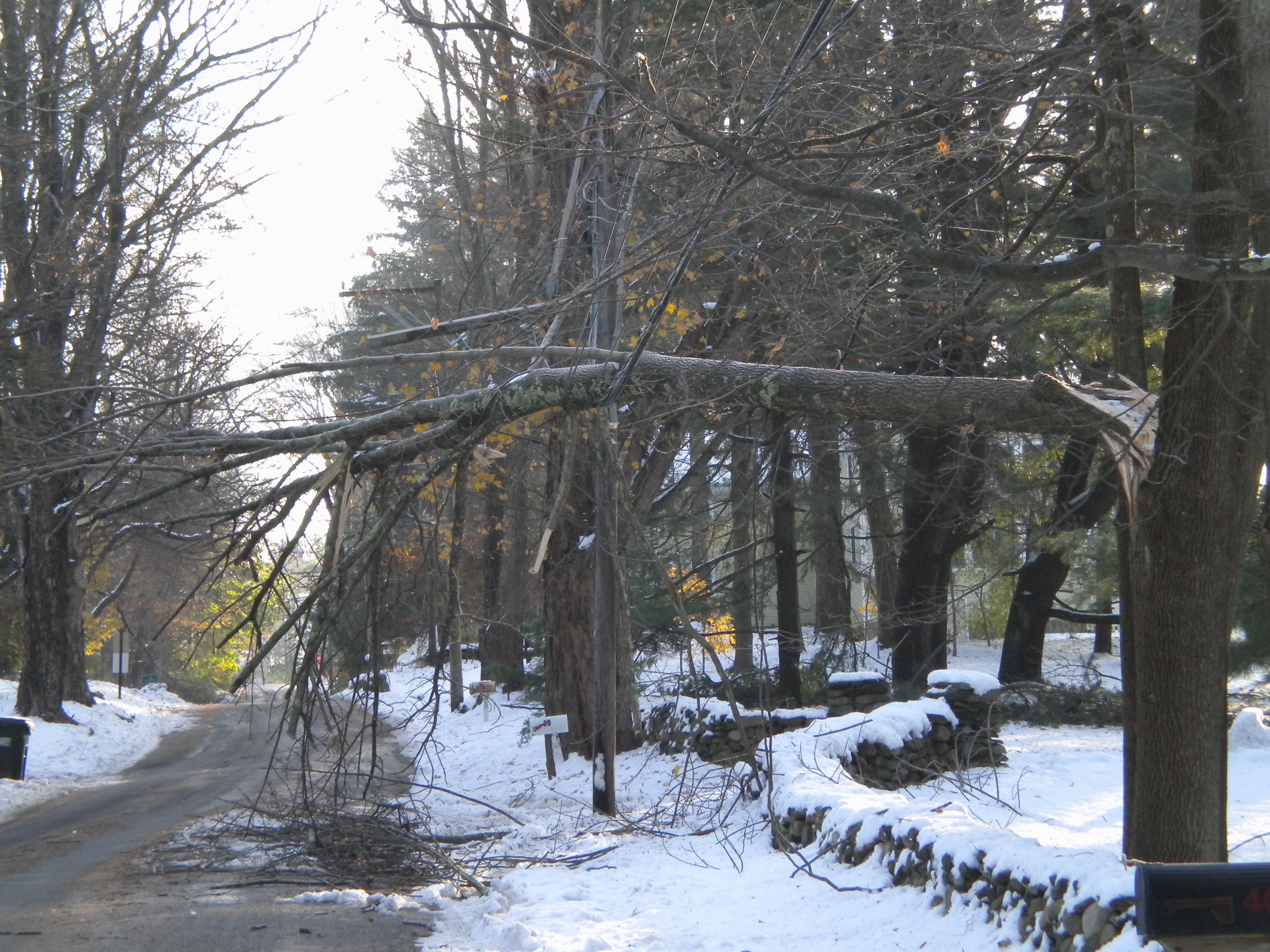
Damage to neighborhood trees and power lines

By now, most of the US knows about the damage caused in the Northeast by Winter Storm Albert. On October 29th, the entire state of Connecticut was WWF’d by a heavy wet snow. That night tree limbs snapped with M80 sound effects. By morning, residents were powerless-literally and figuratively.

Teachers, like their students, generally love a snow day. A sudden snowstorm can provide an opportunity to grade a stack of papers, plan lessons, or catch up on reading. A snow day grants a leisurely reading of the morning paper and an extra cup of coffee. A snow day permits the wearing pajamas and and the testing of a new soup recipe. A snow day is a collective opportunity to “catch one’s breath.”

Unless the power goes out. Winter Storm Albert knocked out the power in our area for five…six…seven…eight days, depending on the local street address.

Of course, when the power goes out, the sudden separation from all modern conveniences seems to put the 21st Century brain on hold. Habits of convenience, the flicking of on/off switches or pushing reheat on microwaves, are hard to break. But I have discovered that the disconnect from the Internet, however, is almost intolerable…particularly if one lives in an area without cell towers for 3G, and the power, phone and cable lines are down.

Our school has a 1:1 initiative for English classrooms. We have netbooks in our classes. Students are also encouraged to bring their digital devices to class in order to participate. Responses to prompts are uploaded to one open source software program (we use Edmodo.com), essays and vocabulary sentences are uploaded to a subscription software program (we use turnitin.com), and information is delivered to students by way of a wiki, another software program (we use PBWorks.com). When the power went out, I was unable to access student work or lessons….for five whole days!

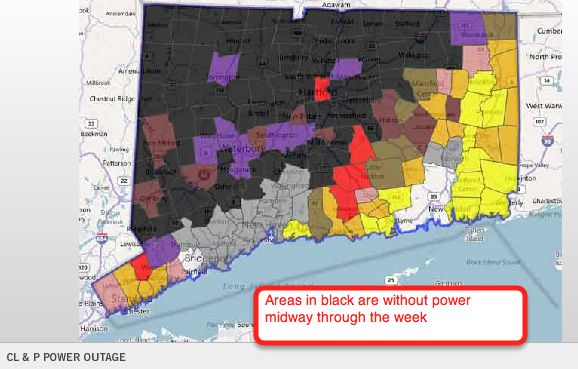
Map of Connecticut's Winter Storm Albert power outages

The storm came at the end of a marking period, a time when there is always too much to do, and I had no access to any student work. I found myself driving many, many miles out of town to set up in areas of the state, and out of state, that had power and free wi-fi. I scouted and found seats in malls, Panera’s restaurants, Starbucks, and 24-hour diners. Once I found the free wi-fi, I would set up my computer and read student work. I was not alone. I met many teachers who have also moved student work into a digital format who were in search of a signal in order to stay on track with student work. Several woefully admitted that they actually longed for a pile of actual papers to correct. The expression “digital divide” took on new meaning; we were divided from our students’ work in cyberspace.

When school reopened this past week (11/7), I was already behind. I had lost precious classroom time, but that time will be recovered by adding more five school days to the calendar, the harsh retribution for the aforementioned pleasures of a snow day. I mourn instead grading and planning time that was lost due to a growing dependance on the Internet.

The use of technology in the classroom is required in education; all students should be engaged in 21st Century skills. There are standards developed by the International Society for Technology in Education (ISTE) that must be met in districts throughout the state. My lessons almost always require some form of technology, from word-processing to Internet research. The assignments that can be create with technology are engaging, and the use of technology to post assignments can promote student independence and responsibility. Technology in the classroom is necessary if teachers are to prepare students for the future…unless the power goes out, and the Internet is not accessible.

The use of technology in the classroom will certainly increase as the amount of technology adults and students use in the real world is on the rise. These trends will not change, but some consideration should be given to the perplexing problem of what happens when the power goes down for an extended time. How can the business of educating students continue without the hiccups caused by Mother Nature?

Winter Storm Albert may be the harbinger of winter in the 2011-2012 school year and for those school years yet to come. There will be snowstorms, hurricanes, and other natural disasters in our state’s future that will separate students and teachers from the technology that joins them in 21st Century education.

And when that happens, when the power goes out for an extended time, I find myself parodying Shakespeare’s interpretation of the 15th Century Richard III. There I am, struggling along on my snow-covered Bosworth Field crying out, “A signal! A signal! My kingdom for a wi-fi signal!”

Next week, English II students will begin reading All Quiet on the Western Front by Erich Maria Remarque in tandem with the World War I unit on taught in social studies classes. This collaboration is a great opportunity to have the context of a WWI novel explained from another point of view. The social studies classes cover the causes of WWI, many of the battles, and the results of WWI on Europe and American foreign policy while the English classes follow the lives of a few soldiers engaged in the conflict. Social studies can cover the macrocosm setting, the geography of WWI, while we can cover the microcosms of the novel-the intimate settings   of Paul and Kat feasting on a goose they caught or Paul visiting the bedside of Franz Kemmerich, his mortally wounded companion.

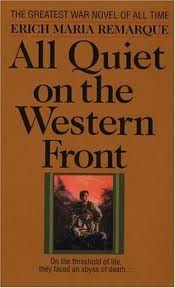
The older edition cover; copies are always found in the YA section of a book sale

Our copies of the book are fairly old, so I am always looking for additional books to replace those who have become too worn for use in class. The e-book (through Questia) is only available as a free trial. There are always copies of the novel in used book sales including the more recent edition, and the book is almost always located in the young adult section rather than on a table or section dedicated to military history or adult fiction. This placement could be attributed  to the popularity of this novel in curriculum around the country; obviously, the person placing the book on the YA table read the book in high school.  The popularity of the book in schools defies many conventions. First, the novel is a translation from German, which distinguishes it from the multitude of British and American titles that crowd middle school and high school reading lists. Second, the point of view is from an enemy combatant; the French, English and American troops are the enemy. Including this novel acknowledges Remarque’s universal message that the consequence of war is devastation, a message that may be even more important for a nation that has been at war for over 10 years.

The new edition cover

Many technological advances made WWI a brutal war: aerial combat, machine guns, mustard gas. Last year, we were reading one of the passages that described a mustard gas attack,  looking for language that described how lethal this weapon was for the foot soldiers.  Suddenly a startled look came across the face of a  student. His hand shot up as he blurted,  “Ms. P told us that the more technology that’s used in war, the further a soldier gets away from the enemy in combat.”  There was a pause-other students had heard the same in class, and the consequence of increasingly sophisticated weaponry used against Paul and his companions was suddenly very real. His point hung there until another student chimed in, “And now we use drones.”  Suddenly, the WWI novel was not dated. The students understood that military drones currently used in combat would certainly have targeted Paul and his companions if they had been available to Allied forces in 1917.

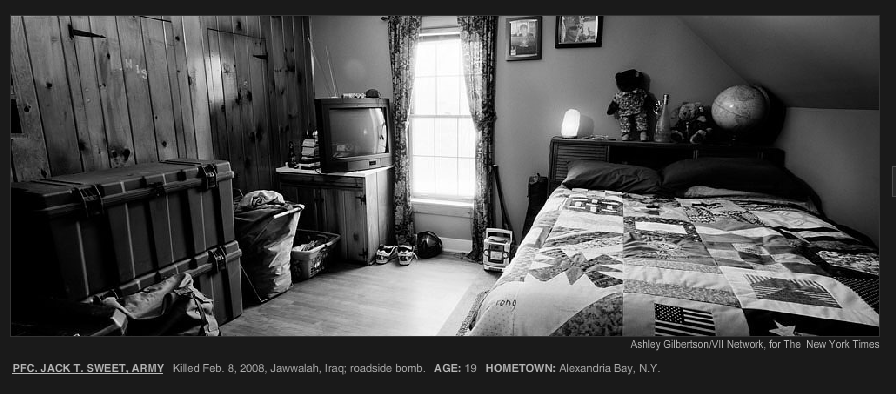
There are several activities that we pair with reading the text, but the most powerful for students is the NY Times Magazine photo essay (Ashley Gilbertson)  of soldier’s bedrooms titled “The Shrine Down the Hall” (there is a video clip as well) In the novel, Paul returns for a visit home. Instead of being a sanctuary, however, the bedroom is a painful reminder of the innocence he has lost after months of combat of the Western Front. Our assignment is to compare the elements of Paul’s bedroom (items, his feelings, his memories) to the elements in the photos of the bedrooms of American soldiers who had been killed in Iraq or Afghanistan. This photo essay brings the impact of war’s devastation to an intense personal level. Many of the students have bedrooms with the same posters, layouts, or furniture, and they note these similarities in their responses.

A photo from Ashley Gilbertson's "The Shrine Down the Hall" photo essay in the NY Times Magazine section

Students are instructed to choose one of the soldier’s bedrooms from the photo essay, and make a connection with text from Chapter 7 (Paul’s visit home) by answering the following questions:

  • How are the text of the novel and the photo alike?
  • How do the text and the photo differ?
  • What is the photographer’s message? What is Remarque’s message? How are they the same? How do they differ?

The students’ responses included:

I chose picture 15, of Matthew J. Emerson’s bedroom. His room is just waiting for him to come home but it never happens. The room also has pictures cut out on the wall, from what appears high school sports, as well as trophies on the shelf. Paul gets to return home one last time, unlike the soldier who was killed in Iraq who returned in a casket with an American Flag on it. Paul feels like a stranger in his own room. War changes people; you can’t go blasting heads off for 2 years and come home and live the normal everyday life again.They come home, changed, forever.

I choose photo 17. The man who died was Sergeant Gilbert who was killed in 2006.  The photographers message is saying that an ordinary young person, even a teenager, can go to war and be killed. The photographer expresses the loneliness, silence, and emptiness that the room has. Remarque’s message is saying that the average soldier has a very hard time coming back because he or she has to make decisions that don’t involve killing, that don’t involve defusing a bomb. These two messages are the same because they both describe the difficulty of coming back home, but they are different because these two messages are set in different times with different technology of warfare.

When I see picture #3 I think of Paul the most. Here are a bunch of pictures everywhere on the walls of all different kinds of things, like “Then below are periodicals, papers, and letters all jammed together with drawings and rough sketches.” When I read this it makes me think of a cluster of a bunch of different things, also when I look at room #3 I see a cutter of a bunch of posters, hats, books, and many other things. I think the picture and Remarque’s  are both saying that life is not the same when you get home and many of the soldiers cannot come home and have everything be the same as when they left.

I chose photo 14 because it is surprisingly similar to the book. The text talks about Paul’s book shelf and his school books all thumbed through. the room has a book shelf and other references to school. What looks like a degree is hanging on his desk. This room however has a poster of the marines in the background which shows that this boy was obviously thinking of joining the military before hand. Paul has no mention to wanting to join the army before Kantorek takes them down to the recruiting office. I think the photographer’s message is to show how innocent the soldier was before.

He was on a sports team and appeared to be quite good, he won a trophy. Remarque’s message is very similar. The soldier is changed after war, he cannot go home and just drink some beers and pretend everything is all right. It’s not.

I chose picture 14. This room was occupied by Nathanial D. Windsor who died on March 11, 2007. He was only 20 years old (about the same age as Paul). T. The photographer said was trying to portray a lonely room that is not occupied anymore. Remarque’s trying to portray that Paul’s room is lonely too. They are both alike because they are lonely.

Christopher Scherer’s room reminded me of when Paul went home. Paul had a nice life before the war he felt at home, when he returned from the war he felt like he was looking through a veil. He tried on his clothes, his civilian clothes, that made him feel like he had nothing. After the two years of war he cannot have that connection to his home, he relates everything back to the war. The war has given him the thought of death and destruction, Paul is no longer himself, he cannot connect to his home, where he is supposed to be.

In the picture a bookshelf was not full which could mean that the soldier was as Paul was did, collecting them gradually.  The solider also has a clear view of the outside that he can sit and watch, just as Paul has in the story. Remarque and the photographer have different views. Remarque tries to display that after the soldiers return home they are never the same people and their rooms do not represent them. While the photographer’s message is that all the pieces of  soldiers’ lives are preserved in their rooms and are now gone forever because they have died.

Remarque’s novel transcends time perhaps because of the intensity the reader feels for one soldier caught up in a conflict beyond his control.  While the social studies classes are required to cover the history of World War I, the English classes are free to cover Paul and “his”-story.

There are a surprising number of students who have never seen The Wizard of Oz, and so as an introduction to the freshman (9th grade) unit dedicated to the power of “The Story”, we showed the film in class. However, in order to keep students engaged and focused on the lessons objective, a software program (G-snap) was set up to allow students the opportunity to live blog during the film.

Our students are fortunate enough to have the use of net books in class or they may bring their own digital device in order to access the materials used in class. G-snap is a free website that allows anyone to set up a live blogging event; access to the event can be posted by a link or directly embedded on a webpage. There is no registration required, comments can be saved, and the event can run for several days. During an event, questions can be posted and participant responses can be moderated before they are shared.

Students were engaged in the film from the moment the opening soundtrack began and several students joined Dorothy in singing Somewhere Over the Rainbow.  Then Almeria Gulch appeared to take Toto away in her bicycle basket and, despite my best efforts to keep everyone quiet, the comments began:

“I was so scared of her on her bike!”
“She is so mean!”
“I can’t watch her change into the witch…I just can’t watch!”

The tornado scene that followed kept them speechless. When the house landed, there was an audible “oh!” from Dorothy. Students flinched as well; they had arrived in OZ.

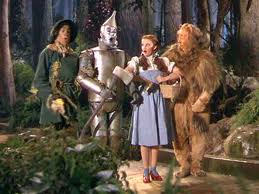
"We're off to See the Wizard" as a way to study character motivation

The lesson’s objective was to have students identify character motivation, specifically motivation that reveals a character’s weaknesses and strengths. We wanted students to recognize that in very often in stories, the qualities that character thinks he or she lacks is exactly the unrecognized quality the character possesses. Of course, the film makes this objective easy to meet.  Frank Baum’s story is all about motivation and character qualities.

For some students, there was a sense of nostalgia as they watched the film. Lines that they missed as children suddenly made sense (“Oil can? Oil can what?”). Other students finally caught on that the doorman, carriage driver, doorman and Wizard were played by one actor. As for the students who had never seen the film, they were both engaged with the film and the enthusiasm of their more knowledgeable peers.

Using G-snap software, I posed a series of questions at different times during the film

What motivates Glinda to place the ruby slippers on Dorothy’s feet? Is this in Dorothy’s best interest?

What happens when one strays off the path of The Yellow Brick Road?

What qualities does the Scarecrow exhibit? How is this connected to his motivation?

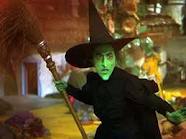
Margaret Hamilton Played The Wicked Witch of the West. Was her performance too frightening for small children?

I also wanted them also to reflect on the intensity of the Wicked Witch’s dialogue.  For example: “those slippers will never come off . . . as long as you’re alive!” or “The last to go will see the first three go before her.”

I posted:  Was this film appropriate for children? Was the film too scary?

In responding to this question, their responses were mixed.  Many felt the film was fine for children, but some students had second thoughts as they considered that the dialogue was really much more frightening then they had remembered:

“I do think some parts are scary for children. I think I was about 5 years old and I remember hiding under a blanket when the flying monkeys came on TV.”

“No I don’t think that children should be protected from watching this movie. There are many violent movies that children shouldn’t see but this movie is classic.”

“Well most Disney movies kill the parents so this isn’t too bad compared to that plus a lot of people saw this when they were really little and didn’t scare them.”

“I was about 6. I think they should watch it. It is ok if they learn about death because it is a part of everybody’s life at any age.”

“I saw this film when I was a little kid, and I was frightened for days, I had nightmares about this horrible witch, so I think it might be a little extreme for little kids.”

“I saw it when was like 4 and no its not that bad, they will get over it. It’s not like a death threat, well it kinda is but never mind. I don’t think it’s that bad.”

“I saw this film first when I was 4 and it was my favorite movie, EVER.”

Overall, the screening of the film was a success and the use of live-blogging allowed students to stay focused on noting character motivation.  Their responses included:

“The Tinman does have a heart. He is the most ‘emo’ character of them all!”

“Scarecrow has a brain and when Dorothy says she will miss him the most she means being smart is what people should look for in friends.”

“The companions represent different things: Lion-Courage, Tin Man-Heart/Love. So it shows that even though you don’t think you have it you still do because the Lion still stood up for himself. And Tin Man loved his friends, so they just thought they did not have them when they really did.”

The power of The Wizard of Oz makes it an ideal classroom tool, and character motivation is only one of the lessons that can be learned. Is it any surprise than that Margaret Hamilton who played the Wicked Witch of the West was a school teacher by profession?