Archives For March 31, 2013

Yes, I make my student memorize Shakespeare’s prologue to Romeo and Juliet.

Two households, both alike in dignity,
In fair Verona, where we lay our scene,
From ancient grudge break to new mutiny,
Where civil blood makes civil hands unclean.
From forth the fatal loins of these two foes
A pair of star-cross’d lovers take their life;
Whose misadventured piteous overthrows
Do with their death bury their parents’ strife.
The fearful passage of their death-mark’d love,
And the continuance of their parents’ rage,
Which, but their children’s end, nought could remove,
Is now the two hours’ traffic of our stage;
The which if you with patient ears attend,
What here shall miss, our toil shall strive to mend. (I.i.1-14)

To prepare them for the poem, I opened with the 2009 video Darrin Landroché:

We discussed the images and the music choices to communicate a message. Most of the student know that Romeo and Juliet is a tragedy; this was not a “plot spoiler.”

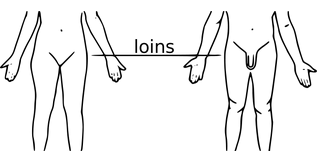
Right now, however, they are baffled by some of the vocabulary contained in the lines of the opening sonnet. (“Mrs. B, What are ‘loins’?”)  On the other hand, there are certain phrases they have already committed to memory. I hear them repeat “where civil blood makes civil hands unclean” and “star-cross’d lovers” under their breath when I ask what they remember.

This morning, I gave them a CLOZE exercise, leaving out words for them to fill in: “_____households both alike in dignity”. They could research the missing words by looking at the small copy of the poem I had them glue into their notebooks.

The best idea, however, has come from my fellow teacher (Ms. S-V) who designed an “annotated prologue” project. We are a BYOT (Bring Your Own Technology) high school, so digital platforms are used regularly, especially the Google Apps.  For this assignment, students illustrate the poem with pictures and links and embed those with the lines of the poem onto a Google Doc.

We did not require a works cited; I would require one if we do this again in the future.

So far, the project is going well. The Google images features are familiarizing students with Verona, Italy. They are also having to  find ways to illustrate “piteous overthrows”. Most all of their responses are literal connections.  Some of the first efforts are heavy with links to songs or movies. All of the annotated prologues have visual elements; some are exclusively visual. Here one example from a student that looks much better that the formatting on this blog. While I love the “two hours traffic”, it’s the “patient ears” that makes me smile. Good work, Molly!

Screen Shot 2013-04-30 at 9.32.33 PM

Two households, both alike in dignity

In fair Verona, where we lay our scene,

In fair Verona, where we lay our scene,\
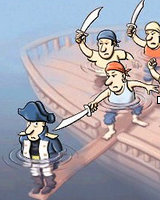
From ancient grudge break to new mutiny,

From ancient grudge break to new mutin

.
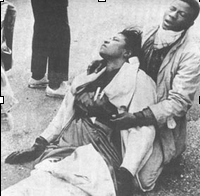
Where civil blood makes civil hands unclean
Where civil blood makes civil hands unclean

From forth the fatal loins of these two foes

From forth the fatal loins of these two foes

A pair of star-cross'd lovers take their life;

A pair of star-cross’d lovers take their life;
Whose misadventured piteous overthrows

Whose misadventured piteous overthrows

Do with their death bury their parents' strife.

Do with their death bury their parents’ strife.

The fearful passage of their death-mark'd love,

The fearful passage of their death-mark’d love,
And the continuance of their parents' rage,

And the continuance of their parents’ rage,

Which, but their children's end, nought could remove,

Which, but their children’s end, nought could remove,

Is now the two hours' traffic of our stage;

Is now the two hours’ traffic of our stage;

The which with patient ear you shall attend

The which if you with patient ears attend

What here shall miss, our toil shall strive to mend.

What here shall miss, our toil shall strive to mend.
muckRight about now, the last week of April, my Advanced Placement English Literature students are noticing a frantic tone creeping into my voice.

“No, finish this multiple choice practice FIRST, then complete the essay prompts. Any questions? No? Let’s go, now. Hurry….hurry….HURRY!!”
“Geez, you are so crabby lately,” notes one.

I am crabby; I understand the pressure they will be under during the AP exam in May, and I want them prepared. In contrast, they just want to be fourth quarter seniors.

These weeks are the “boot camp” weeks before the exam, and I am trying to improve their ability to respond quickly and decisively to a prompt. They will be writing three separate essays; each read by an audience of one, a reader who will grade hundreds of essays a day. They need to make a clear argument.

For practice, I offered a choice of four prompts to students. We just finished reading Eugene O’Neil’s A Long Day’s Journey into Night, and each prompt touched on one aspect of the play: the text, the characters, the theme. Rather than have them write a full essay response to a specific prompt, I had them write two separate opening and concluding paragraphs for their two chosen prompts. I gave them forty minutes to do both. The whining began immediately:

“I have a hard time just writing a beginning and an opening.”
“I always start in one place and end in another.”
“I need to write the middle or I can’t write the end!”

“That’s because you write to find out what you think,” I respond, “and that should show up in the introduction or the conclusion.”

Since the AP exam is a timed test, 120 minutes for three prompt analysis and response questions, timed practices are helpful. These truncated practice essays are incomplete and rough, but they do help students practice how to reconcile an introduction with a conclusion in a short time. In these hastily written drafts of beginnings and endings, I can help them distinguish their good ideas from linguistic clutter so an AP reader will better appreciate their argument. I do not want my students to make a thesis so hidden that the AP Reader is hunting for the “manifesto in the muck”.

What “muck” you ask? Essays cluttered with empty words:  a lot, kind of, sort of, actually, stuff, thing, very, really, quite

Essays cluttered with the muck of empty phrases:

  • Because of the fact of
  • The reason…is because

Essays cluttered with the muck of statements of the obvious:

  • The author uses diction and syntax to communicate his meaning.
  • The theme is the message the author is trying to communicate.
  • Words have meaning.

In one block period, the students wrote the truncated essays of introductions and conclusions in response to O’Neill’s semi-autobiographical play,  A Long Day’s Journey into Night.  We reviewed each draft to find the one powerful statement that publicly declared that student’s view, a statement that could get an AP reader’s attention. The prompts are in bold; student’s statements below each prompt:

PROMPT #1: Select a line you find especially memorable; analyze the reasons for its effectiveness.

  • When I read about this family, it reminded me of the advice, “only the strong survive’; the Tyrone family lives like a pack of animals, not a family.
  • If the characters in the play had the ability to leave behind their past, forget the things that made them lesser, they would be better off.

PROMPT #2: Describe how the author manages to give internal awakenings, discoveries, changes in consciousness the sense of excitement, suspense, and climax usually associated with external action.

  • James is struck with the conflict of having someone say his greatest fear is being in a class he does not think he belongs. 
  • The choice presented to each character is which moral or ethical barrier to shatter in order to overcome the cycle of insanity.
  •  Literature is an extension of human understanding and comes from our musings, our curiosities, and our imaginations.

PROMPT #3: Discuss the contribution scenes of social occasions reveal about the values of the characters and the society in which they live.

  • Whether these experiences dealt with alcohol abuse, substance abuse, or general unhappiness in life, all topics were acted out to be ignored or forgotten about, yet these [experiences] remained the most memorable. O’Neill wanted the conflicts to be pushed aside, which then caused the audience to latch on and never forget.
  • We seek out the approval and forgiveness of others when our own soul’s condition is purely of our own pilot.

PROMPT #4: Explain how the tragic figure functions as an instrument of the suffering of others and that the suffering brought upon others by that figure contributes to the tragic vision of the work.

  • In this way, each individual’s poisoned action spreads like a virus and affects all those in its proximity devouring them to the point of self destruction.
  • Edmund’s sickness is not just  source of unwanted strains on the family; it is an object to represent the family relationship.

When I come upon one of the above statements, in the beginning or the end of the draft, I can almost hear the “clink” that went on in the student’s head (and hand) as he or she drafted the essay.  At a point in the writing conferences that followed, a student will agree, “Yeah, that was when I figured out what I was writing about.” My experience is that students write their way into a thesis, and it is important for the student to recognize that statement, so he or she can parse away the clutter, removing the muck so that the AP Reader can find that statement too.

During this last week of AP English Literature practice, students will work at drafting responses to prose and poetry prompts. They will be writing their responses quickly, and I will still be crabby. But because of the practice, there will be less muck that covers a student’s manifesto in an AP literature essay response. After that, they can go back to being 4th quarter seniors.

ScantronThe New York State Department of Education’s new standardized tests were administered last week. The tests for grades 3-8 were developed by the educational testing company Pearson and contained new “authentic” passages aligned to the new Common Core State Standards. State tests might have been routine news had not several teachers also noticed that the English Language Arts “authentic” passages mentioned products and trademark names including Mug ©Root Beer and Lego ©.

Product placement on standardized tests in elementary schools is bigger news. The public has grown accustomed to advertisements on webpages, before videos, on scoreboards, and with the well-placed beverage during a movie. Subtle and direct advertising to the youth market to develop brand loyalty at an early age is the goal of almost every corporation.

Consider a survey by Piper Jaffray, a leading investment bank and asset management firm, the  “Taking Stock With Teens” survey (taken March 1–April 3, 2013), that gathered input from approximately 5,200 teens (average age of 16.3 years). The survey is used to determine trends, and the most recent results note:

“Spending has moderated across discretionary categories for both upper-income and average-income teens when compared to the prior year and prior season. Yet nearly two-thirds of respondents view the economy as consistent to improving, and just over half signaled an intent to spend ‘more’ on key categories of interest, particularly fashion and status brand merchandise.”

Much attention, therefore, is placed on the youth market, and product placement on standardized testing could be a new marketing strategy. For example, corporations in the fashion industry could read this report and be inclined to offer some news stories or commission a short story that mentioned clothing brand names in the future to Pearson or another testing company in order to provide “authentic” passages. What better opportunity for corporations to build brand loyalty then to an audience, captive in a classroom during a state-mandated test?

The education reporter for the Washington Post, Valerie Strauss, reported on the “authentic” passages that mentioned products as “author’s choices”; Pearson’s response to her query:

As part of our partnership with NYSED, Pearson searches for previously published passages that will support grade-level appropriate items for use in the 3-8 ELA assessments. The passages must meet certain criteria agreed upon by both NYSED and Pearson in order to best align to Common Core State Standards and be robust enough to support the development of items. Once passages are approved, Pearson follows legal protocols to procure the rights to use the published passages on the assessment on behalf of NYSED. If a fee is required to obtain permission, Pearson pays this fee. NYSED has ultimate approval of passages used on the assessment.

Strauss’s report, “New Standardized Tests Feature Plugs for Commercial Products” also indicated that this practice is not exclusive to NY, and that “several different assessment programs have instances of brand names included due to use of authentic texts.” There were no specifics mentioned.

Following up with the NY Department of Education, Beth Fertig from the blog Schoolbook (WNYC),  Stories from the Front Line of Testing asked about the recent product placement:

“This is the first time we have had 100 percent authentic texts on the assessments,” said spokesman Tom Dunn. “They were selected as appropriate to measure the ELA standards. Any brand names that occurred in them were incidental and were cited according to publishing conventions. No one was paid for product placements.”

Perhaps no one was paid this year, but an unwritten taboo was broken with these standardized test. The New York Post reported one teacher response in the article  “Learn ABC’s – & IBM’s: Products in Kid Exams” by Yoav Gonen and Georgett Roberts

“I’ve been giving this test for eight years and have never seen the test drop trademarked names in passages — let alone note the trademark at the bottom of the page,” said one teacher who administered the exam.

They also reported that other commercial enterprises including the TV show “Teen Titans” and the international soccer brand FIFA  were also included on the tests.

While gaining the loyalty of the youth market is a necessary step for major corporations, the appearance of these brands on standardized tests brings our students one step closer to the future as envisioned by Stephen Spielberg in the film Minority Report. In one scene, the fugitive John Anderton (Tom Cruise) walks along a corridor while animated billboards market directly to him by calling his name:

The possibility of this kind of marketing exists and perhaps personalized advertising will call to us everyday; a cacophony of advertisements designed to keep brand names in our consciousness. Similarly, even the youngest students are the target of marketing campaigns as part of any corporation’s long term economic strategy; advertisements on multiple platforms are the “white noise” of their lives. So frequent are advertisements in students’ lives that any product placement, paid or unpaid, on these standardized tests may contribute to the definition of what is “authentic”. Students are exposed to ads so frequently and in so many genres that a text is not real without some brand name mentioned.

And if that product placement is a small part of what makes a passage “authentic” on a standardized test, can talking “authentic” billboards in the school hallways be far behind?

Once the snow has melted, and mud dries up enough so wearing flip flops is possible, the season of dress code violations begins. Whether your school dress code policy is ultra conservative or lassiez faire, every spring, there will be one or two students, usually female, who will challenge the dress code with an alarmingly inappropriate outfit.

Part of the problem is that middle and high school females come in all shapes and sizes. A T-tank may be perfectly acceptable on one boyish girl’s figure, but eye-popping on a more buxom girl. A short skirt that looks sporty on one girl can look like taut athletic bandage wrap on another. Showing a little skin, say a an upper arm or a long leg may look healthy on one student while baring a large middle abdominal area or the top of the derriere provides more information than necessary.

I have often wondered how any student could think that the off the shoulder or midriff display is acceptable in school. Lately, I have been assigning the blame to Disney. Specifically, I blame the Disney princesses.

Consider how the Disney princesses of older generations were fully clothed. These princesses were:

  • Snow White (1937)
  • Sleeping Beauty (1959)
  • Cinderella (1950)

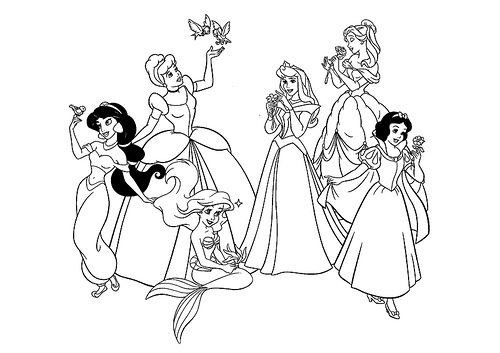
disney-princess-coloring-pages-7-comThese old-fashioned Disney princesses twirled with full skirted gowns, short or full sleeves, and accessorized their looks with gloves, capes, and the occasional scarf for cleaning.  There was an open neckline, but no décolletage. Princess Aurora (Sleeping Beauty) had a slight “over the shoulder” design that was covered by a large white collar in the pink/blue/pink/blue ballgown. The only character to reveal much flesh was Peter Pan’s Tinkerbell (1953) in a strapless gymnastic tight of sparkling citrus green. In subsequent generations, and without the benefit of a singing voice, Tinkerbell has been upgraded from fairy to princess. Her more melodious princess cousins were more modest dressers.

The next round of Disney princesses began in 1989. These princesses looked and acted very differently beginning with:

  • The Little Mermaid (1989) 
  • Beauty and the Beast (1991) 
  • Aladdin (1992) 
  • Pocahontas (1995)
  • The Hunchback of Notre Dame (1996) 
  • Hercules (1997) 
  • The Frog Princess (2009)

Recall the fashion influences of each of these princesses on students for the past 24 years:

  • The Little Mermaid‘s Princess Ariel’s species (born mermaid/part-time human) dictated that she wore little clothing, but the clamshells and low cut waist on her tail left little to the imagination. In creating such a daring outfit, the irony of Ariel’s lyrics,”Bet’cha on land they understand/That they don’t reprimand their daughters” appears to have been lost on her costume designers.
  • Beauty and the Beast‘s Princess Belle was a throwback to the princesses of the previous generation with the exception of her bare shoulders and a plunging neckline, a daring choice for dancing with a (possibly hungry?) “Beast”.
  • Aladdin‘s Princess Jasmine drew from the Ariel model; her cropped top and low cut balloon pants left a large expanse of middle, a surprising choice for a princess from a culture that suggests head to toe coverage for females in public.
  • In Pocahontas, the athletic Princess Pocahontas was designed as an American-Tarzan-ette. Dressed organically in a one-shoulder playsuit of buckskin and shells, she was lean, muscular, and barefoot; there was little clothing to hamper her progress through Colonial Virginia’s brush and briar.
  • In The Hunchback of Notre-Dame, the Gypsy Princess Esmerelda was dressed as the seductress Victor Hugo created; with her dark eyes smoldering over a daring low neckline and her shawl wrapped provocatively at her hips over a high slit skirt to jingle as she swayed. 
  • Princess Megera from Hercules had a body design lifted from the Barbie model with an equally impossible ratio of bust to hips size that allowed her to squeeze into her tight toga. While other princesses swayed, Megera sashayed into her hero’s life.
  • In The Frog Princess, Disney removed the racial barrier in creating Tiana. An African American Princess, Tiana was dressed in a gown mashup of Belle’s flowing ball gown skirt sitting below Tinkerbell’s bodice, that is when she was not on screen as a naked frog.

The fashions of these Disney princesses (1989-2009) were generally less modest than the fashions of previous generations. Their costumes had plunging necklines, bared midriffs, and high skirts. Their outfits, however, could also indicate the kinds of princesses they were, not castle-bound beauties, but more hands-on active counterparts to their princes.

For a quarter of a century, girls have grown up with the images of Ariel, Belle, Jasmine, Megera, Esmerelda, Pocohantas, and Tiana. They have dreamed of swimming “Under the Sea” or running with the “Colors of the Wind” or dancing with teapots to “Be Our Guest”.

So what would be the outfit of choice for school boards trying to design policy for  female students who have imitated the fashions of their beloved princesses since childhood? What princess outfit could pass muster?

There could be a vote for the clothing of Mulan (1998) a warrior princess who was forced to remain clothed top to bottom in order to hide her gender during warrior training and battle. Even when she returned to her role as a dutiful daughter, she was completely covered in a beautiful kimono. This choice, however, may be too much of a cultural stretch.

Finally, there could be a vote for the Princess Rapunzel from Tangled (2010) whose hair was the fashion statement. Part costume and part weapon, Rapunzel’s hair kept the audience from noticing any exposed body parts, however hair like hers could make movement through the crowded school hallways difficult.

Oh, Disney, if only you knew the consternation caused by your princess fashion designs. Maybe school boards could send your animators their dress codes so future princesses would dress accordingly. Better yet, Disney, you could stick to animating animals. We don’t mind seeing Dory (Finding Nemo) or Nala (The Lion King) naked; in fact, we like them better that way.

sols_6Why do I stay? This question is circulating on blogs and in videos by teachers from across the country. My friend Catherine, a teacher and literacy specialist, brought this question to my attention in her post this week. She was participating in a challenge organized by Two Writing Teachers called  The Slice of Life. The instructions for participating are on a link that goes first to a definition (“Slice of life is a phrase describing the use of mundane realism depicting everyday experiences in art and entertainment“) while other links provide procedures:

WRITE your slice. SHARE your link. GIVE some comments to (at least three) other slicers.

On one post she linked her Slice of Life post to blogger Beth Shaum’s video “Why I Stay”.  Catherine listed her reasons for staying and noted that other teachers have written about their reasons for remaining in the classroom, “despite changes in curriculum because of Common Core State Standards, new testing, and new evaluations that are being imposed on educators.” The video on Shaum’s blog addresses startling statistics about the teaching and the education profession:

More than 30% of new educators quit teaching after three years, and nearly 50% leave before hitting the five-year mark. (USNews.com)

Shaum’s video showed dozens of teachers from around the country sharing their reasons for staying in education.

I have not written to The Slice of Life challenge, but I did think the idea of recording my personal reasons as to why I have stayed and taught for 22 years in grades 6-12 would be an exercise that could both help me frame my own thinking and possibly encourage younger teachers who are often overwhelmed.

My reason for “why I stay” is purely selfish.…I want to share the stories.

I want to share with children, teens, and adults the stories they have read, seen, or heard.

I want to share the stories in picture books.
I want to share the stories in chapter books.
I want to share the stories in the canon.

So, I teach students to read stories so that we can talk and share the stories that make us human..

I want to share books.

I want to share books at every grade level.

hungry Whales Go_Dog_Go

I want to share books:

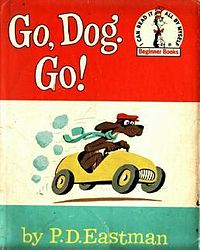
  • Go, Dog, Go
  • Hungry Hungry Sharks
  • The Whales Go By

I want to share more books:

  • Nancy Drew’s The Password to Larkspur Lane
  • The Twenty-One Balloons
  • A Wrinkle in Time

Larkspur wrinkle 21 balloons

I want to share novels:

  • Of Mice and Men
  • The Road
  • The Curious Incident of the Dog in the Night-time

I want to share stories written as dramas. I want to talk about:

  • Hamlet
  • Medea
  • The Importance of Being Ernest

I want to share stories made into film. I want to talk about:

  • One Flew Over the Cuckoo’s Nest
  • The Wizard of Oz
  • The Shawshank Redemption

I want to share stories in poems. I want to talk about:

  • The Odyssey
  • Paradise Lost
  • The Cremation of Sam McGee

Guernica Fall of Icarus

GW Delaware

I want to share the stories in paintings. I want to talk about:

  • Guernica
  • The Fall of Icarus
  • George Washington Crossing the Delaware

I want to share the stories that were responsible for essays and speeches. I want to talk about:

  • The Gettysburg Address
  • A Modest Proposal
  • Self-Reliance

I want to share the stories of people’s lives, stories about nature, and stories that mark cultural trends. I want to share:

  • Will You Sign Here, John Hancock?
  • Silent Spring
  • The Tipping Point

From the ancient lights of the campfires to the soft glow from a Kindle, our stories record our humanity.I stayed 22 years in teaching because I want students to understand that record of humanity. I stayed 22 years in teaching because I want students to respond to stories through writing and through speaking. And I stayed because I wanted to encourage students to record their own stories. I want to read and hear and see their stories.

In this great cultural experiment of public education for ALL, I stay to share the stories.

Here is an educational policy riddle: How much background knowledge does a student need to read a historical text?

According to New York Engage website: None.

The Common Core State Standards (CCSS) are being implemented state by state, and there is an emphasis from teaching students background knowledge to teaching students skills, specifically the skill of close reading.

The pedegogy is explained by The Partnership for Assessment of Readiness for College and Careers (PARCC):

Close, analytic reading stresses engaging with a text of sufficient complexity directly and examining meaning thoroughly and methodically, encouraging students to read and reread deliberately. Directing student attention on the text itself empowers students to understand the central ideas and key supporting details. It also enables students to reflect on the meanings of individual words and sentences; the order in which sentences unfold; and the development of ideas over the course of the text, which ultimately leads students to arrive at an understanding of the text as a whole. (PARCC, 2011)

There are many lessons that strongly advocate the use of close reading in teaching historical texts on the EngageNY.com website, including a set of exemplar lessons for Lincoln’s Gettysburg Address promoted by CCSS contributor and now College Board President, David Coleman. The lesson’s introduction states:

The idea here is to plunge students into an independent encounter with this short text. Refrain from giving background context or substantial instructional guidance at the outset. It may make sense to notify students that the short text is thought to be difficult and they are not expected to understand it fully on a first reading–that they can expect to struggle. Some students may be frustrated, but all students need practice in doing their best to stay with something they do not initially understand. This close reading approach forces students to rely exclusively on the text instead of privileging background knowledge, and levels the playing field for all students as they seek to comprehend Lincoln’s address.

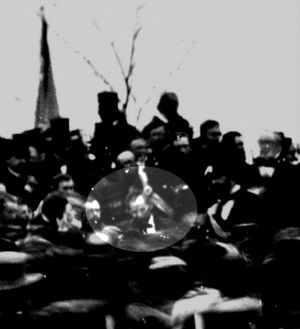
Photo of Lincoln delivering Gettysburg Address- (www.wikipedia.org)

Photo of Lincoln delivering
Gettysburg Address- (www.wikipedia.org)

The lesson plan is organized in three sections. In the first, students are handed a copy of Lincoln’s Gettysburg Address and perform several “cold” readings, to themselves and then with the class.

Lesson Plan SECTION 1 What’s at stake: a nation as a place and as an idea

Students silently read, then the teacher reads aloud the text of the Gettysburg Address while students follow along.

  • Students translate into their own words the first and second paragraph. 
  • Students answer guiding questions regarding the first two paragraphs

Please note, there is no mention of any historical context for the speech. Students will come to this 273-word speech without the background knowledge that the Battle of Gettysburg was fought from July 1 to July 3, 1863, and this battle is considered the most important engagement of the American Civil War. They will not know that the battle resulted in “Union casualties of 23,000, while the Confederates had lost some 28,000 men–more than a third of Lee’s army” (History.com). They will not know how the Army of Northern Virginia achieved an apex into Union territory with “Pickett’s Charge,” a failed attempt by General George Pickett  to break through the Union line in South Central Pennsylvania, and that the charge resulted in the death of thousands of rebel soldiers. They will not know how the newly appointed Major General George Gordon Meade of the Army of the Potomac met the challenges of General Robert E. Lee by ordering responses to skirmishes on Little Round Top, Culp’s Hill, and in the Devil’s Den. They will not know that Meade would then be replaced by General Ulysses S. Grant in part because Meade did not pursue Lee’s troops in their retreat to Virginia.

Instead of referencing any of this historical background, the guding questions in the lesson’s outline imagine the students as blank slates and mention another historical event:

A. When was “four score and seven years ago”? B. What important thing happened in 1776?

The guiding responses for teachers seem to begrudge an acknowledgement that keeping students bound to the four corners of a text is impossible, and that, yes, a little prior knowledge of history is helpful when reading a historical text:

This question, of course, goes beyond the text to explore students’ prior knowledge and associations. Students may or may not know that the Declaration of Independence was issued in 1776, but they will likely know it is a very important date – one that they themselves have heard before. Something very important happened on that date.  It’s OK to mention the Declaration, but the next step is to discover what students can infer about 1776 from Lincoln’s own words now in front of them.

In addition, there are admonishments in Appendix A of the lesson not to ask questions such as, “Why did the North fight the civil war?”

Answering these sorts of questions require students to go outside the text, and indeed in this particular instance asking them these questions actually undermine what Lincoln is trying to say. Lincoln nowhere in the Gettysburg Address distinguishes between the North and South (or northern versus southern soldiers for that matter). Answering such questions take the student away from the actual point Lincoln is making in the text of the speech regarding equality and self-government.

The lesson plan continues:

Lesson Plan SECTION 2  From funeral to new birth

  • Students are re-acquainted with the first two paragraphs of the speech.
  • Students translate the third and final paragraph into their own words.
  • Students answer guiding questions regarding the third paragraph of the Gettysburg Address.

Please note this does not provide the context of the speech that was given that crisp morning of November 19, 1863, at the dedication of the National Cemetery on a damp battlefield that only months before had been dampened red with the blood of tens of thousands of soldiers from either side. The students would be unaware that Lincoln had taken the train from Washington the day before and was feeling slightly feverish on the day of the speech. There is some speculation that he may have been suffering from the early stages of smallpox when he delivered the speech reading from a single piece of paper in a high clear voice. The students would not know that Lincoln’s scheduled time at the podium followed a two hour (memorized) speech by Edward Everett, who later wrote to Lincoln stating, “I should be glad if I could flatter myself that I came as near the central idea of the occasion in two hours as you did in two minutes.” The students would not know that many of the 15,000 crowd members did not hear Lincoln’s two minute speech; the 10 sentences were over before many audience members realized Lincoln had been speaking. The students would not know that this speech marked Lincoln’s first public statement about principles of equality, and they would not know that he considered the speech to be a failure.

Lesson Plan SECTION 3  Dedication as national identity and personal devotion

  • Students trace the accumulated meaning of the word “dedicate” through the text
  • Students write a brief essay on the structure of Lincoln’s argument

The lesson provides links to the five handwritten copies of the text, in the “Additional ELA Task #1: Comparison of the drafts of the speech” so that students can see drafts of the speech and the inclusion of “under God” in the latter three versions. There is also an additional Social Studies task that incorporates the position of respected historian Gary Wills from his book Lincoln at Gettysburg: The Worlds that Remade America. This activity suggests students use excerpts from Wills’s book and an editorial from the Chicago Times (November 23, 1863) to debate “Lincoln’s reading of the Declaration of Independence into the Constitution”. One excerpt from Wills’s book includes the statement,”The stakes of the three days’ butchery are made intellectual, with abstract truths being vindicated.” Finally, here is information about the battle itself; the battle lasted three days and soldiers died.

The enterprise of reading the Gettysburg Address without context defeats PARRC’s stated objective of having the students “arrive at an understanding of the text as a whole”. The irony is that in forwarding their own interpretation of the speech, David Coleman and the lesson plan developers have missed Lincoln’s purpose entirely; Lincoln directs the audience to forget the words of the speech, but never to forget the sacrifices made by the soldiers during that brutal conflict:

The world will little note, nor long remember what we say here, but it can never forget what they did here.

Lincoln wrote and delivered the Gettysburg Address to remind his audience “that these dead shall not have died in vain”. Analyzing the language of the address isolated from the Civil War context that created the tone and message is a hollow academic exercise. Instead, students must be taught the historical context so that they fully understand Lincoln’s purpose in praising those who, “gave the last full measure of devotion.”

“It is altogether fitting and proper that we should do this.”

Continue Reading…

Stephen King scares me. I have read only a handful of his books: Christine, The Green Mile, Carrie, but those have left a residue in my brain. My fear, created by the gruesome images in his fiction, would probably please him: he likes to tell stories that unsettle the reader.

I have, however, become a fan of his non-fiction book On Writing. While I am not as rabid as Annie Wilkes of Misery, I push this book on as many readers as possible. When I mention King’s name, however, I recognize the same uncomfortable flicker in their eyes. King scares them.

“No, really,” I urge, “this is nothing like the Stephen King books you don’t like. This is the Stephen King book you will like.”

On the surface, On Writing: A Memoir of the Craft is King’s memoir mixed with writing tips. The book is divided into three parts; the second part has two subsets of witty literary criticism.

In section one, the reader learns about King’s childhood, the history of his writing career, and the inspiration for several stories. He discusses his addictions, his stories, and his marriage to Tabitha, an author and his chief literary critic. In the second section, King discusses the craft of writing, first through the use of a “toolbox” of grammar  and then with application of these tips in various works of literature. The third and final section of the book covers his near death experience in June of 1999 when he was hit by a motorist on a side road in Maine.

We assign this book to our juniors who are taking the Advanced Placement English Language class, a course in familiarizing students with rhetoric and argument. The critical commentaries he offers in his “toolbox” section are especially helpful in helping students develop a style of writing.

He lectures the reader in a voice that is informal and wise. He gets the respect that English teachers struggling to impart the importance of subject-verb agreement crave to have from students. Plus, he swears; he swears a lot:

“You’ll also want grammar on the top shelf of your toolbox, and don’t annoy me with your moans of exasperation or your cries that you don’t understand grammar, you never did understand grammar, you flunked that whole semeste rin Sophomore English, writing is fun but grammar sucks the big one. Relax. Chill. We won’t spend much time here because we don’t need to. One either absorbs the grammatical principles of one’s native language in conversation and in reading or not.”

Some of his other observations include:

“Remember that the basic rule of vocabulary is use the first word that comes to your mind, if it is appropriate and colorful. If you hesitate and cogitate, you will come up with another word — of course you will, there’s always another word — but it probably won’t be as good as your first one, or as close to what you really mean.”

“Bad grammar produces bad sentences.”

The adverb is not your friend. … Adverbs, like the passive voice, seem to have been created with the timid writer in mind.”

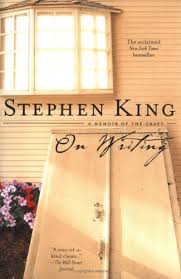
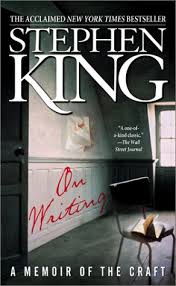
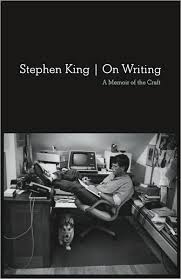
I have had some success in locating used copies of the book in its various editions. There are hardcovers and paperbacks in the secondary markets of thrift stores and library book sales, but I need to look close at the book spines since they are different in size and appearance. Our class set is a mish-mash of all editions.  The most frequent edition’s cover art is a picture of the cellar door, and if there was a book cover design that was dead wrong for the contents, this cover gets my vote. The cellar door may mean entrance to the “foundation” of writing, but the cream colored clapboards, bright window, and potted plant are an odd chice for King. The cover art with the letters of rejection nailed to a wall is macabre, perhaps a better choice for King and the contents. My favorite cover, though, is the most recent and centers on a photo of King working at his desk.

Cover simply did not match content!

Cover disconnect from content.

The macabre cover with rejection letters nailed to the wall

The macabre cover with rejection letters nailed to the wall; blood red title.

The most appropriate cover; one that matches the content

The most appropriate cover; one that matches the content-King writing On Writing

Last week, I offered this book to my own book group, an adult group of educated readers. Our discussion led to the question, “What is good writing?” We failed like so many others to come up with a definitive answer, but we did appreciate KIng’s four pages of suggested titles listed at the end of the memoir to read as examples of good writing. This list brings me to a major point in On Writing, King likes to read. This is repeated many times in the text:

“If you don’t have time to read, you don’t have the time (or the tools) to write. Simple as that.”

“If you want to be a writeryou must do two things above all others: read a lot and write a lot.

King’s dedication to the craft of writing is inspiring; the final paragraph captures his passion:

“Writing isn’t about making money, getting famous, getting dates, getting laid, or making friends. In the end, it’s about enriching the lives of those who will read your work, and enriching your own life, as well. It’s about getting up, getting well, and getting over. Getting happy, okay? Getting happy.”

On Writing has changed how I write. Because of On Writing, I hesitate to add an adverb (see? I consciously did not use “frequently hesitate”). I hear his voice say “I believe the road to hell is paved with adverbs” when I craft sentences,

My favorite part of the “toolbox” deals with his disdain for the passive voice. King tells the writer to “energize your prose with active verbs. … good writing is often about letting go of fear and affectation.”  My students tell me they write in write in passive voice to sound smart, so I need to counter with a clear example of why the use active voice is more powerful. King provides me a hilarious example:

“Everyone’s entitled to his/her opinion, but I don’t believe ‘With a hammerhe killed Frank‘ will ever replace ‘He killed Frank with a hammer.’”

“But how do you know when you are using passive voice?” my students ask. I offer my new “tool” to test, a tool I found on a Facebook post.

“If you can put ‘by Zombies’ after the verb, then you have passive voice,” I respond.

“Frank was killed…by Zombies?”

“Passive voice. To make the sentence active, you would have to write, ‘The Zombies killed Frank’. Much clearer, don’t you think?”

Passive voice and Zombies? I think Stephen King would enjoy that discussion.

60 of my students met their first Hamlet on stage at Yale Repertory Theatre in New Haven, Connecticut, this past week. Their Hamlet was the actor Paul Giamatti, who after speaking 40% of the play’s 4,042 lines (roughly 1,440), came out onto the stage for an audience talkback to speak a few more words to them.paul giamatti

“He looks tired,” on student remarked to me. The play had begun at 10:15 AM, and we were still sitting three and a half hours later as the actors and crew began to respond to questions.

If we thought they looked tired, the actors seemed surprised to see us still sitting there.
“Wow!” Polonius (Gerry Bamman) said as he sat, “You stayed!”

Students were curious about how the sets moved (“The stage has a large fly space.“). Students wondered how long the cast had rehearsed (“Eight weeks, a real luxury…”). Students wondered who was most like his or her character (“I understand Gertrude much more since I have a son”). Students asked about the creation of set pieces including a large portrait (“That’s an oil painting from a  photograph”).

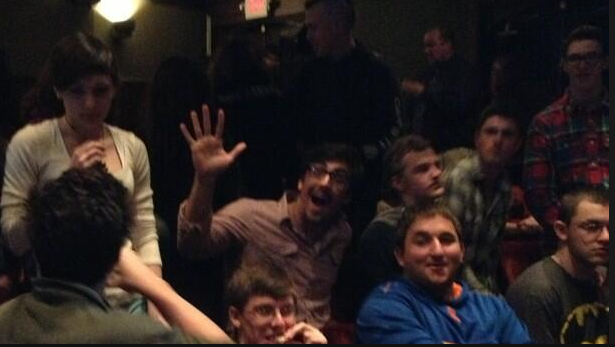
Of course, there was no stopping the students from calling attention to Giamatti’s role in Big Fat Liar, a film from their youthOne student stood to ask, “Did Hamlet remind you of Marty Wolf?” Giamatti laughed in response, “Well, maybe,…a little… except for the blue crap!”

Hamlet is a 12th grade text, and I asked students to take a survey after they returned to the school to see what they thought of this production. While the survey indicated that the teachers in our English department had done their job, the students indicated that seeing the play performed was very different that studying the play in class:

Shakespeare was meant to be live. Although the “perfection” of a movie is enhancing to the performance, it is unrealistic. I believe that watching a play live is important to seeing the different styles and methods possible.

It was fun and a lot better than just reading it in class, it made it come alive.

I did not think it was going to be as entertaining as it was. I also did not think I would find parts humorous, but I did.

This Hamlet was part of the WILLPOWER! series (funded by the National Endowment of the Arts). The website states:

WILL POWER! is Yale Repertory Theatre’s annual educational initiative in conjunction with one of its productions and features specially-priced tickets and early school-time matinees for middle and high school student groups. The program also includes free professional development for educators, study guides and post-performance discussions with members of the company.

One of the objectives of the WILLPOWER! series is to create new audiences, specifically younger audiences, for Shakespeare. Students who have attended a Shakespeare play may be more willing to attend another play when they are older; in other words, a favorable dramatic experience will yield future audiences for Yale Drama School graduates!

Seniors at intermission watching Hamlet at Yale Rep

Seniors at intermission watching Hamlet at Yale Rep

The survey indicated that this goal is being met with the WILLPOWER! series; my students are certainly willing to try another play:

The performance was a wonderful experience, especially since it was my first time to see Shakespeare.

I wouldnt mind going to another because it was so enjoyable that I didn’t even realize the 4 hours passing by.

I like the way that a play has a certain kind of vibe. It’s like a live concert, where there’s a certain kind of energy. It was like seeing a live performance of a film. I would especially like to see another Shakespeare because it is the way that he intended his works to be portrayed.

After seeing Hamlet so well done, it would definitely be worth going to see another one whether it be Shakespeare or a different kind of performance.

Perhaps the most satisfying moments of the actor’s talkback for teachers is hearing the actors say things that we wish our students would pay attention to in class. When Giammati was asked about how he felt about memorizing all those lines, he explained that he enjoyed learning the lines and playing on the open space of the stage.

When one student asked, “What part of the play did you like best?” Giamatti responded, “I enjoy the end, when Hamlet returns to the graveyard, until the end.” Then, thoughtfully, he added, “Shakespeare’s words begin to come through you if you let them.” (Honestly…you could hear the teachers in the audience swoon!)

But nothing was better than hearing the young Remsen Welsh (Player Prologue) explain how the director, James Bundy, had prepared her for her role. “It’s simple,” the actress gestured enthusiastically from the front of the stage. Facing the crowd of students twice her age, she cheerfully acknowledged, “He told me, ‘Suit the action to the word, the word to the action..’ and I did!”

Exactly.

A first Hamlet they will remember.