Archives For August 31, 2014

“So….what problems do your students have in writing?” I ask middle school teachers.
“The thesis statement.”

“So….what problems do your students have writing?” I ask high school teachers.
“The thesis statement.”

One might conclude that students in grades 7-12 have a thesis statement problem…or maybe not.

Maybe the problem of writing a thesis statement is that so many teachers in middle and high school expect that students must have a well-written thesis statement before they can write an essay.

Maybe the emphasis on a well-developed thesis as the start to the essay is misplaced.

After all, according to Webster’s Online Dictionary, an essay (noun) has another meaning beyond “a short piece of writing that tells a person’s thoughts or opinions about a subject”. The word essay also means a “trial, test; an effort, attempt.” An essay is literally “an initial tentative effort; the result or product of an attempt” and a thesis statement is a student’s position in such an effort or attempt….a “test drive” of sorts.

Instead of expecting well-developed thesis statements, teachers could have student test drive a thesis statement by using one of several online tools known as “thesis generators.” These online tools are free and allow students the opportunity to practice with different ideas as they prepare to write an essay.

My favorite, and easiest to use, is the Tom March Thesis Builder 

Screenshot 2014-09-23 21.12.56This site asks students to respond to a series of questions:

  • What’s the topic you want to write about?
  • What’s your main opinion on this topic?
  • What’s the strongest argument supporting your opinion?
  • What’s a second good argument that supports your opinion?
  • What’s the main argument against your opinion?

As they use this thesis generator, students are instructed to:

  1. Answer questions in short phrases (not full sentences).
  2. Do not use periods / full stops (.) at the end or capital letters at the beginning of the phrases you write.
  3. Click the “Build a Thesis” button when you’re finished.
  4. A window will pop open with your Built Thesis.
  5. Go back and adjust your answers to smooth out the thesis until it makes sense and expresses your beliefs. Clicking on the “Build a Thesis” button again will update your thesis to show your changes.
  6. Once you’ve got a thesis statement, use the Make an Online Outline button to generate the framework for your essay.

Once students use a generator, such as the Tom March thesis generator,  they may recognize a sentence “pattern” used in creating a thesis that acknowledges a counter argument. These sentence patterns might start with a qualifier such as “even though”, “because”, “despite”.

Acknowledging the counter arguments is specifically addressed in the thesis builder on John Garvey’s Thesis Builder site. The generator on this site asks students:

  • Is what you say always true always?
  • Are there exceptions?
  • Are there good reasons why your position may have a down side?
  • How can you make your position have a reality check?
  • What general reasons why your position may have problems can you admit up front? To make absolute statements usually causes your essay’s thesis to seem foolishly simplistic.  Get real!.
  • Here’s a trick: begin your qualification with a word like “although” or “It is true that. . .” Don’t worry if it’s not a complete sentence.

Finally, the thesis builder on the Ashford University website  provides different levels of complexity as a student creates a thesis. Once a student enters information into this generator, a series of different thesis statement models on the same idea is offered for students to choose:
Model #1: Thesis Statement
Model #2: Thesis with Concession
Model #3: Thesis with Reasons
Model #4: Thesis with Concession and Reasons

There is also an outline generated on this site that can be used by students in writing the essay.

If teachers and students use these thesis generators, the emphasis on the thesis statement as a starting point might be shifted to another, often overlooked, important part of the essay…the conclusion. The conclusion is where the student’s “test drive” ends, and where the student ends up should matter even more than where the student started.

The advertisement on Book Sale Finder for the Wilton Public Library Book Sale  in Wilton, CT, read,All books on sale for this sale… not just Children and Teens.”

The reason for the clarification? This annual end of summer book sale usually offers the best selections of donated books for children and teens in the area.

This past weekend’s sale  (9/19-21) did not disappoint.

In the space of an hour, I collected over 200 books suited for students in grades 5-10. High interest titles such as Angus, Thongs and Perfect Snogging for the older students, selections from the Lunch Lady graphic novel series (“serving justice, and serving…..lunch!”) for the younger students. My shopping spree was fueled by the knowledge that Sunday was the 1/2 price day. Hardcovers were $1.50; paperbacks were as little as $.25. At these prices, who could resist picking up multiple copies of Chicken Soup for the Teenaged Soul or duplicate selections from Margaret Peterson’s Haddix series?

All books are headed to the independent reading classroom libraries in the intermediate, middle, and high schools in West Haven. In particular, the SSR (silent sustained reading) in grades 7 & 8 is a reading initiative that is now possible because of the new 90 minute block schedule. Teachers explained the SSR program to parents during the Open House last week and encouraged attending parents to discuss reading for fun with their children.

My industrious selecting caught the attention of several of the volunteers who provided the extra bags and boxes I needed. These Friends of the Wilton Library were genuinely delighted that I was removing a large portion of their inventory.
“These books will be enjoyed again,” from one.
“You are exactly who we want to come to these sales,” from another, “these will be books for classrooms!”
“You got so many of the better titles,” from a third who seemed to know YA literature as she perused my selections.

Like good professional salespeople, they continued to affirm the choices I made as they counted….and counted, and counted. The sum total? $150.00!

This event was advertised as an “Awesome Autumn Book Sale” and yes, it was awesome! This is the first day of autumn, and this autumn I can confidently predict there will be a multiple floods…multiple classroom book floods!

Thank you, Friends of the Wilton Public Library!

The 7th and 8th grade teachers who administered our own  “How I Feel about Reading Survey” to teams of students have collected some contradictory data. The survey is based on questions suggested by Kelly Gallagher in his book Readicide. In this book, Gallagher uses the term “readicide” to define “the systematic killing of the love of reading, often exacerbated by the inane, mind-numbing practices found in schools.”

The student body is divided into four teams at each grade level, and each team has taken the survey these first few days of school. Each team’s survey provides a snapshot for  a group of students and their attitude towards reading.

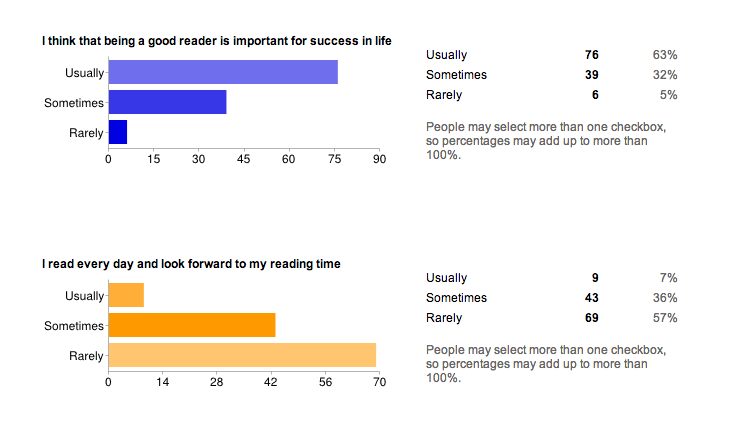
The results are contradictory. Take for example the results on 8th grade team in student responses to two prompts: I think being a good reader is important for success in life juxtaposed with the results from I read everyday and look forward to my reading time.

Screenshot 2014-09-04 22.19.16

Yes, students agree that reading is important, but the data shows they do not feel that the practice is important enough to do every day. Moreover, most students do not think reading if pleasurable with over 50% voting they “rarely” look forward to reading. This results from these questions were repeated throughout the grades 7 & 8, team by team.

This data suggests Gallagher’s diagnosis that students could be suffering from “readicide”, an unfortunate consequence of education’s current culture of assessment. The requirements to assess student learning often means employing reading practices that include worksheets, quizzes, or tests; none of these are “fun.”

To counter this, teachers at the middle school are implementing an ambitious independent reading program- 20 minutes a day in a block period- where students are encouraged to read whatever they want from classroom libraries. There are no quizzes. There are no tests. There are no worksheets.  The students will have time built into their day to read, but most important, the students get to choose what they want to read. They can choose from the school book collections or bring in their own book. They will talk about their books with each other, and teachers will visit and conference with them to listen about the books they choose.

In fighting the toxic effects of “readicide”, teachers already have the data that gives them an ace up their collective sleeves…most students have admitted that reading is important for success in life. Guaranteeing that success will be the goal of the 7th and 8th grade teachers who will be working this year to change that high percentage of students who are “rarely” looking forward to reading to a higher percentage of students who “usually” looking forward to reading. Hopefully, teachers can add an “always looking forward to reading” survey choice as well.

I’m moving.moving_van

This blog is moving with me.

This Used Books in Class blog will now be headquartered in West Haven, Connecticut, as I have taken a position as the Language Arts, Social Studies, Library Media and Testing Coordinator for their public school system. West Haven is a shoreline community with six elementary schools, one intermediate school, one middle school, and a high school that houses a student population four times my previous school.

I am very excited about this opportunity.

One of my first responsibilities will be helping teachers at the middle school (grades 7 & 8)  develop an independent reading program for their extended English/Language Arts period. To make the reading program a success, the teachers plan to offer student choice in reading and that means the classroom libraries need to be expanded.

photo 3

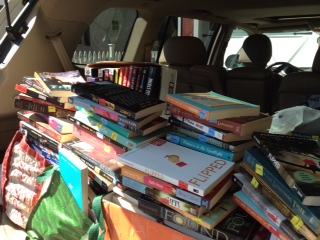
Six bags full for $180 !

Building or expanding a classroom library can be expensive, but by seeking out gently used books, the expense can be minimized to as little as $.50/book. One simply needs to know where to look….and the best place to look for gently used quality books for any age is at the Grandmother of all Connecticut Book Sales, the Labor Day Book Sale that benefits the Mark Twain Public Library in Redding, Connecticut.

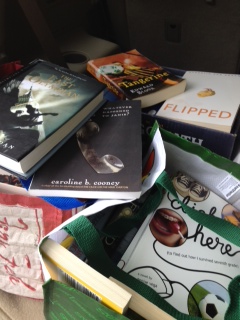
photo 1Some library book sales in Connecticut have a few tables or sections of a room devoted to books for children or teen readers. In contrast, the Mark Twain Library Book Fair has an entire room with literary treasures galore for young readers. I had hardly scanned the first tables when the neatly arranged copies of Rick Riordan books caught my eye. All three copies of the Red Pyramid filled the bottom of my bag, followed by novels from his Percy Jackson series, including the elusive The Last Olympian. I turned around to find a variety of titles from John A. Flanagan’s Ranger’s Apprentice series, selections from Anthony Horowitz’s Alex Rider series, selections from Margaret Peterson’s Haddix series as well as copies from Suzanne Collins’ The Hunger Games trilogy.

photo 2

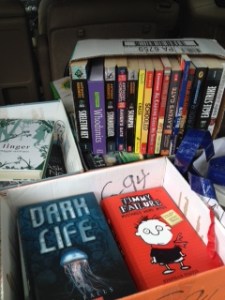
Boxes of Young Adult (YA) novels & non-fiction from the Mark Twain Library Book Sale; $.50-3.50 each!

Once I collected books from YA series, I looked for individual titles by writers who are always popular: Gary Paulsen’s Hatchet and Brian’s Winter, Mike Lupica’s Heat and Travel Team; Jerry Spinelli’s Maniac Mcgee, Milkweed, Stargirl; and a plethora of princess stories from Meg Cabot. If there was a book that was a hit with middle school readers, this book sale had it…in triplicate. Finding multiple copies was helpful, since multiple classrooms will be accessing these books during the same independent reading periods. For this reason, I had no problem justifying the purchase of seven copies of Louis Sacher’s Holes or Wendelin Van Draanen’s Flipped.

There were several student volunteers tabulating my haul, and I would ask them every now and then, “Did you ever read that book?” or “Do you think a student would like to read this book?” They would nod enthusiastically. Chicken Soup for the Teenage Soul got a soulful look from one of the tabulators, who explained, “Some stories in this are just so…sad. I felt better reading them.” They approved of my selections.

I was soon packed up with six bags full of young adult novels and non-fiction for $180, and I was helped to my car by a boy scout (literally…he was in uniform!).

Tomorrow, I plan deliver this first load of books to the teachers, creating the “book flood” in their classrooms. The Mark Twain Library Book volunteers who so capably load the tables, organize the donations, and make the whole experience a “destination” for readers of all ages must be credited with helping more than their own library. Their hard work has made an expansion of classroom libraries possible. A wonderful effort from a library named for the American writer who once said that, “out of the public school grows the greatness of a nation.”

Now, let us see how these expanded classroom libraries help grow the students of West Haven!