In looking for lessons for poetry month, I came upon a worksheet that asked students to analyze a poem. The poem on the worksheet was “Introduction to Poetry” by former U.S. Poet Laureate Billy Collins.
Below the poem on the worksheet were two columns: “Examples of figurative language” go in the left hand column; “Types of Figurative Language” go into the right hand column.
When I came upon this worksheet in a curriculum guide, I was, at first, amused by the situational irony of this assignment.
But I became bothered once I considered that if this worksheet exists, there probably are others just like it in countless number of curriculum guides across the country.
In the poem’s 16 lines, Collins captures the kind of encounter that language arts teachers too often promote. He is able to highlight the absurdity of “worksheet” analysis used to prepare students to discuss the elements of poetry without regard for the beauty of the poem itself.
Collins’s opening line sets up this poem as a gift, one worthy of wonder and imaginative speculation for the reader:
I ask them to take a poem
and hold it up to the light
like a color slide
or press an ear against its hive.
But Collins is familiar with how literature is “taught” to students. His attitude towards literary analysis is in the last two lines of the poem. You can hear his speaker’s …what is it….frustration? exasperation? resignation? in knowing what will happen to his gift of a poem:
But all they want to do
is tie the poem to a chair with rope
and torture a confession out of it.
They begin beating it with a hose
to find out what it really means.
So here is the situational irony. The poem that tries to make a case for admiring the beauty of a poem rather than reducing it to its elements to find out what it means is reduced to a worksheet in order to beat a confession out of the poem to find out what it means.
I really like this poem. In his typical gentle melancholy fashion, Collins makes a solid case against “teaching” a poem. I would like to think I could honor that purpose and not use a worksheet to teach Introduction to Poetry.
The blizzard raging outside recalls the looping GIF of drifting snow that opens the 2013 Pulitzer Prize winning New York Times feature story, Snowfall: The Avalanche at Tunnel Creek.
As a model text, this example of digital writing is the kind of writing that we should be preparing our students to do.
This story of 16 expert skiers and snowboarders and their fatal decision to ski outside the Stevens Pass ski area in the Washington Cascades was written by journalist John Branch and published digitally on Dec. 20, 2012. His recount of the group’s excursion into the “unmonitored play area of reliably deep snow, a ‘powder stash,’ known as Tunnel Creek” is complemented with embedded video, photos, and other graphics, the result of his extensive research and first person interviews. The print version was published in a 14-page special section on 12/ 23/12, and according to the Times editors, generated more than 1,100 comments online.
Branch’s prose is gripping from the start:
The snow burst through the trees with no warning but a last-second whoosh of sound, a two-story wall of white and Chris Rudolph’s piercing cry: “Avalanche! Elyse!”
The very thing the 16 skiers and snowboarders had sought — fresh, soft snow — instantly became the enemy. Somewhere above, a pristine meadow cracked in the shape of a lightning bolt, slicing a slab nearly 200 feet across and 3 feet deep. Gravity did the rest.
12 journalistically short paragraphs into the feature is the first video clip, an interview with professional skier, Elyse Saugstad, Her interview is juxtaposed next to the text that describes how the avalanche “vomited” her into position:
Saugstad was mummified. She was on her back, her head pointed downhill. Her goggles were off. Her nose ring had been ripped away. She felt the crushing weight of snow on her chest. She could not move her legs. One boot still had a ski attached to it. She could not lift her head because it was locked into the ice.
A graphic map of Cowboy Mountain and the Tunnel Creek area splits the text that follows her interview. Below that graphic are two photos of another avalanche in 1910, that was responsible for the death of 96 people. Each of the six sections of Snowfall is laid out with similar interactive features, the result of a collaboration between Branch and a team of graphic editors and researchers (see end of post)*
“Snow Fall” online accounted for more than a million unique visits; a significant percentage of the people who found the story online were first-time visitors to nytimes.com; huge numbers of those readers came to the story through social media; the average time of reader engagement was off the charts.
Snowfall‘s arrival on digital platforms will no doubt give rise to a wave of stories with similar features. As authentic practice, students should have the chance to experiment with their own narratives, fiction or non-fiction, using digital platforms (Google, wikis, blogs, etc.) that allow for embedding video, audio, graphics, and other interactive features. Several of my classes have annotated passages from texts they read in class (ex: The Annotated Prologue: Romeo & Juliet ) with digital links as part of close reading exercises. The text “Snowfall” is the next step, a mentor text that models how to create a story where all forms of media support an author’s purpose.
The blend of genre is seamless in Branch’s narrative; each of the 16 personal stories is fleshed out in detail, along with those other lives who were so effected by the tragedy. There is the expository information devoted to Tunnel Creek’s tragic history interwoven with the informational sections that capture the science of an avalanche. Finally, there is the persuasive argument of how easily “how so many smart, experienced people could make the types of decisions that turned complex, rich, enviable lives into a growing stack of statistics.” Snowfall is proof that good writing is not compartmentalized into separate genres, as the Common Core outline would lead teachers to believe.
Here is evidence that students should move between genres, adding rich expository or informational media to a piece in order to engage readers. Here also, is evidence that good writers should follow their own inquiry, as Branch did as he:
….interviewed every survivor of the avalanche, and the families of its three victims; he researched the world of backcountry skiing, the fastest-growing corner of a handsome, but dangerous sport; he traveled to Alaska to speak with snow scientists and to enlist their help in recreating in words and graphics the physics of the avalanche on Cowboy Mountain; he hiked the terrain, clawed through the avalanche’s path, and established a precise chronology of the disaster; he read formal accident reports, pieced together ski patrol and police photographs, reviewed dozens of 911 calls, and unearthed the formal avalanche warnings that all but predicted trouble the night before the accident.
While our students may not have the opportunity to complete this exhaustive marathon of research that Branch did in order to write Snowfall, they should recognize in this model the link between a writer’s own curiosity, painstaking research, and good prose. They should see that compelling storytelling, engaging literary non-fiction, is generated through participatory experience. They should move away from the desk in order to experiment and to find the answers to their questions.
Branch’s Snowfall contribution to journalism has already been awarded by the Pulitzer Prize Committee who rightfully saw it as an historic achievement; Snowfall’s contribution to student learning as a mentor text is only beginning. Continue Reading…
Stuck in the windowless corner of the teacher’s room, churning out page after page of quizzes, newsletters, and course descriptions. Probed and shoved and slammed, the oft maligned copier needs a break.
What could teachers do to lessen the toll that results in the overheated roller or stapler malfunction?
Stop the madness….there is no reason to copy a graphic organizer!
The graphic organizer is meant to help students prepare for another activity…a discussion, a quiz, or an essay. Graphic organizers can be used at any grade level. Graphic organizers can be used in any subject. But, teachers, please…. most graphic organizers do not need to employ a copier.
Who cannot draw the T-chart?
Take the T-Chart here at left. The T-Chart consists of two lines, a long horizontal line that is bisected by a vertical line. Why does this need to be prepared and run through a copier? Students can draw a T-Chart easily, or fold a paper “hot-dog style” to get the same result. What part of the T-Chart necessitates the use of expensive toner?
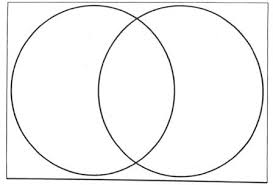
Venn Diagram-Perfect circles can be problematic
Consider next, the popular Venn Diagram used for compare and contrast exercises. Of all the organizers, this is one that may require students to have little practice to get perfect, however, is the symmetry of shape what teachers want students to notice about the Venn Diagram? That there are two perfect circles overlapping with a shared oval in the center? The problem with two perfect circles of equal size and shape is the implication that when an object or topic is compared and contrasted, the information is also equitable. On a prepared Venn Diagram, there is exactly the same amount of space on each side for the purpose of contrast, but there is a smaller, cramped center for comparable attributes. Perhaps a student can practice some freehand circle creation, find out how to use a protractor, or use some object -a water bottle? cup? paper plate?-to trace a circle. What students should not fret about is how to draw two perfect circles, because the Venn Diagram functions as an organizer even with lopsided ellipses.
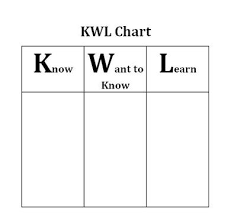
Then, there is the popular K-W-L chart, where students list what they know, what they want to know, and what they learned. This graphic organizer is much like the T-Chart, and even the youngest student can draw vertical two lines on a page. Folding a paper into thirds is also an effective way to achieve a K-W-L organizer without have to wait for the teacher in front of you to finish copying next month’s math worksheets. Having students write the headings for this chart can reinforce the purpose of the organizer as well.
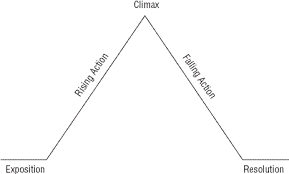
Plot Mountain diagram
Next, the “plot mountain” diagram is a staple in English Language Arts classrooms, but as a universal tool in deconstructing literature, the organizer has its flaws, so much so that the replication could make its use damaging. Some plots have long expositions (Return of the Native by Thomas Hardy comes to mind); some have short expositions (Shakespeare’s Romeo and Juliet‘s opening sonnet). One of arguably several climaxes for Harper Lee’s To Kill a Mockingbird is the courtroom scene which is followed by a long falling action (four chapters) before Bob Ewell’s climatic attack on Scout. There is no falling action in The Tell-Tale Heart by Poe which ends at the climax. These few examples demonstrate that each story has its own construction, its own mountain; plot is not a one size fits all, as this organizer would seem to claim. For this reason, teachers should allow students to sketch their own version of a story’s plot mountain, featuring all the little crags and mini-climax moments in rising and in falling. Teachers should save the plot mountain as a flexible concept, one that is not enhanced by standardized reproduction.
Finally, there is the “four-square” organizer, used to provide attributes on a topic that is printed in the center. The object is to think of details that fit specific categories or boxes in each of the paper’s four quadrants. Think of a big cross in the center of the paper, or a paper folded in half vertically, and then folded again horizontally. This organizer is often used in word study, as in the Frayer model, with a word in the center and each box used for a specific purpose: an illustration, an example, a definition,or an antonyms are all possible categories for this organizer.
Guru Mind Map on Wikipedia
Using the copier to create these organizers not only is expensive in toner ink and valuable teacher time (spent trying to get that last crinkled bit of paper out of the feed drawer!), but these organizers limit critical thinking for some students.
Students should be given the opportunity to organize their ideas the way that best helps them understand a concept. They should be cognitively and kinesthetically active in creating and completing an organizer of their own design
Mind maps, for example, are original creations that are centered on a concept that is drawn or written on the center of a blank landscape or page. From this central concept or word, an individual can branch out on the page by adding using words or pictures that show other connections. No two mind maps are the same, and their use in improving student understanding is well documented. My favorite mind-mapping website is Daniel Weinstein’s The Creativity Core with variations on mind-mapping activities for his students.
So, teachers, step away from the overheated copying machine, and get out blank paper and markers. Let the students fold their paper to make graphic organizers, trace shapes, or choose other patterns to list information. Bring out the rolls of butcher block paper and let students try and map out their ideas. Let them pencil their thoughts in wobbly circles and uneven lines, because the use of the graphic organizer is not about the shape for the information, but the information that is organized in the shape.
And leave that copier for the more important duties….those field trip permission slips!
The Hollywood Academy released the 2015 nominations this past week, and their choices for best picture, best actor, and best director lit a firestorm on social media about the lack of diversity in their choices.
Some of the heated discussions called into question the make-up of the Academy, which according to a 2014 Los Angeles Times article is:
93 percent white
76 percent male
Average age of 63
The percentages that make up the homogenized Academy bear a striking resemblance to the make-up in the canon of literature traditionally taught in high school English classrooms, a list of works dominated by white male writers. There are numerous reasons as to why the literature is singular in gender and race: politics, economics, culture, and textbooks play a part. The most probable explanation on why the traditional canon endures, however, may be as simple as teachers teaching the books they were taught.
Even the average age of the dead white male writers in the canon is the same as those in the Academy. A sampling of traditionally assigned authors at the time of their deaths (offered in no particular order) is the average age as the members in the Academy=63 years: John Milton (72), Percy Bysshe Shelley (30), F. Scott Fitzgerald (44), Dylan Thomas (39), Arthur Miller (90), William Shakespeare (52), John Keats (27) Ernest Hemingway (62), William Faulkner (65), John Steinbeck (66) William Blake (70), George Orwell (47), and TS Eliot (77).
My observation that older white male literature dominates the curriculum is nothing new, and while there are there are glimmers of diversity, authorship bears little resemblance to readership. Occasionally, Richard Wright, Langston Hughes, and August Wilson pop up to address racial diversity, while the inclusion of Mary Shelley, Harper Lee, Jane Austen and the Bronte sisters are worthwhile contributions to gender equity.
At the same time, there is a growing body of popular young adult literature from authors representing diversity such as Jacquelyn Woodson, Sharon Draper, Pam Muñoz Ryan, Gary Soto, and Sherman Alexie. In a manner akin to film audiences, students have been voting for these book choices with their pocketbooks or checking out library books. They are selecting materials (novels, graphic novels, animé, pop culture, biography) that they want to read.
As readers, students look for characters like themselves, who have problems like themselves, even if the settings of the stories are in the ancient past or distant future. If a student never builds empathy with a character because all the assigned reading comes from the canon, then the canon is disconnected from personal experience and useless for that student. If creating life long readers is the goal, curriculum developers must pay attention to student interests and the trends in the popular reading lists. Continuing the disconnect between the traditional canon in school and what students choose does little to build credibility.
That same kind of disconnect is seen in the nominations submitted by the Academy. Their choices show a wide gulf of opinion between critics and audiences, between the selected films and popular films at the box office. National Public Radio (NPR) film critic Bob Mondello noted the low audience numbers for many of the 2015 nominated films:
MONDELLO: If you total up all of the grosses for all of the best picture nominees this year, you come up to about 200 million, which is roughly what a picture like “Teenage Mutant Ninja Turtles” makes all by itself so that you’re talking about very few eyeballs were on those pictures.
Mondello’s noting the difference in box office is striking in comparison to the the top three box office films to three of the nominated films for best picture:
TOP GROSSING:
1 Guardians of the Galaxy – $333,145,154
2 The Hunger Games: Mockingjay – Part 1 $330,643,639
3 Captain America: The Winter Soldier – $259,766,572
NOMINATED FOR BEST PICTURE:
94 Birdman $26,725,993
95 The Theory of Everything $26,317,946
100. Boyhood $24,357,447
Mondello further suggests that Academy has not supported its own self interest in making nominations:
And the idea here is that you’re not going to watch the Oscar telecast unless you have a horse in the race….And I think what they’re hoping is that the next six weeks up until the show, these movies will be seen by a lot more people. If they aren’t – and they only have 38 days to do this – then you’re going to have the lowest rated Oscars telecast in the history of the Oscars.
Encouraging people to attend the films nominated by the Academy will be a challenge, and the success of the Oscars this year will be determined by audience choice. The deaf ear of the Academy this year may make them more open to diversity in future years. In contrast, a deaf ear from curriculum developers who continue to assign literature from the canon because “it has always been taught” may result in student audiences disconnected and less interested in reading anything at all.
We endeavor to encourage diversity of race, gender, geographical origin, sexual orientation, and class among both the creators of and the topics addressed by kid lit. We strive for a more diverse range of employees working within the industry, of authors and illustrators creating inspiring content, and of characters depicted in children’s and young adult books.
The organization We Need Diverse Books is also committed to expanding diversity in literature and in the video below, the popular YA writer Jon Green (The Fault in Our Stars, Paper Towns, Looking for Alaska) makes a compelling case for including other, newer voices into the literary canon that is taught in classrooms.
Unlike the choices made by this year’s Academy, the choices in English classroom should represent diversity in authorship, in genre, in character, and in topics because the readership is diverse. NPR’s Bob Mondello’s metaphor about engaging an audience for the Oscar show this year could be a metaphor for creating life long readers. Unless students “have a horse in the race” in what they read, they will not value the choices made for them.
I have seen how the monthly Scholastic Publishing Company book flyer can set student readers’ hearts aflutter. Scholastic’s marketing through classroom book clubs gives them direct access to all levels of student readers, and when a school hosts a Scholastic book fair, students can browse books or products with book title tie-ins. Moreover, Scholastic offers resources to teachers including lesson plans, discussion guides, and leveled reading programs.
The Fall 2014 report was based on a survey given in conjunction with the UK international marketing firm YouGov. The objective was to “explore family attitudes and behaviors around reading books for fun.”
The key findings of this research, were based on a nationally representative sample of 2,558 parents and children including 1,026 parents of children ages 6–17.
In this survey, there were questions about parental reading habits, ages for reading aloud, and the use of e-readers.
Given my interest in providing time in school for reading, I was particularly interested in what the survey had to say about dedicated time and developing readers.
There were three key finding about reading in school:
#1: One third of children ages 6–17 (33%) say their class has a designated time during the school day to read a book of choice independently, but only 17% do this every or almost every school day.
Scheduling time for independent reading is important, but making sure that time is sacrosanct conveys to students the critical importance of reading. Making sure independent reading time is respected also demonstrates that schools value the ninety-one percent of children ages 6–17 in the survey who stated that “my favorite books are the ones that I have picked out myself.”
#2: Half of children ages 6–17 who read independently as a class or school (52%) say it’s one of their favorite parts of the day or wish it would happen more often.
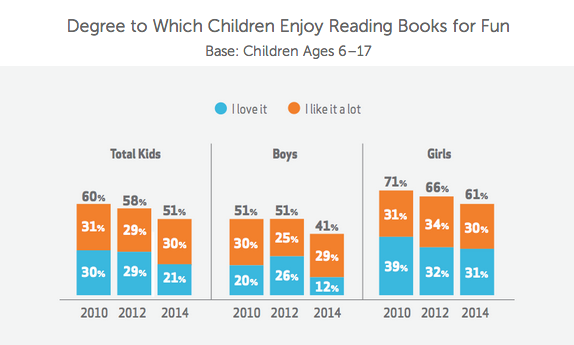
The 52% is a combined percentage of boys and girls, with 61% of girls agreeing in contrast to the lower percentage of 41% of boys agreeing (see data below). However, it is distressing to see a drop of 9% in reading for fun since 2010.
#3 School plays a bigger role in reading books for fun among children in lower-income homes. 61% percent of children ages 6–17 from the lowest-income homes say they read for fun mostly in school or equally at school and at home, while 32% of kids ages 6–17 from the highest-income homes say the same.
There was no one reason for the difference why twice as many low-income students read for fun during dedicated time in school, however, time and access to books are the most obvious possibilities. How students have access to independent books was factored into this survey with libraries as being the most important resource. Although Scholastic was not directly named, school book fairs, book clubs, and bookstores were judged to be among the leading sources for children ages 6–17 to find books to read for fun.
Finally, the survey suggests the most important allies schools have in promoting reading are parents who want their children to choose books:
Three-quarters of parents with children ages 6–17 (75%) agree “I wish my child would read more books for fun.”
So while this Scholastic survey could be considered self-serving, (after all, they are interested in selling more books) the data does support the importance of time for independent choice reading in schools. The survey highlights the power of enlisting parents in putting independent reading programs in place in school. Ultimately, the results of Scholastic’s survey supports those classroom teachers who recognize the value of independent choice and inviolable time to read.
So, pass out those book flyers, browse the book sale, get those students to the library, and put up the sign:
This four-year-old blog has had a slight makeover in appearance. I removed the header photo
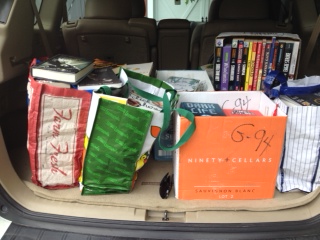
montage of used books on the classroom shelves and in the back of my car:
Used books stuffed into the back of my car
This purpose of this blog, however, will not change. There still will be posts dedicated to how I am putting books in the hands of students. There will be posts about instructional strategies that work in classrooms. There will be posts about issues in education.
In other words, this blog will continue offering the same old messages in a new wrapping.
Of course, educators regularly refurbish old ideas with new wrappings. Take for example, the literature circle. The literature circle has been in education since 1982 when, according to Wikipedia, fifth grade students in Karen Smith’s class, organized themselves loosely into groups, and started to discuss individual novels.
Smith was surprised at the degree of their engagement with the books and the complexity of their discussions, they had no outside help or instruction from their teacher (Daniels, 1994). From here literature circles evolved into reading, study and discussion groups based around different groupings of students reading a variety of different novels.
In contrast to the the classroom where a whole class novel is taught by the teacher,literature circles have provided students the chance to participate in self-directed discussions in by taking on different roles and responsibilities.
I am a big fan of literature circles as a way to encourage critical thinking, student choice, and independence in students. I have been promoting the incorporation of literature circles at multiple grade levels. Most recently, several of the 7th and 8th grade classes in my district have been using the literature circles in their new block schedule with some success. The teachers in these classes began by using the traditional roles for students: discussion director, connector, illustrator, vocabulary enricher, text locator, and researcher. The transition was smooth since students were already familiar with these roles from literature circles in elementary school.
Last month, I began offering teachers suggestions on how to offer some “new wrappings” for these old roles. Using a list of writing genres, I suggested that the teachers could offer roles for students in the literature circles and also include authentic writing prompts.
In these new wrappings, each student’s role could center on one of the following writing genres:
Write a Personal Letter from one character to another;
Prepare a Greeting Card to or from a character;
Develop a Things to Do List for a character;
Write Classified or Personal Ads that connect to a chapter;
Prepare a mix tape for a character and explain the choices;
Draft a resume for a character;
Compose a TV script from a chapter with notes for stage directions;
Script a Talk Show Interview or Panel with characters;
Record a recipe that is associated with the book;
Organize an Infographic using facts from the story;
Create and organize Receipts, Applications, Deeds, Budgets from the story
Obituary, Eulogy or Tribute for a character
These roles could rotate the way the traditional roles rotate in a literature circle, or the roles could be added as special collaborative writing activities.
The incorporation of technology to literature circles expands the opportunity to “wrap” the old roles in new digital covers. In a literature circle of four or five students, the major platforms for social media can be used as a way to have students interact with a text. With (or without) technology, students can rotate roles where they could:
Tweet a summary
Design a Facebook Page for a character or event;
Suggest “pins” for a character as on Pinterest;
Write e-mail correspondences between characters;
Plan Instagram messages.
I also encouraged teachers to number the seats in the literature circles, and then assign roles based on the number of the seat a student selected. Another strategy would be to offer a “surprise” role that rotates to a different numbered chair every meeting.
Like so much in education, old strategies can be made new.
Old literature circle roles can be made new with genre writing and/or with social media.
2015 New Year means a new wrapping for this old blog, but there will always be used books for classrooms in the back of my car!









 Used Books in Class