Archives For October 31, 2015

I like “one word” explorations to sum up an experience.

This time the experience was the National Council of Teachers of English Conference (NCTE) held in Minneapolis, Minnesota, November 19-22, 2015. This time my exploration uses the noun “context” which is defined at Dictionary.com as:

1. the parts of a written or spoken statement that precede or follow a specific word or passage, usually influencing its meaning or effect;

2.  the set of circumstances or facts that surround a particular event,situation, etc.

An important concept to know is that in the context of any English teacher conference, authors are rock-star-like celebrities that drive well-manner educators at every grade level to act like paparazzi at gala openings; it’s literary fandom gone wild.

Frankly, it’s embarrassing.

Staid teachers will suddenly go stalker-mode, staging selfies and pressing writers for autographs. When they do catch (trap?) an author, these articulate adults -who are capable of controlling legions of adolescents- will suddenly go tongue-tied, lining up to blurt out Hallmark-like sentiments: “love you” “you’re the best” or “you changed my life”…drowning the poor author in a litany heartfelt sentimentalities. At these conferences, authors should know to be careful not to incite such emotional responses.

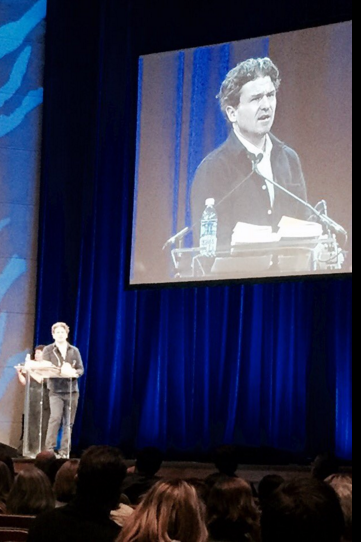
Which makes me wonder how the author Dave Eggers made it out of the Minnesota Conference Center Auditorium in one piece!
Dave Eggers, writer and 2015 NCTE Keynote speaker

Dave Eggers, writer and 2015 NCTE Keynote speaker

Eggers was the Saturday night speaker (11/21)  where he delivered a heartbreaking speech of humor and pathos dedicated to teachers…and to one teacher in particular. He is the author of ten books including Zeitoun, The Circle and A Hologram for the King, a finalist for the 2012 National Book Award. He is also the founder of McSweeney’s, an independent publishing company that also publishes Voice of Witness, a nonprofit book series that uses oral history to illuminate human rights crises around the world.

He began by asking the all-educator-audience to picture a 14 year-old boy “covered in zits” with “foot odor”, a friendless outsider, “angry” and unhappy at home. Many teachers did not have to imagine such a 14-year-old; this brand of boy is often seated in their classrooms.

Eggers proceeded to explain how this boy’s anger led to a subversive approach in responding to English writing assignments: the argumentative paper he wrote promoted a bike trip to the inner mantle of the Earth; the  informational essay he wrote warned of the coming sheep apocalypse. When the anticipated confrontation to change topics did not come from his English teacher, the boy channeled energy into the papers….and he became less angry. Both assignments received an A-.

At the end of the year, there was an encouraging handwritten note penned across a paper:

“I sure hope you become a writer one day.”

Eggers detailed how such encouragement from his teacher brought the boy to the school’s newspaper, then to the school’s literary magazine, and then to the attention of the “elders in the tribe” of the English Department.

Heads nodded in approval.

“And because you are English teachers,” he conceded, “and you understand plot…you have figured out that the 14 year-old in this story is me….”

All heads nodded in agreement; they understood the “he is me” context.

“But, what you don’t know,” Eggers stated, “is that my English teacher is here tonight.”

Gasps….and hundreds of misty-eyed teachers stood in applause as the teacher, Mr. Peter Ferry,  rose from the front row to take a bow.

Eggers rushed down to him and handed over a box festooned with a bright red ribbon.

The applause was deafening.

“And what you don’t know,” Eggers continued, breathless from his leap off and back onto the stage, “is that the gift in the box is my latest manuscript…because Peter Ferry is also the person who reads my first drafts…”

More gasps and more applause.

“And what you also don’t know….” paused Eggers again, “is that I have been the first reader of the manuscripts to his two novels.”

Gasping air depleted, teachers could only clap harder in appreciation for such inspiration, and as cliché it sounds, there were teachers shouting their (intellectual) love for Eggers. But for the height of the stage, he could have been mobbed.

He  held off the crowd by answering questions, and this gracious opportunity provided another familiar educational context…the  Q & A interview. As Eggers is also involved in his own educational enterprise in supporting writing centers, he shared pictures of 826 Valencia  the first of eight tutoring centers for schoolchildren, 6-18.

His efforts began in San Francisco in 2002 with the plan “to close the academic achievement gap for under-served youth in the Bay Area by connecting caring adults to young people in need of individualized support.” In describing the activities at this writing center, he explained that the original space was zoned for retail, and that they needed to open a store. The ship-like surfaces of the former gym gave them the idea to open a pirate store, where the pirate supplies profits helped offset the rent to the writing center.

Eggers has spoken often about  826 National including his TED talk titled Once Upon a Schoola video (in one of its various iterations) is here below:

In sharing the stories of Mr. Ferry, 826 Valencia, and 826 National with English teachers, Dave Eggers served as an illustration of the the word context.

The etymology of the word context comes from the 15th C. Latin contextus meaning “a joining together”. The word context was originally the past participle of contexere, which means to “to weave together,” from com- “together” + texere “to weave, to make”.

Eggers’ speech recounted the initial context that joined together a teacher and a student – Eggers and Ferry- in order to “to weave, to make” good writing. His message to teachers in the context of this NCTE convention was powerful as he thanked the audience saying, “I had incredible uninterrupted string of great English teachers!”

That message helps teachers to encourage the students in their classrooms, the new authors and the next celebrities – and to encourage them “to weave together” stories to share…and to create those contexts where one may write to a student, “I sure hope you become a writer one day.”

Hey, Minnesota:

Warn those comma splicers….Alert those passive voice abusers….Screen Shot 2015-11-18 at 9.48.19 PMThis third weekend in November is the traditional weekend for the annual National Council of Teachers of English (NCTE) Conference, and thousands of red-pen toting grammarians are descending on the city of Minneapolis!

My first time attending the NCTE Conference was in 2003 in New York City. I came back with new lesson suggestions, helpful tips on grading papers, and the names of fellow educators that have since grown into my own network of professional educators.

I came back inspired.

Since then, I have been fortunate to attend several other NCTE conferences as it moved annually to different cities across the country.  I even got the opportunity to present at conferences in 2010, 2011, and 2014.

This year I will be attending the NCTE conference with a young teacher from my district. Back in January, I submitted an engaging lesson that was created by English Language Arts teacher Caitlin Pinto, a 7th grade teacher from West Haven’s Harry Bailey Middle School.  That lesson was accepted as part of a session titled “Digital Pedagogies and Approaches to Media.”

In her session, Caitlin will be demonstrating how she has has been using social media templates in a literature circles to discuss historical fiction. In our middle school, the designed mashup of Facebook social networking with the format of the literature circle promotes literacy for students as social beings making connections. The inclusion of social media platforms in literature circles allows Caitlin’s students the chance to explore literature through multiple lenses as diverse as the platforms themselves. In addition, in giving her students the choice of different social media as tools to reimagine and evaluate literature shows that Caitlin values the ways that her students communicate.

In Caitlin’s lesson, the social media platforms that are familiar to students are incorporated as the traditional roles in literature circles: the Summarizer is reinvented when a student uses a Twitter template; the Connector is reconfigured when a student uses a Facebook template, the Researcher is expanded when the Pinterest template is followed, and the Illustrator is reimagined with the Instagram template

She will be bringing examples of how this approach has increased the amount that students write about the texts they read.
She will also be demonstrating how she works with students to improve the writing skills and processes that go into creating text.

Her students are excited that their “Ms. Pinto” will be a presenter at this conference. Her fellow teachers are cheering her accomplishment. Her administration is supportive, and her vice-principal even helped arrange for her conference expenses to be covered by the local Rotary Club.

I hope she will return with new ideas for lesson plans, perhaps with new tips on grading papers, and maybe even with her own list of fellow educators as she builds her own professional network.

I have experienced firsthand the power of the NCTE conference.

I know that Caitlin Pinto will come back to West Haven Bailey Middle School inspired.

Dear Teacher,

As the school year moves forward,  full of…… anyone? anyone? 

And you are no doubt planning the next …..anyone? anyone?

How can you get students to be more engaged?….. anyone? anyone?

How do you get them to respond?….. anyone? anyone?

Just wait.

Instead of droning on and asking question after question, just wait.

Three (3) seconds should do the trick.

That was the minimum amount of time Mary Budd Rowe found in order to move students from passive droolers to active listeners. Her seminal study (1972)  “Wait-Time and Rewards as Instructional Variables: Their Influence on Language, Logic, and Fate Control” set the ground work for the use of wait-time in the classroom.

The “wait-time” of three (3) seconds (or more) is the length of the pause or period of silence that should follow a teacher’s question.  In gathering her data, Budd observed classroom behaviors where the time between the teacher’s question and an answer then given by the teacher “rarely lasted more than 1.5 seconds in typical classrooms.” Some classroom observations also revealed that if a student managed to get a response in, teachers tended to ask another question within an average time span of .09th of a second. Budd noted that many teachers engaged in rapid-fire questioning, especially with low-level questions based on recall.

In contrast, when there was a period of silence after a question that lasted at least three (3) seconds, Budd noted a number of positive outcomes for students. The length and correctness of student responses increased, and the number of their “I don’t know” and no answer responses decreased. The number of volunteered, appropriate answers by larger numbers of students greatly increased as well as the scores of students on academic achievement tests.

Even more impressive was the positive outcome for teachers who deliberately waited three seconds or more. Their questioning strategies tend to be more varied and flexible, the number of questions decreased, and their expectations for student performance appeared to change. They increased the quality and variety of their questions including those that required more complex information processing and higher-level thinking on the part of students.

Rowe found that wait-time on the part of teachers increased the amount of “think-time” on the part of students, shifting them from passive to active learning in the classroom.

Building on Rowe’s research, Robert J. Stahl, a professor in the Division of Curriculum and Instruction, Arizona State University, Tempe, published his own research several years later (1990)  Using “Think-Time” and “Wait-Time” Skillfully in the Classroom. In these findings, he constructed the concept of “think-time”.

Think-time can be defined as a distinct period of uninterrupted silence by the teacher and all students so that they both can complete appropriate information processing tasks, feelings, oral responses, and actions. (Stahl,1990)

Stahl noted other variables, including the quality of questions, in improving student engagement. Vague or confusing questions would confuse or frustrate students, no matter how long a teacher waited for a response.

Stahl offered eight ways to identify pauses in the classroom so that teachers could  recognize when and where “wait-time” silence can be effectively used as “think-time” and to see how these could be employed as instructional strategies. Some of these include the Post-Teacher Question Wait-Time that requires at least 3 seconds of uninterrupted silence after a teacher’s clear, well-structured question, so that students have sufficient uninterrupted time to first consider and then respond. There is also the pause identified as Post-Student’s Response Wait-Time is three (3) or more seconds of uninterrupted silence that occurs after a student has completed a response and while other students are considering volunteering. This could be way that academic discussions are facilitated. There was also the Impact Pause-Time when a teach may use a dramatic pause way to place an emphasis on material. This pause may continue for longer periods, up through several minutes, depending upon the time needed for thinking.

Stahl’s research, along with Rowe’s, demonstrated that silence-even for as little as 3 seconds- can be a powerful instructional tool. Those three seconds can be enough to provide time for students to frame their own questions or to finish their previously started answers.

Just think…and wait.

Three seconds.
How hard can that be? (..one one-thousand; two one-thousand; three one-thousand….) Anyone?  Anyone?

Watching a HD live broadcast of a Shakespeare play is a surprisingly intimate experience, even on the big movie screen. The camera zooms in and out capturing the details on set pieces, on costumes, and on the facial expressions of the actors, even capturing a wrinkle or two.
There was a wrinkle or two in the audience as well watching the encore screening of London’s National Theatre production of Hamlet last Thursday night in Fairfield, Connecticut. National Theatre Live is the “groundbreaking initiative to broadcast theatre live from the stage to cinemas around the world,” via satellite to over 2000 venues in more than 40 countries.
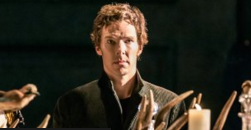
Academy Award® nominee Benedict Cumberbatch takes on the title role of Shakespeare’s great tragedy in the National Theatre Live broadcast: http://ntlive.com/hamlet

Academy Award® nominee Benedict Cumberbatch takes on the title role of Shakespeare’s great tragedy in the National Theatre Live broadcast: http://ntlive.com/hamlet

The live and encore screenings of Hamlet allowed audiences in the United States access to one of the hottest tickets in London this season.  The reason? Benedict Cumberbatch was playing the title role. Cumberbatch has made a name for himself in the PBS series  Sherlock (2010) and in The Imitation Game (2014) which earned him a Golden Globe, Screen Actors Guild Award, and an Academy Award nominations for Best Actor in a Leading Role.

At 39 years old, Cumberbatch played a bellicose, mid-aged Hamlet.
But while  Cumberbatch was the reason for the crowd, this audience had more in common with Gertrude, Hamlet’s mother. While the character of Gertrude could have been a child bride (12-15 years old), the youngest she could be is in her early 30s.
Hamlet is at minimum 12-16 years old, an age indicated in the Q1 or “First Quarto” the short early text of the play. The Gravedigger provides information that Yorick’s skull has been in the ground a dozen years since old Hamlet overcame Fortinbras, and that Yorick used to carry young Hamlet on his back.
But in a later version of the text (Q2)  the Gravedigger says that he has been in his profession since the day that Hamlet’s father defeated Old Fortinbras, on “the very day that young Hamlet was born.” He later adds that “I have been sexton here, man and boy, thirty years.”That would mean that Hamlet could be at minimum 30 years old, placing Gertrude at over 60 years old.
Anastasia Hille plays Gertrude

Anastasia Hille plays Gertrude

In this production, Gertrude was played by the actress Anastasia Hille as a woman in her late 50s. 10 years older than her co-star Cumberbatch, Hille was regal in each scene, graceful and lithe, her muscle tone noticeable in a brief appearance in a satin undergarment.

The audience clearly enjoyed the broadcast, hinting at familiarity with each scene. There was appreciation for some of the comic staging by the director Lyndsey Turner, including the arrival of Rosencrantz and Guildenstern, with military play toys as set pieces.
By Act III, there was an detectable level of anticipation for the closet scene, the scene where Hamlet stabs Polonius hiding behind the arras. From Hamlet’s entrance, “Now, mother, what’s the matter?” the audience seemed to tighten, eager to hear how these two would play the scene: he the accuser and she the astonished.
As scripted, Polonius had no sooner hit the floor then Hamlet turned to accuse his mother of murder:
“…a bloody deed! almost as bad, good mother,
As kill a king, and marry with his brother.” (III.iv.27-28)
HD cameras closed in on Hille’s astonished Gertrude looking past the bleeding body on the floor and deeply into her son’s face for answers. Cumberbatch’s Hamlet continued in a frenzy, pointing to a portrait of his father on the wall and to the reproduction of his Uncle Claudius’s face on a cheap souvenir commemorative plate:
“Look here, upon this picture, and on this,
The counterfeit presentment of two brothers.”(III.iv.54-55)
The tension from this exchange was palpable as Hamlet’s accusation spilled out into the air;
“….Ha! have you eyes?
You cannot call it love; for at your age
The hey-day in the blood is tame, it’s humble,
And waits upon the judgment:”(III.iv.67-70)
Translation? “Mom, you can’t possibly be swept off your feet–or make decisions based on sexual passion-you are too old!”
 
Audience response was immediate…a round of snorts and chuckles, that gave way to a few loud guffaws. This over 60 crowd, with its disproportionately high number of females in the audience, was having none of son Hamlet’s logic:
A mother’s heydey? Not over.
Gertrude tame? No way.
“What Hamlet doesn’t know,” they sniggered, “It ain’t over till it’s over.”
Was it the venue that let them feel more free to laugh?  Was it their way to express comfort with their sexuality? A response from a culture that celebrates “cougars” ? A reaction from the regular dose of TV ads promoting Viagra… for both sexes? I was struck at how this particular audience interpreted the line, disrupting the dramatic tension in so public a manner.
Their interruption was brief. Whatever empowered their response soon passed, and upon the entrance of the Ghost, the audience quieted.  The play continued without interruption, and by the end of Act V, the stage was littered with bodies.
This Hamlet in HD beamed by satellite to audiences around the world did not lose any of the emotional impact, and proves that regardless of how the production is presented, Shakespeare’s statement that “the play is the thing” is true for audiences. The National Theatre Live experience shared with aging baby boomers proves that who is in the audience matters as well.