Archives For March 31, 2016

There is always talk about preparing students for college and career readiness (CCR), but the recent simultaneous and collaborative news release of the Panama Papers by newspapers around the globe is an example of how preparing students using technology in the classroom can be taught as an authentic application.

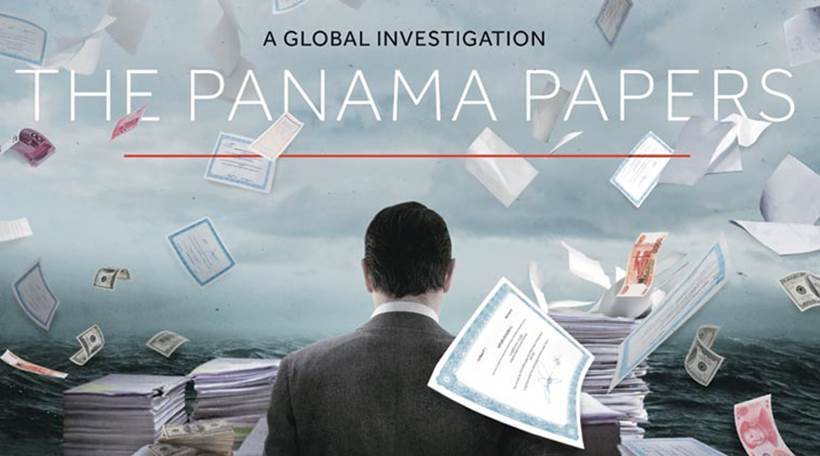
The Panama Papers Collaboration panama-papers-820
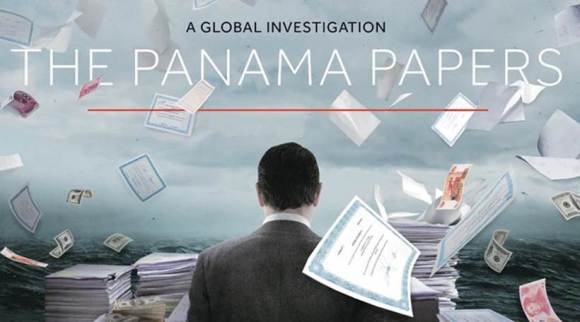
Under the headline OFFSHORE LINKS OF MORE THAN 140 POLITICIANS AND OFFICIALS EXPOSED, the The International Consortium of Investigative Journalists (ICIJ) and more than 100 other news organizations around the globe, “revealed the offshore links of some of the world’s most prominent people.”

“In terms of size, the Panama Papers is likely the biggest leak of inside information in history – more than 11.5 million documents – and it is equally likely to be one of the most explosive in the nature of its revelations.”

 The article in the NYTimesWorld|Here’s What We Know About the ‘Panama Papers’ explained the significance of the documents that were part of a cooperative global pact of reporting:

“The papers — millions of leaked confidential documents from the Mossack Fonseca law firm in Panama — identify international politicians, business leaders and celebrities involved in webs of suspicious financial transactions. The revelations have raised questions about secrecy and corruption in the global financial system.”

How did the ICIJ accomplish this simultaneous and collaborative news scoop? They used collaborative writing platforms.

Collaboration is the Key

In an interview with National Public Radio’s (NPR) Ari Shaprio, titled Panama Papers Leak Is The Result Of Unprecedented Media Collaboration the director of ICIJ, Gerard Ryle explained how the 100 media organizations around the world to were able to read and analyze the 11.5 million files from the Panama Papers leak. Ryle explained,

“We would never be able to do this kind of collaboration even five, six years ago. But technology has advanced so much that we can make all of these documents available over the Internet and pipe them right into all the newsrooms so that, I mean, we can have 10 reporters working in one newsroom. We can have 20 in another. We can have five in another. And they can all see the same documents, and we basically host all of the documents on servers and pipe them down over the Internet.”

The ICIJ was able to use digital platforms where documents could be shared in asynchronous collaborations, where news organizations could partner to connect, to share and to respond across time zones.

These same digital platforms are available in many classrooms today, where students can work in class synchronously or asynchronous with classmates as well.

A key difference between journalists’ practices and students, is that students are trained to be more cooperative and collaborative. Ryle describes how unusual the sharing of information is in the journalism profession:

” I had to unlearn everything I had learned as a journalist to do this kind of work. I mean, most of our careers, we basically don’t even tell our editors what we’re working on.”

In contrast, students today who understand the power of collaboration will not have to “unlearn” to be effective journalists.

Common Core Connections

Educators, especially those at the middle and high school grade levels, have been using these digital platforms to meet the key shifts in College and Career Readiness Standards (CCRS) as part of the Common Core:

“These standards require students to gather, comprehend, evaluate, synthesize, and report on information and ideas, to conduct original research in order to answer questions or solve problems, and to analyze and create a high volume and extensive range of print and non-print texts in media forms old and new. The need to conduct research and to produce and consume media is embedded into every aspect of today’s curriculum.”
Screenshot 2016-04-10 08.56.23

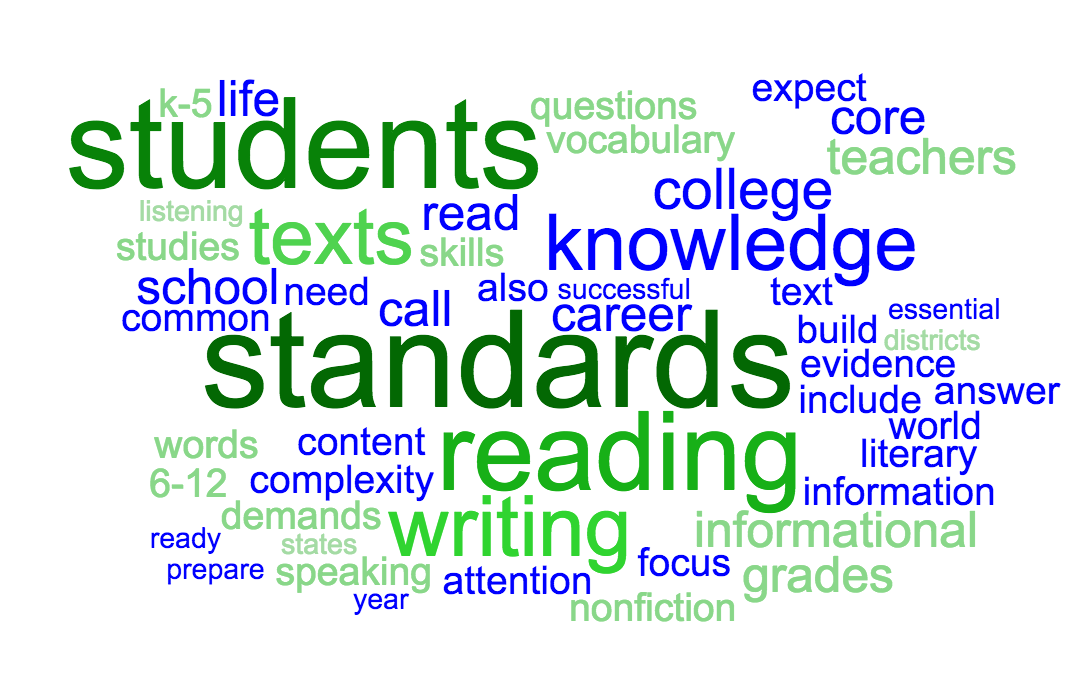
Word sift of common words in College and Career Readiness Standards

Within the Frameworks of the Common Core State Standards (CCSS) there is also a specific anchor standard for writing for all students:

CCSS.ELA-LITERACY.CCRA.W.6
Use technology, including the Internet, to produce and publish writing and to interact and collaborate with others.

Today’s technology allows students to mirror the same approach using same skills-as seen in word sift-(reading, writing, evidence, informational texts, answers ) that the international journalists in the ICIJ did in breaking this important news story. Students who use digital platforms are refining the same skills used by ICIJ -“The World’s Best Cross-Border Investigative Team.”

Multiple Platforms Available

Perhaps the best known platforms used in schools for teacher to student or student to student collaborations are on the sites such as Edmodo, WikispacesWordPress (and its companion Edublogs). A quick search on the Internet, however, will produce a multitude of additional options. For example, posts like 102Free (or Free to Try) Online Collaborative Learning Tools for Teachers (updated 2/2016) list the myriad of choices that educators can use to increase collaborations in the classroom. There are so many that, for example, the behemoth Google Drive is listed at #51:

Once known as Google Docs, Google Drive offers a comprehensive suite of collaborative, online tools: word documents, spreadsheets, presentations, forms or drawing files.

Celebrating Global Collaboration in Education

Moreover, just like the journalists who broke the Panama Papers stories, educators are experimenting with virtual collaborative experiences on a global level. There is a Global Collaboration Day (GCD) (celebrated the 2nd week in September) where the focus is on cooperation and collaboration to enhance global understanding so that students will have practice in both solving problems across borders when they enter the workforce and an appreciation for bringing global ideas to their own local experiences.

The GCD website describes how students can participate in authentic collaborations that are either short-term or long-term using blogs, wikis, or social media tools such as Twitter and Skype.

Next Generation

The next generation of journalists is being groomed in classrooms today, but for now, students and educators are increasing their proficiency with the same methods as the professionals in the International Consortium of Investigative Journalists.

The final project known as the Panama Papers has met the Common Core State Standards for College and Career Readiness…they might even get an A+.

There is a comedian whose improvisation routine includes asking “What if?” questions using Google search engine. Audience members call out a letter, the comedian enters “What if+ letter” in the search bar, he reads the first topic(s) that pop up, and then he jokes about that topic.

In honor of Shakespeare’s 400th, here is a try at the same routine (without the jokes) taken on (4/9/16)

Top 5 Google Search Results:

“What if Shakespeare…?”

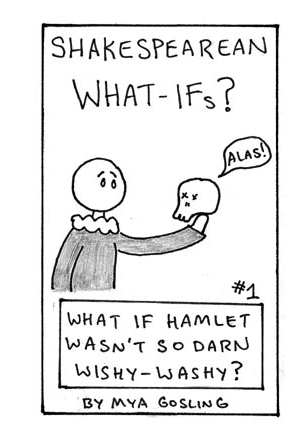
#1. Shakespearean What-Ifs — Good Tickle Brain

 This first entry to pop-up features the mini-comics of  Mya, artist and librarian who was introduced to Shakespeare at  eight or nine years old, and has been addicted ever since. She drew the first Shakespearean What-If in five hours for Mini-Comics Day at the University of Michigan Art, Architecture and Engineering Library.Screenshot 2016-04-09 08.47.35

Her “What ifs…” feature alternate Shakespearean timelines that “…hinge on a single moment when Tragedies could so easily become comedies, and comedies could so easily end in tears.”
Here’s a look at some alternate Shakespearean timelines that she offers for print:

If you are so inclined, feel free to download the Hamlet PDF and print them out full size (no scaling to fit page, thank you) Also Julius Caesar and Macbeth.


#2. Quote by Gayle Forman: “But what if Shakespeare― 

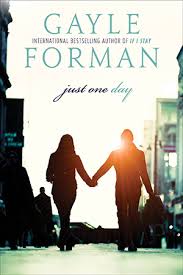
 “But what if Shakespeare― and Hamlet― were asking the wrong question? What if the real question is not whether to be, but how to be?” (1).Just one day

The second pop-up was a quote by Gayle Forman who is also writer, a writer that does not have to be assigned to read in high school. Young adults made her novel If I Stay a best-seller. She also wrote the novel Just One Day, in which the protagonist Allyson Healey’s post-graduation trip to Europe changes her life, She makes an uncharacteristically unpredictable decision to stay with Willem, a Shakespearean actor. The quote above opens the novel.

Forman’s bio on her website lists 13 interesting facts; here are three:
  • When I was little I wanted to grow up to be the sun. I was devastated to learn this was not a career option.
  • I bombed my SATs. I still did okay in life.
  • As a teen, I was so obsessed with Molly Ringwald that I started biting my lip like she did and now I have a permanent scar. And this is why I am a YA author.


#3. If Shakespeare Had a Sister

To be honest, Virginia Woolf’s 1929 essay, one that centered on how Shakespeare’s gender allowed him to become the great dramatist, occupied both #3 and #4 positions in the “What if Shakespeare?” search.
Woolf ‘s essay suggests that if Shakespeare had a sister, one who also was brilliant playwright, she would not have had the same opportunities to write and to stage plays,. Furthermore, she would be driven mad and would have died in obscurity. Woolf imagines this sister-Judith- who as a child,
“…picked up a book now and then, one of her brother’s perhaps, and read a few pages. But then her parents came in and told her to mend the stockings or mind the stew and not moon about with books and papers.”
Rather than marry, young Judith would run away from home, seeking drama,like her brother William, to express her genius:
“She had the quickest fancy, a gift like her brother’s, for the tune of words. Like him, she had a taste for theatre. She stood at the stage door; she wanted to act, she said. Men laughed in her face.”
Judith would meet a far different fate than her brother. Woolf suggests,
“that any woman born with a great gift in the sixteenth century would certainly have gone crazed, shot herself, or ended her days in some lonely cottage outside the village, half witch, half wizard, feared and mocked at.”

In her essay Woolf’s mourns not only the fictional Judith, but also the unheard voices of real women writers throughout history who suffered similar fates.


#4. What if… we didn’t have Shakespeare – Prospect Magazine

The subtitle of this article by Justina Crabtree Could Christopher Marlowe have equalled Shakespeare’s achievement? is a commentary on the budding genius of playwright Marlowe before his untimely end in a knife fight in a bar. Crabtree poses the question as to whether Marlowe might have had the same impact on language as Shakespeare did:

“Without [Shakespeare] him, nobody would “melt into thin air” (The Tempest), nor would there be “method in our madness” (Hamlet). We’d never be “in a pickle” (The Tempest), nor would we ever be a “laughing stock” (The Merry Wives of Windsor). Things would never go “full circle” (King Lear), or be achieved in “one fell swoop” (Macbeth).”

Furthermore, Crabtree ponders if Marlowe had the potential to match Shakespeare’s characters, those “truly rich, three-dimensional characters” which were a “progression away from the Medieval morality tradition.”


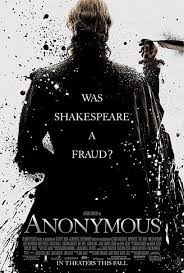
anonymousThis   or response –not a review- by Stephen Marche on Roland Emmerich’s film, Anonymous (2011) laments how the central question in the film, “Was Shakespeare a fraud?” was so poorly presented. As a professor who had taught Shakespeare in the past, Marche admitted that he is no film critic, but he is a critic of the flawed position that credited Edward de Vere as the real author of Romeo and Juliet, Hamlet, Othello, etc:
“And if you take “Anonymous” as just a movie, it may not even be that bad. I couldn’t possibly judge, because I was apoplectically stuttering about the inconsistencies…”
Marche is convinced that Emmerich’s film will drive students to challenge Shakespeare’s authenticity and sympathizes with the Shakespeare scholars who will be driven crazy with ridiculous speculations. As for Marche? He has no doubt about Shakespeare:
“So, enough. It is impossible that Edward de Vere wrote Shakespeare. Notice that I am not saying improbable; it is impossible.”

While I had thought five entries would be enough, the #6 entry is too good not to share

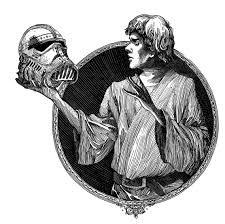
#6. What if Shakespeare wrote Star Wars? “Alas, poor … 

 What if William Shakespeare took a crack at Star Wars? Just imagine the classic Wookie and R2-D2 chess scene re-written as a Greek chorus.
Well, you do not have to imagine, because there is stirring in the Force, a new series of the Star Wars trilogies by Ian Doescher. An example?

Star Wars HamletLUKE Alas, poor stormtrooper, I knew ye not,
Yet have I ta’en both uniform and life
From thee. What manner of a man wert thou?
A man of inf’nite jest or cruelty?
A man with helpmate and with children too? 5
A man who hath his Empire serv’d with pride?
A man, perhaps, who wish’d for perfect peace?
Whate’er thou wert, good man, thy pardon grant
Unto the one who took thy place: e’en me.

The tagline? Zounds! This is the book you’re looking for.

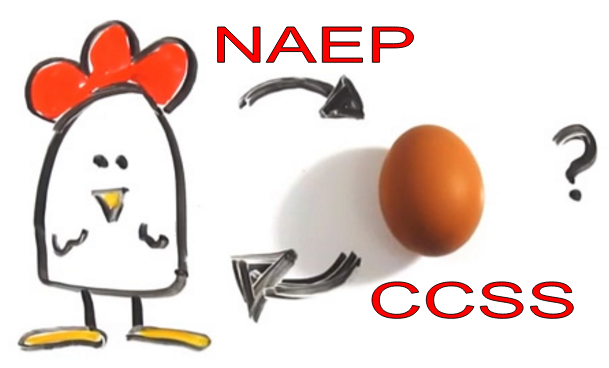
Screenshot 2016-03-29 10.37.46In a previous post, I discussed how the “Chicken or Egg?” conundrum is a way to view which agency-  National Assessment of Educational Progress (NAEP) or the Common Core State Standards (CCSS) – is responsible for the recommendations for fiction vs. non-fiction in a student’s reading diet.

In 2015, the NAEP the “largest nationally representative and continuing assessment of what America’s students know and can do in various subject areas” provided a voluntary survey on which teachers could select the literary genre they emphasized in class “to a great extent.” NAEP noted that over the past six years, there has been a steady increase in nonfiction in grade 4 and 8, a phenomena that coincides with the adoption of the CCSS and the revisions to the NAEP reading content. As the primary reason or as a result, the CCSS has promoted expectations that a student’s reading diet reflect a ratio  30% fiction and 70% nonfiction across the content areas by the time he or she graduates from high school.

Creative

The Evolution of Creative Nonfiction

Complicating the question of which came first, the CCSS recommendations or the NAEP, another genre has been evolving and gaining popularity with students at all grade levels, the genre of creative nonfiction. Creative non-fiction or the narrative non-fiction genre features the same techniques that fiction writers, playwrights, and poets use in order to present real people and events as stories while still using factually accurate prose. The goal of the creative non-fiction writer is to make nonfiction stories as exhilarating, arresting, vivid, or dramatic as anything in the fictional story.

In meeting that goal, consider how the Newbery Award winning children’s nonfiction author Russell Freedman (author of Children of the Wild WestLincoln: A PhotobiographyWashington at Valley Forge) has dipped into the fiction trademark, the story, by saying:

“A nonfiction writer is a storyteller who has sworn an oath to tell the truth.”

That desire to imitate a storyteller has been generated by a primitive need to communicate and to remember. The story, as author and consultant Lisa Cron explains in her book Wired for Story: The Writer’s Guide to Using Brain Science to Hook Readers from the Very First Sentence, allows humans to be human. She writes:

“Story, as it turns out, was crucial to our evolution—more so than opposable thumbs. Opposable thumbs let us hang on; story told us what to hang on to. Story is what enabled us to imagine what might happen in the future, and so prepare for it—a feat no other species can lay claim to, opposable thumbs or not. Story is what makes us human, not just metaphorically but literally.”

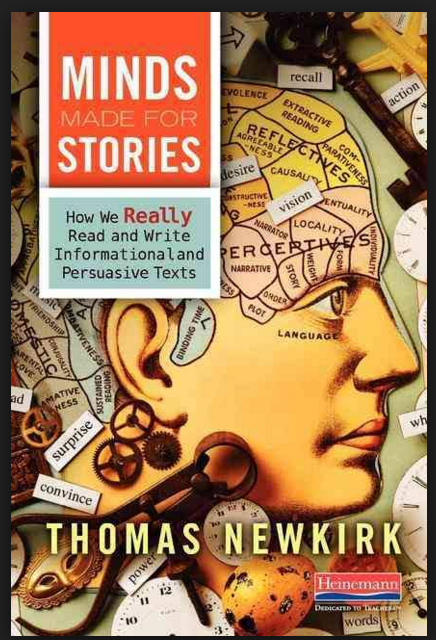
Screen Shot 2016-03-29 at 9.46.08 PMSimilarly, Thomas Newkirk, a faculty member of the University of New Hampshire, has argued that that we are hard-wired for the story format in his brilliant book Minds Made for StoriesHow We Really Read and Write Informational and Persuasive Texts. He writes that, “…as humans, as time-bound mortals, we must tell stories” as though the need to tell stories is instinctive as embedded in all humans as is our DNA. Newkirk explains:

“We rely on stories not merely for entertainment, but for explanation, meaning, self-understanding. We instinctively make connections of cause and effect, and always have. To deny the centrality of narrative is to deny our own nature” (146).

Examples of Creative Nonfiction by Grade Level

Consider the following examples of great openings that use the poetry, humor, or suspense, associated with fiction in different kinds of non-fiction.

The first is the short opening of the picture book Ivan: The Remarkable True Story of the Shopping Mall Gorilla by Katherine Applegate:

“In leafy calm, in gentle arms, a gorilla’s life begins.”

The poetic combination of “leafy calm” and “gentle arms” sets a peaceful tone that is soon disrupted when the infant gorilla is kidnapped from the Democratic Republic of the Congo and brought to Tacoma, Washington, to live his real life in a mall.

Or read the opening from the Ludwig Von Beethoven chapter, one of 19 truncated biographies collected for How they Croaked:The Awful Ends of the Awfully Famous by Georgia Bragg. Bragg knows her teen audience and keeps the pace moving quickly and informally:

“Beethoven’s dad forced him to practice the piano, like dads have done since the dawn of music. We don’t know what tunes Beethoven practiced, but today, kids are forced to play Fur Elise and Moonlight Sonata, melodies that Beethoven wrote. Practice paid off for Beethoven and he became a musical genius. He played his first gig when he was eight years old. He performed for kings, he did concert tours, and he had a lot of fans. And he had long hair just like a rock star. It turns out Beethoven’s hair helped uncover how he died.”

Yes, this does follow a standard biographical timeline, starting in Beethoven’s youth, and, yes, there is the gratuitous connection to rock stars and “gigs”. This entry-and all of the others in the book- capitalize on a multitude gory details in describing how famous real people in history “croaked.”

The last example is from the  opening of the 2013 multi-media Pulitzer Prize winning article in the NY Times  Snowfall: The Avalanche at Tunnel Creek by John Branch. This digital form of storytelling is an excellent piece for secondary students. It begins in medias res (middle of action):

“The snow burst through the trees with no warning but a last-second whoosh of sound, a two-story wall of white and Chris Rudolph’s piercing cry: ‘Avalanche! Elyse!’

The very thing the 16 skiers and snowboarders had sought — fresh, soft snow — instantly became the enemy. Somewhere above, a pristine meadow cracked in the shape of a lightning bolt, slicing a slab nearly 200 feet across and 3 feet deep. Gravity did the rest.”

Accompanying the text are snowfall loops of digital GIFs embedded with video, audio interviews, graphics, and other interactive features. I have written before that the text of “Snowfall” marks a new step in storytelling, a mentor text that models how to create a story where all forms of media support an author’s purpose. Real stories are breaking the 3rd wall in storytelling.

Preference for Narrative Nonfiction

In their books, both Lisa Cron and Thomas Newkirck have identified how our brains have preference for reading and writing the narrative. That preference is advancing genre adaptations that may render recommendations for reading diet ratios unnecessary, whether they come from the NAEP, the CCSS, or some other agency.

Because we are human, and because our brains want stories, the evolving genre of creative non-fiction is rapidly becoming another egg in the reader’s basket.