Archives For May 31, 2016

It is summer, and most elementary classroom walls have been laid bare for repainting or for cleaning. Their empty exposure reminds me of a classroom from an earlier age, from my own elementary school. From grade 3 on up, I could count on one singular decorative element….the cursive alphabet that hung over the chalkboard:

Cursive

Of all the letter companions, neatly penned in upper and lower case, the most fun to practice, the most enigmatic, the most beautiful-and the most confusing if not done correctly -was the letter Q q or Screen Shot 2016-06-27 at 6.01.18 PMScreen Shot 2016-06-27 at 6.01.05 PM.

Nothing else hung in the room.

Today’s elementary classrooms are markedly different. There are classrooms that receive Pinterest-inspired wall, door, or window treatments. There are multiple software programs that let teachers create posters or infographics chockfull of facts for every content area. Inspirational posters are ready to be to copied, to be downloaded, to be printed for every grade level. Once school is back in session, rainbow-brite colors combine messages with eye-popping fonts in a competition for attention.

And that’s the problem...competition for attention.

Apparently a supersaturated color and text-rich environment is not good for learning.

Beginning as early as preschool, classrooms may be decorated to an extreme. In many cases, “clutter passes for quality,” a  sentiment expressed by Erika Christakis in her book The Importance of Being Little: What Preschoolers Really Need from Grownups (2016). In Chapter 2 (“Goldilocks Goes to Daycare”) Christakis describes the average preschool the following way:

“First we’ll bombard you with what educators call a print-rich environment, every wall and surface festooned with a vertiginous array of labels, vocabulary list, calendars, graphs, classroom rules, alphabet lists, number charts, and inspirational platitudes – few of those symbols you will be able to decode, a favorite buzzword for what used to be known as reading”(33).

In addition, hanging in plain sight, Christakis notes, are a myriad of mandated regulations: hand washing instructions, allergy procedures, and emergency exit diagrams:

‘In one study, researchers manipulated the amount of clutter on the walls of a laboratory classroom where kindergarteners were taught a series of science lessons. As the visual distraction increased, the children’s ability to focus, stay on task, and learn new information decrease” (33).

Christakis’s position is supported with research by researchers from The Holistic Evidence and Design (HEAD) which assessed hundred fifty-three U.K. classrooms to study the link of classroom environment to the learning of 3,766 pupils (ages 5-11).  Researchers Peter Barrett, Fay Davies, Yufan Zhang, and Lucinda Barrett published the The Holistic Impact of Classroom Spaces on Learning in Specific Subjects (2016) and reviewed the impact of different factors on student learning measured by progress in reading, writing, and math.

The principle of stimulation included the measure the impact brought about by color and complexity:

“The scientific research into color is extensive and color can affect children’s moods, mental clarity, and energy levels (Englebrecht, 2003). The measure of complexity here relates to visual impact from both architectural and display elements in the classroom. For example, Fisher, Godwin, and Seltman (2014) found more distraction and off-task behavior in children in more visually complex environments” (Barret, et al).

Their results showed that both reading and writing performances were particularly affected by stimulation.

Stimulation in the form of posters has
 the potential 
of
 overwhelming
 a student’s working
 memory. According to Michael
 Hubenthal and Thomas
 O’Brien
 in their research Revisiting 
Your Classroom’s
 Walls:
 The 
Pedagogical
 Power
 of
 Posters (2009) a student’s working memory uses 
different components 
that
 process 
visual
 and verbal 
information
. The “
visual 
complexity 
caused
 by 
an abundance
 of
 text
 and
 small
 images” can set up an overwhelming visual/verbal competition between text and graphics for which students must gain control in order to give
 meaning 
to 
information.

In contrast to overwhelming posters, there are good choices for classroom decorations. Education reformer Alfie Kohn published suggestions for decorating the classroom in his article Bad Signs  (2010) fall issue of Kappa Delta Pi. He listed several “Good Signs” that a classroom could be decorated as a model learning environment:

  • Walls covered with student work;
  • Evidence of student collaboration;
  • Signs, exhibits, lists created by students (not the teacher); 
  • Information and personal mementos from the people who learn in the classroom.

Kohn also stated that the best classrooms, regardless of age level or academic discipline, have a different approach to decoration, one that is distinctly non-commercial. The best classrooms:

“….often feature signs, exhibits, or other materials obviously created by the students themselves.  And that includes students’ ideas for how to create a sense of community and learn together most effectively — as opposed to a list of rules imposed by the teacher (or summarized on a commercial poster)” (Kohn).

Just as too much color or text complexity will have a negative impact on student learning, a sterile classroom with too little decoration may not help to activate the students’ brains. Therefore, teachers should be prepared to decorate a classroom to make it an active place to learn. They could ask the following questions:

  • What purpose does this poster, sign or display serve?
  • Do  these posters, signs, or items celebrate or support student learning?
  • Are the posters, signs, or displays current with what is being learned in the classroom?
  • Can the display be made interactive?
  • Is there white space in between wall displays to help the eye distinguish what is in the display?
  • Can students contribute to decorating the classroom (ask “What do you think could go inside that space?”)

These six questions can help teachers to create classrooms that can engage students without overstimulation.

Speaking of questions, the word questions starts with the letter Q…and thanks to that singular decoration in my elementary classroom, I know how to script a  capital and lower case letter “Q”:q

It is still a beautiful letter in cursive.


Lin-Manuel Miranda’s gift to high school social studies teachers is Hamilton, his Pulitzer and Tony award winning play.  Using musical theatre, he rescued history from the mind-numbing facts listed in textbooks and gave students an alternative narrative, a hip-hop lens to view the tumult of America’s creation.

His gift to English teachers came on Sunday, June 12, during the Tony Award Ceremony in NYC. These awards were held the night after a mass killing in an Orlando, Florida, nightclub, and throughout the broadcast actors and actresses paid tributes to the victims.

When Miranda’s name was called for Musical Best Score, he bounded on the stage. He began this acceptance speech (the first of 11) with an apology, “I’m not going to free-style” (note: he is famous for his free styling poems) ….”I’m too old (note: he is 36)…”

He opened a folded paper:

“I wrote you a sonnet instead.”

A sonnet!

One can imagine the heads of English teachers nationwide snapping to attention.

A sonnet!??

That 14-line poem with a variable rhyme scheme that originated in 14th Century in Italy? (Yes!)

Sonnet? As in...Shakespeare? (Yes!)

Miranda began to read:

“My wife’s the reason anything gets done
She nudges me towards promise by degrees
She is a perfect symphony of one
Our son is her most beautiful reprise.
We chase the melodies that seem to find us
Until they’re finished songs and start to play
When senseless acts of tragedy remind us
That nothing here is promised, not one day.
This show is proof that history remembers
We lived through times when hate and fear seemed stronger;
We rise and fall and light from dying embers,
remembrances that hope and love last longer
And love is love is love is love is love is love is love is love cannot be killed or swept aside.
I sing Vanessa’s symphony, Eliza tells her story
Now fill the world with music, love and pride.”

Of course the sonnet was his choice to connect the joy of winning a Tony Award to his love and inspiration, his wife Vanessa. The sonnet was his poetic choice to contrast the heartbreaking tragedy of a massacre in a gay nightclub with the more powerful forces of music and love.

Why the sonnet?

Here’s a quick refresher on the sonnet:

  • it has 14 lines (could be stretched to 16 lines…and this sonnet was s-t-r-e-t-c-h-e-d)
  • it is written in iambic pentameter (a rhythm that sounds like 5 “heartbeats”)
  • it has a rhyme scheme:
    • Italian (Petrarchan): ABBA ABBA CDECDE or ABBA ABBA CDCDCD 
    • Shakespearean: ABAB CDCD EFEF GG (note: this sonnet is more Shakespearean)
    • The word sonnet means “little song.”
    • A sonnet traditionally settles upon a single sentiment (love, anguish, friendship, etc)
    • A sonnet has a “turn” (also known as the volta) where the question or problem posed in the first part of the poem is answered or solved in the concluding lines.

Miranda’s Sonnet

Like most poems, Miranda’s sonnet was filled with word play: allusions, metaphors, figurative language. Contained in the first quatrain of the sonnet was a musical conceit (extended metaphor), consistent with an award for “Best Score”; his wife and son are the “symphony” and “reprise” in this “little song.”

The next quatrain directly referenced to the Orlando shootings and the arbitrary violence, or “senseless acts of tragedy” that can happen at any moment.

Miranda then cited his play Hamilton as “proof that history remembers,” claiming that “hope and love last longer.” He then launched into eight (8) successive “love is,” an emotional refrain  (rhetorically, an epizeuxis: repetition without any words in between). He “sings” this symphony, just as the character Eliza Schuyler Hamilton tells the story of Alexander Hamilton.

And then came the volta or turn; the reason he “wrote you a sonnet, instead.” In the last line Miranda offers his answer, his solution to tragedy. His last line is a command, a command given to his audience watching the awards “to fill the world with music, love and pride.”

A Sonnet Instead

Tickets for the musical Hamilton will probably still be at a premium this coming fall, but this sonnet by Miranda is available-(and free!)- now.

English teachers can take this opportunity to share with their students these three points:

  1. That a poet who excels in free style rap chose a sonnet, instead;
  2. That a lyricist who reimagined American history through hip-hop chose a sonnet, instead;
  3. That an actor trained to gain an audience’s empathy through prose chose a sonnet, instead.

In making a choice in art to combat tragedy, the playwright Manuel Lin Miranda chose a sonnet, instead.

The term ekphrasis is Greek in origin, meaning “writing inspired by art”.

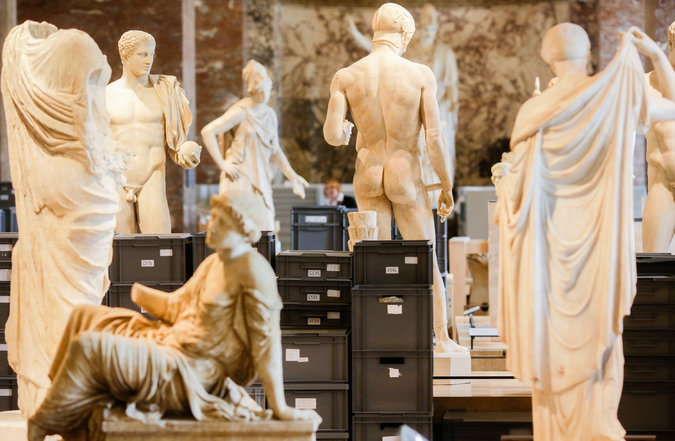
So, what better excuse for ekphrasis than Greek statues of antiquity? And where better to find Greek statues, than in a museum?

This past week, the Seine River that bisects the city of Paris ran over its banks, cresting at 21.3 feet. This flooding has meant that the curators of the many art museums and galleries that line the Seine scrambled to save works of art that had been stored below flood level. The Louvre Museum closed to the public as masterpieces were relocated to higher ground.

The lead story for the June 3rd, 2016 NYTimes, “In Paris, the Seine Rises to Highest Level Since 1982” (by Lilia Blaise and Benoit Morenne), reported on this disruption:

The evacuation of artworks from the Louvre, which was closed to visitors, has attracted particular attention…

…An estimated 150,000 artworks in storage rooms and an additional 7,000 pieces in galleries were vulnerable to flooding, and a large portion of those were moved to higher floors as a precaution, officials said.


6/3/16 NYTIMES: Staff at the Louvre scrambled Friday to move artworks to higher floors as Paris experienced its worst flooding in 30 years. Credit Markus Schreiber/Associated Press

 NYTIMES: (6/3/16) Staff at the Louvre scrambled Friday to move artworks to higher floors as Paris experienced its worst flooding in 30 years. Credit: Markus Schreiber/Associated Press


Here, then, is my art inspired poem-an ekphrasis


A Collection at the Louvre


Ancient visitors, unearthed from the basement,

fix their gaze on pieces from the collection

of 21st Century office furniture

in the famed Louvre’s Salon de Files.


They are stolid, polished rock, 

marveling at the smooth steel geometry:

a maze of files and crates;

appraising the nuanced shades of black:

obsidian, charcoal, onyx, jet;

admiring the asymmetrical shapes:

tall, narrow, wide, short.


They note the detailed inset pulls on metal drawers;

they puzzle over the labels on such Decorus artem,

translating into Latin or Greek

the names, dates, and numbers.

They pose and ponder in thought

as they have seen others do.


Sculptures who tilt an antique head

(if there is one)

or raise an antique arm

(if there is one)

to point and question, “Qu’est-ce que c’est?”

something they have heard others say.


Far in the background, 

a suspicious guard keeps watch

on this underdressed crowd.


They stand still, 

breathless,

as if poised to hear,

with their cool marbre ears,

the stories contained in these modern repositories.

“Si haec lima loqui. Quod si dixerint ad fabulas ?”

(“If only these files could talk. What stories would they tell?”)


This week’s Poetry Friday is hosted by Carol Varsalona on her blog Beyond Literacy Link. Stop there to visit some of the other poetic submissions for June 10, 2016.

The Memorial Day Parade in my town of Bridgewater, Connecticut takes 11 minutes.

Newcomers to town are told to “get there early, or you’ll miss it….and you had better get there early, because it begins at 8:15 A.M.”

Every year, there is a ceremony that follows the parade. The boy scouts lead the pledge, and students recite The Gettysburg Address. Small American flags are clutched in the hands of children, volunteer fireman in uniform stand at attention, and there is always a small puppy in the crowd.

The reason we gather together, however, is always for a more somber tribute. The names of those recently deceased residents who served in the military in defense of the country are read aloud. Then, there is a guest speaker.

Memorial Day

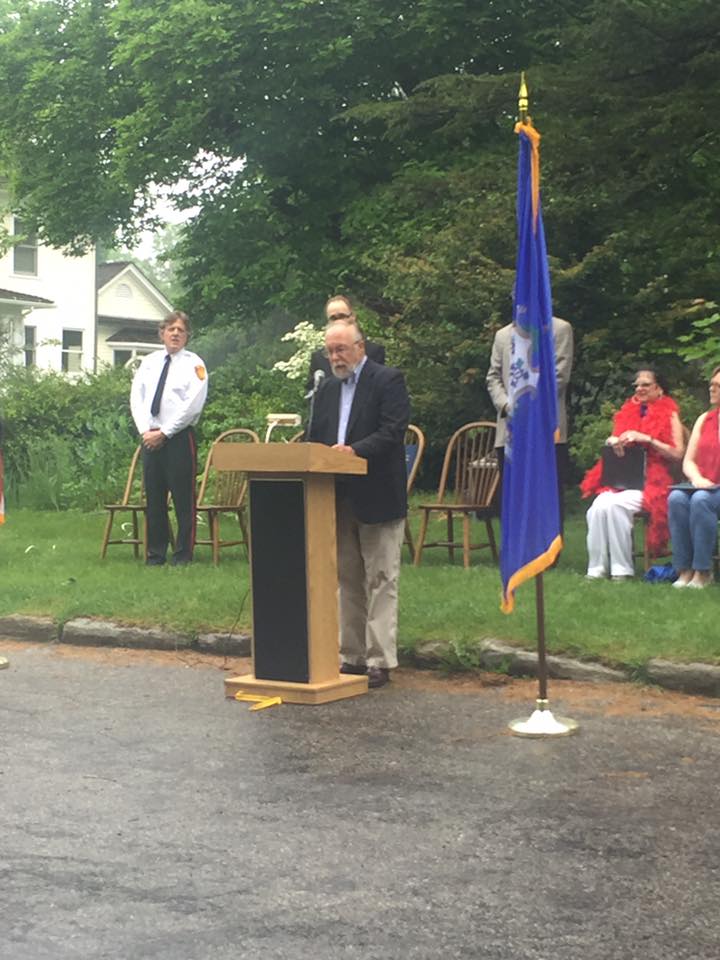
Bridgewater resident John Kracen telling his real war story

This year, resident John Kracen told a real war story.

He began his war story with the date: July 29, 1967, a “date that would change forever the lives of 5,000 men.”

He described the location: Gulf of Tonkin, during the Vietnam War.

He named the ship: the USS Forrestal.

As Kracen began his real war story, he described the ship, a Forrestal-class aircraft carrier: 990 ft at waterline, steam turbines, 33 knots. He then described the aircraft on board, and included the F-4B Phantom II that accidentally fired a Zuni rocket on the flight deck that July morning. He described how that misfired rocket hit another aircraft’s external fuel tanks leaking jet fuel, spreading a fire across the flight deck.

Kracen described how one of the Composition B bombs detonated minutes after the start of the fire, tearing a hole into the ship’s hull. He described how the shrapnel from that explosion pierced the water hoses of the fire crew and that the burning jet fuel drained into a lower bay of the ship.

Near me, a small boy sitting on the curb of the Green listening to Kracen turned to his mother. “What is happening, Mom?” he asked quietly.

“It’s a story,” she whispered back.

The boy turned his attention back to Kracen to listen.

Kracen continued telling the story of his friend, Stephen L. Hock, who had gone to help put out the fires that continued throughout the night. He described Hock’s kindness and his camaraderie.  He then told us that his friend Stephen Hock was one of the 134 men killed on the USS Forrestal because of the fire.

For a small town, 1,727 residents, Bridgewater has significant connections to history. During the morning’s Memorial Day Roll Call, there was “survivor of Iwo Jima” from World War II who had his name read aloud.  Now, his neighbors stood in the soft rain listening to a survivor from another historical event tell his story from a different war.

A war story has power when it is a first-hand account. The poet Walt Whitman (1819–1892) was a first-hand witness to events of the Civil War and his auto-biographical accounts of the Civil War were collected in several volumes. He spent time in the hospitals that were filled with the casualties from both sides, and the carnage led him to conclude,

“I now doubt whether one can get a fair idea of what this war practically is, or what genuine America is, and her character, without some such experience as this I am having. “

Whitman wrote of his difficulty to produce an “authentic” portrait of the war and in the essay titled “The Real War Will Never Get in the Books” (1875)  in Specimen Days, he wrote

Future years will never know the seething hell and the black infernal background of countless minor scenes and interiors…

….Think how much, and of importance, will be—how much, civic and military, has already been—buried in the grave, in eternal darkness.

John Kracen shared his own story with a crowd on Memorial Day to commemorate the sacrifice his friend Stephen Hock made, a sacrifice like so many other American soldiers who now lay buried in the grave, in eternal darkness. Kracen’s emotional account of the disastrous fire on the USS Forrestal was compelling because it was his first hand, his authentic account, his own story.

Research proves that our brains are hard-wired for such stories. We tell our children stories to explain how the world works; our children learn the quality of empathy through story.

This past Memorial Day in Bridgewater, the small boy sitting on the curb, the students in the school’s marching band, and the parents in the crowd heard Kracen tell his story of his experience during the fire on the USS Forrestal. They heard a powerful real war story, one that may never, as Whitman said, get in the books.