Archives For November 30, 1999

Books read in Grade 10- World Literature

I am sitting through a professional development session on how to use peer to peer writing conferences. I want to believe there will be a moment in this workshop when the “ah-ha” moment will happen, when I finally unlock the formula for successful in class peer to peer writing conferences at the high school level. The presenter reiterates how important this process is for writers to hear critical feedback to their writing. I hear again that “sticking with it and training students” to peer to peer conference are key ingredients that will improve student writing. Then I think of my students….my 9th, 10th and 11th grade students. This unspoken heresy forms in my mind:

Forgive me, well-intended and passionate presenter, but in my experience, in class peer to peer writing conferences do not work.

There, I admit it. Success in implementing face to face, peer to peer writing conferences, real critical encounters, has eluded me. I have 20 plus years in the English classroom, grades 6-12, and I have always come away from peer to peer writing conference sessions with the uncomfortable opinion that I have been wasting class time.

I now know why.
This summer, I am participating in the Connecticut Writing Project, and I have to write on demand, and then I must share that work. This is a horrible experience for me. I pass my paper wondering, “What will this person think of me?” and “What if there is a grammar error? I’m an English teacher!!” I have to provide feedback on a fellow teacher’s work, and I see the same kind of panic in her eyes.
I quickly reflect. How does my adolescent, pimply, over-stimulated teen-age boy feel as he hands in his rough draft for a critique by the fair skinned, sweet smelling young girl who sits behind him? How does that painfully shy artist who doodles his responses but has yet to complete a paragraph in writing feel about sharing his work with the amazingly popular class jock (boy or girl)?
I mention this to the presenter who says, “Yes, sometimes, there are student combinations that do not work.” That confirms my problem.

Problem #1: My struggle with peer to peer conferencing begins with setting up partnerships. Do I put the uneven writer with the good writer? Does the good writer need another good writer for good editing? Do I put two poor writers together and expect a miracle? Do I let the students choose their partners? How effective is the conference if friendship is in play?

Problem #2: The research shows that students should learn how to peer conference in the elementary and middle school grades to carry that behavior into the high school grades.However, I have found that training in writing conferences in the elementary and middle school grades is  erased in the high school environment. Many high school students claim to hate sharing their work with other members of the class; participation is mixed.

Problem #3: I teach in a regional school where one third of our freshman class comes from out of district schools. Several of these students have not had any training  in peer conferencing. The number of incoming students who are already uncomfortable in moving to a new regional school requires that I need to start at square one and  train everyone how to conference effectively.

Ultimately, I do not want to give up on students providing critical feedback to other student; I just want to take away the awkward immediacy of that face to face encounter. Since I teach in a 1:1 school district with digital literacy embedded in my curriculum, I will continue to use the solutions that have worked in place of those face to face, peer to peer writing conferences. I use digital conferencing.

Solution #1: I use blogs. Each blog is organized for a small group (8-10 students)   to use as a team. Only members of their team see their posts and comments over a period of time, say a semester or a school year. Students post book reviews, and other students comment on that post by asking questions about the book, or by making recommendations to improve the original book review  post. Each student must respond to the posted book reviews. Writing on the blogs allow students the physical distance they need to comfortably respond to each other. Written comments take time to construct, and students are more thoughtful if they know what they write will have a larger audience. Blogs let me  monitor the comments as well and determine which students are the most effective in providing good critical feedback to a student and which students are simply putting down, “great job!” or “I like what you wrote!” I might not have this information if the students were having face to face conferences. During my writing conferences with students I can follow up with the comment stream and target what is necessary to improve a critical response.

Solution #2: I use wikis. Students upload a report or story to a wiki page, and their peers can respond with questions and provide feedback in the comment section at the bottom of the digital page. Here too, the wiki page and the comment section will be seen by a larger audience and students are more thoughtful if they know their work will be read by an entire class. Responses in the comment section of the wiki also allows me to monitor who has provided good critical feedback to the writer.

Solution #3: I use Google docs. Students can upload their work to a Google doc and share that link with one or more students. Each peer reviewer can use the comment feature to provide feedback. This feature also identifies the peer conference partner on each comment he or she makes. All  comments by the peer reviewer are recorded on the document’s margin. An student author can even post questions about his or her writing in a comment box. The document can be also shared with multiple students who could work on the same document at the same time if necessary. All  comments are part of the document’s history, and I can monitor changes made by the student writer before and after a peer review. This method is particularly helpful if I have specific students who are hesitant about facing another student in a peer review.

Of course, all this digital peer to peer conferencing is improved if I provide students with  guiding questions (“Did the opening engage you as a reader?”) they would use in written conferences or if they prepare specific questions for the peer reviewer.

Digital platforms: wikis, blogs, and Google docs, allow me the means to provide peer to peer writing conferences by removing those awkward face to face conferences that I have found so unproductive in my high school classrooms. These digital platforms also let me organize students across class periods, and if I found a teacher in a cooperating school who wanted to peer conference, the digital platforms would allow my students to conference outside the classroom. Students still have plenty of opportunities for face to face encounters during class discussions and presentations, but they are comfortable communicating their feedback about a peer’s writing in a digital environment. And, heresy or not, I am finally comfortable with the productive peer to peer (via the Internet) writing conference.

Two weeks ago, I composed a post that questioned whether I should pass or fail E  a student in my English II class who could meet many of the benchmarks of English II but who had failed to complete the  assignments; I could not justify a passing grade. The post was published  a week later in the Teacher edition of Education WeekThe student’s pseudonym  “E” was replaced with “Elena”, and the post received a spectrum of replies (71 to date) which ranged from the hard-line stance of “flunk her” to a more forgiving “grades are meaningless so pass her” position. Responses questioned whether assessments are necessary to measure student learning; others argued that assessments are a means to measure student responsibility. What was the most striking was that these variety of replies to my post revealed the deep divides in teachers and other stakeholders’ opinions on assessing student performance.

There were a few answers that suggested  “how to” better measure student standards. For example, Craig M advocated a standards-based, formative/summative, 4-point grading noting “the 4-point scale changes the difference between passing and a zero from 60% to 20% (a 1 is a D)” and recommended I “look up The Case Against the Zero by Reeves.” Another practical suggestion came from LearnOutside, “The key accommodation that I always made in my classroom was to have a reasonable ‘late work’ policy that accommodated for some of my students’ inability to plan for the future. To me, it made sense to allow them to get partial credit. It tracks with what we know about the teenage brain’s capacity to deal with future risk/reward, and in the end gets them to do the work.”

A response by DrKenGoldberg did detect that E’s current status was not an isolated problem, suggesting that “these issues are often seeded by homework difficulties in the early grades….what most teachers don’t see is ‘the rest of the story’. I admit that for reasons of privacy, I did not detail E’s complicated family history.

There were responses that urged me to think beyond the limits of grades such as the post by Jerry Heverly who offered, “How foolish does all this national testing seem when I think of students like E and when I think of the people who have enriched our society without a high school diploma?” Similarly, Jan Priddy suggested, “It’s another matter of judgment. Education is not the same as building a roof. It’s an appealing analogy, but our students are people, not carpenters, and as teachers we work with minds, not lumber.” Similarly, Dan M noted that, “Most likely, E is not going to be entering corporate America upon graduation from high school or college if she chooses to go. Her actions have demonstrated evidence of this. But that doesn’t mean that she will be a failure in life. One of the mistakes we as educators make is trying to fit (and assess) all of our students within the same paradigm.”

Some were concerned with legal problems that arise from grading, especially Michael Keathley who stated, “We are a culture dominated by legalities. If such students were passed without demonstrating the knowledge by completing written assignments, etc., certainly lawsuits would follow.” His response was echoed by R.x  who suggested, “teachers can only assign the grades their administrations will support.” I would like to think that it was their responses and not my original post that led Thien Ha to conclude that, “this proves that American education system have too much powers on the hands of parents and students than school administrators, and teachers. Many students must pass even though they were not qualified to pass, since teachers have no power to fail or if they fail many students, they would be evaluated by parents by principals as a failure teacher, they might got fired.  “

Certain responses were sympathetic, the “I’ve been there” commiserating type. Duane Swacker considered that I should, “always give the students the benefit of the doubt as there is no teacher grading system that is accurate to even 5-10 percentage points. It’s a fallacy most believe in but grades, standards and standardized testing are all falsehoods with many errors involved in the process.” However, ArtG  scolded my “story of muddled thinking or rather, muddled by emotional overflow”.  In my defense, I would argue that he has never met E or seen her interactions with others; she is difficult not to like.

Ultimately, the see-saw of debate tipped toward taking a hard-line approach. Momwithbrain1 bluntly expressed, “today [students] think they can skate by and when they graduate and take on a job, that simply is NOT the reality. I’d rather they learn life lessons in school. She may have gained some knowledge in the class but she is also learning that she can be irresponsible and lazy and it has no impact on her.” Bntradical agreed stating, “When Elena enters the work world, she will get the job, because she knows the content, but if she fails to meet the real world deadlines, she will get fired. Thus, if you fail to fail her now, you will be failing her later in life, failing yourself, and failing society.” MrLionsDen added, “Failing, at any grade level, is an important life lesson and it’s not terminal.”

Nick Mangieri pointed out the problems that I could experience in the future saying, “What happens in the future when it becomes known that you don’t have to turn in the work in Mr/Mrs X’s class because you’ll pass anyway as long as he/she likes you?” Certainly BK was the most chastising, ” I really, really do not see a dilemma here. You are being paid whatever your contract says – and it’s fair, even though you are also ‘more than a unit to be measured.’ What if instead you were paid whatever your principal ‘feels like’? It seems like this is what you are considering here – and it’s utterly unfair to all the other kids who DID pass and DID earn their A’s and B’s.” Finally, I feel particularly responsible for the students of agardne3 who concluded that, “Your article has pushed me over the edge to grade them as they deserve.”

Numerous replies concluded that I speak to E once more as an intervention, a practice I had performed daily the entire fourth quarter. I was quite serious in when I spoke to E once more the last week of school; I did not hold out much hope after the conversation. I had heard her promises before.

But E strolled in the morning the day grades closed. Clutched in her hand were three missing major assignments…two dialectical journals and one motif paper. She sheepishly handed them to me, “I don’t care if they only get a few points, but would these be enough to pass?”

Yes. The missing work, given even a few points (20/100 each) would push her GPA into passing English for the year.

So I passed her.

She obviously was following the grade change on Powerschool,  and that afternoon she sent me an e-mail:

 I am so excited I passed, Thanks for the second chances!! If it wasn’t for those I would be taking it over. I highly appretiate [sic] it (:

Sharing this story of E has reassured me that I am not alone in wrestling with the obligations of judging student performance in a classroom. This forum has certainly informed me on methods I could employ in order to avoid this problem in the future. Despite the divisions in the commenters’ opinions, each response indicated a desire to help me be a better teacher, or at least help me avoid the an unnecessary dramatic finale for next year.

One of my favorite final exam questions to assign is a creative narrative assigned to sophomores who are challenged with reading World Literature. The prompt is  based on an imaginary literary awards ceremony that celebrates all of the literature read during the year. I cannot claim this is an original idea; a fellow teacher, Trish,  gave me the prompt several years ago when we both taught sophomores, and the results have never disappointed.

What our imaginary literary awards ceremony might look like!

The prompt asks the student to chose any three characters from the literature read in class as candidates for “The Most Interesting Character of the Year”Award, the coveted MIC. This question is provided to the students at least one day before the exam so that students have time to select the characters and collect evidence.When the students spend a class period preparing for the exam, they are provided a 3X5 index card to write down the quotes and any other evidence they may wish to incorporate in the essay. The card is stapled onto the essay; students who do not use a card lose five points on the essay response.

The student must write a self-nomination speech in the voice of each character in which the character discusses his or her motivations; relationships with other characters; and accomplishments and/or failures.  Each character must also compares/contrasts himself or herself against the other nominees. The name of the work (underlined or in quotes), the author of the work, and at least one quote from the literary work said by or about each nominee is also required. Students are cautioned that they must use MLA style for the integration and and citation of evidence.

While I hate grading a stack of final exam essays, this particular prompt always provides some interesting responses. Rarely is there a combination of characters repeated. Furthermore, although there are plenty of Macbeths, Beowulfs and Paul Bauers, there are an equal number of minor or obscure characters. For example, there have been nominating speeches from the Porter in Macbeth, the airman in Yeat’s An Irish Airman Foresees His Death; one student even wrote from the perspective of Bulleye, Bill Sykes’s dog in Oliver Twist.

There have been students who include details from the ceremony itself (“Live from Hollywood!”), decribing the location or decorations. Several students have had the nominees deliver their nomination speeches from a red carpet area, and many students choose another character, classmate, celebrity act as the evening’s emcee; others use a twist on the American Idol model. Students have included dialogue between characters during the ceremony, while other students have had characters hurl insults at each other.

For example, one student had the witches from Macbeth serving as the evening’s emcees who introduced each nominated character saying, “By the pricking of my thumbs, one more wicked than the other comes.” Another had a “fierce and reckless Grendel” prowling in the audience in order “to snatch thirty audience members from their slumber” when he was suddenly called up to the podium to deliver his own nomination. His monosyllabic charming and tearful self- nomination speech (“You like me!”) was interrupted when the band began to play, and the student wrote that Grendel once again became that “powerful monster, living down/ In the darkness, [who]  growled in pain, impatient/ As day after day the music rang /Loud In that hall,” and charged off the stage with his prey. Another student had Fagin from Oliver Twist give his nomination speech performing magic and juggling tricks while the Artful Dodger led a group of pickpockets through the audience.

My favorite response came two years ago when a student nomintaed Napoleon from Animal Farm and placed him on the dias where he was heckling Heathcliff  from Wuthering Heights and Jack from Lord of the Flies as each gave a self-nominating speech. Suddenly, a flash of lightning blinded the audience for several seconds, and when they had regained a view of the dias, only two nominees remained. Napoleon, like so many of Stalin’s government officials, had mysteriously vanished!

Students never have any trouble filling three full pages of content for this essay response. I grade each of the three essays holistically with special attention given to the incorporation of quotes as evidence and the motivations of each of the nominees. An “A” response would:

  • Demonstrate a clear understanding of the assignment’s purpose (writes in each character’s voice)
  •  Evaluate relevant significant points of view (character, audience)
  • Gather and integrate sufficient, credible, relevant evidence (minimum on quality quote) and cites evidence correctly (MLA)
  • Use standards of English correctly (particular attention to mini-lesson topics) including spelling and capitalization (titles, character names)

Recently, we were aligning our curriculum with the 10th Grade Language Arts Common Core Standards when we came upon standard W.9-10.3: Write narratives to develop real or imagined experiences or events using effective technique, well-chosen details, and well-structured event sequences. The narrative is not a form we generally use in grade 10, so as we were puzzled if we addressed this standard at any point in our curriculum, we remembered the Most Interesting Character Award essay. We determined that this essay allows us to meet standard W.9-10.3 without designing a new lesson/assignment.

I do not require students to pick a winner for this exam question, in fact, I think it is easier for them to write with no winner in mind. No pre-determined winner allows them to write the ultimate cliff-hanger….”and the award goes to_____?”

E is a beautiful young 16 year old who blithely drifted in and out of my English II classroom this year without any materials. She seemed surprised to find herself in the class every day. She is pleasant, friendly, and well-liked by her peers; we have a cordial relationship. Unfortunately, E achieved a 31% in English for the first quarter, which seriously damaged her GPA for the remainder of the 2011-2012 school year. Over the course of eight months, E continued to leave assignments incomplete and did little classwork, choosing instead to text or to socialize with the students sitting around her. She lost study guides, lost materials, and lost interest in editing and revising her work. She once sent me an e-mail telling me she “could not get online to see the assignment.”

This  week, I will enter her final grade.  After  four quarters of assigning, collecting, correcting, and returning, I am looking at a failing grade (just below a 60%). Her grade must be a reflection of her academic ability….or is it?

I am in the Groundhog Day of academics when every June I  experience this exact philosophical dilemma: Do I pass a student who understands the materials but who has not completed the assigned work or do I enter a failing grade? Over the course of the year, I am careful that the work I do assign is critical to assessing student understanding. Assigned work should be meaningful and assessed accurately, a process that should result in plenty of data (tests, projects, quizzes) that determines student progress. However, and perhaps more importantly, there is also anecdotal information to consider; classroom performance is the  “third leg” to the footstool of data collection.

While class was in session, and E was engaged, she made contributions. I recently overheard her explain the complicated allegorical ending of The Life of Pi to a fellow student (“The author is saying you have to decide which story is the true story…”). In March she made connections to the  Kony 2012 campaign after we watched Hotel Rwanda as part of our  Night unit. She casually suggested that over time Lady Macbeth “developed insecurities and should have taken a little Valium to settle her nerves.” She equitably included fellow students in “tossing” the plush witch doll when the class was reviewing important lines from the play, and she decided that the witches should be assigned 70% of the responsibility for Duncan’s death but only 20% of the responsibility for Banquo’s death. She noted that Macbeth was deteriorating as a “human” as his guilt increased. She empathized with Oliver Twist (“If I was an orphan, I might have been a pickpocket too…”) and suggested that the “Irish Airman Who Foresees His Death” had a “need for speed.” She understood an author’s purpose, tone, and use literary devices. I anticipate she will have a passing grade on the state mandated assessment that she took in February.

On the rare occasion when E turned in work, she demonstrated that she was capable of writing on grade level. Numerous common assessments taken in class indicated that her reading comprehension was also on grade level.   She remained blissfully unconcerned as I cajoled, teased , chided, scolded, and threatened her into completing work. Calls home were unproductive, and other teachers indicated that English was not the only cause for academic concern. The school year was maddening.

Now, as the grades are totaled in June, I wonder, do I hold her accountable for work left incomplete? Can she be exempted from the assignments that all her classmates completed? What is the minimal number of assignments that are the most important to determining student performance?  If I exempt her from less important assignments, am I reinforcing her lack of responsibility? Finally, is passing her fair to the students who did complete the work assigned?

I have been teaching for over twenty years, and I still wrestle with the emphasis placed on grades. Do grades really reflect student ability? There are students in the class who have completed all of the work I assigned. Does their “B” grade mean they really understand 85% of the material? Does E’s failing grade mean she understands less than 60% of the material in grade 10 English? Will enrolling her in another year in 10th grade English bear a different result? Is she prepared or unprepared to meet the rigors of Grade 11 English?

These philosophical questions become more complicated as education is increasingly driven by data. Student performance is quickly aggregated and evaluated using collective (vs. class) and individual (vs. self) bits of data. Mean scores and t-tests are recorded, spreadsheets are created, and reports generated to create “smart goals” that target instruction. Ultimately, assessment data will be used to evaluate teacher performance. Unfortunately, E’s overall 10th grade performance in English  has been measured by a lack of data.

Ultimately, I need to make the decision that relegates E to summer school, requires her to repeat Sophomore English, or allows E to move to  Junior English. Every year I am in the same philosophical dilemma with a student who defies the conventions of assessment. This year it is E; last year it was J. Every year I wonder how I can make this objective data-driven decision when the subjective experience in the classroom informs me so differently? My professional experience as an educator encourages me to see E as more than a unit to be measured. Finally, while I am painfully aware that the decisions she has made directly  impacts the decisions I now must make, she remains characteristically blithely unaware.

To pass or not to pass? That is the question.

UPDATE


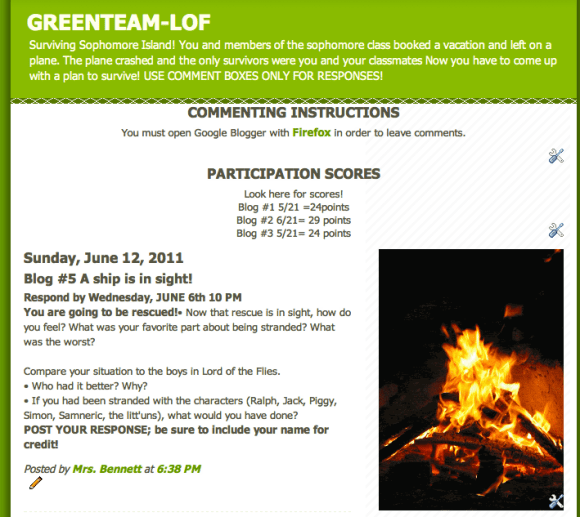
YOU AND MEMBERS OF THE SOPHOMORE CLASS BOOKED A VACATION AND LEFT ON A PLANE. UNFORTUNATELY, THE PLANE CRASHED AND THE ONLY SURVIVORS WERE YOU AND YOUR CLASSMATES. NOW YOU HAVE TO COME UP WITH A PLAN TO SURVIVE! 

This is the bold notice at the top of each of five blogs that the grade 10 teachers organized for teaching William Golding’s novel Lord of the Flies. This survival game is played in the English World Literature course at the end of the school year. The intent is to engage an entire grade level of 10th grade students in discussing a text without the limitations of the class schedule.

The game is simple: there are five teams (red, yellow, blue, green and orange) that are invited to a blog to respond to posts within a short period. Once the students are sorted onto teams (2 or three in each class period on one team), they respond to a post on their team’s blog using the comment box. Points are awarded on the percentage of team participants who respond to a blog post, and the winning team receives a 100% test grade.

The five posts on each blog are scenarios adapted from a number of similar activities I have found on the Internet. We used Blogger for our platform without much difficulty last year; this year their new interface has been glitchy, but since the game is about survival of the fittest, we have soldiered on! Each post deals with a scenario similar to the daily experiences of Ralph, Piggy, Jack and the choirboys, etc. The posts are uploaded over the course of a  two week period.

Post #1 deals with a list of 15-20 resources that were “recovered from the plane.” The post asks students to comment individually, “What do you do now?”

Post #2 poses the next complication suggesting that a giant storm seriously damaged their resources, “So, what happened to the supplies you gathered yesterday?” (ex: Bed Sheets: blew away in the storm last night; mosquito netting: large gashes/holes created by trees in the storm)
“What do you and your fellow survivors do now? What supplies do you have remaining? How are you using these remaining supplies?”

Post#3 Provides directions for shelter, fire and potable water. The post reads, “While you and some members of your group were building the shelters, digging the fire pit, and setting up the water supply; two (2) of your members decide that they are tired of working and want to go swimming instead. What do you do with the slackers in your group?”

Post #4 begins, “You wake up on the third morning to find that half of the food you had taken from the plane and gathered since is gone. Either some sort of animal has taken it, or one of your group members has taken it and hidden it for himself or herself. You start out the day suspicious of the other members of the group – and hungry!
• What sorts of rules/procedures are you going to put in place to make sure your food and water supplies do not get stolen or contaminated?
• Now that you are suspicious of your other group members, how are you going to act around them? Are you going to be able to continue to work together? What is your plan for discovering who took the food? What will you do with that person when you find him or her?”

Post #5 is the final opportunity for students to participate. The post reads, “A ship is in sight! You are going to be rescued! Now that rescue is in sight, how do you feel? What was your favorite part about being stranded? What was the worst? Compare your situation to the boys in Lord of the Flies. Who had it better? Why? If you had been stranded with the characters, what would you have done?”

This year’s comments were similar to responses from previous years with team members discussing suggestions for survival:

  • Nobody goes off exploring alone, pretty much NOBODY GOES ANYWHERE ALONE. We don’t know what’s on the island but if we stay together and work as one, unified, force; we will get off of this island alive. There’s no doubt in my mind that we WILL get off of this island. 
  • Water will be gathered by our “plastic bags” that we have laid out in a hole, held together by rocks. The water will be collected by nearby dewey grass etc. The rest of our plastic bags will be placed in a hole on top of a cup-or carved out fruit shell if cups are not available. 
  • The food has already been taken. Yes, it is maddening that one on our own team would have taken food from their own, but what can you do? I would move on, with a warning that if this ever happens again, whomever dared to steal twice will be exiled.
  • To deal with the ones that aren’t helping, we should put dead fish in their beds and then we’ll see who doesn’t wanna work then. 🙂 
  • Our slackers on the other hand will be banned from any rations of food caught by our hunters. The only way to become accepted is to find food elsewhere, and make sure (the slackers) they are able to feed the rest of the group.
  • To keep the fire going there should be a 2 person shift, and while one sleeps the other maintains the fire. The shift will be rotated i.e. 2 new people every night. 
  •  im surviving so as long as the slackers arent affecting me then they’re not my problem, if they were affecting me then id prbably end up killing them in a survival situation
  •  You never know who it could be so there’s always that feeling of suspicion while you’re near and working with the other group members
  • For the slackers, they can continue to eat the food and stay in the shelters. Karma will get em.
While Golding did not write Lord of the Flies as an adventure story that is in the same genre as Robert Louis Stevenson’s  Robinson Crusoe or Robert Zemeckis’s film Castaway with Tom Hanks, there are elements of survival that make the book appealing to 10th graders. Once they are placed on “Sophomore Island,” the Blogger platform lets them communicate their expectations as to what might happen in the unlikely event they were marooned with classmates. Not surprisingly, they often found themselves frustrated and caught in similar power struggles as those between Jack and the hunters and Ralph and Piggy. Once they are on “Sophomore Island” they discover Golding’s real reason for the novel, for the Lord of the Flies who challenges them by asking, “I’m the reason why it’s no go? Why things are the way they are?”  Their virtual experience on “Sophomore Island” helps them understand why Ralph would weep “for the end of innocence.”

 The marathon of testing  is over! In the State of Connecticut, the two week window for the Connecticut Mastery Tests (CMT -elementary) and the Connecticut Academic Performance Test (CAPT grade 10) has ended, and some teachers are looking at the two week “hole” in grade books and unit plans that the intensive state testing created.

While education experts strongly advocate against “teaching to the test” and advocate the development of skills, most classroom teachers feel some obligation to prepare students for the tests by simulating at least one timed practice session for a specific test. Our state releases past testing materials for each discipline, and to be honest, our students do a fair amount of practice with these released materials before the test.

For the past two weeks, the daily school schedules have been modified to accomodate early morning testing sessions. During the school day, the lessons for students who have spent a grueling 45-90 minutes calculating or writing have been modified as well. For example, when they finally have  attended English classes, our tenth grade students have been provided silent sustained reading time for books they have independently chosen or have been watching videos to supplement a world literature unit on people in conflict.

The reading or Response to Literature test, associated with English classes,  requires students to read a short story and then write four lengthy  responses. Sadly, year after year, the quality of the story on this test pales in comparison to the classic short stories a student will encounter in even the most limited literature anthology. So we prepare students how to respond to  a question that asks “Is this good literature?” with even the most mediocre story.  Now that that the test is over,  students will begin the epic poem Beowulf, and the teachers are looking forward to having the students engage with this 8th Century grandfather of literature. We are ready for some “epic-hero-wrenching-monster’s-arm” action.

The writing or Writing Across the Disciplines test, associated with social studies, requires students to read newspaper articles about a controversial  topic, take a position on the controversial topic, and then develop a persuasive argument. There is absolutely no content from the social studies curriculum, in this case Modern World History, associated with the test. Now that this test is over, teachers can return to history content outlined in their curriculums; back to the arrival of the American forces on the shores on Iwo Jima and in the forests of the Ardennes.

Pencil and scantron testing is not an authentic practice in the world outside the classroom, but I am not against testing as a means to determine student progress; I accept that some form of testing is inevitable in education. However, the past two weeks of reading instructions (“Does everyone have two #2 pencils?”), writing in booklets (“Stop. Do not turn page”),  and racing against the clock (“You have 10 minutes left”) has taken a toll on students and faculty alike. Everyone is looking forward to the routine of a regular schedule.

Wearily, our students climbed the stairs for the last time this morning after taking the final  “supplemental” test, an extra assessment given to test materials for future test-takers. The students’ time in the testing crucible had passed; their scores will be posted during the the lazy days of summer when this experience will be nothing but a memory. Hopefully, they will have done well, and we will be pleased with the results.

Post-CAPT, there are several weeks left in the third quarter, and one full quarter after that.  Teachers can return to content without incorporating CAPT preparation with clear consciences. Our tenth graders will have the chance to read Macbeth where they will have the opportunity to create and respond to more significant questions than “Is this good literature?”  The importance of this great play placed against the activities of the past two weeks puts me in the mind  to parody Shakespeare’s famous speech-

Out, out, two weeks of testing
The CAPT is but a walking shadow, a poor player,
That struts and frets his hour upon the stage,
And then is heard no more. It is a test,
mandated by others, full of sound and fury,
Signifying nothing.

NEWLY EDITED 12/29/12:
I hate Reader Response Theory, one that considers readers’ reactions to literature as vital to interpreting the meaning of the text.

CHANGED TO:
I hate how Reader Response Theory has been abused by standardized testing. Two most annoying questions for me in the Connecticut standardized testing for reading (CAPT-Response to Literature) are reader response based questions to a short story prompt:

  • CAPT #1:What are your thoughts and questions about the story? You might reflect upon the characters, their problems, the title, or other ideas in the story.
  • CAPT #4: How successful was the author in creating a good piece of literature?  Use examples from the story to explain your thinking.

After 10 years of teaching with this standardized test, I can recognize how many of my students struggle with these questions. Many lack the critical training gained from extensive reading experiences in order  to judge the quality of a text. Combine this lack of reader experience with the see-saw quality of the text on the exam year to year.  Since classic short stories such as those by Saki, Anton Chekhov, Kate Chopin, Stephen Crane, and Jack London, to name a few, are considered too difficult for independent reading by 3rd quarter 10th grade students, more contemporary selections have been used on the exam. For example, these stories in the past years have included Amanda and the Wounded Birds by Colby Rodowsky, Catch the Moon by Judith Ortiz Cofer, and a story written by Jourdan U Playing for Berlinsky published in Teen Ink. While some stories are well-written, many lack the complexity and depth that would generate thoughtful responses to a prompt that asks about “good literature.”  My students are in the uncomfortable position of defending an average quality story as good; the prompt promotes intellectual dishonesty.

So, I use a formula. I teach my students how to answer the first question by having them list their intellectual (What did you think?) and emotional (What did you feel?) reactions to the story. I have them respond by listing any predictions or questions they have about the text, and I have them summarize the plot in two short sentences. The formula is necessary because the students have only 10-15 minutes to answer this in a full page handwritten before moving to another question. The emphasis is one that is reader’s response; what does the reader think of the story rather than what did the author mean?

I teach how to answer the evaluation question much in the same way. Students measure the story against a pre-prepared set of three criteria; they judge a story’s plot, character(s) and language in order to evaluate what they determine is the quality of the story. Again, this set of criteria is developed by the student according to reader response theory, and again there is little consideration to author intent.

The newly adopted Common Core State Standards (CCSS) in Language Arts is designed differently. The  focus is back on the text; what the reader thinks is out of favor. For example, in three of the ten standards, 10th grade students are required to:

  • Analyze how complex characters (e.g., those with multiple or conflicting motivations) develop over the course of a text, interact with other characters, and advance the plot or develop the theme;
  • Determine a theme or central idea of a text and analyze in detail its development over the course of the text, including how it emerges and is shaped and refined by specific details; provide an objective summary of the text;
  • Cite strong and thorough textual evidence to support analysis of what the text says explicitly as well as inferences drawn from the text.

Please note, there is nothing in the language of the standards that asks what the student thinks or feels about the text.

In an article titled, “How Will Reading Instruction Change When Aligned to the Common Core?” on The Thomas B. Fordham Institute website (1/27/2012), Kathleen Porter-Magee  discusses the shift from the student centered response to the CCSS  “challenges to help students (and teachers) understand that reading is not about them.”

Porter-Magee  describes how David Coleman, one of the architects of the CCSS ELA standards, is promoting the close reading of texts, sometimes over extended periods of several days. The article notes that currently, “teachers often shift students’ attention away from the text too quickly by asking them what they think of what they’re reading, or how it makes them feel. Or by asking them to make personal connections to the story.” Coleman states that, “Common Core challenges us to help students (and teachers) understand that reading is not about them.” Instead, he advocates the practice of close reading, a practice that  “challenges our overemphasis on personal narrative and personal opinion in writing classrooms.”

In addition to the movement away from reader response criticism, the CCSS will be upgrading the complexity of the texts. Porter-Magee notes that,

“Of course, there’s only value in lingering on texts for so long if they’re worthy of the time—and that is why the Common Core asks students to read texts that are sufficiently complex and grade-appropriate. Yes, such texts may often push students—perhaps even to their frustration level. That is why it’s essential for teachers to craft the kinds of text-dependent questions that will help them break down the text, that will draw their attention to some of the most critical elements, and that will push them to understand (and later analyze) the author’s words.”

In other words, the quality of the texts will be substantively different than the texts used in the past on the Response to Literature section of the CAPT. This should make the response about the quality of text more authentic; a genuine complex text can be analyzed as “good literature.” How the more complex text will be used in testing, however, remains to be seen. A student trained in close reading will require more time with a complex text in generating a response.

I confess, the movement away from reader response is a move I applaud. A student’s response to a complex text is not as important in for the CCSS as what the text says or what the author intended, evidence will supplant opinion.

However, I am very aware that the momentum of the every swing of the educational pendulum brings an equal and opposite reaction. Swish! Out with reader response. Swoop! In with close reading of complex texts. Students,this swing is not about you.

Beware the Ides of March!
March Madness!
Mad as a March Hare!

Why so much warning about March?
Well, here in Connecticut, our students are preparing for the Connecticut Mastery Tests (CMT) in grades 3-8 and the Connecticut Academic Performance Test (CAPT) in grade 10 which are given every March. While every good teacher knows that “teaching to the test” is an anathema, there is always that little nagging concern that there should be a little practice in order to anticipate performance on a standardized test. So, we “practice” to the test.

In English, 10th grade students participate in a Response to Literature section of the test where they read a selected fiction story (2,000-3,000 words; RL 10th) and respond to four questions that ask:

  • a student’s initial reaction;
  • to note a character change or respond to a quote;
  • to make a connection to another story, life experience, or film;
  • to evaluate the quality of the story.

Unfortunately, an authentic practice for this test is time consuming, requiring 70 minutes which includes the reading of the story and the four essays, roughly a full hand-written page response to each question. Needless to say, our students do not like multiple practice tests for the CAPT, so developing the skills needed to pass the Response to Literature must be addressed throughout the school year.

When practice time does arrive,  students can be “deceived” into CAPT practice through technology. We have been trying two abbreviated practice approaches using our class netbooks where students actively read a text using hyperlinks or use quiz/test taking software. In these practice assessments the student responses are typed and shorter in length, but still cover the same questions. A hyperlinked test practice, including the sharing of results, can be done in one  40 minute class period.
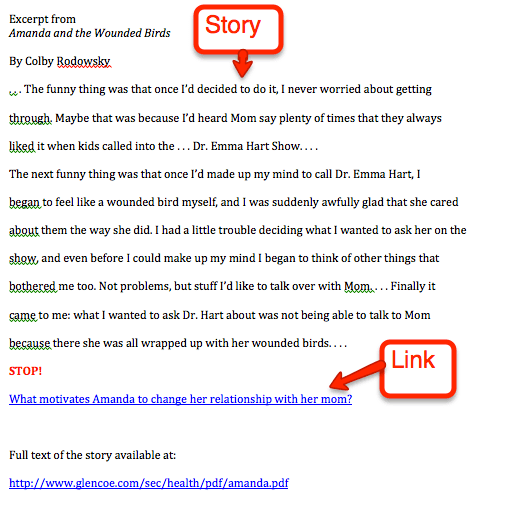
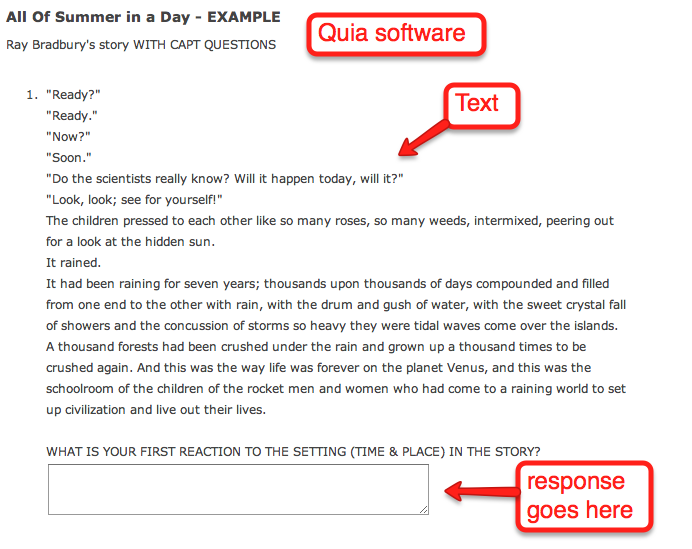
In the first approach, we select a short story that can be read in under 15 minutes and embed questions at critical points in the text that are tied directly to the Response to Literature questions. The students then respond to these questions as they read. The easiest software to use in creating a hyperlinked text is Google Documents using the “form” option to create individual questions. Each question’s URL link can be hyperlinked at specific moments in the text. An example is seen below. Multiple choice , scale or grid question are alternate selections that can be embedded in a story in order to provide a quick snapshot of a group’s understanding by looking at the “show summary of responses” option once the assessment is complete. There are many short stories in the public domain which can be posted on a site such as Google Docs for  student access in order to not conflict with copyright laws.

The second approach uses quiz and test taking software, such as Quia, where a teacher can paste sections of the text with question posed at the end of each section. Ray Bradbury’s All of Summer in a Day  (under Creative Commons license) is one story we are currently using for CAPT practice next week; the practice test (section seen below) can be taken at http://www.quia.com/quiz/3525412.html

The use of hyperlinks to monitor student understanding or to practice a procedure that will be helpful in a standardized test is not difficult to implement. Teachers are able to choose the kinds of questions and the placement of questions at critical sections of a text, and students like the ability to respond as they read in short answers rather than in practice essays.

While there is nothing that can be done to stop the onslaught of tests that come in March, the embedded hyperlink provides ways to satisfy that urge to practice and still engage the students.  You can even try a hyperlink response to a text by clicking here!

See? Wasn’t that easy?

“Chance favors the prepared” in the used book market.

Saturday is my day for running errands which takes me to Brookfield or New Milford, two Northwest Connecticut communities. Each of these towns has a their own Goodwill store located on Route 7, and I make regular stops to their bookshelves of donated books looking to see what has been most recently donated.

This past Saturday morning, I did just that. In fact, I stopped at both stores and purchased a total of 47 books for $41.43. WhenI came home, I noticed that WebEnglish Teacher had posted a link to a website listing the 100 Essential Reads for the Lifelong Learner  organized by Online Schools. These books were organized by discipline: fiction, non-fiction, autobiography/memoir, biography, world literature literary theory, history, political science,science/math/social science. Her question was “How many of these essential books have you read?” I was happy to see some familiar titles on the list, but many were new to me.

I could not help but notice that I had just purchased five of the suggested titles on this list for different classroom libraries that very day! There were other titles on the list available on thrift store shelves that I did not get since our libraries either already had enough copies or the titles are available online in the public domain.  The Online Classroom Essential Reads List is organized so that each title had a designated number, not a rank, and link provided for each book with a short explanation. Some of the links are helpful.

Here is a list of the 5 PURCHASED ESSENTIAL READS and the grade or class that uses them:

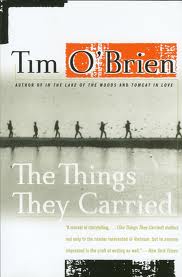
35. The Things They Carried by Tim O’Brien. This fictional account of a platoon in Vietnam is based on Tim O’Brien’s experience in the war himself and explores the fear and courage that are necessary to bring one through to the other side.

-This is a text that is used in our Grade 11-American Literature classes. The book is one of the few texts that students will willingly complete; once they finished the first story, they are hooked which is a tribute to O’Brien’s writing style. The prose is artistic but not difficult for even our lowest readers. Our students are curious about Vietnam, a part of history that is chronologically left for those lazy days of June. We use film clips (Platoon, Apocolypse Now, The Deer Hunter) in our unit with this text. We also eat MREs in class, and organize lists as to what each of use “carries.”

43. This Boy’s Life by Tobias Wolff. Wolff recounts his life as a boy and teen struggling with his identity as he lives with his divorced mother and her second husband in the 1950’s.

-This text will go into the English IV elective Memoir. There is a possibility that a 9th grader will choose this as an independent reading book in the non-fiction unit. The narration captures teen angst very well, and could work as a non-fiction companion piece to Catcher in the Rye in Grade 11. If Common Core wants classrooms to integrate more non-fiction, this is an excellent piece to add.

61. The Alchemist by Paulo Coelho. Discover how to find the beauty in life no matter what your experience as you follow the life of a young shepherd who gains so much from his journey of life.

-This book is assigned as summer reading for incoming English II honor students. We require a dialectic journal with 30 quotes from the texts as the summer reading assignment. Despite the burden of writing, students really enjoy this book which allows us to segue from “the journey” archetype taught in Grade 9 to the different types of perspectives in Grade 10 World Literature.

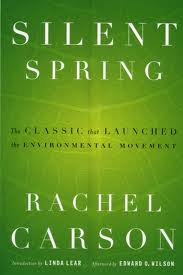
94. Silent Spring by Rachel Carson. Carson’s powerful writing on the topic of environmental justice creates a book that will make the reader think seriously about humanity’s relationship to the Earth.

-I got this book for the environmental studies teacher. So far, I have found five nice copies this past year. She offers this as optional reading to her students, and I think this should be required reading for students interested in pursuing an environmental science…or any science, for that matter.

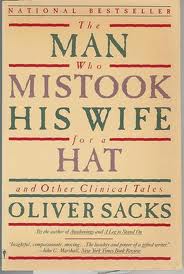
100. The Man Who Mistook His Wife for a Hat by Oliver Sacks. Psychology student or not, this book will appeal to anyone who has an interest in the curious way the mind works–and how it does not work. Several of the most bizarre cases are detailed here.

-I rarely find copies of this book, so finding one in good condition is a score! The psychology/sociology teacher loves to lend this book to her students; they are fascinated by the case studies. I am always excited to find a gently used copy for her to share.

Here is a list of the 10 essential reads I LEFT ON THE SHELVES (and where they are used in our curriculum)

1. The Great Gatsby by F. Scott Fitzgerald.-Grade 11; we have enough copies

12. Heart of Darkness by Joseph Conrad. -AP English Literature; text is in the public domain so students read this online.

14. The Call of the Wild by Jack London.- Grade 9;  text is in the public domain so students read this online.

15. To Kill a Mockingbird by Harper Lee. -Grade 11; we have enough copies

28. The Poisonwood Bible by Barbara Kingsolver.- AP English Literature; we have enough copies

33. Middlesex by Jeffrey Eugenides.- Optional read for Grade 11 Coming of Age unit OR Advanced Placement English

34. Life of Pi by Yann Martel. -Grade 10; We have enough copies

58. One Hundred Years of Solitude by Gabriel Garcia Marquez. AP English Literature; we have enough copies

82. The Elements of Style by William Strunk and E. B. White.- Resource for AP English Language and AP English Literature and Creative Writing

98. The Interpretation of Dreams by Sigmund Freud.-I will need to check with the psychology teacher!

 Both Goodwill stores, Brookfield and New Milford, regularly offer a wide variety of used books, and our classroom libraries are currently well-stocked with titles puchased used for $.50-$2.00.
This past Saturday, the  total cost for the five  “essential” titles I did purchase? $5.18. Getting these essential reads into the hands of our students? Priceless.

The original purpose of this blog was to explain how used books were purchased in order to increase the classroom libraries at Wamogo Middle and High School, grades 7-12. The name of the blog, “Used Books in Class”, was initially chosen to indicate the condition of the texts. The term “used”, however, can also serve to mean how the text are used in class. In other words, how are the used books being used in the English Language Arts Classrooms at each grade level?

A carload of Used Books after a summer book sale!

In writing this blog, I have found myself increasingly commenting on English/language arts curriculum, lesson plans, and current issues in education. This means the purpose of the blog has grown to include topics that are all related to the use of reading materials in the classroom, and reading is the most important skill that students will need to be successful students at every grade level. Providing a wide variety of books-new and used- is critical to engaging readers.

To date, the used books purchased in the secondary markets have helped in four specific ways:

Used books have replaced copies at each grade level. Used books have been used to replace lost or damaged copies of books assigned to a particular curriculum. For example, there have been replacement copies of The Giver for Grade 7, Of Mice and Men in 9th grade, and Animal Farm in Grade 10. These titles are taught in almost every school system in Connecticut, and are titles that are relatively easy to find locally in the secondary market. These are also titles that are readily available in large quantities online on used book dealer sites such as Better World Books.

-Used books have increased selections for independent reading in classrooms. The English Department has incorporated more time for silent sustained reading (SSR) in class at each grade level, and classroom libraries have been increased to allow students the opportunity to choose books to read. For example, students in grade 9 are provided 40-45 minutes each week to read self-selected books during the school year. Students may choose a book from the school’s library media center, or choose a book from one of the carts in the classroom.  Titles vary in genre, subject and reading level in order to meet student interest. Students are responsible for blogging reviews about the books they read at least twice a quarter.

Other classes that take advantage of independent reading are the Advanced Placement English Language and English Literature classes. Students select independent reading that meets the critical standards of the Advanced Placement program. These selections range from the classics (Dostoevsky’s Crime and Punishment) to more contemporary titles (Roth The Plot Against America) and write responses to these books.

-Used books are added titles as “satellite texts”. English teachers have extended thematic units to include titles that complement a text from the literary canon. For example, the 11th grade thematic unit “Coming of Age” is usually associated with Salinger’s Catcher in the Rye. Purchasing used books have increased selections to include Sittenfield’s Prep, Cormier’s The Chocolate War, Lamb’s She’s Come Undone, Gibbons’s Ellen Foster, and Chbosky’s Perks of Being a Wallflower. Students select a text to explore the thematic idea through the lens of another author.

Score! A set of books for Grade 10

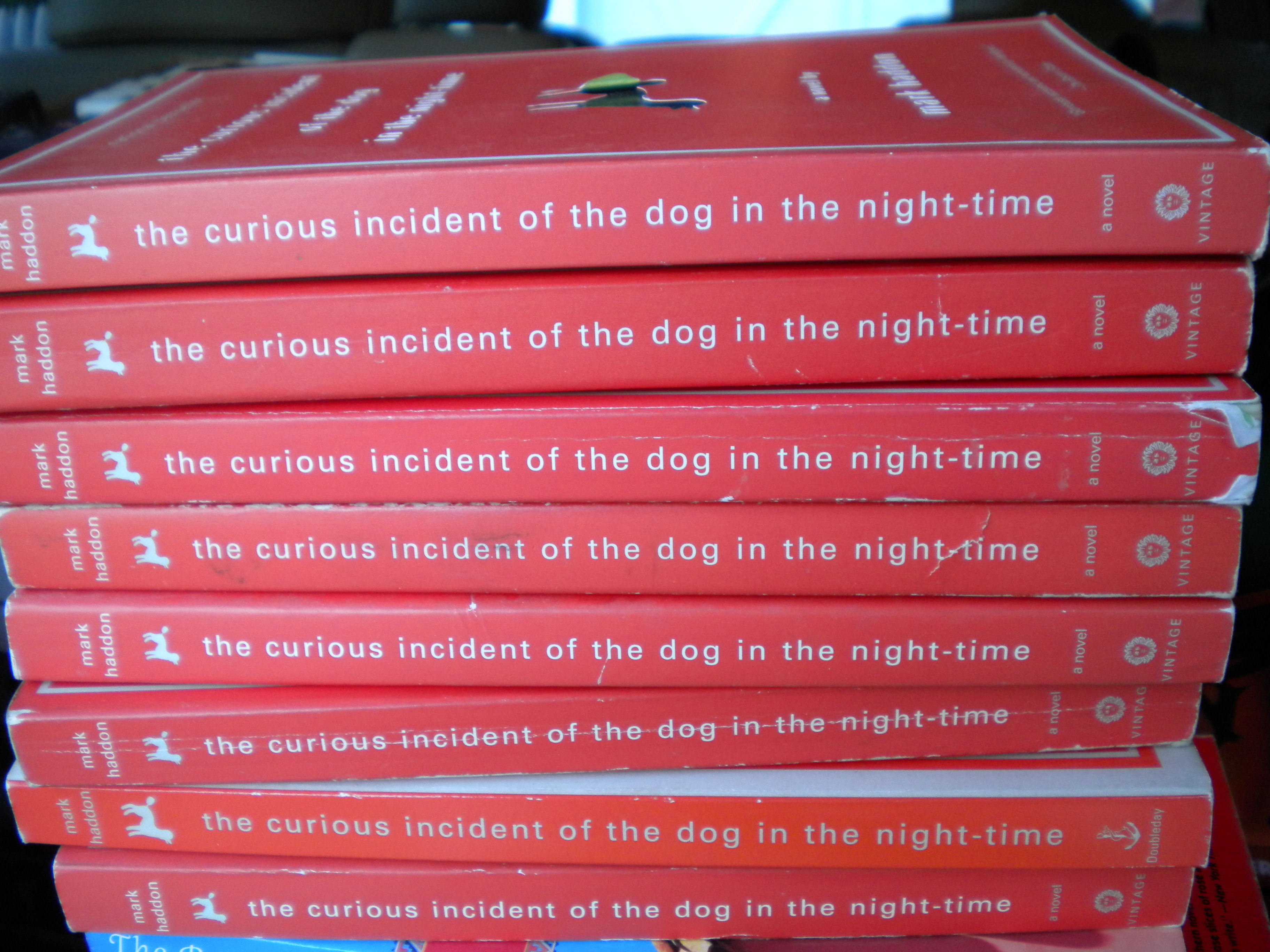
-Used books have allowed for the addition of new texts. The purchase of used books has expanded curriculum at several grade levels with high interest titles.  For example, Hosseini’s The Kite Runner, Coelho’s The Alchemist and Haddon’s The Curious Incident of the Dog in the Night-time (see picture) have been added to the World Literature curriculum in grade 10. In addition, Walls’s The Glass Castle has been added to Grade 12 Memoir class while Farmer’s The House of the Scorpion will be added to grade 7.

Ultimately, the re-stated purpose of this blog will be to continue to discuss the inclusion of specific used book titles in English/language arts classrooms as well as discuss how we are working to improve reading in and out of the classroom  at every grade level. Used books in class is also about using books in class to improve reading!