Archives For November 30, 1999

To some educators, the Common Core State Standards (CCSS) could be consider the work of control freaks. To other educators, the CCSS could be interpreted like the line spoken by Captain Barbossa in Pirates of the Carribean, “the code is more what you’d call ‘guidelines’ than actual rules.”

At my core I am a control freak with strong tendencies towards being a perfectionist. However, 21 years of teaching in real classrooms with real students has informed me to deal with these tendencies in order to achieve realistic educational outcomes. I must teach the student in front of me, not the student I want to teach. I must deal with each student’s  particular mix of strengths and weaknesses. As I deal with that reality, I have learned to hand over more control to my students in their choice of reading and their choice to demonstrate understanding at each grade level.

When I give up control, the results are often unexpected, occasionally raw, and generally more than I planned every year. However, this  process is messy and individualized which is probably why policymakers cannot wrap their neat little statements around what really happens in a classroom. I have learned teaching  in the classroom is more like following the guidelines rather than following a strict set of rules.

But there are those policymakers who claim that following the rules is more important. One argument for this ideology recently was posted by Kathleen Porter-Magee who argues for text complexity in a blog post on the Thomas B. Fordham Institute website, “Common Core Opens a Second Front in the Reading Wars” (8/15/12):

But the Common Core ELA standards are revolutionary for another, less talked about, reason: They define rigor in reading and literature classrooms more clearly and explicitly than nearly any of the state ELA standards that they are replacing. Now, as the full impact of these expectations  starts to take hold, the decision to define rigor—and the way it is defined—is fanning the flames of a debate that threatens to open up a whole new front in America’s long-running “Reading Wars.”

Her missive across the bow of education uses the motif of war, the subject of a 2007 post “Reading Wars Redux”  which scratches at the scab of the phonics vs. whole language debate associating a student’s “natural” selection of a text with whole language; a student’s reading choice does not fit with scientifically-based reading research reading programs. Porter-Magee references that argument as part of a strict adherence to text complexity as outlined in English Language Arts Standard 10 and the complexity determining software.

The ELA Standard 10’s arc begins in kindergarten where students will, “Actively engage in group reading activities with purpose and understanding.” By grades 11-12, students should, “Read and comprehend literature, including stories, dramas, and poems, in the grades 11–CCR text complexity band proficiently, with scaffolding as needed at the high end of the range.” Determination of a text’s rigor is suggested through six different computer programs that factored in the research study: ATOS by Renaissance Learning; Degrees of Reading Power® (DRP®) by Questar Assessment, Inc.; Flesch-Kincaid; The Lexile® Framework For Reading by MetaMetrics; Reading Maturity by Pearson Education; SourceRater by Educational Testing Service; and the Easability Indicator by Coh-Metrix. These educational commercial enterprises (only the Flesh-Kincaid is in the public domain) are the means to determine what Porter-Magee argues is critical to developing rigor in our classrooms.

I would argue differently. A curriculum is not rigorous because of a text; a curriculum is rigorous because of what a student does with a text. Assigning students a rigorous text, say Narrative of the Life of Frederick Douglass, an American Slave in grades 6-8 does not mean the curriculum is rigorous. However, a curriculum with a lesson that has students read the narrative, compare this autobiography with  narratives from former slaves that were recorded in the 1930’s as part of the Federal Writers’ Project, and then have students conduct research on slavery and tell a story based on their findings could be considered rigorous. This lesson would be an example of a whole class read.

This lesson, however, does not promote a critical learning experience. The lesson does not address a student’s love of reading. Students may enjoy the Autobiography of Frederick Douglass, but I would venture that few 6-8th graders would choose to read the text independently. That is why there needs to be a place in every curriculum for independent choice where students may read above, on, or maybe even below grade level. Teachers are educating students so that we will be a nation of readers. My experience in the classroom informs me that handing a low level reader a complex text for close reading does not lead to a love of reading. Moreover, forcing rigor is not authentic; many adults do not choose complex texts, in fact, many admit to avoiding text complexity as a result of being force fed the literary canon in a misguided attempt to enforce rigor.

The ELA CCSS itself does not require the forced rigor that Porter-Magee implies. Appendix A of the ELA CCSS “Key Considerations in Implementing Text Complexity” notes the flexibility that educators have:

The tools for measuring text complexity are at once useful and imperfect. Each of the tools described above—quantitative and qualitative—has its limitations, and none is completely accurate. The question remains as to how to best integrate quantitative measures with qualitative measures when locating texts at a grade level. The fact that the quantitative measures operate in bands rather than specific grades gives room for both qualitative and quantitative factors to work in concert when situating texts. The following recommendations that play to the strengths of each type of tool—quantitative and qualitative—are offered as guidance in selecting and placing texts.

Quantitatively, a book may be at the level for a grade 10 student; qualitatively, the book may be too mature in theme, or the student may need additional support. The ELA CCSS recognizes this difference. That is why Appendix A offers guidelines rather than rules; suggested texts rather than required reading.

This is not a war. This should not be a skirmish. The ELA CCSS can be met with a blend of independent reading and complex texts. (see my earlier post  on blending independent student selected reading with whole class novels) Porter-Magee’s hyperbolic statement about a second front in a reading war is  one of ideology not reality. Teachers, even the most controlling, have an understanding of how text complexity can be balanced in the classroom today with the real students in front of them. Policymakers who see rigor through the addition of texts are distanced from the classroom. Magee-Porter’s post should be met with the same level of criticism as given to the pirates of the Caribbean, “You’re teachers. Hang the code, and hang the rules. They’re more like guidelines anyway.”


English teachers, defend literature in the classroom!

I teach English, and I am feeling a little defensive lately. In the past week, I have had two separate “literature-threatening” incidents.

The first came from a reader to an opinion piece I wrote that was featured in Education Weekly, 21st Century Students Need Books, Not Textbooks. The responder was repeating the myth that English classrooms need to abandon teaching literature in favor of teaching math and science texts:

“You need to look at the Common Core ELA [English Language Arts] standards and realize you now have a responsibility to teach reading and writing for STEM subjects. That is why this discussion is so wrong. Start reading math and science textbooks and start teaching what your students need, not what you love. I learned early on: the most boring subject is the world is another person’s hobby. Your hobby is reading “literature.” Your students need to learn to read and write STEM [science, technology, engineering, and math] topics, and those are found in textbooks. PERIOD!!”-Ebasco

This kind of response comes from the mistaken interpretation that the 70% of informational texts suggested by the Common Core State Standards (CCSS) need to be taught in English class; even the CCSS devotes a clarification to this on page 5 of their document in a footnote. Instead, reading is to be a critical part of all disciplines, generally 70% informational texts in all subjects and 30% fiction in English classrooms. However, English teachers can assign informational texts just as history/social studies can assign historical fiction; the genre assignment is fluid. An entire section of the ELA CCSS titled “Reading in History/Social Studies, Science, Math and the Technical Areas” is a guide devoted to improving the reading and writing standards in all disciplines. The push for reading informational texts is certainly a result of STEM, but literature is not being jettisoned out of the curriculum because it is a “hobby”.

Indeed, the benefits of reading literature is rooted in the second of the “literature threatening” incidents, in a WNYC Schoolbook blog post a piece titled Never Mind Algebra, Is Literature Necessary?  In this post, Tim Clifford made a compelling case regarding the stripping of literature from English classrooms in favor of Common Core, and again, the roots of this anti-literature movement are found in mistaken interpretations of the CCSS.

Clifford began his post with a multiple choice quiz based on the following quote:

“Now, what I want is facts. Teach these boys and girls nothing but facts. Facts alone are wanted in life. Plant nothing else, and root everything else out.”

Clifford posed the question “Who said the above?” and then offered three responses:

a. Bill Gates, Microsoft founder and educational gadfly
b. Michelle Rhee, staunch proponent of standardized testing
c. David Coleman, author of the Common Core standards

Then he offered the real answer,
d. Thomas Gradgrind, a fictional character created by Charles Dickens in the 1854 novel Hard Times.

The quote expressed the publicized sentiment of standardized testing advocates David Coleman, Bill Gates and Michelle Rhee. (I had chosen David Coleman as my answer). In discussing the correct answer, Gradgrind, Clifford explained that Dickens’s character was an attempt to skewer those utilitarian values in the mid 19th Century. Like today, there was a push for informational facts and statistics at the expense of creativity and imagination in public education.

Dickens’s novel Hard Times expressed his belief that an over-emphasis on facts over creativity promoted contempt between mill owners and workers.  Gradgrind’s name, like other Dickens creations, immediately expresses to the reader that he is an altogether unpleasant man, espousing that all one needs is “facts and statistics.” His daughter Louisa’s breakdown towards the conclusion of the novel brings him to the realization that fiction, poetry and other pursuits are not “destructive nonsense.”   Oh, if only Gates, Rhee, and Coleman were characters that could be similarly convinced.

In his post, Clifford described how his 6th grade curriculum has been altered to fit the ELA CCSS. He bemoaned the earlier loss of vocabulary and grammar in context and the most recent loss of creative writing which, “has been chopped clean away, to be replaced with unending persuasive essays that are the darlings of the Common Core standards.” He continues:

“Even reading has not been left unscathed. Many schools teach reading as a set of skills to be mastered rather than as a journey to be embarked upon. Children are taught how to predict, to connect, to draw inferences, and so forth, but they are rarely allowed the leisure to savor what they read or to reflect on the art of good writing.”

Clifford wrote about a successful novel writing project that, “engaged students on many levels and taught them story structure, characterization, use of dialogue, and exposition.” Unfortunately the project, “was jettisoned last year because of the national shift to the Common Core. It was replaced with an eight-page (for sixth graders!) research project.” He sadly noted, “The results were predictably dull and uninspired, but Gradgrind certainly would have approved. The papers were filled with facts but devoid of imagination.” In Clifford’s scenario, a successful unit of reading and writing was eliminated to favor lesson plans that do not have the evidence to prove success.

Where is the evidence that eliminating writing literature in favor of writing research papers will serve a mission statement of educating  “productive problem solvers and decision makers” who are “personally fulfilled, interdependent, socially responsible adults” ? Why are so many interpretations of the ELA CCSS rigidly eliminating what does work in favor of what might work? More to the point, why is there even a 70% vs. 30% split in reading genres, and why do stakeholders keep missing the point that the increase in informational texts must come by increasing reading in other content areas?

The positive impact of reading literature was discussed in the NYTimes article by Annie Paul Murray, “The Neuroscience of Your Brain on Fiction”. Reading fiction, “is an exercise that hones our real-life social skills, another body of research suggests. Dr. Oatley and Dr. Mar, in collaboration with several other scientists, reported in two studies, published in 2006 and 2009, that individuals who frequently read fiction seem to be better able to understand other people, empathize with them and see the world from their perspective.” To summarize, the data using neuroscience proves that reading fiction is good for you.

I teach literature, and my students make connections to the real word (Macbeth to Afghan Warlords; Frankenstein to the science of cloning) in my class everyday. Literature helps my students make sense of the world; they do not need to suffer under a despot, but they can experience a corrupt political system in Orwell’s  Animal Farm. They do not need to crash on a deserted island to understand how quickly very civilized young people can tun into savages when they read William Golding’s  Lord of the Flies. They can contemplate how precious is the relationship between a father and son who cling to decency and humanity without having to survive an apocalyptic nightmare  from Cormac McCarthy’s The Road.  They  can better understand the historical context of Jim Crow laws from Harper Lee’s To Kill a Mockingbird and in Kathryn Stockett’s more recent novel The Help.

And they can also learn about the utilitarian movement in England during the Industrial Revolution, the rise of the middle class, the frightening system of government-run workhouses, and the dangers of child labor in another Dicken’s novel,  Oliver Twist. Dickens’s literature demonstrates the power of fiction as a means of providing background information. Read a textbook of facts and statistics explaining the Industrial Revolution, and then read Oliver Twist. Which version will you vividly remember?

The cold in “Ethan Frome” might be what we need in the long hot summer!

It’s 103 degrees here today in Connecticut during one of the numerous heat waves we have had so far this season. Tomorrow’s forecast bodes no better news. The garden has been drying up; even the most stalwart perennials are buckling under the sun’s intensity. Leaving an air-conditioned home or car means hitting a wall of humidity; my glasses fog over and I am temporarily blinded. A headline on the Reuters website reads, “Heat Wave and Drought Besiege Already Deteriorated US Crops” (July 18, 2012). Suddenly, I have a new appreciation for the heat of Steinbeck’s Dust Bowl in The Grapes of Wrath:

  • People in flight along 66. And the concrete road shone like a mirror under the sun, and in the distance the heat made it seem that there were pools of water in the road. (Ch 12)
  • They were tired and dusty and hot. Granma had convulsions from the heat, and she was weak when they stopped. (Ch 16)
  • The sun sank low in the afternoon, but the heat did not seem to decrease. Tom awakened under his willow, and his mouth was parched and his body was wet with sweat, and his head was dissatisfied with his rest. (Ch 18)
  • While the sun was up, it was a beating, flailing heat, but now the heat came from below, from the earth itself, and the heat was thick and muffling. (Ch 18)

I believe that where a reader has lived or visited contributes to an understanding of a novel’s setting. This does not mean that a reader cannot appreciate the descriptions of Mars in Ray Bradbury’s The Martian Chronicles or Panem’s District 12 in The Hunger Games by Suzanne Collins or on the battlefields on the plains of Troy in Homer’s Iliad or the Congo River in Conrad’s Heart of Darkness. Indeed, the only way for the reader to “visit” and remember these locations is through the vivid descriptions the author writes. However, there is an advantage for a reader in being familiar with the setting of a particular story, especially where setting is a dominant character. Say, for example, the town of Starkfield in Edith Wharton’s Ethan Frome.

In the introduction, the narrator of the story explains how his employment has brought him to the aptly named Starkfield-“the least habitable spot”, where he “chafed at first, and then, under the hypnotising effect of routine, gradually began to find a grim satisfaction in the life”. Grim satisfaction indeed, as the winter weather in Western Massachusetts, where Wharton sets her ficticious Starkfield, can be mind-numbingly bleak.

“When I had been there a little longer, and had seen this phase of [December] crystal clearness followed by long stretches of sunless cold; when the storms of February had pitched their white tents about the. devoted village and the wild cavalry of March winds had charged down to their support; I began to understand why Starkfield emerged from its six months’ siege like a starved garrison capitulating without quarter.”

My most memorable image of the town was Wharton’s description of the graveyard that Ethan and Mattie pass on the night of the dance:

“They turned in at the gate and passed under the shaded knoll where, enclosed in a low fence, the Frome grave-stones slanted at crazy angles through the snow. Ethan looked at them curiously. For years that quiet company had mocked his restlessness, his desire for change and freedom. ‘We never got away- how should you?’ seemed to be written on every headstone…”(Ch 2)

This closing sentiment to this passage addresses the way I feel every winter when the dismal drizzle of freezing rain turns every trip in the car into heart-pounding sliding near-misses or when crusted mounds of filthy snow makes walking outdoors a life-threatening experience. My mantra becomes, “I’ve got to get out of this place.”

So how does a reader from Southern California really understand Starkfield? Yes, Wharton is genius at explanation, but that visceral understanding of January in New England is limited if the reader is reading her novel poolside on a sunny day, 78 degrees with a light wind blowing. Wharton can only stimulate the reader’s imagination to understand the kind of wet grey cold that chills to the bone until June. The memory of physically freezing in Western Massachusetts is an entirely different experience.

Conversely, a case can be made for other authors. How can the Wharton’s New England reader really understand the physical and cultural landscape for the characters of Faulkner’s  Yoknapatawpha County ? How does a student from the plains and mesas of Cather’s Death Comes for the Archbishop comprehend the mansions on Fitzgerald’s East Egg Long Island?  There are so many elements in creating the setting: the temperature and the angle of sunlight during the day, the architecture of the houses or buildings, the landscape and the vegetation, the dialect of the locals, the smell of the foods, and the sounds of the evenings. Each locale has identifying qualities that a great author captures in order to make a setting understandable to a reader. The author’s descriptions will resonate even more with a reader who has a first-hand experience in that setting.

Of course, reading Wharton’s novel in the in the middle of summer anywhere in the United States might be a form of mental air-conditioning. The mind can be a powerful tool into tricking the readers to feel cooler. Imagine the book display: “Feeling hot? Read Ethan Frome!”

 How do you get to the  Olympics? Practice, practice, practice!

In this third post, my “tri-blog-a-thon”, connecting education to the recently completed London Summer Olympics 2012,  I ask you to recognize the significance of practice.

The 10,004 athletes from 204 National Olympic Committees (NOCs) who participated in the 2012 London Summer Olympics practiced for their athletic contests. There were incalculable hours of practice that contributed to each athlete qualifying for a specific event. Similarly, this fall there will be over 37.9 million primary grade and 26.1 million secondary school children* who will practice the skills taught in our nation’s schools. These students will have a mandated minimum of 180 days or 64,800 minutes of practice in a school year.

Practice by athletes makes participation in the Olympics possible. Practice makes education for our schoolchildren possible.

Of course, there is always a great deal of attention placed on the winner(s) of each Olympic event. Gold, silver, and bronze medals distinguish the best athletes on a given day in a given event. Similarly, our nation is obsessed with test scores in education, the final event in measuring specific skills on a given day.  However, there is often too little attention paid to the practice that is necessary to achieve high grades on these tests of skills. All skills, athletic and intellectual, can only be achieved through practice.

In preparing for back to school, teachers, parents, and students must recognize the importance of practice in education. Practice is to do or perform (something) repeatedly in order to acquire or polish a skill. Practice is to work at a profession; as in the exercise of an occupation. Practice is what athletes and students have in common.

Unfortunately, practice is often hard work. Practice requires attention. Practice means focus. Practice is demanding. And practice can be boring if there is no reason for the practice.

When my students complain about the amount or variety of reading they may have to do, I point out that they are engaged in a practice. Like a runner, they cannot win a race without running wind sprints or running longer more challenging race courses. They are practicing to be better readers.

Similarly, when they complain about the amount or variety of writing I assign, I point out that composing in various forms such as letters, essays, narratives, research papers or even texting is a practice. They will need to communicate in the future in numerous formats, handwritten and digital. They are practicing to be good communicators.

Student practice a wide variety of skills in different disciplines every day at every grade level. There are some skills that come easily to students with little practice; there are other skills that require more practice. The kind of practice a student engages in matters as well; repetition is not the only kind of practice to improve skills. There must be variations in the kinds of practice for a student to become good at a skill.

In his book  Outliers, Malcolm Gladwell  wrote extensively about  a “10,000 hour rule” where the key to success in any field is the practice of a specific task for a total of around 10,000 hours. Gladwell’s book called attention to the work of researcher Anders Ericsson. In TIME Magazine’s article “The Science of Experience” by John Cloud, Ericsson had become the world’s leading expert on experts, ” a term he distinguishes from ‘expert performers’ — those individuals, possessing both experience and superior skill, who tend to win Nobel Prizes or international chess competitions or Olympic medals.” But more important than routine repetition, varying the kind of practice had the most significant impact on skill improvement.

Cloud detailed how Ericsson found, “Experts tend to be good at their particular talent, but when something unpredictable happens — something that changes the rules of the game they usually play — they’re little better than the rest of us.” Changing practice to incorporate more complex tasks improved performance:

“Ericsson’s primary finding is that rather than mere experience or even raw talent, it is dedicated, slogging, generally solitary exertion — repeatedly practicing the most difficult physical tasks for an athlete, repeatedly performing new and highly intricate computations for a mathematician — that leads to first-rate performance. And it should never get easier; if it does, you are coasting, not improving. Ericsson calls this exertion ‘deliberate practice,’ by which he means the kind of practice we hate, the kind that leads to failure and hair-pulling and fist-pounding.”

This kind of deliberate practice can build confidence. Other desirable qualities associated with deliberate practice are motivation,  self-discipline, and commitment, all qualities we want to imbue in our students.

So, here is a goal for the new school year. Let the school year be filled with “deliberate” practice for every student at every grade level. Let the practice be frustrating. Let the practice be difficult. Let the practice be challenging. Let the practice lead to failure, so that the practice leads to success. “Let there be practice” should be the mantra for all stakeholders in our nation’s education system in this coming school year.

Now let the practice begin!

*2006-07 statistics from US Census

The EDsitement website, funded by the National Endowment on the Humanities, offers lesson plans that are aligned to the Common Core State Standards.  I have modified several of these lessons; other lessons on this site are familiar fare in English classrooms. One example is the lesson on Carl Sandburg’s Chicago  which asks students to pick a location and respond to prompts such as, “If this place were a person, what kind of person would he or she be? What noticeable physical characteristics would this person have? How would he or she act? What would this person wear and do?”  The lesson on Arthur Miller’s Crucible is also familiar, “Have students answer the following questions: What is John Proctor’s dilemma in Act IV? What motivates Proctor’s initial decision to lie?”

While there is always a need for more resources and support for teachers, I have two complaints about theEDsitement site. The featured lesson on the site this month is  Vengeful Verbs  in Hamlet for grades 6-8. The targeted age group and the objectives for this lesson are inappropriate; Hamlet is not for middle school students. That leads me to question the appropriateness of lessons for other students as well.

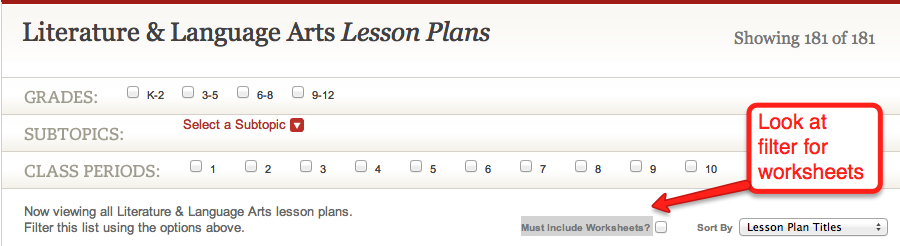
The second problem is a worksheet filter option on the site where lessons can be identified as offering worksheets or not.  Worksheets?  In the 21st Century, with all the digital possibilities, the National Edmowment for the Humaties is promoting worksheets? Why?

Many educators consider worksheets the “busy work” of education. Worksheets have correct answers; they are prescribed and limiting. Early childhood experts have pointed out that many worksheets do not allow the kind of problem solving that involves an element of risk, saying “if we want children to learn to solve problems we must create safe environments in which they feel confident taking risks, making mistakes, learning from them, and trying again” (Fordham & Anderson, 1992). Activities that require creative problem solving or critical thinking should be the goal of every teacher. The worksheet can limit both.

Additionally, worksheets are expensive. Paper and toner ink are the first expense, but the second expense is time. How familiar are teachers  with the number of hours that are wasted in front of copy machines copying worksheets?  Sadly, very familiar. What happens when the copier breaks down? Frustration. A teacher who relies on worksheets is forced to scramble when an unreachable tiny scrap of paper lodges into one of the copier’s feeders, or when the toner is low, or when code505 appears on the digital screen. In contrast, the increase of digital platforms in education allows teachers the opportunity to spend time more productively setting up documents that can be used by individual students or collaboratively.

Students have so many ways to record responses digitally, for example on Google docs or blogs or wikis, so why waste paper? The worksheet should be relegated to files of emergency backup lesson plans for a substitute.

The National Endowment of the Humanities should lead the way in weaning teachers off the worksheet. The emphasis on filtering lesson plans for worksheets should be eliminated. The availability of lesson plans aligned to the Common Core State Standards is a great resource that is cheapened with the pedestrian 20th Century tool of worksheets. EDSitement should not straddle  a 20th-21st Century divide. With funding support from  Verizon Thinkfinity, a foundation firmly in the 21st century,  EDsitement should lead.

Dear Governor Dannel Malloy:

I forgive you for the inflammatory comments about teachers in your State of the State speech delivered last February (2/8/12),   “In today’s system basically the only thing you have to do is show up for four years.  Do that, and tenure is yours.” After all, I  have said some pretty unflattering things about politicians these past few years. Let us agree that professions should not be demonized.

Instead, I would rather provide you with an example of  great professional development for educators by discussing the value of the Connecticut Summer Institute which is a part of the Connecticut Writing Project. Eleven dedicated teachers from different school districts in the State of Connecticut have spent the past four weeks this summer (July 9-August 3, 2012) at the Connecticut Summer Institute organized and taught by Bryan R Crandall  at Fairfield University. These were elementary, middle school and high school teachers, social studies and English, willing to spend a good portion of their summer vacations (for graduate credit) learning how to improve student literacy through writing from 8:30-3:30 daily. A variety of guest speakers  also visited the Summer Institute and shared their writing experiences; there was a a journalist, an author, a poet, and veterans including  co-director Julie Roneson of past Connecticut Writing Project programs. This program is associated with the National Writing Project, an organization dedicated to improving writing at every grade level. The NWP website states:

Writing is essential to communication, learning, and citizenship. It is the currency of the new workplace and global economy. Writing helps us convey ideas, solve problems, and understand our changing world. Writing is a bridge to the future.

Two weeks ago, I composed a post that questioned whether I should pass or fail E  a student in my English II class who could meet many of the benchmarks of English II but who had failed to complete the  assignments; I could not justify a passing grade. The post was published  a week later in the Teacher edition of Education WeekThe student’s pseudonym  “E” was replaced with “Elena”, and the post received a spectrum of replies (71 to date) which ranged from the hard-line stance of “flunk her” to a more forgiving “grades are meaningless so pass her” position. Responses questioned whether assessments are necessary to measure student learning; others argued that assessments are a means to measure student responsibility. What was the most striking was that these variety of replies to my post revealed the deep divides in teachers and other stakeholders’ opinions on assessing student performance.

There were a few answers that suggested  “how to” better measure student standards. For example, Craig M advocated a standards-based, formative/summative, 4-point grading noting “the 4-point scale changes the difference between passing and a zero from 60% to 20% (a 1 is a D)” and recommended I “look up The Case Against the Zero by Reeves.” Another practical suggestion came from LearnOutside, “The key accommodation that I always made in my classroom was to have a reasonable ‘late work’ policy that accommodated for some of my students’ inability to plan for the future. To me, it made sense to allow them to get partial credit. It tracks with what we know about the teenage brain’s capacity to deal with future risk/reward, and in the end gets them to do the work.”

A response by DrKenGoldberg did detect that E’s current status was not an isolated problem, suggesting that “these issues are often seeded by homework difficulties in the early grades….what most teachers don’t see is ‘the rest of the story’. I admit that for reasons of privacy, I did not detail E’s complicated family history.

There were responses that urged me to think beyond the limits of grades such as the post by Jerry Heverly who offered, “How foolish does all this national testing seem when I think of students like E and when I think of the people who have enriched our society without a high school diploma?” Similarly, Jan Priddy suggested, “It’s another matter of judgment. Education is not the same as building a roof. It’s an appealing analogy, but our students are people, not carpenters, and as teachers we work with minds, not lumber.” Similarly, Dan M noted that, “Most likely, E is not going to be entering corporate America upon graduation from high school or college if she chooses to go. Her actions have demonstrated evidence of this. But that doesn’t mean that she will be a failure in life. One of the mistakes we as educators make is trying to fit (and assess) all of our students within the same paradigm.”

Some were concerned with legal problems that arise from grading, especially Michael Keathley who stated, “We are a culture dominated by legalities. If such students were passed without demonstrating the knowledge by completing written assignments, etc., certainly lawsuits would follow.” His response was echoed by R.x  who suggested, “teachers can only assign the grades their administrations will support.” I would like to think that it was their responses and not my original post that led Thien Ha to conclude that, “this proves that American education system have too much powers on the hands of parents and students than school administrators, and teachers. Many students must pass even though they were not qualified to pass, since teachers have no power to fail or if they fail many students, they would be evaluated by parents by principals as a failure teacher, they might got fired.  “

Certain responses were sympathetic, the “I’ve been there” commiserating type. Duane Swacker considered that I should, “always give the students the benefit of the doubt as there is no teacher grading system that is accurate to even 5-10 percentage points. It’s a fallacy most believe in but grades, standards and standardized testing are all falsehoods with many errors involved in the process.” However, ArtG  scolded my “story of muddled thinking or rather, muddled by emotional overflow”.  In my defense, I would argue that he has never met E or seen her interactions with others; she is difficult not to like.

Ultimately, the see-saw of debate tipped toward taking a hard-line approach. Momwithbrain1 bluntly expressed, “today [students] think they can skate by and when they graduate and take on a job, that simply is NOT the reality. I’d rather they learn life lessons in school. She may have gained some knowledge in the class but she is also learning that she can be irresponsible and lazy and it has no impact on her.” Bntradical agreed stating, “When Elena enters the work world, she will get the job, because she knows the content, but if she fails to meet the real world deadlines, she will get fired. Thus, if you fail to fail her now, you will be failing her later in life, failing yourself, and failing society.” MrLionsDen added, “Failing, at any grade level, is an important life lesson and it’s not terminal.”

Nick Mangieri pointed out the problems that I could experience in the future saying, “What happens in the future when it becomes known that you don’t have to turn in the work in Mr/Mrs X’s class because you’ll pass anyway as long as he/she likes you?” Certainly BK was the most chastising, ” I really, really do not see a dilemma here. You are being paid whatever your contract says – and it’s fair, even though you are also ‘more than a unit to be measured.’ What if instead you were paid whatever your principal ‘feels like’? It seems like this is what you are considering here – and it’s utterly unfair to all the other kids who DID pass and DID earn their A’s and B’s.” Finally, I feel particularly responsible for the students of agardne3 who concluded that, “Your article has pushed me over the edge to grade them as they deserve.”

Numerous replies concluded that I speak to E once more as an intervention, a practice I had performed daily the entire fourth quarter. I was quite serious in when I spoke to E once more the last week of school; I did not hold out much hope after the conversation. I had heard her promises before.

But E strolled in the morning the day grades closed. Clutched in her hand were three missing major assignments…two dialectical journals and one motif paper. She sheepishly handed them to me, “I don’t care if they only get a few points, but would these be enough to pass?”

Yes. The missing work, given even a few points (20/100 each) would push her GPA into passing English for the year.

So I passed her.

She obviously was following the grade change on Powerschool,  and that afternoon she sent me an e-mail:

 I am so excited I passed, Thanks for the second chances!! If it wasn’t for those I would be taking it over. I highly appretiate [sic] it (:

Sharing this story of E has reassured me that I am not alone in wrestling with the obligations of judging student performance in a classroom. This forum has certainly informed me on methods I could employ in order to avoid this problem in the future. Despite the divisions in the commenters’ opinions, each response indicated a desire to help me be a better teacher, or at least help me avoid the an unnecessary dramatic finale for next year.

E is a beautiful young 16 year old who blithely drifted in and out of my English II classroom this year without any materials. She seemed surprised to find herself in the class every day. She is pleasant, friendly, and well-liked by her peers; we have a cordial relationship. Unfortunately, E achieved a 31% in English for the first quarter, which seriously damaged her GPA for the remainder of the 2011-2012 school year. Over the course of eight months, E continued to leave assignments incomplete and did little classwork, choosing instead to text or to socialize with the students sitting around her. She lost study guides, lost materials, and lost interest in editing and revising her work. She once sent me an e-mail telling me she “could not get online to see the assignment.”

This  week, I will enter her final grade.  After  four quarters of assigning, collecting, correcting, and returning, I am looking at a failing grade (just below a 60%). Her grade must be a reflection of her academic ability….or is it?

I am in the Groundhog Day of academics when every June I  experience this exact philosophical dilemma: Do I pass a student who understands the materials but who has not completed the assigned work or do I enter a failing grade? Over the course of the year, I am careful that the work I do assign is critical to assessing student understanding. Assigned work should be meaningful and assessed accurately, a process that should result in plenty of data (tests, projects, quizzes) that determines student progress. However, and perhaps more importantly, there is also anecdotal information to consider; classroom performance is the  “third leg” to the footstool of data collection.

While class was in session, and E was engaged, she made contributions. I recently overheard her explain the complicated allegorical ending of The Life of Pi to a fellow student (“The author is saying you have to decide which story is the true story…”). In March she made connections to the  Kony 2012 campaign after we watched Hotel Rwanda as part of our  Night unit. She casually suggested that over time Lady Macbeth “developed insecurities and should have taken a little Valium to settle her nerves.” She equitably included fellow students in “tossing” the plush witch doll when the class was reviewing important lines from the play, and she decided that the witches should be assigned 70% of the responsibility for Duncan’s death but only 20% of the responsibility for Banquo’s death. She noted that Macbeth was deteriorating as a “human” as his guilt increased. She empathized with Oliver Twist (“If I was an orphan, I might have been a pickpocket too…”) and suggested that the “Irish Airman Who Foresees His Death” had a “need for speed.” She understood an author’s purpose, tone, and use literary devices. I anticipate she will have a passing grade on the state mandated assessment that she took in February.

On the rare occasion when E turned in work, she demonstrated that she was capable of writing on grade level. Numerous common assessments taken in class indicated that her reading comprehension was also on grade level.   She remained blissfully unconcerned as I cajoled, teased , chided, scolded, and threatened her into completing work. Calls home were unproductive, and other teachers indicated that English was not the only cause for academic concern. The school year was maddening.

Now, as the grades are totaled in June, I wonder, do I hold her accountable for work left incomplete? Can she be exempted from the assignments that all her classmates completed? What is the minimal number of assignments that are the most important to determining student performance?  If I exempt her from less important assignments, am I reinforcing her lack of responsibility? Finally, is passing her fair to the students who did complete the work assigned?

I have been teaching for over twenty years, and I still wrestle with the emphasis placed on grades. Do grades really reflect student ability? There are students in the class who have completed all of the work I assigned. Does their “B” grade mean they really understand 85% of the material? Does E’s failing grade mean she understands less than 60% of the material in grade 10 English? Will enrolling her in another year in 10th grade English bear a different result? Is she prepared or unprepared to meet the rigors of Grade 11 English?

These philosophical questions become more complicated as education is increasingly driven by data. Student performance is quickly aggregated and evaluated using collective (vs. class) and individual (vs. self) bits of data. Mean scores and t-tests are recorded, spreadsheets are created, and reports generated to create “smart goals” that target instruction. Ultimately, assessment data will be used to evaluate teacher performance. Unfortunately, E’s overall 10th grade performance in English  has been measured by a lack of data.

Ultimately, I need to make the decision that relegates E to summer school, requires her to repeat Sophomore English, or allows E to move to  Junior English. Every year I am in the same philosophical dilemma with a student who defies the conventions of assessment. This year it is E; last year it was J. Every year I wonder how I can make this objective data-driven decision when the subjective experience in the classroom informs me so differently? My professional experience as an educator encourages me to see E as more than a unit to be measured. Finally, while I am painfully aware that the decisions she has made directly  impacts the decisions I now must make, she remains characteristically blithely unaware.

To pass or not to pass? That is the question.

UPDATE


GOAL -School districts want to report their students to read great literature.
GOAL-School districts want to report good reading test scores.

Unfortunately, these two goals are currently incompatible; great literature’s complexity can be challenging to read, and schools can ill afford to have students get low test scores on reading because of great literature’s complexity.

Concerns about the removal of great literature from classrooms have been raised before, but NY public school English teacher Claire Needall Hollander passionately argues how intellectually damaging this practice has become in state testing. Her  op-ed piece in 4/21/12  NYTimes Teach the Books, Touch the Heart decries the elimination of great literature in the classroom in order to incorporate practice materials to prepare students to take the standardized tests. Hollander described her role as a reading enrichment teacher as an opportunity to provide great literature as academic equity for her students. She described several of her students as  the sons and daughters of immigrants or incarcerated parents; she noted some students lived in crowded, violent, or abusive homes. Great literature, she believed, was “cultural capital” that could help her students compete against more affluent peers. However, when the lackluster data from standardized reading tests came in, she felt pressured to abandon great literature and curtailed her efforts for the majority of these students in order to teach materials prescribed for the state test.  While the reading selections on the state tests did have some syntactical complexity, she eventually decided that these reading materials lacked the literary qualities that make literature great. Texts that are “symbolic, allusive or ambiguous are more or less absent from testing materials.” Hollander writes, “It is ironic, then, that English Language exams are designed for ‘cultural neutrality.'”

In one sense, great literature is already culturally neutral. The themes or characters in a great piece of literature are not limited to one decade or one millennium. The elements that make a work of literature great can transcend culture and context, can speak to a universal audience, can be read by any tradition and still connect to a reader. Ms. Hollander’s concerns about cultural neutrality are akin to concerns about cultural acceptability. Creators of standardized tests are particularly sensitive in selecting texts that are cultural acceptable because great literature  intentionally confronts morality, questions society’s rules, or challenges tradition. Great literature gives voice to the outsider, and authors of great literature are often on the margins of society or write to unsettle the status quo. For these reasons, selections from great literature may not be considered culturally acceptable.

I have some experience on what goes onto a standardized state test as I had a seat one year as a member of the text selection committee for the reading and writing sections of the Connecticut Academic Performance Test (CAPT)  given to grade 10 students. Much time was spent reviewing materials for inclusion on a future Response to Literature exam. Out of a number of mediocre short stories, the only selection given to educators that could meet some standards of great literature was a chapter from Lois Lowry’s Number the Stars, a young adult novel that is usually read in Grade 5.  That selection was eliminated not only because of the low reading level (5.1; Lexile 670) but because the manner in which Lowry portrayed the terrifying rounding up of Jews. One committee member actually wondered aloud if Lowry could be persuaded to “reword the chapter” to address the concern. Fortunately, that debate ended with the decision that the chapter was not “acceptable” for the committee.

One problem in great literature is difficult vocabulary; for example, the simple conversations between the Man and the Boy in Cormac McCarthy’s The Road (RL 4) are interspersed with diction describing the apocalyptic setting:  “rachitic “, “miasma”, “escarpment”, “crozzled”.  Another problem is vocabulary  considered vulgar or profane that has eliminated a number of literary pieces from standardized testing and even from school libraries. According to the American Library Association (ALA) website which  lists challenges to classic literature that Hollander might teach: To Kill a Mockingbird- “contains  racial slurs”;  Of Mice and Men – “takes God’s name in vain 15 times and uses Jesus’s name lightly.” Finally,  great literature almost always contains themes that can be considered dangerous  or offensive to someone in society:  The Color Purple is “sexually graphic and violent”;  1984 is “pro-communist”; and Catcher in the Rye– is infamously “blasphemous and undermines morality.”

Engineering English language tests in order to make them culturally neutral or culturally acceptable encourages intellectual dishonesty. Take the reading section on the Connecticut Academic Performance Test (CAPT)  where every 10th grader is required to read a short story and evaluate the quality of the story, “How successful was the author in creating a good piece of literature?” in a one page essay. I have spent over 10 years preparing students for this  question on the Response to Literature standardized test, and I know how students struggle with this question. Many students do not read challenging texts outside of the classroom, limiting their experience to develop critical evaluation skills. However, the more distressing problem is that year after year, the quality of the story on the CAPT pales in comparison to the classic short stories a student could encounter in even the most limited literature anthology. Classic short stories available in the public domain by Saki, Anton Chekhov, Kate Chopin, Stephen Crane, and Jack London, to name a few, are considered too difficult for independent reading by 3rd quarter 10th grade students. Copy-write requirements or an author’s unwillingness to truncate a story to comply with a maximum word requirement or to make textual changes to make the subject palatable to a text selection committee, prevents other literary materials from being used.   As a result, more recent selections have come from Teen Ink (stories written by teens) and Boy’s Life magazine, both publications not known for superior literary content. While some stories may meet a sentence complexity standard and have been vetted for acceptable content, most lack the literary depth that should generate thoughtful critical responses to a prompt that asks about “good literature.”

To further complicate the choice a student makes in a response, released materials from previous exams used to prepare students how to respond to “How successful was the author in creating a good piece of literature?” include student responses, and all of the exemplars, good and bad, argue that the story was “good”.  The  lack of reader experience coupled with the year to year see-saw quality of the text on the exam places  students in the uncomfortable position of defending a merely average quality story as good literature; therefore, the prompt promotes intellectual dishonesty.

Perhaps the problem of including good literature on a standardized test may be addressed with the adoption of the English Language Arts Common Core State Standards where text complexity is standard #10: “By the end of grade 9, read and comprehend literature, including stories, dramas, and poems, in the grades 9–10 text complexity band proficiently, with scaffolding as needed at the high end of the range.”

In other words, the use of good literature on a CCSS English Language Arts exam might be substantively different than the texts used on the Response to Literature section of the CAPT. This could make the response about the quality of text more authentic since a complex literary text can be analyzed as “good literature.” How this more complex literary text will be used in testing, however, remains to be seen since history demonstrates that cultural opposition to a story will often trump quality.

Comprehending and evaluating a text are desirable skills, and measuring those skills will still be difficult.  Multiple choice questions are quickly corrected, but they are limited to measuring reading comprehension, and a student essay response to a complex text will require considerably more time to write and correct. Anticipating this, Hollander calls for an assessment that is more reflective of student learning:

 “Instead, we should move toward extensive written exams, in which students could grapple with literary passages and books they have read in class, along with assessments of students’ reports and projects from throughout the year. This kind of system would be less objective and probably more time-consuming for administrators, but it would also free teachers from endless test preparation and let students focus on real learning.”

The CCSS should consider Hollander’s proposal as states develop assessments.  All stakeholders should also recognize that using anything less then quality literature to measure a student reading comprehension and evaluation skill on an English/Language Arts exam is intellectually dishonest.

The English Language Arts Common Core State Standards (CCSS) wants students to read in every discipline from elementary school through grade 12. The standards demand an increase in the reading of informational texts, the genre formally known as non-fiction. So where is the passage that concludes that English/Language Arts teachers will continue to teach fiction and literary non-fiction while other disciplines increase reading in informational texts? Where is the passage that dispels the notion that English/Language Arts teachers are not required to meet the 70%  required reading of informational texts in their classrooms?  Where is the passage that clarifies where students will read more informational texts across the curriculum by senior year?

Well, the passage is a footnote on page 5:

Footnote: 1 The percentages on the table reflect the sum of student reading, not just reading in ELA settings. Teachers of senior English classes, for example, are not required to devote 70 percent of reading to informational texts. Rather, 70 percent of student reading across the grade should be informational.

Why is an explanation of this magnitude only a footnote? By definition, a footnote is:
1. A note placed at the bottom of a page of a book or manuscript that comments on or cites a reference for a designated part of the text;
2. Something related to but of lesser importance than a larger work or occurrence.

This  footnote on page 5 of the CCSS functions to clarify that English/Language Arts teachers are not responsible for the increase in reading informational texts. Is this footnote, according to the definition,  “Something related to but of lesser importance than a larger work or occurrence”?  Why is this statement not given more importance in an English/Language Arts document? Why is this statement not written in bold? Why is this statement not a separate bullet point in Key Designs Considerations? Why is this statement relegated to be a footnote?

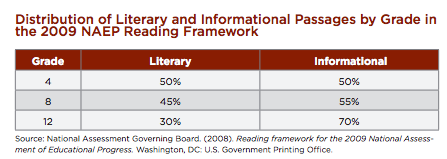
The specific ratio of how much reading students should do in in fiction and informational texts can be found in a chart in the ELA CCSS  taken from the 2009 reading framework of the National Assessment of Educational Progress (NAEP). This chart sets up the progression from an even split between fiction and informational texts in grade 4 to the 30% fiction and 70% informational text ratio expected by grade 12.

Chart with 30% fiction, 70% informational Text ratio

The chart is on the Key Designs Considerations page and addresses the demands to include informational texts because “a great deal of informational reading in grades 6–12 must take place in other classes if the NAEP assessment framework is to be matched instructionally.”

Really?  If the NAEP assessment framework is to be matched? Why “if”? The only way the ratio for 70% informational texts will meet the NAEP assessment framework is “WHEN” there is an increase of informational texts in classes other than English. Additonally, it is highly unlikely that English teachers will teach a reduced percentage of  fiction or literary non-fiction as students move from elementary (Grade 4) to middle (Grade 8) to high school (Grade 12), and there is nothing in the standards that specifies the ratio of fiction to other texts in an English classroom.

So, heads up History/Social Studies, Science and the Technical Areas teachers, the CCSS English/Language Arts Framework is looking at you!

While English/Language Arts teachers are developing curriculum to align with the CCSS, how many of the History/Social Studies, Science and the Technical Areas teachers are informed and cooperating in the incorporation of informational texts?  Are teachers in History/Social Studies, Science and the Technical Areas developing additional reading to their specific curriculum? Hopefully they are, but my sense is that these resources will take time to develop and integrate.

Already, I have heard the argument from teachers in disciplines other than English/Language Arts moaning, “what do I drop out of my course to include reading?” -which could be read as the reason why the authors of the ELA CCSS felt the need to develop reading and writing standards for History, Social Studies, Science and the Technical Areas teachers. A sidebar column in the document explains the need for other disciplines to increase reading:

“Reading is critical to building knowledge in history/social studies as well as in science and technical subjects. College and career ready reading in these fields requires an appreciation of the norms and conventions of each discipline, such as the kinds of evidence used in history and science; an understanding of domain-specific words and phrases; an attention to precise details; and the capacity to evaluate intricate arguments, synthesize complex information, and follow detailed descriptions of events and concepts…Students must be able to read complex informational texts in these fields with independence and confidence because the vast majority of reading in college and workforce training programs will be sophisticated nonfiction (60).”

The last sentence of this section should be in bold: “It is important to note that these Reading standards are meant to complement the specific content demands of the disciplines, not replace them.” 

While the teachers of History, Social Studies, Science and the Technical Areas are on notice to include more informational texts, these standards still fall under the English Language Arts Framework which begs the question, who will be responsible for enforcing these standards? Will the testing of a student’s comprehension of informational texts be assigned to a discipline other than English/Language Arts? Will overall reading scores reflect on an entire school, as it should, or will reading scores reflect on the English/Language Arts departments since the CCSS frameworks are designed under the heading English Language Arts frameworks?

Of course, many English teachers, fearing the removal of fiction and literary non-fiction (essays, memoir, etc), raised their concerns about the demand for informational texts. Responding to these concerns (among others), the  CCSS developed a page on their website titled Myths vs. Facts.
Here, the CCSS attempts to clear the confusion as to what reading will be done in English/Language Arts:

Myth: English teachers will be asked to teach science and social studies reading materials.

Fact: With the Common Core ELA Standards, English teachers will still teach their students literature as well as literary non‐fiction. However, because college and career readiness overwhelmingly focuses on complex texts outside of literature, these standards also ensure students are being prepared to read, write, and research across the curriculum, including in history and science. These goals can be achieved by ensuring that teachers in other disciplines are also focusing on reading and writing to build knowledge within their subject areas.

Unfortunately, the CCSS’s use of footnotes and charts to define the percentages in the increases in informational text reading leaves questions as to which exactly how each discipline will be held responsible.  The CCSS makes the assumption that other disciplines will  incorporate more reading under a English/Language Arts framework. The CCSS states that the English/Language Arts classrooms will not be required to replace their fiction and literary non-fiction with informational texts, but infers that there will be a mechanism “to ensure that teachers in other disciplines are also focusing on reading and writing to build knowledge within their subject areas.” The method of measuring the increase and the results of this increase is yet to be determined.  The process of how reading will be incorporated across the curriculum needs more than an assumption and an inference. For English/Language Arts teachers there is a footnote is where the “devil is in the details”, but only if all other stakeholders in this shift to a Common Core curriculum read that footnote.