Archives For November 30, 1999

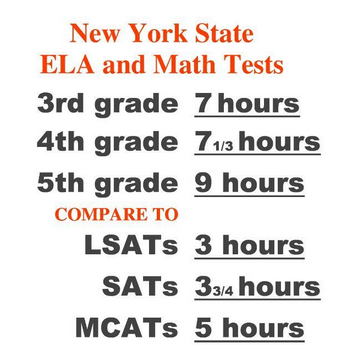
An interesting graphic came across my screen this week. The purpose was to call attention to the hours spent testing elementary students by comparing them to the tests for college or graduate school:
Screen Shot 2013-10-29 at 8.28.06 PM

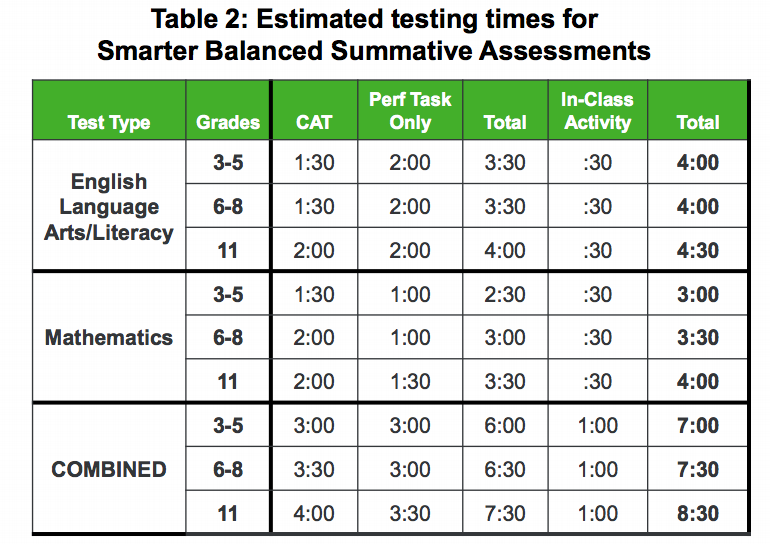
Standardized testing is not new to schools in the State of Connecticut. Many schools will be using the Smarter Balance Assessment (SBAC) this year (pilot) for state testing. The new testing schedule will be the same as the NY State tests. The SBAC website provides testing times:
Screen Shot 2013-10-30 at 8.26.11 PM

Both charts illustrate the number of hours that elementary, middle, and high school students will sit in order to take tests to measure their achievement in meeting the Common Core State Standards (CCSS). The SBAC tests will be given over a period of week(s), and scheduling may depend on the number of available computers that meet the testing software criteria.

Each sitting will match the minimum amount of time an older student sits for college and law school entrance exams. While these entrance exams (SAT, LSAT, and MCATs) are taken only once, the SBACS are taken annually in grades 3-8 and again in grade 11. Consider that an average student’s experience taking the SAT is a little under four hours, while a student will take the SBAC repeatedly for a total of 52 hours over the course of one academic career. Yet, the hours spent taking a test are not the only hours committed.

Washington Post education reporter, Valerie Strauss, cited a study by the American Federation of Teachers in her July 25, 2013, article How much time do school districts spend on standardized testing? This much.”  The report compared “two unnamed medium-sized school districts — one in the Midwest and one in the East” and determined that:

The grade-by-grade analysis of time and money invested in standardized testing found that test prep and testing absorbed 19 full school days in one district and a month and a half in the other in heavily tested grades.

The percentage of time for SBAC testing is roughly .07% of the school year (based on an average of 1100 school hours/year), but when when test preparation is added, (ex:19 days), that percentage jumps to 11%. This jump is enough to make the time for test preparation equivalent to a year of physical education classes. Ironically, research is proving that physical education may be the best kind of test preparation.

An article by Dr. Catherine L. Davis and Dr. Norman K. Pollock  detailed some of the more recent studies on the relationship between physical education and cognition, noting that “benefits have been detected with 20 minutes per day of vigorous physical activity”.

Their paper, Does Physical Activity Enhance Cognition and Academic Achievement in Children? determined that, “incorporating 40 minutes per day of vigorous activity to attain greater cognitive benefits would require additional programs available to children of all skill levels.” They concluded that:

In a period when greater emphasis is being placed on preparing children to take standardized tests, these studies should give school administrators reasons to consider investing in quality physical education and vigorous activity programs, even at the expense of time spent in the classroom. Time devoted to physical activity at school does not harm academic performance and may actually improve it.

Schools are motivated to try different strategies in order to improve test scores. The data from standardized tests are used to determine the effectiveness of curriculum as well as individual student performance. Standardized test scores are also an increasing metric in teacher evaluations. In the State of Connecticut, test scores could count as much as 40% in a teacher’s performance review, with the spotlight on those educators who teach in testing grades 3-8 and grade 11.

Paradoxically, the focus on standardized testing as an evaluation tool is a contributing factor to the increasing commitment of time and resources to test preparation. Next generation tests like the SBACs will be taken on computers that will require school systems to invest in computer hardware that meets specific criteria. The cost of the hardware and practice software could be justified by increasing the number of students who will take the tests.

Additionally, those who fund education want tests that run on this hardware to be an effective measure of student achievement, and these tests must be of a substantive duration to make the expense worthwhile. Given the commitment of time and money, students will continue to sit for tests and test preparation, perhaps for even longer periods in the future.

What might students be thinking about sitting for all these standardized tests?

They might borrow the words of their favorite author, Dr. Seuss, “And we did not like it. Not one little bit.”

The education reformers often look back to see what lessons can be learned from the past in order to direct the future, and the recent article in The Wall Street Journal  “Why Tough Teachers Get Good Results” (9/27/2013) by Joanne Lipman integrates current research to the old-fashioned teaching techniques of her former music teacher, Jerry Kupchynsky. After creating a nostalgic portrait of a demanding educator, Lipman posed the questions, “What did Mr. K do right? What can we learn from a teacher whose methods fly in the face of everything we think we know about education today, but who was undeniably effective?“ She continued:

Comparing Mr. K’s methods with the latest findings in fields from music to math to medicine leads to a single, startling conclusion: It’s time to revive old-fashioned education. Not just traditional but old-fashioned in the sense that so many of us knew as kids, with strict discipline and unyielding demands. Because here’s the thing: It works.

In responding to her own questions, Lipman listed out the eight factors that were the hallmark of Kupchynsky’s teaching style, a style that Lipman admits would be controversial. She writes, “Today, he’d be fired.”

The tenets of Kupchynsky teaching method were summarized by Lipman as:

  • 1. A little pain is good for you.
  • 2. Drill, baby, (kill and) drill.
  • 3. Failure is an option.
  • 4. Strict is better than nice.
  • 5. Creativity can be learned.
  • 6. Grit trumps talent.
  • 7. Praise makes you weak…
  • 8.…while stress makes you strong.

I also grew nostalgic reading the article. I doubt Kupchynsky ever had to mention his objective. He never was mandated to place the Common Core Teaching Standards in a visible location at all times or worry about collecting data from formative assessments to inform his instruction. This was a man who knew his discipline and was disciplined in his teaching. The evidence was in the success of his students:

Some were musicians, but most had distinguished themselves in other fields, like law, academia and medicine. Research tells us that there is a positive correlation between music education and academic achievement.

This story about Jerry Kupchynsky’s teaching came to mind when I heard Teacher’s College Reading and Writing Project  (TCRWP) Director Lucy Calkins speak this past Saturday at Columbia University at the 85th Reunion (10/19/2013).

Calkins offered an afternoon session about “Leading From Within: Turning Schools into Places Where Everyone’s Learning Curve Is Sky High” and her opening wry comment, “This session could be titled ‘Staying Alive in a Toxic World’,” was met with appreciative laughter by the audience of educators jammed into the large meeting room.

Calkins immediately addressed the reform efforts, teacher evaluation programs, and the Common Core State Standards.  “We cannot control what happens to us,” she stated clearly, “but we can control our reactions.”

She discussed how her acceptance of the Common Core, detailed in her book Pathways to the Common Core, has put her on the outs with many education reformers, and she acknowledged with some frustration that the “350 billion on tests and technology…nothing left for support for teachers and kids,” angers many educators.

Against these controversies, she asked, “Is there a way for us to move students/our work forward?”  and she explained that in trying to find that way, many opportunities have been presented to TCRWP, and that the pressures in this environment, “Can lead you to do really problematic things.”

She paused for a moment and then said, “Sometimes to say ‘no’ is good.”

The room was quiet as the teachers in the crowded room considered what Calkins meant.

“The ‘nos’ protect your brand,” she said emphatically, “the ‘nos’ define your brand. If you do not say no, then you have no brand…but we must be evidence based when we say ‘no’.”

Lipman’s music teacher Kupchynsky had a brand.  I imagine he said “no” quite a bit. Consider how easily “no” fits into seven of the eight ways his brand was defined. For example, “no pain, no gain” is the same as “a little pain is good for you.” Even the idea that “creativity can be learned” refutes the commonly held belief that people are born with creativity or they are not.

The Kupchynsky model worked because he knew his discipline and the direction he wanted for his students; he had a brand.

The Calkins model works because she knows her discipline and the direction she takes as she pushes the teacher leaders at the TCRWP; she has a brand.

noThe toughest teacher in the room, however, does not have to employ the Kupchynsky methods of teaching; given today’s climate, the behaviors detailed in the article could lead to a dismissal.  The toughest teacher in the room can be quiet and unassuming, yet someone who is passionate and skilled in a discipline.

The toughest teacher in the room has a brand, and like all brands, one that is defined by “nos”. The toughest teacher in the room says “no” to excuses from any stakeholder that stops student achievement in the classroom.  The result can be a brand of teaching that possesses the “unyielding demands” like those made by Kupchynsky, the brand of teaching that provides evidence reported in a newspaper article some twenty years later by a former student.

The recent invitation to respond to the statement “Don’t Teach the Test” was under discussion in the New York Times: Invitation to a Dialogue series. The question was posed by Peter Schmidt,  the director of studies at Gill St. Bernard’s School, and he singled out two tests in particular: the SAT and the Advanced Placement Tests.

Schmidt suggested that the SAT should be eliminated as a requirement for college on the basis of economic inequality.  Students who have the finances to take prep courses or hire tutors have an advantage, and Schmidt suggests that, “our colleges are further promoting the inequities of our society.”

Schmidt also called for the end to  Advanced Placement  (A.P.) courses in high school, saying that they

“too often fail to prepare students adequately for college-level course work. They also put pressure on students to perform well on the A.P. exams in the spring, leaving them exhausted and lacking a spirit of intellectual curiosity.”

Full disclosure: I teach Advanced Placement English Literature, and I have served as an A.P. Reader.

AP TestsThat said, I believe Schmidt is right about the pressure the testing for these courses places on students. I agree that these students are exhausted the first two weeks of May since students who take A.P. courses often take more than one A.P. class. Many students are scheduled for two separate tests on the same day. But as to his assessment that the A.P. courses do not prepare students for college level work, I must respectfully disagree.

Students who take A.P. courses recognize that they may or may not receive college credit for the course. College credit is given based on a student’s test score (minimum a level “3” on the A.P. English Language or Literature) and the willingness of the college to accept that score in lieu of an undergraduate course.  As a result, there are no guarantees of college credit in an A.P. class; however, colleges do look to see if students are taking A.P. classes as an indication of their academic ambitions.

The A.P. exams in all subject areas are a mix of multiple choice questions and essay responses questions.  In the A.P. English Literature exam, there are 55 challenging questions on five or six literature selections. Students need a command of vocabulary and the ability to “close read”, a skill that was the hallmark of A.P. courses long before the Common Core State Standards. But the most demanding part of the AP English Literature exam is the essay section where students write three essays in response to three prompts in two hours. 

My students practice writing to these prompts throughout the school year.  They learn to read, annotate, and draft quickly, but Schmidt raises a good question.

Does the A.P. test prepare students for college?

In responding to Schmidt’s concern, I have thought about how my student’s responses to the essay test questions are not the only measure for determining student understanding. A good A.P. course incorporates the practice of revising drafts written for a practice test. There is always a gem of an idea in these hasty constructions. There is always some hypothesis that student will discover as he or she “writes into” the prompt, something I have previously referred to as a “manifesto in the muck.” A good A.P. course provides a student with the chance to take that essay draft, and expand and revise. A good A.P. course gives students the chance to start again with the end of the draft in order to begin a better essay.

Schmidt complains about “the  lack of  imagination and creativity” that “are the cornerstones of genuine learning,”but these generalizations are not true.  I know first-hand that there is nothing to stop a student’s imagination or creativity in responding to a work of literature in an A.P. course. Some of the most amazing statements or ideas I have read have come from students undergoing the intellectual crucible of writing an organized essay in under 40 minutes. In reading these practice drafts, some ripe with grammatical errors and misspellings,  I will pause with my red pen suspended, repeating to myself, “First do no harm”, as I leave a draft untouched. A.P. advises instructors to “reward the student for what they do well”, even on a practice test.

There are too many reasons to not like the standardized tests that are choking education today; the limited data that standardized testing yields is often not worth the time and expense. Frankly, I am no fan of the College Board. The limitations of the A.P. test, however, does not mean that an A.P. course is not valuable.

The A.P. test, like all standardized tests, is a single metric measure, but an A.P. course is a much broader experience.  So, yes, I teach to the test, but I also teach the A.P. course as a preparation for the rigors of college level work, and in particular, I teach the course so that my students will have the option to waive a 100 level composition class giving them the option to take a course in their major field of study.

Schmidt concluded his invitation with an impassioned plea,

As E. M. Forster wrote more than a century ago in Howards End, in addressing the shortcomings of British universities: “Oh yes, you have learned men who collect … facts, and facts, and empires of facts. But which of them will rekindle the light within?”

I would argue that my A.P. class is the only place in my curriculum where I can offer the writings of E.M Forster, if for no other reason than to see how students would respond to that literary prompt.  I know that in their responses, there could be one from a student who, writing under intense pressure, could draft a sentence or two that would reveal a “kindle of light within.”  Whether that student response would be in a test booklet written during the A.P. test or not does not matter.

Open House: OMG!

September 15, 2013 — 1 Comment

September is Open House Month, and the welcoming speech from a teacher could sound like this:

“Welcome, Parents! Let me show you how to access my website on the SMARTboard where you can see how the CCSS are aligned with our curriculum. You can monitor your child’s AYP by accessing our SIS system, Powerschool. In addition, all of our assignments are on the class wiki that you can access 24/7.  As we are a BYOD school, your child will need a digital device with a 7″ screen to use in class.”

OMG!

How parents may feel during Open House listening to education acronyms

The result of such a speech is that parents may feel like students all over again. The same people who sat in desks, perhaps only a few years ago, now are on another side of the classroom experience, and the rapid changes caused by the use of technology in education necessitate a need for education primer, a list of important terms to know. While attending the Open House, parents can observe that there are still bulletin boards showcasing student work. They can note how small the desks appear now, if there are desks. Perhaps the lunch lady is the same individual who doled out applesauce and tater tots onto their school lunch trays.  Yet, listening to how instruction is delivered, monitored, and accessed may make parents feel that they are in some alien experience with instructors and administrators spouting a foreign language. Just what is a wiki? they may wonder, and what does BYOD stand for?

So, let’s begin with some of the acronyms.  At Open House, educators may casually throw around some of the following terms to explain what they teach or how they measure what they teach:

  • PBL (Project Based Learning) a hands-on lesson;
  • SIS (Student Information System);
  • Bloom’s Taxonomy: a sequence of learning based on complication of task and level of critical thinking which is being replaced by the DOK;
  • DOK (Depths of Knowledge) complication of task and level of critical thinking required
  • ESL (English as a Second Language);
  • AYP (Adequate Yearly Progress);
  • WIKI: a web application which allows people to add, modify, or delete content in a collaboration with others; and
  • SMARTboard: interactive white board

Subject area names may also seem unfamiliar since they now reflect a different focus on areas in education. English is now ELA (English/Language Arts) while science and math have merged like the Transformers into the mighty STEM (Science, Technology, Engineering, and Math). The old PE class may now bear the moniker Physical Activity and Health (PAH), but  History has already dealt with the shift to the more inclusive term Social Studies coined in the 1970s.

Assessment (testing) brings about another page in the list of education acronyms that parents may hear on Open House, including these few examples:

DRP (Degrees of Reading Power) reading engagement, oral reading fluency, and comprehension younger elementary students;
DRA (Developmental Reading Assessment) reading engagement, oral reading fluency, and comprehension in elementary and middle grade students;
STAR: new skills-based test items, and new in-depth reports for screening, instructional planning, progress monitoring;
PSAT/SAT/ACT:designed to assess student academic readiness for college 

Parents, however, should be aware that they are not alone in their confusion. Educators often deal with acronym duplication, and  state by state the abbreviations may change. In Connecticut, some students have IEPs (Individual Education Plans), but all students have SSP (Student Success Profiles) which shares the same acronym with the SSP (Strategic School Profile). Connecticut introduced the teacher evaluation program SEED known as the System for Educator Evaluation and Development, which is an acronym not to be confused with SEED, a partnership with urban communities to provide educational opportunities that prepare underserved students for success in college and career.

Federal programs only add to the list of abbreviations. Since 1975, students have been taught while IDEA (Individuals with Disabilities Education Act) has been implemented. NCLB (No Child Left Behind) has been the dominating force in education for the length of the Class of 14’s time in school, along with its partner SSA (Student Success Act) which is similar to, but not exactly like, the SSP mentioned earlier. The latest initiative to enter the list of reform movements that parents should know  is known as the CCSS the Common Core State Standards.

The CCSS are academic standards developed in 2009 and adopted by 45 states in order to provide “a consistent, clear understanding of what students are expected to learn, so teachers and parents know what they need to do to help them.” Many of the concepts in the CCSS will be familiar to parents, however, the grade level at which they are introduced may be a surprise. Just as their parents may have been surprised to find the periodic tables in their 5th grade science textbooks, there are many concepts in math (algebra) and English (schema) that are being introduced as early as Kindergarten.

So when a student leaves in the morning with a digital device for school, BYOD or BYOT (Bring Your Own Technology) and sends a “text” that they will be staying late for extra help or extra-curricular activities, parents should embrace the enhanced communication that this Brave New World of technology in education is using. If at Open House a parent needs a quick explanation of the terms being used by a teacher, he should raise his hand;  in spite of all these newfangled terms and devices, that action still signals a question.

Above all, parents should get to know the most important people in the building: the school secretary (sorry, the Office Coordinator) and the school custodian (sorry, FMP: Facility Maintenance Personnel). They know where your child left her backpack.

Saki

Author H.H. Munro also known as Saki

H.H. Munro was the NYTimes crossword across clue last week, and as it so often happens, I just happened to be talking about H.H. Munro to the sophomore English class these first days of school. Just name dropping Saki, his pseudonym, caught their attention.
“What kind of a name is that?” they asked.
When I told them he might have been referring to the Saki monkey, a small South American primate, they concurred that he had chosen a cool pen name. 

Saki’s short stories open our World Literature course which complements the Modern World History course offered the same year. Our students will be reading complex texts required by the English Language Arts Common Core State Standards (CCSS), and  complex texts are those that meet four criteria:

1) Meaning: Multiple levels of meaning (such as satires, in which the author’s literal message is intentionally at odds with his or her underlying message).
(2)  Structure: Complex, implicit, and (particularly in literary texts) unconventional structures.
(3) Language: Figurative, ironic, ambiguous, purposefully misleading, archaic or otherwise unfamiliar language
(4) Knowledge Demands: Everyday knowledge and familiarity with genre conventions required; cultural and literary knowledge useful.

Saki’s work meets the CCSS criteria above, but I have learned that the practice of close reading never follows the lengthy tortuous path suggested by Common Core developers who have no classroom experience. My students stray.

The text selected was “The Interlopers”. (SPOILER ALERT For those of you who are unfamiliar with the story and want to read it before I reveal the plot twist, link to the text. There is also an audio-text.)

To prepare students, but careful not to “overteach” before reading, I gave students slips of paper with 25 words from the story. The slips including some of the more difficult vocabulary (languor, succor, marauder) and some plot details (woodland, feud, detest). Some of the students sorted the words alphabetically, but others grouped words that shared some commonality. After a few minutes of discussion, we joined together to predict what the story would be about using the grouped words; there would be a dispute in the forest that was linked to some feud, just like the feud in Romeo and Juliet.
Then we read the story.

Thirteen minutes later, some heads shot up. They had reached Saki’s iconic last word…”wolves!”

“Wolves!” one student questioned, “does that mean they die?”
There was much stirring. Some seemed surprised; others seemed confused.
In contrast, I thought the ending was obvious. Two men, trapped under a tree, end a bitter feud over forest land only to eaten by wolves.

Several, but not all, of my students thought differently.

“They weren’t rescued?” asked Kailey, “but one of them said he had men that would be there to rescue them in the forest.”
“He was bluffing,” responded Logan. “He was trying to scare the other guy when they first met.”
“But there was a gun,” pointed out Stephan, “one could have used the gun.”
“They had their arms ‘pinioned’,” I responded, trying to slip in another vocabulary word, “pinioned means to tie up the arms of…”
“They could have wriggled out when they saw the wolves,” insisted Stephan, “the rush of adrenaline would make them so strong, they could un-pinion their arms.”
“But there is no evidence to show that,” I responded. “The last word is their last word because the wolves come upon them.”

I had thought the story was straightforward. There were no flashbacks, and no change in setting. This was, according to Aristotle, a story that demonstrated unity of time, unity of place, and unity of action.

Yet the conversations in the room showed the text’s complexity. Saki’s The Interlopers has all the elements suggested by the CCSS. There is the figurative language in the character Ulrich’s statement, “We have quarrelled like devils all our lives over this stupid strip of forest, where the trees can’t even stand upright in a breath of wind.” There is the ironic wish, “If only on this wild night, in this dark, lone spot, he might come across Georg Znaeym, man to man, with none to witness – that was the wish that was uppermost in his thoughts.” There is also the multiple meaning in the revenge sought by man and the revenge exacted by Nature. Our close reading should have been “textbook”. The evidence proved the characters’ demise…or did it? I began to consider the renegade students’ position.

“See,” insisted Kailey, “look at the text, Georg says he has seven men out with him before the tree fell. These seven men would hear their screaming.”
“Yes, there would be screaming. Their last words were, ‘AHHH!!! OUCH!!! THAT HURTS!!'”Jay yelled.
“But that does not mean they were definitely eaten,” corrected Kai, “this guy Saki wants you to make up your mind.”

Which is true. Saki does not end the story with screams of pain or with tales of rescue. He trusts the reader to use evidence to make up his or her own mind. Several of my students did not want to see Ulrich and Georg meet their demise, especially when they had settled their long standing feud.

The class discussion continued with each piece of evidence for the “eaten by wolves” side being countered by evidence from the “escaped with their lives” side. The students were definitely close reading, but they were exploiting Saki’s ambiguity to defend their differing positions. A case could be made for both.

Yes, they understood the importance of irony in the story, and yes, they were familiar with plot twists, but they still held out hope. Saki had made them care for these characters in the 2100 words of this short story. He had given just the right amount of contradictory information to leave room for just a sliver of hope. A 99 and 44/100’s sort of hope.

Did they hold out hope because of their youth? Aristotle suggests that, “Youth is easily deceived because it is quick to hope.” Yet, Aristotle is also credited with saying, “Hope is the dream of a waking man.” 

In retrospect, Saki himself would probably have enjoyed their commentary. I discovered too late for the discussion that Saki has been quoted as saying, “A little inaccuracy sometimes saves a ton of explanation.”

Continue Reading…

“Inconceivable!” Rigor

September 3, 2013 — 4 Comments

Some of best lines in the film The Princess Bride are given to the assassin-for-hire Vizzini. For those unfamiliar with this classic film, Vizzini’s repeated use of the word “inconceivable” is finally challenged by the vengeance-seeking swordsman Inigo Montoya while they stand overlooking a cliff watching the Dread Pirate Roberts climb in pursuit:

[Vizzini has just cut the rope The Dread Pirate Roberts is climbing up]
Vizzini: (enraged)  HE DIDN’T FALL? INCONCEIVABLE!
Inigo Montoya: You keep using that word. I do not think it means what you think it means.

I believe the same misunderstanding is happening when education reformers overuse the word “rigor”. This word is tossed about by education reformers who do not demonstrate an understanding of what rigor means. To clear up any confusion, here are three definitions of rigor according to Vocabulary.com:

1 n excessive sternness
“the rigors of boot camp”
Synonyms:
hardness, harshness, inclemency, rigorousness, rigour, rigourousness, severeness, severity, stiffness
Type of:
sternness, strictness
uncompromising resolution

“Excessive sternness” sounds like a  workhouse/boarding school from a Charles Dickens novel, while “boot camp” is an altogether different kind of training. Both interpretations are not tied to 21st Century skills. How do education reformers who  create the rigor of “uncompromising resolution” help to make students career and college ready when cooperation and collaboration are part of 21st Century skills?

The second meaning:

2. n something hard to endure
Synonyms:
asperity, grimness, hardship, rigorousness, rigour, rigourousness, severeness, severity
Types:
sternness
the quality (as of scenery) being grim and gloomy and forbidding
Type of:
difficultness, difficulty
the quality of being difficult

“Something hard to endure” is how many high school students do feel, enduring school as a requirement.  Many employ a degree of “difficult-ness” in order to stop class. “Grimness” and “hardship” are not qualities that encourage students to do well or succeed. Education reformers who seek to make schools “forbidding” with rigor sound as though they want to eliminate schools.

The third meaning:

3. n the quality of being valid and rigorous
Synonyms:
cogency, rigour, validity
Type of:
believability, credibility, credibleness
the quality of being believable or trustworthy

Here at last is a definition that addresses one quality needed for education- “validity”. Yes, there should be validity to information in school and a way to measure student understanding of information in order to be credible. A synonym to validity is “the property of being strong and healthy in constitution”. Education reformers should substitute rigor with validity in order to promote better attitudes towards improving education.

So how did rigor become so misused? In 2008, education advocate Tony Wagner called for a new definition of “rigor” according to 21st Century criteria. In an article published in ASCD Magazine titled “Rigor Redefined” he indicated that:

 “It’s time to hold ourselves and all of our students to a new and higher standard of rigor, defined according to 21st-century criteria. It’s time for our profession to advocate for accountability systems that will enable us to teach and test the skills that matter most. Our students’ futures are at stake.”

Wagner suggested the following criteria:

  1. Critical Thinking and Problem Solving
  2.  Collaboration and Leadership
  3. Agility and Adaptability
  4.  Initiative and Entrepreneurialism
  5. Effective Oral and Written Communication
  6.  Accessing and Analyzing Information
  7.  Curiosity and Imagination

Note that there is nothing about severity or harshness in Wagner’s recommendations for rigor in education. Unfortunately, the Draconian definition from Vocabulary.com is the one that most often captures the attitude of education reformers and politicians who call for tougher standards, increased testing, and more (home) work in order to create an impression of rigor in making school more demanding. Their misuse of what Wagner sought by using the word rigor fails to include higher order thinking skills, problem solving or the significance of imagination.

Therefore, when education reformers misuse the word rigor to mean more demanding lessons or tests so difficult that students cannot possibly succeed, I propose teachers respond with by saying the word “Inconceivable!”

When education reformers misuse the word rigor as a means to evaluate student or teacher performance with tools that only measure basic comprehension skills without addressing any creative problem solving, I propose teachers respond again with the word “Inconceivable!”

And if education reformers continue to misuse the word rigor to describe what is lacking in curriculum at every grade level, I propose teachers stop and correct the reformers, with or without Inigo Montoya’s accent, and say, “You keep using that word …I do not think you know the meaning of that word!”

My school district completed four days of first class professional development that began with a visit from Dave Burgess, the author of Teach Like a Pirate and ended with faculty-led collaborative committees organizing for an accreditation visit from the New England Association of Schools and Colleges (NEASC).  In four short days, the veteran teachers adjusted, organized classrooms, and prepared the first week of lessons. The administrators indicated that schools were off to a “great start”  while the facility management personnel finished polishing the floors and touching up wall paint. One group however, looked different.

teacher appleThe new teachers’ eyes glazed over. Although some have taught for years in other districts, each one has been lost in the labyrinth of our hallways at least once this past week. There are at least fifty names they still need in order to match staff to academic disciplines and a number of faces before they begin to match their attendance rolls with students. The location of materials for various units of study has yet to be established; boxes are unopened in their classrooms.

In short, they are whelmed. Merriam-Webster online defines whelmed as

1. to turn (as a dish or vessel) upside down usually to cover something : cover or engulf completely with usually disastrous effect
2. to overcome in thought or feeling : overwhelm

According to the dictionary, there is no “over” in being “overwhelmed”. Watching the newest members of the faculty trying to mentally sort through the information they had taken in the past four days reminded me of how I felt my first few years of teaching. Putting “over” with whelmed seemed redundant; I was “engulfed completely” my first years of school as well.

Twenty-three years later, I am less whelmed by the start of school, but I still have to adapt. There are always new materials, new changes to schedules, new students to get to know. In 2013-2014 there is also a new state mandated teacher evaluation system and a set of new tests will be rolled out this year to measure the new Common Core State Standards. For these new-to-district teachers, the flood of information in the early days of the school year must seem insurmountable. There is research, however, that indicates with three years of practice, teachers develop strategies for being effective in improving student achievement in the classroom.

In particular, there is research that demonstrates that “teachers in their first and, to a somewhat lesser extent, their second year tend to perform significantly worse in the classroom” (Rivkin, Hanushek, and Kain -2005). In a follow-up interview to this study, Kati Haycock was quoted in Education Next as saying,

“And experience does matter for inexperienced teachers. As a group, first-year teachers tend to be less effective than those with even a little more experience, and effectiveness tends to climb steeply for any given cohort of teachers until it begins to plateau after a few years. According to research by Eric Hanushek and others, disproportionate exposure to inexperienced teachers contributes to the achievement gap.”

How a teacher develops on a learning curve is significant for both the teacher and the students, which is why the story from Mokoto Rich of the New York Times At Charter Schools, Short Careers by Choice (8/26/2013) flies in the face of both anecdotal data and research studies. The article addressed the high turnover rate of teachers in charter schools by first highlighting the story of 24 year-old teacher, Tyler Dowdy. With two completed years of teaching behind him, Dowdy is “exploring his next step, including applying for a supervisory position at the school.” The article described him as someone, “who is already thinking beyond the classroom, wants something more.” His interest in education appeared cursory, “I feel like our generation is always moving onto the next thing,” he said, “and always moving onto something bigger and better.”

Supporting Dowdy’s lack of commitment to the profession, was the statement by Wendy Kopp, founder of  Teach for America (TFA)  who said,

“Strong schools can withstand the turnover of their teachers…The strongest schools develop their teachers tremendously so they become great in the classroom even in their first and second years.”

Kopp’s claims, however, have little credibility considering her own lack of classroom experience. While she has taken TFA from a $22 million dollar enterprise in 2003 to a $244 million dollar business in ten years before her departure this year as CEO, there is no record of her creating or delivering lessons to students herself. She has not had the experience of developing or implementing classroom management skills, a major cause of much teacher turnover.  Teachers, new and old, experience first-hand the fallacies in her argument. Yes, during the first years, teaching can be greatly improved, but that does not mean a new teacher has become “great”. Like so many educational reformers without classroom experience, Kopp dismisses critical teacher training as something that can be condensed, like TFA’s five week summer teacher preparation program.

A five week training for TFA is luxurious compared to the two and a half weeks of training over the summer for other teacher training programs, such as the YES Prep program like Dowdy’s, where new teachers “learn common disciplinary methods and work with curriculum coordinators to plan lessons.” Yet, these teachers from these accelerated programs will look the way new recruits in my district look, glazed and anxious. These teachers will soon learn the importance of experience. They will understand that the only way to learn how to teach is to practice teaching over and over and over….in spite of being whelmed.

Literally….David Coleman

August 24, 2013 — 2 Comments

Literally added a new meaning this past month….literally.

A quick look at the Cambridge Dictionaries Online indicates that while the meaning of literally as ” having the real or original meaning of a word or phrase” will now include use of the word “to emphasize what you are saying”. A similar entry from an authority across the pond, Oxford Dictionaries notes:

In recent years an extended use of literally (and also literal) has become very common, where literally (or literal) is used deliberately in non-literal contexts, for added effect, as in they bought the car and literally ran it into the ground. This use can lead to unintentional humorous effects (we were literally killing ourselves laughing) and is not acceptable in formal contexts, though it is widespread.

This chatter about literally and literalness came to mind when I read the Frizzleblog on the Scholastic website ten “takeaways” from a presentation given by David Coleman, an architect of the Common Core State Standards (CCSS) and the current College Board president, to a group of New York City teachers. The blog entry was titled 10 Things Worth Doing in Your Classroom by  Suzanne McCabe, Editor in Chief at Scholastic, and she listed ten summaries from Coleman’s presentation on how to enrich classroom instruction.

Her summary statement #4 stopped me cold…literally.
4. Only draw conclusions that can be substantiated by the words on the page. Scrape away terms like “metaphorical,” and talk as simply as possible. Once you bring up metaphor and meaning, kids are out of the game.
McCabe may be misrepresenting Coleman in this statement, however, the Common Core State Standards promoted by Coleman centers on textual evidence, so the “conclusions substantiated by the words on the page” summarizes his preferred reading strategy.  In addition, his lack of classroom experience at any grade level explains why he may have said something akin to “kids are out of the game” when metaphors are discussed.
To the contrary, children of all ages understand metaphor according to Maria Popova in her post The Magic of Metaphor: What Children’s Minds Teach Us about the Evolution of the Imagination on her Brain Picking’s blog:

During pretend play, children effortlessly describe objects as other objects and then use them as such. A comb becomes a centipede; cornflakes become freckles; a crust of bread becomes a curb.

The combination of life experience and practice with similes (“pancakes are like nickels,”  “A roof is like a hat,”“Plant stems are like drinking straws,”) builds a student’s understanding of metaphors that are more complex (“”I am the good shepherd; I know my sheep and my sheep know me” John 10:14). 

So why would a teacher want to “scrape” away metaphorical terms at this important stage in developing a student’s understanding of more sophisticated metaphors?
Furthermore, how could Coleman reconcile an author’s choice in using a metaphor if that metaphor is scraped away in order to talk as “simply as possible”? McCabe’s summary of Coleman’s position reduces students to reading “literally”, rendering them unable to appreciate an author’s craft .
For example, if students had to scrape away the  metaphorical ideas in some of Shakespeare’s most recognized literary comparisons, what would they say?

“All the world’s a stage, and all the men and women merely players. They have their exits and their entrances.” As You Like It

Students may determine through textual evidence that Shakespeare was literally referring to the stage.

Night’s candles are burnt out, and jocund day
Stands tiptoe on the misty mountain tops.” Romeo and Juliet

Students may determine through textual evidence that Shakespeare was literally writing about candles.

Smiling sunStudents are more creative than Coleman recognizes in his untested design of the CCSS. From the beginning of their academic careers, they draw their metaphors: smiling suns, hearts in hands, trees with large red dots. They start simply “Freddie is a pig when he eats,” before moving to more sophisticated constructs on their own such as “Love is a chocolate fountain that never runs out.” They are capable of sustaining elaborate metaphors to explain the writing process:

I choose my audience very carefully when playing for an audience for the first time. I want constructive criticism, and therefore I prefer to have my peer musicians as well as my conductor or private instructor hear me play aloud for the first time. . . .When I have read and reread [the paper] so many times that I am unable to find any mistakes, I then like to read my paper aloud to my family or a group of my close friends in order to get their reactions. Maria, National Writing Project website

These students knew they were not writing about a pig, chocolate fountains, or conducting music. If Coleman had classroom experience, he would have first hand evidence about student creativity.

Finally, many of the most beloved children stories are saturated with metaphor.  Lewis Carroll’s Alice in Wonderland is filled with metaphors that address life’s absurdities, and one specific metaphor brings me back to an entry I wrote titled  David Coleman, the Cheshire Cat of Education.

While I did not mean that Coleman is a cat literally, I do mean that his philosophy of education is as contradictory as the character in Carroll’s imaginative classic. “Curiouser and curiouser,” wonders Alice, when the enigmatic Cheshire Cat appears and reappears at critical moments in the story. Likewise, Coleman’s curious contradictions may be the reason for any inaccuracies in McCabe’s summary of his presentation. On the other hand McCabe may have accurately recorded these contradictions and illustrated how Coleman’s inexperience makes his statements about how to teach in a classroom ridiculous…literally.

Late August and early September means back to school for all students. Many primary school teachers are pulling out the traditional “apple” unit to welcome their students. Many of these teachers will be ready with “pumpkin”, also a fruit, for the following month of October. During the school year, teachers of all grade levels might find out that a lesson turned out to be a “lemon”, or one that is “not worth a fig.” Educational stakeholders can “cherry-pick” data to see if the efforts of a teacher “bears fruit”, while the focus on data-driven instruction can drive some teachers “bananas”.

Fruit metaphors are plentiful when discussing education, and a recent post by a friend and literacy specialist, Catherine Flynn, explains a possible reason. Consider that fruits, although uniform at first glance are, upon closer inspection, very different. Fruits flourish in different environments, and fruits require different nutrients. Fruits require different means of harvesting, and fruits ripen at different times.

blackberriesThis ripening was the point of Catherine’s blog post in her response to the Slice of Life blog challenge, a weekly prompt organized by Two Writing Teachers. Catherine’s response to their prompt on her Reading to the Core Blog was titled Ripe Blackberries.  Since she lives in a rural area, she had the opportunity to consider the ripening blackberries on a bush near her home:

 Each morning as I walk my dog, I notice that some of the fruit is deep black, as ripe as it’s going to get, while others still have just a hint of red. Why such variation on one bush? Each blackberry has gotten the same amount of rain and sun. Each one has the same genetic make up. So why are some ripening faster than others?

There are many forces in nature that cause the variations that Catherine noted as she admired the blackberry bush. These forces dictate the time for harvesting those blackberries, but this fruit is never uniformly ready for harvest at the same moment. For example, the advice for picking berries on several websites suggests that to “ensure that none of the fruit gets too ripe, berries should be picked every two or three days.” Berries are not the only fruit that may require a second or third harvest, and pinpointing the exact moment of any fruit’s maturity is a combination of science and practiced guessing.

In contrast to how nature influences fruit to ripen and mature, our educational system requires students to be “ripe” collectively at the same time, regardless of the variations in age, race, or gender of the students. The educational system measures how well a student meets a pre-determined standard through tests given on a prescribed date, picked perhaps years in advance. There is no accounting for arbitrary changes that may have happened in a school system, perhaps changes in staff, facility, or materials. There is no accounting for the arbitrary changes in a student’s personal life. Rather, there is a standardization for elements in our educational system that defies the individual nature of each student.

In her post Catherine notes:

Within every classroom, there will be a variety of strengths, abilities, and weakness. Students will arrive at school with a vastly different amounts of background knowledge and interests. Despite these differences, in the hands of a caring, knowledgable teacher in a supportive, nurturing environment, almost all children will learn and grow. Not at the same pace, and not to the same degree, but they will learn, just as most of the berries on those bushes will eventually ripen.

Screen Shot 2013-08-14 at 8.54.31 PM

Teachers see the differences in the nature of each student: the emotions, the ability, and the interests. Teachers see each student as more than a data point in achieving instruction, and teachers know that each student is more than what a test score represents. As Catherine suggests, in the hands of a caring and knowledgeable teacher, each student will learn and grow.

Yet, countering the forces in the nature of each student are the forces of educational reform that are increasing testing at every grade level. Tests focus on a limited range of skill sets with little consideration for other student aptitudes. To determine each student’s preparedness, students are bunched together by a “date of production” or birthdate, not when a student is “ripe” or cognitively mature.

Therefore, trying to compare student cognition through collective testing on any given day is the final metaphor of this post. It is like comparing apples to oranges. Yes, they are both fruit, but they are very different. So are our students.

CT Stae flagThe other day, I made a scan of my teaching and administrative certificates and sent them to my school office in order to update my records. If you teach in the State of Connecticut, as I do, you are required to provide the necessary transcripts and payments to secure and maintain a teaching or administrative certificate. The Connecticut Department of Education (CT SDE) has always been one of those great equaling institutions: no paperwork=no certificate.

Until now. Until Paul Vallas, Interim Superintendent of Schools in Bridgeport, Connecticut.

Vallas has served 17 months as Interim Superintendent of Schools for Bridgeport, Connecticut, a 21,000-student school system. Before coming to Connecticut, Vallas had served as the Superintendent of the Recovery School District of Louisiana; and the CEO of Chicago Public Schools and the School District of Philadelphia. Vallas, however, was ousted by a Connecticut Superior Court Judge Judge Barbara Bellis’s weeks ago because he lacked graduate coursework and that the “alternative program” created for Vallas by the State Commissioner of Education, Stefan Pryor, fell far short. Pryor’s letter certifying Vallas’s credentials, according to Jacqueline Rabe Thomas writing (6/28/13) in the Connecticut Mirror, was not accepted by the judge who ruled:

“’There is no doubt that Vallas received preferential treatment,’ the judge wrote in her 27-page decision.The judge also noted that Vallas lacked the required prerequisites to enroll in the regular UConn [University of Connecticut] program in the first place, and that such an independent study hadn’t been approved for anyone else in the last decade. Additionally, the university’s governing board had never approved an independent study program.’Ultimately, the course standards were reduced,’ the judge wrote. ‘The court accepts Vallas’ testimony that the work, although done over the course of 10 weeks while fulfilling his employment as acting superintendent, could have been completed in a week.'”

Ultimately, the judge ruled that Vallas’s BS in Political Science/History and MA Political Science from Western Illinois University were not comparable for a certification in education according to Connecticut’s Department of Education (CT SDE). While his experience as the Executive Director of the Illinois Economic and Fiscal Commission, revenue director and budget director for the City of Chicago provided him the experience to deal with Bridgeport’s financial woes, he lacked training as an educator.

Vallas has a number of supporters on the Bridgeport Board of Education, and his ouster has received the attention from the state and national press. There are articles and editorials, mostly positive about his work in Bridgeport. The editorial headline from the Hartford Courant (7/25/13) was particularly sympathetic: Why Make It So Hard For Paul Vallas To Help Bridgeport Schools? Qualifications shouldn’t obstruct a promising superintendent

It would be a blow to the city of Bridgeport’s school system and its 21,000 students if Paul Vallas is not permitted to stay on as superintendent. Someone of Mr. Vallas’ experience and gravitas is just what the doctor ordered for the city’s ailing school system.

While I know little about Vallas’s efforts to improve the school system in Bridgeport, I was particularly attentive to several comments that followed this editorial discussing the role of the state’s colleges and university programs. These comments made clear that academic institutions should be concerned when their undergraduate and graduate education certificate programs are being discounted at the highest level.

Educators in the Constitution State spend time and money at state colleges and universities to meet the requirements for teacher and administrator certifications. Even the state-run Alternate Route to Certification (ARC) for those entering the profession with degrees other than education has been made more demanding. There are special graduate certificate programs offered at different institutions (Administrator-092, Literacy Specialist-097, Superintendent-093) each with requirements of extensive coursework of 30 credits or more.

In addition, CT SDE requires that educators provide all transcripts and results from subject area texts (PRAXIS II); these cost educators time and money. CT SDE website also states:

All prospective administrators enrolled in Connecticut administrator preparation programs seeking a recommendation for the Initial Educator Certification for Intermediate Administration or Supervision (#092) must pass the CAT (Connecticut Administrators Test) in order to be certified.

All administrators prepared outside of Connecticut with fewer than 3 years within the last 10 years of administration experience who apply for the Initial Educator Certification for Intermediate Administration or Supervision (#092) must pass the CAT. An applicant recommended by an out-of-state institution may be eligible for a one-year deferral of the CAT.

Paul Vallas did not meet these requirements.

The controversy has captured the opinions of state politicians, educators, and reached the federal level with the Secretary of Education, Arne Duncan, siding with Vallas. They argue in the press over what Vallas has done for Bridgeport, or what he has accomplished outside of the state.

A more serious far reaching problem, however, is this example of the State of Connecticut’s unequal application of certification requirements to educators. If a certificate is not necessary for a high-profile educator to work as an administrator in the state, why have the requirement at all? If education course work is unnecessary, why should the state’s colleges and universities offer courses at all? And if there is no need for certificates or coursework, why have I paid money to the state to keep my teaching and administration certificates updated?

In Connecticut, the land of steady habits, inequalities in certification requirements make the state a little less steady.