Archives For November 30, 1999

“It’s the Minotaur vs. Fenris”, I announce as the pair is selected from a name randomizer on the BarryFunEnglish website.
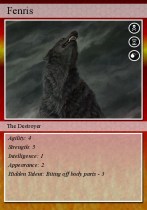
 Students look at their playing cards.
“Agility?” I ask.
“Fenris…a 4,” one student responds.
“Minotaur…a 3,” another student adds.

“Round One to Fenris!” we agree.

This monster smackdown game is taking place in the Hero & Monster English IV elective class. There are 16 students in the class, several of whom who petitioned our department for a class on mythology, monsters, and heroes this year. The class was created in response to their petition. During the first week of school, they wrote the essential questions they will be studying

  • What is the difference between a hero or monster?
  • What criteria do we use to determine who or what is a hero?
  • What criteria do we use to determine who or what is a monster?
  • Created Monsters (serial killers) vs. Monsters created (Boogey man; Monsters, Inc.)
    • Is there a difference? Why or why not?

In order to quickly provide them with a pantheon of mythological monsters, I devised this monster smackdown game where each student was first assigned one mythological monster. The monsters on the list originated in different cultures: Norse, Algonquian, Greek, Roman, Persian.

  • Minotaur
  • Wendigo
  • Scylla
  • Fenris
  • Medusa
  • Kraken
  • Sphinx
  • Charybdis
  • Cyclops
  • Furies
  • Basilisks
  • Sirens
  • The Hydra
  • Cerberus
  • Leviathan
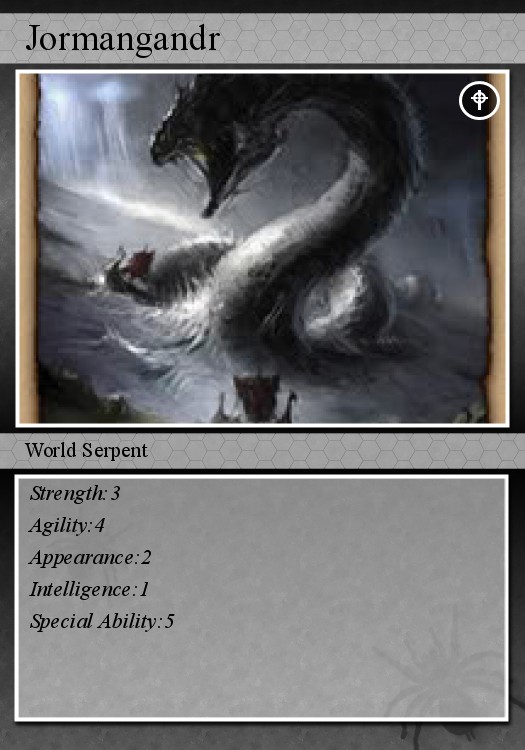
  • Jörmungandr
  • Chimera
  • Manticore

Each student had to research the monster and create a trading card. We used the template on the BigHugeLabs website. The student had to rate the monster on five qualities: agility, appearance, intelligence, strength, and a “special” or “hidden” talent on a scale of 1-5. One the cards were made, I printed them out on on card stock using a business card template (12 on a page). This was the most costly part of the exercise (time & ink). Before we played the smackdown, each student had one minute to “sell” the monster to the rest of the class, an advertisement for the proceeding game, and pass out that trading card to each classmate.

To play the monster smackdown, I placed each monster’s name into a randomizer. I used a virtual dice creator to call out the competitive quality being tested in the smackdown. What I did not tell the students was that they would be battling on a different location. These locations were also randomly selected and included:

  • nuclear power plant
  • frozen pond in a wilderness
  • aircraft carrier in the Indian Ocean
  • Wamogo High School’s senior parking lot
  • Drive-in movie theatre
  • Nevada Salt Flats
  • Mount Rushmore
  • Iceberg floating from the North Pole
  • Grand Canyon
  • Little Susie’s closet

Each monster had an opportunity to have his or her monster qualities tested against an adversary; students defended their individual monster’s abilities on different battlegrounds.

“Charybdis would so rule in the Grand Canyon,” yelled Jed, “He’s already a whirlpool!”
“But the Sirens would make him go mad with their singing,” Sam calmly replied, “he would swallow himself up.”
The class voted Sam’s as the better response.

There were contentious battles between Medusa and the Wendigo (malevolent cannibalistic spirit from Algonquian myths) and between the Scylla and the Kraken. My Sphinx was eliminated on round one (apparently being able to riddle is not all that great a monster power).

The winner of the monster smackdown was the Jormangandor, a “midgard” serpent that is so big he encircles the globe and holds onto his own tail.
“The world will end when he lets go of his tail!” proclaimed Eric.
“How can he fight then?” challenged Matt.
“I don’t know,” blustered Aaron, “but either way, he beats your Cerberus!”

The chief complaint about the game were from students who noted that some of their peers had not properly filled out their cards; spelling was not the only issue.
“This Medusa card is wrong. He has two ‘5’s rated -one for intelligence and one for appearance!” said Zach. He turned to confront the card-maker, “Look, if this game is going to work, you need to fill the card out properly.”
I said nothing; peer-to-peer correction is far more enduring than my suggestions.

There are a few changes I would make with regards to the scoring, but several of the students have offered to come up with a more complex system of rating and handicaps. I will also be investigating the Trading Card Creator on the Read,Write,Think website (NCTE) which allows for more detailed information on each subject; we still need to create our hero cards. Overall, the game received enthusiastic support, even from the principal who was found his way to the raucous activity that Friday morning. He left with a set of trading cards of his own.

We will be tackling “movie” monsters next. The list will include Dracula, the Balrog, Frankenstein’s Monster, Harry Potter’s Dementors, Godzilla, and King Kong. In keeping with that medium, students will make 30 second movie trailers using Animoto software. For that challenge, we will hold an Academy Awards of Movie Monsters.

The monster smackdown game provided students a quick review of monsters they encounter in literature, the allusions they need to comprehend complex texts. Already we have encountered the chimera in our reading of Frankenstein, “…because the powers of the latter were chimerical, while those of the former were real and practical, under such circumstances I should certainly have thrown Agrippa aside and have contented my imagination…” (ch 2).
“What does that mean?” I asked Steve, who had researched the Chimera.
“Changing and adding shapes to make something different? My monster changed shapes,” he replied hesitantly.
“Yes, to make something new and fantastic. Was your monster fantastic?”
“Of course,” he responded, “fantastic like me!”

These mythological monsters are the result of wildly imaginative stories from every culture; they are fanciful, fascinating, and fantastic…apparently, just like my seniors.

An interviewer can ask a question to get the answer he or she wants to hear. That may have been the case on September 2, 2012 when   CBS’s 60 Minutes  framed a question on educators and education. The interview featured Google chairman Eric Schmidt who was responding to questions about Sal Khan, founder of the Khan Academy. The educational enterprise Khan Academy began as a series of math video tutorials given by Khan for his nephew in 2004. Khan Academy expanded into its own YouTube channel to feature other disciplines including history, healthcare and medicine, finance, physics, chemistry, biology, astronomy, economics, cosmology, organic chemistry, American civics, art history, macroeconomics, microeconomics, and computer science. Schmidt was heaping praise on Sal Khan when he was asked, “He [Khan] was the guy to sort of make this happen? Why do you think it was him and not some person who was an educator, who had a background in this area?”

Schmidt’s response was incredibly disappointing:

“Innovation never comes from the established institutions. It’s always a graduate students or a crazy person or somebody with a great vision.”

With one sweeping over-generalization, Schmidt and the producers of 60 Minutes dismissed the efforts of our nation’s teachers as innovators inferring that outsiders, specifically outsiders from the business world, are better equipped to reform our education system.

Both Schmidt and the producers of 60 Minutes are wrong. Teachers are innovative.
Just look at the definition of “to innovate”:

1: to introduce as or as if new (as transitive verb)
2 (archaic) : to effect a change in
3: to make changes : do something in a new way

“To innovate” is conceptually connected to the verb “to teach”; teachers introduce content as new, effect a change in understanding, and encourage students to make changes in order to prepare for the future. Our nation’s public school system is an innovative effort; no other nation has so purposefully engaged in the enterprise of educating ALL children, regardless of ability or disability.

Apparently, Mr. Schmidt blanked on the relationship between his company and teachers who are familarizing students with Google’s mutiple applications. The Google Educator Academy is offered to teachers so they can better learn how to integrate Google products into classrooms. Of course, the Google Educator Academy also allows Google designers the opportunity to pick the brains of innovative educators as to what is needed in the classroom. For example, many teachers innovate with Google products in ways engineers did not anticipate. I doubt that when Google Maps programmers designed the software to provide directions on virtual maps that they anticipated teachers would use their program to create as virtual field trips to locations in literature. There are hundreds of these trips online including Jon Krakauer’s Into the Wild, Christopher Curtis’s The Watsons Go To Birmingham, or David Wiesner’s Flotsam. My own Grade 12 students have created their “journeys of life” dropping their pins and explanations on their own Google Maps. Everyday, teachers use the available technologies in ways the creators never imagined.

Teachers are not in the business of developing technologies. Developing technologies are in the purview of engineers, graduate students, or a Schmidt put it, some “crazy person”. Instead teachers innovate with creativity and flexibility everyday in the classroom to promote understanding for diverse learning styles. At any moment, a change in schedule (fire drill, student emergency) could require an immediate shift in plans, a demand for innovation. An elementary teacher needs to be prepared to walk into a classroom at any grade level armed with little else than a picture book and innovate a writing lesson for pen and paper or for an open software program. Subject area teachers need to be innovative in content areas: to deliver a memorable lesson on percentages with pizza (virtual or otherwise), or to implement a lesson on measuring area using nothing but paper clips (virtual or otherwise), or to create a lesson on character development using paper bag puppets or animation software. Before accepting the premise that teachers are not innovative, consider how you might engage 24 fifth graders right after a recess period. If you are not innovative, I can assure you that 45 minute period will be memorably exhausting and/or uncomfortable..

While I certainly appreciate Sal Khan’s innovative contributions of providing video tutorials, I would also like to point out that his method of delivering content takes place some distance away from the classroom. His Khan Academy is a great supplement or complement to education, but the Khan Academy cannot replace the role of the teacher in the classroom. Khan’s methodology of taping lectures is also not entirely innovative. Eric Mazur at Harvard developed Peer Instruction in the 1990s, and the birth of YouTube in 2007 saw a plethora of teachers providing lessons for students. The Flipped Classroom Movement, started by teachers, is currently adopting the practices and offering variations to Khan Academy. What does bear remembering is that Khan’s position as a hedge fund manager provided him the time, financing, and connections to develop and market his Academy’s method to deliver content. Teachers do not have those resources so readily available.

Finally, I would suggest to Mr. Schmidt that innovation most certainly does come from established institution of education, and that he need only look around the offices and boardrooms of Google to see how traditional education has directly benefitted his company. Every single person in these rooms has had an education from an established institution, yet they are considered innovators. The people at Google, however, are not under the same kind of pressure to innovate at least five (5) hours a day for a minimum of 180 days a year.  That grueling pace is what innovative teachers keep.

Wamogo High School (Region 6)  in Connecticut finished four days of teacher driven professional development. There were a few “requested sessions” which were organized to address concerns about the upcoming block schedule; we are moving from a sequence of 38-45 minute periods to alternating days of 80 minute blocks. The question came up, “What plans can a teacher leave a substitute teacher for this length of time?”

I suggested that a lesson plan that incorporates film is easy to prepare in advance, so I organized the following links that teachers can use to prepare a substitute lesson that incorporates film.

The substitute teacher may have students who think they have the “day off”, but a film lesson organized with a written reflection can be an effective way to promote new learning.

Film lessons are popular with substitute teachers. They are usually engaging, and they are easy to implement as long as the substitute can access the video online or operate the hardware to run a hard copy of the video.

Video/film lessons also meet many of the Common Core Standards as stated in the Overview for the ELA Standards: “Just as media and technology are integrated in school and life in the twenty-first century, skills related to media use (both critical analysis and production of media) are integrated throughout the standards.”

Our school has a subscription to Discovery Education which is jammed packed with digital content: film clips and prepared lesson plans are available for every grade level. However, other school systems may not have this resource.

The following free websites were reviewed in the presentation for teachers to use in order to find videos, lesson plans to use with videos, and/or worksheets that can be completed by students watching videos.

One major source to start looking for all video materials is the updated Edudemic 100 Video Sites on the Edudemic.com website.This website is organized with sub-headings General; Teacher Training; Science Math & Technology; History, Arts and Social Sciences; Lesson Planning; Video Tools and true to its name there are 100 sites, each rich with links to videos of all lengths in all subjects.

To accompany a selected film or video, I strongly recommend students have a writing assignment. The writing assignment can be in a variety of formats: notes, critical analysis, or reflection. I am not a fan of the worksheet, but substitutes benefit from a well-designed worksheet that students can complete and turn in at the end of class. For that reason, I located a number of websites that can be used to either develop a worksheet or websites that have worksheets already prepared:

Video documentaries are also popular; since these are often shorter than a feature length film, many can be run during one block period. A note of caution: several of these videos will need to be vetted to assure content appropriate materials are used. Many of the video clips on these sites are current and can be associated with news articles to use to supplement the viewing as a comparison or a contrast. 

The Oscars.com website offers a generic documentary worksheet. This prepared sheet is organized around political discourse, but the sheet has questions that can be used with any documentary. 

The Ted Talks website describes the numerous video presentations as “Ideas Worth Spreading.” TED began in 1984 as a “conference bringing together people from three worlds: Technology, Entertainment, Design.” There are very entertaining videos on every subject, but most recently, there has been a new category devoted to education TED-ED. These short film clips at  http://ed.ted.com/ are offered with interactive quizzes and writing prompts.

My Film and Literature class used many of the lessons off the Film English blog devoted to film and English Language Learners (ELL) http://film-english.com/. The lesson plans are very detailed and involve critical thinking skills that can be used outside of the ELL classroom as well.

Our English Department has been phasing out the department’s DVD library; so many DVDs were scratched or went missing during the school year. We now use commercial “instant streaming” websites where we can purchase videos for safekeeping “in the cloud”. Unfortunately, this means that one of the best features used for showing a film, the closed-captioning feature, is not available. If we cannot locate a film through an “instant streaming” service, we check with OpenCulture.com http://www.openculture.com/freemoviesonline which has hundreds of movies available. Some are subtitled in English; most are classic films. Suppose the DVD case is empty? Teachers can check here to see if the film is available for free on this site.

Finally, the “motherlode” of film lesson plans is on the NYTimes Learning Network website. This is a one stop shopping for plans website (no subscription required) with lessons written by “[freelance] educators with deep and broad experience in the classroom and in curriculum development. They work with the editors, Katherine Schulten and Holly Ojalvo, who are also longtime educators, to develop the lessons.” The lessons are thorough, tied to standards, and so easy to follow that a sick teacher need only browse for a few minutes to find a lesson, film or otherwise, that can connect to a discipline.

This year, the 80 minute time block is new for our school and for our substitutes, and this longer class period demands even more attention to preparation. No teacher or administrator wants to lose 80 minutes (X) times the number of students in the classroom; do the math- 20 students in a class X 80 mins = 1600 educable minutes! A film/video lesson should not be offered as babysitting, but rather a lesson that extends learning in another medium. This quick presentation of information was designed to help teachers design lessons that can be easily implemented by a substitute teacher and meaningful for the students.  A well-designed film lesson can be effective even if the classroom teacher is not the one clicking the “play” button.

The EDsitement website, funded by the National Endowment on the Humanities, offers lesson plans that are aligned to the Common Core State Standards.  I have modified several of these lessons; other lessons on this site are familiar fare in English classrooms. One example is the lesson on Carl Sandburg’s Chicago  which asks students to pick a location and respond to prompts such as, “If this place were a person, what kind of person would he or she be? What noticeable physical characteristics would this person have? How would he or she act? What would this person wear and do?”  The lesson on Arthur Miller’s Crucible is also familiar, “Have students answer the following questions: What is John Proctor’s dilemma in Act IV? What motivates Proctor’s initial decision to lie?”

While there is always a need for more resources and support for teachers, I have two complaints about theEDsitement site. The featured lesson on the site this month is  Vengeful Verbs  in Hamlet for grades 6-8. The targeted age group and the objectives for this lesson are inappropriate; Hamlet is not for middle school students. That leads me to question the appropriateness of lessons for other students as well.

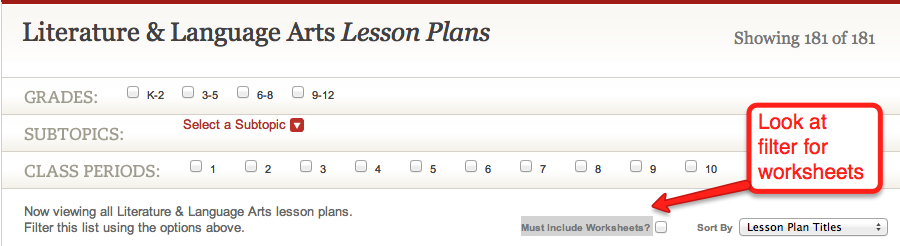
The second problem is a worksheet filter option on the site where lessons can be identified as offering worksheets or not.  Worksheets?  In the 21st Century, with all the digital possibilities, the National Edmowment for the Humaties is promoting worksheets? Why?

Many educators consider worksheets the “busy work” of education. Worksheets have correct answers; they are prescribed and limiting. Early childhood experts have pointed out that many worksheets do not allow the kind of problem solving that involves an element of risk, saying “if we want children to learn to solve problems we must create safe environments in which they feel confident taking risks, making mistakes, learning from them, and trying again” (Fordham & Anderson, 1992). Activities that require creative problem solving or critical thinking should be the goal of every teacher. The worksheet can limit both.

Additionally, worksheets are expensive. Paper and toner ink are the first expense, but the second expense is time. How familiar are teachers  with the number of hours that are wasted in front of copy machines copying worksheets?  Sadly, very familiar. What happens when the copier breaks down? Frustration. A teacher who relies on worksheets is forced to scramble when an unreachable tiny scrap of paper lodges into one of the copier’s feeders, or when the toner is low, or when code505 appears on the digital screen. In contrast, the increase of digital platforms in education allows teachers the opportunity to spend time more productively setting up documents that can be used by individual students or collaboratively.

Students have so many ways to record responses digitally, for example on Google docs or blogs or wikis, so why waste paper? The worksheet should be relegated to files of emergency backup lesson plans for a substitute.

The National Endowment of the Humanities should lead the way in weaning teachers off the worksheet. The emphasis on filtering lesson plans for worksheets should be eliminated. The availability of lesson plans aligned to the Common Core State Standards is a great resource that is cheapened with the pedestrian 20th Century tool of worksheets. EDSitement should not straddle  a 20th-21st Century divide. With funding support from  Verizon Thinkfinity, a foundation firmly in the 21st century,  EDsitement should lead.

On Textbooks: Opinion Piece published by Education Week 8/8/12

I read a tweet by the National Education Association’s (NEA) president, Dennis Van Roekel, which brought me to this quote: “I’m so tired of OTHERS defining the solutions….without even asking those who do the work every day of their professional life.”

Consider how solutions determined by others have determined the profound changes in education in the past 12 years. The legislation for No Child Left Behind (NCLB) and Common Core State Standards (CCSS), have come from stakeholders who are looking into  the classroom as if they are looking through a one-way window. This one-way window prevents the sounds of education, limits other visual perspectives, and prevents dialogue with teachers. The one way also window prevents the teachers from seeing or communicating with those stakeholders who have made these changes.

This past week, in my Twitter feed, I found links to information which made me wonder, with the increasing adoption of technology in education, how might this one-way window dynamic change?

The first piece of information came from a tweet by @webenglishteach. On a recent post titled “My career by the numbers (so far)” on her Chalkboard blog, Carla discussed her retirement as an English teacher and reflected on the numbers in her educational career, for example, the number of papers she had corrected or numbers of students she taught over the course of her 32 year career. She has spent the past year with the Department of Education (DOE), and noted:

“People at the DOE like to identify themselves as teachers. ‘I taught 2 years.’ They’re good people, but teachers make more decisions that affect other people on Monday than someone at DOE does all week. Be proud of what we do.”

The second piece of information came from a link in the article The Gates Foundation’s Education Philanthropy: Are Profit Seeking and Market Domination a Public Service?  tweeted by Education Week . The article comprehensively argued against the agenda of wealthy philanthropic enterprises that partner with public institutions, a public-private partnership.This article by Anthony Cody contained a link to a April 2011 article by Sam Dillon in the New York Times Foundations Join to Offer Online Courses for Schools  that described how the Bill and Melinda Gates Foundation will be working with the textbook and testing firm Pearson:

“In his educational work, Bill Gates has explored ways that new technologies can transform teaching. Vicki Phillips, a director at the Gates Foundation, said the partnership with Pearson was part of a ‘suite of investments’ totaling more than $20 million that the foundation was undertaking, all of which involve new technology-based instructional approaches. The new digital materials, Ms. Phillips said, “have the potential to fundamentally change the way students and teachers interact in the classroom.”

This investment will be extremely profitable for Pearson, a large corporation that also houses the publishing companies Penguin and the Financial Times; $330 million in Department of Education financing. The partnership with the Gates Foundation could give Pearson a considerable advantage as textbook and learning technology companies position themselves in an education marketplace upended by the creation of the common standards. Finally, Susan Neuman, a former Education Department official with the Bush Administration commented in the story, “Pearson already dominates, and this could take it to the extreme. This could be problematic for many of our kids. We could get a one size fits all.”
In both these instances, the classroom teachers are clearly not involved solutions. There are Department of Education employees with fleeting experience in the classroom  determining educational policy.  Public-private partnerships are fundamentally changing how content is delivered in the classroom. Finally, education services companies are developing both the texts and the tests for use in the classroom.
So why are teachers, those with years of expertise in the classroom, not leading to challenge the solutions offered by others?   That is what Van Roekel was asking when he addressed the NEA Annual Meeting and Representative Assembly  at the 2012 convention:
“I’m so tired of OTHERS defining the solutions… without even asking those who do the work every day of their professional life.
I want to take advantage of this opportunity for US to lead – and I’m not waiting to be asked, nor am I asking anyone’s permission.
Because if we are not ready to lead, I know there are many others ready, willing, and waiting to do it for us. Or maybe I should say, do it ‘to’us.There are plenty of people outside our profession who have their own ideas about what we should be doing, how we should be evaluated, and how to improve public education…”
Teachers could define the solution if they had time and the ability to effectively dialogue with other teachers. Unfortunately, there is little teachers can do about the finite elements of time, however, teachers can communicate with teachers much more effectively today through numerous platforms. Research has proved that peer to peer professional development is successful, and one platform for such dialogue is  Twitter. No, not the “Katie Holmes vs Tom Cruise” Twitter or the #justsayin  Twitter trend. Twitter provides teachers a means to communicate (140 characters) quickly, to link content, to help research, or to celebrate success. Twitter can be an effective a part of a  PLN (personal learning network) for a teacher who has only a few minutes to spare each day, weekends included, during the school year and can be part of self-directed professional development mandated in some state teacher evaluations.
Twitter offers evening “chats” by subject, grade level, or on educational topics simply by using a hashtag (EX: #edchat, #engchat, #sschat). A complete schedule of educational chats is available on technology guru Jerry Blumengarten’s (alias Cybraryman)  Twitter page .
Using Twitter as my PLN, I found each of the articles I referenced above through Twitter. I will Tweet this blog. I may be re-Tweeted so that the information finds its way to other teachers.
Now consider that there are more than 7.2 million teachers (US Census in 2009)  , and then consider how Twitter could be used to connect teachers in dialogue (quickly), so that solutions in education can be proposed from the inside the classroom with the one-way window. Twitter PLNs can keep teachers informed (quickly) when “others define solutions” and help teachers generate their response in shared dialogues.  Twitter can be a tool for teachers in creating the powerful voice of those “who do the work every day of their professional life” and lead them to share their solutions to the problems in education. The decible level of collective teacher Tweets can be the noise to shatter the glass of that one-way window that “others” use to see into the classroom.

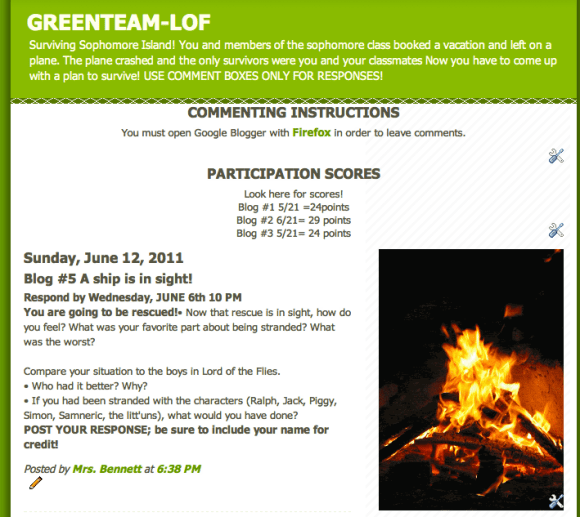
YOU AND MEMBERS OF THE SOPHOMORE CLASS BOOKED A VACATION AND LEFT ON A PLANE. UNFORTUNATELY, THE PLANE CRASHED AND THE ONLY SURVIVORS WERE YOU AND YOUR CLASSMATES. NOW YOU HAVE TO COME UP WITH A PLAN TO SURVIVE! 

This is the bold notice at the top of each of five blogs that the grade 10 teachers organized for teaching William Golding’s novel Lord of the Flies. This survival game is played in the English World Literature course at the end of the school year. The intent is to engage an entire grade level of 10th grade students in discussing a text without the limitations of the class schedule.

The game is simple: there are five teams (red, yellow, blue, green and orange) that are invited to a blog to respond to posts within a short period. Once the students are sorted onto teams (2 or three in each class period on one team), they respond to a post on their team’s blog using the comment box. Points are awarded on the percentage of team participants who respond to a blog post, and the winning team receives a 100% test grade.

The five posts on each blog are scenarios adapted from a number of similar activities I have found on the Internet. We used Blogger for our platform without much difficulty last year; this year their new interface has been glitchy, but since the game is about survival of the fittest, we have soldiered on! Each post deals with a scenario similar to the daily experiences of Ralph, Piggy, Jack and the choirboys, etc. The posts are uploaded over the course of a  two week period.

Post #1 deals with a list of 15-20 resources that were “recovered from the plane.” The post asks students to comment individually, “What do you do now?”

Post #2 poses the next complication suggesting that a giant storm seriously damaged their resources, “So, what happened to the supplies you gathered yesterday?” (ex: Bed Sheets: blew away in the storm last night; mosquito netting: large gashes/holes created by trees in the storm)
“What do you and your fellow survivors do now? What supplies do you have remaining? How are you using these remaining supplies?”

Post#3 Provides directions for shelter, fire and potable water. The post reads, “While you and some members of your group were building the shelters, digging the fire pit, and setting up the water supply; two (2) of your members decide that they are tired of working and want to go swimming instead. What do you do with the slackers in your group?”

Post #4 begins, “You wake up on the third morning to find that half of the food you had taken from the plane and gathered since is gone. Either some sort of animal has taken it, or one of your group members has taken it and hidden it for himself or herself. You start out the day suspicious of the other members of the group – and hungry!
• What sorts of rules/procedures are you going to put in place to make sure your food and water supplies do not get stolen or contaminated?
• Now that you are suspicious of your other group members, how are you going to act around them? Are you going to be able to continue to work together? What is your plan for discovering who took the food? What will you do with that person when you find him or her?”

Post #5 is the final opportunity for students to participate. The post reads, “A ship is in sight! You are going to be rescued! Now that rescue is in sight, how do you feel? What was your favorite part about being stranded? What was the worst? Compare your situation to the boys in Lord of the Flies. Who had it better? Why? If you had been stranded with the characters, what would you have done?”

This year’s comments were similar to responses from previous years with team members discussing suggestions for survival:

  • Nobody goes off exploring alone, pretty much NOBODY GOES ANYWHERE ALONE. We don’t know what’s on the island but if we stay together and work as one, unified, force; we will get off of this island alive. There’s no doubt in my mind that we WILL get off of this island. 
  • Water will be gathered by our “plastic bags” that we have laid out in a hole, held together by rocks. The water will be collected by nearby dewey grass etc. The rest of our plastic bags will be placed in a hole on top of a cup-or carved out fruit shell if cups are not available. 
  • The food has already been taken. Yes, it is maddening that one on our own team would have taken food from their own, but what can you do? I would move on, with a warning that if this ever happens again, whomever dared to steal twice will be exiled.
  • To deal with the ones that aren’t helping, we should put dead fish in their beds and then we’ll see who doesn’t wanna work then. 🙂 
  • Our slackers on the other hand will be banned from any rations of food caught by our hunters. The only way to become accepted is to find food elsewhere, and make sure (the slackers) they are able to feed the rest of the group.
  • To keep the fire going there should be a 2 person shift, and while one sleeps the other maintains the fire. The shift will be rotated i.e. 2 new people every night. 
  •  im surviving so as long as the slackers arent affecting me then they’re not my problem, if they were affecting me then id prbably end up killing them in a survival situation
  •  You never know who it could be so there’s always that feeling of suspicion while you’re near and working with the other group members
  • For the slackers, they can continue to eat the food and stay in the shelters. Karma will get em.
While Golding did not write Lord of the Flies as an adventure story that is in the same genre as Robert Louis Stevenson’s  Robinson Crusoe or Robert Zemeckis’s film Castaway with Tom Hanks, there are elements of survival that make the book appealing to 10th graders. Once they are placed on “Sophomore Island,” the Blogger platform lets them communicate their expectations as to what might happen in the unlikely event they were marooned with classmates. Not surprisingly, they often found themselves frustrated and caught in similar power struggles as those between Jack and the hunters and Ralph and Piggy. Once they are on “Sophomore Island” they discover Golding’s real reason for the novel, for the Lord of the Flies who challenges them by asking, “I’m the reason why it’s no go? Why things are the way they are?”  Their virtual experience on “Sophomore Island” helps them understand why Ralph would weep “for the end of innocence.”

To all those who claim that all students today are digital “natives,” I beg to disagree.

Digital natives are defined as those people who have grown-up using technology daily beginning in the 1960s, but the term is more commonly used to describe those born in the 21st Century. According to the PBS Frontline Website, 

  • Digital Natives aged 12 to 24 spend 4.5 hours a day viewing screen media (TV, Internet, Internet video, mobile video), excluding games;
  • 82 percent of seventh- to twelfth-graders “media multitask” while doing homework, e.g. IM, TV, Web surfing, etc.

The NYTimes 2010 article, “If Your Kids Are Awake, They’re Probably Online” discusses the use of digital devices stating, “Those ages 8 to 18 spend more than seven and a half hours a day with such devices.” Certainly, use by our students has increased since then.

Despite  these statistics, I am convinced that many students are not digital “natives, ” they are digital “tourists.” Really bad tourists. I’m talking the “standing in line to see the Mona Lisa on the busiest day of the year and then leaving the Louvre once they saw it” kind of tourist. The “only want to eat at McDonalds in a foreign country because I don’t like food I don’t recognize” kind of tourist. The “I have no idea what kind of money this is” kind of tourist. In other words, bad tourists.

This past year was a eye-opening experience with my bad tourists. There was a  1:1 integration of student to netbooks in the English and select social studies classrooms. Initially,  members of my department and I were nervous about how we would need to keep up with what we imagined would be an onslaught of tech-savvy teens. We  prepared ourselves by practicing various software platforms that we thought would be used successfully. We played with Google Docs, Edmodo, Edublog, WordPress, Blogger, PBWorks, Twitter, and Quizlet.  We reviewed presentation software: Prezi, Animoto, Glogster, Voice Thread. We made decisions as to how to integrate these platforms gradually and at various grade levels to help us transition students to a paperless classroom. We imagined our classrooms would be full of students investigating and testing which software would best suit their needs. We were ready for the digital natives to collaborate and teach us about this “undiscovered country” of educational opportunites.

Instead what we discovered was that many of our students were reluctant to try new platforms that differed even slightly  in organization or layout. A login in a different location was perplexing; an embed code or link could not be located.  We found our students were not naturally tech-savvy, save the requisite number of computer geeks per class. They did not want to move out of their comfort zone in technology, partly because they knew that work was involved, but, in fairness, partly because they were intimidated.
For example, in every class, a few students would have problems logging on.

“It’s still loading, Mrs. B.” says Student A
“Did you try shutting down and starting up again like I showed you last week?” I respond.
“No,” a flat statement.
I sigh.
Of course not. Student A who knows how to quickly log on to her computer at home to check Tumblr and Facebook, considers this contraption on her desk as a foreign object. She is a digital tourist waiting hours on line for the same roller coaster ride she rode on yesterday.

There were always problems with software.

“Google Docs isn’t showing my changes,” says Student B
“Are you using Firefox or Google Chrome as a browser?” I respond.
I see a glazed look. He is a digital tourist who is having a hard time with trying alternate routes in a foreign city without asking directions.
“No,” a flat statement.
I sigh, again.

They failed to save word documents, adjust file extensions, and rarely took advantage of the spell-check or grammar check functions. And they were always losing their passwords….their “passports” onto websites. They acted as though we had co-opted their toys for unnecessary purposes.

In retrospect, I don’t blame them entirely for their hesitations in traveling through unfamiliar digital territory. Because of their proficiency with social media, there is an expectation that all students attending school today, at any grade level, are endowed by their creator with a new strain of technology enhanced DNA. Because they can operate a joy stick or the Wii remote with grace and ease, they are expected to come pre-familiarized with keyboard commands that would make them more productive (“What do you mean ‘Paste Special’? What’s unformatted text, anyway?”) Our anticipation that our students  are capable with all things digital has led a combined sense of frustration.

That is not to say, however, that student can return home to the land of the pen, pencil, and worksheet. They need to be travelling on this Internet highway, but our digital “natives” need to stop acting like reluctant tourists safely traveling on a prescribed tour bus that never ventures into TCP/IP’s  backcountry. Educators have plenty of support in meeting newly adopted standards. There are a number of organizations who support the development of 21st Century skills-ISTE, 21st Century Partnership to name a few. Plus, this experience has prepared us for next year when our 1:1 initiative will be expanded.

I believe that our students need to break out of the Magic School Bus model of Internet exploration staffed by Ms. Frizzel, the contemporary Pied Piper, who could transport them effortlessly into new  experiences . While Ms. Frizzel served as the elementary school expert in Outer Space exploration, the study of anatomy and physiology, and all things in  underwater research, the magnitude of information and means to access that information on the Internet today far exceeds the abilities of one teacher, even a teacher with Ms. Frizzel’s infinite patience and wisdom.

A better model to adopt for for our students as digital tourists is the Rick Steve’s model, where “travel is a political act.” In this model, students travel the alternate routes for productivity and interact and collaborate with others using many different software “languages”. They may stumble in these challenging and unfamiliar digital locations, but they will benefit from this exposure to the strange and unknown. They just need to get over their xenophobia of new software platforms. They need to develop a sense of curiosity and adventure in order to make their visits in the Internet productive. To facilitate their exploration, educators need to stop assuming that students are comfortable in the digital world and deliberately force students into becoming explorers out of their comfort zones. We need to convince our students that the double-deckered tour bus playing the pre-recorded soundtrack will not make them independent learners whose future success depends on the ability to mingle and cooperate. We need to encourage each of them to become a digital “native”  rather the digital “tourist” who cautiously picks his or her way through the Internet rather than be  immersed in the 21st Century cultural experience.

When I asked a question in class this year, I had to directly address a student: “Christina, what do you think….” or “Patrick, how does…”. I could not just toss out a question to the entire class. In fact, if I failed to individualize the Socratic method, the result was a chorus of dissonance, a cacophony of responses, a gabble of student voices directed towards no particular audience.  I also noted this year that a great number of students would reason aloud rather than think  before speaking.  This year my students did not discuss as much as transmit. What I was hearing was the  sound of student voices broadcasting as individual program streams. I needed to train my students in the art of discussion, when to contribute to conversation, and how to share communal air time.

I wondered how to account for this phenomenon and concluded my students had an “I” problem. They are the “I” tech pioneers students who grew up with multiple digital devices marketed to that 1st person singular pronoun.

Consider that the I-pod was released to the public on November 10, 2001. My 9th grade students who have proven incapable of clicking into a shared conversational stream were two or three years old at that time. My students have grown up listening to a self-selected soundtrack piped through earphones singularly and directly into their ears. They have had complete control over each musical track all of their lives. There has been no “B” side option to their playlist.

My students have been able to control all other forms of media as well, choosing to watch video content commercial-free selected  from multiple streaming websites. They watch TV shows from any  number of platforms (Hulu, Netflix, Amazon), yet few admit to watching TV during regular broadcasting on a TV screen at all.  They design their own video channels or post their own videos online. Pronoun marketing abounds for this generation: YouTube’s use of the 2nd person singular has been an invitation for them to post their content since they were 8-11 years old. How individualized my students’ experiences are from the collective experiences of their elder siblings, their parents, and their grandparents.

They have “friends” they have never met, they play games against people without regards to age or gender, and they cannibalize photos and files from other sources to create “personal” websites. They were 6-9 years old when My Space came online; now they now have a plethora of choices: Facebook, Tumblr, Pinterest, etc.

Yet, for all of their posting and tweeting, they are still communication-impaired. They have difficulty in developing or engaging in a discussion in class. Of course, students in previous years have required guidance on class discussion rules, but this past year was substantively different.  I believe all of this “I”-serving technology has led an increase in personalized content but a decline in knowing how to share “we”-time.

By way of contrast, I am a child of AM radio. I was one pair of the million ears that heard the DJ chatter of Harry Harrison or Cousin Bruce Morrow. I grew up to a prescribed soundtrack that would reverberate in pop record synchronicity on city streets, sidewalks, parks and beaches. In 1970 the air pulsed hourly with The Carpenters Close to You even though I hated the song. I was part of a collective experience whether I wanted that experience or not. I am a child of network television who remembers when one evening’s broadcast of Ed Sullivan or Walter Cronkite would be the following week’s discussion.  I played with peers I could touch; I could see my friends. We talked in person, and we had long extensive conversations. I was in an environment that conditioned me to wait my turn and share my time. I knew I was in a collective, and for good or for bad, I was connected but “unconnected.”

So when I read Sherry Turkle’s opinion piece “The Flight from Conversation” in the NYTimes on Sunday, April 12, 2012, I saw one line that described a symptom I recognize in my students, “A 16-year-old boy who relies on texting for almost everything says almost wistfully, ‘Someday, someday, but certainly not now, I’d like to learn how to have a conversation.’

 In the piece, Turkle describes how an increasing reliance on technology reflects the “I” centered experience:
“We want to customize our lives. We want to move in and out of where we are because the thing we value most is control over where we focus our attention. We have gotten used to the idea of being in a tribe of one, loyal to our own party.”

The daily environment for the “tribes of one”, my students,  in and out of school is filled with digitally enhanced communication, but there is little serious conversation.  My students have few opportunities outside of the classroom to practice the art of discussion without a digital device in hand. So I have been taking “baby steps” in the classroom by first asking them to respond to each other.

“Do you agree with Mackenzie?” ”
“Can you add to what Matt said?”
“Please restate what Breanne said.”

There are popsicle sticks with each name to insure I have each member of the class speak during the day. On some questions,  I also ask them to pause 30 seconds before responding and remind them they are graded on not only what they say but by the attention they give to others. These techniques have helped control the immediate response impulse- the noisy nonsense of 25 incomplete thoughts spark-plugging aloud in the room. Only recently, however, have  I asked them to look at each other when they respond. The first three exchanges were awkward, but Nick’s full on attention to Logan was so comical that  “making eye contact” became fun. I hope that continuing eye contact will help the interchange of ideas which is the basis for conversation.

Turkle’s concern is that, “We are tempted to think that our little ‘sips’ of online connection add up to a big gulp of real conversation. But they don’t. E-mail, Twitter, Facebook, all of these have their places — in politics, commerce, romance and friendship. But no matter how valuable, they do not substitute for conversation.”

I agree with Turkle and recognize that teaching the “I” generation requires changing the way we, teachers and students, communicate in the classroom. Successful participation in conversation and discussion are the critical skills students need to counterbalance the social media that Turkle says continually asks us what’s “on our mind,” but allows us  “little motivation to say something truly self-reflective.” Our students need to move from the digital ease of self-expression to a stage of self-reflection in order to demonstrate understanding and to share that understanding with others. To insure all student have these skills, the recently adopted Common Core Standards in English Language Arts will require teachers to improve the speaking and listening skills from K-12 grades. For example, requirements for grades 9 and 10:

CCSS  SL.9-10.1.Propel conversations by posing and responding to questions that relate the current discussion to broader themes or larger ideas; actively incorporate others into the discussion; and clarify, verify, or challenge ideas and conclusions.

Our students cannot continue the experience of dancing solo to the selected soundtrack of their own “I”-device in the classroom without learning how to either share that experience with others or reflect on how that experience defines them. Educators need to teach all students that they should appreciate the many ways we now communicate but learn to recognize that the limitations “I” center devices have in communicating. We need to encourage those who are like Turkle’s 16 year old student example,  a student who wants “someday”to participate in conversation “but, certainly not now,” to see themselves as social beings.They must learn that their use of technology’s social media can not replace the in-person interaction that happens in social and academic conversation. They need to practice the act of conversation now rather than “someday,” and the classroom is a great starting place. Oh, and we need to remind everyone  to make eye contact.

Advice to Hamlet, “The main point here is you over think everything. You get deeper and deeper into these brilliant plans, but without execution they truly mean nothing!”

“Hamlet, you yourself had said that to dwell on an act too long leaves one part good, and ‘three parts cowardice;’ please, Hamlet, PLEASE learn to follow your own advice,” pleads TJ in his advice to Hamlet.

The Advanced Placement English Literature students are posting their advice to characters from Hamlet by responding to “Stop the Action!” prompts on a blog. Students “advise” Hamlet, Gertrude, Claudius, Laertes, and Ophelia in response to lines from the play. Students discuss whether the Ghost is from Heaven, Purgatory, or Hell; whether Hamlet is mad or acting mad; or choose between the soldier Fortinbras and the scholar Hamlet. Their online discussion is equitable and collaborative, and the format allows me the opportunity to assess student understanding of this play.

I organized the “Stop the Action, Hamlet” on the Google Blogger platform, an easy platform for posting comments or replies. I invited students by email to the site, and they needed only a minute or two to learn to navigate through the 10 prompts that I posted. The  “comment” feature on the Blogger dashboard was helpful in assessing their time stamped responses.

The advice my students gave to each character in the play makes for entertaining reading, but more importantly, each student  was able to share his or her ideas online in an academic manner that cannot be duplicated in class. Class discussions are notoriously short, limited in scope, or marginalize quiet students, unless they are moderated. The class period is limited in time, whereas online discussions can continue for weeks, 24/7 with students posting when they have time to focus. When my students blog online, they respond to each other thoughtfully, post citations to support their positions, and choose their words carefully. The blogging platform elvated the class discussion.

For example, Colleen’s first entry was on whether the Ghost is from Purgatory or from Hell:

“If the ghost was from heaven, I feel as if he would not ask Hamlet to commit such a foul crime. It is through hell that the Ghost is speaking like this. As the play continues on, the Ghost does not seem to leave his demon thoughts but rather continues to carry them out. It is clear that through these actions, the Ghost is from hell.”

Devin later responded to this post,

” I was re-reading the conversation that Hamlet had with the spirit, and another line I found interesting was when the Ghost says to Hamlet, ‘taint not thy mind.’ I think this is interesting because it suggests to the audience that the Ghost cares about Hamlet. If the Ghost was from Hell this wouldn’t make sense and if the Ghost was from Heaven he wouldn’t be there in the first place. The only compromise to this situation is if the Ghost was from Purgatory, then he could care about himself and Hamlet at the same time.”

Annie’s  post followed this argument when she posted a question for Shakespeare:

“Why if the controversy for the ghost is so divided between heaven and hell not bring up any religion? There are very few if any religious references except this whole ghost thing. ..I do think your choice to ignore religion is a reason for your timelessness. By discussing certain religious topics, you may only appeal to one audience. You doesn’t even hint as to what your own opinions are. Choosing not to discuss such controversial topics was a smart decision on your part, and is perhaps why you are so popular even today.”

Colette had advice for Gertrude and Claudius. To Gertrude, she posted, “Your son is clearly in pain and instead of stopping and trying to communicate personally with Hamlet, you’re taking Claudius’ advice to hire spies to keep ‘watch’ over Hamlet when in fact, that’s a mother’s duty. Your maternal switch is definitely shut off.” Her advice to Claudius was equally blunt, “Murder cannot simply be ‘washed’ away. Much like in Shakespeare’s Macbeth, you [Claudius] are searching for a way to wash the blood red off of your hands. However, they are forever stained. No matter how much you clean your hands, they will forever be tarnished and filthy.”

TJ humorously advised Polonius indicting him on the line, “Beware/ Of entrance to a quarrel; but being in, /Bear’t that the opposed may beware of thee” (I.iii.69-71). “Hey, Polonius,” TJ writes, “remember when you were hiding behind that curtain? Remember when Hamlet pulled out a knife on you and you screamed for help instead of present yourself so that ‘the opposed may beware of thee?'”

Kelsey begged Laertes to walk away from Claudius, She recalled his line, “And yet ’tis almost ‘gainst my conscience,” and argued:

“What I want you to do right now, Laertes, is just stop and think. Why would Claudius actually want to help you? He is a manipulative man that just wants power…. Some advice- stop and let Claudius fall to his own fate! He already basically showed that he knew the cup was poisoned by calling out. He is guilty to everyone in the room. Let him take the downfall and WALK AWAY MAN! Gah! Your pride is not worth your life!….you will realize your mistake in about 30 lines in the play….just thought I would let you know…”

Finally, Sara posed a question for Shakespeare:

“As we continue reading through the play, we notice how Hamlet is struggling with avenging his father – yet, he knows he must complete the task of murdering his uncle, as his father had ordered. I leave you with this question – do you [Shakespeare] believe we were all born to complete a task? Does this apply to other plays ? Romeo and Juliet? Macbeth? King Lear?”

In addition, the Hamlet blogs are a means for me to directly address educational technology standards that have been developed by different educational organizations.
Using the standards for the Partnership for 21st Century Skills, these blogs allow the students to:

  • Articulate thoughts and ideas clearly and effectively through writing
  • Be open and responsive to new and diverse perspectives

Using the standards for NCREL(North Central Regional Educational Laboratory)/engage, the blogs promote:

  • Teaming and collaboration to create to solve problems and master content
  • Willingness to make mistakes, advocate unconventional positions, or take on challenging problems to enhance growth.

Finally, using ISTE ( International Society for Technology in Education) standards, the blogs provide an opportunity for students to:

  • Interact, collaborate and publish with peers, experts and others employing a variety of digital tools and media
  • Communicate information and ideas effectively to multiple audiences
  • Apply existing knowledge to generate new ideas, products, or processes and diverse perspectives to explore alternate solutions.

More importantly, the “Stop the Action” blogs have allowed my students to function much like Horatio in the play whose advice to Hamlet, “If your mind dislike any thing, obey it…” goes unheeded. The characters also do not heed the advice of my students, but my students have become proficient in their ability to “tell my story” of Hamlet.