Archives For November 30, 1999

The cold in “Ethan Frome” might be what we need in the long hot summer!

It’s 103 degrees here today in Connecticut during one of the numerous heat waves we have had so far this season. Tomorrow’s forecast bodes no better news. The garden has been drying up; even the most stalwart perennials are buckling under the sun’s intensity. Leaving an air-conditioned home or car means hitting a wall of humidity; my glasses fog over and I am temporarily blinded. A headline on the Reuters website reads, “Heat Wave and Drought Besiege Already Deteriorated US Crops” (July 18, 2012). Suddenly, I have a new appreciation for the heat of Steinbeck’s Dust Bowl in The Grapes of Wrath:

  • People in flight along 66. And the concrete road shone like a mirror under the sun, and in the distance the heat made it seem that there were pools of water in the road. (Ch 12)
  • They were tired and dusty and hot. Granma had convulsions from the heat, and she was weak when they stopped. (Ch 16)
  • The sun sank low in the afternoon, but the heat did not seem to decrease. Tom awakened under his willow, and his mouth was parched and his body was wet with sweat, and his head was dissatisfied with his rest. (Ch 18)
  • While the sun was up, it was a beating, flailing heat, but now the heat came from below, from the earth itself, and the heat was thick and muffling. (Ch 18)

I believe that where a reader has lived or visited contributes to an understanding of a novel’s setting. This does not mean that a reader cannot appreciate the descriptions of Mars in Ray Bradbury’s The Martian Chronicles or Panem’s District 12 in The Hunger Games by Suzanne Collins or on the battlefields on the plains of Troy in Homer’s Iliad or the Congo River in Conrad’s Heart of Darkness. Indeed, the only way for the reader to “visit” and remember these locations is through the vivid descriptions the author writes. However, there is an advantage for a reader in being familiar with the setting of a particular story, especially where setting is a dominant character. Say, for example, the town of Starkfield in Edith Wharton’s Ethan Frome.

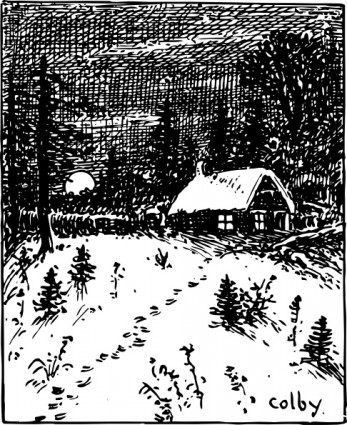
In the introduction, the narrator of the story explains how his employment has brought him to the aptly named Starkfield-“the least habitable spot”, where he “chafed at first, and then, under the hypnotising effect of routine, gradually began to find a grim satisfaction in the life”. Grim satisfaction indeed, as the winter weather in Western Massachusetts, where Wharton sets her ficticious Starkfield, can be mind-numbingly bleak.

“When I had been there a little longer, and had seen this phase of [December] crystal clearness followed by long stretches of sunless cold; when the storms of February had pitched their white tents about the. devoted village and the wild cavalry of March winds had charged down to their support; I began to understand why Starkfield emerged from its six months’ siege like a starved garrison capitulating without quarter.”

My most memorable image of the town was Wharton’s description of the graveyard that Ethan and Mattie pass on the night of the dance:

“They turned in at the gate and passed under the shaded knoll where, enclosed in a low fence, the Frome grave-stones slanted at crazy angles through the snow. Ethan looked at them curiously. For years that quiet company had mocked his restlessness, his desire for change and freedom. ‘We never got away- how should you?’ seemed to be written on every headstone…”(Ch 2)

This closing sentiment to this passage addresses the way I feel every winter when the dismal drizzle of freezing rain turns every trip in the car into heart-pounding sliding near-misses or when crusted mounds of filthy snow makes walking outdoors a life-threatening experience. My mantra becomes, “I’ve got to get out of this place.”

So how does a reader from Southern California really understand Starkfield? Yes, Wharton is genius at explanation, but that visceral understanding of January in New England is limited if the reader is reading her novel poolside on a sunny day, 78 degrees with a light wind blowing. Wharton can only stimulate the reader’s imagination to understand the kind of wet grey cold that chills to the bone until June. The memory of physically freezing in Western Massachusetts is an entirely different experience.

Conversely, a case can be made for other authors. How can the Wharton’s New England reader really understand the physical and cultural landscape for the characters of Faulkner’s  Yoknapatawpha County ? How does a student from the plains and mesas of Cather’s Death Comes for the Archbishop comprehend the mansions on Fitzgerald’s East Egg Long Island?  There are so many elements in creating the setting: the temperature and the angle of sunlight during the day, the architecture of the houses or buildings, the landscape and the vegetation, the dialect of the locals, the smell of the foods, and the sounds of the evenings. Each locale has identifying qualities that a great author captures in order to make a setting understandable to a reader. The author’s descriptions will resonate even more with a reader who has a first-hand experience in that setting.

Of course, reading Wharton’s novel in the in the middle of summer anywhere in the United States might be a form of mental air-conditioning. The mind can be a powerful tool into tricking the readers to feel cooler. Imagine the book display: “Feeling hot? Read Ethan Frome!”


 How do you get to the  Olympics? Practice, practice, practice!

In this third post, my “tri-blog-a-thon”, connecting education to the recently completed London Summer Olympics 2012,  I ask you to recognize the significance of practice.

The 10,004 athletes from 204 National Olympic Committees (NOCs) who participated in the 2012 London Summer Olympics practiced for their athletic contests. There were incalculable hours of practice that contributed to each athlete qualifying for a specific event. Similarly, this fall there will be over 37.9 million primary grade and 26.1 million secondary school children* who will practice the skills taught in our nation’s schools. These students will have a mandated minimum of 180 days or 64,800 minutes of practice in a school year.

Practice by athletes makes participation in the Olympics possible. Practice makes education for our schoolchildren possible.

Of course, there is always a great deal of attention placed on the winner(s) of each Olympic event. Gold, silver, and bronze medals distinguish the best athletes on a given day in a given event. Similarly, our nation is obsessed with test scores in education, the final event in measuring specific skills on a given day.  However, there is often too little attention paid to the practice that is necessary to achieve high grades on these tests of skills. All skills, athletic and intellectual, can only be achieved through practice.

In preparing for back to school, teachers, parents, and students must recognize the importance of practice in education. Practice is to do or perform (something) repeatedly in order to acquire or polish a skill. Practice is to work at a profession; as in the exercise of an occupation. Practice is what athletes and students have in common.

Unfortunately, practice is often hard work. Practice requires attention. Practice means focus. Practice is demanding. And practice can be boring if there is no reason for the practice.

When my students complain about the amount or variety of reading they may have to do, I point out that they are engaged in a practice. Like a runner, they cannot win a race without running wind sprints or running longer more challenging race courses. They are practicing to be better readers.

Similarly, when they complain about the amount or variety of writing I assign, I point out that composing in various forms such as letters, essays, narratives, research papers or even texting is a practice. They will need to communicate in the future in numerous formats, handwritten and digital. They are practicing to be good communicators.

Student practice a wide variety of skills in different disciplines every day at every grade level. There are some skills that come easily to students with little practice; there are other skills that require more practice. The kind of practice a student engages in matters as well; repetition is not the only kind of practice to improve skills. There must be variations in the kinds of practice for a student to become good at a skill.

In his book  Outliers, Malcolm Gladwell  wrote extensively about  a “10,000 hour rule” where the key to success in any field is the practice of a specific task for a total of around 10,000 hours. Gladwell’s book called attention to the work of researcher Anders Ericsson. In TIME Magazine’s article “The Science of Experience” by John Cloud, Ericsson had become the world’s leading expert on experts, ” a term he distinguishes from ‘expert performers’ — those individuals, possessing both experience and superior skill, who tend to win Nobel Prizes or international chess competitions or Olympic medals.” But more important than routine repetition, varying the kind of practice had the most significant impact on skill improvement.

Cloud detailed how Ericsson found, “Experts tend to be good at their particular talent, but when something unpredictable happens — something that changes the rules of the game they usually play — they’re little better than the rest of us.” Changing practice to incorporate more complex tasks improved performance:

“Ericsson’s primary finding is that rather than mere experience or even raw talent, it is dedicated, slogging, generally solitary exertion — repeatedly practicing the most difficult physical tasks for an athlete, repeatedly performing new and highly intricate computations for a mathematician — that leads to first-rate performance. And it should never get easier; if it does, you are coasting, not improving. Ericsson calls this exertion ‘deliberate practice,’ by which he means the kind of practice we hate, the kind that leads to failure and hair-pulling and fist-pounding.”

This kind of deliberate practice can build confidence. Other desirable qualities associated with deliberate practice are motivation,  self-discipline, and commitment, all qualities we want to imbue in our students.

So, here is a goal for the new school year. Let the school year be filled with “deliberate” practice for every student at every grade level. Let the practice be frustrating. Let the practice be difficult. Let the practice be challenging. Let the practice lead to failure, so that the practice leads to success. “Let there be practice” should be the mantra for all stakeholders in our nation’s education system in this coming school year.

Now let the practice begin!

*2006-07 statistics from US Census

The EDsitement website, funded by the National Endowment on the Humanities, offers lesson plans that are aligned to the Common Core State Standards.  I have modified several of these lessons; other lessons on this site are familiar fare in English classrooms. One example is the lesson on Carl Sandburg’s Chicago  which asks students to pick a location and respond to prompts such as, “If this place were a person, what kind of person would he or she be? What noticeable physical characteristics would this person have? How would he or she act? What would this person wear and do?”  The lesson on Arthur Miller’s Crucible is also familiar, “Have students answer the following questions: What is John Proctor’s dilemma in Act IV? What motivates Proctor’s initial decision to lie?”

While there is always a need for more resources and support for teachers, I have two complaints about theEDsitement site. The featured lesson on the site this month is  Vengeful Verbs  in Hamlet for grades 6-8. The targeted age group and the objectives for this lesson are inappropriate; Hamlet is not for middle school students. That leads me to question the appropriateness of lessons for other students as well.

The second problem is a worksheet filter option on the site where lessons can be identified as offering worksheets or not.  Worksheets?  In the 21st Century, with all the digital possibilities, the National Edmowment for the Humaties is promoting worksheets? Why?

Many educators consider worksheets the “busy work” of education. Worksheets have correct answers; they are prescribed and limiting. Early childhood experts have pointed out that many worksheets do not allow the kind of problem solving that involves an element of risk, saying “if we want children to learn to solve problems we must create safe environments in which they feel confident taking risks, making mistakes, learning from them, and trying again” (Fordham & Anderson, 1992). Activities that require creative problem solving or critical thinking should be the goal of every teacher. The worksheet can limit both.

Additionally, worksheets are expensive. Paper and toner ink are the first expense, but the second expense is time. How familiar are teachers  with the number of hours that are wasted in front of copy machines copying worksheets?  Sadly, very familiar. What happens when the copier breaks down? Frustration. A teacher who relies on worksheets is forced to scramble when an unreachable tiny scrap of paper lodges into one of the copier’s feeders, or when the toner is low, or when code505 appears on the digital screen. In contrast, the increase of digital platforms in education allows teachers the opportunity to spend time more productively setting up documents that can be used by individual students or collaboratively.

Students have so many ways to record responses digitally, for example on Google docs or blogs or wikis, so why waste paper? The worksheet should be relegated to files of emergency backup lesson plans for a substitute.

The National Endowment of the Humanities should lead the way in weaning teachers off the worksheet. The emphasis on filtering lesson plans for worksheets should be eliminated. The availability of lesson plans aligned to the Common Core State Standards is a great resource that is cheapened with the pedestrian 20th Century tool of worksheets. EDSitement should not straddle  a 20th-21st Century divide. With funding support from  Verizon Thinkfinity, a foundation firmly in the 21st century,  EDsitement should lead.

On Textbooks: Opinion Piece published by Education Week 8/8/12

Watching the Olympics has been an emotional mixture of admiration and frustration. Like many Americans, I was caught by the story of 15-year-old swimmer Katie Ledecky; she is the same age of many of my students. At 11:00 PM Friday (8/3/12), the hype was all about her 800 meter freestyle event; I was hooked. The NCB sports commentator noted, “The race will be about eight minutes long,” before the digital buzz sent the line of swimmers simultaneously into the pool. By the end of the first two minutes, Ledecky was a little ahead of the world record pace and in the lead. She was competing against the hometown favorite Rebecca Adlington of Britain and the 2008 bronze medalist Lotte Friis of Denmark. Ledecky’s arms churned the water, sometimes fully ahead of the animated world record line, sometimes only fingertips stroking its imaginary presence. The NBC commentator chatted away about her strategy; had she pulled in front too soon? Would her more seasoned rivals push her and then pass her? The race was exciting.

Suddenly, NBC cut away from the race to broadcast a series of commercials: a new sitcom, a credit card… who cares what else? The race was continuing in cyberspace while I impatiently waited for its return. Of course, I knew I was watching a rebroadcast. The event had been decided hours ago. I even knew who won, but that did not stop my level of engagement until NBC cut me off.

Six minutes into the race, NBC’s economic responsibilities addressed, Ledecky appeared once more on the screen, solidly in the lead. The commentator who had questioned her strategy was now unabashedly cheering her forward as were the crowds watching the race. She demonstrated that brand of immortal teenage exuberance, simply swimming as fast as she could for as long as she could until she literally hit the wall. This youngest member of the U.S. swim team had finished the race for the gold in 8 minutes, 14.63 second and narrowly missed a world record. Then, I heard the commentator ask, “The future of USA swimming! Have we seen it tonight?”

“No, we did not!” I snarled back to his rhetorical question, a response made more ridiculous by my awareness of our digital divide. No one watching that broadcast saw the race live. Nor did we see the race entire. Instead we saw a truncated version of an Olympic event. We saw the beginning, and the end, but we missed the middle…the plot where the protagonist fights against an antagonist: the water, an opponent, or herself.

I often joke with my fellow teachers that a student’s attention span in class is 24 minutes, the length of a sit-com without commercials. Understanding this programmed behavior has helped to guide my teaching. I get 24 minutes of “real understanding” in a 43 minute period; the rest of the time is administrative (attendance, homework, announcements,lesson prep or product collection, etc). A sitcom , however, is not a continuous 24 minutes, rather, each episode has several breaks at approximately eight minutes intervals throughout a broadcast. The first eight minutes introduces characters and conflict. The second eight minutes features conflict confrontation. The third eight minutes deal with plot resolution. Every eight minutes, a commercial intrusion follows the “cliffhanger moment” or a plot complication to keep viewers intrigued.

This broadcast now has me concerned. The race itself was eight minutes, the length of time that networks have conditioned the public to expect in the story sequence. The race itself could have been shown in its entirety. Instead, NBC pulled away only two minutes into Ledbecky’s race. Why? More than likely, the decision was made to maximize revenues and cram in more commercials to a committed viewing audience. Some executive probably thought that the race would look the same throughout; swimming is not as flashy as gymnastics or basketball. This, however, I see as a dangerous precedent. In chopping up this eight minute race, NBC has catered to the desires of those who only want the outcome.

Many of my students want to read only the beginning of a story and the end “to see how it turns out”, without reading the story itself. These students would rather have the answers rather than experience learning. They think the middle is “boring”. NBC’s coverage of this particular race is similarly condensed. The NBC model suggests that the race, an eight minute sequence of Ledecky’s story, is “boring” and can be interrupted; that the middle of her story is not as important as the concluding last lap.

When we look for reasons as to why students are unable to pay attention for an extended period of time, we might look at the powerful influences of media. How the media tells stories: news, sports, sit-coms, influences the pattern of stories. Audiences will adjust to the shortened version. Ledecky is the same age as many of my students; she is part of the generation that operates on the 24 minute window of learning opportunity. Her race, the plot where she battled in split seconds, at the very minimum deserved the eight minutes of uninterrupted broadcast time. NBC’s methods of broadcasting the “future of swimming” is an indication of a how media will fragment or remove parts of a story in the future; our students’ attention spans will soon reflect the same.

Dear Governor Dannel Malloy:

I forgive you for the inflammatory comments about teachers in your State of the State speech delivered last February (2/8/12),   “In today’s system basically the only thing you have to do is show up for four years.  Do that, and tenure is yours.” After all, I  have said some pretty unflattering things about politicians these past few years. Let us agree that professions should not be demonized.

Instead, I would rather provide you with an example of  great professional development for educators by discussing the value of the Connecticut Summer Institute which is a part of the Connecticut Writing Project. Eleven dedicated teachers from different school districts in the State of Connecticut have spent the past four weeks this summer (July 9-August 3, 2012) at the Connecticut Summer Institute organized and taught by Bryan R Crandall  at Fairfield University. These were elementary, middle school and high school teachers, social studies and English, willing to spend a good portion of their summer vacations (for graduate credit) learning how to improve student literacy through writing from 8:30-3:30 daily. A variety of guest speakers  also visited the Summer Institute and shared their writing experiences; there was a a journalist, an author, a poet, and veterans including  co-director Julie Roneson of past Connecticut Writing Project programs. This program is associated with the National Writing Project, an organization dedicated to improving writing at every grade level. The NWP website states:

Writing is essential to communication, learning, and citizenship. It is the currency of the new workplace and global economy. Writing helps us convey ideas, solve problems, and understand our changing world. Writing is a bridge to the future.

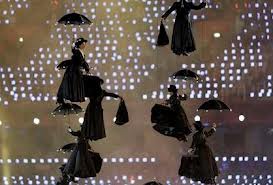
Mary Poppins to the rescue:
Photo from A Guide to the London 2012 Summer Olympics Opening Ceremonies
theblaze.com

The London 2012 Olympic Games Opening Ceremony was broadcast at 9pm on 27 July 2012 (EST). As a platoon of  Mary Poppins clones decended clutching their iconic umbrellas to vanquish the Lord Voldemort mid-ceremony, I was suddenly struck by an idea. How would the Common Core English Language Arts Standards view this production? The extravanganza developed by world-class directors Danny BoyleBradley Hemmings and Jenny Sealey and their teams was an eclectic mix of information  and fiction that “celebrated contributions the UK has made to the world through innovation and revolution.”

What grade, however, would the Common Core State Standards (CCSS) give London’s Olympic Games Opening Ceremonies? To make this assessment, a set of criteria needs to be established.  Informational texts are factual and real. Add a touch of whimsy or artistic interpretation and informational texts blur into that fuzzy blend of the literary genre of fiction. Lyrics in music are often considered poetry, so music also falls in the realm of fiction, and for the purposes of this assessment, so will an artistic dance that expresses a story.

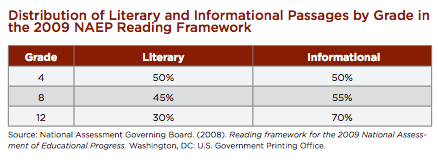
Recommended ratios of informational texts to fiction by grade level.

The CCSS suggest a decreasing ratio of fiction  to an increasing ratio of informational texts  for students in grade 4, grade 8, and grade 12. (see chart) This does not mean that English/Language Arts classes must drop literary fiction, but that other disciplines (History/Social Studies, Math, Science, Health, etc) should include more informational texts in their instruction in order to achieve the suggested ratios. The London 2012 Opening Ceremony was a blend of information and fiction (literally!).

Did London’s “Isles of Wonder” Opening Ceremony meet the recommended ratios of fiction to informational text according to Common Core State Standards?

A quick tally of the highlights as they appeared as either  fiction or informational text:
  • James Bond at Buckingham Palace escorting Queen and Corgis-fiction
  •  Skydiving Queen Elizabeth II-fiction
  • Thames River origin marker, Thames waders, Thames rowers, Thames boat traffic, Thames on a Google map -informational text
  • A flyby of Mr. Rat and Mr. Toad from Kenneth Grahame’s Wind in the Willows arguing in a boat on the Thames-fiction
  • The Pink Floyd Tribute pig  seen floating above the Battersea Power Station-fiction
  • London landmarks Big Ben and London Bridge-informational text
  • Big Ben’s hour and minute hand rapidly spinning and time traveling in London’s Tube- fiction
  • Posters of past Olympics contrasted with posters advertising 2012 Games-informational texts
  • Fluffy White Clouds held with string on a set of an English meadow –fiction
  • Tribute to the Agrarian Society featuring a very busy sheepdog with livestock -informational text
  • Tribute to the Industrial Revolution with Kenneth Branagh as Isambard Kingdom Brunel, the man who was responsible for England’s Industrial Revolution-informational text
  • Kenneth Branagh as Kenneth Branagh reading Caliban’s speech from Shakespeare’s The Tempestfiction
  • Forging of Tolkien’s “One Ring to rule them all” leading to the Forging of the Olympic Rings-fiction
  • Song by Scotland singer Emeli Sandé  and  dance British choreographer Akram Khan: fiction; their performance pre-empted by a silly interview by Ryan Seacrest of Michael Phelps-informational text
  • Tribute to National Health Service replete with backlit hospital beds filled with bouncy children, and dancing nurses and orderlies-informational text
  • Arrival of villainous characters from children’s literature (Including The Child Catcher from Chitty Chitty Bang-Bang, The Queen of Hearts Alice in Wonderland, and an inflated Voldemort from Harry Potter) chased away by PT Traver’s famous nanny, and all replaced by one giant sleeping baby-fiction
  • Rowan Atkinson’s,  (Mr. Bean), imagination running amuck in Chariots of Fire –fiction
  • A “Tube” made of tubes to highlight a contemporary romance: boy meets girl via cell phone-fiction
  • Musical hits from the 60′s, 70′s, 80′s, 90′s with unnecessary extended rap performance-fiction
  • Clothing from  the 60′s, 70′s, 80′s, 90′s (with the exception of the fictional Sgt. Pepper Costumes and Freddie Mercury Bobbleheads)  informational text
  • The big reveal of the creator of Sir Timothy John “Tim” Berners-Lee also known as “TimBL”, computer scientist, MIT professor and the inventor of the World Wide Web -informational text
  • Soccer great David Beckham arriving in a speedboat to hand the torch to Steve Redgrave, a five-time Olympic champion in rowing-informational text
  • The Olympic Cauldron, formed of 205 copper petals (one for each country) ignited by seven young torchbearers nominated by Britain’s past and present Olympic and sporting greats-informational text
  • Paul McCartney’s appearance for a British pound -informational text;  Lyrics of “Hey, Jude” sung by all athletes and audience –fiction
  • Pyrotechnics exploding from every conceivable platform in and around the stadium-informational text

My quick tally of 25 selected moments of the opening games comes to a total of 15 fictional texts (55% ) compared to 13 informational texts (48%)-(including two “blended information and fiction”). These percentages indicate that the production was too heavy in fiction. However, perhaps this high number of fictional texts is not really a surprise as Danny Boyle was hired specifically for his talents with stories (Slumdog Millionaire). According to a CNN report, Bill Morris, director of Ceremonies for the London Games said, “His ability as a storyteller, as a creator of spectacle, his background in both theater and film and the passion he has for this city and this project — they all just screamed at us. It wasn’t a difficult choice.”

Ultimately, London’s Opening Ceremony would not meet the suggested ratio of genres for the Common Core State Standards. According to my criteria and chosen highlights, the elements of the Opening Ceremony would not meet the suggested ratio of 50%  fictional texts to 50% informational texts in Grade 4, and certainly would not meet the ratio of fiction (30%) to informational texts (70%)  for students by grade 12.

There is one more informational fact that could be added to tilt the ratio.  The cost of the opening ceremonies was  27 million British pounds. That cold economic fact could be assessed against the joy of watching the Danny Boyle’s frenetic and spectacular celebration of Great Britain, both real and imagined. However, even this ratio would still not satisfy the recommendations for reading genres. When judging Olympic Opening Ceremonies, the Common Core is not the gold medal standard.

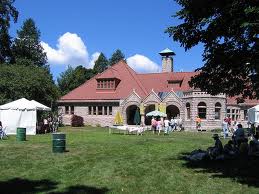
Peqout Library in Southport, CT

The 2012 summer tri-athlon  of Fairfield County, Connecticut, Friends of the Public Library book sales is over! Hundreds of book buyers have visited Newtown’s C.H.Booth’s Library, Westport’s Public Library, and finally, Southport’s Pequot Library in search of bargains and great reads. Each book sale has its own distinctive  level of organization and quality of merchandise. Newtown is “uber”-organized, and Westport caters to large crowds of book buyers with an enormous selection. Southport’s claim to fame is the quality of the texts.

Newtown and Westport book sales offer holding areas for book buyers to place filled boxes or bags. Southport has quality texts. Westport and Newtown book sales have well-organized tables and books sorted into correct genres. Southport has quality texts. Westport and Newtown book sales have volunteers  that move with the crowd and refresh tables. Southport has quality texts.

Quality texts are perhaps the only reason to attend the Pequot Library’s book sale. In two hours, I spent $306.00 on four boxes of books for different grade levels. For example:

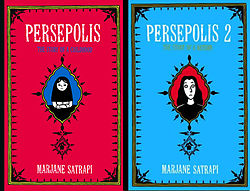
  • 4 copies of Persepolis: The Story of a Childhood- Grade 10 World Literature
  • 12 copies of The Help– Grade 11-Civil Rights unit
  • 5 copies of Speak-Grade 9
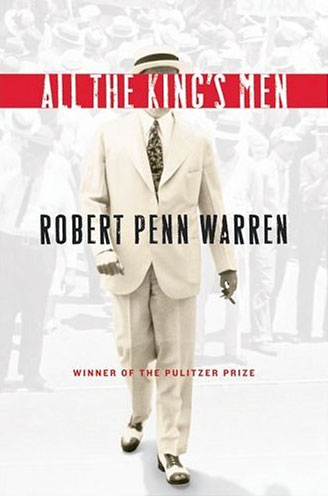
  • 6 copies of All the King’s Men-AP English Language and Literature
  • 6 copies of The Giver-Grade 7
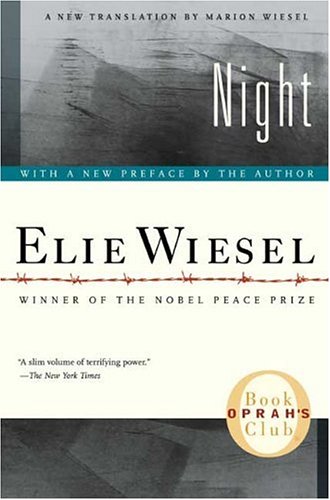
  • 7 copies of Night-Grade 10-Interdisciplinary unit
  • 5 copies of Tuesdays with Morrie-Grade 9 Independent read  or Grade 11 Coming of Age unit
  • 2 copies of The Odessey (Fitzgerald)-Grade 9
  • 4 copies of Beowulf (Heaney)-Grade 10 -World Literature

Each text was in mint condition. More than a few looked “unread” by students who must have purchased the text for class. All copies were free of notes or highlighting. I do suspect that there are students in Southport, like my students in Litchfield, who may be opting for Sparknotes support!

Southport offers a Friday preview day with books at double the cost, but by the following Tuesday, books are $5.00/bag.

2012 Hours and Pricing:
Friday, July 27 – 9am to 8pm – All items double the marked price
Saturday, July 28 – 9am to 5:30pm – All items priced as marked
Sunday, July 29 – 9am to 5:30 pm – All items priced as marked
Monday, July 30 – 9am to 6pm – All items half price
Tuesday, July 31 – 9am to 2pm – $5 per bag day!

The volunteers were gracious, but many seemed to be “in-training” or waiting for an authority to make a decision. That did not take away from the quality of the texts. There were books -particularly fiction-that had been placed on the ends of the tables left partially covered by the large tent. Unfortunately, many of these books did get saturated by the soaking rain the night before. This has happened in years past. One wonders what the volunteers could do in the future to avoid the damage that happens when there are texts uncovered; it is sad to see so many good quality books damaged when they could bring a profit to the library or more literature to a classroom.

There are discounts  offered to teachers in Bridgeport and New Haven, but with education budgets receiving cuts around the state, perhaps consideration can be given to teachers in other towns as well? Most teachers pay out of pocket for school supplies, not the school districts. Teacher discounts would help support literacy in classrooms throughout the state by creating “book floods” in each school.

My tri-athalon of book sales is over for the summer. My classroom libraries grades 7-12 are almost filled in preparation for 2012-2013. I have collected my goal-a class set of The Help, and added a number of new titles for independent reading or literature circles. There is a book flood at Wamogo Middle/High School And, thanks to Southport, many of these books are quality texts.

A series of links took me to a lesson plan  on the Edsitement! The Best of the Humanities on the Web site that is associated with the National Council of Teachers of English (NCTE) . The lesson “Vengeful Verbs in Shakespeare’s Hamlet”  is entirely too disturbing. The opening lines of the lesson plan begin, “Shakespeare’s Hamlet  is an excellent source of instruction for students at the middle school level.”

My thoughts? Sorry. Middle school students, grades 6-8, should not read Hamlet. Teachers, leave that play for high school. Middle schools students need to read. They need to read many, many books.  They need young adult literature. They need to read for pleasure to build up their literary skills.

The lesson plan continues:

It [Hamlet] is a tale full of mystery and suspense and peppered with elements of the supernatural. Everyone loves a good ghost story! The popularity of the ghosts in the Harry Potter series and in The Graveyard Book attests to the appeal of the paranormal for this age group. These ghosts manifest as translucent spirits, yet they impact the physical world and certainly add life to the story line. Figments such as Rowling’s histrionic Moaning Myrtle and Gaiman’s mysterious Silas provide guidance for the young adults in their time of need.

My thoughts? Yes, these are the books they SHOULD be reading! Add the ghost stories Hereafter and Anna Dressed In Blood to the list of well written young adult novels. And yes, Harry Potter and The Graveyard Book are stories that will guide young adults in their time of need. But Hamlet?

Back to the lesson plan:

What better way to expose middle school students to a first taste of Shakespeare than from the angle of the ghost story? The first time Hamlet sees his father’s ghost (Hamlet, act 1, scene 5, lines 13–31) is one of the most dramatic moments in theatre and a prime opportunity to teach the often dry and boring subject of verbs.

My thoughts: Whaa…??? This lesson is turning a critical moment of drama into a lesson on verbs? This idea is dry and boring regardless of the content!

Finishing the description of the lesson plan:

Through the ghost of Hamlet’s father, students receive an introduction to the language of Shakespeare in a context they can understand. In this lesson, they will learn to distinguish generic verbs from vivid verbs by working with selected lines in Hamlet’s Ghost scene. Students will then test their knowledge of verbs through a crossword interactive puzzle.

My thoughts: A crossword puzzle. Yup. That will help them appreciate the play. I can hear the rattling from Stratford on Avon; Shakespeare’s bones are disturbed.

The objectives of the lesson are:

  • Students will be able to identify and define the verbs Shakespeare uses to convey the meaning of the scene
  • Students will exchange the verbs from the scene and replace with more vivid and more generic ones to see how that changes intention of the scene
  • Student will be assess their ability to define vivid and generic verbs used by Shakespeare by solving a crossword puzzle

Yes, readers, in this lesson students will replace Shakespeare’s language with bland or generic verbs using a worksheet.

WHY?

There is little consideration as to how all the language in this scene defines each character. No consideration of motive. No moral or ethical discussion about what the Ghost is asking Hamlet do.   The Harvard scholar Steven Greenblatt wrote an entire book, Hamlet in Purgatory,  wrestling with the central question offered in this scene, is the Ghost from Hell or Purgatory? But no, this lesson is on verbs.

Here are the lines: (Act I.V.13-31)

Father’s Ghost. I am thy father’s spirit,
Doom’d for a certain term to walk the night,
And for the day confin’d to fast in fires,
Till the foul crimes done in my days of nature
Are burnt and purg’d away. But that I am forbid
To tell the secrets of my prison house,
I could a tale unfold whose lightest word
Would harrow up thy soul, freeze thy young blood,
Make thy two eyes, like stars, start from their spheres,
Thy knotted and combined locks to part,
And each particular hair to stand on end
Like quills upon the fretful porcupine.
But this eternal blazon must not be
To ears of flesh and blood. List, list, O, list!
If thou didst ever thy dear father love-
Hamlet. O God!
Father’s Ghost. Revenge his foul and most unnatural murther.
Hamlet. Murther?
Father’s Ghost. Murther most foul, as in the best it is;
But this most foul, strange, and unnatural.

In this passage, the Ghost is very cagey about where he is coming from literally and figuratively. The Ghost plays the ultimate guilt card “If thou didst ever thy dear father love-” Hamlet anticipates the request and interjects a prayer “O God”. The Ghost then, you choose: a. asks, b. demands, c. commands the Prince, Hamlet, to revenge.

Another consideration as to the appropriateness of the use of Hamlet is the berating of Hamlet’s mother, Gertrude sixteen lines later:

Father’s Ghost. Ay, that incestuous, that adulterate beast,
With witchcraft of his wit, with traitorous gifts-
O wicked wit and gifts, that have the power
So to seduce!- won to his shameful lust
The will of my most seeming-virtuous queen.
O Hamlet, what a falling-off was there,
From me, whose love was of that dignity
That it went hand in hand even with the vow
I made to her in marriage, and to decline
Upon a wretch whose natural gifts were poor
To those of mine!
But virtue, as it never will be mov’d,
Though lewdness court it in a shape of heaven,
So lust, though to a radiant angel link’d,
Will sate itself in a celestial bed
And prey on garbage.

There are accusations of incest (a thought of Hamlet’s given voice by the Ghost), witchcraft, and adultery for Claudius. Gertrude acts with “lewdness” and “sates” herself in Claudius’s bed of figurative garbage. The Ghost cannot contain his fury at being replaced by Claudius; he has lost kingdom and queen and his fury spills over and exploits Hamlet’s depression. There is much here to discuss.

But for grades 6-8?  To replace the language of Shakespeare and make it “bland” to prove a distinction about verbs in Elizabethan English and today’s English? To measure the student understanding of the language with a crossword puzzle? Is it any wonder that with lessons like this one, many students come to a high school classroom “hating” Shakespeare? I have to work very hard to convince them otherwise.

There is something rotten on the Edsitement! site, and NCTE should be ashamed for endorsing this lesson. This lesson about verbs, not motivation or ethical dilemmas, disregards the dramatic tension of the scene and is wrong at any grade level!

What next? A lesson on the comma during Macbeth’s “Is this a dagger I see before me? /Come, let me clutch thee”?

There are  better lessons on heaven and earth for students in this age group then are dreamt of in this lesson plan!

NCTE must be aware that we have a nation of students who are not reading in part because many teachers kill the pleasure of a book. Hamlet is not the material that will bring middle school students a love of reading, and the literary analysis skills for these students in grades 6-8 are not sophisticated enough to bring them to an understanding of The Ghost’s manipulations. A grammar lesson plucked from a dramatic moment with a brilliant seduction by a spirit from beyond the grave is just so wrong.

This lesson is out of joint. O cursed spite
That ever I was born to set it right!

I am sitting through a professional development session on how to use peer to peer writing conferences. I want to believe there will be a moment in this workshop when the “ah-ha” moment will happen, when I finally unlock the formula for successful in class peer to peer writing conferences at the high school level. The presenter reiterates how important this process is for writers to hear critical feedback to their writing. I hear again that “sticking with it and training students” to peer to peer conference are key ingredients that will improve student writing. Then I think of my students….my 9th, 10th and 11th grade students. This unspoken heresy forms in my mind:

Forgive me, well-intended and passionate presenter, but in my experience, in class peer to peer writing conferences do not work.

There, I admit it. Success in implementing face to face, peer to peer writing conferences, real critical encounters, has eluded me. I have 20 plus years in the English classroom, grades 6-12, and I have always come away from peer to peer writing conference sessions with the uncomfortable opinion that I have been wasting class time.

I now know why.
This summer, I am participating in the Connecticut Writing Project, and I have to write on demand, and then I must share that work. This is a horrible experience for me. I pass my paper wondering, “What will this person think of me?” and “What if there is a grammar error? I’m an English teacher!!” I have to provide feedback on a fellow teacher’s work, and I see the same kind of panic in her eyes.
I quickly reflect. How does my adolescent, pimply, over-stimulated teen-age boy feel as he hands in his rough draft for a critique by the fair skinned, sweet smelling young girl who sits behind him? How does that painfully shy artist who doodles his responses but has yet to complete a paragraph in writing feel about sharing his work with the amazingly popular class jock (boy or girl)?
I mention this to the presenter who says, “Yes, sometimes, there are student combinations that do not work.” That confirms my problem.

Problem #1: My struggle with peer to peer conferencing begins with setting up partnerships. Do I put the uneven writer with the good writer? Does the good writer need another good writer for good editing? Do I put two poor writers together and expect a miracle? Do I let the students choose their partners? How effective is the conference if friendship is in play?

Problem #2: The research shows that students should learn how to peer conference in the elementary and middle school grades to carry that behavior into the high school grades.However, I have found that training in writing conferences in the elementary and middle school grades is  erased in the high school environment. Many high school students claim to hate sharing their work with other members of the class; participation is mixed.

Problem #3: I teach in a regional school where one third of our freshman class comes from out of district schools. Several of these students have not had any training  in peer conferencing. The number of incoming students who are already uncomfortable in moving to a new regional school requires that I need to start at square one and  train everyone how to conference effectively.

Ultimately, I do not want to give up on students providing critical feedback to other student; I just want to take away the awkward immediacy of that face to face encounter. Since I teach in a 1:1 school district with digital literacy embedded in my curriculum, I will continue to use the solutions that have worked in place of those face to face, peer to peer writing conferences. I use digital conferencing.

Solution #1: I use blogs. Each blog is organized for a small group (8-10 students)   to use as a team. Only members of their team see their posts and comments over a period of time, say a semester or a school year. Students post book reviews, and other students comment on that post by asking questions about the book, or by making recommendations to improve the original book review  post. Each student must respond to the posted book reviews. Writing on the blogs allow students the physical distance they need to comfortably respond to each other. Written comments take time to construct, and students are more thoughtful if they know what they write will have a larger audience. Blogs let me  monitor the comments as well and determine which students are the most effective in providing good critical feedback to a student and which students are simply putting down, “great job!” or “I like what you wrote!” I might not have this information if the students were having face to face conferences. During my writing conferences with students I can follow up with the comment stream and target what is necessary to improve a critical response.

Solution #2: I use wikis. Students upload a report or story to a wiki page, and their peers can respond with questions and provide feedback in the comment section at the bottom of the digital page. Here too, the wiki page and the comment section will be seen by a larger audience and students are more thoughtful if they know their work will be read by an entire class. Responses in the comment section of the wiki also allows me to monitor who has provided good critical feedback to the writer.

Solution #3: I use Google docs. Students can upload their work to a Google doc and share that link with one or more students. Each peer reviewer can use the comment feature to provide feedback. This feature also identifies the peer conference partner on each comment he or she makes. All  comments by the peer reviewer are recorded on the document’s margin. An student author can even post questions about his or her writing in a comment box. The document can be also shared with multiple students who could work on the same document at the same time if necessary. All  comments are part of the document’s history, and I can monitor changes made by the student writer before and after a peer review. This method is particularly helpful if I have specific students who are hesitant about facing another student in a peer review.

Of course, all this digital peer to peer conferencing is improved if I provide students with  guiding questions (“Did the opening engage you as a reader?”) they would use in written conferences or if they prepare specific questions for the peer reviewer.

Digital platforms: wikis, blogs, and Google docs, allow me the means to provide peer to peer writing conferences by removing those awkward face to face conferences that I have found so unproductive in my high school classrooms. These digital platforms also let me organize students across class periods, and if I found a teacher in a cooperating school who wanted to peer conference, the digital platforms would allow my students to conference outside the classroom. Students still have plenty of opportunities for face to face encounters during class discussions and presentations, but they are comfortable communicating their feedback about a peer’s writing in a digital environment. And, heresy or not, I am finally comfortable with the productive peer to peer (via the Internet) writing conference.