Archives For November 30, 1999


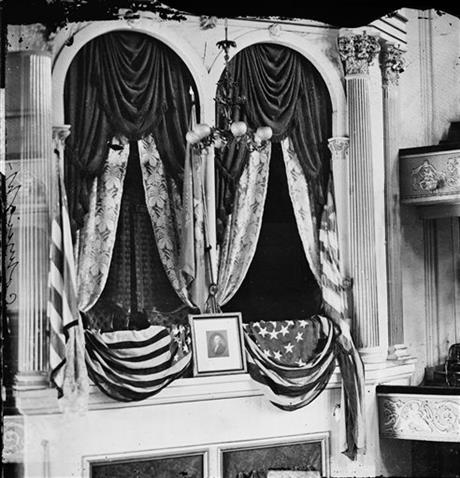
This April 1865 photo provided by the Library of Congress shows President Abraham Lincoln\'s box at Ford\'s Theater, the site of his assassination. Under the headline "Great National Calamity!" the AP reported Lincoln’s assassination, on April 15, 1865. (AP Photo/Library of Congress)

This April 1865 photo provided by the Library of Congress shows President Abraham Lincoln\’s box at Ford\’s Theater, the site of his assassination. Under the headline “Great National Calamity!” the AP reported Lincoln’s assassination, on April 15, 1865. (AP Photo/Library of Congress)

News stories are generally written in what is commonly known as the inverted pyramid style, in which the opening paragraph features the “5 Ws” of journalism: Who, What, Where, When, Why, and How. The reason for this style is so that the reader gets the most important information up front. Given the amount of time readers have today to read the amount of news generated in a 24 hour news cycle, the inverted pyramid makes sense.

In contrast, 150 years ago a dispatch by the Associated Press took a storytelling approach  when President Abraham Lincoln’s assassination at the hands of John Wilkes Booth was relayed by AP correspondent Lawrence Gobright. Under the headline”Great National Calamity!” he chose to deliver gently the monumental news of Lincoln’s death in paragraph 9:

The surgeons exhausted every effort of medical skill, but all hope was gone.

The Common Core State Standards in Literacy promotes primary source documents, such as this news release, in English Language Arts and Social Studies. Documents like this provide students an opportunity to consider the voice or point-of-view of a writer within a historical context.

In this 19th Century AP news release, an editor’s note attached described in vivid detail Gobright’s efforts to gain first-hand information in compiling the story of Lincoln’s assassination. In the tumult that followed the assassination, Gobright became more than a witness as he:

scrambled to report from the White House, the streets of the stricken capital, and even from the blood-stained box at Ford’s Theatre, where, in his memoir he reports he was handed the assassin’s gun and turned it over to authorities.
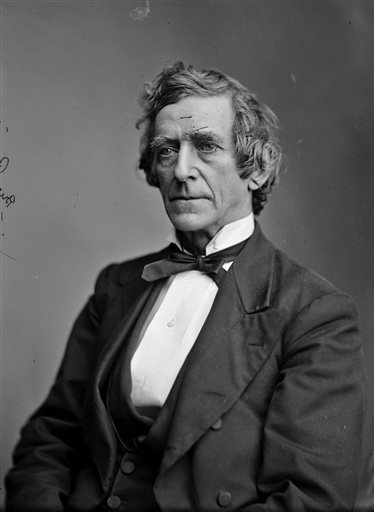
This circa 1865-1880 photograph provided by the Library of Congress' Brady-Handy Collection shows Lawrence A. Gobright, the Associated Press' first Washington correspondent. A native of Hanover, Pa., Gobright covered both inaugurations of Abraham Lincoln, the Civil War and Lincoln's assassination during a career spanning more than a third of a century in Washington. Under the headline "Great National Calamity!" the AP reported President Abraham Lincoln’s assassination, on April 15, 1865. (AP Photo/Library of Congress)

This circa 1865-1880 photograph provided by the Library of Congress’ Brady-Handy Collection shows Lawrence A. Gobright, the Associated Press’ first Washington correspondent.. Under the headline “Great National Calamity!” the AP reported President Abraham Lincoln’s assassination, on April 15, 1865. (AP Photo/Library of Congress)

Gobright’s opening line for the news story identified the setting as Ford’s Theatre; he then added information of considerable interest to the Union Army, that:

It was announced in the papers that Gen. Grant would also be present, but that gentleman took the late train of cars for New Jersey.

After setting up who was or was not in attendance,  Gobright detailed the sequence of events in paragraph 3:

During the third act and while there was a temporary pause for one of the actors to enter, a sharp report of a pistol was heard, which merely attracted attention, but suggested nothing serious until a man rushed to the front of the President’s box, waving a long dagger in his right hand, exclaiming, ‘Sic semper tyrannis,’

Describing the assailant’s escape on horseback, Gobright concluded the reaction of the crowd in the audience in paragraph 4 in an understatement, “The excitement was of the wildest possible description…”

His AP’s edited version online states that the report does not contain details on the second assassination report on Secretary of State William Seward. There is his reference to the other members of Lincoln’s cabinet who, after hearing about the attack on Lincoln, travelled to the deathbed:

They then proceeded to the house where the President was lying, exhibiting, of course, intense anxiety and solicitude.

As part of a 150 year memorial tribute, the AP offers two websites with Gobright’s report, the first with an edited version of the report and the second, an interactive site with graphics. The readabilty score on Gobright’s release is a grade 10.3, but with some frontloading of vocabulary (solicitude, syncope) this story can be read by students in middle school. There are passages that place the student in the moment such as:

  • There was a rush towards the President’s box, when cries were heard — ‘Stand back and give him air!’ ‘Has anyone stimulants?’
  • On an examination of the private box, blood was discovered on the back of the cushioned rocking chair on which the President had been sitting; also on the partition and on the floor.

The NYTimes reporting of the assassination, having the advantage of several hours start, did not bury the lede, or begin with details of secondary importance, offering the critical information through a series of headlines beginning with the kicker “An Awful Event”:

An Awful Event
The Deed Done at Ford’s Theatre Last Night.
THE ACT OF A DESPERATE REBEL
The President Still Alive at Last Accounts.
No Hopes Entertained of His Recovery.
Attempted Assassination of Secretary Seward.
DETAILS OF THE DREADFUL TRAGEDY.

Their six column spread allowed space for the six drop heads, or smaller secondary headlines, above that were stacked to provide an outline of the events. The article that follows begins with then Secretary of War Edwin Stanton’s message to Major General Dix, April 15, 1865 at 1:30 AM:

This evening about 9:30 PM, at Ford’s Theatre, the President while sitting in his private box, with Mrs. Lincoln, Mrs. Harris, and Major Rathburn, was shot by an assassin who suddenly entered the box and approached behind the President.

Stanton’s 324 word report has a readability grade 7.2, and includes also details about the other assassination attempt on Seward’s life:

About the same hour an assassin, whether the same or not, entered Mr. SEWARD’s apartments, and under the pretence of having a prescription, was shown to the Secretary’s sick chamber. The assassin immediately rushed to the bed, and inflicted two or three stabs on the throat and two on the face.

A second dispatch features Gobright’s reporting and appears below Stanton’s message in the second column. Following these accounts, a third dispatch  by an unnamed reporter is dated Friday, April 14, 11:15 P.M. and like Gobright’s account begins with a storybook-type lead:

A stroke from Heaven laying the whole of the city in instant ruins could not have startled us as did the word that broke from Ford’s Theatre a half hour ago that the President had been shot. It flew everywhere in five minutes, and set five thousand people in swift and excited motion on the instant.

These first-person accounts of Gobright, Stanton, and others covering Lincoln’s assassination will allow students to contrast what they recognize as the reporting styles of today with an example of the storytelling reporting style 150 years ago. Students can analyze both styles for conveying information, and then comment on impact each style may have on an audience.

More important is the opportunity to ditch the dry facts from a textbook, as these newspaper releases allow students to discover that at the heart of stories about Lincoln’s assassination, the reporters were really storytellers, and their hearts were breaking.

During the 88th Saturday Reunion Weekend at Teacher’s College in NYC (3/28/15), author and educator Kylene Beers delivered three professional development sessions based on Notice and Note: Strategies for Close Reading, a book she co-authored with Bob Probst. Each session was overflowing with standing room only crowds.Screenshot 2015-03-28 22.29.02

During the afternoon keynote in the Nave of Riverside Church, she delivered her beliefs, and every one of the 2,100 seats was filled.

Screenshot 2015-03-28 20.51.18She opened her address with a historical connection between literacy and power by referring first to the notion that years ago a signature was all that was necessary to prove a person literate. Exploiting this belief were those in power who prepared and wrote contracts, becoming wealthy at the expense of those who could only sign their names with an “X”.

“Literacy in this country has always been tied to wealth.” Beers explained adding, “With literacy comes power, and with power comes great privilege.”

This was the theme of her keynote, that in this age of communication and messaging, literacy equals power and privilege.

Moving to the present and the communication and messaging skills necessary for the 21st Century, Beers justified improving  literacy skills to operate on digital platforms as one way to empower students, but she called into question the practice of prevention by some school districts.

“When schools say they do not want to have students develop a digital footprint,” she cautioned, “they limit their students access to that kind of power.”

Continuing to argue for the empowered students, Beers directed the audience’s attention to making learning relevant for students remarking,  “There is a problem if everything is assigned by me!” By letting students choose what they want to read, she suggested that teachers can make learning relevant for the student. Employing choice to encourage more reading, however, contrasts to the recommendations of the Common Core State Standards that students read fewer texts in order to read “closer.”

“Why fewer?” she asked the crowd of educators, “when the single best predictor is of success is volume of reading. One book for six weeks will never be as helpful as six books in six weeks.”

Teachers must let the students choose what they want to read, Beers argued, raising her voice:

“Damn the Lexiles ! The best book is the one the kid chooses to read… [a student’s] ‘want-ability’ is more important than readability.”

And what should students read? Beers asked the crowd.

“Literature.”

“In the 21st Century, the most important role that literature plays is in developing student values such as compassion and empathy,” she contended. “Brain research shows we get to that compassion best through the teaching of literature.”

Beers called attention to recent disturbing headline events that had students marginalize others: racist chants made by a fraternity, and a teenager’s suicide due to bullying.

It is the role of literature, she explained, to give the reader the experience being the outsider, the marginalized. Reading and learning from literature gives students an understanding of others and an opportunity to lead “literate lives measured by decency, civility, respect, compassion, and, at the very least, ethical behavior.”

Coming to the end of the keynote, Beers saved her scorn for the answer-driven test preparation and testing that dominates schools today:

“A curriculum built on test prep might raise scores, but it will fail to raise curiosity, creativity, and compassion.”

Beers castigated the limits of “bubbled” answers by pointing out that deep thinking never begins with an answer. In connecting back to the role of literature in education she added, “Ethics and compassion are not so easily bubbled.”

As a final invocation Beers reiterated her belief in teachers, those who have met the challenges in order to encourage all students and who never needed a mandate to leave no child behind:

“Success is not found in a test; great teachers are our best hope for a better tomorrow!”

The crowd erupted into applause paying tribute to Kylene Beers, an leader in education whose strong voice reverberated in the cathedral and whose equally strong beliefs reverberated with their own.

One Word Text Complexity

March 23, 2015 — 1 Comment

I recently attended the 2nd Annual Conference for The Teaching Studio at The Learning Community, a public charter school in Central Falls, Rhode Island. Doing double duty as keynote speaker and presenter, author and blogger Vicki Vinton conducted two workshops on text complexity and how students read complex texts.

Vicki Vinton's previous book

Vicki Vinton’s earlier book on reading; Good news, she is writing another!

As an opening exercise, she asked those in attendance in the afternoon session to sum up their attitudes or feelings at that moment using only one word. She explained that while she is in the process of writing a book on the topic of text complexity, she sometimes feels overwhelmed in trying to meet deadlines and keep up with work responsibilities. She said she had chosen a word to sum up her feelings.

On a slide was her word: “Breathe.”

Some of the participants’ words?

Uncertainty
Joy
Time
Try
Action
Happy
Quality
Discover

My word? I combined the words try and action; my word was traction.

This opening activity mimicked how readers approach a complex text. In asking each member of her audience to select a word, Vicki explained that she was using the exercise as an ice breaker. She had established a purpose. Her request to have each person choose only one word to sum up an attitude required that each participant had to tap into his or her background knowledge (schema). As Vicki wrote each single word on the chart paper, the words formed a contextual coherence. Individually, these words were in the abstract, but listed collectively on the page, they provided an emotional portrait of the attendees in the session.

When readers read complex texts, they must perform many of the same steps we performed. Readers must establish a purpose for reading. Readers must tap into their own background knowledge, just as we did when Vicki requested that we select a single word. Our choices illustrated how readers must rely heavily on knowledge of word meanings when reading complex texts.  Finally, a reader needs to recognize a coherence; how words in a text connect to each other. The attendees in Vicki’s session had a chance to recognize the connection of their words to the education profession.

Had we been given the time, we might have explained in more detail why we had chosen our particular words. I would have had the opportunity to explain why I had selected the traction. The dictionary defines traction as:

1: the act of drawing : the state of being drawn
2: the adhesive friction of a body on a surface on which it moves (as of a wheel on a rail)
3: a pulling force applied to a skeletal structure (as a broken bone) by using a special device <a traction splint>; also: a state of tension created by such a pulling force

Of the three possible meanings, my reason for choosing traction is most closely associated with the second definition. One of my educational objectives this year is to help students in my district to make gains in reading and writing. While that means I may encounter some “friction” in meeting this goal, I must be careful about the degree of “tension” that I create as I work to be a “pulling force” in improving literacy.

The complex thinking that began Vicki’s presentation came from her request to choose only one word proving that text complexity has nothing to do with length; text complexity can be found in brevity.

Vicki’s opening exercise was an excellent way to highlight the stages all readers can experience in reading complex texts. Her presentation developed many of these ideas that she promised would be outlined in the book she is currently writing. While the working title Embracing Complexity is, according to her, “subject to change,” the book will offer problem-based approach to the teaching of reading.

I look forward to reading her book when it is published.

In the meantime, I have a new word: anticipation.

When I look for inspiration in writing, I occasionally turn to “On this Day in History” websites. There is always some famous person’s birthdate or some memorable event that can spark the imagination to create a lesson about literature or an author.
So when my best friend, Catherine Flynn from Reading to the Core, offered to host #Poetry Friday on March 20th, I wanted to contribute a special post to mark the occasion. Catherine, a district reading consultant and former teacher, is a fan of historical events.
In doing my research, I discovered that March 20th marks the anniversary (3/20/1942) of General Douglas MacArthur’s statement, “I shall return.”Screenshot 2015-03-19 21.36.41
General MacArthur made this announcement arriving in Australia, after being forced to evacuate the Philippines during the height of a Japanese attack. He fulfilled the promise to return made in his iconic statement two years later on October 20, 1944, striding out onto the beach on the island of Leyte.

A sense of determination “to return” is something I witness everyday in teachers. Teachers must demonstrate endurance in meeting the everyday challenges in education today, challenges large (responsible for educating children for our collective future) and challenges small (bulletin boards, lunch duty, formative assessments, summative assessments, group work, Parent/Teacher Conference Night, and more).

The attitude of teachers to return every day to the doors of their classrooms determined to meet the challenges of each day is what I hope to have captured in the following poem:

“I Shall Return”: The Teacher’s Version


I Shall Return

…to the school parking lot

to snag the last available space

that is farthest from the building

(and it’s pouring)

I Shall Return

…to the back door of the school

balancing the bag of stickers and markers and card stock,

with the bulletin board corrugated cardboard,

and a box of energy bars (sans nuts),

in my paper stuffed satchel-

(“Is that my phone is ringing???”)

-with my keys at the bottom.

I Shall Return

….to the classroom

just in time to set up the desks for ???

(select the one that best applies:)

A. Socratic seminar

B. morning meeting

C. Daily 5

D. computers on carts

I Shall Return

….to the copier,

it’s jammed,

it’s hot,

and out of ink.

I Shall Return

…to the dimly lit book room

and dig through the pile

of dusty boxes filled with dog-earred copies

and abandoned textbooks

desperately seeking 27 paperbacks OF

Ramona the Pest OR

A Wrinkle in Time OR

Of Mice and Men

No matter the grade level…still 3 books short.

I Shall Return

….to the (hard copy/online) grade book

and mark the tardies

and mark the absences

and mark the group work

(and note, “No quiz grade for Mark?”)

I Shall Return

…to the parking lot

lugging the satchel of papers

that have travelled,

ungraded,

from school,

to home,

back to school where

I do what I love.

And so,

I Shall Return

©Colette Marie Bennett, 2015

Submitted with great respect for both General MacArthur and educators everywhere on the March 20th anniversary.

Hope this was ok, Catherine!

To see the other #PoetryFriday posts check out her blog: Poetry Friday is Here!

Screenshot 2015-03-18 07.04.18Saturday, March 14th, Cornelius Minor, a Staff Developer at The Reading & Writing Project gave the luncheon keynote address to over 300 educators at the 2nd Annual Conference for  The Teaching Studio at The Learning Community, a public charter school in Central Falls, Rhode Island.

While he began his address with humor and participation, Minor quickly got to the serious matter of his topic:

“In a world of inequity, how are we giving tools to students to let them become heroes to rescue themselves?”

For those not in attendance, there could be some confusion on Minor’s use of the term “hero”; the word is commonly associated with superhero characters from the Marvel or DC Comics. Minor himself even referenced the superhero Batman in his speech in order to make his claim that teachers are the voice-overs in their students’ lives. He suggested that teachers could emulate the voice of Batman’s mentor, Lucius Fox who is played in the films by the actor Morgan Freeman.

The role of the mentor as the “voice-over” is an integral part of the hero’s journey archetype. In the classic hero’s journey, in film and in literature, there are twelve (12) steps.  Step 1 begins in the Ordinary World, when the hero hears a Call to Adventure (step 2), which He or She initially Refuses (step 3). By step 4, the hero encounters someone who can give him advice in order to prepare for the journey ahead. That someone in step 4 is The Mentor, a character that students are already familiar with some examples from films.

Students at every grade level can name film mentors such as Glinda from the Wizard of Oz, mentor to Dorothy; Obi-Wan Kenobi from Star Wars, mentor to Luke Skywalker; and Gandalf, mentor to both Hobbits, Frodo and Bilbo Baggins, in the the Lord of the Rings trilogy.

Minor, however, asked his audience to turn from cinema’s world of fantasy in order to suggest the role the ordinary teacher plays everyday is as powerful as these other mentors.

“Think about that Morgan Freeman voiceover in the movie…. to ‘Be the Batman,'”intoned Minor enthusiastically in order to illustrate that every student needs to hear that voice-over in their heads to “Be the hero” of their life.

While teachers may lack the gravely voice of Morgan Freeman, teachers can help their students when they decide to Cross the First Threshold into adventure (step 5) and meet Tests, Allies, Enemies (step 6) before taking a New Approach (step 7) when setbacks occur day by day, grade by grade.

Just as the characters in epic literature or in film Confront Ordeals (step 8), teachers in real life can contribute by helping students Achieve Success and Rewards (step 9) as they prepare to Return to the Ordinary World with new knowledge (step 10). Helping students achieve success is critical to prepare students for future tests, both literal and figurative (step 11), and the final step 12 is when students finally complete the journey with knowledge, literally the “elixir”, which will be used to help others.

“What’s the last ‘best’ book you read on your own?” I would ask students when I taught middle and high school.

When I asked them this question, the boys almost always answered “Hatchet“.

“That’s the last book I read, too,” many would admit.

The number of Hatchet fans was 100% among the vocational agriculture students I taught for seven years in a rural school in Northwest Connecticut. Their love of this novel resonated with their desire for independence, adventure, and the outdoors.

The author Gary Paulsen shares many of these interests according to his biography:

Running away from home at the age of 14 and traveling with a carnival, Paulsen acquired a taste for adventure. A youthful summer of rigorous chores on a farm; jobs as an engineer, construction worker, ranch hand, truck driver, and sailor; and two rounds of the 1,180-mile Alaskan dog sled race, the Iditarod; have provided ample material from which he creates his powerful stories.

In Hatchet, Paulsen’s protagonist, Brian Robeson, is a thirteen-year-old boy from New York City. From the onset, Brian is ill-prepared to meet the hardships of the wilderness when the single engine plane he is riding in from New York to Canada crashes because the pilot had a heart attack. Thus begins a compelling survival story, and my students loved survival stories; many of them were experienced hunters or fishermen.

The opening chapters of Hatchet also cover Brian’s personal background, his knowledge of his mother’s affair and his parent’s subsequent divorce, and the events leading up to the plane crash. Since the pilot had offered Brian a few minutes of flight lessons, he is able to control the descent of the plane until it crashes into a lake. He swims to safety with his only asset, a small hatchet he has taken from the crash.

Brian’s wilderness education alternates between emotions of loneliness and his physical needs. He learns to respect the natural world through a series of unexpected encounters with a bear, a porcupine, and a wolf. A turtle’s eggs give him a food source until he learns how to fish.  He learns how to build a fire and how to store food properly after a serious spraying by a skunk. Initially devastated about his inability to signal a passing plane for help, Brian works to improve his skills by constructing a studier lean-to.  These incidents mark a change in the “new” Brian, one who is far more self-reliant than the “city boy” who left on the plane to Canada. My students enjoyed the notion that “city boy” values must change to include skills they valued as well.

In recounting Brian’s emotional turmoil caused by his parent’s recent divorce, Paulsen uses simple and effective word choice and syntax; Brian is monosyllabic with memories, “The words. Always the words. Divorce. The Secret. Fights. Split. The big split.” Many of my male students spoke monosyllabically as well. These simple statements capture Brian’s stream of consciousness effectively without sentimentality.

There is just the right amount of the “yuck” factor in the novel to satisfy a young male reader. When the plane resurfaces, Brian decides to retrieve the plane’s flight location transmitter. While diving in the plane, he comes upon the decomposing body of the pilot:

“The fish. He’d never really thought of it, but the fish—the fish he had been eating all this time had to eat, too. They had been at the pilot all this time, almost two months, nibbling and chewing and all that remained was the not quite cleaned skull and when he looked up it wobbled loosely.”

Paulsen illustrates Brian’s growth as he learns how to adapt to increasingly dangerous situations; he survives a tornado and a terrifying moose attack. The reader is increasing aware of the self-confidence that Brian develops towards the end of the novel:

“Come on, he thought, baring his teeth in the darkness—come on. Is that the best you can do—is that all you can hit me with—a moose and a tornado? Well, he thought, holding his ribs and smiling, then spitting mosquitoes out of his mouth. Well, that won’t get the job done. That was the difference now. He had changed, and he was tough. I’m tough where it counts—tough in the head.”

54 days after the plane accident, Brian is rescued. Like all characters in a coming-of-age novel, he is not the same; he is more introspective and thoughtful. Paulsen’s narrative convinces students that Brian’s transformation is real, and that maybe such transformations are possible for themselves.

The novel’s grade level equivalent is 6.3; the Lexile® measure is 1020, but labeling the interest level as grades 6-8 is a mistake. My students’ interest in Hatchet was the standard for all other reading choices as in, “This book is not like Hatchet” (*sigh*) or “This book is almost as good as Hatchet.”

Hatchet was the 1988 Newbery Honor book and, fortunately for teachers wishing to offer books like Hatchet, it is the first in a trilogy + one. After Hatchet came The River,(1991); Brian’s Winter, (1996); and then Brian’s Return, (1999).

Paulsen also has two non-fiction offerings: the book Guts, a set of true short stories of survival, and Winterdance, a story of running the Iditarod. Both titles were also popular with my students.

Paulsen’s wilderness experiences set a high standard for adventure stories for my students, and the experience of reading this book was often so powerful that I had to (figuratively) drag them “out of the woods” in the book to notice other compelling stories on our classroom’s bookshelves.

Hatchet was my “go to” for the reluctant reader, and I always had several copies on hand to lend out. There were copies for the first time reader and for the re-reader, but I did have to draw the line on occasion. While Hatchet can still be the best book some of my students have ever read, it cannot be their last.

When Erik Larson was interviewed by the NY Times for his latest book Dead Wake about the sinking of the R.M.S. Lusitania, he Screenshot 2015-03-11 23.14.19expressed his purpose for choosing to write in the narrative non-fiction genre:

“It is not necessarily my goal to inform. It is my goal to create a historical experience with my books. My dream, my ideal, is that someone picks up a book of mine, starts reading it, and just lets themselves sink into the past and then read the thing straight through, and emerge at the end feeling as though they’ve lived in another world entirely.”

There is nothing of analysis in his stated purpose for writing, but there is a desire to have a reader engulfed by a narrative that ends in the reader “feeling.”

In contrast, in the first three anchor standards for reading (grades k-12), the Common Core State Standards (CCSS) for English Language Arts spell out the expanse between their objectives and Larson’s expression to use narrative non-fiction to connect viscerally with the readers:

CCSS.ELA-Literacy.CCRA.R.1
Read closely to determine what the text says explicitly and to make logical inferences from it; cite specific textual evidence when writing or speaking to support conclusions drawn from the text.
CCSS.ELA-Literacy.CCRA.R.2
Determine central ideas or themes of a text and analyze their development; summarize the key supporting details and ideas.
CCSS.ELA-Literacy.CCRA.R.3
Analyze how and why individuals, events, or ideas develop and interact over the course of a text.

The anchor and grade level standards were written purposely to be devoid of any reference to reader’s feeling or connection. These standards were carefully articulated not to be confused with the popular  Reader Response Theory supported by Louise Rosenblatt that focused “on the reader rather than the author or the content and form of the work.”

“Reading closely” in the CCSS has been spun as “close reading”, defined by the The Partnership for Assessment of Readiness for College and Careers (PARCC) as:

Close, analytic reading stresses engaging with a text of sufficient complexity directly and examining meaning thoroughly and methodically, encouraging students to read and reread deliberately. Directing student attention on the text itself empowers students to understand the central ideas and key supporting details. It also enables students to reflect on the meanings of individual words and sentences; the order in which sentences unfold; and the development of ideas over the course of the text, which ultimately leads students to arrive at an understanding of the text as a whole. (2011, p. 7)

Analyzing the definition of close reading (above) through analysis in a WORD SIFT highlights the CCSS emphasis on ideas and meaning for the student:Screenshot 2015-03-11 22.02.36

Missing from this definition? The word “author.”

This word sift analysis illustrates how the “close reading” advocated by the CCSS requires students to read for meaning, with no consideration to the intent of an author.

The NYTimes interview with Larson provided him the opportunity to state that he does not write to a standard; he says nothing about “meaning” and “ideas”. Instead, Larson poetically defined his goal for writing. He writes for the reader to have an experience, and that experience is ” his “dream” or “ideal.”

While the language of the Common Core contrives to eliminate the author’s role in creating texts, those same texts students will be expected to “close read”, Erik Larson reminds us that authors do not write to meet a standard.

Authors write to create feelings in their readers, whether those readers are reading closely or not.

There are advertising campaigns that successfully employ the technique of “advertised ignorance” or “false authority” where an individual proudly declares that he or she is not an expert  just before rendering an expert opinion. An example for this form of advertising was from a series of promotions for Vicks Formula 44 cough syrup starring actors who portrayed doctors on popular soap operas. Here is the 1986 TV commercial starring Peter Bergman:

This commercial was the second in a series of successful TV doctor endorsements for over the counter medicines; people responded well to taking medical advice from a celebrity who admitted he was not an expert.

The broad acceptance of this logical fallacy may explain why the creators of the Common Core State Standards (CCSS) were successful promoters.  With minimal experience as educators or certifications in K-12 education, a handful of individuals convinced the National Governors Association that a set of national achievement standards was necessary to improve education.

These “Architects of the Common Core”, David Coleman and Jason Zimba, founded The Grow Network, an internet-based consulting organization before joining with Sue Pimentel to found Student Achievement Partners (SAP), a non-profit organization which researched and developed “achievement based” assessment standards. These three were not experts in education through research or practice, but like the doctor who plays an expert on TV, they were confidently endorsing the Common Core as the cure for all of the nation’s education ills.

The exorbitant cost for their diagnosis and cure was the topic of an article that ran in The Federalist (January 2015) by   titled Ten Common Core Promoters Laughing All the Way to the Bank. The tagline:

People intimately involved with creating or pushing Common Core are making a lot of money despite having demonstrated exactly zero proven success at increasing student achievement.

In addition to Coleman, Zimba, and Pimental, the article lists other who have endorsed the Common Core State Standards (CCSS) for profit. Former New York City Schools Chancellor Joel Klein; Former New York Education Commissioner John King;  Joanne Weiss, Chief of Staff to Education Secretary Arne Duncan; Idaho State Superintendent Tom Luna; Former Education Secretary Bill Bennett; and Dane Linn, Vice President for the Business Roundtable. The lone educator William McCallum, head of the University of Arizona’s math department, has begun a nonprofit curriculum company, Illustrative Mathematics, to generate materials for Common Core.

In her article, Pullman lists the credentials for each of the ten promoters and details how much they have financially gained, or still stand to gain, for supporting the Common Core. What these ten individuals collectively lack in education experience, they make up in business acumen. Like the handsome pretend doctor in the Vicks 44 commercials, who was paid handsomely for his marketing, these quasi-educators endorsing the Common Core will reap profits whether the CCSS initiative is successful or not.

Of course the irony of this form of endorsement is that one of the key shifts in education for the English Language arts standards is that students should place an emphasis on evidence whenever they make a claim:

The Common Core emphasizes using evidence from texts to present careful analyses, well-defended claims, and clear information.

If this key shift in the CCSS had been considered when the standards were in their genesis, there might have been an emphasis on requiring evidence for the claims of these CCSS promoters. However, once the standards were announced in 2009, 44 states rapidly moved to adopt the CCSS. Many of these states were spurred on by the Race to the Top federal funding deadlines that awarded extra points to applications completed by August 2010.

The nationwide rush to adopt the standards had been spurred on by non-educators or policy wonks that represented businesses that stood to profit as state after state swallowed what has turned out to be costly, even bitter, medicine.

Whether that CCSS medicine will be effective is yet to be determined, but twelve states who had initially signed on have filed to opt out….A decision not to follow the “doctor’s” orders.

March 2 was Dr. Seuss’s birthday, celebrated as Read Across America Day. In West Haven, Connecticut, planning for the event began in January when the Reading Department discussed how teachers were the model readers in every building. In a previous post, I added a sideshow of photos of classroom doors that teachers and staff designed to help students recognize the importance of reading and pay tribute to Dr. Seuss.

Many of the designs were remarkable. There were doors decorated as “Readboxes,” a playful twist on the movie-dispensing Redboxes. There were doors decorated with book choices displayed in Twitter tweets, or pie charts, or hot air balloons taking students “to the places they will go.” There was even a Type 40 TARDIS door where Dr. Who can meet Dr. Seuss!

Even more remarkable was the amount of time and effort that these West Haven educators put into the communal sharing of texts. Back in January, the hope of the Reading Department was that conversations about books would happen between students; between teachers and staff; and between teachers and students and staff.  Too often in education, there is an expectation that reading a book will end in an assessment or grade. Too often, reading a book means analyzing theme, discussing character change, or identifying setting.  Too often, there is no celebration in reading.

The hope of asking teachers to share their favorite titles on classroom doors was that these displays would spark new conversations about books that were far more informal, something akin to a student saying,  “Hey, I like that book, too!”

Two other West Haven elementary schools participated in the Read Across America, and their classroom doors and bulletin boards will hopefully continue their school community’s conversations about books. At minimum, their door decorations have definitely sparked conversations about  the impact of Pinterest on education!

Some of Mackrille Elementary  School’s offerings are seen here:

This slideshow requires JavaScript.

The numerous weather delays and cancellations resulted in a delay of festivities for Forest Elementary School, but their enthusiasm for engaging in conversations about favorite books and reading is clearly evident:

This slideshow requires JavaScript.

These posts wrap up the 2015 West Haven edition of Read Across America where educators contributed time and effort to celebrate reading. Now, we can listen for students to say, “Hey, that’s my favorite book, too!”

A Seussian-thanks to all those who participated:

The doors, the books, a wonderful sight
Seeing everyone share was such a delight!

March 2 is Dr. Seuss’s birthday, celebrated as Read Across America Day. Here in West Haven, Connecticut, there were book sharing activities for teachers and students in grades K-12.  Planning for the event began in January when the Reading Department discussed how teachers were the model readers in every building.
Because teachers are successful readers, several teachers and staff members shared their personal reading histories with students and other staff members. This sharing was most evident with a wall display at Washington Elementary School where students could “Guess which book was a childhood favorite?” Photos of teachers when they were in elementary school were paired with book covers such as The Little Prince or Go, Dog, Go!

This slideshow requires JavaScript.


At Bailey Middle School, teachers also shared their favorites with recommendations for students in Grades 7 & 8:

This slideshow requires JavaScript.

Since reading “opens doors”, teachers and students at several different elementary schools shared their favorite books together on classroom doors. The Doors of Haley Elementary School were a Pinterest-lit explosion:

This slideshow requires JavaScript.

While grades 5 & 6 teachers and students combined to pay tribute to Dr. Seuss and share their favorite titles on the Doors at Carrigan Intermediate School:

This slideshow requires JavaScript.

The day’s celebrations included other activities as well. Students at Savin Rock dressed as Dr. Seuss characters and spent time in their classrooms reading. At Pagel’s Elementary school, there was a character parade that ended in a laser light show.  Forest Elementary School will be celebrating with a door contest  held  mid-week. Finally, at West Haven High School, 12th grade students wrote letters to 9th grade students listing the books that they would recommend to read in order to succeed.
The National Education Association (NEA) created Read Across America in order to  motivate children to read. Their research has shown that children who are motivated and spend more time reading do better in school.
The photos from West Haven illustrate a high degree of motivation where teachers and students are talking about books. The day’s success was made possible through the  collective efforts of teachers and students  and building principals.
Thank you to all who participated in a Dr. Seuss fashion:

One Thanks,

Two Thanks,

Big Thanks,

True Thanks!