Archives For November 30, 1999

The amazing artwork in the hallways of the middle school was created by….(wait for it)…math classes!

Last week, Ms. Nihan, the 8th math teacher posted drawings created by students who were studying a geometrical pattern based on the work of a 5th Century Greek mathematician, Theodorous of Cyrene. He developed a pattern called the Spiral of Theodorous, a square root spiral composed of contiguous right triangles.

The artwork on the walls represents a Common Core Mathematical Standard:

CCSS.Math.Practice.MP7 Look for and make use of structure.

“Mathematically proficient students look closely to discern a pattern or structure.” This standard can also represent poetry patterns. Rhythm, rhyme scheme, repetition are all part of poetic patterns and structure that proficient students in English should use in close reading.

Therefore, a tribute to a few of student drawings is in order; each is matched with a poem with a distinct pattern.

First up, a “lullaby” with a rhyme scheme and refrain pattern  (a-a-a-refrain-b-b-b-refrain).  Like “Rock a Bye Baby”, this poem is more frightening than comforting, as the narrator clearly plans to place the child in a hazardous area!

photo (9)

Lullaby

Samuel Hoffenstein (1890-1947)

Yes, I’ll take you to the zoo,
To see the yak, the bear, the gnu,
And that’s the place where I’ll leave you–
Sleep, little baby!
You’ll see the lion in a rage,
The rhino, none the worse for age;
You’ll see the inside of a cage–
Sleep, little baby!

Next up, a quick tribute to the flamingo. This is an offering with the pattern of iambic tetrameter and a single rhyme (glum/gum).

photo (1)

The Flamingo Poem

Richard Medrington

Flamingos dress in fetching pink
can be rather glum, 

Their legs being made of plastic tubes
And bits of chewing gum.

from An Absird Book of Burds (Edinburgh: Puppet State, 2003)
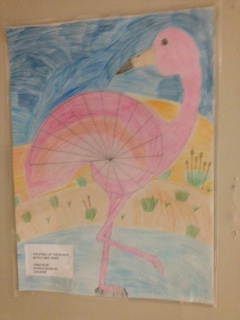
The next poem is a humorous offering titled “X-ray” with two quatrains, each containing one rhyme (Jones/bones; sight/night):

photo (10)

X-Ray

by Joan Horton

“This is your x-ray,”

Said young Doctor Jones.

As he held up a picture

And showed me my bones.

(continued here)
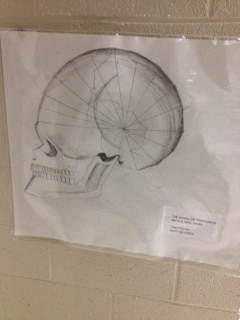
In making these extraordinary drawings, students had to follow a specific pattern for the Spiral of Theodorus:

The spiral is started with an isosceles right triangle, with each leg having unit length. Another right triangle is formed, an automedian right triangle with one leg being the hypotenuse of the prior (with length √2) and the other leg having length of 1; the length of the hypotenuse of this second triangle is √3. The process then repeats; the ith triangle in the sequence is a right triangle with side lengths √i and 1, and with hypotenuse √i + 1.

Screenshot 2014-02-05 09.23.35 (wikipedia)

The original rendering by Theodorus is remarkably like a seashell, so here is an Amy Lowell poem matched with a seashell and its inhabitant, a small hermit crab. This poem has similarities to a Sonnetina Due-a 10 line poem with rhyming couplets. The poem also has a repeated “sing-song” line “Sea Shell, Sea Shell“:

photo (13)

Sea Shell

Amy Lowell

Sea Shell, Sea Shell,
Sing me a song, O Please!
A song of ships, and sailor men,
And parrots, and tropical trees,
Of islands lost in the Spanish Main
Which no man ever may find again,
Of fishes and corals under the waves,
And seahorses stabled in great green caves.
Sea Shell, Sea Shell,
Sing of the things you know so well. 
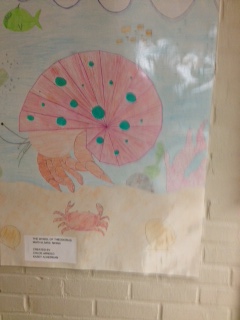
Some of the other drawings are seen here:

Patterns in math meet patterns in poetry, and I am happy to report that no square roots were harmed in this enterprise…Thanks to Ms. Nihan and the 8th grade practitioners of patterns!


Continue Reading…

I planned a “Poetry Passion Smack-down” for Valentine’s Day 2014, but the Nor’easter that roared across the state of Connecticut kept the school shuttered over an extended President’s Day weekend. So, here is a chance for you, the reader, to be in the class and vote.

The plan was to pit 16th Century poet Christopher Marlowe against 21st Century Pop Star Justin Bieber in a “wooing” contest. The question?: Which poem speaks to you?

Each artist tries to persuade his beloved of his desire using the same two arguments:

  1. I’ll buy you anything;
  2. If you agree, we’ll spend lots of time dancing and singing.

Each artist also sounds a bit desperate. Marlowe’s “Passionate Shepherd” escalates his promises, maybe because of her lack of response to each line. His intentions intensify from one quatrain to the next, offering gifts from “beds of roses” to “silver dishes for thy meat.” One wonders, however, how likely such riches would be if one married a shepherd, passionate or not.

Bieber, on the other hand, works the pity angle, pleading that he will be “going down, down, down, down” because his “…first love won’t be around.” To establish the level of his desperation, he drags in his friend and rap artist Ludacris who makes the metaphorical connection between love and a caffeine rush from Starbucks, and who suggests there’s a headache coming from caffeine withdrawal.

But let us allow the poets to entreat their own cases:

First up, Christopher Marlowe making his petition from “The Passionate Shepherd to His Love”:

The Passionate Shepherd to His Love

Come live with me and be my Love,
And we will all the pleasures prove
That hills and valleys, dale and field,
And all the craggy mountains yield.

There will we sit upon the rocks
And see the shepherds feed their flocks,
By shallow rivers, to whose falls
Melodious birds sing madrigals.

There will I make thee beds of roses
And a thousand fragrant posies,
A cap of flowers, and a kirtle
Embroider’d all with leaves of myrtle.

A gown made of the finest wool
Which from our pretty lambs we pull,
Fair linèd slippers for the cold,
With buckles of the purest gold.

A belt of straw and ivy buds
With coral clasps and amber studs:
And if these pleasures may thee move,
Come live with me and be my Love.

Thy silver dishes for thy meat
As precious as the gods do eat,
Shall on an ivory table be
Prepared each day for thee and me.

The shepherd swains shall dance and sing
For thy delight each May-morning:
If these delights thy mind may move,
Then live with me and be my Love.

Next up, The Bieber’s plea, with his catchy refrains that are easily remembered in a song that was the first ever to go 12-times platinum. They may be simple lyrics, but there is no doubting the economic riches that came with this hit:

Baby, Baby

You know you love me, I know you care
Just shout whenever, and I’ll be there
You are my love, you are my heart
And we will never ever ever be apart

Are we an item? Girl, quit playing
We’re just friends, what are you saying?
Say there’s another and look right in my eyes
My first love broke my heart for the first time
And I was like…

Baby, baby, baby oooh
Like baby, baby, baby nooo
Like baby, baby, baby oooh
I thought you’d always be mine (mine)

Baby, baby, baby oooh
Like baby, baby, baby nooo
Like baby, baby, baby oooh
I thought you’d always be mine (mine)

Oh, for you I would have done whatever
And I just can’t believe we ain’t together
And I wanna play it cool, but I’m losin’ you
I’ll buy you anything, I’ll buy you any ring
And I’m in pieces, baby fix me
And just shake me ’til you wake me from this bad dream
I’m going down, down, down, down
And I just can’t believe my first love won’t be around

And I’m like
Baby, baby, baby oooh
Like baby, baby, baby nooo
Like baby, baby, baby oooh
I thought you’d always be mine (mine)

Baby, baby, baby oooh
Like baby, baby, baby nooo
Like baby, baby, baby oooh
I thought you’d always be mine (mine)

[Ludacris:]
Luda! When I was 13, I had my first love,
There was nobody that compared to my baby
And nobody came between us or could ever come above
She had me going crazy, oh, I was star-struck,
She woke me up daily, don’t need no Starbucks.
She made my heart pound, it skipped a beat when I see her in the street and
At school on the playground but I really wanna see her on the weekend.
She knows she got me dazing cause she was so amazing
And now my heart is breaking but I just keep on saying…

Baby, baby, baby oooh
Like baby, baby, baby nooo
Like baby, baby, baby oooh
I thought you’d always be mine (mine)

Baby, baby, baby oooh
Like baby, baby, baby nooo
Like baby, baby, baby oooh
I thought you’d always be mine (mine)

I’m gone (Yeah Yeah Yeah, Yeah Yeah Yeah)
Now I’m all gone (Yeah Yeah Yeah, Yeah Yeah Yeah)
Now I’m all gone (gone, gone, gone…)
I’m gone

To be sure his public understood the lyrics, Bieber shared the message of the song with MTV News, “I’m chasing her around, trying to get her, and she’s kind of playing hard to get, but I’m persistent. I keep going.”

Over four hundred years earlier, Marlowe said much the same; he did not have the advantage of MTV to explain.

Continue Reading…

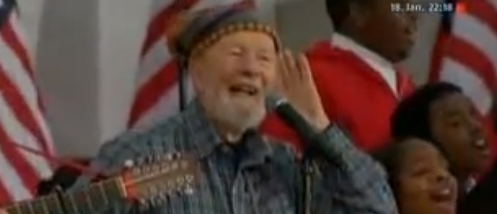
Screenshot 2014-01-31 07.06.53Pete Seeger was a collaborator. Someone acting with others to achieve a goal.

He collaborated in songwriting. The song “Where Have All the Flowers Gone?” was written with Joe Hickerson, “If I Had a Hammer” was written with Lee Hays of the Weavers, and “Turn! Turn! Turn!” was written with a little help from the Old Testament (Ecclesiastics).

He collaborated in performances with other singers: Dylan, Cash, Baez, and frequently with Woody Guthrie. He was a relentless promoter of Guthrie’s music as a tool for social change. His dedication was illustrated in a story told by Bruce Springsteen in a speech at the South By Southwest Festival in 2012. (Read entire speech at SpringsteenKeynoteNPRTranscript)

Springsteen recalled performing with Seeger on the steps of the Lincoln Memorial during the inauguration celebration for President Obama. He recalled the power of singing Guthrie’s “This Land is Your Land” with Seeger that day:

“So four years ago, I found myself in an unusual situation. It was a cold winter day. I was standing alongside of Pete Seeger. It was 25 degrees. Pete had come to Washington. Pete carries a banjo everywhere he goes — the subway, the bus — and comes out in his shirt. I said, “Man, Pete, put on a jacket. It’s freezing out here.” He’s ninety years old — living embodiment of Woody’s legacy.

“There were several hundred thousand of our fellow citizens in front of us. We had the Lincoln Memorial behind us, and a newly-elected president to our right. We were going to sing, “This Land is Your Land” in front of all these Americans. And Pete insisted — he says, “No, we have to sing all the verses. We have to sing all the verses, man. You can’t leave any of them out.”

“I said, ‘I don’t know, Pete.’ We had a crowd of six-year-old school kids behind us. He says, “No, we’re all gonna sing all the verses.” And so we got to it.

At this point in the speech, Springsteen picked up the guitar and began singing: “This Land Is Your Land”

As I was walking I saw a sign there
And on that sign said We’re trespassing
And on the other side It didn’t say nothing.
That side was made For you and me.
This land is your land This land is my land 

He paused to admonish the crowd, “This song is meant to be sung by everybody.” They began to join him:

From California To the New York island
From the Redwood Forest
To the Gulf Stream waters
This land was made for you and me.

Springsteen concluded playing and explained to the crowd:

On that day Pete and myself, and generations of young and old Americans — all colors, religious beliefs — I realized that sometimes things that come from the outside, they make their way in, to become a part of the beating heart of the nation. On that day, when we sung that song, Americans — young and old, black and white, of all religious and political beliefs — were united, for a brief moment, by Woody’s poetry.

Woody’s poetry is American poetry, and Pete Seeger was his American troubadour. Listen:

As a collaborator, Seeger worked with others on many causes: workers’ rights, civil rights, environmental conservation, and world peace. In supporting these causes, he encouraged all others to sing along.
So, here are the words Seeger promoted; the words to Guthrie’s contribution to the American Songbook, the words to “This Land is Your Land.”
Feel free to hum along as you read:

This land is your land, this land is my land
From California to the New York Island
From the Redwood Forest to the Gulf Stream waters
This land was made for you and me.

As I was walking that ribbon of highway
I saw above me that endless skyway
I saw below me that golden valley
This land was made for you and me.

I roamed and I rambled and I followed my footsteps
To the sparkling sands of her diamond deserts
While all around me a voice was sounding
This land was made for you and me.

When the sun came shining, and I was strolling
And the wheat fields waving and the dust clouds rolling
A voice was chanting, As the fog was lifting,
This land was made for you and me.

This land is your land, this land is my land
From California to the New York Island
From the Redwood Forest to the Gulf Stream waters
This land was made for you and me.

Thank you, Pete Seeger, for reminding us to sing about America and to sing ALL the verses.

Continue Reading…

I am seeing patterns.

My recent fascination with looking at crossovers from the Mathematical Practice Standards to the English/ Language Arts classroom has me seeing patterns everywhere. In poetry and in prose, I am seeing applications to the Mathematical Standard #7 where “proficient students look closely to discern a pattern or structure.”

Take, for example, the poem I assigned this morning to the Advanced Placement students. The students are studying how the structure or form of the poem helps to convey the meaning of the poem. The poem under discussion was Elizabeth Bishop’s “Sestina.”

Before reading the poem, however, an understanding of the sestina is in order. This form of poetry is highly structured; 33 lines constructed with five stanzas of six lines each with the final stanza as a tercet. The pattern is in the repetition of the intital six end-words of the first stanza; the last end work in the stanza before becomes the first end word in the following stanza.  The final tercet is called the envoi which contains all of the end-words.

 The form is as follows, where letters represent end-words:

  • Stanza 1: A, B, C, D, E, F
  • Stanza 2: F, A, E, B, D, C
  • Stanza 3: C, F, D, A, B, E
  • Stanza 4: E, C, B, F, A, D
  • Stanza 5: D, E, A, C, F, B
  • Stanza 6: B, D, F, E, C, A
  • Tercet: AB CD EF
    • First line of Envoi: B, E
    • Second line of Envoi: D, C
    • Third line of Envoi: F, A

The pattern above looks to me like sets of algebraic equations, and I mentioned that when I passed out copies of  the sestina by Elizabeth Bishop titled, appropriately enough, “Sestina.”

Listen to the poem:

Sestina

September rain falls on the house.
In the failing light, the old grandmother
sits in the kitchen with the child
beside the Little Marvel Stove,
reading the jokes from the almanac,
laughing and talking to hide her tears.

(READ THE POEM continued…)

animated houseThis poem always reminds me of some small child’s drawing of a house, in which everything suddenly comes to life, to dance or to hover or to fall. These images seem too animated to place under multiple choice microscope I use to prepare students for the Advanced Placement test. But the new semester has begun, and test preparation is necessary, so we took our time studying the questions that had been prepared in dull, unanimated standardized testing rooms.

The grandmother and the child in the poem are portrayed primarily through descriptions of their:
(a) actions
(b) thoughts
(c) conversation
(d) facial expressions
(e) physical characteristics

Reading the question aloud, I was not entirely sure that Bishop would care about the primacy of her descriptions. Given all the action verbs in each stanza, we settled on “(a) actions,” and we were right.

One of the questions dealt directly with the poem’s pattern:

Which of the following literary devices most significantly contributes to the unity
of the poem?
(a) Use of internal rhyme
(b) Use of epigrammatic expressions
(c) Use of alliteration
(d) Repetition of key words
(e) Repetition of syntactic patterns

A discussion of what syntactical patterns appeared ensued.
“There is dialogue,” one said.
“But, not as a pattern,” another replied.
We settled on (c) repetition of keywords, and we were right. Recognizing the pattern was helping with the questions.

 “There’s a lot of crying in this poem,” remarked a student, “What are ‘equinoctial tears’?”

I explained that knowing what “equinoctial” means, a violent storm of wind and rain occurring at or near the time of the equinox, is important to the understanding of the poem. Bishop’s association of tears with “equinoctial” suggests that there is some emotional storm that is the result of an annual event or anniversary. Once the students knew that, they were able to answer the last question:

 The mood of the poem is best described as
(a) satiric
(b) suspenseful
(c) reproachful
(d) mournful
(e) quizzical

“The repetition of words means there is more emphasis on them,” said a student.
“All that crying,” agreed another student, “Someone must have died.”
We decided on (d) mournful, and again we were right.

In the end, students got about 60% of the questions right on the poem, a high score this early in their practice. They had employed both the Mathematical Practice standard #7 and “looked closely to discern a pattern or structure” as well as the English Language Arts Literacy Anchor Standard #1, “Read closely to determine what the text says explicitly and to make logical inferences from it; cite specific textual evidence when writing or speaking to support conclusions drawn from the text.” 

“I liked it,” said a student, as she left.
I know she did not mean the multiple choice questions.
I am sure she meant the poem,“Sestina,” a crossover between English and mathematical practice standards.

A poem with a pattern:

Screenshot 2014-01-24 17.02.08 

Poetry Friday hosted this week by Tara at:http://ateachinglifedotcom.wordpress.com/

Come join her!

The villanelle is a nineteen-line poem with two repeating rhymes and two refrains. The form originated in France in the late 1800s, and the structure is comprised of five tercets followed by a quatrain. The most famous villanelle is by the Welsh poet Dylan Thomas, “Do Not Go Gentle into That Good Night.”

Do not go gentle into that good night, 

Do not go gentle into that good night,
Old age should burn and rave at close of day;
Rage, rage against the dying of the light.

Though wise men at their end know dark is right,
Because their words had forked no lightning they
Do not go gentle into that good night.

Good men, the last wave by, crying how bright
Their frail deeds might have danced in a green bay,
Rage, rage against the dying of the light.

Wild men who caught and sang the sun in flight,
And learn, too late, they grieved it on its way,
Do not go gentle into that good night.

Grave men, near death, who see with blinding sight
Blind eyes could blaze like meteors and be gay,
Rage, rage against the dying of the light.

And you, my father, there on the sad height,
Curse, bless, me now with your fierce tears, I pray.
Do not go gentle into that good night.
Rage, rage against the dying of the light.

I recently taught this poem to a class of Advanced Placement English Literature seniors who after some discussion were able to determine audience (“And you, my father..”), the form of address (imperative “Do not go“) and the poem’s paradox (“Curse, bless, me now“). They were intrigued by the most striking element of the poem, the repetition of the lines “Do not go gentle into that good night” (1, 6, 12, 18) and “Rage, rage against the dying of the light” (lines 3, 5,15,19). The ferocity of Thomas’s repeated exhortations increase because of the structure of the villanelle.

Structure matters. Structure, that “fundamental, tangible or intangible notion referring to the recognition, observation, nature, and permanence of patterns and relationships of entities” is not limited to poetry. Structure is in all the arts, and in all the sciences.

Structure matters in mathematics. Common Core Mathematic Practice Standard #7 requires students to:

Look for and make use of structure.

This standard details that “proficient students look closely to discern a pattern or structure,” and suggests, “young students, for example, might notice that three and seven more is the same amount as seven and three more.” Promoting this practice standard beyond the math classroom will have students noticing structure in other classes in every grade level. Students will be better equipped to recognize and use the structure of the periodic table or the color spectrum; they will be be prepared to identify and to employ patterns in pronouncing vowels and consonants. Students will be empowered to discover coordinates in longitude and latitude or to categorize the ingredients in food groups.

Recognizing and using structure is the critical academic skill that can help a student unravel both a problem in geometry or the complexity of a poetic structure like the villanelle. Once they understand the structure, they can evaluate the poet’s purposeful choice such as the one made by Dylan Thomas who selected the villanelle for this powerful poem.

The Common Core’s Mathematic Practice Standard #7 is in math and poetry. Note the same letters MP? Pattern? PossiblyCoincidence? Maybe not!

Continue Reading…

Best two words in winter? “Snow Day”.

Yes. I will look back in mid-June and see the extension of school days to meet mandatory requirements, and I will sigh. I  might question the wisdom of school administrators who would keep students cooped up in classrooms on warm sunny summer afternoons, but even then I will still admit, I love a snow day.

snowremovalThe outside lights were on all night so I could check on the progress of snow mounting on the barn roof. I could hear the town’s plows, chained tires rattling, working throughout the night. My eyeglasses were handy so that I could grab them and read the small print of scrolling school closings on the TV screen, but this morning I did not need them since my school district thoughtfully sent a robo-call.

I am not surprised that one of my favorite poets, Billy Collins, has a poem titled “Snow Day” where he expresses his appreciation of weather-induced holidays. In stanzas 4-6, he mimics the listings of school closings on the radio:

But for now I am a willing prisoner in this house,
a sympathizer with the anarchic cause of snow.
I will make a pot of tea
and listen to the plastic radio on the counter,
as glad as anyone to hear the news
that the Kiddie Corner School is closed,
the Ding-Dong School, closed.
the All Aboard Children’s School, closed,
the Hi-Ho Nursery School, closed,
along with—some will be delighted to hear—
the Toadstool School, the Little School,
Little Sparrows Nursery School,
Little Stars Pre-School, Peas-and-Carrots Day School
the Tom Thumb Child Center, all closed,
and—clap your hands—the Peanuts Play School.
                    …read more from “Snow Day”
Sailing Alone Around the Room: New and Selected Poems (New York: Random House, 2001).

I have written about Collins’s poetry (see links below) several times in this blog for Poetry Friday. His lyrics run parallel to my experiences of growing up, so there is a sense of nostalgia, a familiarity, when I read his poems. His poetry is accessible to all grade levels, but it is his wry humor in his observations on the universal human experience that makes me want to share him with students. So much of literature can be serious, or downright depressing, that I am grateful, even a little giddy, to have several books of Collins’s poetry on my shelf ready for an opportune moment.

“Look,” I will say, “here’s a funny poem about Emily Dickinson!” or “Hey, want me to read a comic take on the elements of a sonnet?

This snow day is one more excuse to share Collins’s poetry with others- whatever the climate. And for just a day, I can pity those in those waking up in sunny Southern California who are going to school. They may have the warm sun on their toes sticking out of their sandals, but they will never know the pleasure of warm toes stretching out under warm blankets just as there is the announcement of a school cancellation….to roll over…and to hit the snooze button.

Sleep in. It’s a snow day.

Continue Reading…

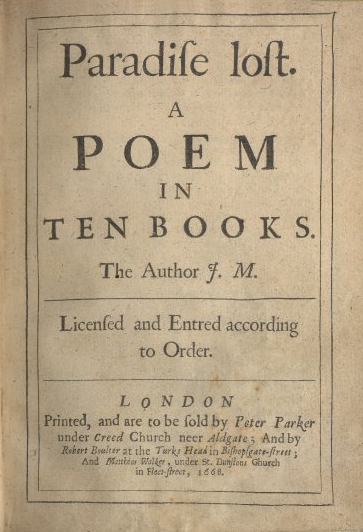
No sooner are essays on Mary Shelley’s Frankenstein handed in, then the copies of Paradise Lost are handed out to the Advanced Placement English Literature Students. Yes, there are over 10,000 lines of blank verse in the poem, but don’t shudder for them…they will be fine. This epic poem is a trip to the “dark side” like no other in literature. All it takes is a reading of Book One; a reading that says “Welcome to Hell”!

The connection is obvious. In her novel, Shelley has Frankenstein’s Monster explain how he gained his knowledge, not with the help of his “father”, but instead by reading several books while he hid from humanity. One of the books in his possession was the epic poem Paradise Lost. When the Monster finally confronts his creator, Victor Frankenstein, on a mountain glacier on Mount Montanvert, the Monster dramatically intones:

“I ought to be thy Adam, but I am rather the fallen angel, whom thou drivest from joy for no misdeed.”

Originally published as 10 books, Milton expanded the epic poem to 12 books in later printings.

Originally published as 10 books, Milton expanded the epic poem to 12 books in later printings.

The “fallen angel” the Monster references is a hero/anti-hero of Paradise Lost: Satan, aka Lucifer, aka the  “infernal serpent”, aka the ‘Arch-fiend’ (and a myriad of other Miltonic epithets).

Students in previous classes have always found Satan the most memorable character in this epic poem since he is given the most memorable lines. They have been particularly intrigued that John Milton’s purpose in writing the poem, “to justify the ways of God to man,” is soon drowned out by the creation of Pandemonium (Hell’s Seat).  From the moment in Book One of Paradise Lost when Satan frees himself from the adamantine chains that bind him to a burning lake, students are taken with his attitude and his defiance as read in his great challenge:

Here at least
we shall be free; the Almighty hath not built
Here for his envy, will not drive us hence:
Here we may reign secure, and in my choice
to reign is worth ambition though in Hell:
Better to reign in Hell, than serve in Heaven. (PL 1 258-263)

No matter that in Book Six’s battle scenes in heaven are an exercise in futility, known as  the “great pie fight in the sky”, students root for the former archangel. They understand the sentiment in his statement,

‘The mind is its own place, and in itself can make a heaven of hell, a hell of heaven…” (PL 211-214).

Paradise Lost was only one of Milton’s great contributions to literature. He was not only a brilliant poet, but he was also a powerful statesman and a Puritan. He became associated with the Puritan partisanship in Parliament, which was credited with banning Christmas in England in 1644. This would seem to be a contradiction since he was already known for the beautiful Christmas Ode, “On the Morning of Christs Nativity Compos’d 1629”. Perhaps it was the general Puritan aversion to Christmas carols that could be blamed for such a heinous act!.

His political career experienced the extreme highs of an appointment as Secretary for Foreign Tongues (1648) and his association with Oliver Cromwell in the execution of Charles I (1649). In contrast there were the lows of an imposed exile upon the return of Charles II and the arrival of the Restoration in 1660. One of the reasons he was not executed for his implicit participation in Charles I’s regicide was that he was struck blind in 1654, and there were many who argued that this blindness was punishment enough. Milton was used to pain and suffering as the deaths of his first and second wives and several children were tragic interludes throughout his life.

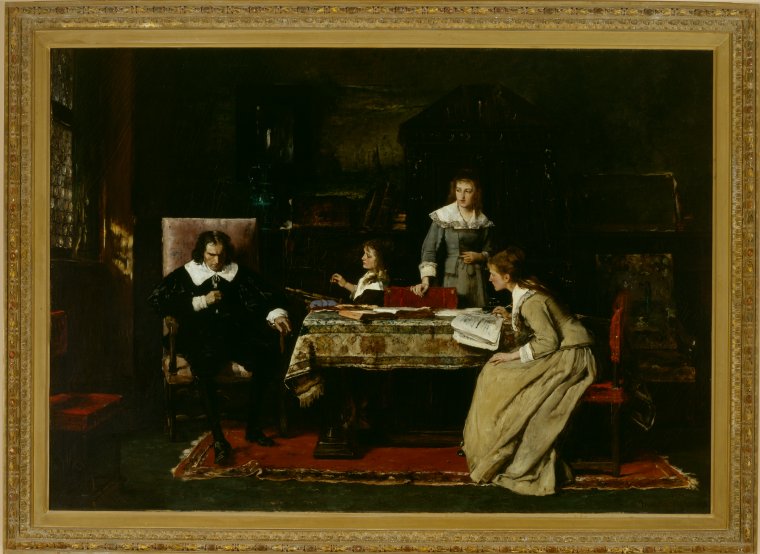
Like another blind poet, Homer, Milton achieved greatness with an “inner sight”. Critics generally agree that his best poetry came after he became blind and dictated all the lines of verse to his remaining daughters. A painting by Mihály Munkácsy (1877) hangs in the New York Public Library (NYPL) and depicts a scene of a head-bowed Milton reciting to one daughter who is scribing lines into a book.

Milton & daughtersThe picture is an apt illustration for his opening thesis in Paradise Lost:

What in me is dark
Illumine, what is low raise and support;
That to the height of this great argument
I may assert eternal Providence,
And justify the ways of God to men. (PL I:18-22)

In 2008, the NYPL held an exhibition, “John Milton at 400: ‘A Life Beyond Life'” which featured illustrated etchings by Gustave Doré for Paradise Lost. One illustration was of Satan on his flight to the Garden of Eden. As he travels, Satan pauses to tell the Sun how conflicted he is over his fallen state:

O Sun, to tell thee how I hate thy beams
That bring to my remembrance from what state
I fell, how glorious once above thy Spheare;
Till Pride and worse Ambition threw me down
Warring in Heav’n against Heav’ns matchless King:
Ah wherefore! he deservd no such return
From me, whom he created what I was
In that bright eminence, and with his good
Upbraided none; nor was his service hard. (PL IV:37-41)

Speaking these lines is a tragic Satan, fully aware that he has brought himself to ruin, as told by a poet, who had also come to political ruin. The reader can sympathize with such a character, and isn’t that the role of great literature? To draw on the reader’s empathy?

By the end of the poem, however, Milton restores the balance of sympathy towards Adam and Eve. They walk bravely, hand-in-hand, out of the Garden, into the sunset, ready to begin “his-story”.  In contrast, the character of Satan is reduced to a hollow hero, receiving accolades from a hissing mob of demi-devils. He is cursed, and like the Monster in Frankenstein, he is unreconciled with his creator.

So happy Birthday, John Milton, (December 9th), but let us not forget, that while your character Satan may dwell in evil, it was you who helped to cancel Christmas!

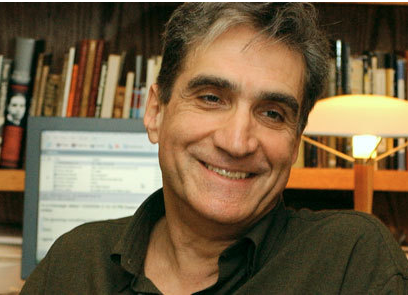
Screen Shot 2013-12-05 at 11.08.36 PMThe sonorous voice delivering the keynote address at the Conference on English Leadership (CEL) on Sunday, November 24, 2013, belonged to the poet Robert Pinsky. He was there to promote his latest book Singing School, which is promoted as, “A bold new approach to writing (and reading) poetry based on great poetry of the past.” This collection of 80 poems includes selections from  Sappho to Allen Ginsberg, Shakespeare to Emily Dickinson. In an interview on NPR,  Pinsky explained that the poems for the book were selected “because of the music of the language, and not from the meaning of the words.” In the interview he explained:

“Even just the cadence of pauses,” he explains. “I stop. I think. I wait. I wait a little longer. Then less. … Something like that generates the poem. And for me, if anything I do is any good, it’s carried by that kind of cadence or melody.”

To prove his point, Pinsky filled his address with reciting lines of poetry, once challenging the crowd of English teachers in attendance to identify the poet; “That was Robert Frost, your New England poet,” he gently chastised when no one responded correctly. (To give you a taste of the experience, you can hear Pinskey read Frost’s poem “Mowing” courtesy of Slate Magazine by clicking here.)

As we listened, I heard someone remark that Pinsky could make a parking ticket sound lyrical.

Screen Shot 2013-11-29 at 2.27.16 PM

Pinsky’s voice was not the only one reciting poems in his keynote. He turned to the presentation screen to show videos from the Favorite Poem Project website. This project  is “dedicated to celebrating, documenting and encouraging poetry’s role in Americans’ lives.”

Pinsky founded the project when he served as the 39th Poet Laureate of the United States, from 1997-2000. The Favorite Poem Project website details how,

“During the one-year open call for submissions, 18,000 Americans wrote to the project volunteering to share their favorite poems — Americans from ages 5 to 97, from every state, of diverse occupations, kinds of education and backgrounds.

Pinsky purposely selected a video to show as a tribute to the City of Boston, host of the CEL. The selected video featured John Ulrich, a student from South Boston, MA, reading Gwendolyn Brooks’s  “We Real Cool”:

We Real Cool
by Gwendolyn Brooks

THE POOL PLAYERS.
SEVEN AT THE GOLDEN SHOVEL.

We real cool. We
Left school. We

Lurk late. We
Strike straight. We

Sing sin. We
Thin gin. We

Jazz June. We
Die soon.

Each video available on the Favorite Poem Project’s website begins with the reader’s reason for choosing the a particular poem. Ulrich provided a touching admission of how Brooks’s short poem reminds him about several childhood friends he lost to suicide. He read her 1950s tribute to the players in a pool hall in the South Side of Chicago with a heavy South Boston accent twice. The defiance on his face during the second reading is visible in the video.

I have taught this poem in my classes, and inevitably one of the more musical students, usually a drummer, will notice, “Hey, this is written in jazz!” The brevity of Brooks’s verse belies the amount of discussion the poem generates for students, particularly with the ending line, “We/ Die soon.”

Pinsky shared other videos: Nick and the Candlestick by Sylvia Plath read by Seph Rodney and Poem by Frank O’Hara read by Richard Samuel. The production quality of these videos garnered admiration from the crowd.

“Are you still taking entries for this project?” one teacher asked.
“We may be,” replied Pinsky.

His final comment sent a ripple that went through the audience as people considered, “What poem could I read for the project?”

Continue Reading…

We have been discussing loss a great deal in English class. In order to begin our  study of King Lear, students had to create lists of their 10 favorite things while I played the song “My Favorite Things” from The Sound of Music. After they made their lists, I  had them “lose” -one at a time- an item off the list.

“Cross off #7,” I announced with great seriousness.
There were immediate groans from students.
“That’s Starbucks!” one whined.
“My truck!” claimed another, “How will I drive?”
“Cross off #3,” I called out.
More protestations. More groans.
“No way I am crossing off my dog,” another retorted.

Soon, their lists were down to two items each. They stirred uncomfortably; they were unsettled by the mere thought of being separated from things or people they valued.

“Maybe I value my stuff over people too much,” mused one thoughtfully looking over her list.

In this short exercise, my students conveyed some of the same sentiments that are expressed in Elizabeth Bishop’s poem “One Art”:

One Art

by Elizabeth Bishop

The art of losing isn’t hard to master;
so many things seem filled with the intent
to be lost that their loss is no disaster,

Lose something every day. Accept the fluster
of lost door keys, the hour badly spent.
The art of losing isn’t hard to master. (continued…)

My students were struck by the repetition of the words “master” and “disaster” in the poem, a result of the villanelle* (see below) format. They noted the progression of items lost in the poem: the car keys, the watch, the houses, the cities, rivers, and finally, the loss of continents.

They noted the choice of hyphens and parentheses in the poem. The hyphen at the beginning of the final stanza was a “hesitation” according to one student, “because she doesn’t even want to write the last stanza.”

“How do you know?” I asked.

“Because she has to command herself,” the student replied, “See the parentheses and the words ‘(Write it!)’ on the last line?”

“Why? What is she losing in the last stanza?” I asked. They called out their ideas:
“Love.”
“You.”
“Her life…”

“So is the art of losing hard to master or not?” I asked them. They thought, and wrote the following in their notebooks:

  • “No one wants to  master losing things…who wants to be a loser, literally?”
  • “She is taking about the loss of physical objects in comparison to the loss of people, and no one wants to lose people…like a friend or lover.”
  • “The speaker is rushing towards the end, speaking faster with ‘shan’t’ and ‘losing’s’ as if things are slipping away, and out of control, until she writes down the losses….and commits them to memory.”
  • “She is trying to convince herself.”

Elizabeth Bishop’s poem brought my class back to the many themes we had been discussing in our unit on King Lear. We had spent several classes focused on the tragedy of a king who in dividing his kingdom, upends the order of the realm. In the process, he loses his daughters, his knights (protectors), his friends, his mind, and finally, his life. The students concluded that Lear was no “master of disaster.”

“Pretty cool that 19 lines can say almost the same thing as Shakespeare’s five act play,” concluded one student as he wrapped up his books  to leave.

Pretty cool, Elizabeth Bishop.

*villanelle: The villanelle has 19 lines, 5 stanzas of three lines and 1 stanza of four lines with two rhymes and two refrains. The 1st, then the 3rd lines alternate as the last lines of stanzas 2, 3, and 4, and then stanza 5 (the end) as a couplet. It is usually written in tetrameter (4 feet) or pentameter.

The rain set early in to-night,
The sullen wind was soon awake,
It tore the elm-tops down for spite,
And did its worst to vex the lake:

In other words, “It was a dark and stormy night.” Thus begins the poet’s Robert Browning’s dark and disturbing dramatic monologue, Porphyria’s Lover, a portrait of a madman that is wonderful to read with students around Halloween. I usually use an audio recording that I can play, and I pause the recording twice as we listen.

The unnamed narrator of the poem sits in a cold cabin, a rendezvous with his lover, Porphyria, who “glides in” as she

…shut the cold out and the storm,
And kneeled and made the cheerless grate
Blaze up, and all the cottage warm;

The narrator’s isolation in the gloomy setting takes on the tone of an illicit romance as Porphyria removes her wet clothing in order to

… let the damp hair fall,
And, last, she sat down by my side
And called me.

But when the recalcitrant narrator does not respond, Porphyria increases her ardent attentions

She put my arm about her waist,
And made her smooth white shoulder bare
And all her yellow hair displaced,
And, stooping, made my cheek lie there,
And spread, o’er all, her yellow hair,
Murmuring how she loved me-

Porphyria’s devotion to the narrator is extreme, expressed in his words “passion”  and “worshipped.” He acknowledges that she could “give herself to me forever” even as she had “come through wind and rain” for this meeting.  This “surprise”

Made my heart swell, and still it grew
While I debated what to do.
That moment she was mine, mine, fair,
Perfectly pure and good:

The narrator revels in this epiphany; Porphyria’s devotion is at its zenith. His reaction seems predictable to my students, and they eagerly anticipate  the romantic tumble they have expected since Porphyria entered the cabin. After all, the word “lover” is in the title.

Yet, the next five lines take a decidedly different turn. The narrator dispassionately admits,

…I found
A thing to do, and all her hair
In one long yellow string I wound
Three times her little throat around,
And strangled her.

Here is where I pause the recording as my students take a moment to comprehend what they have read. Their reactions generally follow this script:

“Wait a minute!”
“What did he do?”
“He ...killed her?”
What is going on here?”

I direct them back to the poem so they can hear the voice of the narrator explain his actions, and his explanation is chilling. “No pain felt she;” the narrator continues, as if to assure my students, “I am quite sure she felt no pain.” As if to prove his judgment, he opens her closed eyes, loosens the hair from her throat, and places a “burning kiss” upon her cheek. Again, the students react in shock:

“This guy is sick!”
“He KISSED her??”
“Ewwww…”
“Why did he do it?”

Why did he do it indeed? The narrator calmly continues to explain his reasons as Porphyria’s head, limp and lifeless, leans upon his shoulder,

The smiling rosy little head,
So glad it has its utmost will,
That all it scorned at once is fled,
And I, its love, am gained instead!

The narrator’s twisted logic in claiming Porphyria’s life in a moment of pure love is so perverse that students are horrified. The final shocker comes as the narrator confidently claims that the murder of Porphyria was something desirable,

Her darling one wish would be heard.
And thus we sit together now,
And all night long we have not stirred,
And yet God has not said a word! –

“He’s a monster.”
“He’s crazy.”
“He is insane.”

Browning’s poem that chronicles a deadly obsession is an excellent addition to the Halloween literary repertoire. The high interest monologue engages students in the “close reading” required by the Common Core.

A close reading can be accomplished by dividing the poem into sections and asking students to identify if the line can be placed into categories:

  • establishing setting
  • poetic technique (metaphor, personification)
  • character development
hair-piece-ponytail-with-draw-string-613-bleach-blonde-longer-length-ponytail-20-inches--401-p

Blonde hair!

Students are encouraged to make adjustments based on their group discussions or to create their own categories.  Once they have categorized the lines, they create large posters that “illustrate” the lines literally or symbolically. They draw or use images that they find online or use photos; then they share the posters which are hung around the room and explain how these details serve the author’s purpose in creating an unforgettable character who is a madman.

Come this Halloween, if you are looking for a poem to send shivers down the spines of your students, try Robert Browning’s “Porphyria’s Lover”.

Try not to think that this frightening portrayal of insanity was created by the husband of Elizabeth Barrett Browning, famous for the poem “How Do I Love Thee? Let Me Count the Ways.”

You can save that sonnet for Valentine’s Day!