Archives For November 30, 1999

Twelve years ago, I was teaching my Advanced Placement English class when word came that a plane had crashed into one of the Twin Towers in New York City. Several hours later, all classes were abandoned in the high school. A line of students formed in the office in order to call and know if family members who worked in NYC were okay.  Our school media specialist hooked up televisions around the walls of the library, and students sat on the floor in the middle; everyone was silent and somber. Teachers and students mingled together, some with arms around each other, watching the catastrophic events on that beautiful September morning when the blue skies belied the carnage happening less than 100 miles away.

In December that year, I took those same AP students to see Othello performed at The Public Theatre in downtown NYC. We arrived early enough, so I suggested to the other chaperones that we have the bus take us down to Ground Zero. We reasoned that students should have a chance to witness history.

We travelled downtown, past the business-as-usual activity of stores and heavy traffic. We turned down a side street when the “shroud” suddenly came into view. The mangled frame was eerily illuminated, bending over the dust created by the workers who were working late into the night dismantling the remaining structures of the two buildings. We got off the bus and walked along the chain link fences that were covered with sheets and banners bearing the names of those killed and the sentiments of others who had come down to witness the aftermath.

A policeman approached us. I stepped out to explain our presence, but he turned to the students and asked, “Are you here to sing for us?”
The students stood dumbfounded. Finally, one choked out a sincere response, “No, but we will if you want us to.”
He hugged her with his big arms. “It’s ok, honey,” he smiled sadly, “just coming here is enough.”
There was no question that Shakespeare’s tragedy took a backseat that night.

This year’s graduating class of high school seniors is the last class that experienced 9/11 while in school. They are members of the last class that shared their emotions with teachers who struggled that day to explain the unexplainable. They were in kindergarten that fall. Chances are they had no idea what was happening except that their teachers may have been agitated, emotional, or distracted that day. Throughout the school year, they may have asked their teachers questions about what happened. In all likelihood, their teachers struggled with prepared responses.

The events of 9/11 have been etched indelibly in the hearts and minds of teachers and students who shared that experience. Now, that last group is graduating school. In the future, students will learn about the events of that day in schools in various classes and through a variety of mediums, but they will not be able to say, “I remember, I was in school when…”.

One way they will learn about the impact of 9/11 is through poetry, and there are many poems written from different perspectives. Billy Collins’s poem “The Names” captures the loss of 2,763 individuals in the Twin Towers by using the names of 26, one for each letter of the alphabet, with the exception of the letter X -“(let X stand, if it can, for the ones unfound)”.

Television’s PBS invited Collins to read “The Names” on a broadcast September 12, 2012. The video and full text of the poem are on the PBS website.

BILLY COLLINS, poet (speaking): “The Names,” for the victims of September 11th and their survivors.

Yesterday, I lay awake in the palm of the night.

A soft rain stole in, unhelped by any breeze,

And when I saw the silver glaze on the windows,

I started with A, with Ackerman, as it happened,

Then Baxter and Calabro,

Davis and Eberling, names falling into place

As droplets fell through the dark. (continued on Billy Collins’s website)

This graduating Class of 2014 is the last where teachers and students were together when the world changed. The images and the aftermath were part of their school experience in 2001. Together, they learned the fate of so many, as Collins says,

Names wheeled into the dim warehouse of memory.

So many names, there is barely room on the walls of the heart.

Continue Reading…

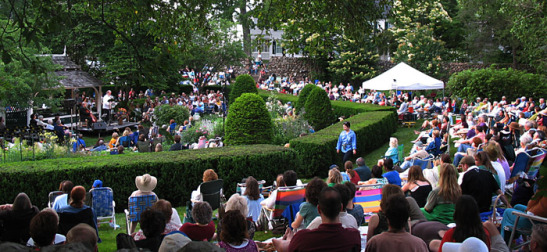
festival-crowd-cynthia-cagenello-cropped-copy

Photo on Sunken Garden Poetry website: http://sunkengardenpoetry.org/

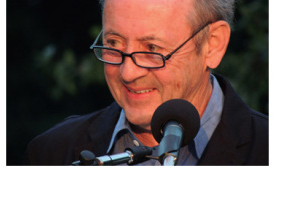
Last Wednesday night, the rain held off for Sunken Garden Poetry at Hill-Stead Museum in Farmington, Connecticut, and the largest crowd of the year heard the former United States Poet Laureate (2001–2003) Billy Collins read his poetry for a little more than an hour. His casual demeanor and the context of the garden setting, peopled with picnickers, contributed to a informal, intimate listening experience, a tone he tries to strike with his poetry:

 “I have one reader in mind, someone who is in the room with me, and who I’m talking to, and I want to make sure I don’t talk too fast, or too glibly. Usually I try to create a hospitable tone at the beginning of a poem. Stepping from the title to the first lines is like stepping into a canoe. A lot of things can go wrong.” (http://www.poetryfoundation.org/bio/billy-collins)

Based on the reaction from the crowd, his concerns about a wrong step was unfounded. Since most of his poems are fairly short, he was able to offer a broad range of topics and observations. There were mice, glistening bars of soap, ill-fitting dinner jackets, a few “frog-less” haikus, and commentaries on adolescent behavior. Screen Shot 2013-08-09 at 2.57.00 PM

He began the reading with You Reader:

I wonder how you are going to feel
when you find out
that I wrote this instead of you

He followed that up with the hilarious Another Reason Why I Don’t Keep a Gun in the House where the opening line explains “another reason why”…

The neighbors’ dog will not stop barking.

Over the course of the evening, Collins read his poems to the appreciative audience. His themes ranged from comical to heartbreaking. You can click the following links to the published texts or video recordings in the order he read them to “attend” your own Billy Collin’s reading:

The Sand Hill Cranes of Nebraska
Drinking Alone after Li Po
Cheerios
After the Funeral (p. 62)
Orient
Dress Code (pg.19)
To My Favorite 17-year-old High School Girl
The Dog on His Master and The Reverent
Oh My God (audio poor)
Divorce
Flock (poem read in interview)
Hippos on Holiday
Aimless Love
The Lanyard
Japan
I Chop Some Parsley While Listening To Art Blakey’s Version Of “Three Blind Mice”
Forgetfulness
The Dead
Aristotle
Nightclub

Collins delivered each of his poems in his conversational tone- dry, wry, and understated. Leaving the poetry reading, I could not help but start to “think” in Collins’s cadence. Later that evening, my thoughts matched his tempo:

I had heard the poet at a reading once before,
when he read the blind mice poem that made me laugh.

I bought the book Sailing Alone Around the Room
and found inside the poems Sonnet and Aristotle that I now use
with my Advanced Placement students, but I do not teach
Taking Off Emily Dickenson’s Clothes.

They do not appreciate the Belle of Amherst the way Billy and I do.

 and

The standing ovation
became a mass migration,
some to their cars and some to the table
where the poet scrawled his signature
repeatedly into book after book after book.

Later when I crushed my bedroom pillow
up to the headboard, I wondered
if he was still held hostage to his adoring fans?

Sunken Garden Poetry should be commended for organizing a memorable summer evening. This coming winter, I suspect that a number of those who attended will turn to a companion, and quote Billy Collins and say, “Too bad you couldn’t have been here six months ago.”

Poetry Friday: Invictus

July 19, 2013 — 4 Comments

The film Invictus tells the story of how in 1995 Nelson Mandela enlisted the help of South Africa’s National Rugby team in order to unite the country and end prejudices associated with Apartheid. The film stars Morgan Freeman as Mandela and Matt Damon as South African rugby star Francois Pienaar, but this is more than a sports film. One mise-en-scene features a visit to the real Robben’s Island Prison, where Mandela was held as a political prisoner for 27 years.

The film footage shows the cell where Mandela served his sentence before his release in February 1990. As the camera pans around the prison, the voice of Freeman recites William Ernest Henley’s poem Invictus

Out of the night that covers me,
Black as the Pit from pole to pole,
I thank whatever gods may be
For my unconquerable soul.

In the fell clutch of circumstance
I have not winced nor cried aloud.
Under the bludgeonings of chance
My head is bloody, but unbowed.

Beyond this place of wrath and tears
Looms but the Horror of the shade,
And yet the menace of the years
Finds, and shall find, me unafraid.

It matters not how strait the gate,
How charged with punishments the scroll.
I am the master of my fate:
I am the captain of my soul.

I am familiar enough with the poem that I do not need to look it up or “cut and paste” the text.
I can recite this poem cold.
So can the grade 12 seniors at Brookfield High School in CT (my tenure 1999-2008) who traditionally memorized the poem and recited its 16 lines for an English grade.

The “Invictus Day” tradition was begun to honor an English teacher who had passed away; the tradition was sustained by her colleague, Carole Smith, who would prepare “Invictus” sheets for students to carry with them to practice. A rubric was on the back that provided selected teachers a rubric to grade the quality of the recitation: A for a spectacular recitation (with feeling; no errors); B for a good recitation (one error allowed); C for an average recitation (errors allowed). A student had only one shot for an A; a teacher would sign off on the quality, but if there was a single flub, the highest grade that could be achieved was a B. Fortunately, the weight of the “Invictus” grade was nominal, however, the honor of getting an A for recitation was an achievement regardless of weight.

“Invictus Day” was an unannounced event held usually in late October or early November. Members of the faculty wore black, and seniors went scurrying to their lockers for their sheets. In Harry Potter-esque fashion, teachers would point at a senior with a finger and command, “INVICTUS”! The senior would be required to drop everything, hand over the sheet, and begin reciting, “Out of the night that covers me…”

There was a great deal of cowering, creeping, lurking,  prowling, skulking, and stalking on “Invictus Day”…on the part of both students and faculty. Some students took full advantage of the dramatic encounters by shouting the poem at the top of their lungs or climbing on tables or desks to recite for a crowd of delighted underclassmen. Others clung together to recite chorally, while the more timid seniors were given the opportunity to pull a teacher aside to recite and “get this over with!” Every year, a student would sing the poem to a familiar tune; one year, a student had a completely original melody with back-up singers. Once a student was graded, or “invicted”, he or she could show the sheet as a pass. Once invicted, a student could not be forced to recite again.

My favorite story of “Invictus Day” was of a one student who advertised his plans for presenting the poem. He prepared to recite the poem holding a heavy plaster skull, a la Hamlet. Hearing this, I convinced the members of the faculty not to invict him. The idea that he would carry the skull for several days was amusing to the faculty and to the student body. November came and went, and so did December and January. By late March, the student was pleading for someone to “invict me” so that he could rid himself of the skull he had been toting for months. Fortunately, he had been cast as a lead in the school musical. One warm April night, at the end of the final night’s production, he ran forward to take his well-deserved bow. As he stood up, I stepped out from the wings and onto the stage and cried, “Invictus!” There was a split second of shock in his eyes, but he bounded backstage and seconds later reappeared with the skull to recite the poem to a full house. There was a standing ovation; his performance for both the musical and the poem deserved the audience’s applause.

The obvious message of the poem is the control of one’s fate, and that makes the poem perfectly suited for seniors who will be steering their own destinies once they graduate. They may go to colleges, training schools, the military, or they make seek their futures in other pursuits, but who they will be after the thirteen years of mandated education is largely up to them. Holding the poem’s message in their heads, and in their hearts, can serve to guide them through rough waters of adulthood.

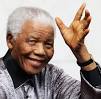
Mandela The same could be said for the use of the poem in the film Invictus. Four years after his release from his 27 years in Robben Island’s prison, Nelson Mandela was elected president of South Africa. He had made great sacrifices in bringing the horrors of Apartheid to an end, but his belief in a united South Africa had prevailed.

This past Thursday, July 18, 2013, Mandela turned 95 years old.

Happy Birthday, Mr. Mandela, your life story is affirmation of Henley’s message:

I am the master of my fate:
I am the captain of my soul.

“Want to know the shortest poem in the world?” I asked my Advanced Placement students when they were overwhelmed with the epic poem Paradise Lost by John Milton. I wanted to use a related poem to demonstrate a close reading, one of the skills students should have in according to the Common Core Standards for English/Language Arts, but they needed a little fun.

“It’s called Fleas.”

I wrote the poem on the board:

Fleas

Adam
had’em

That’s it. Three words…actually two if you consider the contraction “had’em” as one word.

The poem attribution is generally given to Ogden Nash (1902-1971) although there are some who credit Shel Silverstein (1931-1999). An article by Eric Shackle, however, found the originator of the poem was Strickland Gillilan (1869-1954). The article notes:

“At last, after searching dozens of websites, we discovered the identity of the mystery poet. It was revealed on a US National Park Service website describing Mount Rainer National Park, in west-central Washington state. The Mt Rainier Nature News Notes of July 1, 1927 contained this brief item, tucked away as an end-of-column filler:

‘THE SHORTEST POEM
We like poetry but we cannot stand it in too large doses. The following, which according to its author, Strickland Gillilan, is the shortest poem existing, deals with the antiquity of “bugs”. It runs thus: Adam had em!'”

Authorship clarified, I asked my students, “So, what could you write about this poem?”

They stared at me. Surely I was joking…what kind of discussion or essay could a poem of this length generate?

After several minutes, however, here is what they came up with structurally:

  • iambic (duet?)
  • rhyming couplet
  • rhyme (am/em)
  • perfect internal rhyme (ad)
  • there is contraction
  • no punctuation
  • uneven number of letters; shorter first line

Here is what they came up on the topic of fleas:

    • Scientists have discovered that fleas probably fed on dinosaurs
    • Fleas feed on warm vertebrates’ blood
    • Fleas need Adam; Adam does not need fleas

Here is what they came up with figuratively:

  • the name in the first line establishes context
  • literary allusion: Adam from the Bible, the first man in literature
  • Eve was not mentioned, so the setting may be earlier than Genesis 2:20
  • the tone is casual and comical
  • the mood is humorous
  • Adam has fleas; the fleas don’t have Adam
  • the title is critical to the understanding of the message

Unanswered questions they had on the poem:

  • Could there have ever been just one flea?
  • Does Adam bathe?
  • Is the past tense verb “had” mean that he has cleaned up his act?

adam

Their conclusion?

  • Close reading three words yields a fun discussion;
  • Concise poetry captures the relationship between ancient man and an ancient insect pest.

Fleas– the world’s shortest poem!

In my youth I thought Nights in White Satin by the Moody Blues (1967) was a song about knights who galloped on horseback wearing white satin, so I am no longer surprised when the attraction of a song’s melody overrides my understanding of the lyrics.
Such is the case with Bruce Springsteen’s Born in the USA (1984).
This song rates a spin up on the volume of my car radio or a little dance in the kitchen to that driving beat when the CD is playing.
Born in the USA..ay” I will sing along with Bruce, Clarence Clemons and the E-Street Band*, “I was born in the USA..ay.”
I had always thought that this was a paean to America.
Then I read the lyrics.

Born in the USA

Born down in a dead man’s town
The first kick I took was when I hit the ground
You end up like a dog that’s been beat too much
Till you spend half your life just covering up

Born in the U.S.A.
I was born in the U.S.A.
Born in the U.S.A.

Got in a little hometown jam so they put a rifle in my hand
Sent me off to a foreign land to go and kill the yellow man

Born in the U.S.A.
I was born in the U.S.A.
Born in the U.S.A.

Come back home to the refinery
Hiring man says “Son if it was up to me”
Went down to see my V.A. man
He said “Son don’t you understand now”

I had a brother at Khe Sahn fighting off the Viet Cong
They’re still there he’s all gone
He had a woman he loved in Saigon
I got a picture of him in her arms now

Down in the shadow of the penitentiary
Out by the gas fires of the refinery
I’m ten years burning down the road
Nowhere to run ain’t got nowhere to go

Born in the U.S.A.
I was born in the U.S.A.
Born in the U.S.A.
I’m a long gone Daddy in the U.S.A.
Born in the U.S.A.
Born in the U.S.A.
Born in the U.S.A.
I’m a cool rocking Daddy in the U.S.A.

*E-street Band

  • Roy Bittan – piano, synthesizer
  • Danny Federici – organ, glockenspiel, piano on “Born in the U.S.A.”
  • Garry Tallent – bass
  • Steven Van Zandt – acoustic guitar, mandolin, harmony vocals
  • Max Weinberg – drum
(sorry about the advertisement!)
Springsteen’s Born in the USA is not a tribute,  but is instead a grim recollection of a man’s hard life in America; a life that began in abuse, involved a scuffle with the law, a tour in Vietnam, the loss of a friend at Khe Sahn, the return home to unemployment, and a life that still has the shadow of a penitentiary hovering over him as a possible end.

The poetry in the lyrics are a collision with the song’s percussive call to celebrate.
The quick-march tempo complements the song’s narrator’s movement; he is still moving, running, on an endless search for truth that Springsteen says is the true American way.
That truth, however, is full of irony.
While elements of the “American Dream” have eluded him, he remains stubbornly proud of his heritage.
While his service in Vietnam is not reciprocated by a grateful nation, he remains stubbornly proud of his country.
While there is the looming shadow of a penitentiary or unemployment at the refinery, the man has chosen to move down the road in a country where such movement is possible.
While he drifts with Nowhere to run, ain’t got nowhere to go, there is pride in American independence in the last line, I’m a cool rocking daddy in the U.S.A. 
Trust Springsteen to capture the paradox of America, a place where fate and the land of opportunity collide. That collision is captured in this song where we are left hopeful that something good will happen to the man who, despite the odds, remains proud to have been Born in the USA.

Connecticut had an average of over nine inches of rain this June, a mixed blessing. The cool temperatures and constant downpours had a direct impact on the dress code, and the beach attire favored by high school females (and appreciated by young high school males) was not a distraction. Furthermore, the temperatures in the classroom were cool, and the dark skies meant that lighting in the classroom was ideal for showing films to wrap up the year.

The weather, however, did dampen opportunities to teach one of my favorite poems by William Wordsworth, The Tables Turned. The poem is a plea to the reader to throw down the books with poems that try to capture nature, the art that mimics nature, or the science that tries to explain nature:

The Tables Turned

AN EVENING SCENE ON THE SAME SUBJECT (1798)

Up! up! my Friend, and quit your books;
Or surely you’ll grow double:
Up! up! my Friend, and clear your looks;
Why all this toil and trouble?

The sun above the mountain’s head,
A freshening lustre mellow
Through all the long green fields has spread,
His first sweet evening yellow.

Books! ’tis a dull and endless strife:
Come, hear the woodland linnet,
How sweet his music! on my life,
There’s more of wisdom in it.

And hark! how blithe the throstle sings!
He, too, is no mean preacher:
Come forth into the light of things,
Let Nature be your teacher.

She has a world of ready wealth,
Our minds and hearts to bless—
Spontaneous wisdom breathed by health,
Truth breathed by cheerfulness.

One impulse from a vernal wood
May teach you more of man,
Of moral evil and of good,
Than all the sages can.

Sweet is the lore which Nature brings;
Our meddling intellect
Mis-shapes the beauteous forms of things:—
We murder to dissect.

Enough of Science and of Art;
Close up those barren leaves;
Come forth, and bring with you a heart
That watches and receives.

When I teach the poem, I do what is now called “close reading”, a strategy favored by the Common Core State Standards, by having students pay attention to particular images, text structure, and word choice in order to determine an author’s purpose. The process can be a bit tedious, but in this case, I want them to feel a little hostile about “dissecting” the poem.

“What does the poem mean?” I will press them, “What is Wordworth’s purpose?”

“Nature is good?”  (Maybe)

“Poems can make us appreciate nature?” (Perhaps)

“We cannot capture Nature in books?” (Possibly)

“We should ditch our books and go outside?” Absolutely! 

And to the delight of everyone, I instruct my students to close up their books and go outside so that we can “let Nature be your Teacher”. That is the entire lesson. A poem, an analysis, and a trip outdoors that obeys the author’s intent.

Hopefully, next June will give us the day when the  “sun above the mountain’s head/A freshening lustre mellow” lets us upend the tables and go outside to engage with Nature in order to “watch and receive” and leave close reading overturned.