Archives For November 30, 1999

Wordpress Reader for Freshly Pressed

There are waves from England that reach America’s shores.

There are literary waves.
George Orwell’s Animal Farm was published in America in 1946.

There are musical waves.
The Beatles came to America in 1964.

George Orwell used satire as a commentary on Communism in the USSR and the rise of Stalin in his allegory Animal Farm.

John Lennon used the lyrics in the song Revolution as a response to the increase of protests against the Vietnam War, specifically student riots in Paris in May of 1968.

Satire, politics, protests….so many connections. Why not share them in class?
Why not share the Beatles’ song Revolution while students read Orwell’s Animal Farm?

“Revolution”

You say you want a revolution
Well you know
We all want to change the world
You tell me that it’s evolution
Well you know
We all want to change the world
But when you talk about destruction
Don’t you know you can count me out

Don’t you know it’s gonna be alright
Alright, alright

You say you got a real solution
Well you know
We don’t love to see the plan
You ask me for a contribution
Well you know
We’re doing what we can
But if you want money for people with minds that hate
All I can tell you is brother you have to wait (Revolution lyrics continued…)

After we read first chapter of Animal Farm aloud in class, I played the video of the Beatles performing the song Revolution. For some, this was the first time they had ever heard the song; for some, this was the first time they had seen the Beatles perform.

After watching the video, I posted an assignment to use the power of music – “to write a song for your cause.” The directions given to the students were:

You say you want a Revolution….?
Well, you have to write your song!! (for extra credit)

Step 1: Identify your cause. What makes you angry? What do you see as a problem in society? What is your Pet Peeve? What would you like to change about your world? This can be something big or little.

Step 2: The power of music! To persuade people to join your revolution, (like Major’s Beasts of England) you have to write a song.

Step 3: Share your lyrics, and we will join you in song (karaoke tunes preferred)

Their protest songs came in. In their songs the students protested: homework, English class (*sigh*), the school parking lot ban on underclassmen, bad weather, cafeteria food, Twilight movies, dirt clods in the hallways from steel-toed boots, the ban on cupcakes in class, and (and there were several of these), Justin Bieber.

While their songs were unlikely to inspire a revolution, they did appreciate the power of music in communicating a message. Their reactions to their own songs of protest were positive, but they admitted that their songs did not have the same power as the Beatle’s Revolution. They recognized Orwell’s statement on the power of song in Animal Farm “The Beasts of England” sung at the end of Chapter One. That song (sung to the tune of My Darling Clementine) was a take-off on the famous socialist anthem, The Internationale:

Beasts of England, Beasts of Ireland,
Beasts of every land and clime,
Hearken to my joyful tidings
Of the Golden future time.

Soon or late the day is coming,
Tyrant Man shall be o’erthrown,
And the fruitful fields of England
Shall be trod by beasts alone…….(continued )

 “…The singing of this song threw the animals into the wildest excitement…. And then, after a few preliminary tries, the whole farm burst out into Beasts of England in tremendous unison….” (Ch1:Orwell)

Orwell was demonstrating how the lyrics in a song could motivate. The student protest songs, however, were more entertaining than motivating. The Beatle’s song Revolution is both entertaining and motivating, a song written four years after their momentous arrival in America.

From the moment the Beatles disembarked from Pan-Am flight 101 on February 7, 1964, they were a force in American music. Yet, according to TIME magazine’s story, Beatlemania Begins: The Beatles First U.S. Visit to Play Ed Sullivan, the Beatles were surprised by how their music had made thousands of frenetic fans:

Just before 1:30 p.m., Flight 101 taxied to a stop outside the terminal and the aircraft door popped open. An explosion of cheers and screams rang out as the crowd stormed forward….

“We heard that our records were selling well in America,” George [Harrison] noted, “but it wasn’t until we stepped off the plane … that we understood what was going on. Seeing thousands of kids there to meet us made us realize just how popular we were there.”

Their first appearance on The Ed Sullivan Show (February 9) featured a set list that set fans shrieking:

  • All My Loving 
  • Till There Was You (Sue Raney cover)
  • She Loves You 
  • I Saw Her Standing There 
  • I Want to Hold Your Hand

Those five songs began the domination of pop music charts, coined the term “Beatlemania”, and changed the culture of a generation. The Beatles proved the power of music, so our protest song assignment capitalized on student awareness of this power. The students shared what they would protest if given the opportunity. They had a chance to make connections between two genres, between a set of music lyrics and a set of lyrics from a novel-both of which were penned by Englishmen.

This was also an opportunity for me to highlight the Beatles. Students watched and listened to a recording of the “Fab Four” who created a revolution in music here in America; they saw those “lads from Liverpool” who invaded America from England many Yesterday’s ago.

I am seeing patterns.

My recent fascination with looking at crossovers from the Mathematical Practice Standards to the English/ Language Arts classroom has me seeing patterns everywhere. In poetry and in prose, I am seeing applications to the Mathematical Standard #7 where “proficient students look closely to discern a pattern or structure.”

Take, for example, the poem I assigned this morning to the Advanced Placement students. The students are studying how the structure or form of the poem helps to convey the meaning of the poem. The poem under discussion was Elizabeth Bishop’s “Sestina.”

Before reading the poem, however, an understanding of the sestina is in order. This form of poetry is highly structured; 33 lines constructed with five stanzas of six lines each with the final stanza as a tercet. The pattern is in the repetition of the intital six end-words of the first stanza; the last end work in the stanza before becomes the first end word in the following stanza.  The final tercet is called the envoi which contains all of the end-words.

 The form is as follows, where letters represent end-words:

  • Stanza 1: A, B, C, D, E, F
  • Stanza 2: F, A, E, B, D, C
  • Stanza 3: C, F, D, A, B, E
  • Stanza 4: E, C, B, F, A, D
  • Stanza 5: D, E, A, C, F, B
  • Stanza 6: B, D, F, E, C, A
  • Tercet: AB CD EF
    • First line of Envoi: B, E
    • Second line of Envoi: D, C
    • Third line of Envoi: F, A

The pattern above looks to me like sets of algebraic equations, and I mentioned that when I passed out copies of  the sestina by Elizabeth Bishop titled, appropriately enough, “Sestina.”

Listen to the poem:

Sestina

September rain falls on the house.
In the failing light, the old grandmother
sits in the kitchen with the child
beside the Little Marvel Stove,
reading the jokes from the almanac,
laughing and talking to hide her tears.

(READ THE POEM continued…)

animated houseThis poem always reminds me of some small child’s drawing of a house, in which everything suddenly comes to life, to dance or to hover or to fall. These images seem too animated to place under multiple choice microscope I use to prepare students for the Advanced Placement test. But the new semester has begun, and test preparation is necessary, so we took our time studying the questions that had been prepared in dull, unanimated standardized testing rooms.

The grandmother and the child in the poem are portrayed primarily through descriptions of their:
(a) actions
(b) thoughts
(c) conversation
(d) facial expressions
(e) physical characteristics

Reading the question aloud, I was not entirely sure that Bishop would care about the primacy of her descriptions. Given all the action verbs in each stanza, we settled on “(a) actions,” and we were right.

One of the questions dealt directly with the poem’s pattern:

Which of the following literary devices most significantly contributes to the unity
of the poem?
(a) Use of internal rhyme
(b) Use of epigrammatic expressions
(c) Use of alliteration
(d) Repetition of key words
(e) Repetition of syntactic patterns

A discussion of what syntactical patterns appeared ensued.
“There is dialogue,” one said.
“But, not as a pattern,” another replied.
We settled on (c) repetition of keywords, and we were right. Recognizing the pattern was helping with the questions.

 “There’s a lot of crying in this poem,” remarked a student, “What are ‘equinoctial tears’?”

I explained that knowing what “equinoctial” means, a violent storm of wind and rain occurring at or near the time of the equinox, is important to the understanding of the poem. Bishop’s association of tears with “equinoctial” suggests that there is some emotional storm that is the result of an annual event or anniversary. Once the students knew that, they were able to answer the last question:

 The mood of the poem is best described as
(a) satiric
(b) suspenseful
(c) reproachful
(d) mournful
(e) quizzical

“The repetition of words means there is more emphasis on them,” said a student.
“All that crying,” agreed another student, “Someone must have died.”
We decided on (d) mournful, and again we were right.

In the end, students got about 60% of the questions right on the poem, a high score this early in their practice. They had employed both the Mathematical Practice standard #7 and “looked closely to discern a pattern or structure” as well as the English Language Arts Literacy Anchor Standard #1, “Read closely to determine what the text says explicitly and to make logical inferences from it; cite specific textual evidence when writing or speaking to support conclusions drawn from the text.” 

“I liked it,” said a student, as she left.
I know she did not mean the multiple choice questions.
I am sure she meant the poem,“Sestina,” a crossover between English and mathematical practice standards.

A poem with a pattern:

Screenshot 2014-01-24 17.02.08 

Poetry Friday hosted this week by Tara at:http://ateachinglifedotcom.wordpress.com/

Come join her!

The English I Honors teacher in my department recently suffered a serious concussion; no reading or writing for several weeks. Her classes must go on, however, and the new unit on John Steinbeck’s Of Mice and Men is next in the curriculum.  A long term substitute is scheduled for next week, and the students could easily read the novel before her arrival.

Moreover, there is a packet of information and worksheets in the file cabinet with background information on the 1930s and the author, John Steinbeck. The practice of providing such a lengthy introduction, however, is associated with “over-teaching”, a practice now discouraged in the Common Core English Language Arts Standards. In statewide tests students will have to meet the standards of the Common Core, and they will encounter texts from many different sources. The recommendation is that students should practice “close reading” where they can independently mine the language of the text for meaning:

“Students who meet the Standards readily undertake the close, attentive reading that is at the heart of understanding and enjoying complex works of literature. They habitually perform the critical reading necessary to pick carefully through the staggering amount of information available today in print and digitally” (ELA Common Core)

The 9th graders could be staggering indeed; they have just completed a unit on Greek tragedy using Oedipus the King. Some students might suffer whiplash in the jump from 5th Century BCE Ancient Greece to 20th Century California in the Salinas Valley. There needed to be a powerful “bridge” to prepare students for this leap in time and ensuing debate between free will and fate.  What could be accomplished without the teacher directed lecture, especially if the teacher is not available? What format could saturate students in an environment of the 1930s?

A few minutes of research on YouTube provided an answer; I could have a substitute show students several versions of the Bing Crosby’s song recording of Yip Harburg and Jay Gorney’s anthem for the Great Depression, “Brother, Can You Spare a Dime?”

The historical accuracy of some of the photos in this first rendition may be questionable, but the message of an average man’s struggle to find employment in the early 1930s is made very clear. The second version below is a sing-a-long-version that is particularly good as a karaoke opportunity. After watching the first version, all students sang along, some with more gusto than others, following Crosby’s cadence in the second version:

After singing, the students reviewed the lyrics:

“Brother, Can You Spare a Dime”

lyrics by Yip Harburg, music by Jay Gorney (1931)

They used to tell me I was building a dream, and so I followed the mob,
When there was earth to plow, or guns to bear, I was always there right on the job.
They used to tell me I was building a dream, with peace and glory ahead,
Why should I be standing in line, just waiting for bread?

Once I built a railroad, I made it run, made it race against time.
Once I built a railroad; now it’s done. Brother, can you spare a dime?
Once I built a tower, up to the sun, brick, and rivet, and lime;
Once I built a tower, now it’s done.

Brother, can you spare a dime?

Once in khaki suits, gee we looked swell,
Full of that Yankee Doodly Dum,
Half a million boots went slogging through Hell,
And I was the kid with the drum!

Say, don’t you remember, they called me Al; it was Al all the time.
Why don’t you remember, I’m your pal?

Buddy, can you spare a dime?

Once in khaki suits, gee we looked swell,
Full of that Yankee Doodly Dum,
Half a million boots went slogging through Hell,
And I was the kid with the drum!

Say, don’t you remember, they called me Al; it was Al all the time.
Say, don’t you remember, I’m your pal?

Buddy, can you spare a dime?

These lyrics provided students an opportunity to “close read” the context of the Great Depression, particularly in the lyrics “Once in khaki suits, gee we looked swell” and “Half a million boots went slogging through Hell.” While they understood that after the stock market crash there were unemployed men who had helped in the building of railroads and towers, more than one student made the connection that there are currently soldiers who have returned from serving in Iraq or Afghanistan who have not found employment either. Their brief discussion was enough to set up Steinbeck’s tale of Lennie and George, who share a dream of finding employment to be independent farmers raising rabbits.

Once the background was established, students could then read the novel independently, the way the Common Core recommends in the reading standards. Additionally, the long-term substitute can now complete the leap from classical to contemporary tragedy without having to dwell on historical context. The only downside might be getting rid of “Brother, Can You Spare a Dime?”… a song-worm now in their brains!

January weather forecast? Frigid.
Blogger forecast? Sunshine.
Specifically, “Sunshine Awards.”
Nominating or receiving a Sunshine Award is a way for bloggers to get to know each other. There are unlimited winners to this award because this operates much like the chain letters of old. Get an award from a fellow blogger, and then nominate 11 other bloggers to participate. I suspect that sooner or later, every blogger in the world will be nominated proving the blogging universe has no degrees of separation blogger to blogger.
That said, I was delighted to get a mention….really!!
The Sunshine award does give other bloggers an opportunity to learn about each other, although I am not sure any of the following random facts on me will be useful.
There are five “official” rules (in green):

RULE #1 Acknowledge the nominating blogger:

For me, that was Vicki Vinton of To Make a Prairie “A blog about reading, writing, teaching and the joys of a literate life.” Her blog is an amazing combination of education application and literature tie-ins. Her blog looks so organized and engaging. I know if I am thinking that something might be possible, Vicki proves that what I am thinking is doable. I will reread her posts before I write on a topic (ex: Cautionary Tale Close Reading).You owe it to yourself to visit her blog.

RULE #2 Share 11 random facts about yourself.
Okay…..11 random facts about me:

a. I have 31 nieces and nephews (no twins) from my eight younger brothers and sisters.

b. I made my prom dress in high school; I thought pink calico was adorable!

c. The famous clown Emmett Kelly, Jr. patted me on the head when I was a toddler; I am terrified of clowns.

d. I learned to drive a stick shift on my family’s white 68 VW bus that we called “Moby Dick”; consequently, I also know how to jump start a car with a stick shift.

e. I have one “attached” ear lobe and one “unattached” earlobe which is not the genetic abnormality  you might think.

Kindergarten

Kindergarten narrator

f. I was the “lead”narrator in my kindergarten play which surprised my mother and father. NOTE: I am still comfortable onstage.

g. I can recite Marc Anthony’s speech from Julius Caesar III.i.253-275(“O pardon me, thou bleeding piece of earth…”) because my high school teacher made me memorize a soliloquy.

DSCN0868

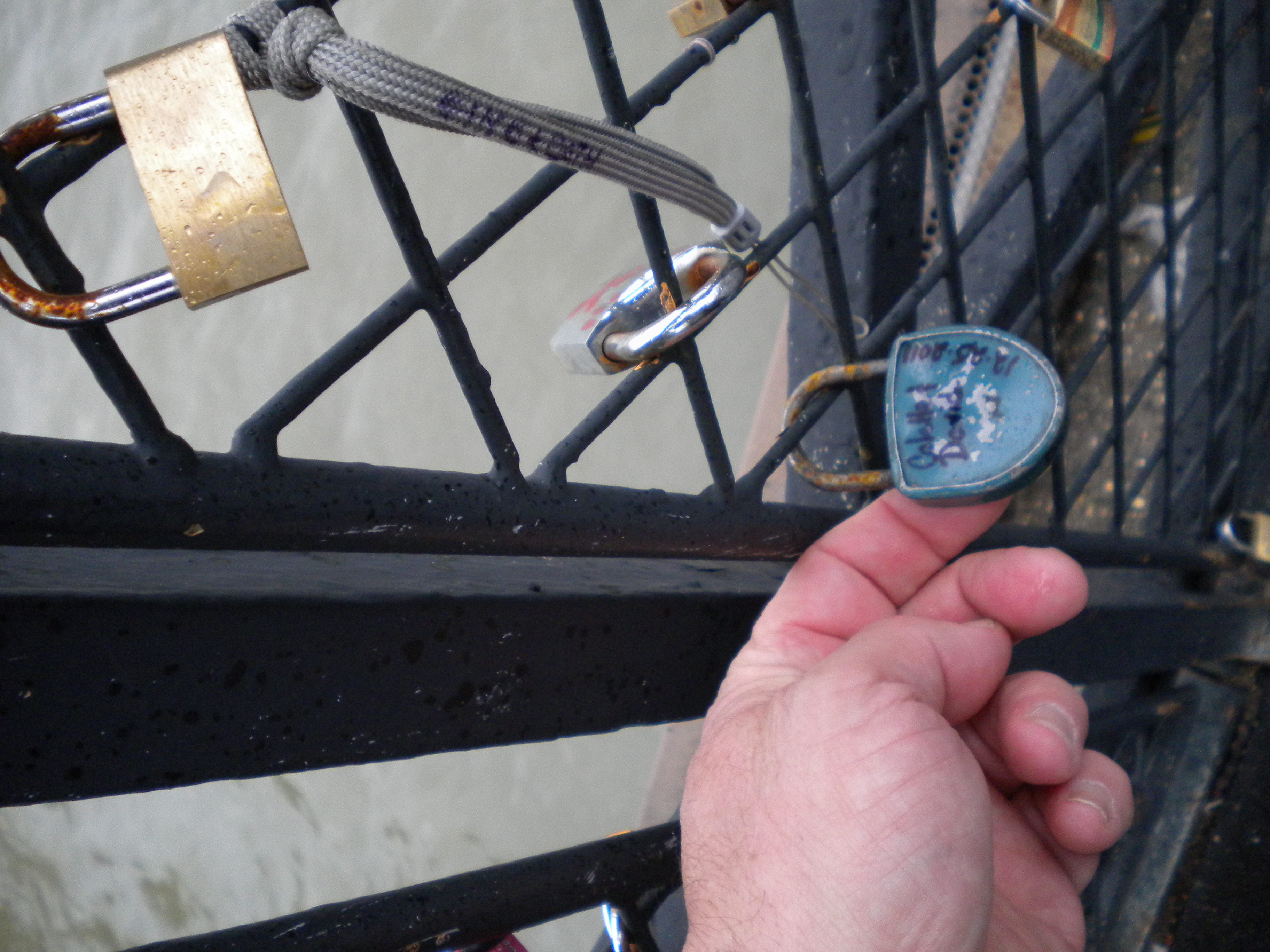
Lock on the Pont L’Archevêché in Paris

h. My husband and I (married 32 years) left a lock on a bridge fence in Paris near Notre Dame in 2011.

i. I tear up at at flash-mob videos. Example? (USAirForce Band at Air & Space Museum)

j. I buy white cars because I want to be seen at night. Paradoxically, these cars always look cleaner than black cars.

Haunted House

My Halloween Haunted House

k. For many years,I had a haunted house for Halloween in my barn while my two sons were young. Now, I shut off all the lights on October 31st and pretend I am not home.

RULE #3. Answer the 11 questions the nominating blogger has created for you.

(Yikes….11 more facts? Aren’t you tired of all this?)

1. What book would you want with you if you were stranded on a deserted island?
How to Build a Ship and Navigate if You Are Ever Stuck on a Desert Island. The more romantic answer, however, would be James Joyce’s Ulysses or Ulysses S. Grant’s letters. Both are on a “to do” list that would require hours of uninterrupted reading time (the connection to Ulysses trying to get back home should not overlooked either…)

2. What did you learn from your mother?
I learned how to cook for a family of eleven; food was plentiful at our dinner table. Cooking is a great skill, but this early training resulted proportion miscalculations and substantial weight gain for my husband. I just cannot get used to cooking for two.

3. Where do you write?
There is a small table in my kitchen where I do much of my writing, but when the weather is nice, I will write on my back patio table. I imagine if I was driving by, I would think, “Oh! I would like to be writing there!”

4. Where do I find joy in my classroom or my work?
When I hear a student correct another student by saying, “a lot is two words.”

5. What do I do to recharge?
I watch movies. I am a movie addict which is not surprising given my addiction to stories.

6. What was my favorite book as a child and why did I love it?
Without question, my favorite book as a child was Little Women. I am the first born, the practical Meg, but in my heart, I am the second born Jo March.

7. If you could have dinner (or coffee or drinks) with anyone living or dead, who would it be and what would you want to ask him or her?
Sister Ella, my first grade school teacher who taught me to read. I want to know if she predicted my interest in reading. She was incredibly -almost frighteningly- tall, and I could never tell if she was smiling or not.

8. Do you have a quote that you keep (in your mind, a notebook, a pocket, your desk, etc.) that captures something that seems important to you? If so, what is it?
The most recent is by Carl Sagan, “What an astonishing thing a book is. It’s a flat object made from a tree with flexible parts on which are imprinted lots of funny dark squiggles. But one glance at it and you’re inside the mind of another person, maybe somebody dead for thousands of years. Across the millennia, an author is speaking clearly and silently inside your head, directly to you.” That’s impressive.

9. How do you feel about the age you are currently in?
Emotionally, I am fine with being 57. I have come to terms with things I will never accomplish (play piano, hike the Appalachian Trail) and still hopeful on other things I want to accomplish (PhD in English, speak French). Physically, I am surprised at how often I need to get up from reading or writing so I don’t get stiff and cramp up. Mentally, I am surprised that 57 sounds old, but 58 sounds wise.

10. What are you afraid of?
I do not like turning off the lights downstairs. To this day, I will race up the stairs as if something is chasing me.

11. If you could go back to one moment in time, when & where would that be & why?
In Our Town Thornton Wilder cautions against revisiting the past; the character Emily finds it too painful. Therefore, I would choose to relieve something I did as a child but not go as myself. I would go back to the 1964-65 World’s Fair in NYC and spend the day with all the exhibits that “predicted” our future.

Now for the fun part:

RULE #4. List 11 bloggers. They should be bloggers you believe deserve some recognition and a little blogging love!

NOTE: Should any of the following bloggers want to accept this award WITHOUT the chain letter-like activities, they have my permission. I have no demands for their participation in what could be a Ponzi-scheme of blogging. These bloggers represent a cross-section of  Bloggers and Tweeters that I read regularly.

 HOWEVER, readers who visit these blogs will benefit. I learn so much from all of these writer/educators…I feel their “love”:

1. First and foremost, my dear friend Catherine Flynn blogged so often in 2013 on Reading to the Core that I could not keep up. I walk with Catherine on the weekends (and I can hardly keep up!), so I am always interested in how our conversations show up in a post. She is a literacy specialist…and a specialist in keeping me focused on the real issues in literacy.

2. I love Bryan Crandall, Connecticut Writing Project (CWP) Director at Fairfield University. He supervised my CWP experience in 2012. His blog this year is Creative Crandall and his entry for January 1st, 2014, reads: “I will spend the next 365 pontificating what creativity means to my world, the people I love, the students I work with, and the teachers that need desperate rejuvenation. The goal is to counter the dreary, maddening, and absolutely criminal doings of governmental leaders and corporate partners who are undoing public schools.” Love that.

3.  Another amazing Connecticut Writing Project Director is Jason Courtmanche at the University of Connecticut. His blog is The Write Space. His posts on Facebook/Twitter alert me to any gem I might overlook in the news that is tied to literature/education. He has worked very hard to outline the transitions of Common Core State Standards to the Early College Experience at UCONN for hundreds of high school teachers.

4.  I met Kate Baker of Baker’s B.Y.O.D.– Bring Your Own Device, Dog, & Deconstruction of Literature in person at the Council of English Leadership (#CEL13) this fall. I had seen many of her posts/tweets. The meeting was kismet…in minutes we had covered The Odyssey, Moby Dick, and other classics. She gave a dynamite presentation of Stop Bleeding Red Ink! at the conference. (FYI: Kate already has posted 11 random facts about herself on her blog!)

5. My mom is in Idaho…and so is Glenda Funk at Evolving English Teacher. I first read her entries on the English Companion Ning; then, I stalked her at the National Conference of English Teachers in 2011.  I LOVED her post about the impact of high school sports on academics: “What We Don’t Talk about When We Talk about Ed Reform in the U.S.A.” In that post she discusses the everyday impact of sports from practice schedules to concussions. Very informative.

6. I read Judy Artz at her blog  Intergrating Learning and Technology-“Here you will find ideas for promoting literacy through the use of technology.” I met her in person also at Council of English Leadership (#CEL13) where I greeted her as an old friend. That is because she tweets (@JudyArtz) at a rapid fire pace, and sometimes mentions me!

7. I also met Daniel Weinstein of The Creativity Core at the National Conference of Teachers of English (@NCTE13) this November. I have used his ideas in my classroom, especially the semantic mapping, with enormous success. The blog is gorgeous with student work as exemplars.

8. Guilty pleasure? The observations of the Anonymous Blogger @ English Teacher Confessions. Entry “This book made me vomit” about Cormac McCarthy’s Child of God is an intriguing homage to McCarthy’s genius as well as a warning. Reading this post will give you an appreciation for this blog writer’s style…who is no slouch herself!

9. Buffy Hamilton, former high school English Teacher and current school librarian, writes at The Unquiet Librarian. She provides interesting and very practical ways to engage students in literacy (Writing Around Texts) through this dual lens. I am more appreciative of advice from educators who have actually been in a classroom.

10. I have participated in the “Slice of Life” challenge series originated by Ruth & Stacey:Two Writing Teachers this year. I admit, I do not always follow the rules (responding to others?!?), but I appreciate their tireless support of teacher writing. I have found that writing my blog (and slices) are the most educational experience I can have. They are to be congratulated for pushing teachers to engage in writing regularly.

11. Not sure where to start? Try The Reading Zone, Sarah Mulhern Gross who writes, “My blog focuses on reading, with a lot of writing and writing workshop thrown in. I also talk about my classroom and classroom projects.” What makes her blog even more legit? She is a regular contributor to The New York Times Learning Network Blog, my “go-to” spot for literacy in content area classrooms. (See how I snuck in two blogs on one entry?)

RULE #5. Post 11 questions for the bloggers you nominate to answer and let all the bloggers know they have been nominated. You cannot nominate the blogger who nominated you.

Here are Vicki’s 11 questions to me, and they are as good as anything I could design. I am plagiarizing them:

  1. What book would you want with you if you were stranded on a deserted island?
  2. What did you learn from your mother?
  3. Where do you write?
  4. Where do you find joy in your classroom or work?
  5. What do you do to recharge?
  6. What was your favorite book as a child and why did you love it?
  7. If you could have dinner (or coffee or drinks) with anyone living or dead, who would it be and what would you want to ask him or her?
  8. Do you have a quote that you keep (in your mind, a notebook, a pocket, your desk, etc.) that captures something that seems important to you? If so, what is it?
  9. What are you afraid of?
  10. How do you feel about being the age you currently are?
  11. If you could go back to one moment in time, when & where would that be & why?

So, dear selected Sunshine Award recipient, here is YOUR choice. You can answer any or all of the 11 questions listed above OR (and I am breaking the rules here) answer this ONE important question….

1. Why write on a blog?

Thanks again, Vicki of To Make a Prairie….this was fun to do on a bitterly cold winter afternoon!

The end of each year is always marked by a roundup or ranking of the year’s most memorable stories. 2013 was no exception. For example, CNN.com ran a poll on the top 10 news stories of 2013 which were then ranked by CNN.com readers:

  1. NEW POPE
  2. BOSTON MARATHON ATTACKS
  3. MANDELA DIES
  4. EDWARD SNOWDEN LEAKS NSA
  5. FEDERAL GOVERNMENT SHUTDOWN
  6. OBAMACARE ROLLOUT DEBACLE
  7. PHILIPPINES TYPHOON
  8. SYRIA CIVIL WAR
  9. CLEVELAND KIDNAPPINGS
  10. SAME-SEX MARRIAGE

All of these stories showed up on other news websites, perhaps ranked differently, but there was remarkable consistency nationally and internationally on how we will remember the year 2013. Pope Francis, the Boston Marathon, and the conflict in Syria dominated the top of most lists.

Screen Shot 2013-12-29 at 2.46.50 PMMany of these stories will soon be, or are already, the subject of non-fiction books, and some of these stories could be retold with such excellence as to be considered for the Samuel Johnson Prize. This prize is an award given annually for the best writing in current affairs, history, politics, science, sport, travel, biography, autobiography and the arts. This prize, named for the 18th Century English author Samuel Johnson is associated with the BBC (British Broadcasting Company) and awards author(s) of any nationality “whose work is published in the UK in English.” The most striking quality of the Samuel Johnson Prize is its motto that “All the best stories are true.”

There is truth in fiction as well. For example, even 2013’s most outlandish film Sharknado, has a degree of truth. The film detailed a supernatural phenomenon where thousands of sharks, scooped from their watery environment, twisted into another force of nature. The film generated waves of chatter on social media sites, so much so that the website Deepseanews.com speculated about the film’s implausibilities and calculated the physics of tornados holding great white sharks aloft. Researchers concluded in a post titled “Recipe for a Sharknado” that, “Winds in the most intense tornadoes are strong enough to keep a shark airborne.” Unlikely? Yes. Impossible? Physics suggests how.

The year 2013 provided many true stories that also lend themselves to possible re-tellings. The following three true stories of 2013 get my votes as the best potential candidates for future re-tellings, either as fiction or non-fiction:

1. NY TimesDiscovery of Art Looted by the Nazis:
The upcoming film The Monuments Men (February 2014,) where “a World War II platoon is tasked to rescue art masterpieces from Nazi thieves,” is a timely example of the storytelling potential about looted art. This past November, Bavarian authorities arrested an art dealer in his  Munich apartment uncovering a horde of art stolen during WWII. The recovered 1,500 works by Pablo Picasso, Max Liebermann, Ernst Ludwig Kirchner, Marc Chagall, Henri de Toulouse-Lautrec, Gustave Courbet, Auguste Renoir and Canaletto are estimated to be worth $1.4 billion. Since the discovery was made public, there are suspicions as to when authorities first knew about the stockpile. The intrigue abounds in this latest episode of Nazi treachery that continues to today.

2.Amazon.com:  Commercial Delivery using Drones:
While today’s science fiction writers may scoff at so pedestrian an example of technology, delivery drones could be fictionalized as key characters, featured perhaps in dystopian literature. While Hedwig, Harry Potter’s delivery owl, was a fantasy, a writer may consider that the possibility for pet drones has potential. The CEO of Amazon, Jeff Bezos, demonstrated that drones could be used for delivery purposes, in 30 minutes or less, and what better audience in a consumer culture motivated by immediate gratification than an audience of young adults? Storytelling or story-commercials…or both?

3. NYTimes: Richard III Rediscovered
My favorite story this year was the discovery of the bones of Britain’s medieval monarch, Richard III, paved over in a parking lot. He had been killed in 1485, at the Battle of Bosworth Field, the last king of England killed on a battlefield. This archaeological find, also dubbed the “King in a Car Park” in the video from the British Channel 4, put an end to the search for remains of the former king of York. A shorter version of the discovery is available from the University of Leicester:

Richard III had been characterized as a brutal tyrant by Shakespeare in the historical play Richard III, but an organization known as the Richard III Society  has tried to clear his reputation. The remains found so ingloriously buried were identified by his hunchback and the bones that bore the scars of the battle that killed him, including eight wounds on his skull.

Richard IIIThe subject of Richard III has already been fictionalized by the great writer Josephine Tey in her 1951 detective story The Daughter of Time. In this novel, she directly confronted Richard III’s sordid reputation in an attempt to clear him of any misdeeds. This latest archeological find is also ripe with storytelling possibilities.

In the end, though, how we will remember 2013 will be through the stories that we created ourselves. We will remember the births, deaths, accomplishments, failures, celebrations, and losses we experienced over the past 365 days of 2013. We will remember because we have, individually and collectively, made the stories of 2013, and the best stories are true.

Best two words in winter? “Snow Day”.

Yes. I will look back in mid-June and see the extension of school days to meet mandatory requirements, and I will sigh. I  might question the wisdom of school administrators who would keep students cooped up in classrooms on warm sunny summer afternoons, but even then I will still admit, I love a snow day.

snowremovalThe outside lights were on all night so I could check on the progress of snow mounting on the barn roof. I could hear the town’s plows, chained tires rattling, working throughout the night. My eyeglasses were handy so that I could grab them and read the small print of scrolling school closings on the TV screen, but this morning I did not need them since my school district thoughtfully sent a robo-call.

I am not surprised that one of my favorite poets, Billy Collins, has a poem titled “Snow Day” where he expresses his appreciation of weather-induced holidays. In stanzas 4-6, he mimics the listings of school closings on the radio:

But for now I am a willing prisoner in this house,
a sympathizer with the anarchic cause of snow.
I will make a pot of tea
and listen to the plastic radio on the counter,
as glad as anyone to hear the news
that the Kiddie Corner School is closed,
the Ding-Dong School, closed.
the All Aboard Children’s School, closed,
the Hi-Ho Nursery School, closed,
along with—some will be delighted to hear—
the Toadstool School, the Little School,
Little Sparrows Nursery School,
Little Stars Pre-School, Peas-and-Carrots Day School
the Tom Thumb Child Center, all closed,
and—clap your hands—the Peanuts Play School.
                    …read more from “Snow Day”
Sailing Alone Around the Room: New and Selected Poems (New York: Random House, 2001).

I have written about Collins’s poetry (see links below) several times in this blog for Poetry Friday. His lyrics run parallel to my experiences of growing up, so there is a sense of nostalgia, a familiarity, when I read his poems. His poetry is accessible to all grade levels, but it is his wry humor in his observations on the universal human experience that makes me want to share him with students. So much of literature can be serious, or downright depressing, that I am grateful, even a little giddy, to have several books of Collins’s poetry on my shelf ready for an opportune moment.

“Look,” I will say, “here’s a funny poem about Emily Dickinson!” or “Hey, want me to read a comic take on the elements of a sonnet?

This snow day is one more excuse to share Collins’s poetry with others- whatever the climate. And for just a day, I can pity those in those waking up in sunny Southern California who are going to school. They may have the warm sun on their toes sticking out of their sandals, but they will never know the pleasure of warm toes stretching out under warm blankets just as there is the announcement of a school cancellation….to roll over…and to hit the snooze button.

Sleep in. It’s a snow day.

Continue Reading…

In the spirit of all end of the year reviews, I have condensed the year 2013 by offering month by month posts from this blog that illustrated the best student (and subsequently, teacher) learning:

January 2013: A Freshman’s Modern Odyssey in the Style of Homer

"Dawn spread her rosy fingers..."

“Dawn spread her rosy fingers…”

The Freshmen final project after reading The Odyssey is a narrative that students complete called “The Wamogossey: A Day in the Life of a Freshman at Wamogo High School.” Writing narratives are once again favored in  Common Core State Standards, and this post explained how students made their own attempt at an epic adventure.

February 2013:  Spilling Over the Corners of a Six Word Text

Short Story in 6 words

Short Story in 6 words

This exercise proves that keeping students “within the four corners of the text” is impossible, even when the text, attributed to Ernest Hemingway, is only six words long. This post also serves as evidence that that admonitions on best practices should be limited to those with actual classroom experience, not to the “architects of the Common Core.”

March 2013 If You Want to Watch the Cow Give Birth

Watching the arrival of our latest calf

Watching the arrival of our latest calf

Yes, “If you want to watch the cow give birth, turn on U-stream now!” was an announcement over the PA system. Normally, I am irritated by interruptions to class time, but this announcement cued students about opportunity watch the birth of a calf in the Agricultural Science wing of our high school. The combination of technology in broadcasting and recording the birth of the newest member of the agricultural program with old-fashioned “hands on” physical labor illustrates 21st Century authentic learning.

April 2013 You Never Forget Your First Hamlet

Members of the senior class were fortunate enough to see Paul Giamatti’s “Hamlet” at Yale Repertory Theatre. I’ll let their words speak for the experience:

The performance was a wonderful experience, especially since it was my first time to see Shakespeare.

I wouldn’t mind going to another because it was so enjoyable that I didn’t even realize the 4 hours passing by.

I like the way that a play has a certain kind of vibe. It’s like a live concert, where there’s a certain kind of energy.

It was like seeing a live performance of a film. I would especially like to see another Shakespeare because it is the way that he intended his works to be portrayed.

After seeing Hamlet so well done, it would definitely be worth going to see another one whether it be Shakespeare or a different kind of performance.

May 2013 Kinesthetic Greek and Latin Roots

Spelling "exo"=outside

Spelling “exo”=outside

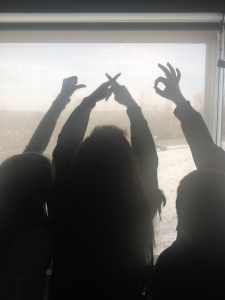
Understanding Greek and Latin roots is critical to decoding vocabulary, so when the freshman had a long list of roots to memorize, we tried a kinesthetic approach. The students used their fingers to spell out Greek roots: ant (against), tech (skill), exo (outside).  They twisted their bodies into letters and spread out against the wall spelling out xen (foreign), phob (fear). They also scored very well on the quizzes as a result!

June 2013 Superteachers!

Superteacher!

Superteacher!

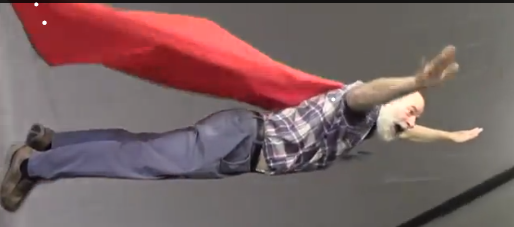
At the end of the 2012-2013 school year, teachers rose to a “friendship and respect” challenge to make a video. With a little help from a green screen, 27 members of the faculty representing a wide variety of disciplines jumped into the nearby closet wearing the big “W” (for Wamogo). Students in the video production class watched and filmed in amazement as, bearing some artifact from a particular subject area, each teacher donned a flowing red cape.

July 2013 Library Book Sales: Three Bags Full!

The original purpose of this blog was to show how I filled classroom libraries with gently used books. The Friends of the C.H. Booth Library Book Sale in Newtown, Connecticut, is one of the premier books sales in the state: well-organized tables filled with excellent quality used books, lots of attentive check-out staff, and great prices. This year, I added three large bags of books to our classroom libraries for $152.00, a discount of 90% off retail!

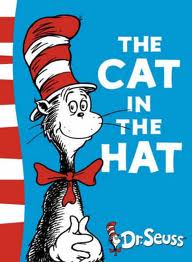
August 2013 Picture Books Are not for Kindergarten Any More!Cat in Hat book cover

At used book sales, I am always looking for picture books I can use in high school classrooms. For example, I use The Cat in the Hat to explain Freud’s theory of the Id, Ego and Superego . Thing #1 and Thing #2 represent Id, and that righteous fish? The Superego. Yes, Dr. Seuss is great for psychological literary criticism, but he is not the only picture book in my repertoire of children’s literature used in high school. This post features a few of my favorite picture books to use and why.

September 2013 Close Reading with Saki and the Sophomores

Saki’s short stories open our World Literature course in which our students will be reading complex texts required by the English Language Arts Common Core State Standards (CCSS). After a “close reading” the conversations in the room showed the text’s complexity. Saki’s The Interlopers has all the elements suggested by the CCSS:  figurative language, the ironic wish, and multiple meaning in the revenge sought by man versus the revenge exacted by Nature. Our close reading should have been “textbook”. The evidence proved the characters’ demise…or did it? The ensuing discussion forced the class to consider other positions.

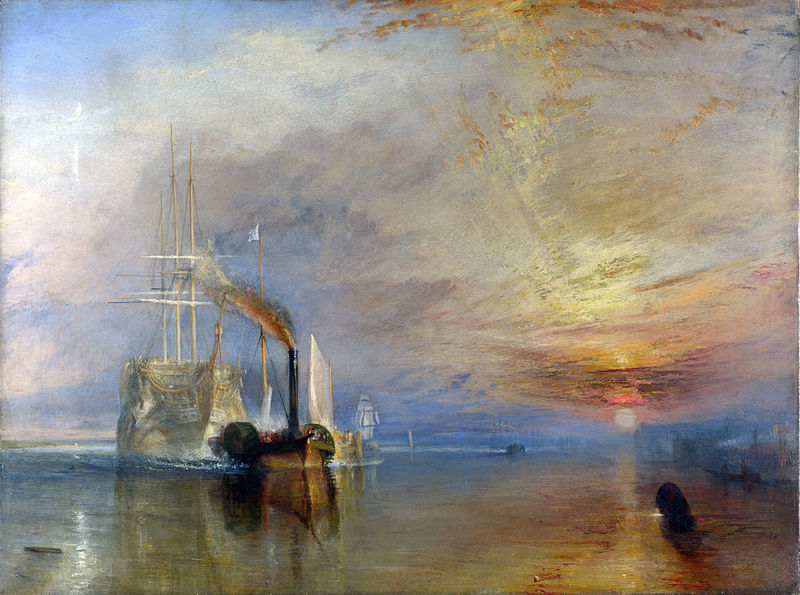
October 2013 Close Reading Art

The Fighting Temeraire

The Fighting Temeraire

After “close reading” short stories, the sophomores were asked to use the same skills to “close read” several paintings that thematically connected to the Industrial Revolution. They studied a Constable pastoral painting, before J.M.W. Turner’s famous painting, The Fighting Temeraire. While some called attention to the the dirty smoke stack, others saw the energetic paddling as a sign of progress. They noticed the ghost-like ship hovering in the background, the light created by the sunset which gave the painting “warmth”or “light extinguishing”. When they were asked to use these elements as evidence to determine the artist’s message, there were some succinct responses to the painting’s “text.”

November 2013 Thanks for the NCTE Conference

Five members of the English Department attended the conference and selected from over 700 sessions at the National Council of Teachers of English and the Conference on English Leadership.  District support for such great professional development is truly appreciated. We are also grateful that four of our proposals were chosen to share as presentations for other educators. The explanations of our presentations with links to these presentations are included in this post.

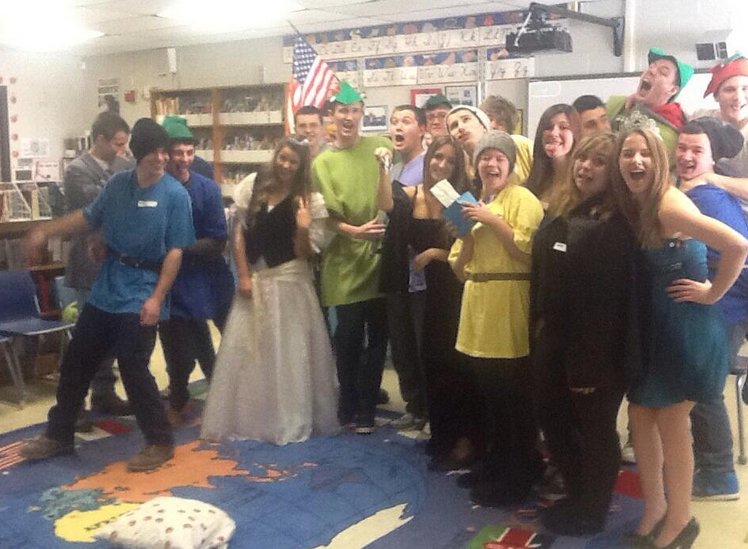
December 2013 Drama Class Holiday Miracle

Cast photo!

Cast photo!

An ice storm two weeks before performance caused a car pile-up, and the drama club teacher was left with a concussion. She could not be in school; the students were on their own, and I was left to supervise their performances of Snow White and the Seven Dwarves at three local elementary schools.

Their “dress rehearsal” was a disaster, but, as the adage says, “The show must go on!” and once they arrived at the elementary schools, the students were anxious to do well. They naturally changed their staging moving from gym floor to library floor, the Evil Queen tossed her hair with anger, and the Prince strode onto the stage with more confidence. The dwarves were a source of comic relief, intentionally or not. I watched the holiday miracle of 2013 repeated three times that day. The students in drama class at each school were applauded, with congratulatory e-mails from the principals that offered praise.

End of the year note:

I am grateful to be an educator and to have the privilege to work with students that I learn from everyday. In this retrospective, I can state unequivocally that 2013 was a memorable year… as you can see from many of the reasons listed above.

Welcome to 2014! May this coming year be even more productive!

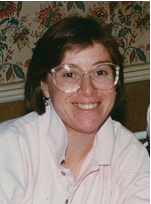
Today is the 25th anniversary of the terrorist bombing of PAN AM #103 over Lockerbie, Scotland.

Elizabeth "Liz" Marek

Elizabeth “Liz” Marek

My friend Elizabeth Marek, Liz, was on that plane. She was killed along with 270 other people that evening when a bomb planted onboard the plane exploded before it crashed into a small Scottish town. Her sudden death left an enormous hole in the lives of my family. She was smart, quick-witted, and loved film and theatre. Her most outstanding quality was her laughter. There are not enough synonyms to describe Liz’s laughter: she chuckled, she chortled, she guffawed, she cackled, she giggled,she tittered, she sniggered, she snickered. She would make us roar/hoot/howl with laughter, crack up, and roll on the floor, Liz supplied the laugh-track of our youth.

That laugh track came to a sudden and uprupt end four days before Christmas. The priest who eulogized her spoke about the “not so silent night” of December 21st, 1988, the night our world became a little quieter.

My world also became a great deal smaller. Suddenly, I knew someone who had been killed by terrorist for a reason that was not clear. Some ideologue had chosen the plane my friend was on to make a statement, to get revenge, or possibly to demonstrate power. Regardless, the bombing connected me and my family to terrorism in a personal way.

Much speculation has been given to level on connection each person has to another in the world. One theory postulated by Frigyes Karinthy is that there are six degrees of separation that separate any two people in the world. This theory suggests that everyone and everything is six or fewer steps away, by way of introduction, from any other person in the world. The idea was central to a 1990 play by American playwright John Guare, Six Degrees of Separation where one of the characters states:

I read somewhere that everybody on this planet is separated by only six other people. Six degrees of separation between us and everyone else on this planet. The President of the United States, a gondolier in Venice, just fill in the names. I find it A) extremely comforting that we’re so close, and B) like Chinese water torture that we’re so close because you have to find the right six people to make the right connection… I am bound to everyone on this planet by a trail of six people.

The accuracy of this theory has been tested using multiple social media platforms, and speculations have been made that there are even fewer than six degrees. In 2011, Facebook’s data team, using 721 million users with 69 billion friendships, averaged the distance of 4.74 between users. With this one social network platform, 1.19 billion monthly users out of a world population of 7.2 billion (as of September 30, 2013) are connected.

Sadly, my connections to other cataclysmic events have also continued. I live less than a five minute drive from Sandy Hook in Newtown, Connecticut, site of last year’s (2012) deadly school shooting. My family knew some of the victims there as well. The press coverage touched us all in our respective homes across the United States. We watched film footage of the famous flagpole in the center of town, the familiar Edmond Town Hall, and interviews with people we knew. We again felt the world become even smaller as our connections expanded.

These two horrific incidents are not the only ways that my family and I can measure connections with others in the world, but they illustrate how interconnected we are on our small blue planet in the larger universe. As 2013 comes to a close, the levels of human connection remind me of what author and scientist Carl Sagan had to say about humanity on Earth in his book Pale Blue Dot: A Vision of the Human Future in Space:

“Look again at that dot. That’s here. That’s home. That’s us. On it everyone you love, everyone you know, everyone you ever heard of, every human being who ever was, lived out their lives. The aggregate of our joy and suffering, thousands of confident religions, ideologies, and economic doctrines, every hunter and forager, every hero and coward, every creator and destroyer of civilization, every king and peasant, every young couple in love, every mother and father, hopeful child, inventor and explorer, every teacher of morals, every corrupt politician, every “superstar,” every “supreme leader,” every saint and sinner in the history of our species lived there-on a mote of dust suspended in a sunbeam……To me, it underscores our responsibility to deal more kindly with one another, and to preserve and cherish the pale blue dot, the only home we’ve ever known.”

On this 25th anniversary of the bombing of PAN AM#103, I imagine that we are more connected to each other than ever before. I know that Liz would agree that we should deal more kindly with one another.

Expecting allusions to Herman Melville’s Moby Dick during the National Teachers of English Conference (NCTE) is like (pardon the pun) shooting fish in a barrel. Okay, I know…the whale is a mammal, but once this white whale has been sighted, he keeps surfacing!

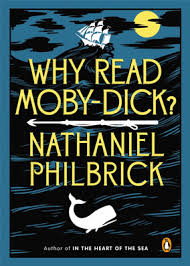
First Sighting: Nathaniel Philbrick’s 2011 slim book Why Read Moby-Dick?

Moby DickThe exhibitors at the NCTE conference were interested in putting books into the hands of teachers who would then put books into the hands of student readers. Once such vendor enthusiastically suggested the book based on its size; “See. you could carry this  book around the convention and hardly know it’s in your bag!”

He was right.  Philbrick’s 127 page argument as to why “this classic tale waits to be discovered anew” fit nicely in my convention bag and was perfect for reading during breaks between sessions.

The book is divided into 28 short chapters each devoted to topics such as setting, characters, or themes. Chapter titles include:

  • Nantucket
  • The View from the Masthead
  • A Mighty Messy Book
  • Queequeg
  • Pulling Dictatorship Out of a Hat

Philbrick is already familiar with the real life incident that was the inspiration for Herman Melville’s literary classic. His non-fiction book In the Heart of the Sea: The Tragedy of the Whaleship Essex in 2000 recounts the loss of the whaling ship Essex in the Pacific Ocean in 1820.  Heart of the Sea won the National Book Award for non-fiction that year, fleshing out the details of the whale attack on the boat, the fateful decision to avoid islands allegedly populated by cannibals, and the ironic turn to cannibalism that claimed the lives of several surviving crew members.

In Why Read Moby Dick?, Philbrick turns to the literary contributions Melville gave American literature, particularly in the creation of Captain Ahab, who in a pre-appearance had been rumored by other sea captains to have “been in colleges as well as ‘mong the cannibals.” In one chapter, “The Anatomy of a Demagogue”, Philbrick analyzes Ahab’s rhetorical craftiness in convincing the crew to hunt and kill the white whale. In discussing first mate Starbuck’s stunned realization that the Pequod is not out on a commercial venture, but rather a mission to settle the score of Ahab’s lost limb, Philbrick engages in a cross-culture reference that is both humorous and insightful:

Starbuck responds by asking what Ahab’s vengence will get ‘in our Nantucket market?’ It’s then, to borrow from the film This is Spinal Tap, that Ahab dials his charisma to eleven. ‘But come closer, Starbuck,’ he says, ‘thou requirest a little lower layer?’ It’s not about the money, he explains; this is personal. Thumping his chest he cries out. ‘My vengeance will fetch a great premium here!’ “(40)

Philbrick also aligns the story as a metaphor for the political turmoil of the United States. In discussing the chapter where Stubbs, the second mate, raises a shiver of sharks by cutting into a whale for a steak, Philbrick writes,

“The job of government, of civilization, is to keep the shark at bay….Here lies the source of the Founding Fathers’ ultimately unforgivable ommission. They refused to contain the great, ravaging shark of slavery, and more than two generations later, their grandchildren and great-grandchildren were about to suffer the consequences.” (78)

Philbrick moves between cultures, between ideologies, between philosophies, and theories in order to encourage more people to actually read Melville’s great American novel. A encouragement that may be necessary, because soon after I received the book, I had whale sighting #2.

Whale sighting #2:  A statement during a key note address at the Conference for English Leadership (CEL):

“We all know the opening line of Moby Dick, but how many of us have actually read the book?” posed speaker Donalyn Miller to the crowd of English teachers. There was a murmur of agreement, and more than a few guilty looks. Miller was discussing her passion and the topic of her two books: how to get students to read for school and independently.

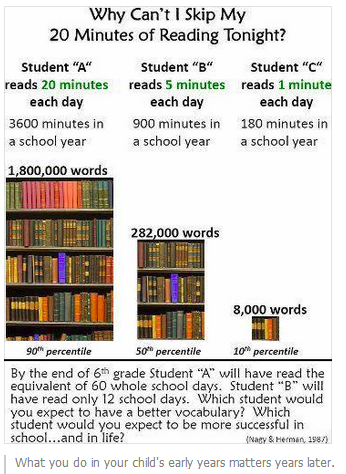
20-minMost notably, Miller is known as the author of The Book Whisperer and the recently released Reading in the Wild. Her keynote address was to encourage students to become the independent readers that could-on their own- pick up a tome like Moby Dick. She discussed the characteristics of “wild readers” and pushed teachers to engage students in examining their reading lives. She advocated for literacy rich environments for students to develop the habits to make them life-long readers. Miller’s assertion that preparing students to read independently is the best guarantor of standardized test success was supported with the graphic she presented. (see left: Nagy & Herman study).

Her point about Moby Dick was that most people know the first line, “Call me Ishmael,” but only those who live literate lives know why the book is so critical to understanding American literature. Students who have not developed the reading endurance necessary for the book may be turned off by both the intimidating size and the 19th Century styled language of the text. Considering that most high schools shy away from teaching Moby Dick to anyone but their best students means that the novel will most likely be an independent choice book for a student who develops into a life-long reader. Miller wants them to be prepared so they can will have the pleasure of sitting back in a comfy chair, perhaps with a cup of coffee, to read.

Whale sighting #3: Coffee at Starbucks.
starbucks

Named for the First Mate of the “Pequod”

Speaking of coffee, I am not sure why I never realized this before, but this coffee company is named for the first mate of the Pequod, Starbuck. I Googled this fact while waiting in the long line of English teachers eager to fuel up before attending the day of sessions at NCTE. According to the company’s website, “The name, inspired by Moby Dick, evoked the romance of the high seas and the seafaring tradition of the early coffee traders.” How did I not put this together?

Whale sightings, continued…….

Once I returned home from NCTE and CEL, the white whale sightings did not stop. A blog post on To Make a Prairie by Edblog award nominee Vicky Vinton summarized a session she had attended at NCTE called “Reading the Visual and Visualizing the Reading” chaired by Tom Newkirk and presented by Louise Wrobleski, Tomasen Carey, and Terry Mohera. Vinton explains the ideas based their mentor text, Moby-Dick in Pictures by the self-taught artist Matt Kish were “too inspiring not to spread around.” Their presentation highlighted the amazing results in student work when students chose one quote from each chapter of the The Scarlet Letter and create an image for it. Vinton notes that, “Mohera was surprised by the depth of the students’ thinking and how, once she’d gotten them started, they took full ownership of the book, the assignments and the whole process.”  The richness of their illustrations shows how literature can inspire new creations, just as Kish’s illustrations were inspired by Melville.

As if on cue, as in the final pages of Melville’s drama, the white whale surfaced dramatically again this morning when I came across another artist who is under Melville’s spell. While perusing the December 16th issue of The New Yorker, there was Mick Stevens’s cartoon of the whale himself (p56), a cross expression behind his spectacles, with his front fins holding a copy of Moby Dick. The caption underneath read, “Oh, C’mon, I wasn’t that terrible!”

Coincidence? I think not. Melville’s white whale is everywhere, but to appreciate him? You have to read the book.

No sooner are essays on Mary Shelley’s Frankenstein handed in, then the copies of Paradise Lost are handed out to the Advanced Placement English Literature Students. Yes, there are over 10,000 lines of blank verse in the poem, but don’t shudder for them…they will be fine. This epic poem is a trip to the “dark side” like no other in literature. All it takes is a reading of Book One; a reading that says “Welcome to Hell”!

The connection is obvious. In her novel, Shelley has Frankenstein’s Monster explain how he gained his knowledge, not with the help of his “father”, but instead by reading several books while he hid from humanity. One of the books in his possession was the epic poem Paradise Lost. When the Monster finally confronts his creator, Victor Frankenstein, on a mountain glacier on Mount Montanvert, the Monster dramatically intones:

“I ought to be thy Adam, but I am rather the fallen angel, whom thou drivest from joy for no misdeed.”

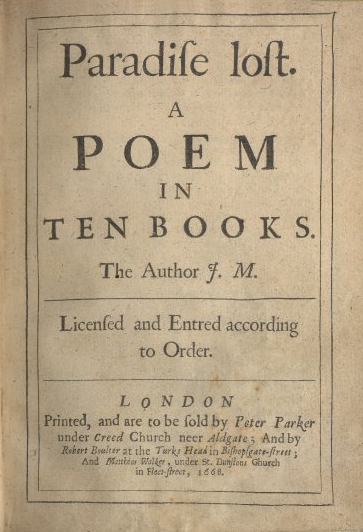
Originally published as 10 books, Milton expanded the epic poem to 12 books in later printings.

Originally published as 10 books, Milton expanded the epic poem to 12 books in later printings.

The “fallen angel” the Monster references is a hero/anti-hero of Paradise Lost: Satan, aka Lucifer, aka the  “infernal serpent”, aka the ‘Arch-fiend’ (and a myriad of other Miltonic epithets).

Students in previous classes have always found Satan the most memorable character in this epic poem since he is given the most memorable lines. They have been particularly intrigued that John Milton’s purpose in writing the poem, “to justify the ways of God to man,” is soon drowned out by the creation of Pandemonium (Hell’s Seat).  From the moment in Book One of Paradise Lost when Satan frees himself from the adamantine chains that bind him to a burning lake, students are taken with his attitude and his defiance as read in his great challenge:

Here at least
we shall be free; the Almighty hath not built
Here for his envy, will not drive us hence:
Here we may reign secure, and in my choice
to reign is worth ambition though in Hell:
Better to reign in Hell, than serve in Heaven. (PL 1 258-263)

No matter that in Book Six’s battle scenes in heaven are an exercise in futility, known as  the “great pie fight in the sky”, students root for the former archangel. They understand the sentiment in his statement,

‘The mind is its own place, and in itself can make a heaven of hell, a hell of heaven…” (PL 211-214).

Paradise Lost was only one of Milton’s great contributions to literature. He was not only a brilliant poet, but he was also a powerful statesman and a Puritan. He became associated with the Puritan partisanship in Parliament, which was credited with banning Christmas in England in 1644. This would seem to be a contradiction since he was already known for the beautiful Christmas Ode, “On the Morning of Christs Nativity Compos’d 1629”. Perhaps it was the general Puritan aversion to Christmas carols that could be blamed for such a heinous act!.

His political career experienced the extreme highs of an appointment as Secretary for Foreign Tongues (1648) and his association with Oliver Cromwell in the execution of Charles I (1649). In contrast there were the lows of an imposed exile upon the return of Charles II and the arrival of the Restoration in 1660. One of the reasons he was not executed for his implicit participation in Charles I’s regicide was that he was struck blind in 1654, and there were many who argued that this blindness was punishment enough. Milton was used to pain and suffering as the deaths of his first and second wives and several children were tragic interludes throughout his life.

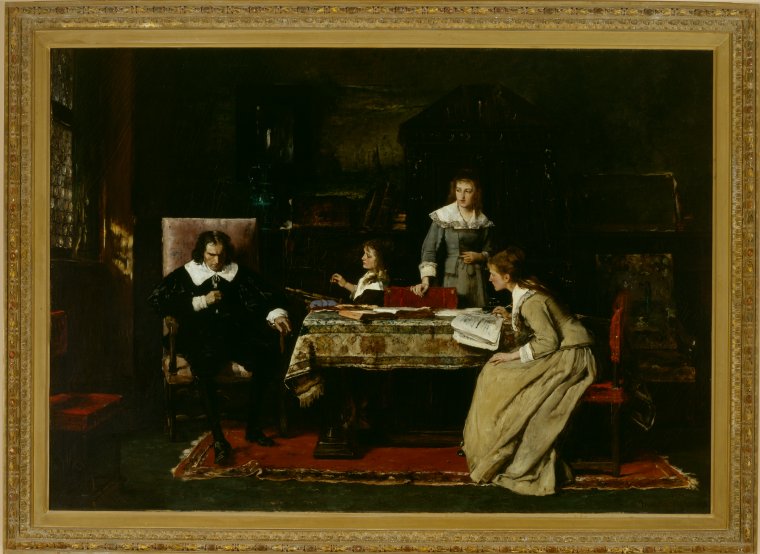
Like another blind poet, Homer, Milton achieved greatness with an “inner sight”. Critics generally agree that his best poetry came after he became blind and dictated all the lines of verse to his remaining daughters. A painting by Mihály Munkácsy (1877) hangs in the New York Public Library (NYPL) and depicts a scene of a head-bowed Milton reciting to one daughter who is scribing lines into a book.

Milton & daughtersThe picture is an apt illustration for his opening thesis in Paradise Lost:

What in me is dark
Illumine, what is low raise and support;
That to the height of this great argument
I may assert eternal Providence,
And justify the ways of God to men. (PL I:18-22)

In 2008, the NYPL held an exhibition, “John Milton at 400: ‘A Life Beyond Life'” which featured illustrated etchings by Gustave Doré for Paradise Lost. One illustration was of Satan on his flight to the Garden of Eden. As he travels, Satan pauses to tell the Sun how conflicted he is over his fallen state:

O Sun, to tell thee how I hate thy beams
That bring to my remembrance from what state
I fell, how glorious once above thy Spheare;
Till Pride and worse Ambition threw me down
Warring in Heav’n against Heav’ns matchless King:
Ah wherefore! he deservd no such return
From me, whom he created what I was
In that bright eminence, and with his good
Upbraided none; nor was his service hard. (PL IV:37-41)

Speaking these lines is a tragic Satan, fully aware that he has brought himself to ruin, as told by a poet, who had also come to political ruin. The reader can sympathize with such a character, and isn’t that the role of great literature? To draw on the reader’s empathy?

By the end of the poem, however, Milton restores the balance of sympathy towards Adam and Eve. They walk bravely, hand-in-hand, out of the Garden, into the sunset, ready to begin “his-story”.  In contrast, the character of Satan is reduced to a hollow hero, receiving accolades from a hissing mob of demi-devils. He is cursed, and like the Monster in Frankenstein, he is unreconciled with his creator.

So happy Birthday, John Milton, (December 9th), but let us not forget, that while your character Satan may dwell in evil, it was you who helped to cancel Christmas!