Archives For November 30, 1999

Wordpress Reader for Freshly Pressed

Open House: OMG!

September 15, 2013 — 1 Comment

September is Open House Month, and the welcoming speech from a teacher could sound like this:

“Welcome, Parents! Let me show you how to access my website on the SMARTboard where you can see how the CCSS are aligned with our curriculum. You can monitor your child’s AYP by accessing our SIS system, Powerschool. In addition, all of our assignments are on the class wiki that you can access 24/7.  As we are a BYOD school, your child will need a digital device with a 7″ screen to use in class.”

OMG!

How parents may feel during Open House listening to education acronyms

The result of such a speech is that parents may feel like students all over again. The same people who sat in desks, perhaps only a few years ago, now are on another side of the classroom experience, and the rapid changes caused by the use of technology in education necessitate a need for education primer, a list of important terms to know. While attending the Open House, parents can observe that there are still bulletin boards showcasing student work. They can note how small the desks appear now, if there are desks. Perhaps the lunch lady is the same individual who doled out applesauce and tater tots onto their school lunch trays.  Yet, listening to how instruction is delivered, monitored, and accessed may make parents feel that they are in some alien experience with instructors and administrators spouting a foreign language. Just what is a wiki? they may wonder, and what does BYOD stand for?

So, let’s begin with some of the acronyms.  At Open House, educators may casually throw around some of the following terms to explain what they teach or how they measure what they teach:

  • PBL (Project Based Learning) a hands-on lesson;
  • SIS (Student Information System);
  • Bloom’s Taxonomy: a sequence of learning based on complication of task and level of critical thinking which is being replaced by the DOK;
  • DOK (Depths of Knowledge) complication of task and level of critical thinking required
  • ESL (English as a Second Language);
  • AYP (Adequate Yearly Progress);
  • WIKI: a web application which allows people to add, modify, or delete content in a collaboration with others; and
  • SMARTboard: interactive white board

Subject area names may also seem unfamiliar since they now reflect a different focus on areas in education. English is now ELA (English/Language Arts) while science and math have merged like the Transformers into the mighty STEM (Science, Technology, Engineering, and Math). The old PE class may now bear the moniker Physical Activity and Health (PAH), but  History has already dealt with the shift to the more inclusive term Social Studies coined in the 1970s.

Assessment (testing) brings about another page in the list of education acronyms that parents may hear on Open House, including these few examples:

DRP (Degrees of Reading Power) reading engagement, oral reading fluency, and comprehension younger elementary students;
DRA (Developmental Reading Assessment) reading engagement, oral reading fluency, and comprehension in elementary and middle grade students;
STAR: new skills-based test items, and new in-depth reports for screening, instructional planning, progress monitoring;
PSAT/SAT/ACT:designed to assess student academic readiness for college 

Parents, however, should be aware that they are not alone in their confusion. Educators often deal with acronym duplication, and  state by state the abbreviations may change. In Connecticut, some students have IEPs (Individual Education Plans), but all students have SSP (Student Success Profiles) which shares the same acronym with the SSP (Strategic School Profile). Connecticut introduced the teacher evaluation program SEED known as the System for Educator Evaluation and Development, which is an acronym not to be confused with SEED, a partnership with urban communities to provide educational opportunities that prepare underserved students for success in college and career.

Federal programs only add to the list of abbreviations. Since 1975, students have been taught while IDEA (Individuals with Disabilities Education Act) has been implemented. NCLB (No Child Left Behind) has been the dominating force in education for the length of the Class of 14’s time in school, along with its partner SSA (Student Success Act) which is similar to, but not exactly like, the SSP mentioned earlier. The latest initiative to enter the list of reform movements that parents should know  is known as the CCSS the Common Core State Standards.

The CCSS are academic standards developed in 2009 and adopted by 45 states in order to provide “a consistent, clear understanding of what students are expected to learn, so teachers and parents know what they need to do to help them.” Many of the concepts in the CCSS will be familiar to parents, however, the grade level at which they are introduced may be a surprise. Just as their parents may have been surprised to find the periodic tables in their 5th grade science textbooks, there are many concepts in math (algebra) and English (schema) that are being introduced as early as Kindergarten.

So when a student leaves in the morning with a digital device for school, BYOD or BYOT (Bring Your Own Technology) and sends a “text” that they will be staying late for extra help or extra-curricular activities, parents should embrace the enhanced communication that this Brave New World of technology in education is using. If at Open House a parent needs a quick explanation of the terms being used by a teacher, he should raise his hand;  in spite of all these newfangled terms and devices, that action still signals a question.

Above all, parents should get to know the most important people in the building: the school secretary (sorry, the Office Coordinator) and the school custodian (sorry, FMP: Facility Maintenance Personnel). They know where your child left her backpack.

“Inconceivable!” Rigor

September 3, 2013 — 4 Comments

Some of best lines in the film The Princess Bride are given to the assassin-for-hire Vizzini. For those unfamiliar with this classic film, Vizzini’s repeated use of the word “inconceivable” is finally challenged by the vengeance-seeking swordsman Inigo Montoya while they stand overlooking a cliff watching the Dread Pirate Roberts climb in pursuit:

[Vizzini has just cut the rope The Dread Pirate Roberts is climbing up]
Vizzini: (enraged)  HE DIDN’T FALL? INCONCEIVABLE!
Inigo Montoya: You keep using that word. I do not think it means what you think it means.

I believe the same misunderstanding is happening when education reformers overuse the word “rigor”. This word is tossed about by education reformers who do not demonstrate an understanding of what rigor means. To clear up any confusion, here are three definitions of rigor according to Vocabulary.com:

1 n excessive sternness
“the rigors of boot camp”
Synonyms:
hardness, harshness, inclemency, rigorousness, rigour, rigourousness, severeness, severity, stiffness
Type of:
sternness, strictness
uncompromising resolution

“Excessive sternness” sounds like a  workhouse/boarding school from a Charles Dickens novel, while “boot camp” is an altogether different kind of training. Both interpretations are not tied to 21st Century skills. How do education reformers who  create the rigor of “uncompromising resolution” help to make students career and college ready when cooperation and collaboration are part of 21st Century skills?

The second meaning:

2. n something hard to endure
Synonyms:
asperity, grimness, hardship, rigorousness, rigour, rigourousness, severeness, severity
Types:
sternness
the quality (as of scenery) being grim and gloomy and forbidding
Type of:
difficultness, difficulty
the quality of being difficult

“Something hard to endure” is how many high school students do feel, enduring school as a requirement.  Many employ a degree of “difficult-ness” in order to stop class. “Grimness” and “hardship” are not qualities that encourage students to do well or succeed. Education reformers who seek to make schools “forbidding” with rigor sound as though they want to eliminate schools.

The third meaning:

3. n the quality of being valid and rigorous
Synonyms:
cogency, rigour, validity
Type of:
believability, credibility, credibleness
the quality of being believable or trustworthy

Here at last is a definition that addresses one quality needed for education- “validity”. Yes, there should be validity to information in school and a way to measure student understanding of information in order to be credible. A synonym to validity is “the property of being strong and healthy in constitution”. Education reformers should substitute rigor with validity in order to promote better attitudes towards improving education.

So how did rigor become so misused? In 2008, education advocate Tony Wagner called for a new definition of “rigor” according to 21st Century criteria. In an article published in ASCD Magazine titled “Rigor Redefined” he indicated that:

 “It’s time to hold ourselves and all of our students to a new and higher standard of rigor, defined according to 21st-century criteria. It’s time for our profession to advocate for accountability systems that will enable us to teach and test the skills that matter most. Our students’ futures are at stake.”

Wagner suggested the following criteria:

  1. Critical Thinking and Problem Solving
  2.  Collaboration and Leadership
  3. Agility and Adaptability
  4.  Initiative and Entrepreneurialism
  5. Effective Oral and Written Communication
  6.  Accessing and Analyzing Information
  7.  Curiosity and Imagination

Note that there is nothing about severity or harshness in Wagner’s recommendations for rigor in education. Unfortunately, the Draconian definition from Vocabulary.com is the one that most often captures the attitude of education reformers and politicians who call for tougher standards, increased testing, and more (home) work in order to create an impression of rigor in making school more demanding. Their misuse of what Wagner sought by using the word rigor fails to include higher order thinking skills, problem solving or the significance of imagination.

Therefore, when education reformers misuse the word rigor to mean more demanding lessons or tests so difficult that students cannot possibly succeed, I propose teachers respond with by saying the word “Inconceivable!”

When education reformers misuse the word rigor as a means to evaluate student or teacher performance with tools that only measure basic comprehension skills without addressing any creative problem solving, I propose teachers respond again with the word “Inconceivable!”

And if education reformers continue to misuse the word rigor to describe what is lacking in curriculum at every grade level, I propose teachers stop and correct the reformers, with or without Inigo Montoya’s accent, and say, “You keep using that word …I do not think you know the meaning of that word!”

My school district completed four days of first class professional development that began with a visit from Dave Burgess, the author of Teach Like a Pirate and ended with faculty-led collaborative committees organizing for an accreditation visit from the New England Association of Schools and Colleges (NEASC).  In four short days, the veteran teachers adjusted, organized classrooms, and prepared the first week of lessons. The administrators indicated that schools were off to a “great start”  while the facility management personnel finished polishing the floors and touching up wall paint. One group however, looked different.

teacher appleThe new teachers’ eyes glazed over. Although some have taught for years in other districts, each one has been lost in the labyrinth of our hallways at least once this past week. There are at least fifty names they still need in order to match staff to academic disciplines and a number of faces before they begin to match their attendance rolls with students. The location of materials for various units of study has yet to be established; boxes are unopened in their classrooms.

In short, they are whelmed. Merriam-Webster online defines whelmed as

1. to turn (as a dish or vessel) upside down usually to cover something : cover or engulf completely with usually disastrous effect
2. to overcome in thought or feeling : overwhelm

According to the dictionary, there is no “over” in being “overwhelmed”. Watching the newest members of the faculty trying to mentally sort through the information they had taken in the past four days reminded me of how I felt my first few years of teaching. Putting “over” with whelmed seemed redundant; I was “engulfed completely” my first years of school as well.

Twenty-three years later, I am less whelmed by the start of school, but I still have to adapt. There are always new materials, new changes to schedules, new students to get to know. In 2013-2014 there is also a new state mandated teacher evaluation system and a set of new tests will be rolled out this year to measure the new Common Core State Standards. For these new-to-district teachers, the flood of information in the early days of the school year must seem insurmountable. There is research, however, that indicates with three years of practice, teachers develop strategies for being effective in improving student achievement in the classroom.

In particular, there is research that demonstrates that “teachers in their first and, to a somewhat lesser extent, their second year tend to perform significantly worse in the classroom” (Rivkin, Hanushek, and Kain -2005). In a follow-up interview to this study, Kati Haycock was quoted in Education Next as saying,

“And experience does matter for inexperienced teachers. As a group, first-year teachers tend to be less effective than those with even a little more experience, and effectiveness tends to climb steeply for any given cohort of teachers until it begins to plateau after a few years. According to research by Eric Hanushek and others, disproportionate exposure to inexperienced teachers contributes to the achievement gap.”

How a teacher develops on a learning curve is significant for both the teacher and the students, which is why the story from Mokoto Rich of the New York Times At Charter Schools, Short Careers by Choice (8/26/2013) flies in the face of both anecdotal data and research studies. The article addressed the high turnover rate of teachers in charter schools by first highlighting the story of 24 year-old teacher, Tyler Dowdy. With two completed years of teaching behind him, Dowdy is “exploring his next step, including applying for a supervisory position at the school.” The article described him as someone, “who is already thinking beyond the classroom, wants something more.” His interest in education appeared cursory, “I feel like our generation is always moving onto the next thing,” he said, “and always moving onto something bigger and better.”

Supporting Dowdy’s lack of commitment to the profession, was the statement by Wendy Kopp, founder of  Teach for America (TFA)  who said,

“Strong schools can withstand the turnover of their teachers…The strongest schools develop their teachers tremendously so they become great in the classroom even in their first and second years.”

Kopp’s claims, however, have little credibility considering her own lack of classroom experience. While she has taken TFA from a $22 million dollar enterprise in 2003 to a $244 million dollar business in ten years before her departure this year as CEO, there is no record of her creating or delivering lessons to students herself. She has not had the experience of developing or implementing classroom management skills, a major cause of much teacher turnover.  Teachers, new and old, experience first-hand the fallacies in her argument. Yes, during the first years, teaching can be greatly improved, but that does not mean a new teacher has become “great”. Like so many educational reformers without classroom experience, Kopp dismisses critical teacher training as something that can be condensed, like TFA’s five week summer teacher preparation program.

A five week training for TFA is luxurious compared to the two and a half weeks of training over the summer for other teacher training programs, such as the YES Prep program like Dowdy’s, where new teachers “learn common disciplinary methods and work with curriculum coordinators to plan lessons.” Yet, these teachers from these accelerated programs will look the way new recruits in my district look, glazed and anxious. These teachers will soon learn the importance of experience. They will understand that the only way to learn how to teach is to practice teaching over and over and over….in spite of being whelmed.

Back to school soon, eh?
Gotta go back to work?
The long vacation almost over?

August sunday nightI hear these comments from friends and relatives the last days of August. Acquaintances who pass with a quick “How are you?” any other time of year, now take time to gloat and ask, “Back to the grind, right?” Apparently, they are under the impression that I have not thought about school these past weeks of relaxed responsibility. To the contrary, for the past eight weeks, I continued to think about school.

While summer vacation allowed me the opportunity to catch up on reading for pleasure, some of the books I read this summer (The Fault in Our Stars by Jon Green, When She Woke by Hillary Jordan),  are ones I plan to share with my students. Summer allowed me the opportunity be a student and to take classes to improve my understanding of instructional strategies. Cris Tovani’s book, Do I Really Have to Teach Reading? was particularly interesting as a resource to share with content area teachers.  Finally, during the summer I had long stretches of uninterrupted time to think and to write.  Consequently, the activities I pursued in the summer are not unlike the activities I pursue during the school year. The difference is that I do not have to complete reading or writing during July’s halcyon days at the almost breakneck speed I use from September to June. Even in these days of leisure, the classroom is never far from my mind. August’s arrival signals an end to the unhurried pace practiced by those in other professions.

For teachers, there is a great deal of physical preparation to teach: preparing the classroom, preparing the materials, and preparing the kidneys to go hours on end. There is also the emotional preparation for the highs and lows that will follow for the next 38 weeks of school. Teachers know that setting the right tone on Mondays can make  a huge difference on the academic success of a school week. Which brings me to the importance of Sunday night.

Sunday night is for planning.

Those hours before the beginning of any school week are fraught with detailed lists of necessary supplies, schedules for delivering instruction, and aggressive strategies to beat other teachers to the copier on Monday mornings.

Those few hours before the Monday morning announcements are also exciting as planned lessons, packed with potential, sit ready to be deployed. Sunday nights are full of promise.

Therefore, August is the Sunday night of the school year. Teachers mentally planned bulletin boards, unpacked supplies, arranged classroom furniture, and put their last touches on unit plans before they set a foot in their classroom. On that first day of school-that first day of the week- their preparations will pay off.

So, yes, to those who have asked; the long vacation is over. But going “back to school”? I really never left.

Literally….David Coleman

August 24, 2013 — 2 Comments

Literally added a new meaning this past month….literally.

A quick look at the Cambridge Dictionaries Online indicates that while the meaning of literally as ” having the real or original meaning of a word or phrase” will now include use of the word “to emphasize what you are saying”. A similar entry from an authority across the pond, Oxford Dictionaries notes:

In recent years an extended use of literally (and also literal) has become very common, where literally (or literal) is used deliberately in non-literal contexts, for added effect, as in they bought the car and literally ran it into the ground. This use can lead to unintentional humorous effects (we were literally killing ourselves laughing) and is not acceptable in formal contexts, though it is widespread.

This chatter about literally and literalness came to mind when I read the Frizzleblog on the Scholastic website ten “takeaways” from a presentation given by David Coleman, an architect of the Common Core State Standards (CCSS) and the current College Board president, to a group of New York City teachers. The blog entry was titled 10 Things Worth Doing in Your Classroom by  Suzanne McCabe, Editor in Chief at Scholastic, and she listed ten summaries from Coleman’s presentation on how to enrich classroom instruction.

Her summary statement #4 stopped me cold…literally.
4. Only draw conclusions that can be substantiated by the words on the page. Scrape away terms like “metaphorical,” and talk as simply as possible. Once you bring up metaphor and meaning, kids are out of the game.
McCabe may be misrepresenting Coleman in this statement, however, the Common Core State Standards promoted by Coleman centers on textual evidence, so the “conclusions substantiated by the words on the page” summarizes his preferred reading strategy.  In addition, his lack of classroom experience at any grade level explains why he may have said something akin to “kids are out of the game” when metaphors are discussed.
To the contrary, children of all ages understand metaphor according to Maria Popova in her post The Magic of Metaphor: What Children’s Minds Teach Us about the Evolution of the Imagination on her Brain Picking’s blog:

During pretend play, children effortlessly describe objects as other objects and then use them as such. A comb becomes a centipede; cornflakes become freckles; a crust of bread becomes a curb.

The combination of life experience and practice with similes (“pancakes are like nickels,”  “A roof is like a hat,”“Plant stems are like drinking straws,”) builds a student’s understanding of metaphors that are more complex (“”I am the good shepherd; I know my sheep and my sheep know me” John 10:14). 

So why would a teacher want to “scrape” away metaphorical terms at this important stage in developing a student’s understanding of more sophisticated metaphors?
Furthermore, how could Coleman reconcile an author’s choice in using a metaphor if that metaphor is scraped away in order to talk as “simply as possible”? McCabe’s summary of Coleman’s position reduces students to reading “literally”, rendering them unable to appreciate an author’s craft .
For example, if students had to scrape away the  metaphorical ideas in some of Shakespeare’s most recognized literary comparisons, what would they say?

“All the world’s a stage, and all the men and women merely players. They have their exits and their entrances.” As You Like It

Students may determine through textual evidence that Shakespeare was literally referring to the stage.

Night’s candles are burnt out, and jocund day
Stands tiptoe on the misty mountain tops.” Romeo and Juliet

Students may determine through textual evidence that Shakespeare was literally writing about candles.

Smiling sunStudents are more creative than Coleman recognizes in his untested design of the CCSS. From the beginning of their academic careers, they draw their metaphors: smiling suns, hearts in hands, trees with large red dots. They start simply “Freddie is a pig when he eats,” before moving to more sophisticated constructs on their own such as “Love is a chocolate fountain that never runs out.” They are capable of sustaining elaborate metaphors to explain the writing process:

I choose my audience very carefully when playing for an audience for the first time. I want constructive criticism, and therefore I prefer to have my peer musicians as well as my conductor or private instructor hear me play aloud for the first time. . . .When I have read and reread [the paper] so many times that I am unable to find any mistakes, I then like to read my paper aloud to my family or a group of my close friends in order to get their reactions. Maria, National Writing Project website

These students knew they were not writing about a pig, chocolate fountains, or conducting music. If Coleman had classroom experience, he would have first hand evidence about student creativity.

Finally, many of the most beloved children stories are saturated with metaphor.  Lewis Carroll’s Alice in Wonderland is filled with metaphors that address life’s absurdities, and one specific metaphor brings me back to an entry I wrote titled  David Coleman, the Cheshire Cat of Education.

While I did not mean that Coleman is a cat literally, I do mean that his philosophy of education is as contradictory as the character in Carroll’s imaginative classic. “Curiouser and curiouser,” wonders Alice, when the enigmatic Cheshire Cat appears and reappears at critical moments in the story. Likewise, Coleman’s curious contradictions may be the reason for any inaccuracies in McCabe’s summary of his presentation. On the other hand McCabe may have accurately recorded these contradictions and illustrated how Coleman’s inexperience makes his statements about how to teach in a classroom ridiculous…literally.

radio

Many WABC recordings are available on the NYRadio Archive website at http://www.nyradioarchive.com/wabc.html

In the midst of preparing lessons for back-to-school, I learned that August 20th was designated as National Radio Day. The convergence of radio tribute with my preparations for the start of school seemed appropriate. As I grew up, the music and chatter from an AM radio served as the soundtrack for school mornings, after school hang-outs, and evening homework sessions. The dial on our small transistor radio was fixed to one station and one station only- 77WABC. Like so many school children in the greater New York area, the echoic memory center of my brain imprinted the voices from three radio personalities from this radio station: Harry Harrison, Dan Ingram, and Cousin Brucie Morrow.

Harry Harrison’s morning program announced the weather and those oh-so-important school snow cancellations. Between songs and commercials, he would flirt with all the mothers rushing to get children out the door. “Come over to the radio,” he would coo, “I’ll zip you up!” There would be a sound-byte: <<<<ZIPPP!>>>> followed by a chorus of recorded female voices, “Thanks, Harry!” Political correctness was not in vogue during my youth.

After school hours were given over to Dan Ingram, a DJ who mastered artful repetition. While important geometric theorems, irregular French verbs, and the names of specific geographic land masses have left my memory, hearing a song from the 1960s-70s brings a clear recollection of the lyrics and stylized vocals of lead and background singers. He played (and over-played) The Beach Boys’s Good Vibrations, The Association’s Windy, The Carpenters’s Close to You, or The Monkees’s Daydream Believer; a mere three bars of the introduction is enough to trigger a flashback to a particular time or place.

Now that I teach, I try to use the powerful bond of audio recitation in order to help students memorize. I now recognize the success of WABC radio was in its formula of redundancy; if Ingram wanted an audience to know a song or product, he would play that musical selection or commercial unapologetically, sometimes 10-12 times during his show.

Finally, there was Cousin Brucie Morrow in the evenings. His contribution was his role in introducing  me, and thousands of other screaming pre-teens and teenagers, to the Beatles. As I would do my homework, the distraction by “All My Lovin'” necessitated a sing-a-long, “A Hard Day’s Night” needed a little dance, and “Penny Lane” was cranked loud enough for everyone -even the parents-to enjoy. Cousin Brucie’s patter was fast; his commercial promotions were smooth. His jester-like laugh was often the last sound heard before falling asleep.

The combined power of these three personalities was evident in the collective of fans who listened to 77WABC. There is a dedicated website WABC Music Radio  that offers a collection of audio clips, biographies, playlists, interviews and photos for those feeling nostalgic. A quick listen to two audio clips can flood a fan with memories:

WABC intro
The Most Music WABC

Thousands of schoolchildren grew up in this shared atmosphere of Motown soul, pop, hard rock, and surf music. The same, however, cannot be said for students today who have complete control over their individualized radio diet. They can personalize their own music selections through radio Internet stations such as Pandora, Rhapsody, Last.fm, iHeartRadio or Spotify. There are subscription radio formats such as Sirius and XM radio. There are the non-profit stations for National Public Radio and colleges, and all of these options have crowded out the once dominant commercial AM radio stations.

The range of choice for radio programming today is mind-boggling; students can tailor music to meet their every mood or occasion. Yet with this choice, the collective experience of sound, that audio community has vanished.  As one of the few options available, 77WABC developed a congregation of devoted listeners. We knew the personalities that shared songs with us. We knew their routines, their cliches, and their schtick. We knew the songs they played, over and over and over. 77WABC radio was a shared soundtrack for growing up, a sharing that does not exist today.

So, Happy Belated National Radio Day and thanks, Dan. Thanks, Cousin Brucie. Thanks, Harry…(but, I’ll zip myself up.)

“Are you upstairs hiding with a book?” my mother was exasperated as she called up the stairs.
“No-oo..” I would reply, stashing the copy of The Sign of the Twisted Candles, The Password to Larkspur Lane or The Secret in the Old Attic under the covers.
My mother would be looking for me for some chore I had left undone, but the lure of those yellow-spined mystery books was so hard for me to combat. I would succumb and lose track of time, and responsibilities, the minute I picked up one of the mysteries.

I was Nancy Drew addicted.

From the day I found my first copy at age eight under the Christmas tree, I read every Nancy Drew title available, a total 46 titles by the time I completed eighth grade.

“So, how’s that little blue roadster?” my father would ask, passing me while I was lost in a mystery.
“Oh! You are going to ruin your eyes,” my mother would complain finding me reading by hall light.

The contradictory message from my parents to read or not to read while feeding my addiction with new editions of Nancy Drew for birthdays and other holidays only heightened my regard for the series. Nancy Drew was the dessert to my reading diet, the forbidden fruit during Saturday chores, the delicious temptation to finish “just one more chapter” before falling asleep.

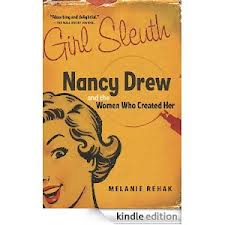
Girl SleuthSo, I was delighted when at a public library book sale I came across a “used” brand new copy of Girl Sleuth, Nancy Drew and the Women Who Created Her by Melanie Rehak.

Here was the story of Nancy’s origins, the brainchild of Edward Stratemeyer (1862-1930) who developed and ran a syndicate of writers of children’s fiction. I have only recently come to understand how much Stratemeyer influenced generations of young readers, myself included, by producing book series specifically geared to their interests.

He created the Tom Swift and The Hardy Boys series. He was responsible for the adventures of Nan, Bert, Flossie and Freddie in The Bobbsey Twins. Early in his writing career, Stratemeyer recognized that writing under different pseudonyms and with different publishers, he could offer more books each year. Unable to keep up with the demand for his stories, he began to outsource his work by hiring writers to complete stories he had outlined. By 1905, his book publishing syndicate mirrored the Henry Ford model of assembly linewriting; Stratemeyer editing the work of other writers who filled in the details from his summary notes.

It was Edward Stratemeyer that conceived of the young girl detective, and he developed five plots that he could offer a writer who could meet his exacting standards. Originally, the character Nancy Drew was named Stella Strong, and one of the plots that Stratemeyer developed was for Stella Strong at Mystery Towers:

How Stella visited the old Tower House and met the rich and eccentric maiden ladies, Patricia and Hildegarde Forshyne, who were much disturbed by unusual happenings about the place. She learns that some relatives are trying to get possession of the Forshyne fortune  Stella was once made a prisoner, but turned the tables and made a startling exposure (112).

Stratemeyer suggested other names for his new sleuth: Nell Cody, Nan Nelson, Diana Dare, Helen Hale, Nan Drew. The decision to expand Nan to Nancy was made by the publishing company Grosset & Dunlap who were enthused by this chance to have books for the growing market for young female readers. Stratemeyer had already decided that the pseudonym Carolyn Keene would be used for the series; each book would sell for fifty cents with two cents royalty going to his syndicate. From a number of applicants, he selected Mildred Wirt Benson, a “convention-flouting journalist” and agreed to pay her $125 for each manuscript (114). She, like all other writers in the Stratemeyer syndicate, signed away all rights to the stories and character.

Rehak’s extensive research clearly shows that Wirt was responsible for developing the character of Nancy Drew from the beginning. When Edward Stratemeyer passed away suddenly after the launch of the first Nancy Drew mystery, his daughter Harriet Stratemeyer Adams, took over the editing and eventually, the supervision of all things Nancy Drew. It was Wirt, however, who fleshed out the Nancy’s character against the backdrop of the Great Depression in 1930. Her Nancy was popular in school with two devoted friends, Bess and George. She was intelligent and attractive, moving stylishly between tweed suits and a “party frock of blue crepe which matched her eyes”. Blue was also the color of her little shiny roadster, a gift from her supportive father, Carson Drew. The mother figure, housekeeper Hannah Gruen, was also Wirt’s idea; the boyfriend Ned Nickerson came later in the series.

In recounting the success of the Nancy Drew series, Rehak notes that Wirt “later confessed  that Nancy Drew was “everything she -or any girl, in fact-wanted to be, and then some” (117). Rehak’s recounting of the success of the series is dampened by the deteriorating relationships in the Stratemeyer family, reduced pay for Wirt, and Harriet’s demands to keep the syndicate’s ghost writers from claiming their authorship.

Rehak also explores the other media ventures that featured Nancy Drew: TV series, movies, graphic novels, and a sordid connection to Playboy magazine.  Harriet’s control of her family’s publishing company’s intellectual property kept many of the writers like Wirt from claiming authorial attribution.

Subsequent revisions of Nancy Drew get less exploration by Rehak, who has little praise for the “loud flashy plots and clothing and crushes” that recent publishers have tried in order to “revamp the sleuth” (311). Nancy Drew’s back story is well organized by Rehak and a must read for all her fans who knew that it was not the plot that made the book exciting, but rather the “pleasure comes from her [Nancy Drew’s] autonomy, her taking events into her own hands”(307).

Rehak concludes with the feminist view that Nancy Drew was a guide for the ages as many of the problems for women (equal pay, inadequate day care, etc) still exist:

Nancy DrewThanks to Mildred and Harriet and the generation of women and girls who glimpsed in Nancy Drew a vision of what they might be someday, it doesn’t look like the sleuth is going away anytime soon, which is a good thing. There are fighting days still ahead of us, and we’re going to need her (314).

Perhaps this is why my memories of Nancy Drew are so salient, and my addiction forgivable. While my chores waited, Mildred Wirt Benson and Harriet Stratemeyer Addams offered me, and thousands of young girls like me, a role model.

So, Mom, I really was not hiding upstairs with a book…I was growing up.

Late August and early September means back to school for all students. Many primary school teachers are pulling out the traditional “apple” unit to welcome their students. Many of these teachers will be ready with “pumpkin”, also a fruit, for the following month of October. During the school year, teachers of all grade levels might find out that a lesson turned out to be a “lemon”, or one that is “not worth a fig.” Educational stakeholders can “cherry-pick” data to see if the efforts of a teacher “bears fruit”, while the focus on data-driven instruction can drive some teachers “bananas”.

Fruit metaphors are plentiful when discussing education, and a recent post by a friend and literacy specialist, Catherine Flynn, explains a possible reason. Consider that fruits, although uniform at first glance are, upon closer inspection, very different. Fruits flourish in different environments, and fruits require different nutrients. Fruits require different means of harvesting, and fruits ripen at different times.

blackberriesThis ripening was the point of Catherine’s blog post in her response to the Slice of Life blog challenge, a weekly prompt organized by Two Writing Teachers. Catherine’s response to their prompt on her Reading to the Core Blog was titled Ripe Blackberries.  Since she lives in a rural area, she had the opportunity to consider the ripening blackberries on a bush near her home:

 Each morning as I walk my dog, I notice that some of the fruit is deep black, as ripe as it’s going to get, while others still have just a hint of red. Why such variation on one bush? Each blackberry has gotten the same amount of rain and sun. Each one has the same genetic make up. So why are some ripening faster than others?

There are many forces in nature that cause the variations that Catherine noted as she admired the blackberry bush. These forces dictate the time for harvesting those blackberries, but this fruit is never uniformly ready for harvest at the same moment. For example, the advice for picking berries on several websites suggests that to “ensure that none of the fruit gets too ripe, berries should be picked every two or three days.” Berries are not the only fruit that may require a second or third harvest, and pinpointing the exact moment of any fruit’s maturity is a combination of science and practiced guessing.

In contrast to how nature influences fruit to ripen and mature, our educational system requires students to be “ripe” collectively at the same time, regardless of the variations in age, race, or gender of the students. The educational system measures how well a student meets a pre-determined standard through tests given on a prescribed date, picked perhaps years in advance. There is no accounting for arbitrary changes that may have happened in a school system, perhaps changes in staff, facility, or materials. There is no accounting for the arbitrary changes in a student’s personal life. Rather, there is a standardization for elements in our educational system that defies the individual nature of each student.

In her post Catherine notes:

Within every classroom, there will be a variety of strengths, abilities, and weakness. Students will arrive at school with a vastly different amounts of background knowledge and interests. Despite these differences, in the hands of a caring, knowledgable teacher in a supportive, nurturing environment, almost all children will learn and grow. Not at the same pace, and not to the same degree, but they will learn, just as most of the berries on those bushes will eventually ripen.

Screen Shot 2013-08-14 at 8.54.31 PM

Teachers see the differences in the nature of each student: the emotions, the ability, and the interests. Teachers see each student as more than a data point in achieving instruction, and teachers know that each student is more than what a test score represents. As Catherine suggests, in the hands of a caring and knowledgeable teacher, each student will learn and grow.

Yet, countering the forces in the nature of each student are the forces of educational reform that are increasing testing at every grade level. Tests focus on a limited range of skill sets with little consideration for other student aptitudes. To determine each student’s preparedness, students are bunched together by a “date of production” or birthdate, not when a student is “ripe” or cognitively mature.

Therefore, trying to compare student cognition through collective testing on any given day is the final metaphor of this post. It is like comparing apples to oranges. Yes, they are both fruit, but they are very different. So are our students.

A favorite New Yorker cartoon of mine is by Sidney Harris.

Screen Shot 2013-08-07 at 6.06.50 AMTwo men stand in front of a chalkboard. Their demeanor indicates they are mathematicians. Scrawled on the chalkboard to the left of them is step one, a complicated mathematical formula. To the right of them, step three, is the solution to that complicated formula. In the center of these numbers and symbols,one of the men is pointing to the phrase, “THEN A MIRACLE OCCURS…”.

Under the cartoon is the caption spoken by one of the mathematicians: “I think you need to be a little more explicit here in step two.”

There are so many scenarios that could be explained by this cartoon, but lately I have been thinking about how this cartoon represents the process of education. The missing “step two” is the miracle of how a teacher helps a student to learn, since by definition, a miracle is an extremely outstanding accomplishment. Good teaching is that miracle that blends both science and art. The science formula here is the diagnosis of student needs and the application of strategies that address these needs. The art is the manner in which a good teacher does both.

This blend of science and art is necessary since each student learns differently. Students’ brains are different. Students’ personalities are different. There are differences in how students mature physically and emotionally, and students’ learning styles are different. A great deal of time and energy has been expended in researching the science of teaching to address these differences.

For example, at the beginning of the 20th Century, researchers noted that those students who performed well on one type of test, say mathematics or verbal fluency, were also successful on other academic tests, while those who did poorly on one test tended to do poorly on other tests as well. British psychologist Charles Spearman, put forth a theory that a student’s mental performance across different could be consolidated in a single general ability rating, the g factor. In 1983, American developmental psychologist Howard Gardner countered with his Theory of Multiple Intelligences. He suggested that a measuring student’s intelligence should also include the following considerations:

Visual/Spatial – Involves visual perception of the environment, the ability to create and manipulate mental images, and the orientation of the body in space.
Verbal/Linguistic – Involves reading, writing, speaking, and conversing in one’s own or foreign languages.
Logical/Mathematical – Involves number and computing skills, recognizing patterns and relationships, timeliness and order, and the ability to solve different kinds of problems through logic.
Bodily/Kinesthetic – Involves physical coordination and dexterity, using fine and gross motor skills, and expressing oneself or learning through physical activities.
Musical – Involves understanding and expressing oneself through music and rhythmic movements or dance, or composing, playing, or conducting music.
Interpersonal – Involves understanding how to communicate with and understand other people and how to work collaboratively.
Intrapersonal – Involves understanding one’s inner world of emotions and thoughts, and growing in the ability to control them and work with them consciously.
Naturalist – Involves understanding the natural world of plants and animals, noticing their characteristics, and categorizing them; it generally involves keen observation and the ability to classify other things as well.

Gardner’s theory has been adopted by educators, including Sir Ken Robinson, an English author, speaker, and international advisor, who has stated that,

Many highly talented, brilliant, creative people think they’re not — because the thing they were good at at school wasn’t valued, or was actually stigmatized.

He has noted that organizing students by birthdate is not the best determiner of learning saying,

Students are educated in batches, according to age, as if the most important thing they have in common is their date of manufacture. 

Robinson advocates accounting for student differences in an educational system that has been standardized for ease of delivery, an educational system of definitions and measurement. Balancing these forces of measurement and definition in the science of good teaching demands another great force, the art of good teaching.

Good teachers practice the art of teaching in accounting for student differences in maturity, in personality, and in interest. Good teachers practice the art of teaching by choosing how to challenge or aid a student with new content. Good teachers practice the art of teaching when they distinguish between the look of confusion from a look of comprehension and respond appropriately. The art of teaching is knowing how to address the needs of the individual learner.

While there is a degree of science used in the “miracle” step two of the cartoon, the degree of art is trickier. Science is valuable to education as measuring the student; art is valuable to education because the art of teaching has an effect on the student that cannot be measured. The miracle of good teaching is a blend of the two, a blend of science and art for each individual student.

As to those mathematicians in the cartoon who need to be more explicit in step two? They should ask a teacher about performing miracles.

I hold up the book I will be reading aloud, Dr. Seuss’s The Cat in the Hat. The students start commenting:

This is one of my favorite books…
I love Thing #1 and Thing #2!
I (loved) or I (hated) the movie!
Can we read Green Eggs and Ham, too?

Cat in Hat book coverI settle the students down and begin,

“The sun did not shine.
It was too wet to play.
Just sit in the house all that cold, cold wet day.”

32 eyes blink brightly up at the pages as I turn them.
Several mouths move without sound to recite along with me.
The students are mesmerized.

Oh, did I mention that these are seniors in high school?

I am using a picture book to explain Freud’s theory of the Id, Ego and Superego (see post). Thing #1 and Thing #2 represent Id, and that righteous fish? The Superego. Yes, Dr. Seuss is great for psychological literary criticism, but he is not the only picture book in my repertoire of children’s literature used in high school. Here are a few of my favorites to use and why:

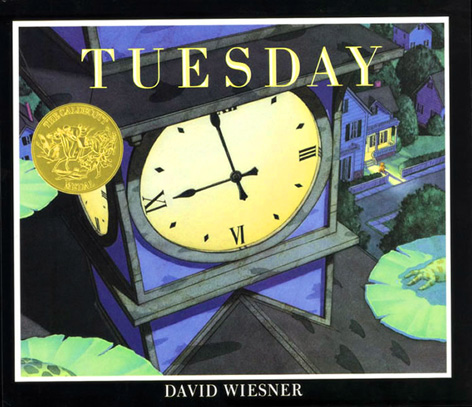
Tuesday by David Wiesner_CoverTuesday by David Weisner. We use this text for our 9th grade mythology unit because a myth explains the unexplainable. Our students have to create a myth for why frogs might lift off from a local pond and terrorize some inhabitants of a small town (see post).

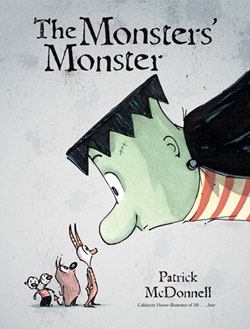
The Monsters’ Monster by Patrick McDonnell. This mash-up of the 1931 film Frankenstein and Mary Shelley’s 1818 novel is ideal to stimulate discussion on the relationship between a creator and the created. In McDonnell’s version, however, the Monster is sensitive, compassionate, with more of an interest in warm, powdered jelly doughnuts than in seeking vengeance…a nice break from the rigors of Advanced Placement English Literature.coverbook_monsters-monster

the-arrival-by-shaun-tanThe Arrival by Shaun Tan. Surreal images capture the point of view of an immigrant experience which makes this wordless text ideal for students who are studying Ellis Island or Angel Island. Many of the illustrations are available on the website so students can look at the haunting pictures on their own devices as well.

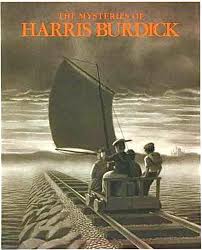
Harris BurdickThe Mysteries of Harris Burdick by Chris Van Allsburg. A book full of provocative images that has inspired thousands of stories explaining the mysteries in each sepia toned drawing. This book is wonderful for writing classroom, and there have been contests for the best stories written by children. Celebrated children’s authors have also taken an opportunity to try their imaginations using the pictures as story prompts in The Chronicles of Harris Burdick.

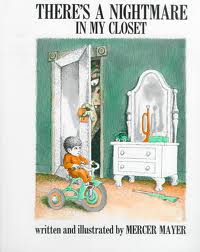
The Monster at the End of this Book by Jon Stone; illustrated by Mark Smollin and There’s a Nightmare in My Closet by Mercer Mayer. Both of these books have been incorporated into our Heroes and Monsters English IV (grade 12) elective. I use them as a starting point for an inquiry project about images of monsters given to children contrasted with the images of monsters we know as adults. Most students discuss the “fuzzy factor” with cute, loveable old Grover as something they remember fondly. They also remember very clearly the monster that lived in their closets. The anxiety of Mayer’s “Nightmare”, sobbing at the foot of the bed, usually brings about a discussion of facing fears.

grover

There are YouTube Videos for students to watch in advance of class (flipped classroom):  The Monster at the End of this Book and There’s a Nightmare in My Closet

Nightmare

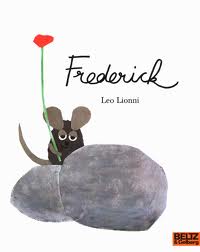
Fredrick

Fredrick by Leo Lionni. What does the poet do for society? This little fable answers that question and works well in any poetry unit. Frederick’s use of language paints pictures in the minds of the other mice who are struggling through a particularly bleak winter season. There is a delightful video recording of this to share in class or to have students watch on their own (flipped classroom).

The True Story of the Three Little Pigs by Jon Scieszka; illustrated by Lane Smith. Want a lesson on point of view? This retake of the three little pigs is one of the best ways to present the advantages of this literary device to students of all ages. In his explanation of the story, A. Wolf comes across the first little pig after the house of straw caved in. With culinary justification, he says,

True story“It seemed like a shame to leave a perfectly good ham dinner lying there in the straw. So I ate it up. Think of it as a cheeseburger just lying there.”


The story presents opportunities to use other fairy tales for students to practice retelling stories from another point of view once they buy into Scieszka’s formula.

Fables by Arnold Lobel. Here are modern little fables that are one page long with morals such as “It is the high and mighty that have the farthest to fall.” One year, I used these fables with my drama class as short sketches. My favorite sketch to watch was the story of the Lobster and the Crab where the insanely spirited Lobster took timid Crab out for a ride in a boat during a tremendous storm. When the boat capsized, the student playing Crab cried out in despair, “Horrors!” while the student playing Lobster jumped and shouted with glee.”Down we go!” she yelled at the top of her lungs.
FablesLobel writes:

The Crab was shaken and upset.
The Lobster took him for a relaxing walk along the ocean floor.
“How brave we are,” said the Lobster. “What a wonderful adventure we have had!”

The moral? “Even the taking of small risks will add to the excitement of life.”

The same can be said for using children’s literature in high school.
The use of a well-chosen picture book will add to the excitement of a lesson! Continue Reading…