Archives For November 30, 1999

I hold up the book I will be reading aloud, Dr. Seuss’s The Cat in the Hat. The students start commenting:

This is one of my favorite books…
I love Thing #1 and Thing #2!
I (loved) or I (hated) the movie!
Can we read Green Eggs and Ham, too?
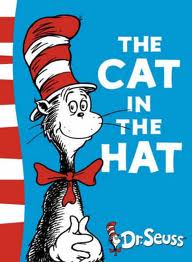
Cat in Hat book coverI settle the students down and begin,

“The sun did not shine.
It was too wet to play.
Just sit in the house all that cold, cold wet day.”

32 eyes blink brightly up at the pages as I turn them.
Several mouths move without sound to recite along with me.
The students are mesmerized.

Oh, did I mention that these are seniors in high school?

I am using a picture book to explain Freud’s theory of the Id, Ego and Superego (see post). Thing #1 and Thing #2 represent Id, and that righteous fish? The Superego. Yes, Dr. Seuss is great for psychological literary criticism, but he is not the only picture book in my repertoire of children’s literature used in high school. Here are a few of my favorites to use and why:
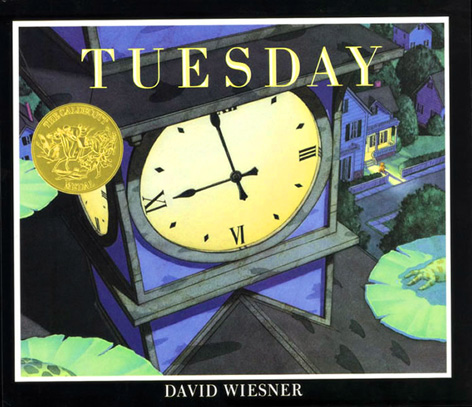
Tuesday by David Wiesner_CoverTuesday by David Weisner. We use this text for our 9th grade mythology unit because a myth explains the unexplainable. Our students have to create a myth for why frogs might lift off from a local pond and terrorize some inhabitants of a small town (see post).

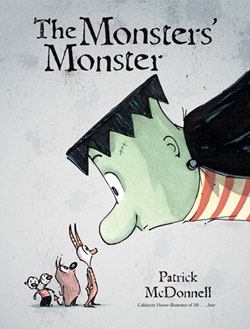
The Monsters’ Monster by Patrick McDonnell. This mash-up of the 1931 film Frankenstein and Mary Shelley’s 1818 novel is ideal to stimulate discussion on the relationship between a creator and the created. In McDonnell’s version, however, the Monster is sensitive, compassionate, with more of an interest in warm, powdered jelly doughnuts than in seeking vengeance…a nice break from the rigors of Advanced Placement English Literature.coverbook_monsters-monster
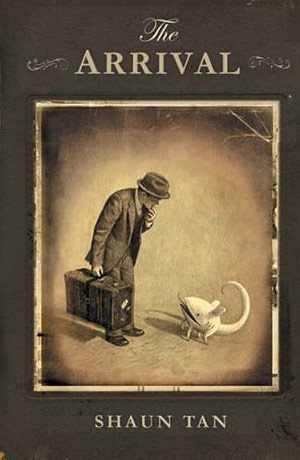
the-arrival-by-shaun-tanThe Arrival by Shaun Tan. Surreal images capture the point of view of an immigrant experience which makes this wordless text ideal for students who are studying Ellis Island or Angel Island. Many of the illustrations are available on the website so students can look at the haunting pictures on their own devices as well.
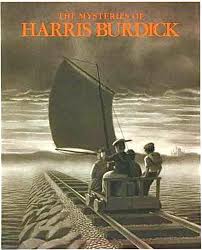
Harris BurdickThe Mysteries of Harris Burdick by Chris Van Allsburg. A book full of provocative images that has inspired thousands of stories explaining the mysteries in each sepia toned drawing. This book is wonderful for writing classroom, and there have been contests for the best stories written by children. Celebrated children’s authors have also taken an opportunity to try their imaginations using the pictures as story prompts in The Chronicles of Harris Burdick.

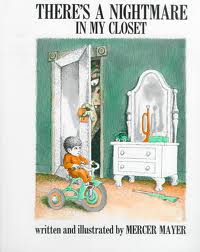
The Monster at the End of this Book by Jon Stone; illustrated by Mark Smollin and There’s a Nightmare in My Closet by Mercer Mayer. Both of these books have been incorporated into our Heroes and Monsters English IV (grade 12) elective. I use them as a starting point for an inquiry project about images of monsters given to children contrasted with the images of monsters we know as adults. Most students discuss the “fuzzy factor” with cute, loveable old Grover as something they remember fondly. They also remember very clearly the monster that lived in their closets. The anxiety of Mayer’s “Nightmare”, sobbing at the foot of the bed, usually brings about a discussion of facing fears.
grover

There are YouTube Videos for students to watch in advance of class (flipped classroom):  The Monster at the End of this Book and There’s a Nightmare in My Closet
Nightmare

Fredrick

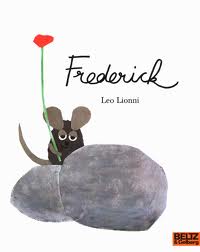
Fredrick by Leo Lionni. What does the poet do for society? This little fable answers that question and works well in any poetry unit. Frederick’s use of language paints pictures in the minds of the other mice who are struggling through a particularly bleak winter season. There is a delightful video recording of this to share in class or to have students watch on their own (flipped classroom).

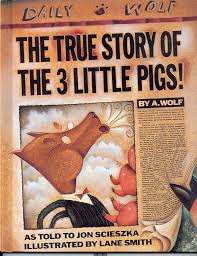
The True Story of the Three Little Pigs by Jon Scieszka; illustrated by Lane Smith. Want a lesson on point of view? This retake of the three little pigs is one of the best ways to present the advantages of this literary device to students of all ages. In his explanation of the story, A. Wolf comes across the first little pig after the house of straw caved in. With culinary justification, he says,

True story“It seemed like a shame to leave a perfectly good ham dinner lying there in the straw. So I ate it up. Think of it as a cheeseburger just lying there.”

The story presents opportunities to use other fairy tales for students to practice retelling stories from another point of view once they buy into Scieszka’s formula.

Fables by Arnold Lobel. Here are modern little fables that are one page long with morals such as “It is the high and mighty that have the farthest to fall.” One year, I used these fables with my drama class as short sketches. My favorite sketch to watch was the story of the Lobster and the Crab where the insanely spirited Lobster took timid Crab out for a ride in a boat during a tremendous storm. When the boat capsized, the student playing Crab cried out in despair, “Horrors!” while the student playing Lobster jumped and shouted with glee.”Down we go!” she yelled at the top of her lungs.
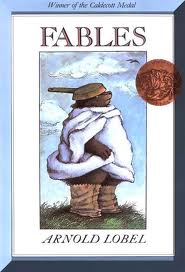
FablesLobel writes:

The Crab was shaken and upset.
The Lobster took him for a relaxing walk along the ocean floor.
“How brave we are,” said the Lobster. “What a wonderful adventure we have had!”

The moral? “Even the taking of small risks will add to the excitement of life.”

The same can be said for using children’s literature in high school.
The use of a well-chosen picture book will add to the excitement of a lesson! Continue Reading…

Read picture books.

Yes, I am talking to you.

(No, not you kids….)

I am talking to you….you, Advanced Placement English Literature teacher, pretentiously waving me off with your worn cover of Thomas Hardy’s Tess of the D’Urbevilles. Yes, you too..the one taking notes on Nathaniel Hawthorne’s The Scarlet Letter, the book you assigned for summer reading?

Time to do some other kind of reading.

Time to read for pleasure.

It’s time to wallow in Sendack (Maurice), Carle (Eric), and Seuss (Dr.).

Max Horton Ladybug

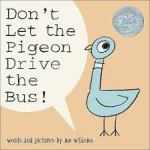
It’s time to discover Mo Williams’s Pigeon, Jon Scieszka’s Big Bad Wolf, and Jon Klassen’s hatless bear.

BearPigspigon

Why?

Primarily because teachers, all teachers, who are familiar with children’s literature can be positive role models for their students. They can engage students by making references to these books or they can make suggestions to young readers. They may even use them in lessons. But a new compelling reason has come out of a study by Jo Bowers and Dr Susan Davis, senior lecturers in primary education at Cardiff Metropolitan University. A review of responses by teacher trainees for primary grades indicates that reading children’s literature is good for your well-being.

An article in the British paper The Guardian Why Teachers Should Read More Children’s Books explains the study and promotes a paper Reflecting on Teacher Wellbeing that Bowers and Davis will give at Issues and Changing Perceptions conference in December 2013.

They had set up a year-long blog where teacher trainees could post reviews for three books they used with children over the course of the year. They then asked a focus group of these blog contributors a series of questions about their own reading experiences, such as, “What made you become a reader?”

The joys of reading became apparent, namely, how they had enjoyed “getting totally lost in a book” or “absorbed” by the narrative. It also became evident that they had close personal associations with certain texts from their own childhoods, and the fact that they could turn the page of a book and by knowing what was on that page gave them comfort and confidence to share that book with their class.

Trainee teachers reported they were using children’s books of all genres as a form of escapism from the stresses and strains of teaching in the primary classrooms. Researchers concluded that trainee teachers were using the book as a form of bibliotherapy, a therapy “increasingly moving away from its original medical model– whereby practitioners ‘prescribed’ self-help books to patients suffering from depression or eating disorders.” While the teacher trainees had to read the children’s literature selections as part of their professional development, they also found the experience pleasurable:

We have also found that trainee teachers often don’t read purely for pleasure, citing time constraints as the reason. Our blog project forced them to read as part of their professional development, and because they wanted to improve their subject knowledge. Wellbeing was secondary, but nonetheless became part of the project, almost by default. One of our students summed it up nicely: “Books are like best friends during stressful times.”

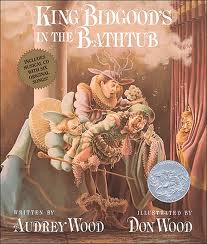
So, go ahead and pick up that copy of King Bidgood’s in the Bathtub and chant loudy the refrain “…and he won’t get out!”
Listen to the poetic wisdom of a small mouse who notes that everyone has a gift to bring in Leo Lionni’s Fredrick.
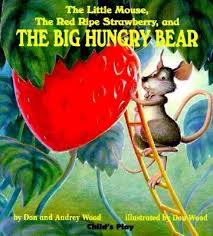
Or, share a red, ripe strawberry in The Little Mouse, The Big Hungry Bear and The Red Ripe Stawberry.

king Fredrick mouse

You will be reading for pleasure. You will be reading quickly, and you will probably feel better, things Thomas Hardy and Nathaniel Hawthorne may not do for you.

References according to The Guardian:

Jo Bowers and Dr Susan Davis are senior lecturers in primary education at Cardiff Metropolitan University. Follow them on Twitter: @Jo_Bowersand @drsuzyw. Reflecting on Teacher Wellbeing – Issues and Changing Perceptions conference will be held at Cardiff Metropolitan University on Wednesday 4 December 2013. For further information please contact:cseenterprise@cardiffmet.ac.uk.


Browsing at the Southport Pequot Library Book Sale, I overheard the following conversation:

“Why, here’s another book by Thackeray….”Pendennis”. Have you read that?”
“That’s a lovely read, but I’m not reading Thackeray this year; I told you that this is the summer I am reading Trollope.”
“Yes, you did..(*pause*)…Oh!…do we have a nice copy of “Ethan Frome”?”

Behind the two people conversing was a sign with an appropriate message:

Old (but Interesting) Books.

“Yes,”I thought, “that certainly was an interesting conversation about old books,”

The Pequot Library Book Sale
720 Pequot Avenue  Southport, CT 06890-1496  |  203.259.0346

Pequot library

Friday, July 26 to Tuesday, July 30, 2013
OVER 140,000 BOOKS, CDs, DVDs, RECORDS, etc.
Admission is FREE and all Sale proceeds benefit Pequot Library.
HOURS AND PRICING
Friday, July 26 9am to 8pm DOUBLE the marked price
Saturday, July 27 9am to 5:30pm Priced as marked
Sunday, July 28 9am to 5:30pm Priced as marked
Monday, July 29 9am to 6pm HALF the marked price
Tuesday, July 30 9am to 2pm $5 PER BAG DAY!
High quality books at reasonable prices
Visa, MasterCard, Discover, and American Express Accepted

Going to the Pequot Library in this small Fairfield County town reminds me of visiting my Grandma Rosie; she was eclectic, tousled and conversational with books and crosswords stacked around her armchair. This sale is equally eclectic, housed partially in a venerable mansion that is the main library and partially under the large white tents that cover the lawn.  Inside both the library and under the tents the books are laid out onto tables in rows, in stacks, in mounds; many tables bend with the weight and some books spill over to the boxes or tarps below.

As you shop, there are surprising little gems mixed in every genre. Admittedly, some of these surprises are probably due to volunteer book sorters who, when faced with the daunting task of organizing the 140,000 plus books, may have been a little unclear about the divide between fiction and non-fiction. What else could explain the placement of several copies of Mark Haddon’s The Curious Incident of the Dog in the Night Time on both the Fiction and the Animals and Nature Table? Or why would Dodie Smith’s I Capture the Castle be on the Art and Architecture table? But I quibble. Be polite and pretend that you are sorting though the library in Grandma Rosie’s house. Notice and enjoy the rich variety of texts available for purchase, regardless as to where they have been placed. Tidy the piles as you go, and you will be a welcome guest.

I secured a dozen hardly used copies of Cormac McCarthy’s All the Pretty Horses. The first time I read the book, I was so annoyed by the lack of punctuation for dialogue that I complained to several of my students. One student thoughtfully replied, “It’s like he is breaking down the walls between what is thought and what is spoken.” I have not complained about the lack of punctuation since.

New copies of All the Pretty Horses retail for $12.29 each and my 12 copies would have cost $147.48; I spent a total of $132.00 for four bags of books in addition to these copies. The titles I selected were mostly “replacement” books such as Harper Lee’s To Kill a Mockingbird, Cormac McCarthy’s The Road, Coehlo’s The Alchemist, Andersen’s Speak and Kesey’s One Flew over the Cuckoo’s Nest. I even purchased a number of copies of John Knowles A Separate Peace; I dislike the book, but the copies were too new to pass up, and the English I honors classes like the story. There were no copies of my target book The Help to be had, but I could have purchased a class set of 30 or more copies of Kidd’s The Secret Life of Bees.

Other notable qualities of the sale that provide hints to the character of Southport’s residents include:

  • an amazing array of cookbooks, many in pristine condition (may not be a good thing in a cookbooks; shouldn’t they be falling apart?)
  • well organized audio texts (someone knew his/her stuff!)
  • award-winning fiction seriously represented  (the Booker Prize, the National Book Award, the National Book Critics Circle Award, Pulitzer Prize, Newbery Medal, Nobel Prize for Literature, PEN/Faulkner Award, etc.)
  • a tremendously large section of biographies in the main library (My Grandma Rosie loved biographies as well…)
  • teachers from area schools are given vouchers (wish my school could be included??)

The drawbacks?

  • books under the table are hard to access and bending and straightening leads to awkward collisions of heads/buttocks/stomachs/elbows;
  • the children’s section was ransacked by…you guessed it…children;
  • not enough room around paperback fiction, while the romance section sat forlorn with wide aisle surrounding it;
  • the smell of the cookout is hard to bear on an empty stomach…be warned.

At the checkout line, the volunteers were characteristically more gracious than efficient. Your choice of books could be the start of a lovely conversation, but you should hasten the end of the pleasantries as long lines could be building behind you.
Like my Grandma Rosie, they understand, just as long as you promise to visit next year as well.

I love books.

While that is not the most eloquent statement about reading, the three word sentence communicates my desire to spend time with the writings of another.

In contrast to my simple declaration, there are are a number of very eloquent statements about the importance of books.  On my e-mail correspondence, I have a quote from the Victorian Scottish born essayist and historian Thomas Carlyle (1795-1881)

 “All that mankind has done, thought, gained, or been; it is lying as in magic preservation in the pages of books.”

I enjoy sharing that quote and two other facts about Thomas Carlyle:

Carlyle

Thomas Carlyle

1. He invented the word Eleutheromania: A mania or frantic zeal for freedom. If I were to use this word in a sentence, I would write, “At the conclusion of every school year, I suffer a serious case of Eleutheromania.”

2. He and his wife were very unhappy. They were so unhappy that the author Samuel Butler said of their marriage: “It was very good of God to let Carlyle and Mrs Carlyle marry one another, and so make only two people miserable and not four.”

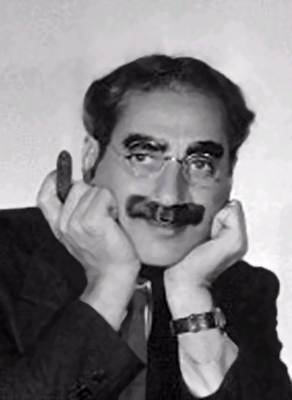
I also have a favorite funny quote about reading books. This quote is by the brilliant comedian Groucho Marx (1890-1977) and is spelled out in big gold letters on one of my book bags:

groucho-marx-on-reading-21664922

Groucho Marx

”Outside a dog, a book is man’s best friend. Inside a dog, it’s too dark to read.”

I get a number of people who look at my bag from a distance, I see their lips move as they read the joke aloud…and then I see them smile when they understand. Groucho’s humor is timeless.

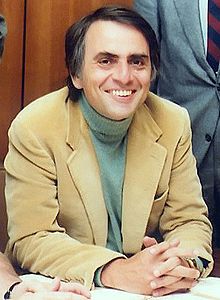
Sagan

Carl Sagan

By far the most eloquent comment I have ever read about reading books, however, comes from Carl Sagan (1934-1996).  Sagan was was an American astronomer, astrophysicist, cosmologist, and author who relentless promoted science. His brilliant TV series in the 1980s Cosmos received critical acclaim and gave over a reported 500 million viewers a new perspective on the size and scope of the universe and the relative size of planet Earth in comparison.  The 11th episode was titled “The Persistence of Memory” and in this episode Sagan stated the following:

“What an astonishing thing a book is. It’s a flat object made from a tree with flexible parts on which are imprinted lots of funny dark squiggles. But one glance at it and you’re inside the mind of another person, maybe somebody dead for thousands of years. Across the millennia, an author is speaking clearly and silently inside your head, directly to you. Writing is perhaps the greatest of human inventions, binding together people who never knew each other, citizens of distant epochs. Books break the shackles of time. A book is proof that humans are capable of working magic.”

A book reaches across the millennia. An author is in your head speaking to you. Books bind people together.

Astonishing indeed, and reason enough to say, “I love books.”

This past week, I wrote a blog post that critiqued the results of The National Assessment of Educational Progress (NAEP) 2013 test. There was a 2% growth in reading scores over the past 41 years for students at age 17.
A 2% increase.
That’s all.
Billions of dollars, paper piles of legislation, incalculable time…..and the result has been an abysmal 2% increase.

In a subsequent post, I wrote how NAEP also provided data to prove independent reading was the key to improving test scores. NAEP reported that students who claimed to read for fun scored higher on standardized tests with the obvious conclusion that the more time a student spent reading, the higher the student’s score. This information, included in a report that demonstrated a failure of reading programs, offered a possible solution for increasing reading scores: adopt a no-cost, read for fun initiative in order to improve results.

I tweeted out the the link to my post:

2013 NAEP Tests show only 2% growth in reading by age 17 UNLESS students “read for fun”

I received this tweet in response:

 http://www.reading-rewards.com is a lovely site to use when you want to encourage kids to read for fun

So, I went to the Reading Rewards website, but I had some concerns. The headline banner read:“The Reward is in the Reading”, certainly a noble sentiment. However, below this banner was the text that read:

Parents & Teachers:
We know all about the rewards that reading offers, but sometimes our more reluctant readers need a little extra incentive. The Reading Rewards online reading log and reading incentive program helps make reading fun and satisfying. Find more about Reading Rewards’s benefits for parents and teachers.

The concept of an incentive program or reading for “rewards” is not reading for fun. Reading for pleasure should be the only incentive, and offering incentive programs can be counter-productive. Consider education advocate Alfie Kohn‘s explanation of his research that illustrates why incentivized reading programs are not successful:

The experience of children in an elementary school class whose teacher introduced an in-class reading-for-reward program can be multiplied hundreds of thousands of times:

The rate of book reading increased astronomically . . . [but the use of rewards also] changed the pattern of book selection (short books with large print became ideal). It also seemed to change the way children read. They were often unable to answer straight-forward questions about a book, even one they had just finished reading. Finally, it decreased the amount of reading children did outside of school.

Notice what is going on here. The problem is not just that the effects of rewards don’t last. No, the more significant problem is precisely that the effects of rewards do last, but these effects are the opposite of what we were hoping to produce. What rewards do, and what they do with devastating effectiveness, is to smother people’s enthusiasm for activities they might otherwise enjoy.

Kohn’s explanation in his A Closer Look at Reading Incentive Programs (Excerpt from Punished by Rewards 1993/1999) illustrates the problems that develop for late middle school and high school teachers (gr 7-12) experience once elementary students have experienced a reward program with their reading. Students who are conditioned to read for any kind of reward develop a Pavlovian response. They learn to expect a reward; once the reward is removed, however, they lose interest.

Sadly, most students are already in a “quid pro quo” educational experience. Even in elementary school, students are conditioned to want a grade for every activity. Matt Groening, creator of The Simpsons poked fun of this conditioned response for constant feedback in one episode when Springfield’s teachers went out on strike, and a distraught Lisa begged her mother, Marge, to “grade her”:

“Grade me! Look at me! Evaluate and rank me!
I’m good, good, good and oh so smart!
GRADE ME!”

LISA: "Grade me! Look at me! Evaluate and rank me! I’m good, good, good and oh so smart! GRADE ME!"

LISA: “Grade me! Look at me! Evaluate and rank me! I’m good, good, good and oh so smart! GRADE ME!”

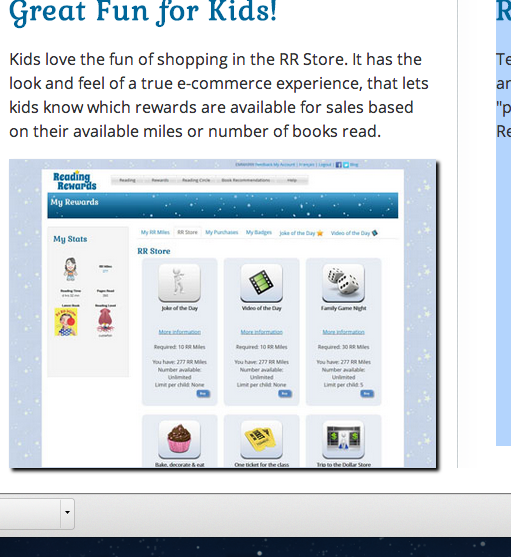
While grades are not the currency for this website, Reading Rewards is perfectly positioned to be a commercial enterprise with language on the site promoting the RR “store” and “e-commerce”.  This initial shopping experience may be for some trinket in a teacher’s box, a homework pass, or a pizza party, but the potential for “shopping” on this site is certainly a possibility.

Here is the promotional text for teachers:

Screen Shot 2013-07-10 at 10.43.43 AM

The website advises teachers what items to have for students to “purchase”, and even suggests major retailers i-Tunes and Amazon:

Reward Ideas
Teachers and parents can create any reward they want and define how many RR miles are required to “purchase” each reward. Here are some ideas of Rewards selected by many of our users:

  • Movie night at home
  • Movie in the theater
  • Family game night
  • Sleepover with friends
  • Trip to the dollar store
  • Prize draw from a treasure box
  • Extra tickets for a classroom raffle
  • The right to choose the dessert after dinner
  • Make/decorate/eat cupcake session
  • Amazon credit
  • iTunes credit
  • Game console time

Again, Kohn believes that in teaching students to read, incentives should not be used. Instead he notes:

But what matters more than the fact that children read is why they read and how they read.  With incentive-based programs, the answer to “why” is “To get rewards,” and this, as the data make painfully clear, is often at the expense of interest in reading itself.

So while the key to independent reading is the key to raising reading scores, students should not be raising profits for software companies as well. There are other features on this software that are admirable. The site includes places for reading logs, creating reading wish lists, and peer sharing reviews, but those features could be accomplished on a (free) blog or wiki without the distractions of prizes or rewards.

I do not fault the teacher who was well-intended when she tweeted out this website. She wants students to read for fun. The NAEP report proves that independent reading can effectively raise scores when the reading is self-motivated reading for pleasure. Teachers should question, however, when reading for fun is linked to reading with “funds”.

The release of the National Assessment of Educational Progress (NAEP) Progress Report for 2012  (“Nation’s Report Card”) provides an overview on the progress made by specific age groups in public and private schools in reading and in mathematics since the early 1970s. The gain in reading scores after spending billions of dollars, countless hours and effort was a measly 2% rise in scores for 17-year-olds. After 41 years of testing, the data on the graphs show a minimal 2% growth. After 41 years, Einstein’s statement, “Insanity is doing the same thing repeatedly and expecting different results,” is a confirmation that efforts in developing effective reading programs have left the education system insane.

The rather depressing news from NAEP in reading scores (detailed in a previous blog) could be offset, however, by information included in additional statistics in the report. These statistics measure the impact of “reading for fun” on student test scores. Not surprisingly, the students who read more independently, scored higher. NAEP states:

Results from previous NAEP reading assessments show students who read for fun more frequently had higher average scores. Results from the 2012 long-term trend assessment also reflect this pattern. At all three ages, students who reported reading for fun almost daily or once or twice a week scored higher than did students who reported reading for fun a few times a year or less

The irony is that reading for fun is not measured in levels or for specific standards as they are in the standardized tests. For example, the responses in standardized tests are measured accordingly:

High Level readers:

  • Extend the information in a short historical passage to provide comparisons (CR – ages 9 and 13)
  • Provide a text-based description of the key steps in a process (CR)
  • Make an inference to recognize a non-explicit cause in an expository passage (MC – age 13)
  • Provide a description that includes the key aspects of a passage topic (CR – ages 9 and 13)

Mid Range Readers:

  • Read a highly detailed schedule to locate specific information (MC – age 13)
  • Provide a description that reflects the main idea of a science passage (CR – ages 9 and 13)
  • Infer the meaning of a supporting idea in a biographical sketch (MC – ages 9 and 13)
  • Use understanding of a poem to recognize the best description of the poem’s speaker (MC)

Low Level Readers:

  • Summarize the main ideas in an expository passage to provide a description (CR – ages 9 and 13)
  • Support an opinion about a story using details (CR – ages 9 and 13)
  • Recognize an explicitly stated reason in a highly detailed description (MC)
  • Recognize a character’s feeling in a short narrative passage (MC – age 13)

(CR Constructed-response question /MC Multiple-choice question)

Independent reading, in contrast, is deliberately void of any assessment. Students may choose to participate in a discussion or keep a log on their own, but that is their choice.  The only measurement is a student’s willingness to volunteer the frequency of their reading, a form of anecdotal data.

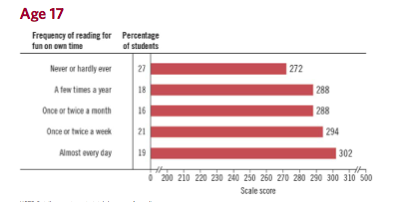
According to the graph below (age 17 only), students who volunteered that they read less frequently were in the low to mid-level ranges in reading. Students who volunteered that they read everyday met the standards at the top of the reading scale.

Graph showing that 17-year-olds who read for fun score higher on standardized tests

#1 Graph showing that 17-year-olds who read for fun score higher on standardized tests

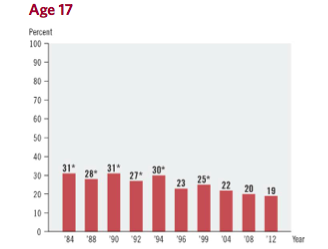
Sadly, this NAEP data recorded a decline in reading for fun over the last 17 years-exactly the age of those students who have demonstrated only a 2% increase in reading ability. The high number of independent readers (“reading for fun”) was in 1994 at 30%.

Steady decline  in the number of 17- year-old students who say that they  "read for fun."

#2 Steady decline in the number of 17- year-old students who say that they “read for fun.”

So what happened the following years, in 1995 and 1996, to cause the drop in students who read voluntarily? What has happened to facilitate the steady decline?

In 1995 there were many voices advocating independent reading: Richard Allington, Stephen Krashen, and Robert Marzano. The value of independent reading had been researched and was being recommended to all districts.

Profit for testing companies or publishing companies, however, is not the motive in independent reading programs.There are no “scripted” or packaged or leveled programs to offer when students choose to “read for fun”, and there is no test that can be developed in order to report a score on an independent read. The numerical correlation of reading independently and higher test scores (ex: read 150 pages=3 points) is not individually measurable; and districts, parents, and even students are conditioned to receiving a score. Could the increase of reading programs from educational publishers with leveled reading box sets or reading software, all implemented in the early 1990s, be a factor?

Or perhaps the controversy on whole language vs. phonics, a controversy that raged during the 1990s, was a factor? Whole language was increasingly controversial, and reading instructional strategies were being revised to either remove whole language entirely or blend instruction with the more traditional phonics approach.

The sad truth is that there was plenty of research by 1995 to support a focus on independent “reading for fun” in a balanced literacy program, for example:

Yet seventeen years later, as detailed in the NAEP report of 2012, the scores for 17-year-old students who read independently for fun dropped to the lowest level of 19%. (chart #2)

While the scores from standardized testing over 41 years according to the NAEP report show only 2% growth in reading, the no cost independent “reading for fun” factor has proven to have a benefit on improving reading scores. Chart #1 shows a difference of 30 points out of a standardized test score of 500 or a 6% difference in scores between students who do not read to those who read daily. Based on the data in NAEP’s report, reading programs have been costly and yielded abysmal results, but letting students choose to “read for fun” has been far less costly and reflects a gain in reading scores.

The solution to breaking this cycle is given by the authors of The Nation’s Report Card. Ironically, these authors are assessment experts, data collectors, who have INCLUDED a strategy that is largely anecdotal, a strategy that can only be measured by students volunteering information about how often they read.

The choice to include the solution of “reading for fun” is up to all stakeholders-districts, educators, parents, students. If “reading for fun” has yielded the positive outcomes, then this solution should take priority in all reading programs. If not, then we are as insane as Einstein said; in trying to raise reading scores through the continued use of reading programs that have proven to be unsuccessful, we are “doing the same thing repeatedly and expecting different results.”

I recently had to write a position statement on assessment and evaluation.  The timing of this assignment, June 2013, coincided with the release of the National Assessment of Educational Progress (NAEP) Progress Report for 2012. This “Nation’s Report Card” provides an overview on the progress made by specific age groups in public and private schools in reading and in mathematics since the early 1970s.

Since NAEP uses the results of standardized tests, and those standardized tests use multiple choice questions, here is my multiple choice question for consideration:

Based on the 2012 NAEP Report results, what difference(s) in reading scores separates a 17-year-old high school student in 1971 from a 17-year-old high school student in 2012?

a. 41 years
b. billions in dollars spent in training, teaching, and testing
c. a 2 % overall difference in growth in reading
d. all of the above

You could act on your most skeptical instincts about the costs and ineffectiveness of standardized testing and make a calculated guess from the title of this blog post or you could skim the 57 page report (replete with charts, graphs, graphics, etc) that does not take long to read, so you could get the information quickly to answer correctly: choice “D”.

Yes, 41 years later, a 17-year old scores only 2% higher than a previous generation that probably contained his or her parents.

There have been billions of dollars invested in developing reading skills for our nation’s children. In just the last twelve years, there has been the federal effort in the form of Reading First, the literacy component of President Bush’s 2001 “No Child Left Behind” Act. Reading First initially offered over $6 billion to fund scientifically based reading-improvement efforts in five key early reading skills: phonemic awareness, phonics, fluency, vocabulary, and comprehension. The funding of grants for students enrolled in kindergarten through grade three in Title I Schools began in 2002-2003.

There have been individual state initiatives that complement Reading First, funded by state legislatures, such as:

There have been efforts to improve literacy made by non-profit educational corporations/foundations such as The Children’s Literacy Initiative, the National Reading Panel, and a Born to Read initiative from the American Library Association. In addition, there have been a host of policy statements from The National Council of Teachers of English and programs offered by the National Writing Project that have helped to drive attention towards the importance of reading.

All of these initiatives drove publishers of educational materials to create programs, materials and resources for educators to use. Unfortunately, the question of which reading program would prove most effective (Direct Instruction, Reading Recovery, Success for All and others) became a tangled controversy as charges of conflicts of interest between the consultants who had been hired by the Department of Education (DOE) and who trained teachers and state department of education personnel had also authored reading programs for curriculum. Fuel to this controversy was added when a review in 2006 by the DOE’s Inspector General suggested that the personnel in the DOE had frequently tried to dictate which curriculum schools must use with Reading First grant money.

Trying to improve our our students’ reading scores has been the focus so much so that our education systems have been awash in funding, materials, initiatives and controversies since 2001 in our collective to improve reading for students…and the result?

The result is a measly 2% of growth in reading for those leaving our school systems.

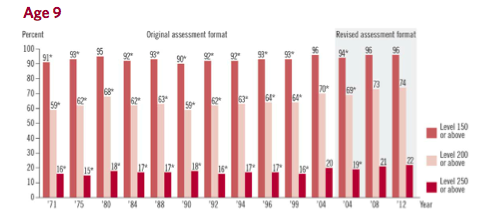
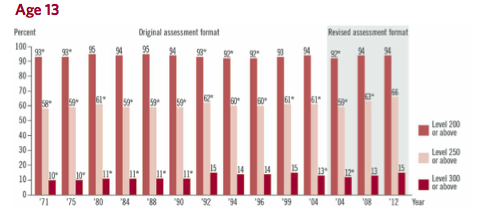
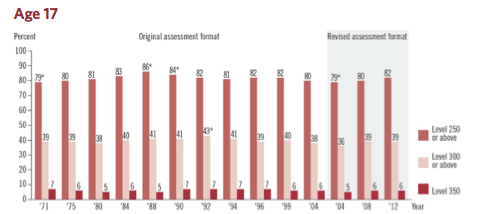
The evidence for this statement has been tracked by NAEP, an organization that has been assessing the progress of  9-, 13-, and 17-year-olds in reading. The graphs below taken from the NAEP report measure annual growth at each age level at the high level 250, mid level 200, and low level 150 of reading.  There are other levels measured for highest or lowest achieving students, but the levels measured on the graphs levels are correlated to the following descriptions:

LEVEL 250: Interrelate Ideas and Make Generalizations
Readers at this level use intermediate skills and strategies to search for, locate, and organize the information they find in relatively lengthy passages and can recognize paraphrases of what they have read. They can also make inferences and reach generalizations about main ideas and the author’s purpose from passages dealing with literature, science, and social studies. Performance at this level suggests the ability to search for specific information, interrelate ideas, and make generalizations.

LEVEL 200: Demonstrate Partially Developed Skills and Understanding
Readers at this level can locate and identify facts from simple informational paragraphs, stories, and news articles. In addition, they can combine ideas and make inferences based on short, uncomplicated passages. Performance at this level suggests the ability to understand specific or sequentially related information.

LEVEL 150: Carry Out Simple, Discrete Reading Tasks
Readers at this level can follow brief written directions. They can also select words, phrases, 9 or sentences to describe a simple picture and can interpret simple written clues to identify a common object. Performance at this level suggests the ability to carry out simple, discrete reading tasks.

Screen Shot 2013-06-29 at 7.52.04 PM

The NAEP report does offer some positive developments. For example, from 1971-2012, reading scores for 9-year-olds have seen an increase of 5% in students reading at the lower (150) level, an increase of 15% for students reading at mid-range (200), and an increase of 6% for students reading at the higher (250) level.

Screen Shot 2013-06-29 at 7.52.16 PMSimilarly, reading scores for 13-year olds have increased 8% for students reading at mid-level, and 5% for students at the higher level. Scores for student reading at the lower level, however, saw a negligible increase of only 1%.

At this point, I should note that the NAEP report does contain some positive finding. For example, the measurements indicate that the gaps for racial/ethnic groups did narrow in reading over the past 41 years. According to the report:

Even though White students continued to score 21 or more points higher on average than Black and Hispanic students in 2012, the White – Black and White – Hispanic gaps narrowed in comparison to the gaps in the 1970s at all three ages. The White – Black score gaps for 9- and 17-year-olds in 2012 were nearly half the size of the gaps in 1971.

Unfortunately, even that positive information should be considered with the understanding that most of these gains for racial and ethnic groups were accomplished before 2004.

Finally, for students leaving public and private school systems, the overall news is depressing. Any gains in reading in ages 9 and 13, were flattened by age 17. The growth for students reading at higher level dropped from 7% to 6%, while the  percentage of mid-range readers remained the same at 39%. The gains of 3% were in the scores of lower range readers, from 79% to 82%. Considering the loss of 1% at the higher end, the overall growth in measurement is that measly 2%.

Screen Shot 2013-06-29 at 7.55.37 PM

That’s it. A financial comparison would be a  yield $.02 for every dollar we have invested. Another comparison is that for every 100 students, only two have demonstrated improvement after 13 years of education.

Assessing the last 12 of the 41 years of measuring reading initiatives illustrates that there has been no real progress in reading as measured by standardized tests in our public and private education institutions grades K-12. NAEP’s recounting of the results after considerable funding, legislation, and effort, is as Shakespeare said, “a tale…full of sound and fury, signifying nothing.”

Continue Reading…

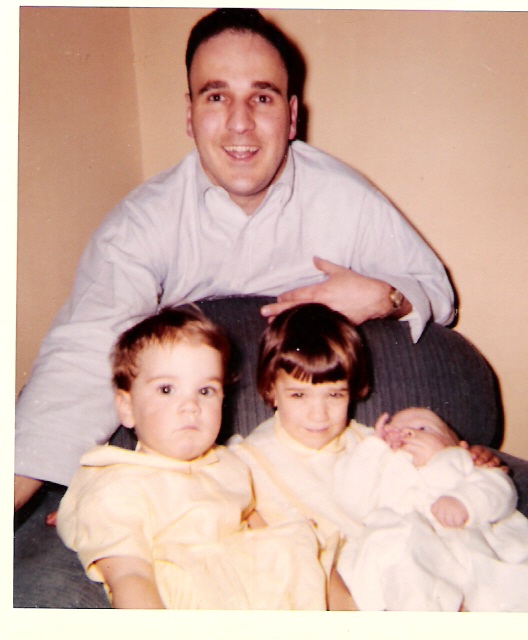
Dad-Peg, Colleen, Colette -59

Dad with first three daughters (I am in the middle); we were fortunate to have his read alouds more frequently

My father was a reader, and he read bedtime stories to us. Of course, the older children, my four sisters and I, will recollect many more occasions when my father read a bedtime story while the younger children, the remaining four, have fewer memories. Yes, there were nine of us, and the limited number of hours after work combined with the challenges in getting a houseful of children through meals, chores, and school work, made story time with our father less and less frequent. When he did have the time and energy to read aloud, however, we were mesmerized. Part actor-all salesman, he knew how to make a story come alive.

He had read very broadly when he was a child because he had been confined for long periods to hospital beds due to a handicapped leg. He was knowledgeable on the children and young adult literature available from 1928 on, and he was quick to make a recommendation.

“The black spot!” he would dramatically intone, “in the Tavern of the Black Dog, it was the blind man who delivered the the black spot!” This was enough to send shivers into me and me over into Robert Louis Stevenson’s Treasure Island.

“Madame Defarge…” he would growl, “Madame Defarge and her knitting.” He would lower his voice conspiratorially, daring me to discover the dark secrets of Charles Dickens’s Madame Defarge from A Tale of Two Cities years before it was assigned in high school.

He started my sisters and me on A.A. Milne’s House at Pooh Corner reading different stories aloud before we went to bed. “Poohsticks” was our collective favorite, and we demanded the tale because of the way he would read the funniest line in the story. The characters from Pooh Corner were playing a game that involved tossing sticks over one side of the bridge and running to the opposite side waiting to see whose stick would be first to float out from under a bridge. My father would read each character’s voice with only a shade of difference in voice, but he understood how to create suspense from Milne’s language:

“It’s coming!” said Pooh.
“Are you sure it’s mine?” squeaked Piglet excitedly.
“Yes, because it’s grey. A big grey one. Here it comes!
A very–big–grey—- Oh, no, it isn’t, it’s Eeyore.”
And out floated Eeyore.

He would pause there for our mutual astonishment and laughter. No matter how often he told this story, we were surprised and delighted to find that Eeyore had been bounced into the the river, and that once he was “washed” over to the riverbank, Piglet would make the obvious conclusion:

“Oh, Eeyore, you are wet!” said Piglet, feeling him.

My father read folklore to us. He read Uncle Remus’s tongue twisting dialect of B’rer Rabbit and B’rer Bear, and so we knew the allusion of “tossing someone in dat brier-patch”. We learned how to never bet against a turtle, a lesson from Remus’s Old Man Tarrypin, or the famous race between turtle and hare from Aesop. We learned about John Bunyan and his blue ox, Babe; Pecos Bill and the rattlesnake; and the Legend of Sleepy Hollow.

He started me on the Bobbsey Twin series, and after addicting me to Freddie, Flossie, Nan and Bert, he recommended other series: the Boxcar Children, the Hardy Boys, and finally Nancy Drew.

“How was The Sign of the Twisted Candles?  Nancy’s little blue coupe?” he would ask. “The Password to Larkspur Lane?” He seemed so knowledgable, I was convinced he had read every one, not realizing the successful formula that the Carolyn Keene enterprise used was reused in every mystery. Nancy would solve the crime and discuss the solution with her father, Carson Drew; I would retell the solution to mine.

My father also gave me Little Women at the exact right age, and I am convinced that Louisa Alcott’s story was a “girl” book he had read. He was familiar with feminine concerns of the March girls perhaps because he had several older sisters himself, but he knew the details about Jo’s ambitions to be a writer, and Mr. Baer’s umbrella too well to have only a passing understanding.

I tore through the canon he knew, and soon he was floundering a bit with suggestions. One night, he  tossed a copy of Alistair MacLean’s The Guns of Navarone at me after we had watched the movie on TV. At age 12, I became a reader of espionage, and we found mutual enjoyment from Clive Cussler, Robert Ludlam, and Ken Follett.

He also listened to suggestions from others, and one Christmas I found a copy of Madeline L’Engle’s A Wrinkle in Time before it had received the Newbery Award. He knew enough about me to know that I would love the story, and I did. I loved to read.

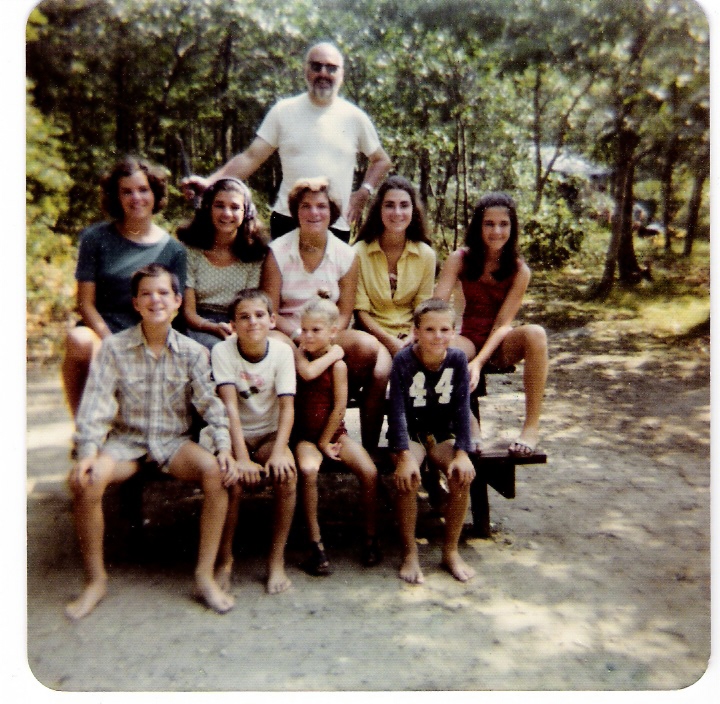
Group Camping with KKC '76

Dad with his nine (six girls; three boys) on a camping trip.

Kevin K. Connolly passed away in 1990 at the age of 62, leaving a void in all his children’s lives that we try to fill with stories about him. When I read “Poohsticks” aloud to my own sons, I heard his voice.

There are many gifts a father can give a child, but a love of reading is a powerful gift. On this Father’s Day, I pay tribute to the man who gave me life, and who made that life infinitely richer by making me a reader. Thank you, Dad; you were a great reader, you were an amazing father.

Screen Shot 2013-06-05 at 4.32.55 PMWhile some of my students have no problem cracking open a good book over the summer, others might prefer an audio text. That is why when I found the SYNC audiobook website, I was delighted to spread the word (and recorded voices) about great literature available all summer long. I have challenged my students to read (listen) with me all summer!

SYNC has organized a summer full of classics paired with young adult (YA) texts that are similar in theme. Each pairing is available only for a download for a short period of time, but once a reader downloads the MP3 files, the audiobook is available for listening at any time.

The software that makes this offer possible is  Overdrive Media Software that can be installed on a computer (compatible with Windows and Mac) or through an Overdrive App on a mobile device (compatible with iOS, Android, BlackBerry, Windows Phone 7).

Visit the OverDrive website to download the App or Software.

I have already listened to the full cast production of Shakespeare’s The Tempest, and enjoyed the dramatization. My familiarity with this play (I teach this every fall to my Advanced Placement Literature students) may influence how I think a student hearing the production for the first time might understand the plot. I hope they can follow some of the plot intricacies.

Screen Shot 2013-06-05 at 4.29.30 PMI was surprised that the play was paired with Of Poseidon, a romantic fantasy involving a independent and beautiful Emma and her strange encounters with the incredibly handsome Gaylen.  I would have paired this book with Romeo and Juliet because the inferences about clan conflicts are too frequent not to imagine “two houses both alike in dignity, in the fair ocean where we lay our scene.” This debut novel by Anna Banks addresses mermaid lore, the legend of Atlantis, and forbidden love on the Jersey Shore. Unlike the TV show, listeners are 75% into the book before the first kiss; there is a great deal of “raising her chin with his fingers” and “cheek-stroking” to keep romantics hopeful. The reader (Rebecca Gibel) was also excellent, lacing some of the more exclamatory phrases with the right amounts of sarcasm or ruefulness.  My only complaint was that this novel is the first in a series. As I got closer to the end of the recording, I began to realize that this novel was the “introductory”, a sentiment seconded by this reviewer:

This book also ends in a most inopportune place. I get it – we’re being set up for the second book – but this book sort of has this massive reveal and then BAM we’re at the end. I’d seen enough people’s reactions, though, to expect it, so I wasn’t quite as upset as some readers have been with the abrupt ending. Still, not a whole lot is resolved in this book, and I have a problem with a book that didn’t seem to have much of a point aside from setting up for the next one. (Merin; Amazon Book Review)

Complaining about a free download, however, seems ungrateful. Like the reviewer, I enjoyed the novel very much, so much that I was annoyed when all the loose ends were not resolved. Obviously, this is one way for SYNC to market additional texts. In this case, the strategy will work; I probably will purchase the sequel.

The schedule for titles downloads during this summer is listed below:

May 30 – June 5, 2013
Of Poseidon by Anna Banks, read by Rebecca Gibel (AudioGO)
The Tempest by William Shakespeare, read by a Full Cast (AudioGO)

June 6 – June 12, 2013
The Incorrigible Children of Ashton Place, Book 1: The Mysterious Howling by Maryrose Wood, read by Katherine Kellgren (HarperAudio)
Jane Eyre by Charlotte Brontë, read by Wanda McCaddon (Tantor Audio)

June 13 – June 19, 2013
The Raven Boys by Maggie Stiefvater, read by Will Patton (Scholastic Audiobooks)
Bless Me, Ultima by Rudolfo Anaya, read by Robert Ramirez (Recorded Books)

June 20 – June 26, 2013
Once by Morris Gleitzman, read by Morris Gleitzman (Bolinda Audio)
Letter From Birmingham Jail by Martin Luther King, Jr., read by Dion Graham (christianaudio)

June 27 – July 3, 2013
Rotters by Daniel Kraus, read by Kirby Heyborne (Listening Library)
Frankenstein by Mary Shelley, read by Jim Weiss (Listening Library)

July 4 – July 10, 2013
Carter Finally Gets It by Brent Crawford, read by Nick Podehl (Brilliance Audio)
She Stoops to Conquer by Oliver Goldsmith, read by a Full Cast (L.A. Theatre Works)

July 11 – July 17, 2013
The Peculiar by Stefan Bachmann, read by Peter Altschuler (HarperAudio)
Oliver Twist by Charles Dickens, read by Simon Vance (Tantor Audio)

July 18 – July 24, 2013
Grave Mercy by Robin LaFevers, read by Erin Moon (Recorded Books)
Hamlet by William Shakespeare, read by a Full Cast (L.A. Theatre Works)

July 25 – July 31, 2013
The False Prince by Jennifer A. Nielsen, read by Charlie McWade (Scholastic Audiobooks)
The Prince and the Pauper by Mark Twain, read by Steve West (Blackstone Audio)

Aug 1 – Aug 7, 2013
Death Cloud by Andrew Lane, read by Dan Weyman (Macmillan Audio)
The Adventures of Sherlock Holmes by Arthur Conan Doyle, read by Ralph Cosham (Blackstone Audio)

Aug 8 – Aug 14, 2013
Enchanted by Alethea Kontis, read by Katherine Kellgren (Brilliance Audio)
Through the Looking Glass by Lewis Carroll, read by Miriam Margolyes (Bolinda Audio)

Aug 15 – Aug 21, 2013
Sold by Patricia McCormick, read by Justine Eyre (Tantor Audio)
Let Me Stand Alone by Rachel Corrie, read by Tavia Gilbert (Blackstone Audio)

I am looking forward to a summer full of great audiotexts, and I hope my students will take advantage as well. Thank you, SYNC!

 I hear the chatter from elementary school teachers: 
  • They can’t wait for reading!
  • Oh, they love to read!
  • When we have to cancel reading, they are so disappointed.

Yet, what happens when I get the ninth graders in my class? I hear:

  • Reading is so boring.
  • I hate to read.
  • I don’t like reading.

What caused the change in students’ attitude towards reading?

97%

Reading Speed Limit?

I have been attending graduate courses on reading instruction for pre-K-6 in order to find out the reason for the shift in attitudes. One of the textbooks used was Guiding Readers and Writers (Grades 3-6), a 672 page tome packed with information written by authors Irene Fountas and Gay Su Pinnell. The 2001 edition reflected the ideal reading and writing workshop schedule; 3.5 hours of uninterrupted reading and writing daily.So, how did the instructional strategies for elementary students in the Fountas and Pinnell book prepare students for grades 7-12 ?

The Fountas and Pinnell strategies use a Benchmark Assessment System that allowed for leveled literacy intervention for very early readers. Texts were rated (A to K) on their difficulty for the reader in fluency and comprehension at instructional or independent levels. Each level suggests a percentage of accuracy that a student should achieve before moving to the next level, for example:

 For levels A to K, a text read at 90%-94% accuracy (with satisfactory or excellent comprehension) is considered an instructional level text. That means that the student can read it effectively with teacher help–a good introduction, prompting, and discussion).

For levels A to K, a text read at 95%-100% accuracy (with satisfactory or excellent comprehension) is considered to be an independent level text. That means that the student can read it without help. Reading at the independent level is extremely valuable because the reader gains fluency, reading “mileage,” new vocabulary, and experience thinking about what texts mean (comprehension).

Fountas and Pinnel are very clear that these percentages should not be fixed, stating:

We wouldn’t want anyone to interpret these percentages in a rigid way, of course. A child might read one text at 91% and then experience a few tricky words in the next book and read it with 89%.

They also note that reading broadly increases a student’s vocabulary, and they suggest that schools could mandate their own policies in insuring that students reading smoothly and easily with satisfactory accuracy and comprehension before moving to the next level.

I heard, however, a number of literacy specialists/instructors from elementary schools in my classes representing different districts in the state explaining, “We hold students to a 97% accuracy rate before moving them on” or “I would not move a student who isn’t reading at a 95%-97% accuracy rate.” Are these literacy specialists/instructors misreading the Fountas and Pinnell book? Furthermore, is a district’s adherence to this 97% accuracy rule hurting students as they transition to the higher grade levels? If a student is directed to read only those books that can be read at 97% or even a 91% or 89% accuracy, what happens when he or she is handed a required text that is above his or her reading level?

The problems in reading accuracy are clearly evident in when students enter middle school, and they are handed textbooks and whole class novels from the literary canon. Richard Allington, a past president of the International Reading Association and the National Reading Conference, wrote an article that directly addressed the problem of difficult texts for the journal Voices from the Middle (May 2007, NCTE) titled, “Intervention All Day Long: New Hope for Struggling Readers “ In this article, Allington makes the argument that districts should not mandate the same grade level texts for readers of varying ability:

This means that districts cannot continue to rely on one-size-fits-all curriculum plans and a single-period, daily supplemental intervention to accelerate struggling readers’ academic development. Districts cannot simply purchase grade-level sets of materials—literature anthologies, science books, social studies books—and hope to accelerate the academic development of students who struggle with schooling. There is no scientific evi- dence that distributing 25 copies of a grade-level text to all students will result in anything other than many students being left behind.

He argues for an extension of the 97% accuracy rate using easier texts and explains that the more difficult texts at the middle and high school levels will have many more words per page than the texts in elementary school. He notes that in a book of 250 and 300 running words on each page, 97% accuracy would mean 7–9 words will be misread or unreadable on every page:

 In a 20-page chapter, the student would encounter 140–180 words he or she cannot read. And typical middle school textbooks have twice as many words per page, creating the possibility that a reader reading at 97% accuracy would be unable to correctly read 14–20 words per page or 250–400 words per chapter.

As a result, Allington argues that struggling readers will not be helped by reading these texts, regardless as to the amount of support.
The very texts that are supposed to be a resource for a discipline’s content, “won’t help them learn to read.”  Many upper grade level texts are  textbooks are  heavy, difficult to read with all the subject specific vocabulary embedded in passages; the different fonts, pictures, and information boxes may confuse a poor reader.

I am, however, a little skeptical about Allington’s point regarding students who miss words in texts. I am not sure that the multiplication factor Allington uses to calculate the number of words missed since words are repeated in a novel.  Yes, a student may miss “purloined” on page 12, and on page 17, but should that word be counted twice? There is a context that eventually brings about an understanding; by the third “purloined” a student may have a better understanding of the word because of that context. As an additional concern, requiring a 97% accuracy rate would stop most middle/high school literature programs that use whole class texts. For example, we teach Romeo and Juliet to our 9th graders, and the accuracy rate for Shakespeare, even for teachers with Master degrees in English, is about 80%. Yet, year after year, as we read the play aloud, students do understand generally what is going on. Perhaps some literature is as the poet T.S. Eliot wrote, “Poetry communicates before it is understood.”

On the other hand, Allington has every reason to be concerned that students entering middle school and high school will encounter texts that are complex with high exile levels.  These texts will not be modified to accommodate struggling readers, instead the Common Core State Standards (CCSS) are moving in the opposite direction with Lexile levels being raised at all grade levels. Allington’s concerns are not the concerns for publishers who want to meet the CCSS in order to sell as many textbooks as possible. Ultimately, a 97% accuracy rate is not realistic with the materials in each subject area at the middle school and high school levels.

The students who have been swimming in the shallow end of the reading pool throughout their elementary school experience are suddenly tossed into the deep end of literature and informational texts when they hit middle school. The aforementioned elementary literacy specialists/instructor’s adherence to the 97% accuracy with Fountas and Pinnell benchmark assessments limit students to highly filtered reading experiences as opposed to challenging students to develop their own strategies when they encounter difficult texts. More practice with difficult reading materials should be part of an elementary school literacy regimen, just like a batter at the plate who must learn how to swing at a number of different kinds of pitches; not every pitch comes in the strike zone over the plate, and not every book is at a prescribed accuracy rate.

Requiring every student read at a 97% accuracy rate was not the intention of the Fountas and Pinnell directives, but the directives of others may be contributing to the comments I hear from my grade 9 students that “Reading is so boring” or “I hate to read.” A steady diet of the same level of reading caused by requirements to achieve a 97% (or A+) accuracy may hem in or deaden a student’s independent nature or curiosity. Furthermore, when a student gets to middle school, the requirement to read at 97%, or any literacy rate, is not enforced in all disciplines; students who have been spoon-fed reading materials may feel betrayed. Their 97% or A+ reading excellence is suddenly plunged to lower percentiles, which ultimately results in much lower grades. Any confidence or trust a struggling reader may have developed with purified texts is quickly lost, and “I hate to read” is the result.

Maybe they don’t hate to read; maybe with years of preparation at 97%, they are unprepared for any other speed.