Archives For November 30, 1999

Saki

Author H.H. Munro also known as Saki

H.H. Munro was the NYTimes crossword across clue last week, and as it so often happens, I just happened to be talking about H.H. Munro to the sophomore English class these first days of school. Just name dropping Saki, his pseudonym, caught their attention.
“What kind of a name is that?” they asked.
When I told them he might have been referring to the Saki monkey, a small South American primate, they concurred that he had chosen a cool pen name. 

Saki’s short stories open our World Literature course which complements the Modern World History course offered the same year. Our students will be reading complex texts required by the English Language Arts Common Core State Standards (CCSS), and  complex texts are those that meet four criteria:

1) Meaning: Multiple levels of meaning (such as satires, in which the author’s literal message is intentionally at odds with his or her underlying message).
(2)  Structure: Complex, implicit, and (particularly in literary texts) unconventional structures.
(3) Language: Figurative, ironic, ambiguous, purposefully misleading, archaic or otherwise unfamiliar language
(4) Knowledge Demands: Everyday knowledge and familiarity with genre conventions required; cultural and literary knowledge useful.

Saki’s work meets the CCSS criteria above, but I have learned that the practice of close reading never follows the lengthy tortuous path suggested by Common Core developers who have no classroom experience. My students stray.

The text selected was “The Interlopers”. (SPOILER ALERT For those of you who are unfamiliar with the story and want to read it before I reveal the plot twist, link to the text. There is also an audio-text.)

To prepare students, but careful not to “overteach” before reading, I gave students slips of paper with 25 words from the story. The slips including some of the more difficult vocabulary (languor, succor, marauder) and some plot details (woodland, feud, detest). Some of the students sorted the words alphabetically, but others grouped words that shared some commonality. After a few minutes of discussion, we joined together to predict what the story would be about using the grouped words; there would be a dispute in the forest that was linked to some feud, just like the feud in Romeo and Juliet.
Then we read the story.

Thirteen minutes later, some heads shot up. They had reached Saki’s iconic last word…”wolves!”

“Wolves!” one student questioned, “does that mean they die?”
There was much stirring. Some seemed surprised; others seemed confused.
In contrast, I thought the ending was obvious. Two men, trapped under a tree, end a bitter feud over forest land only to eaten by wolves.

Several, but not all, of my students thought differently.

“They weren’t rescued?” asked Kailey, “but one of them said he had men that would be there to rescue them in the forest.”
“He was bluffing,” responded Logan. “He was trying to scare the other guy when they first met.”
“But there was a gun,” pointed out Stephan, “one could have used the gun.”
“They had their arms ‘pinioned’,” I responded, trying to slip in another vocabulary word, “pinioned means to tie up the arms of…”
“They could have wriggled out when they saw the wolves,” insisted Stephan, “the rush of adrenaline would make them so strong, they could un-pinion their arms.”
“But there is no evidence to show that,” I responded. “The last word is their last word because the wolves come upon them.”

I had thought the story was straightforward. There were no flashbacks, and no change in setting. This was, according to Aristotle, a story that demonstrated unity of time, unity of place, and unity of action.

Yet the conversations in the room showed the text’s complexity. Saki’s The Interlopers has all the elements suggested by the CCSS. There is the figurative language in the character Ulrich’s statement, “We have quarrelled like devils all our lives over this stupid strip of forest, where the trees can’t even stand upright in a breath of wind.” There is the ironic wish, “If only on this wild night, in this dark, lone spot, he might come across Georg Znaeym, man to man, with none to witness – that was the wish that was uppermost in his thoughts.” There is also the multiple meaning in the revenge sought by man and the revenge exacted by Nature. Our close reading should have been “textbook”. The evidence proved the characters’ demise…or did it? I began to consider the renegade students’ position.

“See,” insisted Kailey, “look at the text, Georg says he has seven men out with him before the tree fell. These seven men would hear their screaming.”
“Yes, there would be screaming. Their last words were, ‘AHHH!!! OUCH!!! THAT HURTS!!'”Jay yelled.
“But that does not mean they were definitely eaten,” corrected Kai, “this guy Saki wants you to make up your mind.”

Which is true. Saki does not end the story with screams of pain or with tales of rescue. He trusts the reader to use evidence to make up his or her own mind. Several of my students did not want to see Ulrich and Georg meet their demise, especially when they had settled their long standing feud.

The class discussion continued with each piece of evidence for the “eaten by wolves” side being countered by evidence from the “escaped with their lives” side. The students were definitely close reading, but they were exploiting Saki’s ambiguity to defend their differing positions. A case could be made for both.

Yes, they understood the importance of irony in the story, and yes, they were familiar with plot twists, but they still held out hope. Saki had made them care for these characters in the 2100 words of this short story. He had given just the right amount of contradictory information to leave room for just a sliver of hope. A 99 and 44/100’s sort of hope.

Did they hold out hope because of their youth? Aristotle suggests that, “Youth is easily deceived because it is quick to hope.” Yet, Aristotle is also credited with saying, “Hope is the dream of a waking man.” 

In retrospect, Saki himself would probably have enjoyed their commentary. I discovered too late for the discussion that Saki has been quoted as saying, “A little inaccuracy sometimes saves a ton of explanation.”

Continue Reading…

radio

Many WABC recordings are available on the NYRadio Archive website at http://www.nyradioarchive.com/wabc.html

In the midst of preparing lessons for back-to-school, I learned that August 20th was designated as National Radio Day. The convergence of radio tribute with my preparations for the start of school seemed appropriate. As I grew up, the music and chatter from an AM radio served as the soundtrack for school mornings, after school hang-outs, and evening homework sessions. The dial on our small transistor radio was fixed to one station and one station only- 77WABC. Like so many school children in the greater New York area, the echoic memory center of my brain imprinted the voices from three radio personalities from this radio station: Harry Harrison, Dan Ingram, and Cousin Brucie Morrow.

Harry Harrison’s morning program announced the weather and those oh-so-important school snow cancellations. Between songs and commercials, he would flirt with all the mothers rushing to get children out the door. “Come over to the radio,” he would coo, “I’ll zip you up!” There would be a sound-byte: <<<<ZIPPP!>>>> followed by a chorus of recorded female voices, “Thanks, Harry!” Political correctness was not in vogue during my youth.

After school hours were given over to Dan Ingram, a DJ who mastered artful repetition. While important geometric theorems, irregular French verbs, and the names of specific geographic land masses have left my memory, hearing a song from the 1960s-70s brings a clear recollection of the lyrics and stylized vocals of lead and background singers. He played (and over-played) The Beach Boys’s Good Vibrations, The Association’s Windy, The Carpenters’s Close to You, or The Monkees’s Daydream Believer; a mere three bars of the introduction is enough to trigger a flashback to a particular time or place.

Now that I teach, I try to use the powerful bond of audio recitation in order to help students memorize. I now recognize the success of WABC radio was in its formula of redundancy; if Ingram wanted an audience to know a song or product, he would play that musical selection or commercial unapologetically, sometimes 10-12 times during his show.

Finally, there was Cousin Brucie Morrow in the evenings. His contribution was his role in introducing  me, and thousands of other screaming pre-teens and teenagers, to the Beatles. As I would do my homework, the distraction by “All My Lovin'” necessitated a sing-a-long, “A Hard Day’s Night” needed a little dance, and “Penny Lane” was cranked loud enough for everyone -even the parents-to enjoy. Cousin Brucie’s patter was fast; his commercial promotions were smooth. His jester-like laugh was often the last sound heard before falling asleep.

The combined power of these three personalities was evident in the collective of fans who listened to 77WABC. There is a dedicated website WABC Music Radio  that offers a collection of audio clips, biographies, playlists, interviews and photos for those feeling nostalgic. A quick listen to two audio clips can flood a fan with memories:

WABC intro
The Most Music WABC

Thousands of schoolchildren grew up in this shared atmosphere of Motown soul, pop, hard rock, and surf music. The same, however, cannot be said for students today who have complete control over their individualized radio diet. They can personalize their own music selections through radio Internet stations such as Pandora, Rhapsody, Last.fm, iHeartRadio or Spotify. There are subscription radio formats such as Sirius and XM radio. There are the non-profit stations for National Public Radio and colleges, and all of these options have crowded out the once dominant commercial AM radio stations.

The range of choice for radio programming today is mind-boggling; students can tailor music to meet their every mood or occasion. Yet with this choice, the collective experience of sound, that audio community has vanished.  As one of the few options available, 77WABC developed a congregation of devoted listeners. We knew the personalities that shared songs with us. We knew their routines, their cliches, and their schtick. We knew the songs they played, over and over and over. 77WABC radio was a shared soundtrack for growing up, a sharing that does not exist today.

So, Happy Belated National Radio Day and thanks, Dan. Thanks, Cousin Brucie. Thanks, Harry…(but, I’ll zip myself up.)

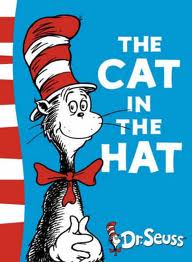
I hold up the book I will be reading aloud, Dr. Seuss’s The Cat in the Hat. The students start commenting:

This is one of my favorite books…
I love Thing #1 and Thing #2!
I (loved) or I (hated) the movie!
Can we read Green Eggs and Ham, too?

Cat in Hat book coverI settle the students down and begin,

“The sun did not shine.
It was too wet to play.
Just sit in the house all that cold, cold wet day.”

32 eyes blink brightly up at the pages as I turn them.
Several mouths move without sound to recite along with me.
The students are mesmerized.

Oh, did I mention that these are seniors in high school?

I am using a picture book to explain Freud’s theory of the Id, Ego and Superego (see post). Thing #1 and Thing #2 represent Id, and that righteous fish? The Superego. Yes, Dr. Seuss is great for psychological literary criticism, but he is not the only picture book in my repertoire of children’s literature used in high school. Here are a few of my favorites to use and why:

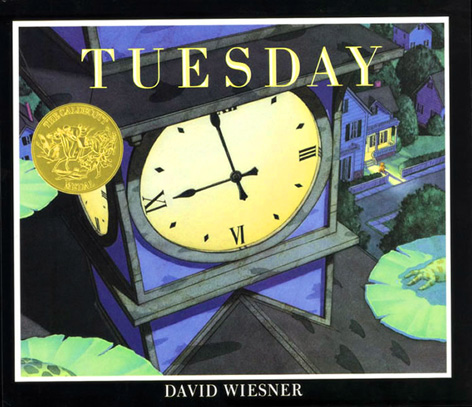
Tuesday by David Wiesner_CoverTuesday by David Weisner. We use this text for our 9th grade mythology unit because a myth explains the unexplainable. Our students have to create a myth for why frogs might lift off from a local pond and terrorize some inhabitants of a small town (see post).

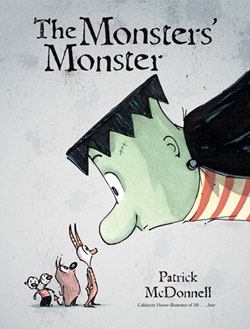
The Monsters’ Monster by Patrick McDonnell. This mash-up of the 1931 film Frankenstein and Mary Shelley’s 1818 novel is ideal to stimulate discussion on the relationship between a creator and the created. In McDonnell’s version, however, the Monster is sensitive, compassionate, with more of an interest in warm, powdered jelly doughnuts than in seeking vengeance…a nice break from the rigors of Advanced Placement English Literature.coverbook_monsters-monster

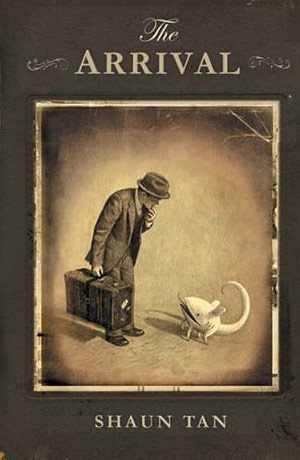
the-arrival-by-shaun-tanThe Arrival by Shaun Tan. Surreal images capture the point of view of an immigrant experience which makes this wordless text ideal for students who are studying Ellis Island or Angel Island. Many of the illustrations are available on the website so students can look at the haunting pictures on their own devices as well.

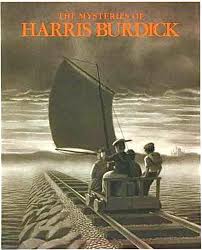
Harris BurdickThe Mysteries of Harris Burdick by Chris Van Allsburg. A book full of provocative images that has inspired thousands of stories explaining the mysteries in each sepia toned drawing. This book is wonderful for writing classroom, and there have been contests for the best stories written by children. Celebrated children’s authors have also taken an opportunity to try their imaginations using the pictures as story prompts in The Chronicles of Harris Burdick.

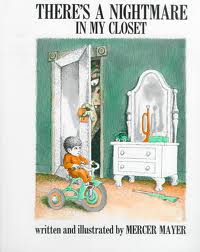
The Monster at the End of this Book by Jon Stone; illustrated by Mark Smollin and There’s a Nightmare in My Closet by Mercer Mayer. Both of these books have been incorporated into our Heroes and Monsters English IV (grade 12) elective. I use them as a starting point for an inquiry project about images of monsters given to children contrasted with the images of monsters we know as adults. Most students discuss the “fuzzy factor” with cute, loveable old Grover as something they remember fondly. They also remember very clearly the monster that lived in their closets. The anxiety of Mayer’s “Nightmare”, sobbing at the foot of the bed, usually brings about a discussion of facing fears.

grover

There are YouTube Videos for students to watch in advance of class (flipped classroom):  The Monster at the End of this Book and There’s a Nightmare in My Closet

Nightmare

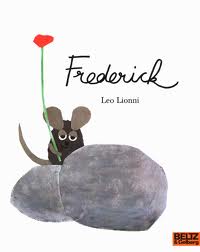
Fredrick

Fredrick by Leo Lionni. What does the poet do for society? This little fable answers that question and works well in any poetry unit. Frederick’s use of language paints pictures in the minds of the other mice who are struggling through a particularly bleak winter season. There is a delightful video recording of this to share in class or to have students watch on their own (flipped classroom).

The True Story of the Three Little Pigs by Jon Scieszka; illustrated by Lane Smith. Want a lesson on point of view? This retake of the three little pigs is one of the best ways to present the advantages of this literary device to students of all ages. In his explanation of the story, A. Wolf comes across the first little pig after the house of straw caved in. With culinary justification, he says,

True story“It seemed like a shame to leave a perfectly good ham dinner lying there in the straw. So I ate it up. Think of it as a cheeseburger just lying there.”
The story presents opportunities to use other fairy tales for students to practice retelling stories from another point of view once they buy into Scieszka’s formula.

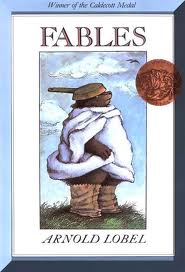
Fables by Arnold Lobel. Here are modern little fables that are one page long with morals such as “It is the high and mighty that have the farthest to fall.” One year, I used these fables with my drama class as short sketches. My favorite sketch to watch was the story of the Lobster and the Crab where the insanely spirited Lobster took timid Crab out for a ride in a boat during a tremendous storm. When the boat capsized, the student playing Crab cried out in despair, “Horrors!” while the student playing Lobster jumped and shouted with glee.”Down we go!” she yelled at the top of her lungs.
FablesLobel writes:

The Crab was shaken and upset.
The Lobster took him for a relaxing walk along the ocean floor.
“How brave we are,” said the Lobster. “What a wonderful adventure we have had!”

The moral? “Even the taking of small risks will add to the excitement of life.”

The same can be said for using children’s literature in high school.
The use of a well-chosen picture book will add to the excitement of a lesson! Continue Reading…

July 2013 marks the 150th anniversary of the Civil War’s Battle of Gettysburg. There has been a great deal of preparation to commemorate this event, and last September (2012), I heard the following brief story on National Public Radio (NPR) Morning Edition:

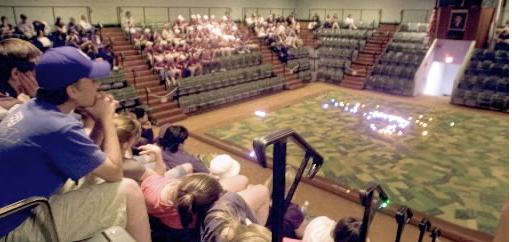
Good morning. I’m Steve Inskeep. This may be the closest you can ever get to owning your own Civil War battlefield. Generations of tourists saw a map at Gettysburg, Pennsylvania – 29 feet on each side laid on the floor. This relief map features electric lights to show the battle. The Pittsburgh Post Gazette says after building a new visitor’s center, the National Park Service is auctioning off the old map. Not one person has made an offer, though bidding started at $5.

What? I was shocked! The Gettysburg electrical map was for sale? For $5.00?

The electrical Gettysburg Map had been the highlight of our family vacation to Gettysburg Battlefield National Park in Pennsylvania in 1970. The Visitors Center’s map covered a huge portion of the floor and the electrical lights depicted troop movements during the three day battle that had raged in and around the small town of Gettysburg, Pennsylvania,N from July 1–3, 1863. Different colored lights separated the positions of the Union Army of the Potomac from the Army of Northern Virginia. We watched the lights change and understood how the generals manuvered their troops during this turning point of the Civil War. My father had paid the admission, an unusual treat, so that we could watch the lights on the topographical recreated hillsides flicker as they had in the evenings that hot July. Countless tourists had also paid to see the electrical map before it was retired in 2009, packed up, and indignantly placed on the auction block. As I listened to the NPR story, I thought that putting the map up for sale on EBAY seemed an anathema.

My family had camped for two nights that summer at Gettyburg, our campfire mimicked the lights of campfires that had lit the late night troop encampments a century earlier. The Carpenter’s rendition of “Close to You” had played on the car’s radio repeatedly during the day, but at night, when my father strummed “When Johnny Comes Marching Home” on the guitar, the area seemed haunted as we imagined the lives of the soldiers who took part in the deadly battles of the Civil War.

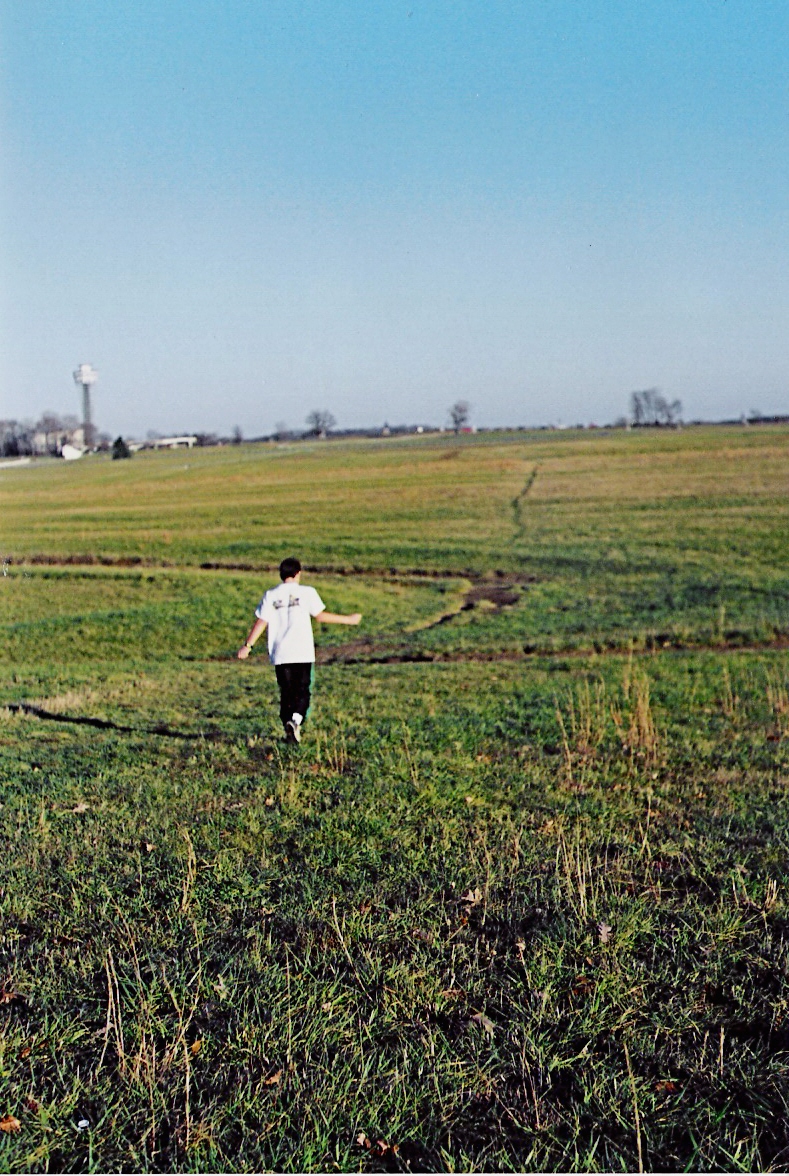
By day we travelled from monument to monument in our ’68 VW van. When we arrived at Seminary Ridge, we saw the expanse of fields where Major General George Pickett led his troops the last day of battle. Because of the electrical map, we knew exactly what had happened to the soldiers who had advanced under heavy fire from the Union’s artillery. We tumbled out of the  van and ran out into the field, imitating Pickett’s Charge, the high-water mark of the Confederacy. We fell as so many soldiers did in that last ditch effort to break through the Union Army’s lines.

Walking Pickett's Charge

Walking Pickett’s Charge…

standing at Pickett's Charge

or standing at Pickett’s Charge.

Years later,  I took my own two sons to Gettysburg, and I tried to have them rush the field, recreating Pickett’s Charge just as my family had done years earlier. Instead my sons casually walked out into the open.
“Come on!” I encouraged, “You have to run to charge!” But they would have none of that behavior.
Discouraged, I walked them back to the car.
As I closed our car door, a van drove up into the parking lot next to us.
A tumble of bodies spilled out of the side door; several boys and girls raced out from the parking lot.
“Pickett’s Charge!” they yelled out in unison and were soon sprinting out onto the field.
“You see?” I turned to my boys who watched dumbfounded, “That’s the family I want to be with!”

My boys did love the electrical map, however, seeing the lights in action. When we returned home, they were inspired enough to build a map of their own. Listening to the NPR report, I grew concerned. If the map was not sold on EBAY, would it be destroyed? What could possibly replace such inspiration? Apparently, I was not alone with my concerns. When the map was dismantled and placed in storage, a website Save the Electric Map sprang up. There are pages were people posted their own memories of their visits. The history of the map, additional photos, and petition forms to save the map (and to drop admission fees) are also linked on the site.

Happily, the map was purchased for a little over $14,000 in October of 2012 by another map enthusiast Scott Roland. He has enlisted the help of the Gettysburg Campus HACC college student volunteers to complete the necessary electrical updates and controller programming. The Hanover Evening Sun reported on 6/14 that the map will again go on display for visitors. The article Electric Map Owner Partners with Gettysburg HACC Students for Renovations had an interview with Tom Lepp, mechatronics instructor in the industrial technologies department, to explain how the repairs will be made:

“The decision was made to refit the map with new electrical components rather than repair the existing wiring and lights due to the condition of the existing components, which are over 50 years old. The electrical system also suffered significant damage when the map was sectioned for removal and throughout the process of moving. This left the aged wiring in need of serious repair and damaged a number of lights. The original lights are difficult to service, repair, and source parts for. Many lights and lenses for lights are severely damaged or missing. The replacement lights, while providing ease of service, will preserve the aesthetics of the original lamps.”

There will be other families on summer vacations who will sit around campfires after touring the Gettysburg battle sites. There will be other families who will spill from their cars and spontaneously recreate Pickett’s Charge. And I am happy to report that the Gettysburg electrical map that was rescued from destruction will continue to illuminate the troop positions and visually tell the story to future generations so they may better understand the significance of this battle in our nation’s history. You will still have to pay an admission, but these memories are priceless.