Archives For November 30, 1999

One of my favorite things to do when I taught a poetry unit was to select a poem I had not ‘prepared” to teach and then ask students to give me their impressions. A selection like this always brought interesting discussions because there was no prescribed agenda; we read for meaning together. One of the “go to” poets in such classroom experiments was the American poet Henry Wadsworth Longfellow.

My students were already familiar with his Paul Revere’s Ride. They were also familiar with some of his acquaintances including the authors Nathaniel Hawthorne and Charles Dickens. His verse was always accessible to students in different grade levels; the narrative in his poetry always captured their imaginations.

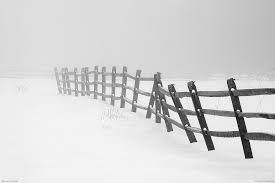
As we approach this last weekend in the coldest February on record, readers can get a glimpse of how Longfellow might have approached his birthday on the 27th with  Afternoon in February:.

The day is ending,fence
The night is descending;
The marsh is frozen,
The river dead.

Through clouds like ashes
The red sun flashes
On village windows
That glimmer red.


The snow recommences;
The buried fences
Mark no longer
The road o’er the plain;

While through the meadows,train
Like fearful shadows,
Slowly passes
A funeral train.

The bell is pealing,
And every feeling
Within me responds
To the dismal knell;

Shadows are trailing,
My heart is bewailing
And tolling within
Like a funeral bell.

In six short stanzas, this New England poet accurately captures the bleak experience of this winter month. Looking back, I am reminded how well my students understood that this Longfellow’s poem makes a solid case for February’s brevity!

Testing a Thousand Madelyns

February 25, 2015 — 1 Comment

My niece is a beautiful little girl. She is a beautiful girl on the outside, the kind of little girl who cannot take a bad picture. She is also beautiful on the inside. She is her mother’s helper, fiercely loyal to her older brothers, and a wonderful example for her younger brother and sisters. She is the gracious hostess who makes sure you get the nicest decorated cupcake at the birthday party. She has an infectious laugh, a compassionate heart, and an amazing ability “to accessorize” her outfits. For the sake of her privacy, let’s call her Madelyn.

Two years ago, the teachers at her school, like teachers in thousands of elementary schools across the United States, prepared Madelyn and her siblings for the mandated state tests. There were regular notices sent home throughout the school year that discussed the importance of these tests. There was a “pep-test-rally” a week before the test where students made paper dolls which they decorated with their names. A great deal of time was spent getting students enthused about taking the tests.

Paper dollSeveral months later, Madelyn received her score on her 4th grade state test. She was handed her paper doll cut-out with her score laminated in big numbers across the paper doll she had made.

Madelyn was devastated.

She hated her score because she understood that her score was too low. She hid the paper doll throughout the day, and when she came home, she cried. She could not hang the paper doll on the refrigerator where her brother’s and sister’s scores hung. The scores on their paper dolls were higher.

She cried to her mother, and her mother also cried. Her mother remembered that same hurt when she had not done well on tests in school either. As they sobbed together, Madelyn told her mother, “I’m not smart.”

Now, the annual testing season is starting again. This year, there will be other students like Madelyn who will experience the hype of preparation, who will undergo weeks of struggling with tests, and then endure a form of humiliation when the results return. The administrators and teachers pressured to increase proficiency results on a state test, often forget the damage done to the students who do not achieve a high standard.

That paper doll created during the fervor of test preparation is an example of an unintended consequence; no one in charge considered how easily scores could be compared once they were available to students in so public a manner. Likewise, many stakeholders are unaware that the rallies, ice-cream parties, and award ceremonies do little to comfort those students who, for one reason or another, do not test well.

There is little consolation to offer 10-year-old students who see the results of state tests as the determiner of being “smart” because 10-year-old students believe tests are a final authority. 10-year-old students do not grasp the principles of test design that award total success to a few at the high end, and assign failure to a few at the low end, a design best represented by the bell curve, “the graphic representation showing the relative performance of individuals as measured against each other.” 10-year-old students do not understand that their 4th grade test scores are not indicators for later success.

Despite all the advances in computer adaptive testing using algorithms of one sort or another, today’s standardized tests are limited to evaluating a specific skill set; true performance based tests have not yet been developed because they are too costly and too difficult to standardized.

My niece Madelyn would excel in a true performance based task at any grade level, especially if the task involved her talents of collaboration, cooperation, and presentation. She would be recognized for the skill sets that are highly prized in today’s society: her work ethic, her creativity, her ability to communicate effectively, and her sense of empathy for others. If there were assessments and tests that addressed these particular talents, her paper doll would not bear the Scarlet Letter-like branding of a number she was ashamed to show to those who love her.

Furthermore, there are students who, unlike my niece Madelyn, do not have support from home. How these students cope with a disappointing score on a standardized test without support is unimaginable. Madelyn is fortunate to have a mother and father along with a network of people who see her all her qualities in total; she is prized more than test grades.

At the conclusion of that difficult school year, in a moment of unexpected honesty, Madelyn’s teacher pulled my sister aside.
“I wanted to speak to you, because I didn’t want you to be upset about the test scores,” he admitted to her. He continued, “I want you to know that if I could choose a student to be in my classes, I would take Madelyn…I would take a thousand Madelyns.”

It’s testing season again for a thousand Madelyns.
Each one should not be defined by a test score.

During a pop-in visit with the 8th grade social studies teachers last week, the discussion turned to the growing number of interruptions to the school calendar because of the snow cancellations and delays we are experiencing here in Connecticut this winter. The teachers were grumbling, frustrated that they were not able to cover the content in the curriculum units.

“There are some advantages to ice and snow this winter,” I suggested.
They looked at me skeptically.
“Our students are feeling the same conditions that the Continental Army felt that winter at Valley Forge,” they paused.
I continued, “I can’t imagine how teachers in San Diego get students to understand what it was like to be a soldier in that winter in 1778.”

Of course, imagine is the key word here. Students taking classes in sunny 75 degree weather would have to imagine the conditions penned by George Washington to then New York Governor George Clinton from his headquarters in a chilly farmhouse at Valley Forge. Our first Commander-in-Chief’s desperation to keep his troops fed and clothed in frigid conditions is clearly evident in this letter, written while the well-stocked British troops camped comfortably nearby in Philadelphia. During that encampment at Valley Forge beginning on December 19, 1777, nearly 2,500 American soldiers, a quarter of the Continental Army, succumbed to disease and exposure by the end of February 1778. A modified version of Washington’s letter for students (Created through the TAH Making History Grant)  appears below:

To Governor George Clinton

Head Quarters, Valley Forge, February 16, 1778

Dear Sir:

It is with great reluctance, I trouble you … For some days…, there has been…a famine in camp. A part of the army has been a week, without any kind of flesh, and the rest for three or four days. Naked and starving as they are, we cannot enough admire the incomparable patience and fidelity of the soldiery, that they have not been [led]…by their sufferings, to a general mutiny…

…I am, on my part, putting every engine to work, that I can possibly think of, to prevent…fatal consequences…. I am calling upon all those, whose stations and influence enable them to contribute their aid upon so important an occasion; … I expect every thing within the compass of your power, and that the abilities and resources of the state over which you preside, will admit….

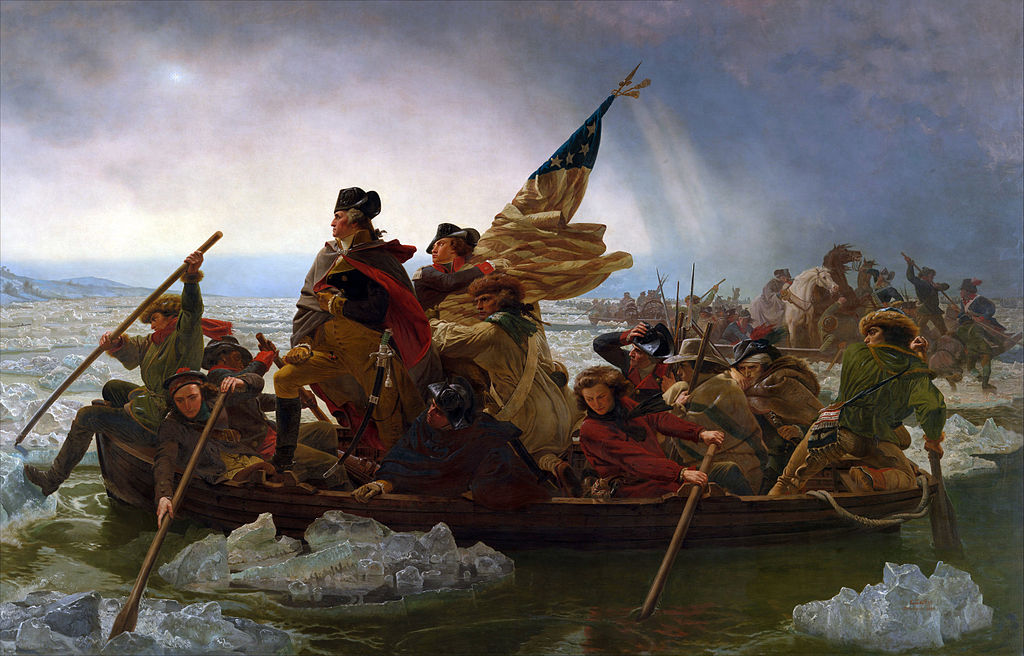
Valley Forge was not Washington’s first test of endurance in harsh winter conditions. Two years previous to this encampment, Washington had successfully crossed the Delaware River in a surprise attack against the Hessian forces in Trenton, New Jersey. Taking advantage of the Hessian’s late night holiday celebration, Washington crossed the icy waters on December 25, and attacked on the following morning.

Washington’s trip across the icy waters was immortalized in the painting Washington Crossing the Delaware by Emanuel Leutze, (Metropolitan Museum of Art-NYC, 1851).

Washington_Crossing_the_Delaware_by_Emanuel_Leutze,_MMA-NYC,_1851

Washington Crossing the Delaware is also the name and subject of a sonnet by David Shulman (1936).  This sonnet is entirely composed of anagrams, or verses of word play, where the letters of a word or phrase are used (once) to produce a new words or in Shulman’s case, verses:

A hard, howling, tossing water scene.
Strong tide was washing hero clean.
“How cold!” Weather stings as in anger.
O Silent night shows war ace danger!

The cold waters swashing on in rage.
Redcoats warn slow his hint engage.
When star general’s action wish’d “Go!”
He saw his ragged continentals row.

Ah, he stands – sailor crew went going.
And so this general watches rowing.
He hastens – winter again grows cold.
A wet crew gain Hessian stronghold.

George can’t lose war with’s hands in;
He’s astern – so go alight, crew, and win!

The nation’s tribute to George Washington, combined his birthday (2/22) with Lincoln’s birthday (2/12) to make President’s Day, a National Holiday celebrated from the frigid shores of the Delaware River, across those same fields of Valley Forge, and all the way to the warm sunny beaches of the San Diego coastline.

The combination of Washington’s letter to George Clinton, the famous painting by Emanuel Leutze, and the sonnet by David Shulman can help students everywhere in the United States to imagine the severe weather conditions of these most famous exploits of Washington, but the students here in the Mid-Atlantic and in New England have the historical advantage to experience that same weather first-hand every year.

Here in Connecticut, in the winter of 2015, our students’ empathy lies with George.

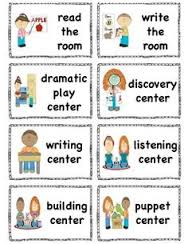
K centers

Examples of center activities

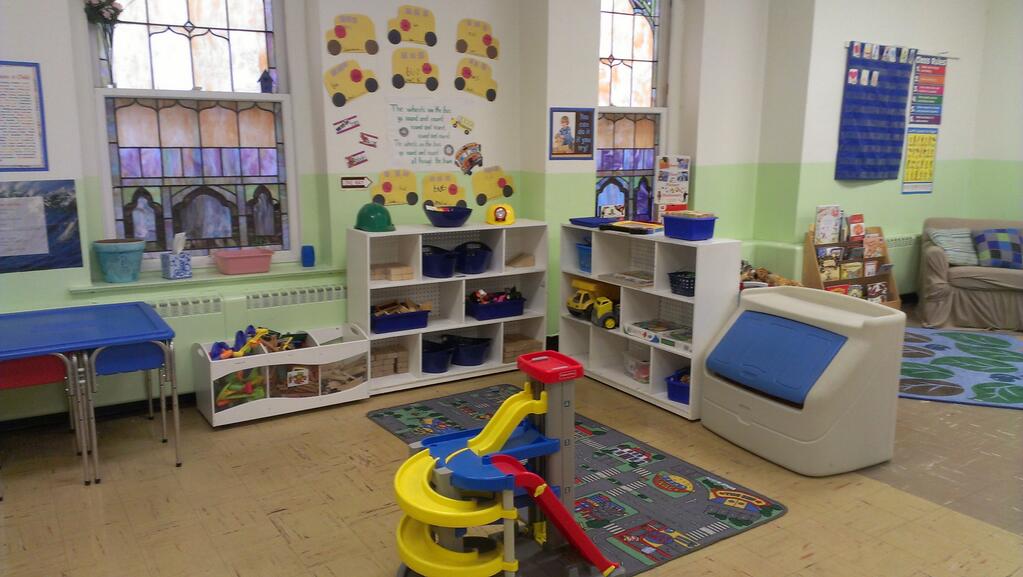
At the beginning of my teaching career, I worked as the 8th grade English Language Arts teacher in a K-8 parochial school. Once a month, my students would pair up with the kindergarten students to complete a creative project: paper maché globes, paper kites, Q & A interviews. On those afternoons, my noisy and awkward adolescents longingly stared at various learning stations: art centers, counting blocks, easels,finger paints, and beanbag chairs circled around picture books. It was evident that my 8th graders wanted to go back to kindergarten.
And why wouldn’t they want to go back? Even back then, kindergarten combined the elements of fun and learning through a structured day of collaborative and independent activities. In today’s kindergarten classes, the morning meeting is a cooperative exercise where students are oriented for the day’s activities. Language arts centers develop reading and writing skills and include collaborative guided reading or read alouds. Math centers provide materials for independent practice in developing math skills. Structured play activities build social interaction, while recess, especially outdoor recess, allows students to practice unstructured play. “Specials” expose students to the arts and/or other disciplines. The entire kindergarten day day is structured to provide students with multiple opportunities to collaborate or to be independent.

In an article titled Ready for Kindergarten? In Parent Child Magazine (Scholastic publication), five kindergarten teachers discussed what attributes they believe children should have to be successful in kindergarten.

Their recommendations for the top five readiness skills students should have, in no particular order, are:

  • Ability to play well with others
  • Ability to listen
  • Solid oral-language skills
  • Desire to be independent
  • Enthusiasm toward learning

What is interesting is comparing these skills that kindergarten teachers look for in students to the skills that recruiters look for in hiring once students have exited a school system. A recent survey by The National Association of Colleges and Employers (NACE) a non-profit group that links colleges with recruiters, asked hiring managers what top skills they believe to be the most important in recruiting employees. The top skills for recruiters look for are:

  1. Ability to work in a team structure
  2. Ability to make decisions and solve problems (tie)
  3. Ability to communicate verbally with people inside and outside an organization
  4. Ability to plan, organize and prioritize work
  5. Ability to obtain and process information

The elements of collaboration and independence that started in the structures and strategies from kindergarten are evident in both lists. The ability to communicate is critical whether a student is entering as a five year old or exiting with five years of graduate school.

In addition to this information, consider the first-hand individual employee accounts from those who work at Fortune 500 companies that have been designated as “The Best Places to Work.” Included on this list are predictable choices (Google #1) where the  activities of a Google Employee (highly edited) might look something like this:

Google Workspace or Center

Google Workspace or Center

  • 9:00 AM: Morning meeting
  • 11:00 AM: Call with the team to plan
  • 2:00 PM: Brainstorming with my team.
  • 4:00 PM: Submit ideas; Spend ten minutes trying to convince others.

The skills of communicating and collaboration in this abridged account mirror the qualities required by the five kindergarten teachers. And those reviews by employees from various Fortune 500 companies included statements about additional learning, “They really know how to push you” (McKinsey#9) and “Given great opportunities to expand my knowledge about the field” (Chevron #6). The desire to participate or be “pushed” was a connecting thread for all the top rated companies, and that desire for additional learning could be the spark that is ignited in kindergarten.

An example of a Kindergarten workspace

An example of a Kindergarten workspace

I am not suggesting that the focus of kindergarten should be career readiness as has been expressed by some education reformers, but it is surprising how many of the kindergarten-like structures and strategies are embedded in the more successful companies. Perhaps it is no wonder these companies receive such enviable reviews from their employees.

A little creative liberty in rewording one of the reviews from Forbes given by an employee from the top rated company Acuity, illustrates how these structures and strategies in employee satisfaction might sound like the ideal kindergarten experience [my additions]:

One Millennial commented, “I have never worked for a company that has an upper management team [OF TEACHERS] that is so forthcoming and approachable. They are always praising us and you can tell we actually are making a difference in the organization [SCHOOL]. I love coming to work and doing my job [OF LEARNING]. It’s just an added bonus that we often get special treats like food and gifts as well as parties to celebrate our success as a company [CLASS].”

Yup. Let’s not forget that “special treats like food and gifts as well as parties,” are also part kindergarten experience, and just one more way that kindergarten may be preparing employees for those Fortune’s Top 500 companies.

Graphic 2It’s snowing again in Connecticut.
It’s February.
No surprise.

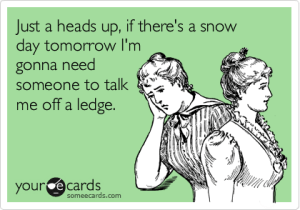
In fact, snow days are not a surprise for thousands of school districts across the US.
Snow days interrupt instruction.
Again, no surprise.

It’s a fact that schools have requirements for school instruction days and for instruction hours or seat time. So if snow days and interruptions to instruction time requirements are not a surprise, what can educators do to be ready for the inevitable snow day?

There are some districts that prepare for snow days in advance by organizing assignments before the school day.

In New Hampshire, some districts have used ‘‘Blizzard Bag Days.” On these days, students complete assignments at home, either online or on paper. If 80% of students complete assignments, then the snow day is not added to the end of the school year. Some districts have reported that the number of students who participate in Blizzard Bag Days has risen to 90%.

As technology expands in the classroom, the use of different learning platforms can halt the disruption of learning by allowing students to participate in activities that allow them to practice skills they have been taught in the classroom. For districts that are concerned about the amount of technology in homes, many platforms are easily accessed by digital phones through mobile apps. Phone message apps that deliver assignments do not chew up the data time if the materials have already been sent home in anticipation of a snow day.

One possible argument in designing the use of technology to facilitate learning on a snow day is how to determine the percentage of students who must participate in order for the day to “count” in the school calendar. Previous attendance figures by school could be used to choose such a percentage for credit, and student work turned in or digital work submitted could be used to validate these percentages.

Another argument is choosing a method to determine how many hours or how much seat time is necessary to complete an assignment  in order to “count” for credit. The seat time argument may be less of a concern given that there are districts with students, particularly in the upper grades, who are receiving credit for core coursework on platforms with flexible seat time requirements. For example, instead of using Carnegie units (120 hours per unit) for course credit, some online platforms, such as platforms like Odysseyware, provide fewer coursework hours in grade level subject areas. Many of these online course platforms require the use of seat time waivers, with sometimes as little as 70-80 hours, to complete coursework.

Another concern may be raised by teachers who might initially interpret snow day assignments as “extra work” to prepare, review, or grade. As a former teacher, I would argue that while snow days gave me an opportunity to catch up on grading or lesson plans, I was in effect, working twice. I would work during the snow day, and then work again on the date tacked onto the school year. How many times in June, in a particularly warm and steamy classroom, did I wish that we could have kept to the original school closing date?

The Common Core’s focus on increasing non-fiction materials into all grade level curriculum means that every subject area, including “specials” or electives (art, music, physical education, computer technology, etc.) could contribute in preparing materials for snow days; core subject areas need not be the only requirements for snow day lesson preparation. Rotating responsibilities for assigning work (Snow Day #1: English, Art, Science; Snow Day #2: Math, Social Studies, Music) might be a way to ensure that students do not lose practice in the same subject area with each cancellation.

Finally, in support of snow day assignments, is the argument that practice for standardized testing, now required by the Common Core in the form of SBAC or PARCC, needs to happen before early spring test dates. Any interruption in skills practice caused by snow days, particularly in the later winter months, could have an adverse impact on student and school test results. Even at the upper grade levels, snow day interruptions pose problems for delivering Advanced Placement content, already in overstuffed syllabi, in order to prepare students for annual AP exams held in early May.
graphic 1The result is that days added in late June to meet state requirements become educationally superfluous and may place students into another meteorological challenging situation: overheated classrooms when outside temperatures climb into the 90s.

When school calendars are decided a year in advance in any of the Snow Belt States, Mid-Atlantic States, or New England, it is common practice  to add snow days to the school year. The same practice could be extended by having teachers prepare materials for snow cancellations either at the beginning of the school year or soon after the first quarter.

It’s no surprise that it will snow again next year.

Here in New England, when that first snow day comes next year, there should no surprises.

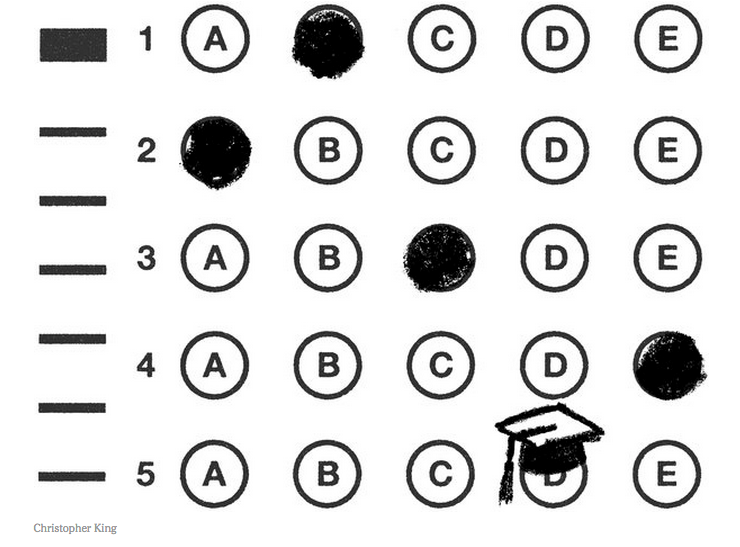
Graphic by Christopher King that accompanied the editorial piece "In Defense of Annual Testing"

Graphic by Christopher King that accompanied the editorial piece “In Defense of Annual Testing”

My Saturday morning coffee was disrupted by the headline in the New York Times opinion piece, In Defense of Annual School Testing  (2/7/15) by Chad Aldeman, an associate partner at Bellwether Education Partners, a nonprofit education research and consulting firm. Agitating me more than the caffeine in the coffee was clicking on Aldeman’s resume. Here was another a policy analyst in education, without any classroom experience, who served as an adviser to the Department of Education from 2011 to 2012. Here was another policy wonk with connections to the testing industry.

In a piece measuring less than 800 words, Aldeman contended that the “idea of less testing” in our nation’s schools, currently considered by liberals and conservative groups alike, “would actually roll back progress for America’s students.”

…annual testing has tremendous value. It lets schools follow students’ progress closely, and it allows for measurement of how much students learn and grow over time, not just where they are in a single moment.

Here is the voice of someone who has not seen students take a standardized test when, yes, they are very much in “that single moment.” That “single moment” looks different for each student. An annual test does not consider the social and emotional baggage of that “single moment” (EX: no dinner the night before; using social media or video game until 1 AM; parent separation or divorce; fight with friend, with mother, with teacher; or general text anxiety). Educators recognize that students are not always operating at optimum levels on test days. No student likes being tested at any “single moment.”

Aldeman’s editorial advocates for annual testing because he claims it prevents the kinds of tests that take a grade average results from a school. Taking a group average from a test, he notes, allows “the high performers frequently [to] mask what’s happening to low achievers.” He prefers the kinds of new tests that focus on groups of students with a level of analysis possible only with year to year measurement. That year to year is measurement on these expensive new tests is, no doubt, preferred by testing companies as a steady source of income.

His opinion piece comes at a time where the anti-test movement is growing and states are looking at the expenses of such tests. There is bipartisan agreement in the anti-test movement that states students are already being assessed enough. There are suggestions that annual testing could be limited to at specific grade levels, such as grades 3, 8, and 11, and that there are already enough assessments built into each student’s school day.

Educators engage in ongoing formative assessments (discussions, polls, homework, graphic organizers, exit slips, etc) used to inform instruction. Interim and summative assessments (quizzes/test) are used continuously to measure student performance. These multiple kinds of assessments provide teachers the feedback to measure student understanding and to differentiate instruction for all levels of students.

For example, when a teacher uses a reading running record assessment, the data collected can help determine what instruction will improve a child’s reading competency. When a teacher analyzes a math problem with a child, the teacher can assess which computational skills need to be developed or reviewed.

Furthermore, there are important measures that cannot be done by a standardized test.  Engaging students in conversations may provide insight into the  social or emotional issues that may be preventing that child’s academic performance.

Of course, the annual tests that Aldeman suggests need to be used to gain information on performance do not take up as much instructor time as the ongoing individual assessments given daily in classrooms. Testing does use manpower efficiently; one hour of testing can yield 30 student hours of results, and a teacher need not be present to administer a standardized test. Testing can diagnose each student strengths and/or weaknesses at that “single moment” in multiple areas at the same time. But testing alone cannot improve instruction, and improving instruction is what improves student performance.

In a perverse twist in logic, the allocation of funds and class time to pay for these annual tests results in a reduction of funds available to finance teachers and the number of instructional hours to improve and deliver the kind of instruction that the tests recommend. Aldeman notes that the Obama administration has invested $360 million in testing, which illustrates their choice in allocating funds to support a testing industry, not schools. The high cost of developing tests and collecting the test data results in stripping funds from state and local education budgets, and limits the financial resources for improving the academic achievement for students, many of those who Aldeman claims have “fallen through the cracks.”

His argument to continue annual testing does not refer to the obscene growth in the industry of testing, 57% in the past three years up to $2.5 billion, according to the Software & Information Industry Association. Testing now consumes the resources of every school district in the nation.

Aldeman concludes that annual testing should not be politicized, and that this time is “exactly the wrong time to accept political solutions leaving too many of our most vulnerable children hidden from view.”

I would counter that our most vulnerable children are not hidden from view by their teachers and their school districts. Sadly their needs cannot be placed “in focus” when the financial resources are reduced or even eliminated in order to fund this national obsession with testing. Aldeman’s defense is indefensible.

time clock americanYes, American teachers do work more hours than their international counterparts, but exactly how much more could be a matter of perception versus reality, and testing may be to blame.

A recent study comparing the number of hours worked by American teachers shows the difference in instructional time is not as significant as has been publicized in the past. Researcher Samuel E. Abrams, director of the National Center for the Study of Privatization in Education at Teachers College, Columbia University, has published his findings in a working paper titled “The Mismeasure of Teaching Time“. His research contradicts claims of American teachers working twice or even 73% more hours than their counterparts in other countries, correcting these claims by grade level to 12% (elementary) 14% (middle/intermediate), and 11% (high school).

The reason for the difference, Abrams suggests, was the the Schools and Staffing Survey (SASS) offered by the Paris-based Organization for Economic Cooperation and Development (OECD) used to collect data on this topic:

The most recent data reported to OECD is from the 2007-08 survey, which was 44 pages long and contained 75 questions.  Teaching time is the 50th question and it asks teachers to round up the number of hours. As a result, responses were often inflated.

In addition to suggesting that the process of answering 50 questions clouded the responses of teachers taking the survey, Abrams contended that the inflated time also came from a misinterpretation of “teaching time” calculated by the OECD as the “net contact time for instruction.” By definition, excluded from net contact time are activities such as professional development days, student examination days, attendance at conferences, and out of school excursions.

In applying the OECD definition of teaching time, Abrams concluded that one contributing factor to the over-estimation by American teachers was the large number of hours spent assessing students.

Using examples from school districts in Massachusetts, Abrams offered a breakdown of the time teachers spend assessing students in grades 2-8:

  • For students in grade two, 48 hours are lost to interim assessments tied to the state exams
  • For students in grades three and six, 48 hours are lost to interim assessments and 16 hours are lost to state exams in ELA and math;
  • For students in grades four and seven, 48 hours are lost to interim assessments and 20 hours are lost to state exams in ELA, ELA composition, and math;
  • For students in grades five and eight, 48 hours are lost to interim assessments and 24 hours are lost to state exams in ELA, math, and science. 

Averaging a student school week at a very generalized 35 hours means that students in Massachusetts grades K-8 could spend approximately 1.5-2 weeks of each school year being assessed. Spreading this time out over the school year may contribute to the perception of a never-ending test season.

The report considered the time American educators spend assessing students at every grade level contributed to the misperception of teaching time. More importantly, the study highlighted the disparity in pedagogical practice between the education systems in United States compared to other countries. Like so many other researchers, Abrams contrasted American schools with Finland’s school system. He noted that the difference in teaching time between the two countries was not as great as originally publicized, but that the difference of practice is the “polar opposite.” In Finland, the structure of the school day has 15 minute breaks between classes or 15 minutes of play for every 45 minutes of instruction, for a total of 75 minutes per day, with no standardized tests. The result is that Finland’s teachers demonstrate little confusion on defining teaching time.

The data provided by Abrams suggests that American teachers do work more than other teachers worldwide. Using Paris-based OECD figures to convert the percentage of time into regular 40 hour weeks means that American elementary teachers work 2.4 weeks (12%); middle/intermediate teachers work 2.75 weeks (14%) and high school teachers work 2.2 weeks (11%) more than other teachers worldwide.

If the demand for assessment is the reason for the difference,  I am confident that most American teachers could think of other things to do during those weeks other than testing.

I am sure their students feel the same way.

Most overused verb used by students in school: Bored.
Least favorite word teachers want to hear: Bored.

In order to bring teachers and students together to explore what could happen when people are bored, look at the the hypothesis of Dr. Sandi Mann. She has been seeking to prove that boredom leads to creativity. Her research with other psychologists at the University of Central Lancashire was explained in an article on the Psychology Blog. In an experiment, she asked one set of participants to copy numbers out of a telephone book for 15 minutes; the other set of participants were immediately engaged in a standard creative task-inventing as many different uses as they could for a polystyrene cup. (Mann & Cadman, 2013).

The group that had been bored for 15 minutes of copying came up with the most uses.

“Boredom at work has always been seen as something to be eliminated, but perhaps we should be embracing it in order to enhance our creativity.

In order to put Mann’s hypothesis to a less scientific test, the writers at the Blog New Tech City posted an article demonstrating a variation on Mann’s experiment using “Post-It notes, sponges, plastic forks (and maybe a little bit of wine).”  The results are seen on the video posted on YouTubeVideo: What Happened When We got 130 People Really, Really Bored:

In New Tech City’s re-staging, one group copied the phone book; one group read the phone book; one group went to the bar. These tasks are not dissimilar from “traditional” classroom activities.  Copying can be tedious, such as copying words from a dictionary, especially if students do not see the purpose in the activity. Reading should never be boring, but there are some textbooks that should carry a prescriptive warning: “May cause drowsiness.” What about the bar? Well, consider the lunchroom. The grouping in New Tech City’s experiment is easily transferred to a school setting.

Teachers could first analyze the procedure from Mann’s or New Tech City’s experiments to get some ideas on how to generate creative thinking or problem solving from the “boredom” of sitting in class. Since both experiments were “low-tech”, the process could be replicated easily. Here is the analysis:

  1. Mann posed a problem that had not one but multiple solutions;
  2. In both experiments, there were cheap, ordinary, familiar objects to use (post-its, forks, sponges, styrofoam cups);
  3. Once placed in a group, participants could sit where they chose;
  4. Ideas between people were shared because talking was permitted;
  5. Results (by group) were visual using post-it notes;
  6. Peer feedback was given.

This example of moving from a state of to boredom to a state of creativity could be reconfigured as a class activity by providing students a challenge to offer a solution to a prompt using similarly innocuous items. Their creations could demonstrate their understanding or interpretation in a creative way. Teachers could use the collaboration and cooperation in the classroom to stimulate ideas and support peer to peer feedback as well as formatively assess what students know, or more important, what students are capable of doing.

There could be some interesting combinations:

  • Paper plates and coffee stirrers illustrating …..Shakespeare’s scenes?
  • post-it notes and yarn ……elements in the periodic table?
  • popsicle sticks and napkins …..for highlights in American history?

Or teachers could just let students create and then reflect on their inventions.

Dr. Mann’s experiments show that boredom is a fertile ground for creative expression. Teachers could use this research in lessons that could benefit their students.

Someday, “I’m bored” might even be the best thing a teacher might hear.

IRONY

Situational Irony

It was situational irony…staring me in the face.

In looking for lessons for poetry month, I came upon a worksheet that asked students to analyze a poem. The poem on the worksheet was “Introduction to Poetry” by former U.S. Poet Laureate Billy Collins.

Below the poem on the worksheet were two columns: “Examples of figurative language” go in the left hand column; “Types of Figurative Language” go into the right hand column.

When I came upon this worksheet in a curriculum guide, I was, at first, amused by the situational irony of this assignment.

But I became bothered once I considered that if this worksheet exists, there probably are others just like it in countless number of curriculum guides across the country.

In the poem’s 16 lines, Collins captures the kind of encounter that language arts teachers too often promote. He is able to highlight the absurdity of “worksheet”  analysis used to prepare students to discuss the elements of poetry without regard for the beauty of the poem itself.

Collins’s opening line sets up this poem as a gift, one worthy of wonder and imaginative speculation for the reader:

I ask them to take a poem   
and hold it up to the light   
like a color slide
or press an ear against its hive.

But Collins is familiar with how literature is “taught” to students. His  attitude towards literary analysis is in the last two lines of the poem. You can hear his speaker’s …what is it….frustration? exasperation? resignation?  in knowing what will happen to his gift of a poem:

But all they want to do
is tie the poem to a chair with rope   
and torture a confession out of it.
They begin beating it with a hose   
to find out what it really means.

So here is the situational irony. The poem that tries to make a case for admiring the beauty of a poem rather than reducing it to its elements to find out what it means is reduced to a worksheet in order to beat a confession out of the poem to find out what it means.

I really like this poem. In his typical gentle melancholy fashion, Collins makes a solid case against “teaching” a poem. I would like to think I could honor that purpose and not use a worksheet to teach Introduction to Poetry.

Accept this apology, Billy Collins.

Continue Reading…

snow giff 2The blizzard raging outside recalls the looping GIF of drifting snow that opens the 2013 Pulitzer Prize winning New York Times feature story, Snowfall: The Avalanche at Tunnel Creek.

As a model text, this example of digital writing is the kind of writing that we should be preparing our students to do.

This story of 16 expert skiers and snowboarders and their fatal decision to ski outside the Stevens Pass ski area in the Washington Cascades was written by journalist John Branch and published digitally on Dec. 20, 2012. His recount of the group’s excursion into the “unmonitored play area of reliably deep snow, a ‘powder stash,’ known as Tunnel Creek” is complemented with embedded video, photos, and other graphics, the result of his extensive research and first person interviews. The print version was published in a 14-page special section on 12/ 23/12, and according to the Times editors, generated more than 1,100 comments online.

Branch’s prose is gripping from the start:

The snow burst through the trees with no warning but a last-second whoosh of sound, a two-story wall of white and Chris Rudolph’s piercing cry: “Avalanche! Elyse!”

The very thing the 16 skiers and snowboarders had sought — fresh, soft snow — instantly became the enemy. Somewhere above, a pristine meadow cracked in the shape of a lightning bolt, slicing a slab nearly 200 feet across and 3 feet deep. Gravity did the rest.

12 journalistically short paragraphs into the feature is the first video clip, an interview with professional skier, Elyse Saugstad, Her interview is juxtaposed next to the text that describes how the avalanche “vomited” her into position:

Saugstad was mummified. She was on her back, her head pointed downhill. Her goggles were off. Her nose ring had been ripped away. She felt the crushing weight of snow on her chest. She could not move her legs. One boot still had a ski attached to it. She could not lift her head because it was locked into the ice.

A graphic map of Cowboy Mountain and the Tunnel Creek area splits the text that follows her interview. Below that graphic are two photos of another avalanche in 1910, that was responsible for the death of 96 people. Each of the six sections of Snowfall is laid out with similar interactive features, the result of a collaboration between Branch and a team of graphic editors and researchers (see end of post)*

The popularity of this kind of digital story is borne out by the Times editor’s testimony:

“Snow Fall” online accounted for more than a million unique visits; a significant percentage of the people who found the story online were first-time visitors to nytimes.com; huge numbers of those readers came to the story through social media; the average time of reader engagement was off the charts.

Snowfall‘s arrival on digital platforms will no doubt give rise to a wave of stories with similar features. As authentic practice, students should have the chance to experiment with their own narratives, fiction or non-fiction, using digital platforms (Google, wikis, blogs, etc.) that allow for embedding video, audio, graphics, and other interactive features. Several of my classes have annotated passages from texts they read in class (ex: The Annotated Prologue: Romeo & Juliet ) with digital links as part of close reading exercises. The text “Snowfall” is the next step, a mentor text that models how to create a story where all forms of media support an author’s purpose.

The blend of genre is seamless in Branch’s narrative; each of the 16 personal stories is fleshed out in detail, along with those other lives who were so effected by the tragedy. There is the expository information devoted to Tunnel Creek’s tragic history interwoven with the informational sections that capture the science of an avalanche. Finally, there is the persuasive argument of how easily “how so many smart, experienced people could make the types of decisions that turned complex, rich, enviable lives into a growing stack of statistics.” Snowfall is proof that good writing is not compartmentalized into separate genres, as the Common Core outline would lead teachers to believe.

Here is evidence that students should move between genres, adding rich expository or informational media to a piece in order to engage readers. Here also, is evidence that good writers should follow their own inquiry, as Branch did as he:

….interviewed every survivor of the avalanche, and the families of its three victims; he researched the world of backcountry skiing, the fastest-growing corner of a handsome, but dangerous sport; he traveled to Alaska to speak with snow scientists and to enlist their help in recreating in words and graphics the physics of the avalanche on Cowboy Mountain; he hiked the terrain, clawed through the avalanche’s path, and established a precise chronology of the disaster; he read formal accident reports, pieced together ski patrol and police photographs, reviewed dozens of 911 calls, and unearthed the formal avalanche warnings that all but predicted trouble the night before the accident.

While our students may not have the opportunity to complete this exhaustive marathon of research that Branch did in order to write Snowfall, they should recognize in this model the link between a writer’s own curiosity, painstaking research, and good prose. They should see that compelling storytelling, engaging literary non-fiction, is generated through participatory experience. They should move away from the desk in order to experiment and to find the answers to their questions.

Branch’s Snowfall contribution to journalism has already been awarded by the Pulitzer Prize Committee who rightfully saw it as an historic achievement; Snowfall’s contribution to student learning as a mentor text is only beginning. Continue Reading…