An ad supporting the Common Core State Standards posted by the Bill and Melinda Gates Foundation featured a Missouri Teacher of the Year, Jamie Manker, saying, “I support the Common Core because it’s asking kids to think.”

Screen Shot 2014-05-03 at 7.31.27 AM

My immediate reaction was, “Good Heavens! What did Manker’s students do before the implementation of the Common Core? Thinking should have been happening all along!”

Of course her students had been thinking or she would not have been a teacher of the year. Her statement may have been truncated to fit on on the #SupporttheCore poster. Yet, she is not alone in making such statements. There have been a number of teachers of the year who state that their students are doing better work because of the Common Core:

From Nancie Lindblom Arizona 2013 Teacher of the Year, The new standards provide the opportunity to do this by increasing the expectations for all students, allowing me to challenge my students to think analytically.”

From Ms. Sponaugle 2014 West Virginia Teacher of the Year, “My students are engaged, they’re motivated, and they’re learning, and that’s what the common core standards are all about-preparing our children to be confident and capable in an ever-more competitive world.”

Again, these admissions are puzzling. Why would a teacher whose credentials and instructional practice are exemplary enough to warrant a state award wait for an “opportunity” to challenge students to think analytically? Or how would a teacher of the year not already be engaging students in order to prepare them for an ever-more competitive world? Did they not already use a set of standards before the Common Core in their classrooms?

Without context, these teachers’ statements make them appear less competent. In an ironic twist, the Bill and Melinda Gates Foundation’s use of teachers of the year as promotional tools has the unfortunate effect of leaving them open to the following line of criticism: What kind of teachers were they B.C.C.(Before the Common Core) when they admit their students were not being challenged?

Their overstatements on behalf of the Common Core contribute to the unfortunate generalization that B.C.C.(Before the Common Core) students were not engaged. They were not being prepared for a competitive world. They did not think.

Collectively, their statements open up a single tricky question for these teachers of the year…..Why not?

On the Studio 360 website, the following photo of a poem written by a 1st grader is posted as the best poem to celebrate National Poetry Month 2014. I would agree that there is something universally appealing about this child’s observations that were created with considerable attention to the way words sound…

first_grade_poem_embed


We did the soft wind.
We danst slowly. We swrld
Aroned. We danst soft.
We lisin to the mozik.
We danst to the mozik. 
We made personal space. 

The poem by this 1st grader is strikingly similar to Gwendolyn Brook’s short poem. She also pays considerable attention to the way words sound:


THE POOL PLAYERS.
SEVEN AT THE GOLDEN SHOVEL.

We real cool. We
Left school. We

Lurk late. We
Strike straight. We

Sing sin. We
Thin gin. We

Jazz June. We
Die soon.

My students have always commented on the inferences that Brooks creates in her eight lines of verse in characterizing the seven pool players. They write about the pool players’ attitudes and their fatalistic approach to life. My students also comment on what is missing in drawing their conclusions. They are satisfied with providing interpretations in the “spaces” of the poem, filling in their own ideas what is not explicit. They agree with T.S. Eliot’s statement: “poetry communicates before it is understood.”

The unnamed 1st grade poet of the poem above communicates the slow, swirling, soft relationship between music and dance in seven short statements on six lines of verse. What does it matter if the reader may never understand if the personal space for the poet is made because of the room needed for the dance or the space made personal by the dance ? In filling in the “space” of the 1st grader’s poem, I like to think that line was probably added because of a teacher’s repeated plea to a room of dancing 6 year- olds:

“PERSONAL SPACE! Remember…PERSONAL SPACE!!”

Continue Reading…

Shakespeare would be 450 years old this year, April 2014. To celebrate this milestone the Shakespeare’s Birthplace Trust has a number of activities scheduled including performances and parades in Shakespeare’s hometown of Stratford-Upon-Avon the weekend of April 26/27:

Screenshot 2014-04-22 08.35.28

The birthday weekend brings together performers, artists, the local community and ambassadors from around the world in a vibrant celebration of the life and works of William Shakespeare. During the two day event, the town’s streets overflow with music, pageantry and drama and you are invited to enjoy a packed programme of special activities and great days out at the five Shakespeare houses.

Whatever activities they plan, I am sure Shakespeare would be honored to be the cause of merry-making and revelry. He would love to the be the cause of festivity; he would enjoy a celebratory bash. But the committee planning the events has been careful not to use the word “party.” That word would confuse Shakespeare because for all of his prowess as a dramatist and poet, Shakespeare does not know the word “party.”

In penning 37 plays and 154 sonnets Shakespeare is credited with contributing an estimated 1,700 words to the English language. In his verse, he used six different meanings to the word party. Using the Shakespeare Navigator, owned by Philip Weller, I researched how the word “party” was used in Shakespeare’s works:

party (n.) 1 side, faction, camp
party (n.) 2 litigant, disputant, side
party (n.) 3 side, part, function
party (n.) 4 participant, accessory, supporter
party (n.) 5 person, fellow
party (n.) 6 side, position, viewpoint

Note: none of these means “celebration.”

Perhaps this is not so much of a surprise since the word “party” as a noun was not used as an occasion for celebration until 1716, a century after Shakespeare’s death. The Online Etymology Dictionary records the first use of “party” as:

Sense of “gathering for social pleasure” is first found 1716, from general sense of persons gathered together (originally for some specific purpose, such as dinner party, hunting party).

“To Party,” the verb derived from the noun was not added until the Roaring 20’s”

“have a good time,” 1922, from party (n.)

Shakespeare was acquainted with the word “birthday” since it had been in use for at least two hundred years before he was writing:

birthday (n.) late 14c., from Old English byrddæg, “anniversary celebration of someone’s birth” (at first usually a king or saint); see birth (n.) + day. Meaning “day on which one is born” is from 1570s. 

He does note “birthdays” in plays:

Antony and Cleopatra: AC III.xiii.184.2 It is my birthday.
Julius Caesar: JC V.i.71 This is my birthday; 
Pericles: Per II.i.109 is It is her birthday, and there are princes and knights come
The Two Noble Kinsmen: TNK II.iv.36 You have honoured her fair birthday with your virtues,

Still Shakespeare chose other ways of expressing birth, as evidence by a particularly sad admission from Beatrice in Much Ado abut Nothing about the death of her mother in childbirth:

BEATRICE
334   No, sure, my lord, my mother cried; but then there
335   was a star danced, and under that was I born. (2.1)

So, members of the Shakespeare’s Birthplace Trust, have a wonderful gala. Have a fabulous social gathering.  Celebrate Shakespeare’s 450th birthday, but please, do not party. 

Shakespeare does not know “party” that way.

April is Poetry Month. What should you do about this?
Take advice from Sir Philip Sidney and “Look in thy heart and write.”

Sidney composed “An Apology for Poetry”  (Defence of Poesie) in 1575, and in this essay maintains poetry combines the liveliness of history with philosophy, and this combination is more effective than either history or philosophy in inspiring readers. According to Sidney, poetry acts in a way that “awakens and enlarges the mind itself by rendering it the receptacle of a thousand unapprehended combinations of thought.”

Sidney himself was an accomplished poet who wrote a sequence of 108 English sonnets known as “Astrophil and Stella” where Astrophil is the star lover, and Stella is his star.

The first sonnet in the sequence sets the conceit; the meaning embedded in the last line (bolded):

Loving in truth, and fain in verse my love to show
That she (dear She) might take some pleasure of my pain:
Pleasure might cause her read, reading might make her know,
Knowledge might pity win, and pity grace obtain;
I sought fit words to paint the blackest face of woe,
Studying inventions fine, her wits to entertain:
Oft turning others’ leaves, to see if thence would flow
Some fresh and fruitful showers upon my sun-burn’d brain.
But words came halting forth, wanting Invention’s stay,
Invention, Nature’s child, fled step-dame Study’s blows,
And others’ feet still seem’d but strangers in my way.
Thus, great with child to speak, and helpless in my throes,
Biting my truant pen, beating myself for spite–
“Fool,” said my Muse to me, “look in thy heart and write.”

writeMeaning? Stop thinking about writing a poem and start writing a poem. Your heart will guide your pen.

So, what to write during Poetry Month?

  • Write a poem and share on a website. There are hundreds of sites. (ex: poetry.com)
  • Write about your favorite poem and share the poem.
  • Write about a lesson on poetry you remember.
  • Write about a lesson on poetry you taught.
  • Write a post for #PoetryFriday, a platform where poets and readers of poetry share their writing.  Each week, a blogger is tasked with rounding up the #PoetryFriday posts around the blogosphere and hosting posts on his or her website.

As Sidney suggests, the best way to know what you think about poetry is to sit and write about poetry.
It’s April.
It’s Poetry Month.
Your muse is impatiently waiting.

Write!

Continue Reading…

There are several reasons the short discourse between Hamlet and a captain from Fortinbras’s army at the end of Act Four has become my favorite scene in the play Hamlet. There are 22 lines spoken between the Captain and Hamlet, but they contain questions about military service that reverberate today. Shakespeare’s fascination with the role of the soldier in society is evident in many of his plays, but rarely does he spotlight such blunt conversation between a character from the military and a member of the royal class.

In the following quick analysis of the scene, Hamlet is being packaged off to England accompanied by the hapless duo Rosencrantz and Guildenstern. Even though he is Prince of Denmark, Hamlet can do nothing but witness what is happening; his Uncle Claudius is in charge of the kingdom.
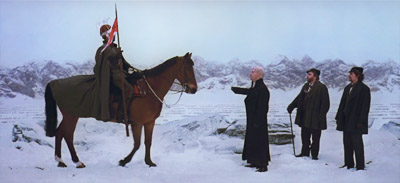
hamlet96-4-4-1

Act IV. scene iv from Branagh’s “Hamlet”

Hamlet opens the exchange by asking the Captain what army is marching across Denmark.

HAMLET
Good sir, whose powers are these?
Captain
They are of Norway, sir.
HAMLET
How purposed, sir, I pray you?
Captain
Against some part of Poland.

To all observers, Fortinbras’s march through Denmark to Poland with an army is a potential threat to Denmark. Hamlet’s father had killed Fortinbras’s father in battle, and Fortinbras is one of the three sons looking to avenge a father in this tragedy.

HAMLET
Who commands them, sir?
Captain
The nephews to old Norway, Fortinbras.
HAMLET
Goes it against the main of Poland, sir,
Or for some frontier?

Hamlet is able to gather information as to Fortinbras’s intent, or at least the Captain’s orders. When the Captain speaks “truly,” he is unaware he is addressing royalty:

Captain
Truly to speak, and with no addition,
We go to gain a little patch of ground
That hath in it no profit but the name.
To pay five ducats, five, I would not farm it;
Nor will it yield to Norway or the Pole
A ranker rate, should it be sold in fee.

Here then, the Captain explains the soldier’s paradox. He has enlisted in the military, and in the military, he follows orders. The Captain knows the  “little patch of ground” is worthless to him personally, “To pay five ducats, five, I would not farm it…” That same land, however, has value to those who command the army, to those who engage in kingdom building, and to those who care for, “no profit but the name.” All land is valuable to those who desire to expand their holdings. Yet  that same land is as valuable to those who own it, and Hamlet learns from the Captain that the Poles have dug in, preparing for Fortinbras’s coming attack:

HAMLET
Why, then the Polack never will defend it.
Captain
Yes, it is already garrison’d.

Shakespeare uses Fortinbras’s “man of action” to contrast Hamlet’s “man of thought” throughout the play. While Hamlet spends almost four acts fuming over his Uncle Claudius, Fortinbras amasses an army to claim or to regain land lost by his father. Of course the Poles will be defending their homeland, an understandable reason to risk their lives, but the Norwegian soldiers are not being attacked; they are the attackers. Hamlet’s last words to the Captain shows him considering an unnecessary war that will cost many soldiers lives:

HAMLET
Two thousand souls and twenty thousand ducats
Will not debate the question of this straw:
This is the imposthume of much wealth and peace,
That inward breaks, and shows no cause without
Why the man dies. I humbly thank you, sir.
Captain
God be wi’ you, sir.
Exit

In the soliloquy that follows, Hamlet wonders why soldiers would enlist in such a venture when they risk their lives for an unknown cause:

“…for a fantasy and trick of fame
Go to their graves like beds, fight for a plot
Whereon the numbers cannot try the cause,
Which is not tomb enough and continent
To hide the slain?”

In offering this soliloquy, Shakespeare poses a universal question: Why does anyone become a soldier?

As the mother of two active duty Marine Corps officers, I think about this same question. I think about this question knowing that only .5% of Americans serve in today’s military as compared to 12% in World War II.

Shakespeare asks what “a fantasy and trick of fame” drives men and women to enlist and follow orders. Certainly full employment is a draw to the profession, but a military that enlists only for money is akin to a military of mercenaries. A report by the US Department of Defense issued by the American Forces Press Service points to another reason, that military service is a family tradition. In a 2011 survey, “79% percent of veterans surveyed reported that an immediate family member is serving or has served in the military. That compares to 61 percent among the civilian respondents.”

New York Times editorial (5/26/2013) Americans and Their Military, Drifting Apart by Karl W. Eikenberry and David Kennedy, also points out the growing disconnect between the general population and those who serve. Eikenberry is a retired Lieutenant General and former United States commander in Afghanistan (2009-2001); Kennedy is an emeritus professor of history at Stanford. They discuss family legacy as the reason young men and women enlist:

“So many officers have sons and daughters serving that they speak, with pride and anxiety, about war as a “family business.” Here are the makings of a self-perpetuating military caste, sharply segregated from the larger society and with its enlisted ranks disproportionately recruited from the disadvantaged.”

I often hear praise heaped upon my sons because sometimes they are the only direct connection to the military for friends and associates. My extended family includes brothers, nephews, and brothers-in-laws who have also served in some branch of service. We could be part of the military caste that understands the concerns of Eikenberry and Kennedy who recount a maxim of George Washington:

“The  [US Military] all-volunteer force may be the most lethal and professional force in history, but it makes a mockery of George Washington’s maxim: When we assumed the Soldier, we did not lay aside the Citizen. Somehow, soldier and citizen must once again be brought to stand side by side.”

Shakespeare presents the plight of the soldier to an audience of citizens by having the Captain speak to the “citizen” Hamlet. As the Captain bluntly assesses the coming attack, Shakespeare creates empathy for the soldier from the citizens who hear him speak. They hear Hamlet “humbled” in his thanks. In this short scene, Shakespeare illustrates the importance of Washington’s maxim: the citizen must stand with the soldier.

There is, however, another reason this scene from Hamlet has a special significance for me. My older son served his first tour (of three) in Afghanistan in 2011. In our mail one day was a small cardboard box top from an MRE box that he had used as a postcard. He indicated he was doing well, healthy and well-fed, and he asked us to thank those who had sent packages to him. He had carefully printed as much as he could on the box top, as if his writing would be sufficient to assure us of his safety. He signed off with his scrawly signature, but at the bottom of the card in a tiny line of postscript he had penned the quote:

“We go to gain a little patch of ground that hath in it no profit but the name.”


17 minutesI was researching websites for the Film and Literature class when I first heard about the “17 Minute Rule;” a rule that suggests the real plot is revealed to the audience 17 minutes into any film.  Todd Pack’s Messy Desk Blog uses a number of examples to illustrate  The 17 Minute Rule:

George Bailey tells his father he couldn’t face being cooped up the rest of his life in a shabby little office at his father’s building and loan 17 minutes into It’s a Wonderful Life.

The rest of the movie is about everything that happens that stops him from leaving Bedford Falls and drives him to consider jumping off that bridge on Christmas Eve.

  • Luke’s uncle buys the droids 17 minutes into Star Wars. The droids are what leads Luke to Obi-Wan Kenobi and Princess Leia and, ultimiately, the Death Star.
  • Buddy leaves the North Pole to find his real dad 17 minutes into Elf.
  • The shark eats the little boy on the raft 17 minutes intoJaws. It’s the second attack that forces the town to close the beach and go after the shark.
  • The Iowa farmer is thinking about plowing under the baseball field he built in his cornfield until Shoeless Joe appears 17 minutes after the credits in Field of Dreams.

This 17 minute phenomenon was corroborated on other blogs as well.  Writer and Director Nathan Marshall posted Screenplay Structure: Three Acts & Five Points Script Frenzy! blog where he also called attention to minute 17:

3) Page 17. Next time you watch a DVD, pause it 17 minutes into the film. Trust me—any film. What’s happening at that point in the story? Most likely, the essential character conflict has just been laid out. A teenage Indiana Jones runs to his father for help, but is shushed instead. Shaun convinces his girlfriend to trust him in Shaun of the Dead. Captain Renault asks Rick why he came to Casablanca. On page 17, your audience should realize what the film is really about. It’s not about finding the Holy Grail, Indy—it’s about learning to forgive dad!

The same was outlined on the  All About Screenwriting blog. In addition to explaining the rule, this post made the claim that the ratio of screenplay to minute of film is 1:1; and page 17 will be the 17th minute of a film. The site provides a basic outline for a screenplay of the average movie made today:

FADE IN: 

  • Between pages 1-5: The HOOK, something that grabs our attention and pulls us in.
  • Page 10: At this point in your script you should have the “MINI CRISIS”. The “MINI CRISIS” should lead us into…
  • Page 17: …The DILEMMA. Creation of the team and what the movie is about.
  • Page 30: The REACTION to the dilemma or situation.
  • Page 45: First “REVERSAL” of the 17 minute point. This point furthers the characters and pushes them deeper into the situation or the dilemma.
  • Page 60: The “TENT POLE” of the movie. Where the passive characters become active or vice versa.
  • Page 75: Second “REVERSAL” to the 17 minute point. To reaffirm what the story is about.
  • Page 90: The LOW POINT of action. The place from which our main character has to rise up from.

FADE OUT.

So when I noticed students picking up books for independent reading and discarding them after the first few pages, I wondered if they were giving the book a real chance. Could a 17 page rule apply to books student might choose to read? And, if the rule applied, would a student become more engaged once he or she reached page 17?

In a short experiment, I grabbed three books off the top of the book cart, and noted the following:

The Hobbit (The Dwarves and Gandalf invade Bilbo’s home)

“The poor little hobbit sat down in the hall and put his head in his hands, and wondered what had happened, and what was going to happen, and whether they would all stay to supper. Then the bell rang again louder than ever, and he had to run to the door.”

Little Women -Marmee gives  Meg, Jo, Beth, and Amy their Christmas gifts with her words of encouragement to survive the difficulties of life.

‘We never are too old for this, my dear, because it is a play we are playing all the time in one way or another.Out burdens are here, our road is before us, and the longing for goodness and happiness is the guide that leads us through many troubles and mistakes to the peace which is a true Celestial City. Now, my little pilgrims, suppose you begin again, not in play, but in earnest, and see how far on you can get before Father comes home.’”

Lord of the Flies-The boys Ralph and Piggy discover they are on their own in a hostile environment:

“They’re all dead,” said Piggy, “an’ this is an island. Nobody don’t know we’re here. Your dad don’t know, nobody don’t know—”
His lips quivered and the spectacles were dimmed with mist.
“We may stay here till we die.”
With that word the heat seemed to increase till it became a threatening weight and the lagoon attacked them with a blinding effulgence.”

Yes, the rule was working for books from the canon. Later that same afternoon, I was working with a “reluctant reader” who had selected James and the Giant Peach as a guided reading text. I glanced at page 17 and noticed the wonderful passage where James finds the entrance to the giant peach.

James and the Giant Peach 

“Almost without knowing what he was doing, as though drawn by some powerful magnet, James Henry Trotter started walking slowly toward the giant peach. He climbed over the fence that surrounded it, and stood directly beneath it, staring up at its great bulging sides. He put out a hand and touched it gently with the tip of one finger. It felt soft and warm and slightly furry, like the skin of a baby mouse. He moved a step closer and rubbed his cheek lightly against the soft skin. And then suddenly, while he was doing this, he happened to notice that right beside him and below him, close to the ground, there was a hole in the side of the peach.”

Not every text has a page 17 moment…sometimes the dilemma is posed on page 16 or page 18 or 19. I suspect the rule holds up because the 17 minute rule/page 17 is part of a pattern in storytelling, and stories always follow a pattern.  Sharing this rule with students gives me another “tool” in my teaching toolbox, so when I see a student toss a book aside after reading only a few pages, I casually remark, “Did you get to page 17 yet? There’s a rule about page 17…. on page 17, something important always happens.”
I may get a quizzical look, but several minutes later, I have seen that same student engrossed in the text.
“The book got better,” says the student.
“Well, you got past page 17,” I respond.

The 4th period senior Advanced Placement Literature class watched Hamlet die four times on Friday. Four times was all the time we had.

These students have been reading and annotating the great soliloquies in Hamlet, but since this is a drama, they have benefitted much more from watching scenes from several film versions of the play. The closed caption feature is on so the students “read” the play while the actors in each cast attempt to, “Fit the action to the word and the word to the action,” per Shakespeare’s directions.

Watching the different film productions complements the study of literary critical theory. These students have been analyzing works of literature through a psychoanalytic, historic, or Marxist lenses, and they are familiar with New Criticism which is so similar to the Common Core State Standards. They know there is more than one way to read a text. Watching the different versions of Hamlet illustrates there are different ways directors and actors interpret and act the text as well.

Moreover, watching the different versions meets the Common Core State Standard:

CCSS.ELA-LITERACY.RL.11-12.7
Analyze multiple interpretations of a story, drama, or poem (e.g., recorded or live production of a play or recorded novel or poetry), evaluating how each version interprets the source text. (Include at least one play by Shakespeare)

This year, I used the 1996 Franco Zefferelli version, which stars Mel Gibson as Hamlet, as the “spine” of analysis for the class. His version is also the shortest, but that is what happens when Zefferelli’s interpretation means he rearranges the order of scenes and drops Fortinbras from the plot entirely.

For “speaking the speech trippingly on the tongue,” I showed  selections from the Kenneth Branagh version (1996) in which he plays the title role. I also used scenes from the much praised 1948 classic starring and directed by Laurence Olivier, as well as the most recent BBC production directed by Greg Doran with David Tennant as Hamlet. To provide contrasts to these versions, the students also watched short scenes from the Hallmark production directed and acted by Campbell Scott and Michael Almereyda’s 2000 modernization with Ethan Hawke as Hamlet.

The scenario of film clips went in this order:

Act I; scene i: The “Who’s there?” opening:

  • Branagh (Note: Jack Lemmon as Marcello is woefully miscast)
  • BBC (Patrick Stewart plays both Ghost and Claudius)
  • Olivier (students thought the graphics and set were amazing for 1948)

Act I; scene v: In order to have students appreciate the complexity of the Ghost’s request, I showed different versions of the Ghost scene with Hamlet. I started with Zefferelli, and then moved to the Branagh version.  I added two more versions to the line-up: short clips from the 1964 Grigori Kozintsev‘s version and a nightmarish version (2007) by Alexander Fodor. To have a sense, here are some clips to compare of the Ghost meeting Hamlet:

Kenneth Branagh
Grigori Kozintsev

Alexander Fodor

I had asked the students to consider the origin of the Ghost-from Heaven (“spirit of health”), from Purgatory (“till my sins were purged”), or Hell (“goblin damned”). Where did they believe the Ghost originated? After watching the clips, they decided:

  • Zefferelli: Heaven or Purgatory (“The ghost looks so sad..”)
  • Branagh: Hell (“there’s fire coming out of the ground! it’s Hell unlashed,” said one.)
  • Hallmark: Hell (“there is a hand that comes from the ground!” “He’s wounded by the Ghost!”)
  • Fodor: Hell (“That’s an abusive dad!”)
  • Grigori Kozintsev: Hell or Purgatory (“Darth Vadar!”)

Act III; scene iv: The students also watched the stabbing of Polonius in Gertrude’s bedchamber where Zefferelli’s version veers into a disturbing Oedipal psychoanalysis akin to Olivier’s version. Students compared that version with the more toned down version from Branagh before moving onto Act IV.

Finally, when we arrived at Act V; scene ii, I lined up the five different versions moving between the Smartboard and a small projector. This year, I followed this order and have summarized the student responses:

  1. Starting with Zefferelli’s authentic combat, Hamlet is both clown and avenger. The three bouts are elaborate and full of suspense; my students were amazed at the hand-to-hand combat that would have been for “entertainment.” Glenn Close’s Gertrude dies in pain with wonderful contortions, and one student noted hearing “a satisfying “crunch” when Claudius is finally stabbed. As the camera pulls away, four bodies litter the stage, and the “rest is silence.”
  2. Branagh wisely kept Fortinbras in the play (all four hours of it!) using the setting of Blenheim Palace in England, which could serve as a substitute for the Russian Winter Palace of the Tsars in his Marxist take on the play. The students did not care for the elaborate staging in the death of Claudius who is “fed” poison after he has been lanced by a foil and crushed by a falling chandelier. They did, however, give “thumbs up” to the editing which juxtaposes the combat between Laertes and Hamlet with the invasion of the palace by Fortinbras. One of the open-ended questions I had asked was to choose “Fortinbras or Hamlet: The soldier or the scholar?” This film put most student squarely in Fortinbras’s corner as the man of action.
  3. The BBC version switches between security camera feed and with a single-camera setup giving the impression that the action recorded will be later viewed in some criminal investigation. Patrick Stewart returned to the BBC as Claudius where played the same role in 1980 with Derek Jacobi as Hamlet. In the final scene, confronted by Hamlet, Stewart’s Claudius takes the cup and with a resigned shrug, drinks the remaining poison and falls dead a few inches from his beloved queen. My students thought this version was hilarious, a dark and cynical twist on justice.
  4. The Almereyda version suggests that Gertrude, played by Diane Venora, willingly drinks from the cup in order to protect Hamlet and that Laertes played by Liev Schreiber is not Claudius’s dupe. As Hamlet remarks to Laertes, “You do but dally. I pray you, pass with your best violence,” Schreiber’s brutish and vengeful son of Polonius stands up with a concealed weapon and, in the scuffle that follows, shoots Hamlet in the abdomen before being wounded in the same way himself. My students reacted in shock:”didn’t see that coming!”  Once avenged, Schreiber’s next act is one of brotherhood towards Hamlet as he hands the weapon off for Hamlet to kill Claudius. Viewers should note that Horatio has something useful to do in this version, as he holds the dying Hamlet upright to hunt Claudius.  

Watching these four Hamlets die took all the time we had in our block schedule (80 minutes). A few more minutes, and I could have offered a fifth? Which one? I never did get to Kevin Kline’s Hamlet (1990), or Richard Burton’s (1964) filmed rehearsal.  There are so many excellent choices from directors, and each has a different way “to draw thy breath in pain. To tell my story.”

Die again, Hamlet, please, die again.

April is Poetry Month.
April also signals the return of flowers, and there were flowers in a small window box on the set of La Bohème in a rebroadcast from the New York City’s Metropolitan Opera at the local movie theatre this past week. The music from Puccini’s most popular opera might sound familiar to most, and the set design by Franco Zefferelli has been impressing audiences since its Christmas Eve reveal in 1981:

When the curtain rose on the second act of Franco Zeffirelli’s new production of ”La Bohème” at the Metropolitan Opera, the audience erupted in a roar of acclaim, amazement, and even disbelief – a roar that went on for nearly a minute. (Christian Science Monitor)

That is not to say that the sets for Act I were any less spectacular. The details accurately depicted the dim squalor of a Parisian garret in 1840s. The lovely seamstress Mimi, looking for a light for her candle, meets the handsome Rodolfo in a darkened room. She, painfully shy; he, eager to impress. I thought of #poetryfriday as he sang the following:

Who am I?
I am a poet.
What do I do here? I Write.
And how do I live? I live
in my contented poverty,
as if a grand lord, I squander
odes and hymns of love.
In my dreams and reveries,
I build castles in the air,
where in spirit I am a millionaire.
Yet sometimes from my safe,
all my gems are stolen
by two thieves, a pair of  lovely eyes!
They entered with you just now! (La Boheme: Puccini)

Pure poetry!

The blend of the visual with the Puccini’s score is as breathtaking in 2014 as it was in 1981 as the review in the Christian Science Monitor explained:

 Stage designer-director Zeffirelli has quite literally re-created a typical Montmartre hill street in Paris, circa1840. Rarely has the Met stage been more brilliantly used. The set is on three levels, with Cafe Momus on the ”ground” level receding back under the set. A huge staircase is on the audience’s left, the chorus milling around above the indoor Momus, and there is another large staircase in the back right-hand corner of the set. By the end of the act, the audience had interrupted three more times with applause for the Zeffirelli spectacle – which culminated in a huge parade, bringing some 240 people onto the Met stage.

The trailer below promotes the rebroadcast using the same Zefferelli’s sets:

During the three 20 minute intermissions, the cameras kept rolling backstage. The audience was able to watch stagehands from Local One, lighting technicians, prop managers maneuver the three movable stages;  a team of set “touch up painters” crawled all over the sets, addressing any nicks to the rooftops and snow scenes of Zefferelli’s 33 year-old design. These minutes watching the crew and actors wander backstage are a literal peek behind the curtain, and it is a very low tech peek. So low tech, in fact, that the stage manager admitted that the snowfall during Act IV on Zefferelli’s moonlit set is generated by paper confetti in a bag with small slits. Making snow means a stage hand, “rubs the bag so the paper snow falls out.”

In La Bohème’s Acts III and IV,  Mimi and Rodolfo’s passion reaches heights of jealousy, but they decide their love means they should stay together; they will stay warm together through the winter. They will part in the spring….when the flowers bloom.

Rodolfo
We’ll part…
Mimì
We’ll part when it’s

the season for flowers again…
Rodolfo
… when it’s the season for flowers again..

Mimì
I wish winter would be everlasting!

When the curtain for Act V opened, my friend whispered, “See the flowers in the window box?” Sadly, the cheerful red blossoms signaled that the lovers had broken up; it was April. Mimi and Rodolfo were not together, her illness contributing to the separation. But Puccini used the vibrant Musetta to reunite the lovers in the garret, and the final duet had them remembering their first encounter:

Rodolfo
You were frightened and nervous!
Then you lost your key…
Mimì
So to try and find it, you
had to grope your way around…

Rodolfo
…and I hunted and hunted.

Mimì
My fine young man,
Though now I can say;
it was found in an instant…

Rodolfo
I helped destiny…

Mimì
It was dark; and so you
didn’t see my blushes…

(she whispers the words of Rodolfo)
“This little hand is frozen…
let me warm it here in mine…”
In the darkness
you held my hand to warm it…

Such imagery. Such beautiful language. Even in opera, April is Poetry Month.

Continue Reading…

Screen Shot 2014-04-06 at 11.16.51 AMNot so long ago, 11th grade was a great year of high school. The pre-adolescent fog had lifted, and the label of “sophomore,” literally “wise-fool,” gave way to the less insulting “junior.” Academic challenges and social opportunities for 16 and 17 years olds increased as students sought driver’s permits/licenses, employment or internships in an area of interest. Students in this stage of late adolescence could express interest in their future plans, be it school or work.

Yet, the downside to junior year had always been college entrance exams, and so, junior year had typically been spent in preparation for the SAT or ACT. When to take these exams had always been up to the student who paid a base price $51/SAT or $36.50/ACT for the privilege of spending hours testing in a supervised room and weeks in anguish waiting for the results. Because a college accepts the best score, some students could choose to take the test many times as scores generally improve with repetition.

Beginning in 2015, however, junior students must prepare for another exam in order to measure their learning using the Common Core State Standards (CCSS). The two federally funded testing consortiums, Smarter Balanced Assessments (SBAC) or the Partnership for Assessment of Readiness for College and Careers (PARCC) have selected 11th grade to determine the how college and career ready a student is in English/Language Arts and Math.

The result of this choice is that 11th grade students will be taking the traditional college entrance exam (SAT or ACT) on their own as an indicator of their college preparedness. In addition, they will take another state-mandated exam, either the SBAC or the PARRC, that also measures their college and career readiness. While the SAT or ACT is voluntary, the SBAC or PARRC will be administered during the school day, using 8.5 hours of instructional time.

Adding to these series of tests lined up for junior year are the Advanced Placement exams. There are many 11th grade students who opt to take Advanced Placement courses in a variety of disciplines either to gain college credit for a course or to indicate to college application officers an academic interest in college level material. These exams are also administered during the school day during the first weeks of May, each taking 4 hours to complete.

One more possible test to add to this list might be the Armed Services Vocational Aptitude Battery (ASVAB test) which, according to the website Today’s Military,  is given to more than half of all high schools nationwide to students in grade 10th, 11th or 12th, although 10th graders cannot use their scores for enlistment eligibility.

The end result is that junior year has gradually become the year of testing, especially from the months of March through June, and all this testing is cutting into valuable instructional time. When students enter 11th grade, they have completed many pre-requisites for more advanced academic classes, and they can tailor their academic program with electives, should electives be offered. For example, a student’s success with required courses in math and science can inform his or her choices in economics, accounting, pre-calculus, Algebra II, chemistry, physics, or Anatomy and Physiology. Junior year has traditionally been a student’s greatest opportunity to improve a GPA before making college applications, so time spent learning is valuable. In contrast, time spent in mandated testing robs each student of classroom instruction time in content areas.

In taking academic time to schedule exams, schools can select their exam (2 concurrent) weeks for performance and non-performance task testing.  The twelve week period (excluding blackout dates) from March through June is the nationwide current target for the SBAC exams, and schools that choose an “early window” (March-April) will lose instructional time before the Advanced Placement exams which are given in May. Mixed (grades 11th & 12th) Advanced Placement classes will be impacted during scheduled SBACs as well because teachers can only review past materials instead of progressing with new topics in a content area. Given these circumstances, what district would ever choose an early testing window?  Most schools should opt for the “later window” (May) in order to allow 11th grade AP students to take the college credit exam before having to take (another) exam that determines their college and career readiness. Ironically, the barrage of tests that juniors must now complete to determine their “college and career readiness” is leaving them with less and less academic time to become college and career ready.

Perhaps the only fun remaining for 11th graders is the tradition of the junior prom. Except proms are usually held between late April and early June, when -you guessed it- there could be testing.

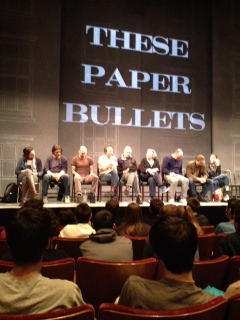
Yesterday, I took a group of 11th and 12th grade on a field trip to Yale Repertory Theatre to see These Paper Bullets, a “modish remake” of Shakespeare’s Much Ado About Nothing. We arrived early enough to have a little time before the show to stroll the sidewalks of Yale/New Haven and grab a cup of coffee before filing into the University Theatre. The weather cooperated for the first time this year, a bright warming sun made the wait before the show a pleasurable experience.

Talkback with the actors at Yale Repertory 4/3/14

Talkback with the actors at Yale Repertory 4/3/14

The comedy was adapted by Rolin Jones, with original songs by Green Day’s Billie Joe Armstrong. The production, offered as part of the Will Power! program, was high spirited fun, featuring live music from the stage and digital projections engulfing the audience.

We remained after the curtain call for the “talkback” with the actors and crew, an experience that always provides my students the most authentic look at the theatre profession. When a student from the audience asked how long it took the cast to memorize lines for the play, actress Liz Wisan made every English and Drama teacher’s heart happy by responding, “Before you can memorize, you have to know the meaning of the words…to understand what the author says …and you must see through the character’s eyes.” She had no need for Common Core or curriculum guides to express her deep appreciation for author’s craft.

After the talkback, we stopped for pizza (this was New Haven, after all) and the students chattered about the play. “Best show ever!” was their collective response, and I agreed.

This was a great field trip, one the students will remember.

Certainly, the educational institution known as the field trip presents any teacher with one of education’s most complex dilemmas: it can be both fraught with peril and, at the same time, infinitely rewarding.  In taking a field trip students are removed from the safe confines of the school building to participate in a volatile mix of authenticity and liability. The only guarantee of success is that while students will forget homework, lessons, and classroom rules, students will always remember going on a field trip.

There are teachers who hate field trips, which can be difficult to organize. There is a laundry list of possible disasters associated with field trips:

  • Final expense could mean that some students may be excluded or choose not to be included;
  • Bad weather cancels activities or negatively impacts trip;
  • Students could be injured;
  • Students could get lost;
  • Busses could break down.

In addition, field trips disrupt class schedules, and even though students are told in advance that they are to complete any work they miss in class due to a field trip, they rarely do. For all these reasons, field trips are sometimes limited in number in a school year. This limit is unfortunate because any field trip is a powerful educational tool.

Field trips are what students remember.

This morning, the entire eighth grade left for a day trip to NYC. The students were scheduled to visit Ellis Island, the Statue of Liberty, and the aircraft carrier Intrepid. However, they were not so fortunate as we had been only 24 hours earlier. The weather was dismal, and a light rain kept the temperatures chilly. Oh, and one of the buses broke down; something about a wheel falling off.

On a positive note, students used social media to keep their parents and friends updated on their 3.5 hour delay. Just before midnight, their organizing teacher posted, “They [students] were well-mannered, patient, resilient, and cooperative.”

Their trip was a great field trip, too; one the students will remember.