
Book Choice Questions

March 1, 2014 — 1 Comment

book loveIndependent reading in our school grades 7-12 means students read books of their own choosing, make recommendations, and keep records of what they read. Recently, however, one of the English teachers in my department suffered a concussion and while the substitutes delivered the curriculum (John Steinbeck’s Of Mice and Men and Laurie Halse Anderson’s Speak), student independent reading had fallen out of regular practice.

Our latest substitute (Natalie) is an enthusiastic graduate of our high school school who has a BS degree in Creative Writing. She has been serious in tackling her lack of experience in the classroom through her best characteristic…she asks questions. She asks a lot of questions.

One of the latest questions she asked was about independent reading. When I expressed my concerns about having the practice reestablished, she seemed doubtful. I suggested that she have students use books they read independently to make connections with the most recent whole class novels.

“You can ask them if they can make a generic ‘coming of age’ connection between Speak and a book of their choosing,” I suggested.

“But what if they choose a book that doesn’t have that connection? What if they choose a book that is too young for them?” she continued, “or a book that they already read? How do I know what they should be reading?”

I recognized her questions; I had those same questions myself several years ago.

So, I sat her down and showed her the following Penny Kittle video that is available through Heinemann Publishers on YouTube under the title “Why Students Don’t Read What is Assigned in Class”:

She had the same reaction I did when I first saw that video.

“Wow,” she said, “I get it. They should read what they want.”

Question answered.

My department is just noticing the benefits after a few years of implementing book choice. We are lucky to have an 80 minute block schedule with the luxury of offering 15-30 minutes a class for Silent Sustained Reading (SSR) independent choice books. We have large classroom libraries with high interest titles and a wonderful school library (with Overdrive e-books available)  to offer students choice in what they read. When we tell students to pull out their SSR book, they are prepared and settle in to read.

Some classes suggest that a book be in a particular genre. Our English IV-Memoir class reads memoirs or biographies. The English II class is based on World Literature, and students read at least one book during the year by an author who is not American. The critical requirement is that each student chooses a book. There is no leveled reading; students can choose a book below their reading ability or they can attempt a book above their lexile level. They learn what to choose to read because they have control of what they want to read.

Penny Kittle, an English teacher and literacy coach at Kennett High School in North Conway, New Hampshire, wrote a guide to helping students read independently titled Book Love. In this text, Kittle offers strategies to help teachers increase the volume of what students read and to deepen student thinking about what they read.

One of the strategies several of our teachers use is to have students respond to reading through the software Shelfairi (Amazon) where they record what they are reading and make connections to other books. I can organize each class in virtual groups and pose general questions for responses. These short responses prepare me for conferences or allow me to respond directly on the software with links or information or suggestions. For example, the English IV Mythology/Fantasy class reads mythologies or fantasies, and I posed a simple question last week and left quick responses for a conference:

How are you doing with your book? What are the connections to myth/fantasy that can you make?

STUDENT: Eragon: So far I am doing well with this book. My book connects with mythology because it is about Eragon who finds a stone which ends up being a dragon egg, and he bonds with the dragon over time. He and Saphira (the dragon) learn to communicate with one another and have a good connection. Saphira and Eragon create a good relationship with one another.

My response: This is a great fantasy…and a series. This novel has elements of the hero’s journey: http://www.thewritersjourney.com/hero’s_journey.htm

STUDENT: Ranger’s Apprentice-The Royal Ranger: Good. I have 10 pages left until its over. Its the final book in the series. There is a giant myth that rangers have special and mystical powers. But that is just false. They are just super stealthy which gives them the appearance of just appearing out of no where.

My response: Now what will you read? Another series?

STUDENT: The Alchemist: The Alchemist is a good book. It has to do more with fantasy than mythology, but there is a myth about a treasure in the pyramids.

My response: And the “stones” have a story behind them as well. Did you know this book is on the NY Times Bestseller list for 291 weeks?

While there are multiple software platforms for sharing book choices, I also find that the features on Shelfari are helpful in having students “shop” for books (without purchasing) and/or write responses using evidence. There are tabs for a book’s Description, a Ridiculously Simplified Synopsis, Characters/People, Quotes, and First sentence. There are recommendations and reviews by other readers for each title as well. The student responses can agree or refute other reviews; they can add information to a book’s page as well.

Regardless of platform, sharing what students choose to read is critical to helping them develop a love of reading. The advertisement for Kittle’s Book Love states,

“Books matter.  Stories heal.  The right book in the hands of a kid can change a life forever.  We can’t wait for anyone else to teach our students a love of books—it’s up to us and the time is now.  If not you, who?”

And that is a very good question.

In New England this winter and in many other areas of the United States, we are experiencing the Polar Vortex, a phenomenon of cold-core low-pressure areas that strengthen during the winter. That is the scientific explanation for the record cold of early 2014.

A literary lens would suggest this uncomfortable freeze is akin to Dante’s ninth circle of Hell detailed in the Inferno section of The Divine Comedy. This last inner circle of Hell is reserved for those whose sins are related to treachery. The ninth circle is divided into four sections, and all sinners are trapped in the frozen lake, Cocytus. Satan himself is frozen waist deep in the lake with an icy wind ensuring his immobility.

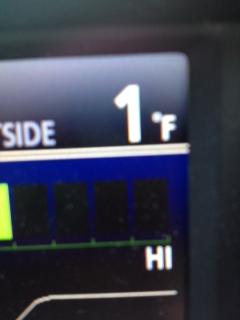
That icy wind sound familiar? Looking at my dashboard this morning, I noted the following temperature reading:

photo (18)Welcome to Hell!

Robert Frost, a New England man himself, considered the destructive power of cold and ice in his short poem “Fire and Ice” (read here by Richard Burton)

Fire and Ice

Some say the world will end in fire,
Some say in ice.
From what I’ve tasted of desire
I hold with those who favor fire.
But if it had to perish twice,
I think I know enough of hate
To say that for destruction ice
Is also great
And would suffice.

Frost’s association of fire with desire is recognizable. There are fires of passion or fires to make something “pure”. One symbol for knowledge is a lamp on fire, and a warm place by the fire is welcome during this recent freeze. Ending in fire may mirror the beginning, if one holds to the Big Bang Theory.

In contrast, his association of ice with hate creates a hostile tone. This association is also recognizable, describing someone as having  an icy heart or with ice in his/her veins leaves an unpleasant impression. The break-up song “Cold as Ice” by Foreigner lyrics state, “You’re as cold as ice/You’re willing to sacrifice our love…”. Economically, there is the dreaded “black ice,” a costly force of destruction on roads that sends thousands of vehicles to body shops annually. Scenes like these have played out all too frequently this year:

One final destructive power of ice to consider is the “melting” danger. National Geographic featured interactive maps in the story If All the Ice Melted  demonstrating what North America and the other six continents would look like if all the ice in the world melted. The result would increase the sea level by an estimated 216 feet.

Screenshot 2014-02-28 08.06.12

Frost’s short poem suggests that destruction by either ice or fire has the same result. However, I would like to point out that in the above-mentioned ice-melting scenario, my home would finally be waterfront, possibly with an ocean view!

Continue Reading…

The amazing artwork in the hallways of the middle school was created by….(wait for it)…math classes!

Last week, Ms. Nihan, the 8th math teacher posted drawings created by students who were studying a geometrical pattern based on the work of a 5th Century Greek mathematician, Theodorous of Cyrene. He developed a pattern called the Spiral of Theodorous, a square root spiral composed of contiguous right triangles.

The artwork on the walls represents a Common Core Mathematical Standard:

CCSS.Math.Practice.MP7 Look for and make use of structure.

“Mathematically proficient students look closely to discern a pattern or structure.” This standard can also represent poetry patterns. Rhythm, rhyme scheme, repetition are all part of poetic patterns and structure that proficient students in English should use in close reading.

Therefore, a tribute to a few of student drawings is in order; each is matched with a poem with a distinct pattern.

First up, a “lullaby” with a rhyme scheme and refrain pattern  (a-a-a-refrain-b-b-b-refrain).  Like “Rock a Bye Baby”, this poem is more frightening than comforting, as the narrator clearly plans to place the child in a hazardous area!

photo (9)

Lullaby

Samuel Hoffenstein (1890-1947)

Yes, I’ll take you to the zoo,
To see the yak, the bear, the gnu,
And that’s the place where I’ll leave you–
Sleep, little baby!
You’ll see the lion in a rage,
The rhino, none the worse for age;
You’ll see the inside of a cage–
Sleep, little baby!

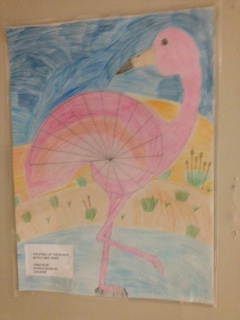
Next up, a quick tribute to the flamingo. This is an offering with the pattern of iambic tetrameter and a single rhyme (glum/gum).

photo (1)

The Flamingo Poem

Richard Medrington

Flamingos dress in fetching pink
can be rather glum, 

Their legs being made of plastic tubes
And bits of chewing gum.

from An Absird Book of Burds (Edinburgh: Puppet State, 2003)

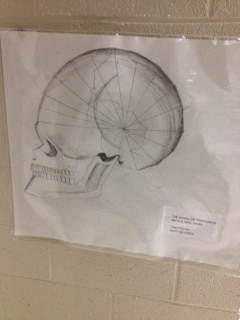
The next poem is a humorous offering titled “X-ray” with two quatrains, each containing one rhyme (Jones/bones; sight/night):

photo (10)

X-Ray

by Joan Horton

“This is your x-ray,”

Said young Doctor Jones.

As he held up a picture

And showed me my bones.

(continued here)

In making these extraordinary drawings, students had to follow a specific pattern for the Spiral of Theodorus:

The spiral is started with an isosceles right triangle, with each leg having unit length. Another right triangle is formed, an automedian right triangle with one leg being the hypotenuse of the prior (with length √2) and the other leg having length of 1; the length of the hypotenuse of this second triangle is √3. The process then repeats; the ith triangle in the sequence is a right triangle with side lengths √i and 1, and with hypotenuse √i + 1.

Screenshot 2014-02-05 09.23.35 (wikipedia)

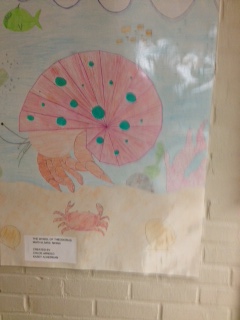
The original rendering by Theodorus is remarkably like a seashell, so here is an Amy Lowell poem matched with a seashell and its inhabitant, a small hermit crab. This poem has similarities to a Sonnetina Due-a 10 line poem with rhyming couplets. The poem also has a repeated “sing-song” line “Sea Shell, Sea Shell“:

photo (13)

Sea Shell

Amy Lowell

Sea Shell, Sea Shell,
Sing me a song, O Please!
A song of ships, and sailor men,
And parrots, and tropical trees,
Of islands lost in the Spanish Main
Which no man ever may find again,
Of fishes and corals under the waves,
And seahorses stabled in great green caves.
Sea Shell, Sea Shell,
Sing of the things you know so well. 

Some of the other drawings are seen here:

Patterns in math meet patterns in poetry, and I am happy to report that no square roots were harmed in this enterprise…Thanks to Ms. Nihan and the 8th grade practitioners of patterns!

Continue Reading…

Perplexed: adj.

1. bewildered; puzzled.
2. complicated; involved; entangled.

(o _ 0 )  ?

I am perplexed as to why this word is on the EngageNY first grade vocabulary list, and again perplexed when I review the first grade units for English Language Arts (ELA) on this website. I am perplexed because I can see that several units in our current grade five curriculum (Early Settlers and the American Revolution) and our entire grade six curriculum (Ancient World History) have  been bundled into a series of units that will be taught in first grade.Did I mention that EngageNY complicates these areas of study with content area lessons on the human body and astronomy in first grade?

All these complications have me even more perplexed as to why so many people are recommending that educators visit and use EngageNY resources. In two separate incidents over the past two weeks, I have heard educators from the State of Connecticut recommend the site. One recommendation was made directly to the Commissioner in the State Department of Education, Stephan Pryor, during a roll-out of the state’s Common Core website. I hope he does not take these recommendations seriously.

Remember that the Common Core State Standards (CCSS) were supposed to guide teachers to teach less and focus more. The CCSS were promoted as a means to stop instruction that is “a mile wide and an inch deep.” The CCSS were promoted to allow teachers to select their own materials, an opportunity to move away from scripted programs, stating,”Teachers are thus free to provide students with whatever tools and knowledge their professional judgment and experience identify as most helpful for meeting the goals set out in the Standards.”

Engage NY curriculum contrasts with these both of these goals; it is both staggering in its breadth and it is highly scripted.

A look at the Grade One English Language Arts curriculum in the “Listening and Learning Strand” demonstrates the breadth in a curriculum that is organized into 11 separate content area Domains. An examination into Domain 4, titled “Early World Civilizations” shows a unit that is 21 days in length for 6 year-old students using  a Tell It Again! Read-Aloud Anthology. Engage NY explains that this unit:

“….for Early World Civilizations contains background information and resources that the teacher will need to implement Domain 4, including an alignment chart for the domain to the Common Core State Standards; an introduction to the domain including necessary background information for teachers, a list of domain components, a core vocabulary list for the domain, and planning aids and resources; 16 lessons including objectives, read-alouds, discussion questions, and extension activities; a Pausing Point; a domain review; a domain assessment; culminating activities; and teacher resources.”

A further examination of Domain 4 means reviewing its 81 student objectives. That number is not as intimidating as the language in the content area objectives. The first ten objectives state that “by the end of this unit, students will be able to….”:
  1. Locate the area known as Mesopotamia on a world map or globe and identify it as part of Asia;
  2. Explain the importance of the Tigris and Euphrates Rivers and the use of canals to support farming and the development of the city of Babylon;
  3. Describe the city of Babylon and the Hanging Gardens;
  4. Identify cuneiform as the system of writing used in Mesopotamia;
  5. Explain why a written language is important to the development of a civilization;
  6. Explain the significance of the Code of Hammurabi;
  7. Explain why rules and laws are important to the development of a civilization;
  8. Explain the ways in which a leader is important to the development of a civilization;
  9. Explain the significance of gods/goddesses, ziggurats, temples, and priests in Mesopotamia;
  10. Describe key components of a civilization…
Consider the readiness for first graders to meet these content objectives, and consider their readiness in meeting  other content area objectives in this unit including:
#16 Explain the significance of gods/goddesses in ancient Egypt;
#26 Define monotheism as the belief in one God….

The problem with these content area objectives is that the response, (and remember this is a six year old’s response), is limited to a shallow or cursory understanding to any of these larger questions. Entire courses at higher grade levels, middle and high school, have been developed around these objectives, and many of these objectives will be repeated again in these higher grade levels.

Next, consider that the unit that follows Domain 5-Early American Civilizations, is dedicated to a study of the Aztec, Mayan, and Incan societies. These first 10 objectives for Domain 5 state that “the student will be able to….”

  1. Explain that a shift occurred from hunting and gathering to farming among early peoples; compare and contrast hunter-gatherer societies and Mayan society;
  2. Explain the importance of extended family to the Maya;
  3. Identify the areas in which the Maya/Aztec/Inca lived;
  4. Explain that the Maya/Aztec/Inca farmed;
  5. Explain that the Maya/Aztec/Inca developed large cities or population centers, or empires, many, many years ago;
  6. Explain that the Maya/Aztec/Inca had leaders (kings or emperors); identify by name the emperor of the Aztec, Moctezuma;
  7. Explain that the Maya/Aztec/Inca each had a religion;
  8. Describe the significance of the stars and planets to the Maya;
  9. Explain the significance of the Mayan calendar;
  10. Identify the Aztec capital as Tenochtitlan; identify that Machu Picchu is an Incan city…
There are 32 more objectives for students in Domain 5, and there are nine other domains with an equally daunting number of “the student will” objectives in the Listening and Learning strands. There are more objectives, with overlap, in the Skill strands for each of remaining nine Domains. According to the curriculum in EngageNY, a first grader would be expected to have a basic understanding of Early World Civilizations and Early American Civilizations as well as these remaining nine domains:

Domain #1: Fables and Stories
Domain #2: The Human Body
Domain #3: Different Lands/Similar Stories
Domain #6: Astronomy
Domain #7: The History of the Earth
Domain #8: Animals and Habitats
Domain #9: Fairy Tales
Domain #10: A New Nation: American Independence
Domain #11: Frontier Explorers

The most striking characteristic of this list of domains is the breadth of content area material that a first grader (remember, these are 6 year-olds), is required to “explain” or “identify” or “describe.” These are at best low level comprehension skills in Bloom’s taxonomy. This list clashes with the CCSS objective to become “more focused and coherent” especially when this list of domains does not appear to be connected by any central theme; their inclusion appears random.

All this content will be important to developing a student’s background knowledge over the course of several years, but how critically important is this material at the first grade level when instruction time is at a premium? Practice in reading and writing should be a priority, and the content used for in the development of reading and writing skills should not overwhelm students, but rather complement student cognitive ability.

Nevertheless, EngageNY provides equally dense ELA curriculum at each grade level. Students often “revisit” content that they may not have understood earlier, an enterprise that could be unnecessary given the cursory treatment that may given a topic at an earlier grade level (example: studying War of 1812 in grade 2).

Like any other website with lessons aligned to the CCSS, teachers may find value in some resources on EngageNY. A cautionary note, however, is that these are not “teacher-tested” lessons, but highly scripted lessons from the juggernaut of publishing and testing, the UK based Pearson. This raises a frightening scenario of having the creators of student achievement tests (Pearson) hold teachers and students accountable for the content they (Pearson) have also created in the lessons.

Connecticut’s adoption of the CCSS should remain true to its stated goals of allowing teachers to select their own materials in the development of focused curriculum at each grade level. The damage may already be done, however, since the website Pryor was offering in the state rollout of the Common Core already contains numerous links to EngageNY resources.

Which brings me to another 1st grade word on the EngageNY vocabulary list.
Apoplexy.

I planned a “Poetry Passion Smack-down” for Valentine’s Day 2014, but the Nor’easter that roared across the state of Connecticut kept the school shuttered over an extended President’s Day weekend. So, here is a chance for you, the reader, to be in the class and vote.

The plan was to pit 16th Century poet Christopher Marlowe against 21st Century Pop Star Justin Bieber in a “wooing” contest. The question?: Which poem speaks to you?

Each artist tries to persuade his beloved of his desire using the same two arguments:

  1. I’ll buy you anything;
  2. If you agree, we’ll spend lots of time dancing and singing.

Each artist also sounds a bit desperate. Marlowe’s “Passionate Shepherd” escalates his promises, maybe because of her lack of response to each line. His intentions intensify from one quatrain to the next, offering gifts from “beds of roses” to “silver dishes for thy meat.” One wonders, however, how likely such riches would be if one married a shepherd, passionate or not.

Bieber, on the other hand, works the pity angle, pleading that he will be “going down, down, down, down” because his “…first love won’t be around.” To establish the level of his desperation, he drags in his friend and rap artist Ludacris who makes the metaphorical connection between love and a caffeine rush from Starbucks, and who suggests there’s a headache coming from caffeine withdrawal.

But let us allow the poets to entreat their own cases:

First up, Christopher Marlowe making his petition from “The Passionate Shepherd to His Love”:

The Passionate Shepherd to His Love

Come live with me and be my Love,
And we will all the pleasures prove
That hills and valleys, dale and field,
And all the craggy mountains yield.

There will we sit upon the rocks
And see the shepherds feed their flocks,
By shallow rivers, to whose falls
Melodious birds sing madrigals.

There will I make thee beds of roses
And a thousand fragrant posies,
A cap of flowers, and a kirtle
Embroider’d all with leaves of myrtle.

A gown made of the finest wool
Which from our pretty lambs we pull,
Fair linèd slippers for the cold,
With buckles of the purest gold.

A belt of straw and ivy buds
With coral clasps and amber studs:
And if these pleasures may thee move,
Come live with me and be my Love.

Thy silver dishes for thy meat
As precious as the gods do eat,
Shall on an ivory table be
Prepared each day for thee and me.

The shepherd swains shall dance and sing
For thy delight each May-morning:
If these delights thy mind may move,
Then live with me and be my Love.

Next up, The Bieber’s plea, with his catchy refrains that are easily remembered in a song that was the first ever to go 12-times platinum. They may be simple lyrics, but there is no doubting the economic riches that came with this hit:

Baby, Baby

You know you love me, I know you care
Just shout whenever, and I’ll be there
You are my love, you are my heart
And we will never ever ever be apart

Are we an item? Girl, quit playing
We’re just friends, what are you saying?
Say there’s another and look right in my eyes
My first love broke my heart for the first time
And I was like…

Baby, baby, baby oooh
Like baby, baby, baby nooo
Like baby, baby, baby oooh
I thought you’d always be mine (mine)

Baby, baby, baby oooh
Like baby, baby, baby nooo
Like baby, baby, baby oooh
I thought you’d always be mine (mine)

Oh, for you I would have done whatever
And I just can’t believe we ain’t together
And I wanna play it cool, but I’m losin’ you
I’ll buy you anything, I’ll buy you any ring
And I’m in pieces, baby fix me
And just shake me ’til you wake me from this bad dream
I’m going down, down, down, down
And I just can’t believe my first love won’t be around

And I’m like
Baby, baby, baby oooh
Like baby, baby, baby nooo
Like baby, baby, baby oooh
I thought you’d always be mine (mine)

Baby, baby, baby oooh
Like baby, baby, baby nooo
Like baby, baby, baby oooh
I thought you’d always be mine (mine)

[Ludacris:]
Luda! When I was 13, I had my first love,
There was nobody that compared to my baby
And nobody came between us or could ever come above
She had me going crazy, oh, I was star-struck,
She woke me up daily, don’t need no Starbucks.
She made my heart pound, it skipped a beat when I see her in the street and
At school on the playground but I really wanna see her on the weekend.
She knows she got me dazing cause she was so amazing
And now my heart is breaking but I just keep on saying…

Baby, baby, baby oooh
Like baby, baby, baby nooo
Like baby, baby, baby oooh
I thought you’d always be mine (mine)

Baby, baby, baby oooh
Like baby, baby, baby nooo
Like baby, baby, baby oooh
I thought you’d always be mine (mine)

I’m gone (Yeah Yeah Yeah, Yeah Yeah Yeah)
Now I’m all gone (Yeah Yeah Yeah, Yeah Yeah Yeah)
Now I’m all gone (gone, gone, gone…)
I’m gone

To be sure his public understood the lyrics, Bieber shared the message of the song with MTV News, “I’m chasing her around, trying to get her, and she’s kind of playing hard to get, but I’m persistent. I keep going.”

Over four hundred years earlier, Marlowe said much the same; he did not have the advantage of MTV to explain.

Continue Reading…

“Stand up…. Now, put out your arms,” the instructor stood watching us.

“OK, pull your right arm back past your body.”Screenshot 2014-02-09 06.56.12

This was a EDR 500 level class, a graduate course in teaching remedial reading to pre-school and elementary aged schoolchildren. On this first night, we did not know what to expect.

“Now try with the other arm.”
We waved our arms erratically in the air.
He paused for a moment, looked amused and asked, “Can you teach someone to swim like this?”

The 26 of us were standing in a very dry classroom with no water in sight.

We all shook our heads in agreement, “No”, “Not Really”, “Probably not.

“Well, how can you learn to teach reading without actually working with students?”
We were surprised. Our instructor was admitting to the disconnect in teacher preparation programs.
“You need to be in the classroom to learn how to teach,” he admonished, “any thing else is waving your arms in the air.”

In this class, we were a mixed group in age and experience. Some of us were already employed as teachers in classrooms; others were completing degrees in order to be hired. All of us were learning how to improve student reading from 4:30-7:30 PM on a Tuesday night in a classroom. With not a student in sight, we were learning in the abstract.

Learning in the abstract is not unusual. A large percentage of learning for students in pre-K through grade12 is spent learning in the abstract. For 13 years, students practice skills they will use in college or in real world careers.

However, for those preparing to be teachers, the “real world” is the classroom. Our instructor was acknowledging that the classroom environment is the pool and prospective teachers and veterans should be immersed in that pool in order to learn how to teach. Unfortunately, the evening time slot and location of the class distanced us from authentic practice.

Accessing classrooms and students for teacher prep is largely unavailable under our current agrarian model of education. There are logistical problems for colleges and universities in scheduling, supervision, and, in today’s tense climate, security. Nevertheless,hands on classroom experience is a critically important part of undergraduate teacher preparation, and a semester or two of supervised student teaching is not enough. Teaching training programs need regular and continuous access to students. At minimum, there are must be more integration and collaboration between the teacher training programs, graduate and undergraduate, and local classrooms that are geographically located near these programs. 

In addition, the professors/instructors in teacher preparation programs must be current in the practices that new teachers are expected to know. They must be current on how their state is integrating the Common Core State Standards, the surrounding controversies around the adoption of these standards, and the testing programs that have been funded to access the effectiveness of these standards.

Also professors/instructors must be current in their state’s evaluation programs and how the teacher competencies being evaluated. Information disseminated through handouts and powerpoint presentations on these topics is not sufficient; classroom practice in teaching strategies through simulations, feedback, reflection and extensive discussions on these standards and evaluation procedures are critically important at every level of teacher training.

Finally, the professors/instructors in teacher training programs must be familiar with the wide range of technologies being used in preK-grade 12 classrooms. The disconnect between college programs and the use of technology in real-life classrooms has been widening. The professors/instructors in today’s teacher preparation programs must develop proficiency with the software teachers are expected to use. They must be familiar with Google Apps for Education, Edmodo, Twitter, Quizlet, Dropbox, Khan Academy, Class Dojo, Pinterest, Evernote.

There are forces outside the education profession that are exerting pressure and changing the face of education for new and seasoned educators alike. There is political pressure from legislators designing state evaluation and curriculum standard programs combined with pressure from testing companies. The voice that is missing in response to these pressures is leadership from those who design and implement teacher training programs in colleges and universities.

Leadership is more than just an advertising slogan or an elective course offered by colleges and universities. Teacher training programs need the leadership of professors/instructors who connected with the realities of the classroom. That kind of leadership requires direct involvement and reflection on the curriculum, instruction strategies, and means of assessment in classrooms today.

Only that kind of leadership can design programs that meet the needs of the classroom today as well as anticipate the training that prepares new and veteran teachers with both pedagogy and experience for success.

sport-graphics-swimming-528905

In this current sea change of education, teacher training programs must become the force that exerts pressure and change, not the institutions forced to respond. Teacher training programs currently offered by colleges and universities must move from the abstract, from the practice of training on dry land, in order to move teacher preparation into deep waters of classroom experience. 

Anything else is just waving arms in the air.

There are waves from England that reach America’s shores.

There are literary waves.
George Orwell’s Animal Farm was published in America in 1946.

There are musical waves.
The Beatles came to America in 1964.

George Orwell used satire as a commentary on Communism in the USSR and the rise of Stalin in his allegory Animal Farm.

John Lennon used the lyrics in the song Revolution as a response to the increase of protests against the Vietnam War, specifically student riots in Paris in May of 1968.

Satire, politics, protests….so many connections. Why not share them in class?
Why not share the Beatles’ song Revolution while students read Orwell’s Animal Farm?

“Revolution”

You say you want a revolution
Well you know
We all want to change the world
You tell me that it’s evolution
Well you know
We all want to change the world
But when you talk about destruction
Don’t you know you can count me out

Don’t you know it’s gonna be alright
Alright, alright

You say you got a real solution
Well you know
We don’t love to see the plan
You ask me for a contribution
Well you know
We’re doing what we can
But if you want money for people with minds that hate
All I can tell you is brother you have to wait (Revolution lyrics continued…)

After we read first chapter of Animal Farm aloud in class, I played the video of the Beatles performing the song Revolution. For some, this was the first time they had ever heard the song; for some, this was the first time they had seen the Beatles perform.

After watching the video, I posted an assignment to use the power of music – “to write a song for your cause.” The directions given to the students were:

You say you want a Revolution….?
Well, you have to write your song!! (for extra credit)

Step 1: Identify your cause. What makes you angry? What do you see as a problem in society? What is your Pet Peeve? What would you like to change about your world? This can be something big or little.

Step 2: The power of music! To persuade people to join your revolution, (like Major’s Beasts of England) you have to write a song.

Step 3: Share your lyrics, and we will join you in song (karaoke tunes preferred)

Their protest songs came in. In their songs the students protested: homework, English class (*sigh*), the school parking lot ban on underclassmen, bad weather, cafeteria food, Twilight movies, dirt clods in the hallways from steel-toed boots, the ban on cupcakes in class, and (and there were several of these), Justin Bieber.

While their songs were unlikely to inspire a revolution, they did appreciate the power of music in communicating a message. Their reactions to their own songs of protest were positive, but they admitted that their songs did not have the same power as the Beatle’s Revolution. They recognized Orwell’s statement on the power of song in Animal Farm “The Beasts of England” sung at the end of Chapter One. That song (sung to the tune of My Darling Clementine) was a take-off on the famous socialist anthem, The Internationale:

Beasts of England, Beasts of Ireland,
Beasts of every land and clime,
Hearken to my joyful tidings
Of the Golden future time.

Soon or late the day is coming,
Tyrant Man shall be o’erthrown,
And the fruitful fields of England
Shall be trod by beasts alone…….(continued )

 “…The singing of this song threw the animals into the wildest excitement…. And then, after a few preliminary tries, the whole farm burst out into Beasts of England in tremendous unison….” (Ch1:Orwell)

Orwell was demonstrating how the lyrics in a song could motivate. The student protest songs, however, were more entertaining than motivating. The Beatle’s song Revolution is both entertaining and motivating, a song written four years after their momentous arrival in America.

From the moment the Beatles disembarked from Pan-Am flight 101 on February 7, 1964, they were a force in American music. Yet, according to TIME magazine’s story, Beatlemania Begins: The Beatles First U.S. Visit to Play Ed Sullivan, the Beatles were surprised by how their music had made thousands of frenetic fans:

Just before 1:30 p.m., Flight 101 taxied to a stop outside the terminal and the aircraft door popped open. An explosion of cheers and screams rang out as the crowd stormed forward….

“We heard that our records were selling well in America,” George [Harrison] noted, “but it wasn’t until we stepped off the plane … that we understood what was going on. Seeing thousands of kids there to meet us made us realize just how popular we were there.”

Their first appearance on The Ed Sullivan Show (February 9) featured a set list that set fans shrieking:

  • All My Loving 
  • Till There Was You (Sue Raney cover)
  • She Loves You 
  • I Saw Her Standing There 
  • I Want to Hold Your Hand

Those five songs began the domination of pop music charts, coined the term “Beatlemania”, and changed the culture of a generation. The Beatles proved the power of music, so our protest song assignment capitalized on student awareness of this power. The students shared what they would protest if given the opportunity. They had a chance to make connections between two genres, between a set of music lyrics and a set of lyrics from a novel-both of which were penned by Englishmen.

This was also an opportunity for me to highlight the Beatles. Students watched and listened to a recording of the “Fab Four” who created a revolution in music here in America; they saw those “lads from Liverpool” who invaded America from England many Yesterday’s ago.

sno_ani07sno_ani07It’s a snow day here in Connecticut. The predictions were so dire (8″-11″; freezing rain) that school was cancelled the night before. I didn’t even have to wait to see my district’s name on the scrolling list of school closings on the bottom of the television screen or check the school’s Twitter account. I could turn off the alarm and sleep as long as I wanted.

I am the first to admit that I look forward to a snow day. Like my students, I check the Weather Channel app on my I-phone or track storms on local weather channels. I deny participating in some of the rituals that are guaranteed to bring about a snow day, however, I have made the following  “suggestions” to students:

  • wear PJs inside out
  • walk up stairs backwards
  • placing a spoon under a pillow
  • yell “Snow Day” into the freezer
  • flush ice cubes down the toilet

In short, I look forward to snow days…but there is a paradox.

Because of snow days, I can catch up on work, BUT because of snow days, I will have to work “extra” days.

The end of one semester (mid-January) is directly in the path of a nature’s pile-up of snow. My desk at the end of one semester (mid-January) is directly in the path of a pile-up of papers. Consequently, snow days are useful for “clearing the deck” of paperwork.

Unfortunately, when the school year comes to a close, all snow days are added to the calendar. These make-up days will also need lesson plans, and there will be work generated during these lessons resulting in a pile up of papers.

An argument can be made that working on a snow day means working twice. By law, school has a finite number of days required, and in Connecticut the required number is 180 days of instruction. Since teachers’ salaries are designed on the numbers of days in the classroom, school calendars are designed with an estimated end date. Snow days are added as make-up days, and working on a snow day does not eliminate make-up days.

In spite of this, each snow day holds a possibility of catching up on schoolwork or of getting ahead.

Technology has only exacerbated this possibility. In the past, student papers could have been left on a desk in the classroom, safely kept away from the red pen by snow or ice-covered  roads. Now, there are a number of ways to assess student work on digital platforms. There are a plethora of ways to plan lessons or webinars to attend. There are Twitter chats to visit, and (this one is obvious) blog posts to write.

This is the paradox of snow days. To work and to work again.

Knowing this may reduce the pleasure of snow days, but only a little. A chance to catch up is a chance enjoyed by teachers everywhere.
Except in San Diego, California.
Oh, how they must suffer.

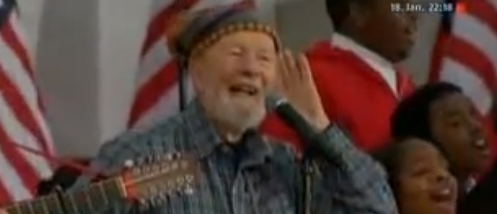
Screenshot 2014-01-31 07.06.53Pete Seeger was a collaborator. Someone acting with others to achieve a goal.

He collaborated in songwriting. The song “Where Have All the Flowers Gone?” was written with Joe Hickerson, “If I Had a Hammer” was written with Lee Hays of the Weavers, and “Turn! Turn! Turn!” was written with a little help from the Old Testament (Ecclesiastics).

He collaborated in performances with other singers: Dylan, Cash, Baez, and frequently with Woody Guthrie. He was a relentless promoter of Guthrie’s music as a tool for social change. His dedication was illustrated in a story told by Bruce Springsteen in a speech at the South By Southwest Festival in 2012. (Read entire speech at SpringsteenKeynoteNPRTranscript)

Springsteen recalled performing with Seeger on the steps of the Lincoln Memorial during the inauguration celebration for President Obama. He recalled the power of singing Guthrie’s “This Land is Your Land” with Seeger that day:

“So four years ago, I found myself in an unusual situation. It was a cold winter day. I was standing alongside of Pete Seeger. It was 25 degrees. Pete had come to Washington. Pete carries a banjo everywhere he goes — the subway, the bus — and comes out in his shirt. I said, “Man, Pete, put on a jacket. It’s freezing out here.” He’s ninety years old — living embodiment of Woody’s legacy.

“There were several hundred thousand of our fellow citizens in front of us. We had the Lincoln Memorial behind us, and a newly-elected president to our right. We were going to sing, “This Land is Your Land” in front of all these Americans. And Pete insisted — he says, “No, we have to sing all the verses. We have to sing all the verses, man. You can’t leave any of them out.”

“I said, ‘I don’t know, Pete.’ We had a crowd of six-year-old school kids behind us. He says, “No, we’re all gonna sing all the verses.” And so we got to it.

At this point in the speech, Springsteen picked up the guitar and began singing: “This Land Is Your Land”

As I was walking I saw a sign there
And on that sign said We’re trespassing
And on the other side It didn’t say nothing.
That side was made For you and me.
This land is your land This land is my land 

He paused to admonish the crowd, “This song is meant to be sung by everybody.” They began to join him:

From California To the New York island
From the Redwood Forest
To the Gulf Stream waters
This land was made for you and me.

Springsteen concluded playing and explained to the crowd:

On that day Pete and myself, and generations of young and old Americans — all colors, religious beliefs — I realized that sometimes things that come from the outside, they make their way in, to become a part of the beating heart of the nation. On that day, when we sung that song, Americans — young and old, black and white, of all religious and political beliefs — were united, for a brief moment, by Woody’s poetry.

Woody’s poetry is American poetry, and Pete Seeger was his American troubadour. Listen:

As a collaborator, Seeger worked with others on many causes: workers’ rights, civil rights, environmental conservation, and world peace. In supporting these causes, he encouraged all others to sing along.
So, here are the words Seeger promoted; the words to Guthrie’s contribution to the American Songbook, the words to “This Land is Your Land.”
Feel free to hum along as you read:

This land is your land, this land is my land
From California to the New York Island
From the Redwood Forest to the Gulf Stream waters
This land was made for you and me.

As I was walking that ribbon of highway
I saw above me that endless skyway
I saw below me that golden valley
This land was made for you and me.

I roamed and I rambled and I followed my footsteps
To the sparkling sands of her diamond deserts
While all around me a voice was sounding
This land was made for you and me.

When the sun came shining, and I was strolling
And the wheat fields waving and the dust clouds rolling
A voice was chanting, As the fog was lifting,
This land was made for you and me.

This land is your land, this land is my land
From California to the New York Island
From the Redwood Forest to the Gulf Stream waters
This land was made for you and me.

Thank you, Pete Seeger, for reminding us to sing about America and to sing ALL the verses.

Continue Reading…

While there are whirlwind changes in education such as new evaluation programs, digital devices in school, or flipped classrooms, one element remains constant: vocabulary. In order for students to succeed, they must understand the content area vocabulary in each subject area.

“Vocabulary knowledge is fundamental to reading comprehension;
one cannot understand text without knowing what most of the words mean.”
(Nagy, 1988)

The Common Core Literacy Standards have dedicated an anchor standard to the acquisition to vocabulary: 

CCSS.ELA-Literacy.CCRA.L.6 Acquire and use accurately a range of general academic and domain-specific words and phrases sufficient for reading, writing, speaking, and listening at the college and career readiness level; demonstrate independence in gathering vocabulary knowledge when encountering an unknown term important to comprehension or expression.

So what strategies work best? While there are familiar ways to teach vocabulary such as flashcards and word lists, every now and then there are the vocabulary lessons that are so effective, that they must be shared…like this political campaign using biology terms.

All month the 10th grade biology teacher centered a political campaign on vocabulary. The campaign immersed the entire school in domain specific words on the parts of a cell.  Teams of students were assigned to promote each part of the cell (EX: nucleus, endomembrane  system, chloroplasts, mitochondria)  for a political election designed to let students determine the most important member of the cell. Students made posters that hung in the hallways, and each poster featured characteristics and functions of the cell’s “candidate.” The posters were filled with content area vocabulary; there were explanations with diagrams or pictures.

For the first week, the campaign posters for different parts of the cell were explanatory in nature:

  • Do you enjoy moving, growing, breathing? Vote for the Mitochondria!
  • Chloroplast: Makes your green last! Carry out Photosynthesis!
  • Let’s assemble or die! Vote for Ribosomes or go home!

This slideshow requires JavaScript.

The final week was dedicated to a “smear” campaign. Additional information was added to posters; opposing candidates countered the claims on posters with even more content area vocabulary:

  • Algae blooms? They are caused by pollution! Look in the mirror! It’s not the chloroplast’s fault
  • Don’t vote for the mitochondria: They cause heart disease, diabetes, and cancer? Why vote for something that is bad?
  • Ribosome: Subject to mutation and damage that can cause illness
  • The Nucleus: if coded improperly can cause all sorts of defects
  • The mitochondria causes stupidity and mental disorders. The nucleus knows you’re smart and will support you through everything.

This slideshow requires JavaScript.

Wall space became a premium.  Attack ads increased the amount of information and featured even more content-area vocabulary. The stairwell going down to the middle school wing was a cluttered word wall.

Finally, election day arrived. To ensure there would be no favoritism, the students in 7th grade were selected to vote on their choice of the most important part of the cell. They had read the posters and become familiar with each of the candidates. They knew the strengths of each part of the cell. They knew the weaknesses of each part of the cell. They knew how each candidate functioned in the cell. They could separate the facts and the hype. The 10th grade waited to hear the results of their campaign.

Who did they vote for?
The Chloroplast.
Why?
Because of its contributions to plant life?
Because of photosynthesis?
Because it synthesizes fatty acids?


Buggin-out-green-sparkle

No….Because, “The poster had green glitter that was pretty.”
Apparently, campaigns for the most important member of the cell do not differ that much from real political campaigns.

Even with all that domain specific language…bling wins.